What Zenity's five posts, AWS's AgentCore pages and Dark Reading's report establish about AgentCorruption: dates, scope, what AWS states, what UK customers must still check on agent roles, and a ranked checklist.
What the 8 October seizure papers, the 58-page joint advisory and the NCSC's own item establish: two alleged breaches, six scan targets not said to be breached, 20 universities or six, and a UK checklist.
OpenAI's 7 October teen post gives no group size, period or method for its figures, and its social media comparison sets a survey against logs. What UK schools, parents and providers can check under Ofcom, ICO and DfE rules.
Of 83 CVEs in Splunk's five 7 October advisories, three Splunk Enterprise flaws score 9.0 or more. One is explained. Two are a weakness class and a score, and the October affected ranges end at August's fix builds.
What CrowdStrike's 7 October post establishes and what it leaves out: AI tooling from the actor's files, no named bank, no victim count, no Anthropic model named, a stack 3 to 63 days old, and a UK checklist.
Bitdefender's Midnight Mimosa report: malware preinstalled in cheap Android firmware, not removable by the owner. The UK is in a chart at 3.49% with no count behind it. The actor, the point of insertion and any reset test are not given; 13 Play apps were still listed.
Footnote 2 explains why 90 per cent off a token is 'around 75 per cent' off the bill. Anthropic's chart data put the 75 per cent at Medium effort and show Max costing 2.3 to 3.6 times Haiku 4.5 per task on three of four benchmarks.
One name, two versions, 15 days apart: what OpenAI's card, help pages and API docs establish about GPT-6 Sol in ChatGPT chat, what they leave out, and a UK checklist for model change control.
What Talos's 8 October post on UAT-11985 establishes and what it leaves out: three emails behind the AI-assisted label, a relay that forwards typed codes and taps, no victim count, and what UK organisations on Google can do.
What the 6 October Lightwell release states and leaves out, what a search of NVD, CVE.org, GitHub and osv.dev found, how backports confuse scanners, and what Cyber Essentials and the NCSC mean for a UK Java estate.
A Shai-Hulud worm release of the tensorlake package sat on npm for no more than about 102 minutes, about 91 of them after Socket flagged it. It carried valid provenance and a trusted publisher. No source reports a victim count, and six native packages at the same version remain.
Monitoring is not unlawful in itself, and a score is not a decision. The Guardian's account leaves open whether callers were told, whether an impact assessment came first, and what managers do with a fail score.
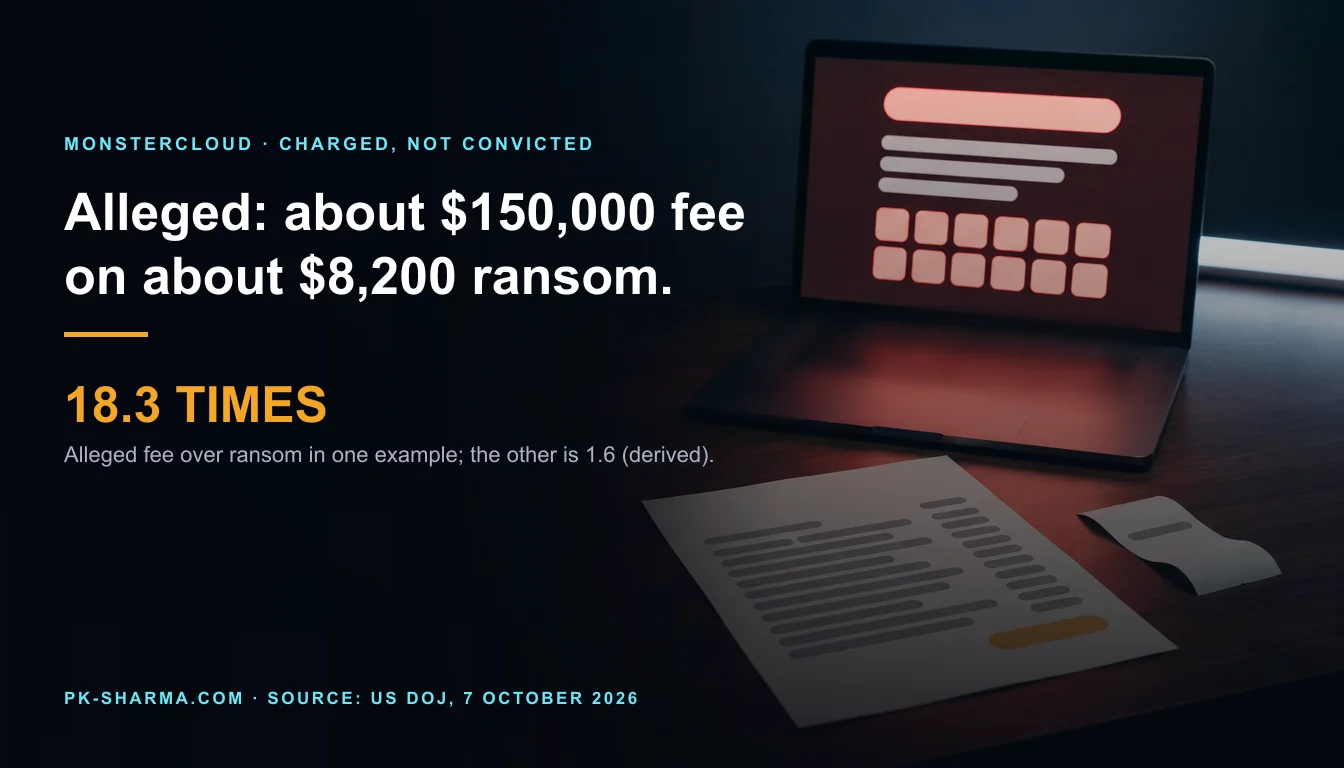
What the DOJ releases and the indictment fix and leave unstated, what each dollar figure counts, and UK guidance on hiring recovery or negotiation help: NCSC assurance, OFSI, the ICO, reporting, and the ban that is still only a proposal.
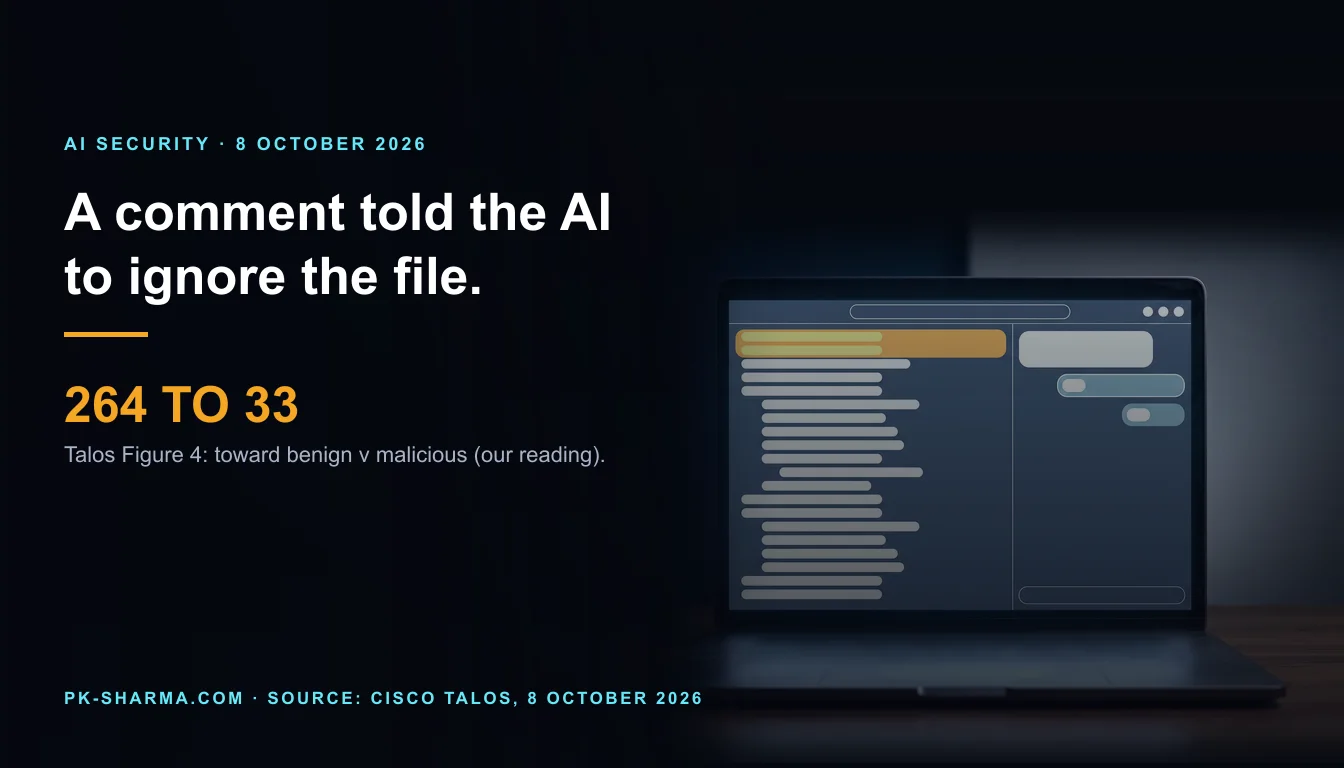
What Talos's 8 October post establishes and what it leaves out: a net rate rather than 35% of runs, five unnamed local models, a corpus built by its own filters, and a UK checklist for SOC and managed detection teams.
What the 14 AI credits establish and do not, SecurityWeek's figures checked against the notes, how 247 compares with earlier Chrome releases, the bounty column, and a UK checklist.
The build that fixed September's exploited SMA1000 flaws is still affected by the 6 October 10.0 flaw. Both earlier advisories that reported exploitation reached CISA's catalogue within a day, and this one is not listed in the version read, which predates it.
JFrog scores CVE-2026-105192 at 9.8 for a routable bind; the default is localhost. LMCache's Kubernetes example binds every interface, and four more LMCache CVEs followed the same afternoon. No fix, no maintainer statement, not in KEV.
Lumen's report on the PoeLLM botnet gives its victim count as more than 3,400 in one place and almost 2,200 in two others. The poem hides a command address; the doors are exposed AI services and a LiteLLM flaw that had a fix for 177 days.
Three ccTLDs, no certificate count, no dates, no CA names. Under the Baseline Requirements a validation completed this autumn can back a certificate valid to 30 September 2027, and CAA and Certificate Transparency are the owner's tools.
What the 10.6 notes state about AI-found reports and release cadence, the 11 CVE records and who scored them, the ML-DSA signature versus key exchange, Debian, Ubuntu and Red Hat status, and a UK checklist in the order worth doing.
Patchstack recorded the first attempt on Ninja Forms CVE-2026-94504 on 5 October, 14 days after the 3.15.4 fix. The campaign leaves four ways back in, only one visible in the dashboard, and two figures in circulation, 600,000 and 3,600, belong to other things.
FBI and USSS advisory JCSA-20261006-01: no CVE, a count credited to SOCRadar (30,791 on 17 June, 86,644 a day later), lockouts and ransomware reporting without numbers. What it does not establish, the UK position, and a checklist.
The window is drawn, the address bar is copied and a typed code is relayed live. Island reports hundreds of submissions, but states no victim count, loss, operator or UK reach.
Anthropic's 6 October CVP page: Red Team 34 of 50 against 67.6% unfiltered, Defense 4 of 50 through. What the run does not show, the 134,500 against 135,610 vulnerability counts, UK GDPR and Computer Misuse Act points, and a checklist.
What Microsoft's notice states about the .msix and .msixbundle block, what it leaves out, the routes it does not touch, and a UK checklist for Exchange Online administrators before the early-November rollout.
Reports rose 34 per cent but victims reporting a loss rose 10.3 times, and no document says how the accounts were taken. A passkey closes one door; recovery and fallback sign-in are others.
The channel is confirmed and the Snowflake claim is not addressed. What the RNS says and leaves out, what UK GDPR and UK MAR say, and what to do about every platform that can message your customers.
The LibreOffice fix shipped on 24 July and the advisory on 5 October. OpenOffice still has no released fix and a public proof of concept has existed since 5 October. What each project documents, and what to do first.
What Forescout's report states about 6% of medical devices and 31% TLS 1.3 on exposed systems, what it leaves out, what the NCSC, NHS England and the MHRA say, and a UK checklist in the order worth doing.
One model, 50% of runs, no run count: what Adversa's Copilot CLI write-up shows, what it leaves out, what GitHub's own pages say about autopilot, and what UK teams should do first.
The count reflects how the kernel's CNA assigns identifiers, not how much danger one update removes. For UK estates the Cyber Essentials 14 day clock runs to 13 October 2026.
In OpenAI's own test, its textGrain watermark was found in about 92% of unedited 400-token passages and 17% after 25% of words were replaced. What that means for the EU rule behind it and for UK universities, employers and publishers.
Eight Atlassian Data Center products, 19 fixed builds, a 9.3 that computes to 8.7 without its downstream assumptions, and a CVE record whose Crowd and Bamboo builds disagree with the bulletin. What the sources state, and what they do not.
Wikimedia's 5 October post links 54 edits it attributes to OpenAI agents: 49 sandbox pages and five citation-tool settings. It reports no compromise and does not state how it made the attribution.
A superseded sign-on service stayed in production because an internal system still called it. Bromcom found the breach on 6 September, posted on 24 September, and by 30 September called the central question ongoing.
What Cloudflare, Chrome, Apple, Microsoft, Mozilla, the IETF and the NCSC have said about post-quantum certificates, what is still a draft, what the GlobalSign deal covers, and a UK checklist in the order worth doing.
Microsoft's 13-million-follower X account carried a disclaimer that told readers to trust only official channels, and Microsoft says it did not write it. The minutes, what is not stated, five routes in, and a UK checklist.
Divide Treasury's headline loss by its own attack count and the average is at most about $27,000. The DOJ, FBI and ATM makers all put the real control at the cabinet door, the keys, the alarm response and the disk, not at the arrest.
At least 476 days between the CVE record and the incident, three AnyDesk download attempts, eight days between two reports on one endpoint. What Huntress states, what it does not, and the order of checks for signage servers.
OpenAI will test ads during ChatGPT image generation, in the US, later in October. A read of its ads pages and policies, and of ICO, ASA and CMA guidance, sets out what is stated, what is not, and what a UK organisation should check.
A Linux botnet dresses its command traffic as STUN, the NAT-traversal protocol behind video calls, but it gets in through flaws first recorded between 2015 and 2026. The disguise is the news; the doors are the part a UK security lead can still control.
The lead flaw is scored Network with no privileges, so it is not a local escalation by Dell's own scoring, but all five need user interaction Dell never explains. One fix, no workaround, nothing on exploitation.
Google's accessibility restriction needs three things at once: Android 17, Advanced Protection switched on, and an app that is not a verified accessibility tool. Only the first has a published figure, and it is a third party's estimate.
What Nikkei's notices say in Japanese and English, what they leave out, how Japanese and UK law treat the security of data held for journalism, and an ordered checklist for any organisation that holds the names of sources or whistleblowers.
A research technique, not an exploited flaw: what the write-up states, how Kettle's 2020 paper named the same bug class, what five vendors' documents say about how keys are joined, and a UK checklist for cached personalised pages.
A supplier to US school districts found a flaw on 14 August and was first reported notifying districts on 1 October, 48 days later. Staff Social Security numbers were taken; the product, the counts and the actor are not stated.
About 80 per cent of the register, more than the population, reached through one company's lawful access. What the ministry and Datatilsynet state, what CPR's own terms say about controls, and the checks a UK team can run.