OpenAI's teen figures: 2.7 million more messages, with no group size, period or method stated
OpenAI says teens with ChatGPT for Teens sent about 2.7 million more learning messages and spend under 15 minutes a day, but its post prints no group size, period or method and never mentions the UK. Its own October card scores the new models lower on every under-18 test than August.
By Parminder Kumar Sharma · · 24 min read
A number with no denominator
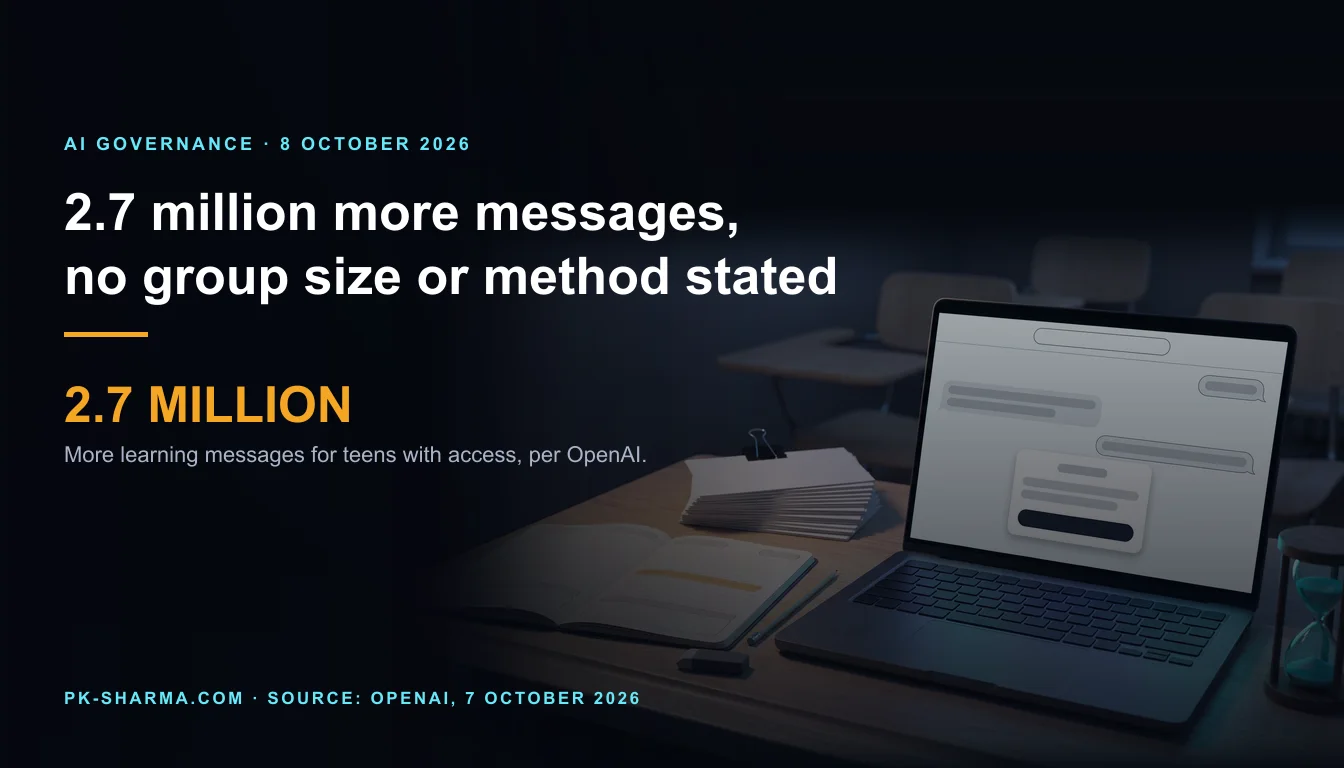
OpenAI's post of 7 October 2026, Helping teens learn, plan, and shape the future of AI, says that teens with access to ChatGPT for Teens "sent about 2.7 million more learning-related messages on average than those who didn't have it yet". The same post says teens spend "under 15 minutes a day" on ChatGPT on average. Those two sentences cannot both be per-teen figures. A teen who sent one message every second of a 15-minute day, every day for a year, would send 328,500 messages (15 × 60 × 365, derived). 2.7 million is about 8.2 times that. So the figure is not a difference between two per-teen averages. It is a total, or an average of totals, and the post does not say a total of what: the number of teens in either group, the period, how the groups were chosen, or how a message is judged to be learning-related.
That matters because a total difference says nothing about any one teen. A larger group sends more messages in total than a smaller one, whatever each teen does. The only teen count on the page is "nearly 1.2 million", for one feature in one week. 2.7 million divided by 1.2 million is 2.25 (derived). If the two numbers described the same teens in the same week, that would be about two extra learning messages each. The page does not say they do, so a reader cannot tell whether 2.7 million is a great deal per teen or almost nothing. The figures do not establish that ChatGPT for Teens improved anyone's learning, that any teen is safer or better off, or that any of them hold in the UK.
There is a second finding, and it is in a different document. The one place OpenAI prints teen-safety scores is a system card, not this post. In the October card of the same day, GPT-6 Sol and GPT-6 Luna score lower than the August models on all six of OpenAI's under-18 tests, and OpenAI itself reports statistically significant regressions on three of them for Sol and four for Luna. The post mentions none of this.
This briefing reports what OpenAI's pages say and what they leave out. It makes no claim about whether OpenAI complies with the Online Safety Act 2023, the UK GDPR or any other UK rule. The post mentions none of them, and no OpenAI page read says whether the teen experience is available to UK accounts. OpenAI sells ChatGPT, wrote the post, holds the logs and chose which figures to print, so its interest is plain. Every figure below is attributed to the page it was read on, and a figure marked derived is our arithmetic.
What the post prints, figure by figure
The table sets each figure beside what the post states with it and what it leaves out. The post is about 1,350 words (our count) and gives no start or end date for any figure, no method, and no definition of "learning-related", "enrolled" or "took a break". It says "once enrolled" while also describing ChatGPT for Teens as "the default experience automatically applied to accounts identified as under 18". What enrolment is, the page does not say.
The usage figures in OpenAI's post of 7 October 2026, what is printed with each, and what is not. Source: the post, read in full on 8 October 2026.
- What the post prints
- About 2.7 million more learning-related messages "on average"
- Stated with it
- Teens with access against "those who didn't have it yet", as the experience "became available to more teens globally"
- Not stated
- Messages per what. The period. Either group's size. How the groups were formed. How a message counts as learning-related.
- What the post prints
- Nearly 1.2 million teens used Learning Visualizations; more than 180,000 used Study Mode
- Stated with it
- "In one week"
- Not stated
- Which week. What counts as use. How many teens are enrolled. Study Mode users are a little over 15% of the other figure (derived: 180,000 ÷ 1,200,000).
- What the post prints
- "On average, teens spend under 15 minutes a day on ChatGPT"
- Stated with it
- A mean, with a ceiling
- Not stated
- Which teens, all or active days only. The period. Whether this is the teen experience or all ChatGPT. The spread.
- What the post prints
- Less than 2% of teens spend more than three consecutive hours
- Stated with it
- A share, with a ceiling
- Not stated
- The base. The period. What "consecutive" means. How many teens that is.
- What the post prints
- In almost half of conversations with a break reminder, teens took a break or ended the conversation within five minutes
- Stated with it
- A five-minute window
- Not stated
- What triggers a reminder. How many conversations. What "took a break" means. Any conversations without a reminder to compare.
- What the post prints
- Among teens with sessions over three consecutive hours, over 80% had at least one learning-related prompt
- Stated with it
- A threshold of one prompt
- Not stated
- What "related to learning" means. How many prompts. The share of the session.
- What the post prints
- A "publicly reported average of 5 hours for teen social media usage"
- Stated with it
- A link to a page of the American Psychological Association
- Not stated
- What it measures: see below. The page itself says 4.8 hours.
- What the post prints
- "Hundreds of thousands of US teens use ChatGPT each week to plan for college"
- Stated with it
- US teens, each week
- Not stated
- Whether these are ChatGPT for Teens accounts. A count. Any figure outside the US.
- What the post prints
- "ChatGPT's 1.2 billion users span many countries"
- Stated with it
- No period on this page
- Not stated
- Any teen share or country split. The same day's GPT-6 announcement says 1.2 billion people use ChatGPT "each week".
| What the post prints | Stated with it | Not stated |
|---|---|---|
| About 2.7 million more learning-related messages "on average" | Teens with access against "those who didn't have it yet", as the experience "became available to more teens globally" | Messages per what. The period. Either group's size. How the groups were formed. How a message counts as learning-related. |
| Nearly 1.2 million teens used Learning Visualizations; more than 180,000 used Study Mode | "In one week" | Which week. What counts as use. How many teens are enrolled. Study Mode users are a little over 15% of the other figure (derived: 180,000 ÷ 1,200,000). |
| "On average, teens spend under 15 minutes a day on ChatGPT" | A mean, with a ceiling | Which teens, all or active days only. The period. Whether this is the teen experience or all ChatGPT. The spread. |
| Less than 2% of teens spend more than three consecutive hours | A share, with a ceiling | The base. The period. What "consecutive" means. How many teens that is. |
| In almost half of conversations with a break reminder, teens took a break or ended the conversation within five minutes | A five-minute window | What triggers a reminder. How many conversations. What "took a break" means. Any conversations without a reminder to compare. |
| Among teens with sessions over three consecutive hours, over 80% had at least one learning-related prompt | A threshold of one prompt | What "related to learning" means. How many prompts. The share of the session. |
| A "publicly reported average of 5 hours for teen social media usage" | A link to a page of the American Psychological Association | What it measures: see below. The page itself says 4.8 hours. |
| "Hundreds of thousands of US teens use ChatGPT each week to plan for college" | US teens, each week | Whether these are ChatGPT for Teens accounts. A count. Any figure outside the US. |
| "ChatGPT's 1.2 billion users span many countries" | No period on this page | Any teen share or country split. The same day's GPT-6 announcement says 1.2 billion people use ChatGPT "each week". |
The post also announces things that are not figures. College Planner is coming "soon" to ChatGPT for Teens, as an initial US experience for grades 10 to 12 planning for a four-year college, with other countries planned and none named. OpenAI says it will support College Advising Corps, a US nonprofit, and the Digital Wellness Lab at Boston Children's Hospital and its Student Advisory Council over three years, with about 22 students in 2026 to 2027. Flashcards, quizzes and multi-photo capture on iOS are added. No amount, date or UK availability is given for any of them.
One date bounds the product, not the figures. OpenAI's launch post for ChatGPT for Teens is dated 18 August 2026, 50 days before this one (derived: 13 days left in August, 30 in September, 7 in October). The post says nothing about what window any figure covers. OpenAI's age prediction post records that age prediction began rolling out on 20 January 2026, so teen safeguards by other names are older than the product name.
What the figures do not establish
An engagement summary is not an outcome study. The post prints no learning outcome, no wellbeing measure and no harm measure; its only uses of "wellbeing" describe the hospital lab it supports. OpenAI's own page of 4 March 2026 says the education sector is "still early" in understanding the impact of AI on learning outcomes. It describes a randomised study of over 300 college students in three groups, with results that were positive in one subject and "not distinguishable" from the control in another. That is what a design looks like when OpenAI has one. The teens post gives none of it. The message count is also shaped by the product: OpenAI says the most selected starter prompts include "give feedback on my draft" and "help me check my evidence", so a teen who taps a learning starter sends a learning message by construction (our inference). The Department for Education says that "evidence is still emerging" on pupils using generative AI themselves.
"With access" against "not yet" is not a controlled comparison. The post says only that the experience "became available to more teens globally", and that those with access sent more than those without. It names no method, no interval and no period. A randomised trial gives access by chance. A staged rollout gives it by place and time, which can differ in age, plan, country, device and season (our inference: the page does not say how access was decided). A difference between such groups can be real and still say nothing about the product.
A mean hides a tail, and the post's own tail is not small in absolute terms. The post gives a mean under 15 minutes and a tail under 2% over three consecutive hours. The distribution between them is not given. At the only teen count on the page, 1.2 million, 2% would be 24,000 teens, and "over 80%" with a learning prompt leaves up to 4,800 of them with none (both derived, as an illustration: the post does not say 1.2 million is the base). One learning prompt in a session of more than three hours is a low bar for "related to learning".
The social media comparison sets two different measures side by side. The linked American Psychological Association page gives "4.8 hours": the average a day that US teens spend on seven popular social media apps. Its source is a Gallup survey fielded from 26 June to 17 July 2023, in which 1,591 US adolescents reported their own time; Gallup's ages run from 13 to 17. So OpenAI sets a survey of what US teens say about seven apps in summer 2023 against a mean from its own logs, for teens and a period it does not define, on one app. OpenAI rounds 4.8 to 5. In minutes it is 288 against "under 15", a ratio of at least 19.2 (derived). The ratio compares unlike things and should not be quoted as a finding.
A break-reminder result is a behaviour with no counterfactual. "Almost half" took a break or ended the conversation within five minutes, which means slightly more than half did neither (derived from the wording). Some of those conversations were ending anyway, and the post gives no conversations without a reminder to compare. In OpenAI's own image of the reminder, the message reads "Ready for a break?" and the card has a Close button. The UK government has said it will require mandatory breaks for under-18s using chatbots and will work with experts on how frequent and how long they should be. OpenAI's figure does not say what frequency or length of break works.
Where OpenAI does print teen-safety numbers: the system cards
OpenAI's launch post of 18 August said it was starting to share under-18 evaluations in its system cards. Three cards now print the same six-category table: the August card (6 August), the Astra card with its September appendix, and the October card, section 3.1.2, published 7 October. The table below sets Sol and Luna side by side across the three: GPT-5.6 in August, GPT-6 in September and GPT-6 again in October. Higher is better.
OpenAI's under-18 evaluation scores for Sol and Luna, each cell reading August, September, October. August is GPT-5.6 Sol and Luna, August update (August card, Table 2); September is GPT-6 Sol and Luna (Astra card appendix, Table 24); October is GPT-6 Sol and Luna (October card, Table 2).
- Category
- Age-restricted goods, services, dangerous challenges
- Sol
- 0.865, 0.861, 0.799
- Luna
- 0.857, 0.848, 0.814
- Category
- Sexual content
- Sol
- 0.971, 0.975, 0.933
- Luna
- 0.984, 0.949, 0.904
- Category
- Eating disorders
- Sol
- 0.808, 0.853, 0.772
- Luna
- 0.810, 0.871, 0.776
- Category
- Emotional reliance
- Sol
- 0.921, 0.948, 0.770
- Luna
- 0.927, 0.946, 0.734
- Category
- Self harm
- Sol
- 0.987, 0.990, 0.977
- Luna
- 0.977, 0.982, 0.974
- Category
- Gore
- Sol
- 0.872, 0.898, 0.845
- Luna
- 0.867, 0.878, 0.812
| Category | Sol | Luna |
|---|---|---|
| Age-restricted goods, services, dangerous challenges | 0.865, 0.861, 0.799 | 0.857, 0.848, 0.814 |
| Sexual content | 0.971, 0.975, 0.933 | 0.984, 0.949, 0.904 |
| Eating disorders | 0.808, 0.853, 0.772 | 0.810, 0.871, 0.776 |
| Emotional reliance | 0.921, 0.948, 0.770 | 0.927, 0.946, 0.734 |
| Self harm | 0.987, 0.990, 0.977 | 0.977, 0.982, 0.974 |
| Gore | 0.872, 0.898, 0.845 | 0.867, 0.878, 0.812 |
OpenAI's October card says GPT-6 Sol and GPT-6 Luna "show statistically significant regressions" against their August counterparts on age-restricted content, sexual content and emotional reliance, and that Luna also does on gore. The card compares only with August. Our arithmetic from the table, labelled derived: against August, the October scores are lower in all 12 cells, by 0.151 for Sol and 0.193 for Luna on emotional reliance, the largest falls. Against the September versions in the Astra card, October is lower in all 12 cells again. That second comparison is ours, across two cards. In its section on standard disallowed content the October card warns that scores from earlier system cards not in its own table should generally not be considered directly comparable, because policies, graders and datasets change, and no card says whether anything changed in the under-18 tests between September and October. Read the September comparison as a pointer, not a trend.
OpenAI gives three qualifications, all of which belong beside the numbers. It says its emotional reliance evaluation "is overly sensitive to the use of benign nicknames" such as "bro" or "bestie". It says an additional classifier-based block on responses that may contain self-harm, sexual content or gore "is not captured in the evaluation results". And it says the tests use difficult cases, so the results "should not be interpreted as estimates of how frequently these behaviors occur in typical production use". The scores are therefore not a rate of harm to teens. They are what OpenAI chose to measure on its models.
What OpenAI prints for under-18 safety in its cards and posts, and what none of the pages read prints for the teen experience.
- Item
- Test scores
- Printed
- Six categories, per model, scale 0 to 1, with OpenAI's statement of which differences are significant
- Not printed
- Number of prompts per category. Confidence intervals. How answers are graded.
- Item
- Which model
- Printed
- Scores for Sol and Luna in ChatGPT chat
- Not printed
- Which model a teen account runs. The 7 October announcement says Free and Go use Luna and the teen help pages name no model, so a teen on a free plan may be served the lowest-scoring column (our inference).
- Item
- The teen experience as a whole
- Printed
- A note that a classifier block exists
- Not printed
- Any score with break reminders, parental controls and the classifier block in place.
- Item
- Age prediction
- Printed
- That it exists and that an uncertain age defaults to a safer experience
- Not printed
- Any accuracy figure, error rate or count of accounts placed.
- Item
- Place
- Printed
- GPT-6 launched in ChatGPT "across free and paid plans globally"
- Not printed
- Any country split, or any UK figure.
| Item | Printed | Not printed |
|---|---|---|
| Test scores | Six categories, per model, scale 0 to 1, with OpenAI's statement of which differences are significant | Number of prompts per category. Confidence intervals. How answers are graded. |
| Which model | Scores for Sol and Luna in ChatGPT chat | Which model a teen account runs. The 7 October announcement says Free and Go use Luna and the teen help pages name no model, so a teen on a free plan may be served the lowest-scoring column (our inference). |
| The teen experience as a whole | A note that a classifier block exists | Any score with break reminders, parental controls and the classifier block in place. |
| Age prediction | That it exists and that an uncertain age defaults to a safer experience | Any accuracy figure, error rate or count of accounts placed. |
| Place | GPT-6 launched in ChatGPT "across free and paid plans globally" | Any country split, or any UK figure. |
The 7 October GPT-6 announcement is the source for Free and Go using Luna. Our briefing covers the two versions of GPT-6 Sol, and a conflict between OpenAI pages about which model Free and Go users get. The teen help pages, read in full, name no model.
Who gets the teen experience: signals, a default and a selfie
The 7 October post does not describe how an account is placed in the teen experience. OpenAI's earlier pages do, and the diagram draws the path from them, with the steps no page states as dashed boxes. The launch post says a person is placed in ChatGPT for Teens "if our system estimates someone is under 18 or they state their age is between 13 and 17". The help article on age prediction lists the signals as the topics a person talks about, the times of day, how and when the account is used, and how long it has existed. OpenAI's January post listed account age, times of day, usage patterns and stated age, without topics. The help article adds that prediction "can identify an account as eligible" even if a date of birth was given at sign-up.
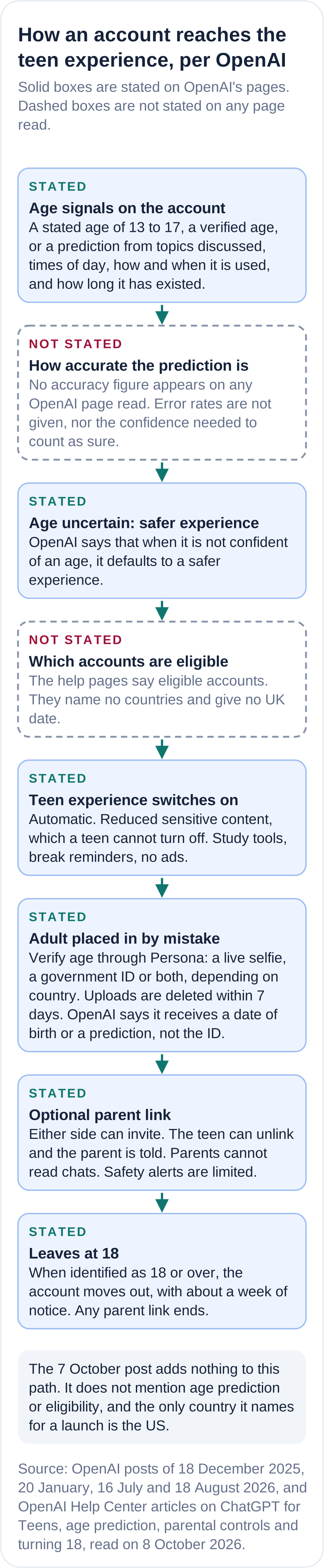
Three points matter for governance. First, uncertainty defaults towards the teen experience: OpenAI says that when it is "not confident about someone's age or have incomplete information, we default to a safer experience". Second, the correction route for an adult is a third-party check. The help article says Persona may ask for a live selfie, a government ID or both depending on country, deletes the upload within 7 days, and passes OpenAI a date of birth or an age prediction, not the ID. Italy is the only country the article names. Third, OpenAI's Europe Terms of Use, which apply to residents of the UK, say a user must be at least 13 and that under-18s must have a parent or guardian's permission; the provider for UK residents is named as OpenAI OpCo, LLC, a Delaware company. A help article on ages says similarly that children aged 13 to 18 must obtain parental consent.
For a parent, the parental controls article lists settings and defaults. Reduce sensitive content is on by default. "Improve the model for everyone", which controls whether the teen's conversations can be used to improve models, shows "Default: Enabled". Memory (where available), voice mode and image generation are enabled by default, and study mode and quiet hours are off. Linking does not give a parent access to conversations, and a teen can unlink. Our briefing on ChatGPT ads during image generation covers the same age signals gating ads: OpenAI shows no ads to accounts it identifies as under 18, and whether that prediction runs on UK accounts is not stated.
What the post mentions of UK rules, and what the rules ask
Searching the post's body text for the UK, Ofcom, the Online Safety Act, the Information Commissioner, the Children's code, GDPR, data protection and the Department for Education returns nothing. It names the US for College Planner and "many countries" for 1.2 billion users. It does not mention age prediction. No OpenAI page read says whether ChatGPT for Teens is available to UK accounts: the help article says "eligible" accounts without defining eligibility or naming a country. The Council the post says OpenAI will support is run by the Digital Wellness Lab at Boston Children's Hospital; the Lab's page says it is in its fifth year, is not affiliated with a tech company and generally seeks US-based students. OpenAI says it expects to seek that group's feedback on teen safety defaults and parental controls. OpenAI does appear on the government's list of organisations that responded to its "Growing up in the online world" consultation; the list gives no content, and the post does not mention the consultation.
The tables state what each UK regime asks of a provider and what a school or parent can check. They are not findings about OpenAI. The first covers online safety regulation, the second data protection and education.
Online safety regulation: what it asks of a provider and what a school or parent can check. Sources: Ofcom, DSIT, Parliament and legislation.gov.uk pages read on 8 October 2026.
- Rule
- Online Safety Act 2023 and Ofcom's children's duties
- What it asks of a provider
- If a user-to-user or search service is likely to be accessed by children: a children's access assessment, a children's risk assessment within three months of launch and before a significant change, safety measures from Ofcom's codes or equivalents, a named accountable person, clear terms, reporting and complaints.
- What a school or parent can check
- Whether the provider says it is in scope. The terms, the reporting route and the complaints route.
- Rule
- Ofcom on chatbots (18 December 2025 and 3 February 2026)
- What it asks of a provider
- Ofcom says a chatbot is outside the Act if it only lets a person talk to the chatbot, does not search multiple websites or databases, and cannot generate pornography. Sharing with other users, search and pornography bring it in. None of the Ofcom pages read names ChatGPT or OpenAI.
- What a school or parent can check
- Which of those features the product has. Ask the provider which applies. This briefing does not say where ChatGPT or its teen experience falls.
- Rule
- Government decisions of July 2026 (response and written statement)
- What it asks of a provider
- The government says it will require mandatory breaks for under-18s using chatbots, with frequency and length to be set with experts, and will stop under-18s using chatbots that mainly offer sexualised content and bar other chatbots from offering children sexually explicit features. Which chatbots are in scope will be set out in regulations "in due course". It says most chatbots used by children are already within the Online Safety Act.
- What a school or parent can check
- Nothing to comply with yet. The first regulations on the social media age limit are promised by the end of 2026.
- Rule
- Crime and Policing Act 2026, section 248
- What it asks of a provider
- Adds section 216A to the Online Safety Act: a power for the Secretary of State to bring AI services into the illegal-content duties by regulations. In force at Royal Assent; legislation.gov.uk lists its version from 29 April 2026. A progress report is due by 31 December 2026 unless draft regulations are laid first.
- What a school or parent can check
- The power is about illegal AI-generated content. Its text names the illegal-content duties, not the children's safety duties.
- Rule
- Age assurance: Ofcom's statement
- What it asks of a provider
- Highly effective age assurance must be technically accurate, robust, reliable and fair. Ofcom's non-exhaustive list includes photo ID matching and facial age estimation. Self-declared age is not highly effective. The Secretary of State has asked Ofcom to report by October on what it looks like for over-16s.
- What a school or parent can check
- What the provider says about accuracy. Whether any OpenAI page links its Persona route or its age prediction to Ofcom's test: none read does.
| Rule | What it asks of a provider | What a school or parent can check |
|---|---|---|
| Online Safety Act 2023 and Ofcom's children's duties | If a user-to-user or search service is likely to be accessed by children: a children's access assessment, a children's risk assessment within three months of launch and before a significant change, safety measures from Ofcom's codes or equivalents, a named accountable person, clear terms, reporting and complaints. | Whether the provider says it is in scope. The terms, the reporting route and the complaints route. |
| Ofcom on chatbots (18 December 2025 and 3 February 2026) | Ofcom says a chatbot is outside the Act if it only lets a person talk to the chatbot, does not search multiple websites or databases, and cannot generate pornography. Sharing with other users, search and pornography bring it in. None of the Ofcom pages read names ChatGPT or OpenAI. | Which of those features the product has. Ask the provider which applies. This briefing does not say where ChatGPT or its teen experience falls. |
| Government decisions of July 2026 (response and written statement) | The government says it will require mandatory breaks for under-18s using chatbots, with frequency and length to be set with experts, and will stop under-18s using chatbots that mainly offer sexualised content and bar other chatbots from offering children sexually explicit features. Which chatbots are in scope will be set out in regulations "in due course". It says most chatbots used by children are already within the Online Safety Act. | Nothing to comply with yet. The first regulations on the social media age limit are promised by the end of 2026. |
| Crime and Policing Act 2026, section 248 | Adds section 216A to the Online Safety Act: a power for the Secretary of State to bring AI services into the illegal-content duties by regulations. In force at Royal Assent; legislation.gov.uk lists its version from 29 April 2026. A progress report is due by 31 December 2026 unless draft regulations are laid first. | The power is about illegal AI-generated content. Its text names the illegal-content duties, not the children's safety duties. |
| Age assurance: Ofcom's statement | Highly effective age assurance must be technically accurate, robust, reliable and fair. Ofcom's non-exhaustive list includes photo ID matching and facial age estimation. Self-declared age is not highly effective. The Secretary of State has asked Ofcom to report by October on what it looks like for over-16s. | What the provider says about accuracy. Whether any OpenAI page links its Persona route or its age prediction to Ofcom's test: none read does. |
Sources for the first table, in row order: Ofcom's protection of children duties; Ofcom on chatbots of 18 December 2025 and 3 February 2026; the government's response of July 2026 and the Secretary of State's written statement of 15 July; section 248 of the Crime and Policing Act 2026; and Ofcom's age checks statement.
Data protection and education rules: what they ask and what a school or parent can check.
- Rule
- ICO Children's code
- What it asks
- A statutory code of 15 standards for information society services likely to be accessed by children. Standard 3: establish age with a level of certainty suited to the risks, or apply the standards to everyone. Also high privacy defaults, profiling off by default, no nudges against privacy, a DPIA. The ICO's August 2026 update says it is scanning for risks to children from AI chatbots and will consider targeted intervention.
- What a school or parent can check
- The provider's privacy information for children and its defaults. OpenAI lists model improvement as "Default: Enabled" for a linked teen.
- Rule
- UK GDPR Article 8 and the ICO's consent guidance
- What it asks
- Where consent is the lawful basis for a service offered directly to a child, 13 is the age a child can consent alone; below 13 a parent must, and the provider must make reasonable efforts to verify it. A power to change the age within 13 to 16 was added on 29 April 2026. The ICO treats a service open to under-18s as offered to children.
- What a school or parent can check
- OpenAI's terms require 13 and parental permission under 18. Article 8 applies only where consent is the lawful basis, and no page read says it is. The privacy policy lists estimating age among its purposes.
- Rule
- DfE guidance for England: generative AI, product safety standards, filtering and monitoring
- What it asks
- Pupils should only use generative AI with safeguards such as close supervision and filtering and monitoring, and schools should comply with age restrictions set by tools. The standards expect default time limits, hard limits teachers can override, session records, and claims "supported by robust and transparent evidence". Filtering and monitoring must be reviewed at least annually.
- What a school or parent can check
- Whether a school-managed pupil account exists. The OpenAI school pages read are for US teachers only; student accounts "may come later".
- Rule
- NCSC (schools section and its AI primer)
- What it asks
- The pages read say nothing about children or pupils using AI chatbots. The DfE guidance links two general NCSC pieces on ChatGPT and machine learning.
- What a school or parent can check
- Nothing specific. Use the DfE and Ofcom material above.
| Rule | What it asks | What a school or parent can check |
|---|---|---|
| ICO Children's code | A statutory code of 15 standards for information society services likely to be accessed by children. Standard 3: establish age with a level of certainty suited to the risks, or apply the standards to everyone. Also high privacy defaults, profiling off by default, no nudges against privacy, a DPIA. The ICO's August 2026 update says it is scanning for risks to children from AI chatbots and will consider targeted intervention. | The provider's privacy information for children and its defaults. OpenAI lists model improvement as "Default: Enabled" for a linked teen. |
| UK GDPR Article 8 and the ICO's consent guidance | Where consent is the lawful basis for a service offered directly to a child, 13 is the age a child can consent alone; below 13 a parent must, and the provider must make reasonable efforts to verify it. A power to change the age within 13 to 16 was added on 29 April 2026. The ICO treats a service open to under-18s as offered to children. | OpenAI's terms require 13 and parental permission under 18. Article 8 applies only where consent is the lawful basis, and no page read says it is. The privacy policy lists estimating age among its purposes. |
| DfE guidance for England: generative AI, product safety standards, filtering and monitoring | Pupils should only use generative AI with safeguards such as close supervision and filtering and monitoring, and schools should comply with age restrictions set by tools. The standards expect default time limits, hard limits teachers can override, session records, and claims "supported by robust and transparent evidence". Filtering and monitoring must be reviewed at least annually. | Whether a school-managed pupil account exists. The OpenAI school pages read are for US teachers only; student accounts "may come later". |
| NCSC (schools section and its AI primer) | The pages read say nothing about children or pupils using AI chatbots. The DfE guidance links two general NCSC pieces on ChatGPT and machine learning. | Nothing specific. Use the DfE and Ofcom material above. |
Sources for the second table, in row order: the ICO's Children's code and its August 2026 progress update; Article 8 of the UK GDPR and the ICO's guidance on consent for information society services; the DfE's generative AI guidance, product safety standards and filtering and monitoring standard; and the NCSC's schools section.
The DfE standards are written for products "deployed, marketed, or made accessible for use in educational settings". ChatGPT for Teens is described by OpenAI as a consumer experience for outside the classroom, so whether the standards apply to it in a school is the school's judgement. They still show what a school can ask a vendor for. Measured against them, the post gives no method for its impact claims, and the OpenAI pages read describe no session record for teachers and no time limit a teacher can set; parents can set quiet hours.
What to do, in order
Take this with you
For a school or trust
- Record which AI tools pupils can reach on school networks and devices, and through personal accounts, by year group, and who decided.
- Check that filtering and monitoring covers them, and put the annual review date in the diary. The DfE core standard was updated on 16 September 2026.
- Read the provider's under-18 terms and data position before any pupil use: the minimum age, the parental permission wording, whether conversations can be used to improve models by default, and where the data goes.
- Decide whether pupil use is through a school account or a personal one, and write down why. The OpenAI school-account pages read are for US teachers.
- Set the DfE product safety standards beside the product: time limits a teacher can override, session records and the evidence behind claims.
- Tell parents what was decided, what the age setting does and where their own settings are.
- Diarise a review for when the government publishes chatbot regulations. A progress report is due by 31 December 2026.
Take this with you
For a parent
- Open the account settings with your teen and look at Settings, then Account, then Age. It shows the age category OpenAI uses. Not every account has a Verify age option.
- Know how age is decided: the age on the account, a prediction from behaviour, and a selfie or ID check through a third party if a category is wrong. If the category does not match the person, the help pages describe a verification route.
- Link accounts under Parental controls if your teen agrees. You will not see conversations. Review the defaults, including whether conversations can be used to improve models, memory, voice and image generation.
- Set quiet hours and study hours if you want them. Both are off by default.
- Treat a break reminder as a prompt, not a lock: in OpenAI's own image it can be closed. The government says mandatory breaks are coming but has not set how.
- Ask the school which AI tool it expects pupils to use, and on which account.
Take this with you
For an organisation that provides services to children or buys AI for them
- Ask the vendor in writing for the denominators and method behind each usage figure: the unit and period of the 2.7 million, both group sizes, how groups were formed, and the definitions of learning-related, enrolled and took a break.
- Ask for the distribution of daily use, not the mean: the median and the 90th and 99th percentiles, and the number of teens above three consecutive hours.
- Ask what triggers a break reminder, how many conversations received one, and what happens at the same point without one.
- Ask whether the teen experience is available to UK accounts, which age assurance route applies to them, and the accuracy of age prediction by age band, with errors in both directions.
- Ask which model teen accounts run, how many prompts each under-18 evaluation uses, and the scores with the classifier block and reminders in place.
- If you run a service children are likely to use, complete the children's access assessment, the children's risk assessment and a DPIA, and apply the ICO's standards on age, defaults, profiling and nudges. Keep the vendor's written answers on file with their dates.
The question that exposes the gap
A vendor's average cannot stand in for the child in front of you. OpenAI's post tells a reader that teens spend under 15 minutes a day and that fewer than 2% stay on for three hours, and it tells them nothing about how many, how long, how measured or where. If a parent, a governor or a regulator asked you today how many of your pupils used an AI tool last week, on which accounts, for how long and under which age setting, would your own records answer, or would you be quoting the vendor's mean?
Key facts
Sources
- PrimaryThe post of 7 October 2026, "Helping teens learn, plan, and shape the future of AI", read in full in a browser with its two images and every link: every usage figure, the College Planner and council text, and what the body text does not contain.OpenAIaccessed 2026-10-08
- PrimaryLaunch post of 18 August 2026, "Introducing ChatGPT for Teens": how an account is placed in the experience, the protections, the plan to publish under-18 evaluations in system cards.OpenAIaccessed 2026-10-08
- PrimaryPost of 16 July 2026, the page the teens post links as "built-in reminders": more frequent break reminders for teens who spend extended time, parental controls, partners.OpenAIaccessed 2026-10-08
- PrimaryAge prediction post of 20 January 2026, updated 25 August 2026: signals used, the default to a safer experience when not confident, the Persona selfie route, EU rollout.OpenAIaccessed 2026-10-08
- PrimaryPost of 18 December 2025 on the Under-18 Principles in the Model Spec: default to an under-18 experience when age is uncertain.OpenAIaccessed 2026-10-08
- PrimaryChatGPT for Teens article (updated two days before reading): availability to "eligible" accounts on Free and paid personal plans, features, no country list.OpenAI Help Centeraccessed 2026-10-08
- PrimaryAge prediction in ChatGPT (updated two days before reading): signals including topics, Persona selfie or ID, 7-day deletion, what OpenAI receives, Italy, no accuracy figure.OpenAI Help Centeraccessed 2026-10-08
- PrimaryManaging parental controls in ChatGPT: the settings and their defaults, including "Improve the model for everyone: Default: Enabled", notifications, unlinking.OpenAI Help Centeraccessed 2026-10-08
- PrimaryWhat changes when a ChatGPT user turns 18: transition rules, about a week of notice, the route for an account moved too soon.OpenAI Help Centeraccessed 2026-10-08
- PrimaryIs ChatGPT safe for all ages: not meant for under 13, parental consent required for 13 to 18.OpenAI Help Centeraccessed 2026-10-08
- PrimaryChatGPT for Teachers: free for verified US K-12 educators, not for students, student accounts "may come later".OpenAI Help Centeraccessed 2026-10-08
- PrimaryPost of 4 March 2026 on learning outcomes: the sector is "still early", the randomised study of over 300 college students and its mixed results.OpenAIaccessed 2026-10-08
- PrimaryGPT-6 Sol and GPT-6 Luna October 2026 card, published 7 October 2026, section 3.1.2 and Table 2: under-18 scores, significant regressions, the classifier-block and evaluation caveats.OpenAIaccessed 2026-10-08
- PrimaryGPT-6 Astra system card (3 September 2026) section 4.1.2 and appendix section 11.2.1.2 Table 24: September under-18 scores for GPT-6 Sol and Luna.OpenAIaccessed 2026-10-08
- PrimaryGPT-5.6 August update card (6 August 2026) section 3.2, Table 2: the August under-18 scores that the October card compares against.OpenAIaccessed 2026-10-08
- PrimaryGPT-6 and Intelligent UI announcement of 7 October 2026: Free and Go use GPT-6 Luna, "each week" for 1.2 billion people.OpenAIaccessed 2026-10-08
- PrimaryChatGPT release notes: no entry naming ChatGPT for Teens; ads in the UK from 4 June 2026; ads not shown to users who say or are predicted to be under 18.OpenAI Help Centeraccessed 2026-10-08
- PrimaryEurope Terms of Use (updated 16 January 2026), served for a UK visitor: apply to EEA, Switzerland and UK residents; minimum age 13, parent or guardian permission under 18; provider for UK residents.OpenAIaccessed 2026-10-08
- PrimaryPrivacy policy for the EEA, UK and Switzerland (updated 25 August 2026): children under 13, permission for under 18, estimating age listed among purposes.OpenAIaccessed 2026-10-08
- PrimaryThe page OpenAI links for the "5 hours" figure: "4.8 hours" a day on seven apps, sourced to Gallup, April 2024.American Psychological Associationaccessed 2026-10-08
- PrimaryGallup, 13 October 2023: the survey behind 4.8 hours, fielded 26 June to 17 July 2023, 1,591 US adolescents, ages 13 to 17, self-reported.Gallupaccessed 2026-10-08
- PrimaryAI chatbots and online regulation (18 December 2025): the three conditions under which a chatbot is outside the Online Safety Act.Ofcomaccessed 2026-10-08
- PrimaryOfcom update of 3 February 2026 on the scope of the Online Safety Act for chatbots and the government looking at how chatbots should be regulated.Ofcomaccessed 2026-10-08
- PrimaryProtection of children duties (published 18 February 2026, updated 1 April 2026): children's access assessment, risk assessment timing, safety measures.Ofcomaccessed 2026-10-08
- PrimaryOfcom age assurance statement of 16 January 2025: the four criteria and the non-exhaustive list of methods.Ofcomaccessed 2026-10-08
- PrimaryOfcom open letter of 8 November 2024 on generative AI and chatbots under the Online Safety Act.Ofcomaccessed 2026-10-08
- PrimaryGovernment response of July 2026 to "Growing up in the online world": mandatory breaks for under-18s using chatbots, sexualised chatbot features, scope in due course.Department for Science, Innovation and Technologyaccessed 2026-10-08
- PrimaryWritten statement HCWS254 of 15 July 2026: mandatory breaks for under-18s using chatbots, Ofcom asked to report by October on age assurance for over-16s, regulations by the end of the year.UK Parliamentaccessed 2026-10-08
- PrimarySummary of evidence, methodology and organisations who responded (July 2026): the respondent list includes OpenAI; no content from its response.Department for Science, Innovation and Technologyaccessed 2026-10-08
- PrimaryPress release of 15 February 2026 announcing the power to bring chatbots into the illegal content duties.Prime Minister's Office and DSITaccessed 2026-10-08
- PrimaryCrime and Policing Act 2026 section 248: new section 216A of the Online Safety Act 2023, in force at Royal Assent. Section 249 (report by 31 December 2026) read on the same site.legislation.gov.ukaccessed 2026-10-08
- PrimaryUK GDPR Article 8 as amended: age 13, and the power in 2A inserted on 29 April 2026 by the Children's Wellbeing and Schools Act 2026.legislation.gov.ukaccessed 2026-10-08
- PrimaryThe Children's code with standards 2, 3, 4, 5, 7, 12 and 13 and the services-covered page read in full.Information Commissioner's Officeaccessed 2026-10-08
- PrimaryICO guidance on the rules about an information society service and consent: age 13, "offered directly to a child", reasonable efforts. Served under an "-old" path.Information Commissioner's Officeaccessed 2026-10-08
- PrimaryChildren's code strategy progress update, August 2026: scanning AI chatbots, an expected edtech code, children in the AI code.Information Commissioner's Officeaccessed 2026-10-08
- PrimaryGenerative AI in education (updated 12 August 2025, England): evidence still emerging, pupil safeguards, age restrictions.Department for Educationaccessed 2026-10-08
- PrimaryGenerative AI: product safety standards (updated 19 January 2026): time limits, session records, evidence for claims.Department for Educationaccessed 2026-10-08
- PrimaryFiltering and monitoring core standard (updated 16 September 2026): AI-generated content, annual review.Department for Educationaccessed 2026-10-08
- PrimaryNCSC schools section, read for anything on children and AI chatbots: none found. Its AI primer was also read and has no content on children.National Cyber Security Centreaccessed 2026-10-08
- PrimaryThe Student Advisory Council page: fifth year, two tracks for 2026-27, not affiliated with a tech company, generally US-based students, kickoff mid-October.Digital Wellness Lab, Boston Children's Hospitalaccessed 2026-10-08