OpenAI to test ads during ChatGPT image generation in the US; its free no-ads option has no image tools
OpenAI's first plan for ads, on 16 January 2026, put them at the bottom of answers; 262 days later it announced a format shown while an image is generated. Its help page says the free no-ads option has no image tools, and its release notes list UK ads from 4 June.
By Parminder Kumar Sharma · · 12 min read
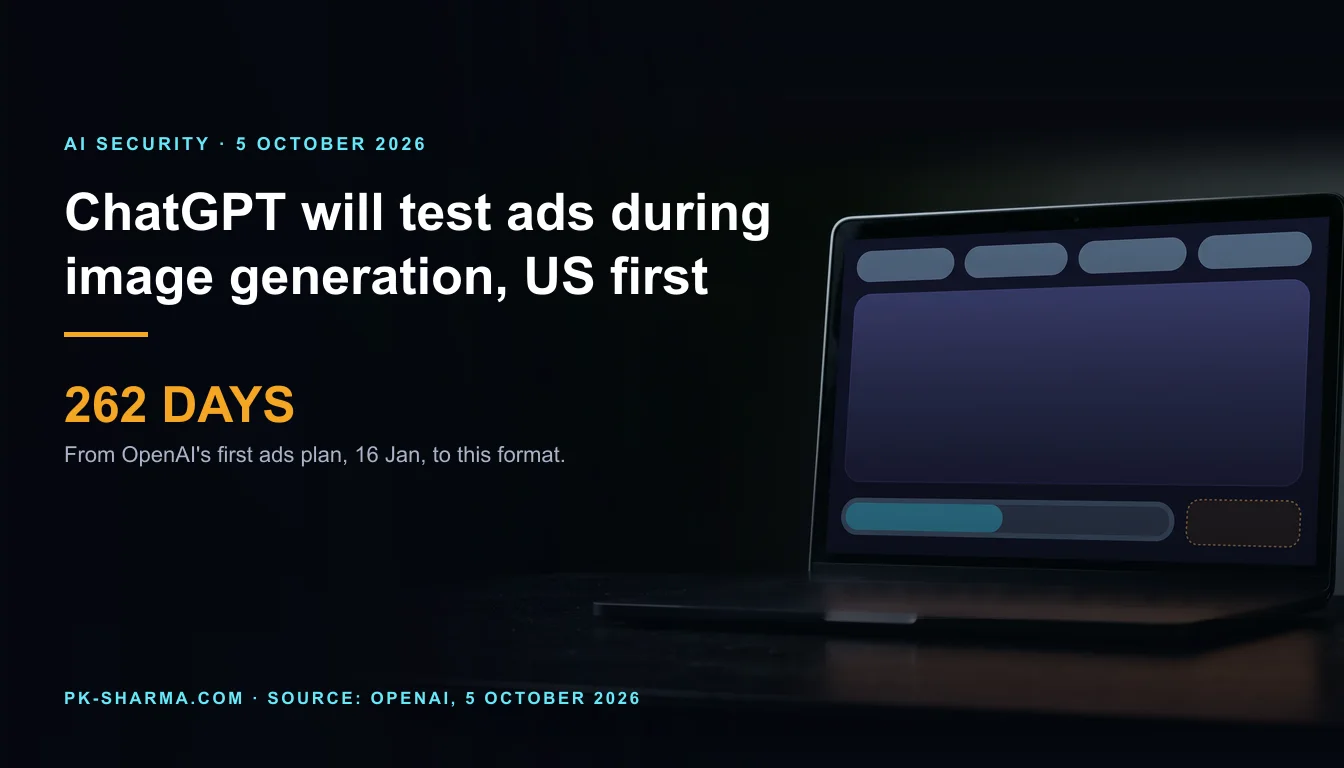
262 days from the bottom of the answer to the wait for an image
On 16 January 2026 OpenAI said it planned to test ads "at the bottom of answers" in ChatGPT. On 5 October 2026, 262 days later (derived), it announced a visual ad format that it will first test "during image generation in ChatGPT", in the US, "later this month", with "an initial group of advertisers". It says: "Ads will be clearly labeled, and remain separate from the image being created."
Read beside OpenAI's help-centre page on ads, the placement has a second edge. That page offers Free users a no-ads option and lists its cost: "fewer messages per day and no access to tools like images". Image generation is the tool the new format sits inside. On that wording, a Free user who wants images without paying has to accept ads (inference). The page, read at 16:44 BST on 5 October 2026 and marked as updated seven days earlier, says ads appear "below the end of a response". It does not mention the image format.
What that does not establish.
- That the image prompt is used to choose the ad. The announcement does not say. The help page says selection considers "the context and intent of your current conversation"; whether this format reads the prompt is left open.
- How many people will see it. "An initial group of advertisers" is the only size given. The 1.2 billion weekly users OpenAI cites are ChatGPT as a whole, not people on Free or Go in a country with ads.
- A UK test. The test is announced for the US. That does not put the UK outside the programme: OpenAI's release notes list "Rolling out ads in the UK" for Free and Go in the entry group dated 4 June 2026, 123 days before this announcement (derived).
Stated and not stated
OpenAI's announcement of 5 October 2026, ads help page, ad policies and Europe privacy policy, read between 16:42 and 17:00 BST on 5 October 2026
- Question
- Where the ad appears
- Stated by OpenAI
- During image generation, labelled, separate from the image. Elsewhere, below the end of a response.
- Not stated
- Screen position, how long it stays, whether it outlasts the wait.
- Question
- Who sees it
- Stated by OpenAI
- Free and Go may see ads. Plus, Pro, Business, Enterprise and Edu will not. The test is in the US.
- Not stated
- Whether Free, Go or both join the test; signed-out use.
- Question
- Image prompt used to pick the ad
- Stated by OpenAI
- Selection uses the current conversation and, with personalisation on, past chats and memory.
- Not stated
- Whether this format uses the image prompt or an uploaded photo.
- Question
- Personalisation off
- Stated by OpenAI
- Ads continue, based on the current chat thread.
- Not stated
- Any switch that stops current-chat targeting.
- Question
- What advertisers receive
- Stated by OpenAI
- Aggregated views and clicks. Never chats, history, memories, name, email, precise location or IP address.
- Not stated
- What an advertiser learns once a person clicks through.
- Question
- Minors
- Stated by OpenAI
- No ads for accounts identified as under 18, by stated age and age prediction "where available".
- Not stated
- Prediction accuracy, UK availability, what a signed-out child sees.
- Question
- Sensitive topics
- Stated by OpenAI
- No ads near personal health, mental health or politics. Ad policies v1.1 (April 2026): medical, legal and financial advice contexts no longer blocked by default.
- Not stated
- How exclusions apply to an image prompt; the policy is written about conversations.
- Question
- UK
- Stated by OpenAI
- Release note dated 4 June: ads rolling out for Free and Go. Testing page, 11 August: "now launched".
- Not stated
- A UK date for the visual format.
- Question
- Independent checks
- Stated by OpenAI
- Brand-suitability pilots with DoubleVerify and Integral Ad Science are being developed, without access to private conversations.
- Not stated
- Any outside check of answer independence or child protections.
| Question | Stated by OpenAI | Not stated |
|---|---|---|
| Where the ad appears | During image generation, labelled, separate from the image. Elsewhere, below the end of a response. | Screen position, how long it stays, whether it outlasts the wait. |
| Who sees it | Free and Go may see ads. Plus, Pro, Business, Enterprise and Edu will not. The test is in the US. | Whether Free, Go or both join the test; signed-out use. |
| Image prompt used to pick the ad | Selection uses the current conversation and, with personalisation on, past chats and memory. | Whether this format uses the image prompt or an uploaded photo. |
| Personalisation off | Ads continue, based on the current chat thread. | Any switch that stops current-chat targeting. |
| What advertisers receive | Aggregated views and clicks. Never chats, history, memories, name, email, precise location or IP address. | What an advertiser learns once a person clicks through. |
| Minors | No ads for accounts identified as under 18, by stated age and age prediction "where available". | Prediction accuracy, UK availability, what a signed-out child sees. |
| Sensitive topics | No ads near personal health, mental health or politics. Ad policies v1.1 (April 2026): medical, legal and financial advice contexts no longer blocked by default. | How exclusions apply to an image prompt; the policy is written about conversations. |
| UK | Release note dated 4 June: ads rolling out for Free and Go. Testing page, 11 August: "now launched". | A UK date for the visual format. |
| Independent checks | Brand-suitability pilots with DoubleVerify and Integral Ad Science are being developed, without access to private conversations. | Any outside check of answer independence or child protections. |
Friendly names are claims about design
Three phrases carry the comfort in OpenAI's text. None is a control a user can inspect.
Conversation privacy means conversations stay private from advertisers. It concerns who receives the chat, not whether OpenAI reads it. The help page says the ads system uses the current conversation, and that with personalisation off a user will "still see ads based on the context of your current chat thread".
Advertising does not influence the answers is a statement about design. The help page says ads run on separate systems from the chat model; a user cannot see that. The independent evaluations announced on 5 October are brand-suitability pilots for advertisers, still in development. They are not described as an audit of answer independence.
Contextual is the shorthand, not OpenAI's word. The ICO says contextual advertising more readily complies because "personal data is not used to determine what advert a user sees". That reasoning was written for a page a publisher wrote. A conversation the user wrote can hold a name, a place or a photograph, and the guidance does not address that case (inference).
The controls that exist are real: under Settings, Ads controls, a user can switch off Personalize ads and Past chats and memory, see ads history, delete ads data (up to 30 days to remove) and open About this ad. Temporary Chats "will not show ads"; whether that holds for image generation is not stated. None of the controls switches off the current-chat signal.
A prompt you wrote, a screen you are watching
An ad during image generation lands while a person waits on something they typed. OpenAI's Images page says generation "may take a few minutes". Its 8 September release note says some users already see "animated dots and a Snake game" during the wait. OpenAI's illustration of the new format (not a live screenshot) shows an "Ad" pill, an advertiser name, a headline and a Learn more button under a placeholder marked 62 per cent. The help pages say ads are labelled "sponsored"; which word a UK user sees is not stated. The ASA's influencer guidance, not binding, advises against "sponsored" as "open to varied interpretation" and calls "Ad" very likely acceptable.
Personal data. OpenAI's Europe privacy policy (updated 24 August 2026, the version that covers UK users) counts prompts and uploaded images as User Content. For personalised ads it lists User Content among the data used, on the basis of consent "when we ask for it". For generic ads it lists "the context of your current ChatGPT chat, location and time of day", on legitimate interests. It names no exception for image prompts and does not say whether this format reads them.
Children. OpenAI shows no ads to accounts identified as under 18, using age information and age prediction "where available"; the prediction signals include "the general topics a person discusses". Signed-out ads are "appropriate for all audiences". Teens can create images: the Images page describes a teen experience with parental controls over image creation. The ICO's Children's code says profiling children for advertising should be off by default, and its May 2026 advice to government calls legitimate interests for advertising to children "likely to be difficult". None of the sources says what happens when ChatGPT cannot tell that a child is the user.
The UK position: ads are already here, the format is not
The 4 June release note says OpenAI was "beginning to roll out" ads in the UK. An update to its "Testing ads in ChatGPT" page says that on 11 August the programme had "now launched" there. The Ads Manager availability page lists the United Kingdom as available, but that concerns where advertisers are based, not where viewers are.
Dates from OpenAI's own pages; the gaps are derived day counts, checked on 5 October 2026
- Date (2026)
- 16 January
- What OpenAI's page says
- Plan to test ads at the bottom of answers for Free and Go in the US
- Days after row above
- start
- Date (2026)
- 9 February
- What OpenAI's page says
- US test begins (release notes)
- Days after row above
- 24
- Date (2026)
- 4 June
- What OpenAI's page says
- Release notes: beginning to roll out ads in the UK for Free and Go
- Days after row above
- 115
- Date (2026)
- 11 August
- What OpenAI's page says
- Ads "now launched" in the UK, Mexico, Brazil, Japan and South Korea
- Days after row above
- 68
- Date (2026)
- 16 September
- What OpenAI's page says
- Sponsored Agents, a chat with a business's agent after an ad, tested with select US advertisers
- Days after row above
- 36
- Date (2026)
- 5 October
- What OpenAI's page says
- Visual format to be tested during image generation, in the US, later in October
- Days after row above
- 19
| Date (2026) | What OpenAI's page says | Days after row above |
|---|---|---|
| 16 January | Plan to test ads at the bottom of answers for Free and Go in the US | start |
| 9 February | US test begins (release notes) | 24 |
| 4 June | Release notes: beginning to roll out ads in the UK for Free and Go | 115 |
| 11 August | Ads "now launched" in the UK, Mexico, Brazil, Japan and South Korea | 68 |
| 16 September | Sponsored Agents, a chat with a business's agent after an ad, tested with select US advertisers | 36 |
| 5 October | Visual format to be tested during image generation, in the US, later in October | 19 |
What the UK sources say. The ICO's online-advertising guidance, finalised in April 2026, says using storage and access technologies for online advertising "requires consent", including for ad selection, delivery and measurement. That PECR rule concerns reading or storing information on a user's device. OpenAI does not say whether the in-chat ad unit does either, so whether it applies is not established. OpenAI names OpenAI OpCo, LLC, in San Francisco, as controller for residents outside the EEA and Switzerland, which includes the UK. The ICO's advice says special category data in advertising needs explicit consent. Its consent-or-pay guidance (January 2025, under review after the Data (Use and Access) Act) asks whether the core service is "broadly" the same across options. Whether image generation is core or an extra is what the Free no-ads option raises; no ICO source read applies that test to OpenAI.
The CAP Code covers "online advertisements in paid-for space" and paid-for communications aimed at people in the UK. Rule 2.1 requires marketing to be "obviously identifiable as such"; rule 2.3 requires it to "make clear their commercial intent, if that is not apparent from the context", and CAP says it reflects a prohibited practice in Schedule 20 of the Digital Markets, Competition and Consumers Act 2024. The CMA's guidance (CMA207, 18 November 2025) calls failing to identify commercial intent a misleading omission. The ASA says the Codes have no AI-specific rules and apply "regardless of how content is generated, edited, or targeted". None of these sources addresses an ad slot inside a chatbot or an image screen; none rules on OpenAI.
Which plans carry ads depends on which page you read
Six OpenAI pages give different plan lists. The ads help page names five plans as ad-free: Plus, Pro, Business, Enterprise and Edu. The Europe post of 18 August names three. The advertiser-facing page says "Plus, Pro, or any Business plan". The Go plan page says OpenAI "may start testing ads in ChatGPT Go in the future", while the help page lists Go as ad-eligible.
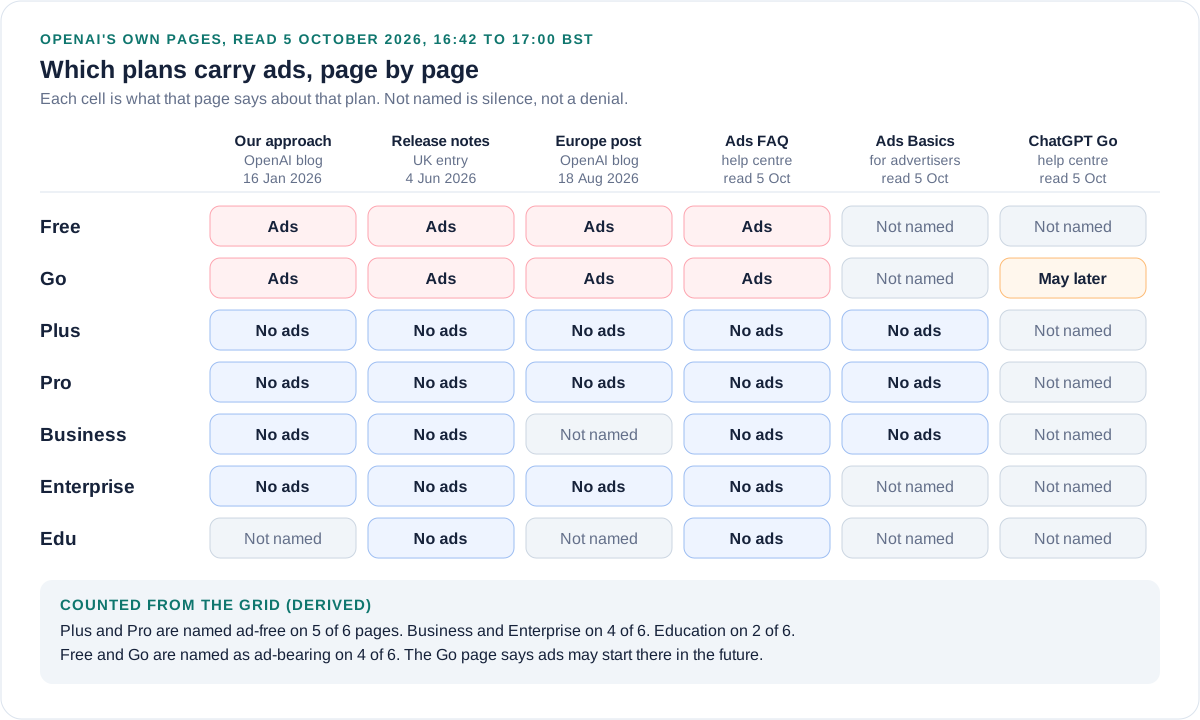
No plan changes sides; no single page is the contract. One more line matters to anyone paying: the help page says Ads-Free is a Free-plan option, so a paying Go subscriber who wants no ads must switch to Free, and lose image tools, or upgrade.
For UK organisations whose staff use free or low-tier accounts
Staff using personal Free or Go accounts for work are on the ad-supported side of OpenAI's own plan boundary. On the other side, OpenAI's data-controls page says Business, Enterprise and Edu content is not used to train its models by default, and its enterprise privacy page (updated 8 January 2026) offers a data processing addendum for Business, Enterprise and the API. The consumer privacy policy says that when an account uses a work email address, OpenAI "may share the fact that you have an account" with the employer: a possible inventory source, not a guarantee.
Earlier briefings show the same data from other angles: a Featured ad blocker whose server sent programs aimed at AI chats, and 13,000 public screenshots that AI agents put in repositories, a reminder that images carry data nobody typed.
Take this with you
Judgement, not a source finding: an acceptable-use checklist in the order worth doing
- Inventory which AI accounts staff use: plan, sign-in email, and whether image generation is used.
- Block or move free-tier and Go use for work. Offer a Business or Enterprise route or an approved alternative, so staff are not choosing between the ad-supported tier and no tool.
- For accounts you cannot move, check the data controls: model improvement, memory, Personalize ads, Past chats and memory, and Temporary Chat. Record that the current-chat signal has no switch.
- Update DPIAs and records of processing to list the ad-supported tier, image prompts and uploads, and sign-in emails.
- Brief staff that an ad-supported tier has a different commercial relationship with prompt data: the current chat helps select ads, so no client data, personal data or photographs of people go into it.
- Review enterprise agreements: name the plans in the contract and confirm no ads, the training default, the data processing addendum and who is controller, because OpenAI's own pages list the ad-free plans differently.
Method, and commercial interest
This briefing follows OpenAI's pages, not the press report. BleepingComputer's account (5 October, 06:28 US Eastern) matches OpenAI's announcement and is used only as a pointer. OpenAI sells these ads and reports its own results; its 31 August post claims a 1 billion dollar annualised run rate, not checked here. Nothing here says OpenAI has broken a rule or a law. Its comfort phrases describe design, and the controls it ships are narrower than the phrases.
The question the announcement cannot answer
When a member of staff types an image prompt into a free account and an ad appears while the image renders, which of your records shows that your organisation decided an ad-supported tool could read that prompt?
Key facts
Sources
- PrimaryBuilding advertising for the way people use AI, 5 October 2026, read in full with a real browser at 16:42 BST: the visual format, the US test later in October, labelling, measurement partners, brand-suitability pilots, and the illustration of the format with its alt textOpenAIaccessed 2026-10-05
- PrimaryOur approach to advertising and expanding access to ChatGPT, 16 January 2026: the first ads plan, the five principles, the plans carrying ads, and ads at the bottom of answersOpenAIaccessed 2026-10-05
- PrimaryAds in ChatGPT, the help-centre FAQ read at 16:44 BST: plans, placement, selection signals, personalisation, advertiser data, minors, the no-ads option and its limitsOpenAIaccessed 2026-10-05
- PrimaryAd policies, version 1.6 updated 10 September 2026: placement exclusions, sensitive contexts, changelog including the April 2026 narrowing of regulated-advice exclusionsOpenAIaccessed 2026-10-05
- PrimaryEurope privacy policy, updated 24 August 2026, the version covering the EEA, UK and Switzerland: User Content, ads data, consent and legitimate-interest bases for ads, controller, employer sharingOpenAIaccessed 2026-10-05
- PrimaryPrivacy policy for other regions, updated 25 August 2026, read only to compare its ads passages with the Europe versionOpenAIaccessed 2026-10-05
- PrimaryChatGPT release notes: Testing ads (9 February), ads in Australia, New Zealand and Canada (16 April), Rolling out ads in the UK (entry group dated 4 June), Images 2.5 waiting-screen note (8 September)OpenAIaccessed 2026-10-05
- PrimaryTesting ads in ChatGPT, with updates of 26 March, 7 May and 11 August 2026 (ads now launched in the UK and four other markets)OpenAIaccessed 2026-10-05
- PrimaryChatGPT Ads expands across Europe, 18 August 2026: 31 markets, Free and Go only, plan listOpenAIaccessed 2026-10-05
- PrimaryA milestone in expanding access to AI, 31 August 2026: run-rate claim, over 40 countries, context of the current conversation as a selection signalOpenAIaccessed 2026-10-05
- PrimaryReimagining advertising with AI, 16 September 2026: Sponsored Agents test with select US advertisersOpenAIaccessed 2026-10-05
- PrimaryAds in ChatGPT: The Basics, the advertiser-facing article: ad format, selection signals, plan exclusions, static tracking parametersOpenAIaccessed 2026-10-05
- PrimaryAds Manager Availability: self-service by country, United Kingdom listed as available, with the note that the advertising entity must be based in a listed countryOpenAIaccessed 2026-10-05
- PrimaryWhat is ChatGPT Go?, read at 16:54 BST: the Go plan page that says ads may start on Go in the futureOpenAIaccessed 2026-10-05
- PrimaryImages in ChatGPT: generation may take a few minutes, availability on all tiers, uploads, teen experience and parental controls over image creationOpenAIaccessed 2026-10-05
- PrimaryData controls in ChatGPT: model-improvement setting, Temporary Chat, managed workspaces not used for training by default, ads controls pointerOpenAIaccessed 2026-10-05
- PrimaryHow OpenAI handles data in consumer services: no sharing of chat content for marketing or advertising purposes, no sale of dataOpenAIaccessed 2026-10-05
- PrimaryEnterprise privacy at OpenAI, updated 8 January 2026: no training on business data by default, data processing addendum for Business, Enterprise and the APIOpenAIaccessed 2026-10-05
- PrimaryMore ways to measure ChatGPT Ads, 5 October 2026: the companion measurement post, Negative Phrases, brand-suitability pilotsOpenAIaccessed 2026-10-05
- PrimaryHow do the rules apply to online advertising?: consent for storage and access technologies used for ad selection, delivery and measurement, and the contextual advertising passageInformation Commissioner's Officeaccessed 2026-10-05
- PrimaryStorage and access technologies guidance, About this guidance: the April 2026 finalisation after the Data (Use and Access) ActInformation Commissioner's Officeaccessed 2026-10-05
- PrimaryICO report for DSIT, May 2026: advice on possible online-advertising exceptions to regulation 6 PECR; special category data and children passages; advice only, for government to decideInformation Commissioner's Officeaccessed 2026-10-05
- PrimaryConsent or pay guidance, About this guidance: published 23 January 2025, under review after the Data (Use and Access) Act; children and Children's code standard 12Information Commissioner's Officeaccessed 2026-10-05
- PrimaryConsent or pay guidance, Equivalence: broadly the same core product or service under either optionInformation Commissioner's Officeaccessed 2026-10-05
- PrimaryCAP Code section 2, Recognition of marketing communications: rules 2.1 to 2.4 and the note that 2.3 and 2.4 reflect Schedule 20 of the DMCC ActAdvertising Standards Authority and CAPaccessed 2026-10-05
- PrimaryScope of the CAP Code: online advertisements in paid-for space, and paid-for communications targeting people in the UK on cross-border platformsAdvertising Standards Authority and CAPaccessed 2026-10-05
- PrimaryDisclosure of AI in Advertising, 29 May 2025: no AI-specific rules, existing rules apply regardless of how content is generated, edited or targetedAdvertising Standards Authority and CAPaccessed 2026-10-05
- PrimaryRecognising ads: Social media and influencer marketing, 6 August 2026: the sponsored label, media-neutral rules for new formats, under-12s and integrated marketing; influencer guidance, not bindingAdvertising Standards Authority and CAPaccessed 2026-10-05
- PrimaryUnfair commercial practices, CMA207, updated 18 November 2025: misleading omission by failing to identify commercial intent, paragraphs 6.7 and 6.8, and banned practice 12Competition and Markets Authorityaccessed 2026-10-05
- Reported byOpenAI will show visual ads in ChatGPT while you generate images, 5 October 2026 (published 06:28 US Eastern): read as a pointer and checked against OpenAI's own announcementBleepingComputeraccessed 2026-10-05
- Reported byChatGPT ads reach the UK: used only to cross-check that UK activation was in the first week of June 2026; its other figures are not usedPPC Landaccessed 2026-10-05