OpenSSH 10.6's notes cite no CVEs, yet MITRE issued 11 within 12 hours; none is for the post-quantum key
OpenSSH 10.6 lists 11 security fixes and cites no CVE. CVE.org holds 11 MITRE records, scored 2.2 to 6.5, none in CISA's KEV list. The post-quantum signature in the headlines is not one of them, and Debian's stable and oldstable releases still show 10 of the 11 as vulnerable.
By Parminder Kumar Sharma · · 19 min read
The notes cite no CVE. CVE.org holds 11 for the release
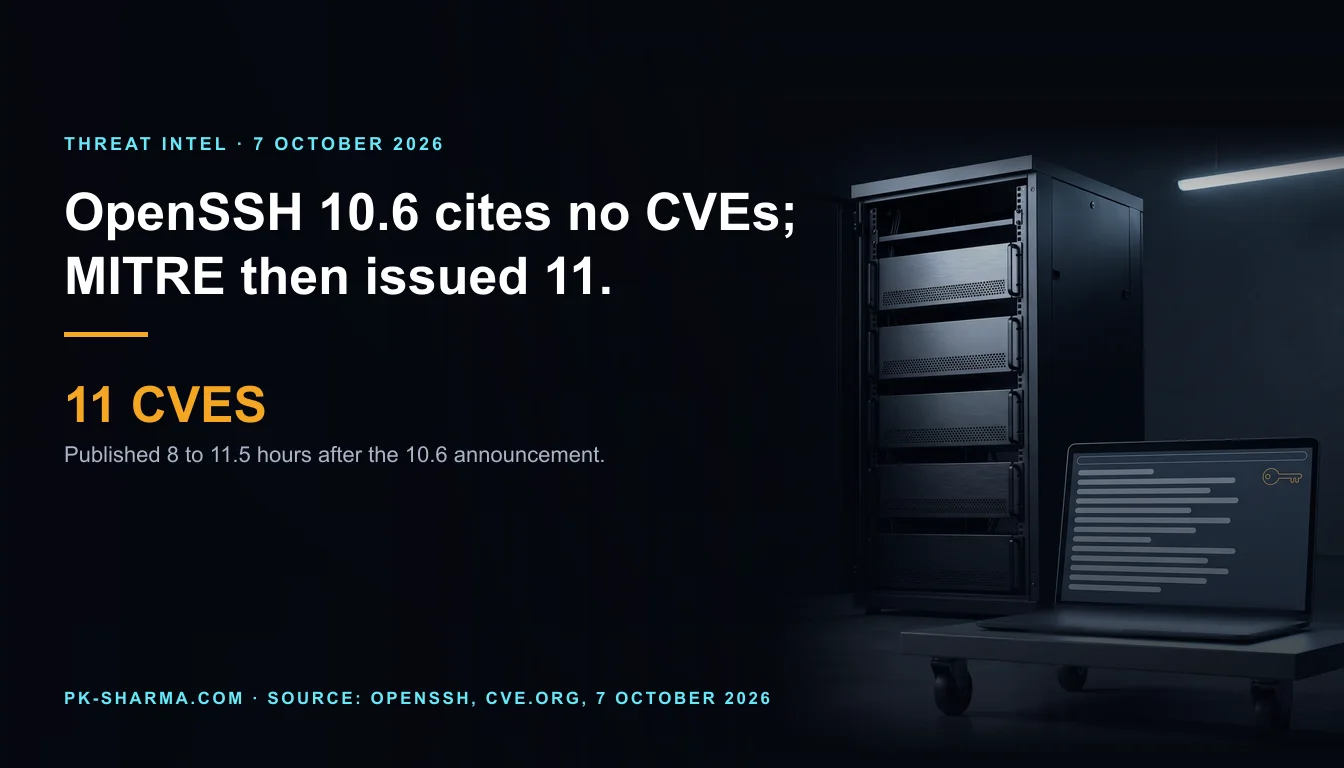
The OpenSSH 10.6 release notes, dated 6 October 2026, run to 48 entries under six headings. Eleven are under Security, and no CVE identifier appears anywhere in them. CVE.org holds 11 records for the release, all assigned by the MITRE CVE Numbering Authority and published between 20:20 and 23:42 UTC on 6 October. That is 8 hours 9 minutes to 11 hours 31 minutes after the maintainers' announcement to the oss-security mailing list at 12:11 UTC (computed from the list's timestamp and each record's publication time). Matched by description, every security entry has exactly one CVE.
Help Net Security led with a different fact: that 10.6 enables a post-quantum signature algorithm, so experimental keys need replacing. That is true. None of the 11 CVEs concerns the new key type.
What the 11 records do not establish, as read between 11:12 and 11:40 BST on 7 October 2026:
- Exploitation. CISA's Known Exploited Vulnerabilities (KEV) catalogue, version 2026.10.04, released 4 October at 18:52 UTC, has no OpenSSH entry. That describes one catalogue version, not the world, and the CISA-ADP exploitation assessment is not yet attached to any of the 11.
- Low severity. The only scores are MITRE's, 2.2 to 6.5 on CVSS v3.1. NVD lists all 11 as Received, not analysed, with no score of its own. For the 12 CVEs of OpenSSH 10.3 and 10.4 that carry both scores, NVD's was higher than MITRE's in 11 and equal in one.
- AI discovery. The notes credit an AI model by name in 2 of 48 entries and say nothing about where the other reports came from.
- Any effect of the post-quantum signature. A signature authenticates a host or a user. It does not protect the confidentiality of a session, which is the recorded-traffic risk and is already covered by the hybrid key exchange.
What the maintainers state about AI-found reports, and what they do not
The paragraph about AI in the 10.6 notes is word for word the paragraph in the 10.5 notes of 11 August 2026: 873 characters in each once the emphasis marks are removed, checked by script. It is 56 days old, not new in 10.6. Table 1 sets it beside what it leaves out.
Table 1. What the OpenSSH 10.6 notes of 6 October 2026 say about AI-found reports and release cadence, and what they leave out. Quotes are from the notes; the paragraph is identical in the 10.5 notes.
- Topic
- Volume
- Stated in the notes
- A "large number of security bug reports, many of which are findings from AI models or made with AI assistance"
- Not stated
- How many reports, how many from AI, how many were valid, over what period
- Topic
- Impact
- Stated in the notes
- "many AI reports are determined not to have security impact" in a realistic threat model
- Not stated
- Which reports, or what share. The entries that did matter are not marked
- Topic
- Rediscovery
- Stated in the notes
- In "a number of cases" a bug found by AI tools was later found independently by a different researcher
- Not stated
- How many, which fixes, how long between the two finds, whether anyone else exploited one
- Topic
- Adversaries
- Stated in the notes
- This "suggests" that adversaries who do not report bugs "are likely to be able to discover these bugs too"
- Not stated
- Any observed exploitation. The notes give none and KEV lists none, read 7 October
- Topic
- Cadence
- Stated in the notes
- More frequent releases "for now", instead of batching fixes for the next planned release
- Not stated
- How often, or until when. Gaps in days: 10.3 to 10.4 95, 10.4 to 10.5 36, 10.5 to 10.6 56 (computed)
- Topic
- Which tools
- Stated in the notes
- Two entries credit work "in collaboration with Claude and Anthropic Research"
- Not stated
- Any other tool or vendor, and which of the 11 security entries came from AI
| Topic | Stated in the notes | Not stated |
|---|---|---|
| Volume | A "large number of security bug reports, many of which are findings from AI models or made with AI assistance" | How many reports, how many from AI, how many were valid, over what period |
| Impact | "many AI reports are determined not to have security impact" in a realistic threat model | Which reports, or what share. The entries that did matter are not marked |
| Rediscovery | In "a number of cases" a bug found by AI tools was later found independently by a different researcher | How many, which fixes, how long between the two finds, whether anyone else exploited one |
| Adversaries | This "suggests" that adversaries who do not report bugs "are likely to be able to discover these bugs too" | Any observed exploitation. The notes give none and KEV lists none, read 7 October |
| Cadence | More frequent releases "for now", instead of batching fixes for the next planned release | How often, or until when. Gaps in days: 10.3 to 10.4 95, 10.4 to 10.5 36, 10.5 to 10.6 56 (computed) |
| Which tools | Two entries credit work "in collaboration with Claude and Anthropic Research" | Any other tool or vendor, and which of the 11 security entries came from AI |
"AI-found" reads as a flood of new flaws. The maintainers say something narrower and more useful: many AI reports have no security impact, and where a real bug is found, someone else is likely to find it too. If that holds, the time between a release and your patch is the exposure, and a report count says little about it.
The count of security entries per release gives a sense of the movement, with the caveats it needs. From 10.0 to 10.6 the notes list 1, 1, 0, 5, 8, 3 and 11 (counted by script). That counts entries, not flaws, and not who found them: 10.4 listed 8 before the AI paragraph first appeared in 10.5. The notes name one AI product family, Claude, in credit lines: in two 10.6 entries and, through an employer, in two 10.5 bugfix entries. They name no other AI vendor. The authors of the compression paper behind one entry state that they used ChatGPT, Gemini and Claude to edit their text and Claude Code to write proof-of-concept code, which they reviewed. In the paper's own account those tools were editors and coding assistants, not finders.
Google took a different course on 1 October and paused its open-source bounty for product flaws over automated submissions, as our earlier briefing records, and what a count measures was the lesson of the 1,313 CVEs in one Debian kernel advisory. A volume figure is a bookkeeping result until someone says what it counts.
The post-quantum signature protects no recorded traffic
The change in the headlines is ssh-mldsa44-ed25519, a composite of ML-DSA-44 and Ed25519. ML-DSA is NIST's FIPS 204, published 13 August 2024; NIST's page carries a 31 July 2026 planning note that a list of minor errata will be corrected in a future revision. The pairing is the safety net: the IETF draft says the composite stays at least as secure as the classical algorithm alone if a flaw is found in the post-quantum part.
OpenSSH 10.4 added an experimental form on 6 July 2026, "not enabled by default". 10.6 is 92 days later. The draft the 10.4 notes cited, posted 2 June 2026, is now marked replaced: first by a broader individual draft, then by draft-ietf-sshm-composite-sigs-00 of 21 August 2026, an IETF working group document and not an RFC. IANA's registry (page updated 8 September 2026) already lists the algorithm name with that last draft as its reference.
The notes say only "enable". The 10.6 source, read at tag V_10_6_P1 on 7 October, shows what that means. The algorithm and its certificate form sit last in each default algorithm list, after Ed25519 and RSA. sshd's default host key list includes ssh_host_mldsa44_ed25519_key, and ssh-keygen -A generates that key. The same key file names exist in the 10.4 and 10.5 source, and the ssh-keygen -A text there already named mldsa44-ed25519. Our reading: a host that ran ssh-keygen -A on an upstream 10.4 or 10.5 build probably holds an experimental key at the path 10.6 now uses. The notes say old keys "must be regenerated and/or removed" and not what happens if one is left in place.
Keys and signatures get much larger. The composite public key is 1,344 bytes against 32 for Ed25519, and a signature is 2,484 bytes against 64 (derived: 1,312 plus 32 and 2,420 plus 64, from FIPS 204 Table 2 and the draft). As an authorized_keys or known_hosts entry that is about 1,828 characters of base64 against 68 (derived). Check anything that stores keys in a field with a length limit.
Table 2. Two post-quantum jobs in OpenSSH, kept apart. Sources: the OpenSSH release notes 9.0, 9.9, 10.0, 10.4 and 10.6, the maintainers' post-quantum page, FIPS 204 and the IETF datatracker.
- Question
- What it protects
- Key exchange (hybrid)
- The confidentiality of a session
- Signature (new in 10.6)
- Who a server or user is
- Question
- Recorded traffic at risk today
- Key exchange (hybrid)
- Yes: the maintainers call it "store now, decrypt later"
- Signature (new in 10.6)
- No: the maintainers state "no risk to existing traffic" from signatures
- Question
- OpenSSH status
- Key exchange (hybrid)
- Hybrid default since 9.0, 8 April 2022. ML-KEM hybrid default since 10.0, 9 April 2025
- Signature (new in 10.6)
- Experimental in 10.4, 6 July 2026. In the default lists, last in preference, since 10.6
- Question
- Standards status
- Key exchange (hybrid)
- Both hybrids are, the maintainers say, being standardised for SSH
- Signature (new in 10.6)
- FIPS 204 final, 13 August 2024. The SSH composite is an IETF working group draft
- Question
- What a 10.6 upgrade changes
- Key exchange (hybrid)
- sshd now logs connections without post-quantum key exchange, on by default
- Signature (new in 10.6)
- A new key type, and a warning that old experimental keys stop working
| Question | Key exchange (hybrid) | Signature (new in 10.6) |
|---|---|---|
| What it protects | The confidentiality of a session | Who a server or user is |
| Recorded traffic at risk today | Yes: the maintainers call it "store now, decrypt later" | No: the maintainers state "no risk to existing traffic" from signatures |
| OpenSSH status | Hybrid default since 9.0, 8 April 2022. ML-KEM hybrid default since 10.0, 9 April 2025 | Experimental in 10.4, 6 July 2026. In the default lists, last in preference, since 10.6 |
| Standards status | Both hybrids are, the maintainers say, being standardised for SSH | FIPS 204 final, 13 August 2024. The SSH composite is an IETF working group draft |
| What a 10.6 upgrade changes | sshd now logs connections without post-quantum key exchange, on by default | A new key type, and a warning that old experimental keys stop working |
The maintainers' own post-quantum page puts it plainly: for signatures there is "no risk to existing traffic", and the only urgency is retiring classical signature keys before cryptographically relevant quantum computers exist. That is the separation our briefing on Cloudflare's post-quantum CA drew between certificates and recorded traffic. Key exchange has been hybrid by default for 1,642 days (4.5 years) as of 10.6, counted from 9.0 on 8 April 2022. Whether a given host benefits is a version test, not a verdict, as our briefing on Forescout's 6% for medical devices showed.
The one new lever on that front is operational. sshd in 10.6 has WarnWeakCrypto, on by default, which logs when a client uses a key agreement that is not post-quantum safe. The notes do not say how noisy that is. Read as a free inventory, it lists the clients that still need updating.
Eleven entries, eleven CVEs, one scorer so far
The records are MITRE's. The OpenSSH security page, read at 11:10 BST, lists nothing for 2026 and its newest entry is dated 9 April 2025, so the maintainers' own channel carries no advisory or rating for any 2026 release. Table 3 matches each security entry in the notes to its record.
Table 3. The 11 security entries of OpenSSH 10.6 and the CVE record for each, matched by description. Scores are MITRE's CVSS v3.1 base scores as shown in NVD, read 11:12 BST on 7 October 2026 and again between 11:33 and 11:40. NVD status for all 11: Received.
- Security entry in the 10.6 notes
- sftp: server-returned paths validated more strictly
- CVE
- CVE-2026-106552
- MITRE score
- 4.2 medium
- Security entry in the 10.6 notes
- sshd: GSSAPI credentials stored only after authentication succeeds
- CVE
- CVE-2026-106553
- MITRE score
- 2.2 low
- Security entry in the 10.6 notes
- sshd: GSSAPIAuthentication state reset before authentication
- CVE
- CVE-2026-106555
- MITRE score
- 2.2 low
- Security entry in the 10.6 notes
- ssh and sshd: LZ77 dictionary coder disabled (compression side channel)
- CVE
- CVE-2026-106582
- MITRE score
- 3.7 low
- Security entry in the 10.6 notes
- ssh: dollar sign and backslash refused in command-line usernames
- CVE
- CVE-2026-106583
- MITRE score
- 2.5 low
- Security entry in the 10.6 notes
- ssh-keygen: Daylight Saving Time handling in certificate dates
- CVE
- CVE-2026-106584
- MITRE score
- 2.5 low
- Security entry in the 10.6 notes
- ssh and sshd: decompressed payload checked against the maximum packet length
- CVE
- CVE-2026-106585
- MITRE score
- 6.5 medium
- Security entry in the 10.6 notes
- sshd: authorized_keys restrict now applied to tunnel forwarding
- CVE
- CVE-2026-106586
- MITRE score
- 2.5 low
- Security entry in the 10.6 notes
- sshd: "none" in some options no longer read as a file name
- CVE
- CVE-2026-106587
- MITRE score
- 3.6 low
- Security entry in the 10.6 notes
- sshd: macOS SDK 27 or later loses sandboxing (affects "through 10.6")
- CVE
- CVE-2026-106588
- MITRE score
- 3.1 low
- Security entry in the 10.6 notes
- sshd: post-authentication process keeps root on QNX 6, SCO OpenServer 5, --disable-fd-passing builds (affects "through 10.6")
- CVE
- CVE-2026-106589
- MITRE score
- 2.9 low
| Security entry in the 10.6 notes | CVE | MITRE score |
|---|---|---|
| sftp: server-returned paths validated more strictly | CVE-2026-106552 | 4.2 medium |
| sshd: GSSAPI credentials stored only after authentication succeeds | CVE-2026-106553 | 2.2 low |
| sshd: GSSAPIAuthentication state reset before authentication | CVE-2026-106555 | 2.2 low |
| ssh and sshd: LZ77 dictionary coder disabled (compression side channel) | CVE-2026-106582 | 3.7 low |
| ssh: dollar sign and backslash refused in command-line usernames | CVE-2026-106583 | 2.5 low |
| ssh-keygen: Daylight Saving Time handling in certificate dates | CVE-2026-106584 | 2.5 low |
| ssh and sshd: decompressed payload checked against the maximum packet length | CVE-2026-106585 | 6.5 medium |
| sshd: authorized_keys restrict now applied to tunnel forwarding | CVE-2026-106586 | 2.5 low |
| sshd: "none" in some options no longer read as a file name | CVE-2026-106587 | 3.6 low |
| sshd: macOS SDK 27 or later loses sandboxing (affects "through 10.6") | CVE-2026-106588 | 3.1 low |
| sshd: post-authentication process keeps root on QNX 6, SCO OpenServer 5, --disable-fd-passing builds (affects "through 10.6") | CVE-2026-106589 | 2.9 low |
Two records give the affected range as "through 10.6", not "before 10.6": CVE-2026-106588 and CVE-2026-106589. On those records upgrading to 10.6 does not clear them. Debian's tracker disagrees on both: it marks the first not affected outside macOS and lists 1:10.6p1-1 as the fix for the second. Two published records disagree and we do not pick between them.
The pattern is not new. For 10.3 to 10.5 the notes list 5, 8 and 3 security entries, and CVE.org holds 16 records, all from MITRE, so 27 entries and 27 records across four releases. For 10.5 a participant on oss-security wrote on 11 August that MITRE "has now published CVE ids for these". What changes is the scoring. Of the 12 CVEs from 10.3 and 10.4 that now carry both a MITRE and an NVD score, NVD's is higher in 11 and equal in one, six reach 7 or above on NVD's score against two on MITRE's, and the widest gap is 4.5 points: CVE-2026-35386, the earlier command-line username fix, scored 3.6 by MITRE and 8.1 by NVD. That is inference from 12 records, not a forecast for any one of the 11: the 10.6 scores can move either way.
The patch gap is the open part
If the maintainers are right that a bug found once is likely to be found again, the date that matters is the one on which your build is fixed. The record for one earlier flaw shows how far apart those dates can be. CVE-2026-60002, in OpenSSH 10.4, is a client-side use-after-free when a server changes its host key during key re-exchange. It has the highest NVD score of the 12 that NVD has scored among the 27 CVEs for 10.3 to 10.6. CISA-ADP recorded exploitation as none on 8 July and it is not in KEV.
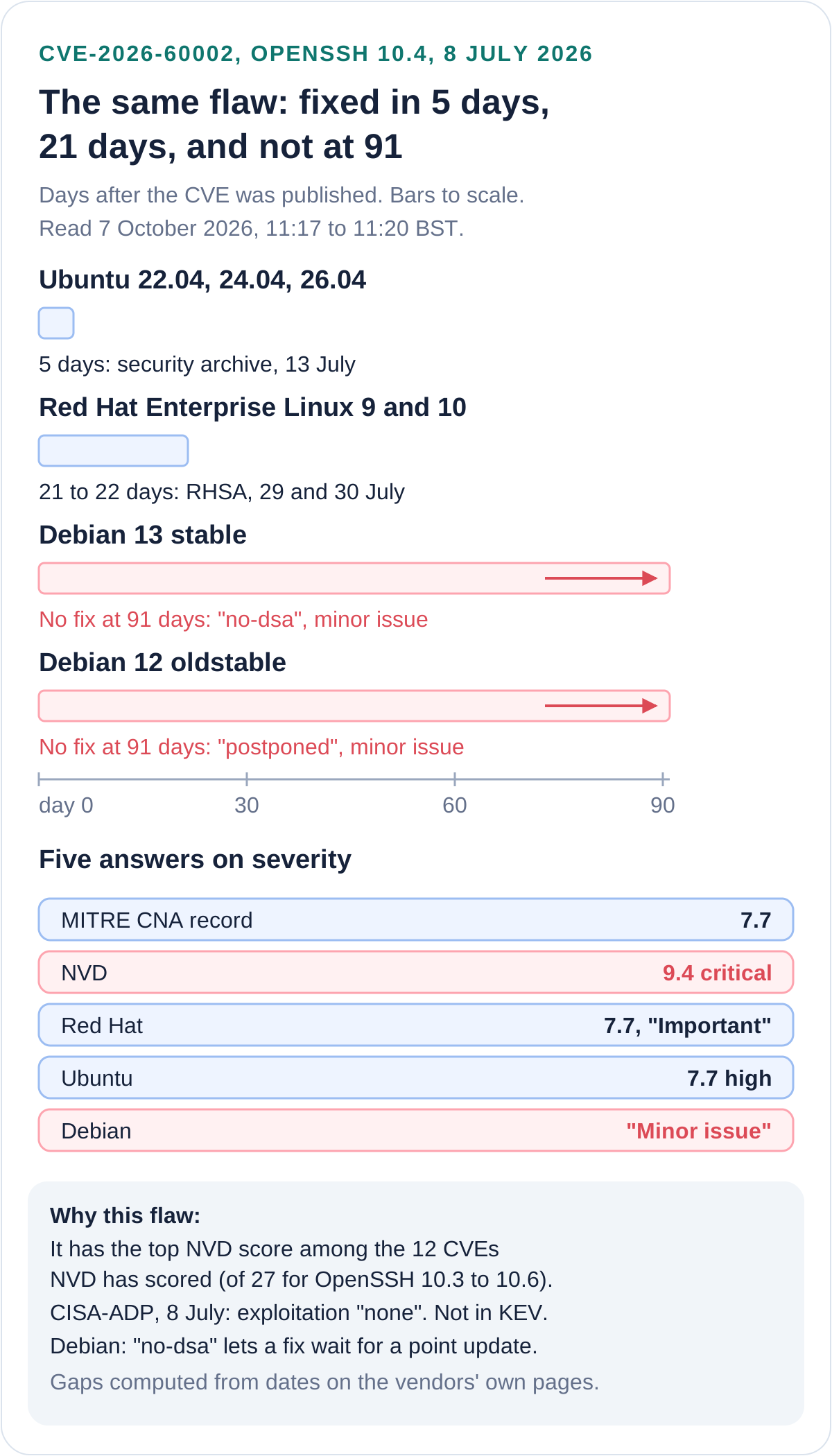
Debian's own definition explains the Debian bars. The "no-dsa" state is for issues that do not warrant an immediate advisory, and such issues "can still get fixed via a point update" or alongside a later fix. Debian's tracker reads the same for all 11 CVEs from 10.4 and 10.5, 57 to 91 days after publication at 7 October, and for the 10.6 CVEs it shows a bare "vulnerable" with no note yet. Red Hat's Enterprise Linux 10.0 Extended Update Support advisory for CVE-2026-60002 came 63 days after publication.
None of the stable releases in Table 4 ships a version that reads 10.6, so a banner check says nothing about a fix. Table 4 shows where each stood the morning after release.
Table 4. What Debian, Ubuntu and Red Hat showed for the 11 OpenSSH 10.6 CVEs on 7 October 2026: Debian between 11:17 and 11:19 BST from its security tracker, Ubuntu and Red Hat between 11:33 and 11:40 BST from their CVE data feeds, shipped versions from Debian's tracker, Launchpad and Red Hat's data.
- Distribution
- Debian 13 (trixie)
- OpenSSH it ships
- 10.0p1 with Debian patches
- Status of the 10.6 CVEs
- 10 of 11 vulnerable, no fix. 1:10.6p1-1 is in unstable only
- Distribution
- Debian 12 (bookworm)
- OpenSSH it ships
- 9.2p1 with Debian patches
- Status of the 10.6 CVEs
- 10 of 11 vulnerable, no fix
- Distribution
- Ubuntu 26.04, 24.04, 22.04
- OpenSSH it ships
- 10.2p1, 9.6p1 and 8.9p1 with Ubuntu patches
- Status of the 10.6 CVEs
- No record for any of the 11 identifiers
- Distribution
- Red Hat Enterprise Linux 9 and 10
- OpenSSH it ships
- 9.9p1 builds with Red Hat patches
- Status of the 10.6 CVEs
- No record for any of the 11 identifiers
| Distribution | OpenSSH it ships | Status of the 10.6 CVEs |
|---|---|---|
| Debian 13 (trixie) | 10.0p1 with Debian patches | 10 of 11 vulnerable, no fix. 1:10.6p1-1 is in unstable only |
| Debian 12 (bookworm) | 9.2p1 with Debian patches | 10 of 11 vulnerable, no fix |
| Ubuntu 26.04, 24.04, 22.04 | 10.2p1, 9.6p1 and 8.9p1 with Ubuntu patches | No record for any of the 11 identifiers |
| Red Hat Enterprise Linux 9 and 10 | 9.9p1 builds with Red Hat patches | No record for any of the 11 identifiers |
"No record" is not "not affected". It means the distribution has not yet published an assessment, which is the normal state a few hours after release and the reason to read these pages again before acting. The eleventh, the macOS-only CVE, is marked not affected. For 1:10.6p1-1, Debian's package tracker showed on 7 October that the upload to unstable on 6 October had not yet migrated to testing, blocked at that time by a missing riscv64 build.
What 10.6 changes in your estate
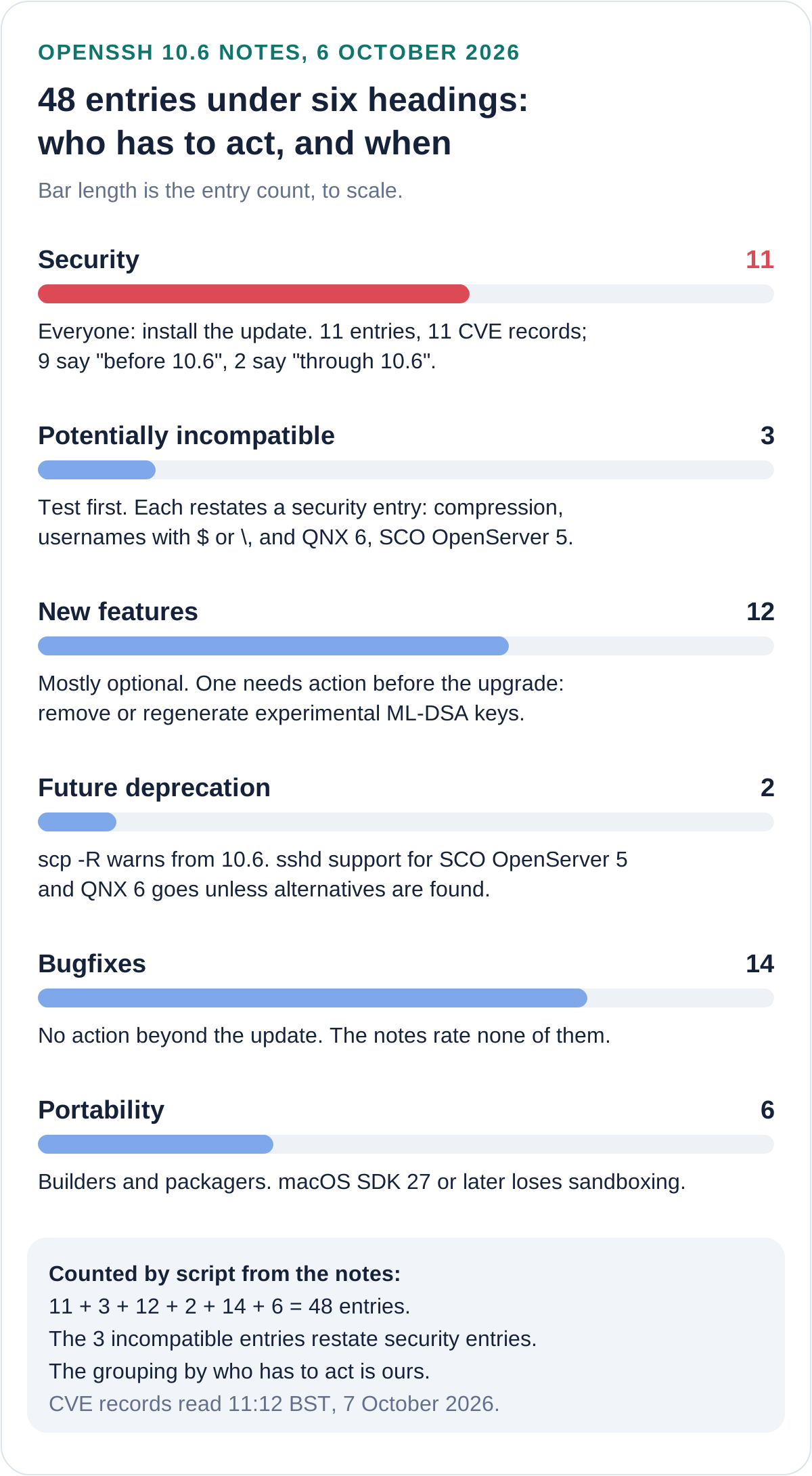
Seven changes need a decision. Each is the maintainers' wording first and our reading second.
- Compression. The notes say ssh and sshd now disable the LZ77 dictionary coder, so the Compression option is "less effective", and recommend application-level compression. In the 10.6 source the sending side starts zlib with its Huffman-only strategy, where 10.5 used the default. Because the compression paper says each direction of a connection has its own context, our inference is that a direction is protected only where its sender runs 10.6. ssh_config defaults to no compression. sshd_config defaults to yes, but on our reading of the negotiation rule the paper describes, a connection compresses only when the client prefers it. Ansible's default ssh arguments include
-C, so every Ansible-driven connection asks for it. The paper says compression is preferred by default in only 4 of 33 clients it surveyed, that 28.1 million of 30.2 million servers (93%) offer it, and that "exposure remains unquantified". - Usernames from untrusted sources. ssh now refuses command-line usernames containing a dollar sign or a backslash, because a name from an untrusted source could inject into a shell context through ProxyCommand or Match exec. Names set with the User directive in config are exempt. This is the third tightening in a year: 10.1 (6 October 2025) refused control characters, 10.3 (2 April 2026) moved the check earlier and validated ProxyJump names. The maintainers say mitigations like this "can not be absolute" and keep recommending against exposing ssh command lines to untrusted input. Likely casualties, our reading: automation that builds a command from a ticket field, a repository name or a domain-qualified account written with a backslash.
- GSSAPI and Kerberos. Two entries: sshd stores GSSAPI credentials only after authentication succeeds, and resets its GSSAPI state before authentication. Both concern GSSAPIAuthentication, so check where Kerberos single sign-on is enabled.
- Certificate dates. ssh-keygen mishandled Daylight Saving Time when converting dates, so certificates could be created with expiry times off by up to an hour (two in the Antarctica/Troll time zone). UK clocks go back on 25 October 2026. The notes do not say which forms of the validity option were affected, and our reading is that certificates already issued keep whatever expiry they were given.
- sftp paths. The sftp client now validates paths returned by a server more strictly. Relevant wherever recursive copies run against servers you do not control, for example a supplier's drop point.
- Legacy platforms. On QNX 6, SCO OpenServer 5 and builds made with
--disable-fd-passing, the post-authentication process keeps root, so GatewayPorts and StreamLocalForwarding are disabled there and support is to be removed in future. Our reading: where they survive in UK estates they will be old appliances or embedded systems. The notes do not say. - Experimental ML-DSA keys. Regenerate or remove them before upgrading, as above.
For UK estates: the clock, the inventory and the order of work
The NCSC's migration timeline, version 1.0 of 20 March 2025, asks organisations to "Complete the discovery and assessment phase" by 2028, to "Complete your highest priority migration activities to protect your most critical assets" by 2031, and to "Complete your migration to PQC" by 2035. The gaps are 3 and 4 years, and from 2026 the three dates are 2, 5 and 9 calendar years away. SSH host keys, user keys, certificate authorities and the algorithms in use belong in that discovery work, with key exchange and signatures as separate rows, as in our briefing on Forescout's report.
For UK Linux and network administrators, hosting providers, managed service providers, universities and NHS suppliers, the order below follows the notes. Items 5, 8 and 9 include our judgement.
Take this with you
Checklist, in the order worth doing
- Inventory first. List each host's OpenSSH build from its package changelog or the distribution tracker, not the version banner: Debian 13 ships 10.0p1, Ubuntu 24.04 ships 9.6p1 and Red Hat Enterprise Linux 9 ships 9.9p1 with backported fixes, so none will read 10.6.
- Read the 10.6 notes and the 11 CVE records and write down the time you read them. NVD, Debian, Ubuntu and Red Hat statuses for these CVEs will move.
- Find experimental ML-DSA keys before upgrading: host keys in /etc/ssh, user keys in ~/.ssh, and any held in agents or key vaults. Decide for each: regenerate or remove, and keep the old file offline for a rollback.
- Test the upgrade on one host of each role: sshd starts, clients authenticate, known_hosts and authorized_keys handling copes with the larger key, and the new WarnWeakCrypto log lines appear.
- Upgrade bastions and jump hosts first. They sit where untrusted usernames meet ProxyCommand and Match exec, and where one connection carries many channels.
- Review configuration for Compression and Ansible's default -C, ControlMaster, ProxyCommand and Match exec that expand the user name, and GSSAPIAuthentication.
- Search scripts, CI jobs and Git remotes that build ssh command lines from names you do not control. Test the new refusal and fix the caller, not the configuration.
- List certificates with explicit end dates, check each expiry against intent, and re-issue any signed by an affected ssh-keygen. UK clocks go back on 25 October 2026.
- Record the decision: which clock you used, who decided, and what stays on an old release (QNX 6, SCO OpenServer 5, --disable-fd-passing builds) with an owner and a date. Add SSH algorithms and key types to the cryptographic inventory for the NCSC 2028 milestone.
# Read-only checks, run as an administrator on a host you own.
ssh -V
ls -l /etc/ssh/ssh_host_mldsa44_ed25519_key* ~/.ssh/id_mldsa44_ed25519* 2>/dev/null
ssh -Q sig | grep -i mldsa
sshd -T | grep -i -E 'hostkey|compression|warnweakcrypto'
grep -rn -i 'compression' /etc/ssh/ssh_config /etc/ssh/ssh_config.d/ ~/.ssh/config 2>/dev/null
The question that exposes the gap
OpenSSH says others are likely to find the same bugs, and its notes cite no CVE, rate nothing and promise only "more frequent releases" for now. The post-quantum signature is about authentication on the NCSC's 2035 horizon. The 11 fixes are about what can be done to an unpatched host this month.
For each OpenSSH build you run, which date does your record call patched: the day upstream released, the day your distribution marked a status, or the day the last jump host restarted sshd?
Key facts
Sources
- PrimaryRelease notes for OpenSSH 10.6, dated 6 October 2026, read in full with curl at 11:09 BST: the AI paragraph and the cadence statement, all 48 entries counted by script, the 11 security entries, the post-quantum signature entry, no CVE identifier anywhereOpenSSHaccessed 2026-10-07
- PrimaryRelease notes page: the 10.6 text matches the txt file; the 10.3, 10.4 and 10.5 sections used for the security entry counts and for the finding that the AI paragraph first appears in 10.5 on 11 August 2026OpenSSHaccessed 2026-10-07
- PrimaryRelease notes for 10.5 of 11 August 2026: the identical AI paragraph, three security entries, two entries crediting a researcher at AnthropicOpenSSHaccessed 2026-10-07
- PrimaryRelease notes for 10.4 of 6 July 2026: the experimental composite ML-DSA 44 and Ed25519 signature, not enabled by default, and eight security entriesOpenSSHaccessed 2026-10-07
- PrimaryRelease notes for 10.3 of 2 April 2026: five security entries, including the earlier command-line username validation fix and ProxyJump name validationOpenSSHaccessed 2026-10-07
- PrimaryRelease notes for 10.1 of 6 October 2025: control characters refused in command-line usernames, the client WarnWeakCrypto warning, experimental XMSS keys removedOpenSSHaccessed 2026-10-07
- PrimaryRelease notes for 9.0 of 8 April 2022: hybrid sntrup761x25519-sha512 key exchange made the defaultOpenSSHaccessed 2026-10-07
- PrimaryRelease notes for 9.9 of 19 September 2024: ML-KEM hybrid key exchange addedOpenSSHaccessed 2026-10-07
- PrimaryRelease notes for 10.0 of 9 April 2025: mlkem768x25519-sha256 used by default for key agreementOpenSSHaccessed 2026-10-07
- PrimaryThe maintainers' post-quantum page: key exchange versus signatures, "store now, decrypt later", and the statement that signatures carry no risk to existing trafficOpenSSHaccessed 2026-10-07
- PrimarySecurity page, read 11:14 BST on 7 October 2026: no entry for 2026, newest entry dated 9 April 2025OpenSSHaccessed 2026-10-07
- PrimaryThe OpenSSH 10.6 announcement, Tue 6 Oct 2026 06:11:18 -0600 (12:11:18 UTC); no reply listing CVE identifiers in the October index at 11:19 BST on 7 Octobeross-security mailing listaccessed 2026-10-07
- PrimaryPreprint "Crossing the Streams: SSH Plaintext Recovery via a Common Compression Context in Multiplexed Channels", v1 7 September 2026, v2 16 September 2026, read as abstract and HTML full text: limitations, the 33 client survey, the Censys figure, the Ansible default, the generative AI usage statementarXivaccessed 2026-10-07
- PrimaryCVE records CVE-2026-106552, 106553, 106555, 106582, 106583, 106584, 106585, 106586, 106587, 106588 and 106589, read through the CVE Services API: assigner mitre, datePublished 20:20 to 23:42 UTC on 6 October 2026, CVSS v3.1 scores, affected rangesCVE Program (MITRE CNA)accessed 2026-10-07
- PrimaryNVD API read at 11:12 BST on 7 October 2026 and 11:33 to 11:40 BST: status Received for all 11, MITRE scores only; the 10.3 to 10.5 CVEs with MITRE, NVD and CISA-ADP (source 134c704f-9b21-4f2e-91b3-4a467353bcc0) dataNIST NVDaccessed 2026-10-07
- PrimaryCVE-2026-60002, OpenSSH 10.4 client use-after-free: MITRE 7.7, NVD 9.4, CISA-ADP SSVC exploitation none dated 8 July 2026NIST NVDaccessed 2026-10-07
- PrimaryKnown Exploited Vulnerabilities catalogue version 2026.10.04, released 4 October 2026 18:52 UTC, 1,734 entries, no OpenSSH entry; read at 11:09 and again at about 11:40 BST on 7 OctoberCISAaccessed 2026-10-07
- PrimaryFIPS 204 (ML-DSA) page: published 13 August 2024, planning note of 31 July 2026 about errataNISTaccessed 2026-10-07
- PrimaryFIPS 204 PDF, Table 2: ML-DSA-44 public key 1,312 bytes, signature 2,420 bytes, security category 2NISTaccessed 2026-10-07
- PrimaryTimelines for migration to post-quantum cryptography, version 1.0 of 20 March 2025: the 2028, 2031 and 2035 milestonesNational Cyber Security Centreaccessed 2026-10-07
- PrimaryCyber Essentials requirements for IT infrastructure v3.3, April 2026, security update management: the 14 day rule and its three limbsNational Cyber Security Centreaccessed 2026-10-07
- Primarydraft-ietf-sshm-composite-sigs-00 of 21 August 2026, sshm working group document, not an RFC: the composite scheme, key and signature layout, security considerationsIETFaccessed 2026-10-07
- PrimaryThe earlier individual draft cited by the OpenSSH 10.4 notes, version 00 of 2 June 2026, marked replacedIETFaccessed 2026-10-07
- PrimarySecure Shell parameters registry, page updated 8 September 2026: ssh-mldsa44-ed25519 listed with draft-ietf-sshm-composite-sigs-00 as the referenceIANAaccessed 2026-10-07
- PrimaryDefault algorithm lists: ssh-mldsa44-ed25519 and its certificate form last in each list. Also read at the same tag: ssh-keygen.1 (-A generates mldsa44-ed25519 host keys), servconf.c (default HostKey list), packet.c (Huffman-only zlib strategy), defines.h (USE_MLDSA)OpenSSH Portable (source tag V_10_6_P1)accessed 2026-10-07
- PrimaryCompression set up with the default zlib strategy, for comparison with 10.6; the 10.4 and 10.5 tags also show the same ML-DSA key file names and ssh-keygen -A textOpenSSH Portable (source tag V_10_5_P1)accessed 2026-10-07
- Primarysshd_config and ssh_config as read on 7 October 2026: Compression defaults (ssh no, sshd yes), the WarnWeakCrypto option, the default algorithm listsOpenBSD manual pagesaccessed 2026-10-07
- PrimarySource package page read at 11:17 BST on 7 October 2026: releases and versions, status of each OpenSSH CVE for bookworm, trixie, forky and sidDebian Security Trackeraccessed 2026-10-07
- PrimaryCVE-2026-60002: trixie no-dsa and bookworm postponed, both noted as minor issue; fixed in 1:10.4p1-1 in unstableDebian Security Trackeraccessed 2026-10-07
- PrimaryDefinition of the no-dsa and postponed states: such issues "can still get fixed via a point update"Debian Security Teamaccessed 2026-10-07
- PrimaryVersions per suite and news: 1:10.6p1-1 accepted into unstable on 6 October 2026, migration to testing blocked at 11:17 BST by a missing riscv64 buildDebian Package Trackeraccessed 2026-10-07
- PrimaryCVE-2026-60002: 7.7 high; fixed in 1:10.2p1-2ubuntu3.4 (26.04), 1:9.6p1-3ubuntu13.18 (24.04), 1:8.9p1-3ubuntu0.16 (22.04). The pages and API for the 10.6 CVE identifiers returned not found between 11:20 and 11:40 BSTUbuntu Securityaccessed 2026-10-07
- PrimaryPublication dates of the openssh fixes in the security pocket, read through the Launchpad API: 13 July 2026 for the CVE-2026-60002 fixes, 3 September 2026 for the 10.5 CVE fixesLaunchpad (Ubuntu archive)accessed 2026-10-07
- PrimaryCVE-2026-60002: Important, CVSS 7.7, RHSA-2026:47756 and RHSA-2026:47757 dated 29 and 30 July 2026, EUS advisory 9 September 2026; no record for the 10.6 CVE identifiers between 11:20 and 11:40 BSTRed Hat Customer Portalaccessed 2026-10-07
- PrimaryDefault ssh_args of the ssh connection plugin: -C -o ControlMaster=auto -o ControlPersist=60s, read 7 October 2026Ansible (ansible-core development branch)accessed 2026-10-07
- PrimaryWhen do the clocks change: clocks go back on 25 October 2026 at 2am, last updated 24 November 2025GOV.UKaccessed 2026-10-07
- Reported byReply of 11 August 2026 on the 10.5 announcement, from a list participant: "MITRE has now published CVE ids for these"oss-security mailing listaccessed 2026-10-07
- Reported byNews report of 7 October 2026, used only as the pointer to the 10.6 release and for the wording this briefing testsHelp Net Securityaccessed 2026-10-07