FBI's FortiBleed alert names no CVE, and its 86,644 is SOCRadar's count, which stood at 30,791 on 17 June
The FBI and Secret Service say FortiBleed can lock owners out of Fortinet firewalls and feed ransomware, but the advisory names no CVE and borrows SOCRadar's count, which was 30,791 on 17 June. Patching and a password reset will not remove an administrator the attacker added.
By Parminder Kumar Sharma · · 21 min read
86,644 is SOCRadar's count, and the same page said 30,791 the day before
On Tuesday 6 October 2026 the FBI and the US Secret Service (USSS) published joint advisory JCSA-20261006-01 on FortiBleed. Its first paragraph carries one number, 86,644 compromised devices in 194 countries, and a footnote credits it to SOCRadar, a security vendor, not to the agencies. SOCRadar's own post, as the Internet Archive captured it at 12:59 UTC on 17 June, was titled "The Compromise of 30,000 Fortinet Firewalls" and said 30,791 devices. A capture at 14:11 UTC on 18 June, 25 hours and 12 minutes later, says 86,644. That is 2.8 times the first figure (our arithmetic). The breakdown tables on the page still use the old base: the top username entry, 6,599, is printed as 21.43%, and 6,599 is 21.43% of 30,791.
What that does not establish. It does not show the campaign grew 2.8 times in a day. SOCRadar does not say why the figure changed, and its FAQ says "different firms are counting different things". It does not show that every one of the 86,644 is a Fortinet firewall: CloudSEK, another vendor, says the operators' raw credential file also holds other vendors' devices and calls the headline numbers "an upper bound". It does not show that any given device is affected today: SOCRadar says each login was verified by the attackers' own tooling and was working "at time of collection". It gives no count for the UK. And it does not show that a vulnerability is involved. The alert names no CVE, and says affected organisations need "remediation steps beyond standard patching and password resets".
What the alert states, and what it leaves out
JCSA-20261006-01 is eleven pages, marked TLP:CLEAR, co-authored by the FBI and the USSS and titled "FortiBleed Operations Continue Targeting Exposed Systems Leading to Reports of Lockouts". Its version history has one entry, 6 October. Its footnotes credit SOCRadar for the count, CloudSEK for the account of the operators' own server, and Fortinet for the mitigations and the hashing guidance. The lockout paragraph and the two indicator tables carry no footnote (the paragraph above the IP table cites CloudSEK), so the alert does not say which observations are the agencies' own. Its only hint is the phrase "Based on initial responses".
What advisory JCSA-20261006-01 states and does not state. Source: the advisory PDF on ic3.gov, read in full on 7 October 2026.
- Topic
- How access was gained
- Stated in the alert
- The campaign "exploits reused or leaked credentials and legacy SHA-256 password storage". Credential stuffing and password spraying from earlier Fortinet leak dumps and infostealer logs.
- Not stated
- How the credentials were first obtained. Any CVE. Any affected or fixed version.
- Topic
- Number of devices
- Stated in the alert
- SOCRadar "verifying more than 86,644 compromised devices across 194 countries".
- Not stated
- Any FBI or USSS count. Any US or UK count. How many logins still worked on 6 October.
- Topic
- Lockouts
- Stated in the alert
- Some victims "may get locked out" if the actor deletes or changes the password for original accounts. Actors "create new accounts not previously on the device".
- Not stated
- How many organisations were locked out, and how any recovered.
- Topic
- Ransomware
- Stated in the alert
- "Reporting indicates" access brokers using the chain gave access to affiliates, "currently including INC/Lynx ransomware and Payload ransomware".
- Not stated
- Any victim, count or date. Who the reporting came from. Which broker.
- Topic
- Indicators
- Stated in the alert
- 13 IP addresses in Table 1, with dates observed from 18 June to 23 July 2026. Seven more in the text. 19 account names found on victim systems.
- Not stated
- Any dated activity after 23 July, 75 days before publication. File hashes.
- Topic
- Patching
- Stated in the alert
- Remediation needed is "beyond standard patching and password resets". The one version number is FortiOS 7.2.11 and later, for PBKDF2 hashing.
- Not stated
- Any vulnerable version, fixed build or patch.
- Topic
- Recovery
- Stated in the alert
- Isolate, hunt, report, then apply eviction countermeasures "after collecting enough threat hunting data". Review REST API keys.
- Not stated
- How to regain control of a device you are locked out of.
- Topic
- The UK
- Stated in the alert
- Nothing. The reporting routes are US ones: IC3, FBI and USSS field offices, CISA's operations centre.
- Not stated
- Any UK count. Any NCSC route.
| Topic | Stated in the alert | Not stated |
|---|---|---|
| How access was gained | The campaign "exploits reused or leaked credentials and legacy SHA-256 password storage". Credential stuffing and password spraying from earlier Fortinet leak dumps and infostealer logs. | How the credentials were first obtained. Any CVE. Any affected or fixed version. |
| Number of devices | SOCRadar "verifying more than 86,644 compromised devices across 194 countries". | Any FBI or USSS count. Any US or UK count. How many logins still worked on 6 October. |
| Lockouts | Some victims "may get locked out" if the actor deletes or changes the password for original accounts. Actors "create new accounts not previously on the device". | How many organisations were locked out, and how any recovered. |
| Ransomware | "Reporting indicates" access brokers using the chain gave access to affiliates, "currently including INC/Lynx ransomware and Payload ransomware". | Any victim, count or date. Who the reporting came from. Which broker. |
| Indicators | 13 IP addresses in Table 1, with dates observed from 18 June to 23 July 2026. Seven more in the text. 19 account names found on victim systems. | Any dated activity after 23 July, 75 days before publication. File hashes. |
| Patching | Remediation needed is "beyond standard patching and password resets". The one version number is FortiOS 7.2.11 and later, for PBKDF2 hashing. | Any vulnerable version, fixed build or patch. |
| Recovery | Isolate, hunt, report, then apply eviction countermeasures "after collecting enough threat hunting data". Review REST API keys. | How to regain control of a device you are locked out of. |
| The UK | Nothing. The reporting routes are US ones: IC3, FBI and USSS field offices, CISA's operations centre. | Any UK count. Any NCSC route. |
One detail needs care. The alert tags the first-access step with ATT&CK technique T1190, whose name in the alert's own table is "Exploit Public-Facing Application". The alert's words under that tag are only "targeted publicly exposed FortiGate infrastructure". A technique tag is not a CVE, and the alert names none.
A name that sounds like a bug, three things it labels, and no bug
FortiBleed labels at least three different things. For CloudSEK it is "the label given to a verified dataset of working device credentials". SOCRadar's FAQ says it "coined the term" for a campaign. The alert uses it for "a credential-harvesting and access-broker operation" and, elsewhere, for an attack chain. The suffix invites a comparison with a memory-disclosure bug that a patch closes. That comparison is ours, and none of the sources makes it. All of them say the opposite. Fortinet, 19 June: "This is not a new Fortinet vulnerability". SOCRadar: "There is no single CVE behind it". CloudSEK: "not a software vulnerability".
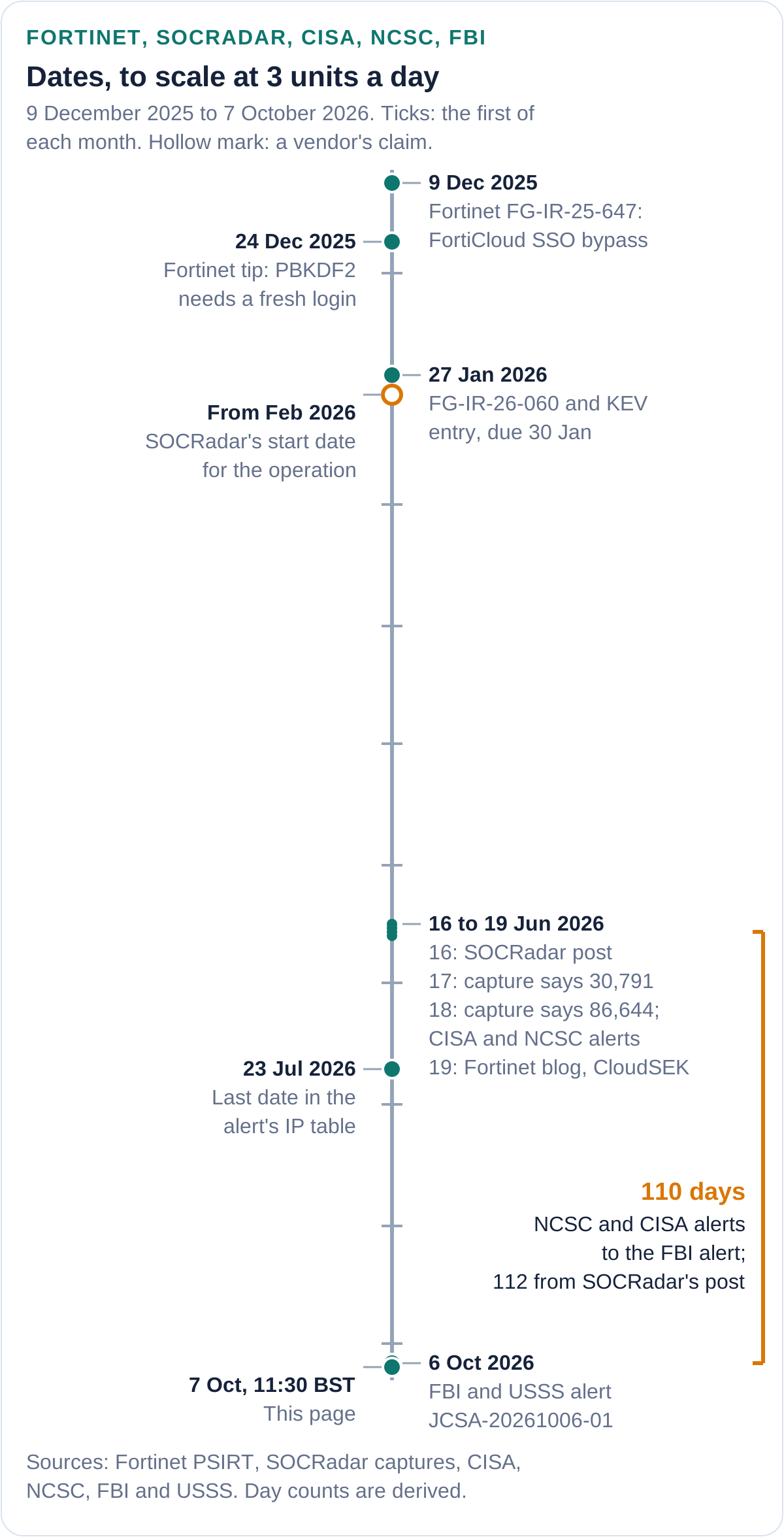
Yet vulnerabilities sit in the history, and the history is why a patch is not the answer. Fortinet's blog says the activity involves "reusing credentials from previous incidents" and cites two of its own advisories, FG-IR-26-060 and FG-IR-25-647. Both are real flaws. FG-IR-25-647 (9 December 2025, CVE-2025-59718 and CVE-2025-59719) and FG-IR-26-060 (27 January 2026, CVE-2026-24858, scored 9.4 by Fortinet) are FortiCloud single sign-on login bypasses that Fortinet marks as exploited. CISA listed CVE-2025-59718 on 16 December 2025 (due 23 December) and CVE-2026-24858 on 27 January (due 30 January). The PSIRT page for FG-IR-26-060 lists the actor's main operations as downloading the customer configuration file and adding an administrator account for persistence.
Our inference, labelled as one. A patch for those flaws closes the route in. It does not change a password that already sits in a downloaded configuration file. Fortinet does not describe that mechanism, and the alert cites neither advisory. SOCRadar says some researchers have discussed whether CVE-2026-24858 contributed in "a subset of cases", that this is under investigation, and that FortiBleed is "primarily a credential reuse and offline cracking campaign". For a different Fortinet product with a real, unfixed flaw, see our briefing on FortiMail CVE-2026-104286. FortiMail is not FortiGate, and the contrast is the point: there the problem is a missing fix, here a fix would not be the answer.
How each source describes first access. Sources as named, read on 7 October 2026.
- Source and date
- FBI and USSS, 6 Oct
- How first access is described
- Reused or leaked credentials and legacy SHA-256 storage. Credential stuffing, password spraying, hashes cracked offline.
- CVE named as the cause?
- No
- Source and date
- NCSC, 18 Jun
- How first access is described
- "brute-force, dictionary and credential stuffing attempts" against internet-facing FortiGate and VPN portals.
- CVE named as the cause?
- No
- Source and date
- CISA, 18 Jun
- How first access is described
- Internet-accessible Fortinet devices targeted "using compromised credentials". No method given.
- CVE named as the cause?
- No
- Source and date
- Fortinet blog, 19 Jun
- How first access is described
- Credentials reused from previous incidents, plus brute force, against devices with weak password hygiene and no MFA.
- CVE named as the cause?
- No. Cites two earlier advisories as the source of the credentials.
- Source and date
- SOCRadar, 16 Jun on
- How first access is described
- Leaked credentials from earlier breach dumps and infostealer logs tried against devices, plus a legacy hashing gap. A whitepaper summary adds SSH brute force against admin accounts.
- CVE named as the cause?
- None as the cause. CVE-2026-24858 "discussed", under investigation.
- Source and date
- CloudSEK, 19 Jun
- How first access is described
- Credential reuse, brute force and offline hash cracking against exposed devices.
- CVE named as the cause?
- No
| Source and date | How first access is described | CVE named as the cause? |
|---|---|---|
| FBI and USSS, 6 Oct | Reused or leaked credentials and legacy SHA-256 storage. Credential stuffing, password spraying, hashes cracked offline. | No |
| NCSC, 18 Jun | "brute-force, dictionary and credential stuffing attempts" against internet-facing FortiGate and VPN portals. | No |
| CISA, 18 Jun | Internet-accessible Fortinet devices targeted "using compromised credentials". No method given. | No |
| Fortinet blog, 19 Jun | Credentials reused from previous incidents, plus brute force, against devices with weak password hygiene and no MFA. | No. Cites two earlier advisories as the source of the credentials. |
| SOCRadar, 16 Jun on | Leaked credentials from earlier breach dumps and infostealer logs tried against devices, plus a legacy hashing gap. A whitepaper summary adds SSH brute force against admin accounts. | None as the cause. CVE-2026-24858 "discussed", under investigation. |
| CloudSEK, 19 Jun | Credential reuse, brute force and offline hash cracking against exposed devices. | No |
Which number counts what
The published figures do not describe one thing. CISA's alert of 18 June, revised on 22 June, says leaked credentials are associated with "approximately 74,000" devices. SOCRadar's own figure went from 30,791 to 86,644 between two captures 25 hours apart. And the later figure CyberScoop quotes from SOCRadar's chief information security officer, "more than 400,000 or 450,000 firewalls", is a different kind of number. SOCRadar's whitepaper summaries say the operation targeted "more than 430,000 FortiGate firewalls". Those are targets, not verified logins, and the pages we read do not define "targeted".
On the ratio: 86,644 is 20.1% of 430,000, or 19.3% to 21.7% against the 450,000 and 400,000 in the interview (our arithmetic). It would be wrong to read that as one targeted firewall in five compromised, or to read the sequence 30,791, 86,644, 430,000 as growth. The first two are the same label, "Compromised Devices", on the same page, 25 hours apart. The third counts targets. SOCRadar's chief information security officer told CyberScoop the later numbers "show the campaign is broader and more serious than we understood at the beginning". That may be so. A rising count from a changing definition is not a measurement of rise.
What "verified" means also moves. The alert says SOCRadar is "verifying" the devices. SOCRadar's FAQ says every credential was "verified by the attacker's own automated tooling" before it was recorded. The first is a researcher checking. The second is the attacker testing. The SOCRadar pages we read describe no independent re-test of the 86,644.
The figures in circulation and what each counts. Sources: SOCRadar (archive captures of 17 and 18 June 2026, its FAQ and report pages), CISA, CloudSEK, read 7 October 2026. Derived items are ours.
- Figure
- 30,791
- Source and date
- SOCRadar post, Internet Archive capture 17 Jun, 12:59 UTC
- What it counts
- "Compromised Devices". 21,108 unique IPs, 8,316 unique domains.
- Figure
- About 74,000
- Source and date
- CISA alert, 18 Jun, revised 22 Jun
- What it counts
- Fortinet devices tied to "exposure of leaked credentials".
- Figure
- 86,644
- Source and date
- SOCRadar post, capture 18 Jun, 14:11 UTC. Quoted by the FBI and USSS
- What it counts
- "Compromised Devices". "80,000+" unique IPs, 22,405 unique domains.
- Figure
- More than 430,000
- Source and date
- SOCRadar report summaries, Volumes I and II (pages undated, Volume II file uploaded July 2026)
- What it counts
- FortiGate firewalls the operation "targeted".
- Figure
- 21,632, then 918, then 148
- Source and date
- CloudSEK, 19 Jun
- What it counts
- Entries in the operators' device-registration email database. Organisations with captured internal Kerberos traffic. Confirmed Active Directory compromises.
- Figure
- 11,250, 409, 354, 12
- Source and date
- SOCRadar's second report, reading one operator spreadsheet
- What it counts
- Portals scanned. Admin access. Full chain to domain admin. Organisations marked LOCKED.
| Figure | Source and date | What it counts |
|---|---|---|
| 30,791 | SOCRadar post, Internet Archive capture 17 Jun, 12:59 UTC | "Compromised Devices". 21,108 unique IPs, 8,316 unique domains. |
| About 74,000 | CISA alert, 18 Jun, revised 22 Jun | Fortinet devices tied to "exposure of leaked credentials". |
| 86,644 | SOCRadar post, capture 18 Jun, 14:11 UTC. Quoted by the FBI and USSS | "Compromised Devices". "80,000+" unique IPs, 22,405 unique domains. |
| More than 430,000 | SOCRadar report summaries, Volumes I and II (pages undated, Volume II file uploaded July 2026) | FortiGate firewalls the operation "targeted". |
| 21,632, then 918, then 148 | CloudSEK, 19 Jun | Entries in the operators' device-registration email database. Organisations with captured internal Kerberos traffic. Confirmed Active Directory compromises. |
| 11,250, 409, 354, 12 | SOCRadar's second report, reading one operator spreadsheet | Portals scanned. Admin access. Full chain to domain admin. Organisations marked LOCKED. |
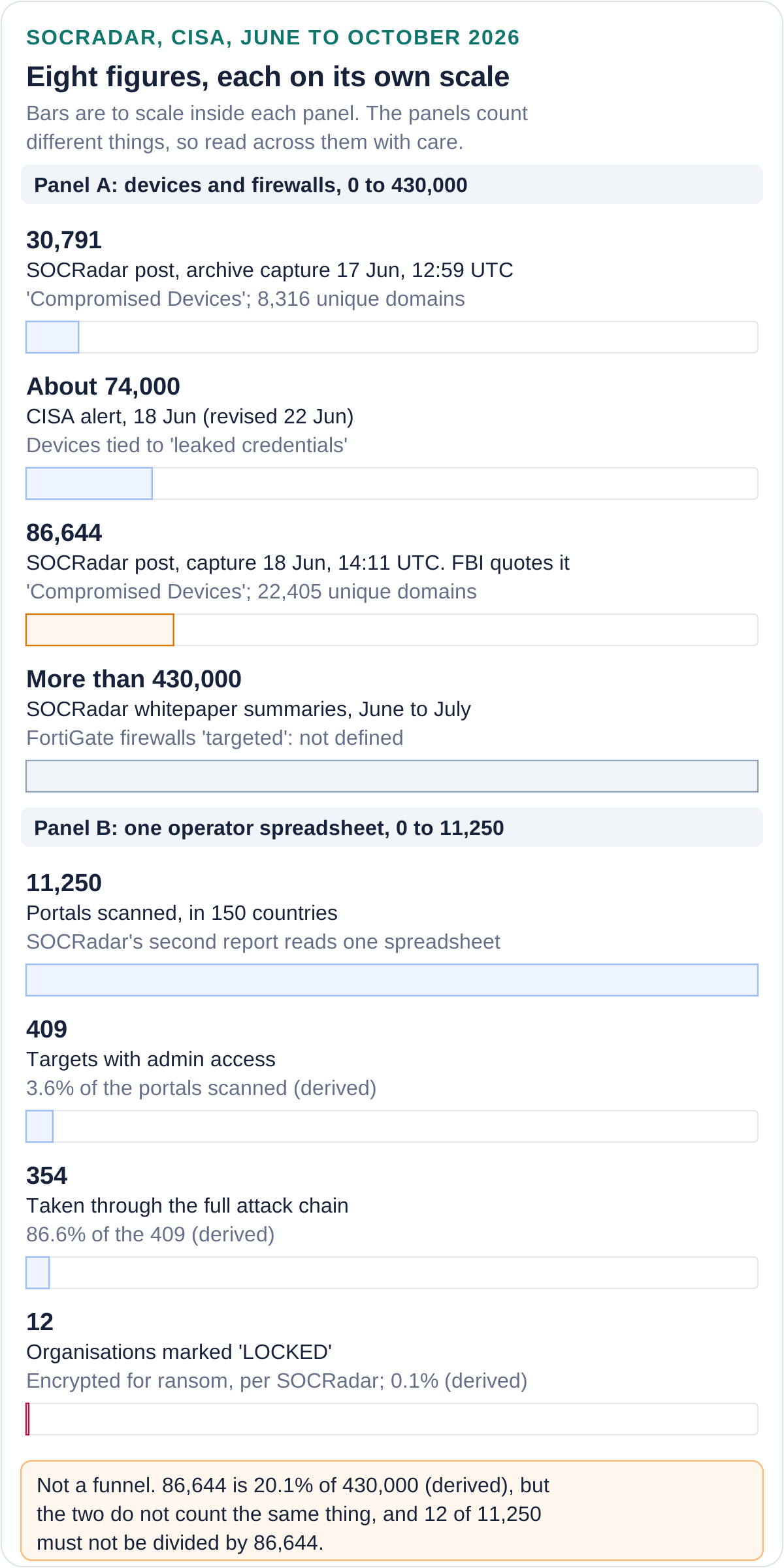
CloudSEK, whose own business is threat intelligence, reads the same operators' files and goes the other way. It says the widely repeated "21,632" is a count of entries in the operators' device-registration database, that only 918 organisations show captured internal Kerberos traffic (4.2%, our arithmetic), and that 148 (0.68% of 21,632) are confirmed compromises with cracked directory credentials. It also says the raw credential file mixes in other vendors' devices. Neither vendor publishes the underlying files; SOCRadar says it gave its dataset to national CERTs. The alert cites both and does not reconcile them.
Both are vendors with something to sell on this topic. SOCRadar runs the free FortiBleed checker and its FAQ ends in offers of monitoring. CloudSEK's report argues that others' numbers are inflated. That does not make either wrong. It means the alert's count and its account of the operators' workflow come from two sources that disagree about what the large numbers mean.
After the login: new administrators, then lockouts
The alert's account of what happens inside a device is short. During the initial intrusion, actors "create new accounts not previously on the device", and "in certain cases" delete existing accounts "to block organizations from accessing affected devices and to maintain persistence" while they try to move laterally. Elsewhere it says they extracted user databases and session tokens, and that SSH may have been used where the port was open. It tells defenders to review REST API keys too, remove unknown ones and refresh the rest.
This is where the friendly name does damage. "Bleed" suggests that closing the leak ends the loss. The alert describes a state: accounts exist that you did not create, and accounts you did create may be gone. A new password for your own account does not touch the first, and cannot be set for the second if you can no longer log in. The NCSC said as much on 18 June: "changing credentials alone may not be sufficient" if the actors have obtained persistence, and it advised a factory reset after collecting logs, configuration and other artefacts. That is 110 days before the FBI and USSS wrote that remediation needs "steps beyond standard patching and password resets" (our arithmetic, 18 June to 6 October).
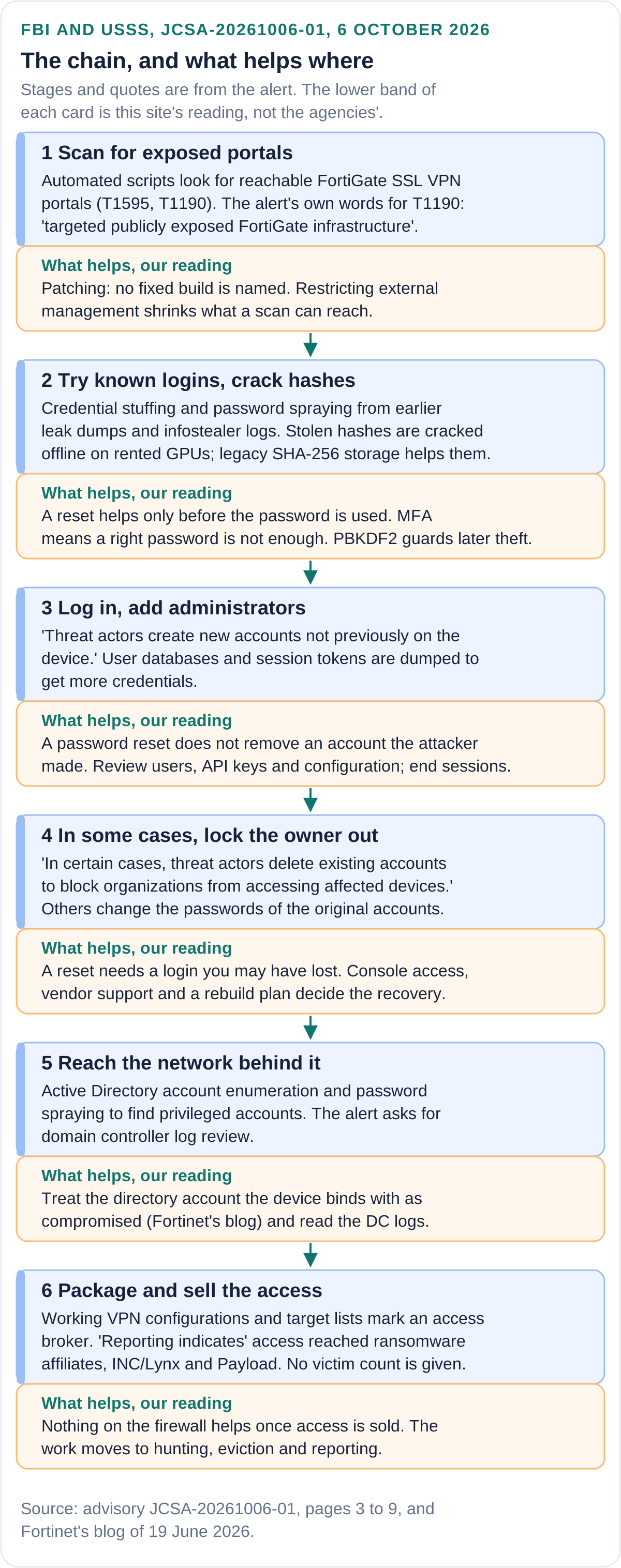
The alert's own advice has two speeds, and the order matters. Its key actions say to terminate all administrator and VPN sessions and reset credentials. Its incident response section, for a device already compromised, says to isolate it, hunt, report, and then apply eviction countermeasures, starting them "after collecting enough threat hunting data". Our reading: reset now on devices with no sign of trouble, and on a device with an unexplained account, stop and collect first. The NCSC's order agrees: obtain logs and configuration, then factory reset, because the reset destroys them.
Two cautions on the lists. The alert's account-name list has 19 names, several imitating vendor support and cloud services and one the default administrator name itself. Fortinet's January advisory FG-IR-26-060 lists 12 names an actor used then, and Fortinet's June blog gives four examples. Only one name appears on both the alert's list and the advisory's, and none of the blog's four is on the alert's list (our comparison). A published list is a start, not a test: review every account against a record you made. And the alert's IP table, introduced as addresses "currently" conducting brute force attacks, carries dates ending on 23 July, 75 days before publication. The alert itself says to read them as "historically observed infrastructure".
Ransomware: what ties FortiBleed to it, and who says so
The alert's sentence is carefully limited. "Reporting indicates" that access brokers using the chain have supplied ransomware affiliates, "currently including INC/Lynx ransomware and Payload ransomware". It names no victim, count, date or source. CyberScoop's "lead to ransomware attacks" is the alert's "observed as an initial entry point for ransomware affiliates" in plainer words.
What ties FortiBleed to ransomware, by source. Sources: the advisory, SOCRadar's blog and second report, CloudSEK, read 7 October 2026.
- Source
- FBI and USSS, 6 Oct
- The link it asserts
- Brokers using the chain gave affiliates access, "currently including" INC/Lynx and Payload.
- What it rests on
- "Reporting indicates". No source, victim or count given.
- Source
- SOCRadar, update of 29 Jun and second report (July)
- The link it asserts
- The operation is linked to Lynx and INC "with high confidence". Payload is not mentioned.
- What it rests on
- An operator workstation showing access to both groups' ransomware panels, a tracking spreadsheet, and 3 of 5 victims in an INC open directory also in FortiBleed target lists.
- Source
- CloudSEK, 19 Jun
- The link it asserts
- Access packaged for sale in the format brokers use. The operators' origin is "unresolved".
- What it rests on
- Files in the exposed directory. Predates SOCRadar's attribution and makes no ransomware link.
| Source | The link it asserts | What it rests on |
|---|---|---|
| FBI and USSS, 6 Oct | Brokers using the chain gave affiliates access, "currently including" INC/Lynx and Payload. | "Reporting indicates". No source, victim or count given. |
| SOCRadar, update of 29 Jun and second report (July) | The operation is linked to Lynx and INC "with high confidence". Payload is not mentioned. | An operator workstation showing access to both groups' ransomware panels, a tracking spreadsheet, and 3 of 5 victims in an INC open directory also in FortiBleed target lists. |
| CloudSEK, 19 Jun | Access packaged for sale in the format brokers use. The operators' origin is "unresolved". | Files in the exposed directory. Predates SOCRadar's attribution and makes no ransomware link. |
The only numbers on outcomes come from SOCRadar's reading of one operator spreadsheet: about 11,250 portals scanned in 150 countries, admin access on 409, 354 taken through the full chain to domain admin, and 12 organisations marked "LOCKED", which SOCRadar says means encrypted for ransom. Those are 3.6% of the portals, 86.6% of the 409, and 12 of 409, or 2.9% (our arithmetic). That is one sheet, relayed by a vendor, and it is not the 86,644. It also shows why a word needs care. "LOCKED" in the spreadsheet is a victim encrypted. "Lockout" in the alert is a defender who cannot log in to a firewall. They are different harms with similar names.
What neither the alert nor the vendors establish: which organisations that appear in any dataset ended up with ransomware, whether the brokers supplying Payload affiliates are the actors SOCRadar links to INC and Lynx, or whether any UK organisation is among the 12. SOCRadar's report gives no country breakdown of the 12.
For UK organisations: what the record says, and what it does not
No source gives a UK count. The NCSC's alert of 18 June says there are "some indications of potential impact in the UK" and gives no number. The UK does not appear among the top 20 countries in SOCRadar's chart of credential entries. The 20th bar, read from the image, is about 400 entries, and the chart looks to be on the early base: by our reading of the bars, India and the United States together are about 9,700 entries, 31.5% of 30,791, which matches the post's "nearly a third". SOCRadar's list of the top 50 organisations by revenue has two UK entries, ranks 34 and 47, with names withheld. And SOCRadar's second report says the operators' spreadsheet legend marks the UK as a "Priority 1" country, alongside the United States, Germany and others. None of that is a count of UK devices. Read together, it says the UK is a market the operators prioritised and a small share of the entries SOCRadar charted, and no more than that.
The NCSC's advice already covers most of it. Its alert tells UK organisations to confirm the device exists and is theirs, look for unauthorised accounts and unexpected log activity, isolate the device if there is evidence, report it, factory reset, investigate other edge devices that share credentials, and harden: no internet-exposed management interfaces, latest version, no default or reused passwords, MFA on all VPN and management logins, PBKDF2 and a forced re-login. It points to its free Early Warning service. Its older guidance says the same about exposure. Its blog of 22 March 2017 on management interfaces says an attacker with stolen privileged credentials can be "thwarted if they can be prevented from accessing the interfaces they would need to use them". Its ransomware guidance, published 13 February 2020, says to "enable MFA at all remote access points into the network, and enforce IP allow listing using hardware firewalls".
What UK-relevant sources say about internet-facing administration of a firewall. Sources as named, read 7 October 2026.
- Source
- FBI and USSS, 6 Oct
- What it says
- Trusted hosts (good), a local-in policy (better), no internet administration (best).
- Reading
- Removal is the top option.
- Source
- NCSC, 18 Jun
- What it says
- When re-commissioning: "Ensure management interfaces are not exposed to the internet."
- Reading
- No exposure.
- Source
- NCSC, 27 Aug (OT advisory)
- What it says
- Manage boundary devices, firewalls included, only from a "segregated management network that is not connected to the internet".
- Reading
- Written for OT. Applies by analogy.
- Source
- Cyber Essentials v3.3, Apr 2026
- What it says
- Change default admin passwords or disable remote administration. Block internet access to the admin interface unless there is "a clear and documented business need", then protect it with MFA or a small IP allow list plus managed passwords.
- Reading
- Exposure allowed, with conditions.
| Source | What it says | Reading |
|---|---|---|
| FBI and USSS, 6 Oct | Trusted hosts (good), a local-in policy (better), no internet administration (best). | Removal is the top option. |
| NCSC, 18 Jun | When re-commissioning: "Ensure management interfaces are not exposed to the internet." | No exposure. |
| NCSC, 27 Aug (OT advisory) | Manage boundary devices, firewalls included, only from a "segregated management network that is not connected to the internet". | Written for OT. Applies by analogy. |
| Cyber Essentials v3.3, Apr 2026 | Change default admin passwords or disable remote administration. Block internet access to the admin interface unless there is "a clear and documented business need", then protect it with MFA or a small IP allow list plus managed passwords. | Exposure allowed, with conditions. |
Our reading of the table: Cyber Essentials is the most permissive of the four. The firewall rule accepts either an allow list with a managed password approach or MFA for an exposed administration page. A separate user access rule says to implement MFA "where available", so an assessor may expect it on a device that supports it. We have not tested how assessors apply the two. Either way, the scheme sits outside the agencies' "best" and the NCSC's "not exposed". It is also a statement about configuration at a point in time. It says nothing about whether a working login is already in someone's dataset. For firewalls an MSP manages, the scheme says accounts used by an MSP to manage your infrastructure are in scope, so the question for the supplier is the same as for your own team.
The ICO's guidance defines a personal data breach to include a loss of availability as well as unauthorised access, and says a notifiable breach must be reported "without undue delay, but not later than 72 hours" after becoming aware of it, in phases if the facts are not yet known. If an unauthorised administrator on a firewall could reach systems holding personal data, or a lockout makes personal data unavailable in a way that harms people, that clock may be running. Whether a given firewall compromise is notifiable depends on the data reachable and the likely risk to people. That is a judgement for your data protection lead. The alert does not make it for you.
The dates, to scale
The NCSC and CISA published on 18 June. The FBI and USSS published on 6 October. That is 110 days, and 112 from SOCRadar's first post of 16 June (our arithmetic). Fortinet's advisories that its blog cites are older again: 301 days from FG-IR-25-647 to the FBI alert and 252 from FG-IR-26-060. The last date in the alert's IP table, 23 July, is 75 days before the alert. The advice to reset credentials, remove exposure and add MFA is not new: CISA and the NCSC gave it on 18 June. What the FBI and USSS alert adds, on the record, is the lockout description, the ransomware-affiliate reporting and the indicator lists.
What to do, in the order worth doing
For a council, NHS trust, school, MSP or smaller organisation with Fortinet firewalls or VPN gateways. Items marked agencies follow the FBI and USSS alert, CISA, the NCSC or Fortinet. Items marked judgement are ours, and we label them so you can weigh them.
Take this with you
A checklist for UK teams with Fortinet firewalls and VPN gateways
- Find every Fortinet firewall and VPN gateway you are responsible for, including those an MSP, reseller or branch runs for you, and record whether its administration page can be reached from the internet. (judgement; Cyber Essentials counts MSP accounts as yours)
- Remove internet administration, or restrict it by trusted hosts or a local-in policy, before anything else. (agencies)
- List the administrator and VPN accounts on each device and check every one against a record you made. Published name lists differ and change, so a name match is not a test. Include REST API keys. (agencies, judgement)
- Read configuration-change and administrator-login history, and the domain controller logs for the accounts the device uses, for anything you cannot explain. (agencies)
- If you find an account or change you did not make: stop, isolate the device, export logs and configuration, and call an assured incident response provider before you reset or rebuild. (agencies, NCSC)
- Terminate all administrator and VPN sessions, then rotate every credential the device holds or uses: local administrators, VPN users, and the LDAP, RADIUS and service accounts it binds with. Check other edge devices that share those passwords. (agencies, NCSC, Fortinet)
- Require phishing-resistant MFA for administrators and VPN users and confirm it is enforced on every gateway. The NCSC ranks FIDO2 first and calls challenge-based apps only partly phishing resistant. Check what your release supports. (agencies, NCSC)
- Confirm PBKDF2 storage: upgrade to FortiOS 7.2.11, 7.4.8, 7.6.1 or later, have every administrator log in again, then remove the legacy hashes by Fortinet's method. (agencies, Fortinet)
- Plan for lockout before it happens: console or out-of-band access, a current support contract, a known good configuration copy and a written rebuild procedure. The alert describes lockouts and gives no recovery steps. (judgement)
- If personal data may be affected, tell your data protection lead the same day. The ICO expects a report within 72 hours of becoming aware where a risk to people is likely, in phases if needed, and a record of the decision either way. (ICO; judgement on scope)
- Share what you find. The agencies ask for the IP addresses and usernames the actors used, though the alert says there is no obligation, and the NCSC asks UK organisations to report a compromise. (agencies, NCSC)
- Register for the NCSC's free Early Warning service, which its alert points to. (NCSC)
The question the alert does not answer
Every control above acts on a door or a login. None of them tells you whether, at some point since June, someone added a name to the administrator list of a firewall you are responsible for and left your own account alone. The alert says that happens "during the initial intrusion". Which record, kept by whom, would show it to you today?
Key facts
Sources
- PrimaryJoint advisory JCSA-20261006-01, 'FortiBleed Operations Continue Targeting Exposed Systems Leading to Reports of Lockouts', 6 October 2026, 11 pages, TLP:CLEAR, read in full: every claim, both indicator tables described, mitigations, footnotesFBI and US Secret Service (ic3.gov)accessed 2026-10-07
- PrimaryCurrent post (first published 16 June 2026, modified 3 September): 86,644 devices, 80,000+ unique IPs, 22,405 unique domains; username and sector tables; root cause and recovery text; read in a browser tabSOCRadaraccessed 2026-10-07
- PrimaryCapture of 17 June 2026, 12:59 UTC: title 'The Compromise of 30,000 Fortinet Firewalls', 30,791 devices, 21,108 unique IPs, 8,316 unique domains, and the same username tableInternet Archive capture of SOCRadaraccessed 2026-10-07
- PrimaryCapture of 18 June 2026, 14:11 UTC: title 'FortiBleed: The Compromise of 80,000+ Fortinet Firewalls', 86,644 devices, 22,405 unique domainsInternet Archive capture of SOCRadaraccessed 2026-10-07
- PrimaryFAQ (19 June 2026, modified 3 September): who coined the name, how firms count, who verified the credentials, UK and sector notes, PBKDF2 gapSOCRadaraccessed 2026-10-07
- PrimaryLanding page of Volume I report: 'over 430,000 FortiGate firewalls' targeted; only the page was read, the report sits behind a registration form that was not completedSOCRadaraccessed 2026-10-07
- PrimaryVolume II report 'FortiBleed Unmasked' (45 pages, file uploaded July 2026, no date on the document): 430,000 firewalls, 450 servers, INC and Lynx link, spreadsheet figures 11,250, 409, 354 and 12, Priority 1 country listSOCRadaraccessed 2026-10-07
- PrimaryAnalysis of the operators' open directory, 19 June 2026: not a software vulnerability, 21,632 then 918 then 148, non-Fortinet devices in the dump, origin unresolvedCloudSEKaccessed 2026-10-07
- PrimaryPSIRT blog of 19 June 2026: 'not a new Fortinet vulnerability', reuse of credentials from FG-IR-26-060 and FG-IR-25-647, brute force, recommended actions; newest item on the PSIRT blog index on 7 OctoberFortinetaccessed 2026-10-07
- PrimaryAdvisory FG-IR-26-060, published 27 January 2026, CVE-2026-24858, CVSSv3 9.4, known exploited; actor operations and account namesFortinet PSIRTaccessed 2026-10-07
- PrimaryAdvisory FG-IR-25-647, published 9 December 2025, CVE-2025-59718 and CVE-2025-59719, CVSSv3 9.1, known exploitedFortinet PSIRTaccessed 2026-10-07
- PrimaryTechnical tip dated 24 December 2025: PBKDF2 from FortiOS 7.2.11, 7.4.8 and 7.6.1; legacy SHA256 kept until each administrator logs in againFortinet Communityaccessed 2026-10-07
- PrimaryAlert of 18 June 2026, revised 22 June: 'approximately 74,000' devices, recommended actionsCISAaccessed 2026-10-07
- PrimaryKnown Exploited Vulnerabilities JSON, version 2026.10.04, read at 11:16 BST on 7 October 2026: 1,734 entries, 31 Fortinet, 8 added in 2026, due dates counted by scriptCISAaccessed 2026-10-07
- PrimaryNVD record for CVE-2026-24858 (read as JSON through the NVD API): published 27 January 2026, status Analyzed, CISA exploit add and due datesNVDaccessed 2026-10-07
- PrimaryCVE Record for CVE-2026-24858 (read as JSON through the CVE Services API): Fortinet as CNA, CVSS 9.4CVE.orgaccessed 2026-10-07
- PrimaryAlert of 18 June 2026: 'some indications of potential impact in the UK', priority actions, factory reset, hardening listNCSCaccessed 2026-10-07
- PrimaryAdvisory of 27 August 2026 on internet-exposed systems and edge devices (written mainly for OT): segregated management network, edge-device actions, Early WarningNCSCaccessed 2026-10-07
- PrimaryBlog post of 22 March 2017 on protecting management interfaces: network-level exposure and stolen privileged credentialsNCSCaccessed 2026-10-07
- PrimaryGuidance published 13 February 2020, reviewed 9 September 2021: MFA at all remote access points, IP allow listingNCSCaccessed 2026-10-07
- PrimaryMFA guidance, recommended types in order: FIDO2 first, challenge-based apps partly phishing resistantNCSCaccessed 2026-10-07
- PrimaryCyber Essentials Requirements for IT Infrastructure v3.3, April 2026: firewall rules on default passwords and internet-facing administration, MFA rule, MSP accounts in scopeNCSC (Cyber Essentials)accessed 2026-10-07
- PrimaryGuide 'Personal data breaches': definition including availability, 72 hours, phased reportingICOaccessed 2026-10-07
- Reported byNews report of 6 October 2026 used as the pointer: the 400,000 or 450,000 quote from SOCRadar's chief information security officerCyberScoopaccessed 2026-10-07
- Reported byNews report of 19 June 2026 corroborating that SOCRadar first warned of over 30,000 devices and later updated the figureSecurityWeekaccessed 2026-10-07