One Debian kernel update lists 1,313 CVEs, 97% of the previous 17 combined. None is on CISA's KEV list
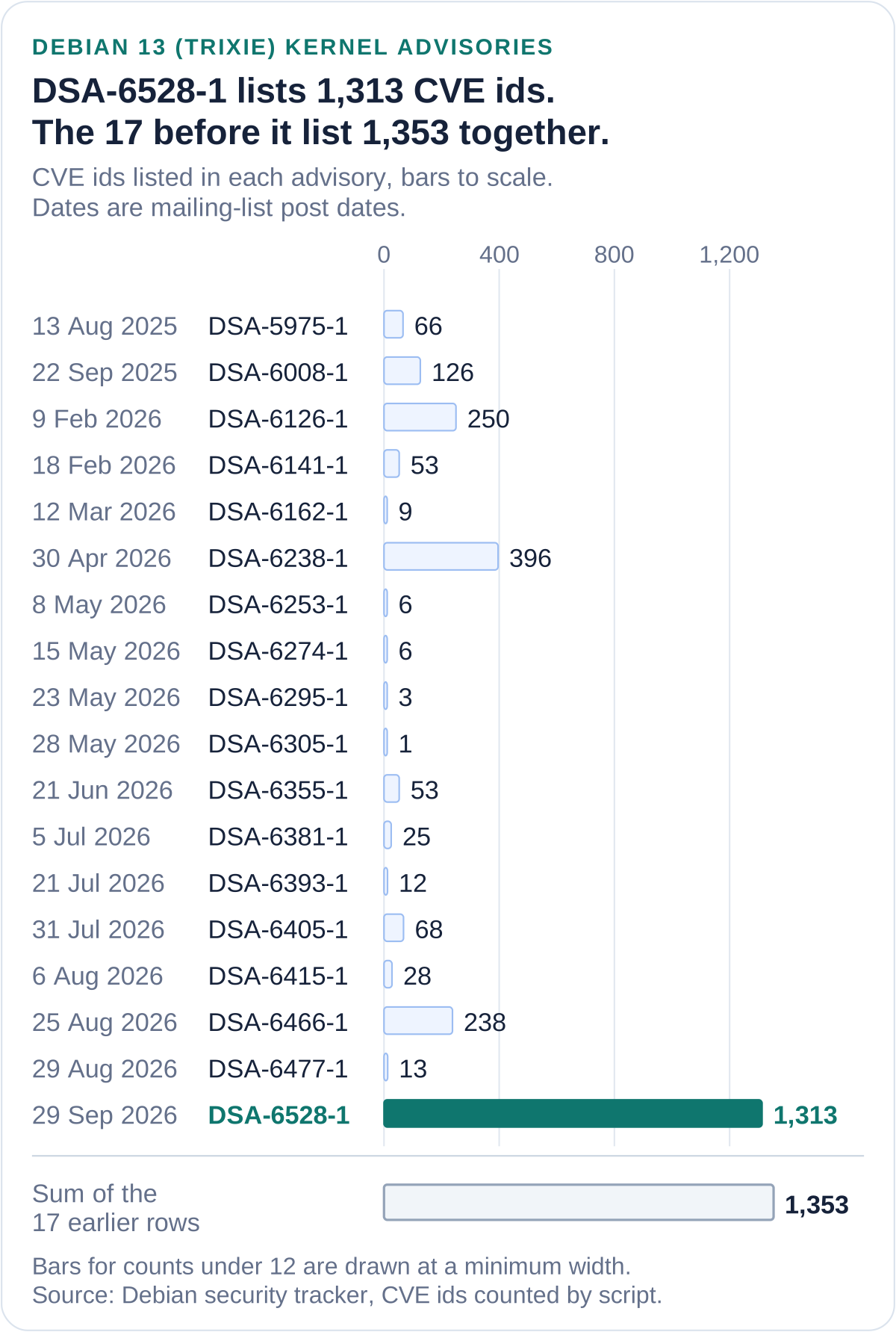
Debian's DSA-6528-1 of 29 September 2026 lists 1,313 CVE identifiers for one kernel package, against 1,353 in the 17 Trixie kernel advisories before it. Debian assigns no severity and none is in CISA's KEV catalogue as of 4 October; the number counts identifiers, not risk.
By Parminder Kumar Sharma · · 20 min read

1,313 identifiers against 1,353 in the previous 17
Debian's security advisory DSA-6528-1, posted on 29 September 2026, lists 1,313 CVE identifiers for one package, the Linux kernel on Debian 13 (Trixie), fixed in version 6.12.111-1. The 17 earlier Trixie kernel advisories, from the first on 13 August 2025 to the last on 29 August 2026, list 1,353 between them, and the largest of those listed 396. No identifier appears in more than one of the 18. One advisory therefore lists 97% as many as the other 17 put together, and 3.3 times the previous largest.
That is the number behind The Register's headline of 5 October. Here is what it does not establish.
- It does not show that 1,313 flaws were found or written in 6.12.111. The Register says so itself, and the kernel CNA's own records give a first affected mainline kernel before 6.12 for 1,238 of the 1,313, and before 5.0 for 570.
- It does not show that any of them is exploited. None is in CISA's Known Exploited Vulnerabilities (KEV) catalogue, version 2026.10.04, released 4 October 2026 at 18:52 UTC and unchanged when re-read at 06:16 UTC on 6 October. That describes the catalogue, not the world: KEV lists only what CISA has reliable evidence of.
- It does not give a Debian severity. Debian's tracker reads "not yet assigned" for all 1,313, and Debian's FAQ says it does not provide CVSS scores.
- It does not show that AI-assisted bug hunting caused the volume. That is The Register's suspicion, and no source I read measures it.
The friendly name is the trap. A CVE count reads as a measure of danger, or of how well a kernel is written. The kernel's own documentation describes something else: its CVE assignment team is "overly cautious and assign CVE numbers to any bugfix that they identify". The 1,313 counts assigned identifiers, which is a policy outcome. It measures how much a policy and its tooling produce, not how much risk the update removes. The update still has to be applied in full, because the kernel ships as one package and the kernel documentation says its changes are "tested together in a unified whole". Its advice is to take all released changes.
What the advisory says, and what it leaves out
The advisory is short. It is dated 29 September 2026 and names the package linux. It says several vulnerabilities in the kernel "may lead to a privilege escalation, denial of service or information leaks", that for the stable distribution (trixie) they are fixed in 6.12.111-1, and that Debian recommends upgrading the linux packages. A list of 1,313 identifiers follows, under one bug number. The list in the advisory as posted and the list on Debian's tracker page for DSA-6528-1 are the same set: both hold 1,313 distinct identifiers.
What DSA-6528-1 states, and what it leaves out, read on 6 October 2026
- Topic
- Package and fix
- Stated
- linux, Debian 13 (trixie), fixed in 6.12.111-1, posted 29 September 2026
- Not stated
- Which of the 1,313 apply to a given configuration or hardware
- Topic
- Impact
- Stated
- "may lead to a privilege escalation, denial of service or information leaks", for the set as a whole
- Not stated
- How many identifiers fall under each effect
- Topic
- Severity
- Stated
- Nothing. Debian's FAQ: it "does not provide CVSS scores". Tracker urgency for all 1,313: not yet assigned
- Not stated
- A rating, urgency or priority for any single identifier
- Topic
- Remote or local
- Stated
- Nothing. Debian's FAQ says the "Problem type" field in advisory mails has not been used since April 2014
- Not stated
- Which identifiers can be reached over a network
- Topic
- Exploitation
- Stated
- Nothing
- Not stated
- Whether any is exploited. KEV lists none of the 1,313 (version 2026.10.04)
- Topic
- Action
- Stated
- "We recommend that you upgrade your linux packages."
- Not stated
- A reboot. A kernel takes effect only when the host boots it, which is how kernels work and not something the advisory says
| Topic | Stated | Not stated |
|---|---|---|
| Package and fix | linux, Debian 13 (trixie), fixed in 6.12.111-1, posted 29 September 2026 | Which of the 1,313 apply to a given configuration or hardware |
| Impact | "may lead to a privilege escalation, denial of service or information leaks", for the set as a whole | How many identifiers fall under each effect |
| Severity | Nothing. Debian's FAQ: it "does not provide CVSS scores". Tracker urgency for all 1,313: not yet assigned | A rating, urgency or priority for any single identifier |
| Remote or local | Nothing. Debian's FAQ says the "Problem type" field in advisory mails has not been used since April 2014 | Which identifiers can be reached over a network |
| Exploitation | Nothing | Whether any is exploited. KEV lists none of the 1,313 (version 2026.10.04) |
| Action | "We recommend that you upgrade your linux packages." | A reboot. A kernel takes effect only when the host boots it, which is how kernels work and not something the advisory says |
Two further Debian records are worth reading beside it, because each can be mistaken for a rating. The changelog entry for the 6.12.111-1 upload reads "trixie-security; urgency=high", but that is the upload's urgency, and every one of the 19 trixie-security uploads in the same changelog carries it. It is not a score for any identifier. And the changelog annotates 626 CVE identifiers against individual fixes, 624 of them in the advisory's list, so the other 689 in the list carry no annotation there. Debian does not say how those were matched, which is a reason to read the list as a bookkeeping result and not as 1,313 reviewed findings.
How the 1,313 divide, by every cut a primary supports
Four cuts have a primary source behind them. All four are computed from Debian's tracker data (fetched at 05:37 UTC on 6 October 2026), the 1,313 CVE.org records, and the kernel's own release logs.
The 1,313 cut four ways; counts by script
- Cut
- By Debian urgency, Trixie
- Result
- 1,313 not yet assigned
- Source and caveat
- Debian tracker data. All 19,709 kernel entries: 17,166 not yet assigned, 2,450 unimportant, 93 low, none medium or high
- Cut
- By upstream release that fixed it, 6.12 line
- Result
- 6.12.108: 59. 6.12.109: 276. 6.12.110: 569. 6.12.111: 407. No 6.12 fix recorded: 2
- Source and caveat
- CVE.org records. The four releases came out between 2 and 21 September 2026
- Cut
- By first affected mainline kernel
- Result
- Before 5.0: 570. 5.x: 354. 6.0 to 6.11: 314. 6.12: 26. After 6.12: 46. None given: 3
- Source and caveat
- The CNA's records. 61 give 2.6.12, the oldest value. It is the CNA's version range, not a date
- Cut
- By CVE identifier year
- Result
- 2026: 1,295. 2025: 15. 2024: 3
- Source and caveat
- The year an identifier was reserved says nothing about when the bug was written
| Cut | Result | Source and caveat |
|---|---|---|
| By Debian urgency, Trixie | 1,313 not yet assigned | Debian tracker data. All 19,709 kernel entries: 17,166 not yet assigned, 2,450 unimportant, 93 low, none medium or high |
| By upstream release that fixed it, 6.12 line | 6.12.108: 59. 6.12.109: 276. 6.12.110: 569. 6.12.111: 407. No 6.12 fix recorded: 2 | CVE.org records. The four releases came out between 2 and 21 September 2026 |
| By first affected mainline kernel | Before 5.0: 570. 5.x: 354. 6.0 to 6.11: 314. 6.12: 26. After 6.12: 46. None given: 3 | The CNA's records. 61 give 2.6.12, the oldest value. It is the CNA's version range, not a date |
| By CVE identifier year | 2026: 1,295. 2025: 15. 2024: 3 | The year an identifier was reserved says nothing about when the bug was written |
Subsystem is the cut readers ask for first. Debian's tracker gives no subsystem field, so the table below groups the first word of each identifier's description, which is the prefix of the fixing commit's title. It is my grouping, not Debian's or the CNA's, and a prefix is a rough guide to where code lives.
Largest commit-title prefixes among the 1,313, grouped by script
- Prefix
- net (includes net/sched, net/rds, net/smc)
- Identifiers
- 93
- Prefix
- wifi
- Identifiers
- 69
- Prefix
- media
- Identifiers
- 44
- Prefix
- nfsd
- Identifiers
- 43
- Prefix
- drm
- Identifiers
- 41
- Prefix
- rdma
- Identifiers
- 37
- Prefix
- usb
- Identifiers
- 35
- Prefix
- scsi
- Identifiers
- 34
- Prefix
- bpf
- Identifiers
- 28
- Prefix
- alsa
- Identifiers
- 28
| Prefix | Identifiers |
|---|---|
| net (includes net/sched, net/rds, net/smc) | 93 |
| wifi | 69 |
| media | 44 |
| nfsd | 43 |
| drm | 41 |
| rdma | 37 |
| usb | 35 |
| scsi | 34 |
| bpf | 28 |
| alsa | 28 |
There are 272 distinct prefixes. The ten above cover 452 identifiers, 34%, so the rest is a long tail across drivers, filesystems and protocols. A host that never loads a Wi-Fi, Bluetooth or graphics driver has no use for the code behind those prefixes, yet the package still carries it and the update still replaces it. Whether that code is reachable on a given machine is the host's question, and the kernel's documentation says so: applicability "is up to the user of Linux to determine".
Remote versus local. No primary splits all 1,313. Debian's tracker data holds a scope field that reads "local" for 19,704 of 19,709 kernel entries, all 1,313 included, so a field that never varies cannot separate anything. The kernel CNA's CVSS vectors cover 500 of the 1,313 (next section): 301 local, 151 network and 48 adjacent, meaning same-network or radio reach such as Wi-Fi or Bluetooth. The network ones sit in code that serves a network, led by 31 in nfsd, 11 in sunrpc, 9 in ceph and 7 in svcrdma. Those matter on hosts that run such a service, which is a judgement to make per host, not a count to read off. Exposure can hinge on a single setting: an earlier briefing found an ARM64 KVM escape that mattered only where nested virtualisation was switched on at boot.
Who scored the 1,313, and who did not
The record answers "how severe" in four different ways, and only one of them is Debian's.
Debian does not rate them. Its FAQ, last modified 17 September 2026, answers a scanner question directly: Debian "does not provide CVSS scores and doesn't use CVSS scores from external sources when triaging security issues". Its tracker documentation says Debian does not use severity levels, with old low, medium and high annotations "no longer applied to current data". So "not yet assigned" is the standard state of a kernel entry, 87% of Trixie's, and not a backlog on this advisory.
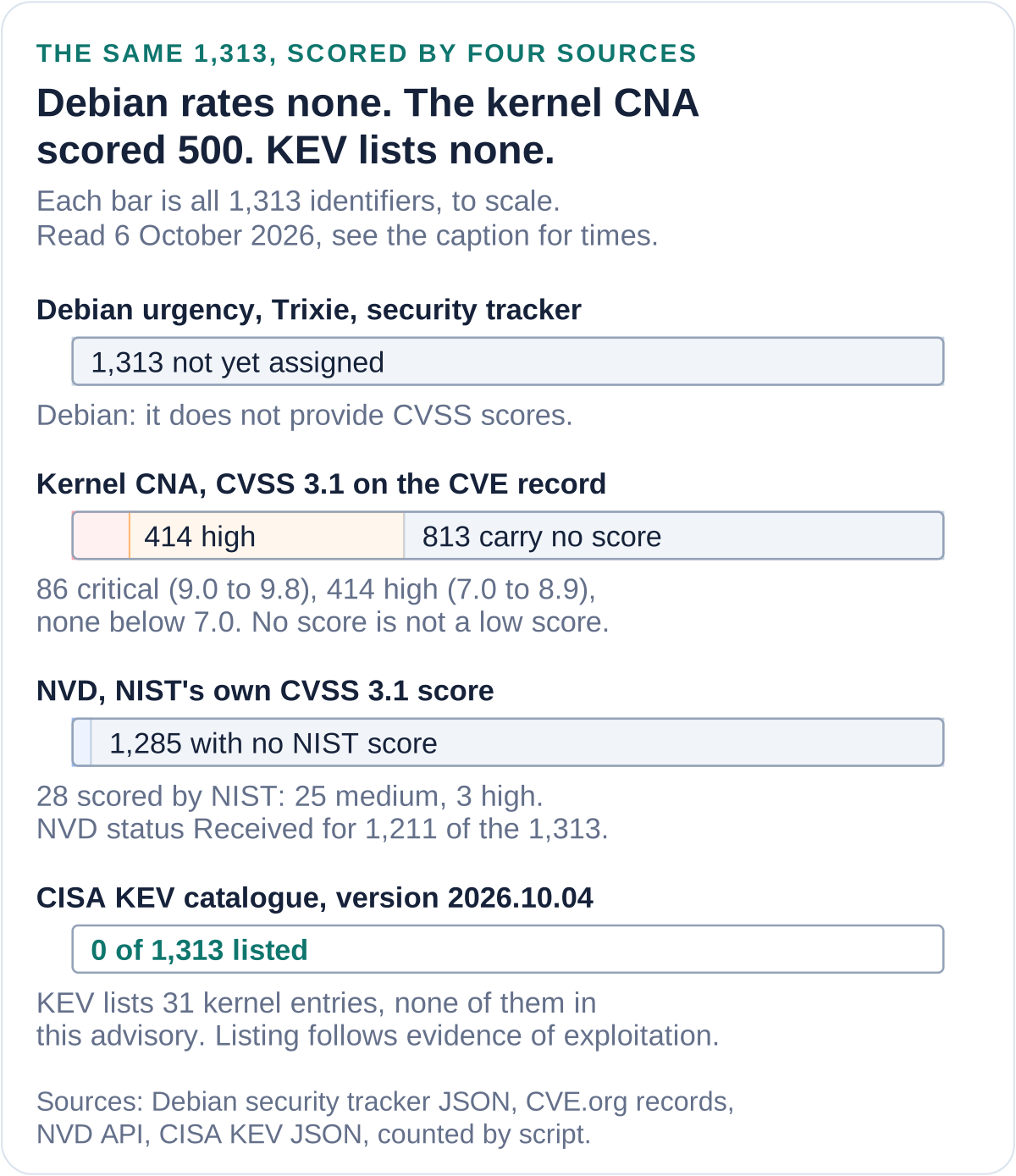
The kernel CNA scores 500, which departs from what it said in February. A post of 16 February 2026 by a member of the CNA team under the heading "We can not assign severity" argues that only the integrator who knows the use case can judge it, and says the team has asked NIST to stop assigning scores. In the CVE.org records I read, the CNA's own container carries a CVSS 3.1 vector, a base score and a paragraph of scenario text for 500 of the 1,313: 414 high and 86 critical, none below 7.0, 22 of them at exactly 7.0. A branch of the CNA's repository holds commits titled "Add CVSS 3.1 score", dated 25 September 2026. I found no CNA statement that explains the change, and the kernel's CVE documentation is silent on scoring. Both are the CNA's words, and both are on the record. The 813 with no score are not low-scored. They are unscored, and I found no explanation from the CNA of why.
NVD mostly relays, and has barely started. NVD shows the CNA's 500 as secondary scores. NIST's own CVSS 3.1 score is on 28 of the 1,313, 25 medium and 3 high, and NVD's status is still "Received" for 1,211 of them (read between 05:47 and 05:59 UTC). NVD's source 134c704f-9b21-4f2e-91b3-4a467353bcc0 is CISA-ADP, not the vendor: it supplies a decision-point block on 5 records, each reading "Exploitation: none", and a CVSS of 5.5 on two. Red Hat's enrichment adds a rating of Important and a CVSS of 7.0 on one. CISA's directive BOD 26-04 of 10 June 2026 says CISA publishes KEV status, automatability and technical impact for every CVE identifier, and on these records that is 5 of 1,313 so far.
KEV lists none, and lists late. CISA's criteria require "reliable evidence that the vulnerability has been actively exploited in the wild", and say a public proof of concept or scanning does not count. The catalogue holds 31 Linux kernel entries, none of them in this advisory, and Debian's tracker shows 30 of the 31 resolved for both Trixie and Debian 12; the other, CVE-2010-3904, is not filed under the linux package. The three added on 18 September 2026 were fixed in Trixie at 6.12.57-1, 6.12.94-1 and 6.12.48-1. The last of those, CVE-2025-39682, was fixed in DSA-6008-1 on 22 September 2025, 361 days before CISA listed it. KEV is a lagging list, which is a reason to patch the kernel on a calendar and not to wait for it.
Why the number is this size
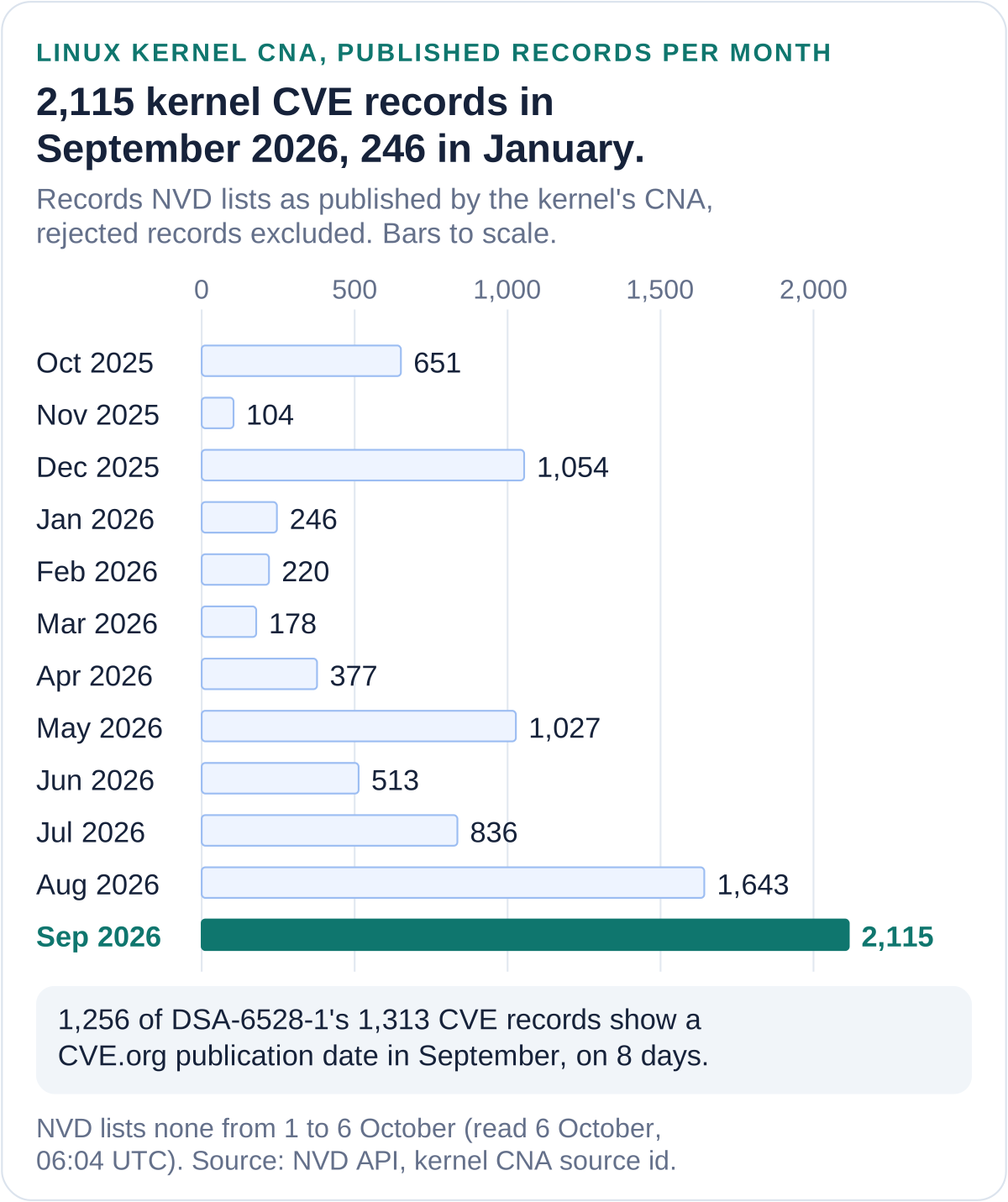
The count follows the CNA's output, and that output has risen sharply. The kernel CNA published 2,115 CVE records in September 2026, against 246 in January, according to NVD's publication dates (rejected records excluded). A February post by a member of the CNA team put the rate at about 60 a week; September's figure is about 494 a week, my arithmetic. 1,256 of the 1,313 in this advisory carry a CVE.org publication date in September, on eight days, and 1,203 of them on five days: 11, 16, 17, 24 and 25 September. NVD listed none for 1 to 6 October at 06:04 UTC, so September is one month and not yet a trend.
More fixes do not explain it alone. The four upstream 6.12 releases behind this advisory hold 2,943 commits between them, counted from the kernel's release logs: 100, 396, 1,362 and 1,085. 6.12.110 is the largest of the 112 releases in the 6.12 line, and the median release holds about 160. But the number of identifiers per commit moved far more than the number of commits.
Upstream 6.12 releases, their commits, and the CVE identifiers Debian lists against each, derived by script
- Release and date
- 6.12.91, 23 May
- Commits
- 663
- CVE ids in Debian advisories
- 19
- Release and date
- 6.12.97, 24 July
- Commits
- 1,204
- CVE ids in Debian advisories
- 67
- Release and date
- 6.12.101, 3 August
- Commits
- 591
- CVE ids in Debian advisories
- 27
- Release and date
- 6.12.103, 9 August
- Commits
- 338
- CVE ids in Debian advisories
- 115
- Release and date
- 6.12.104, 19 August
- Commits
- 180
- CVE ids in Debian advisories
- 98
- Release and date
- 6.12.109, 7 September
- Commits
- 396
- CVE ids in Debian advisories
- 276
- Release and date
- 6.12.110, 14 September
- Commits
- 1,362
- CVE ids in Debian advisories
- 569
- Release and date
- 6.12.111, 21 September
- Commits
- 1,085
- CVE ids in Debian advisories
- 407
| Release and date | Commits | CVE ids in Debian advisories |
|---|---|---|
| 6.12.91, 23 May | 663 | 19 |
| 6.12.97, 24 July | 1,204 | 67 |
| 6.12.101, 3 August | 591 | 27 |
| 6.12.103, 9 August | 338 | 115 |
| 6.12.104, 19 August | 180 | 98 |
| 6.12.109, 7 September | 396 | 276 |
| 6.12.110, 14 September | 1,362 | 569 |
| 6.12.111, 21 September | 1,085 | 407 |
6.12.97 held 1,204 commits and 67 identifiers; 6.12.110 held 1,362 and 569. The ratio is not one identifier per commit and the table is a derived comparison, not a measured rate, but it shows the identifier count tracking the CNA's assignment pace more than the volume of fixes. The kernel's documentation says assignment follows any bugfix "that they identify", and a February post says CVE identifiers are assigned after the fix has been in a released kernel, so the count depends on a process with its own pace.
What each source says about AI-assisted bug hunting and the volume of kernel CVEs
- Source
- The Register, 5 October 2026
- Says
- "strongly suspect" LLM bots are behind the number; it did not examine every entry
- Does not say
- Any measurement. It is the outlet's inference
- Source
- Kernel lead maintainer, 7.1-rc4 mail, 17 May 2026
- Says
- AI reports have made the security mailing list "almost entirely unmanageable", with heavy duplication
- Does not say
- Anything about CVE counts or the share of fixes found that way
- Source
- Kernel CNA post, 16 February 2026
- Says
- Of three core CNA members, one uses a custom tool that queries "some LLM oracles" to review commits for CVE assignment
- Does not say
- How many assignments result, or that this drives volume
- Source
- NCSC chief technology officer, 1 May 2026
- Says
- AI is showing the ability to exploit technical debt "at scale and at pace"; expect a patch wave across all severities
- Does not say
- Kernel figures, or Debian's
- Source
- Debian advisory and tracker
- Says
- Nothing about cause
- Does not say
- Why this advisory is the size it is
| Source | Says | Does not say |
|---|---|---|
| The Register, 5 October 2026 | "strongly suspect" LLM bots are behind the number; it did not examine every entry | Any measurement. It is the outlet's inference |
| Kernel lead maintainer, 7.1-rc4 mail, 17 May 2026 | AI reports have made the security mailing list "almost entirely unmanageable", with heavy duplication | Anything about CVE counts or the share of fixes found that way |
| Kernel CNA post, 16 February 2026 | Of three core CNA members, one uses a custom tool that queries "some LLM oracles" to review commits for CVE assignment | How many assignments result, or that this drives volume |
| NCSC chief technology officer, 1 May 2026 | AI is showing the ability to exploit technical debt "at scale and at pace"; expect a patch wave across all severities | Kernel figures, or Debian's |
| Debian advisory and tracker | Nothing about cause | Why this advisory is the size it is |
None of these ties the 1,313 to AI-assisted discovery by measurement, so the cause stays open. Several facts fit the suspicion and several fit other explanations: two of the three largest of the 112 stable releases in the 6.12 line landed in the window, the CNA assigns for any bugfix it identifies, and it now attaches scores to some records. No vendor's tooling is named by any source as the cause, and this briefing names none. The wider pattern of AI-found reports straining volunteer projects is in an earlier briefing on Google pausing an open-source bounty.
What it means for UK estates running Debian
The people affected are anyone who runs Debian 13 on servers, container hosts or appliances. I have no count of UK Debian estates. Universities, councils, internet service providers and suppliers to health services are the places one would expect them, and that is judgement, not a measured list. Debian-based systems such as Ubuntu publish their own kernel packages and notices, and this advisory covers Debian's package only; see the earlier briefing on Ubuntu's cadence.
Cyber Essentials. Version 3.3 (April 2026), section 3, says software must be "updated, including vulnerability fixes, within 14 days" of release where one of three things holds: the update fixes vulnerabilities "described by the vendor as critical or high risk"; it addresses vulnerabilities "with a CVSS v3 base score of 7 or above"; or "there are no details of the level of vulnerabilities that the update fixes provided by the vendor". It adds a caution: a single update covering several severities must be installed within 14 days if it covers any critical or high risk issue.
Debian describes none of the 1,313 as critical or high and provides no CVSS, so my reading is that the third condition applies. The second is also met if an assessor accepts the kernel CNA's scores, which are 7.0 or above on 500 of them; the scheme text does not say whose CVSS score counts, so I do not rely on it alone, as in an earlier briefing on a vendor sentence that named no level. Fourteen days from 29 September is 13 October 2026. On 6 October, about 07:00 BST, that is day 7. What an assessor decides is for the assessor, and nothing here is certification advice.
NCSC best-practice timescales applied to the 29 September release date
- Type of estate (NCSC)
- Internet-facing services and software
- Update completed within
- 5 days
- Date from 29 September
- 4 October
- Type of estate (NCSC)
- Operating system and applications
- Update completed within
- 7 days
- Date from 29 September
- 6 October
- Type of estate (NCSC)
- Internal and air-gapped
- Update completed within
- 14 days
- Date from 29 September
- 13 October
| Type of estate (NCSC) | Update completed within | Date from 29 September |
|---|---|---|
| Internet-facing services and software | 5 days | 4 October |
| Operating system and applications | 7 days | 6 October |
| Internal and air-gapped | 14 days | 13 October |
The NCSC's timescales "apply to all updates, regardless of the vulnerability severity", so on the NCSC's own page the question "how severe is it" does not set the clock. I read a kernel as part of the operating system, which makes today the seventh day; an internet-facing Debian host was due on 4 October. The NCSC also says organisations "shouldn't make decisions based purely on a single severity score, such as CVSS", and its patch wave blog of 1 May 2026 expects "an influx of updates" across all severities and asks for hot patching to be enabled "as a priority" where it exists. I found no live-patching service in Debian's advisory or FAQ. That is a gap in what I read, not a finding that none exists.
Scanners and dashboards. A scanner that counts each CVE separately can put up to 1,313 findings against a host that has not updated, and clear them when it has. That is accurate, and unhelpful as a priority signal. Three effects are worth knowing. First, clearing does not reach zero: Debian's tracker listed 813 further kernel identifiers as open for Trixie at 05:37 UTC, none of them in this advisory, so a patched host still shows a count. Second, a clock that starts at the CVE's publication date is already running: 395 of the 1,313 were published at least 15 days before Debian released its fix, whereas Cyber Essentials counts from the release of the update. Third, the previous 17 advisories listed 1,353 identifiers over 13 months and this one lists 1,313 on a single day, so any trend line or risk score built on counts will spike for a reason that has nothing to do with exposure. Group findings by advisory and package, as the NCSC suggests when it says to group "similar findings together", and start the clock at the vendor's release.
Reboots and containers. The advisory does not mention a reboot, and a new kernel runs only once the host boots it, so the reboot window has to sit inside the 14 days. Containers use the host's kernel, so patch and reboot the hosts and ignore kernel findings inside images. Debian 12 is a separate decision: its kernel advisories are now numbered DLA, the latest for the linux package being DLA-4777-1 on 8 September with 601 identifiers, and Debian's tracker listed 975 of this advisory's 1,313 as still open for Debian 12 at 05:37 UTC. Hosts on Debian 12 that run the backported linux-6.12 kernel follow a further series of their own, most recently DLA-4817-1 on 4 October.
Debian 12 (bookworm) advisories for the linux package in 2026, identifiers per advisory, from the tracker's page for each
- Posted
- 9 February
- Advisory
- DSA-6127-1
- CVE ids
- 250
- Posted
- 12 March
- Advisory
- DSA-6163-1
- CVE ids
- 52
- Posted
- 1 May
- Advisory
- DSA-6243-1
- CVE ids
- 302
- Posted
- 9 May
- Advisory
- DSA-6258-1
- CVE ids
- 2
- Posted
- 15 May
- Advisory
- DSA-6275-1
- CVE ids
- 1
- Posted
- 28 May
- Advisory
- DSA-6306-1
- CVE ids
- 3
- Posted
- 3 July
- Advisory
- DLA-4665-1
- CVE ids
- 496
- Posted
- 18 July
- Advisory
- DLA-4688-1
- CVE ids
- 18
- Posted
- 5 August
- Advisory
- DLA-4720-1
- CVE ids
- 188
- Posted
- 8 September
- Advisory
- DLA-4777-1
- CVE ids
- 601
| Posted | Advisory | CVE ids |
|---|---|---|
| 9 February | DSA-6127-1 | 250 |
| 12 March | DSA-6163-1 | 52 |
| 1 May | DSA-6243-1 | 302 |
| 9 May | DSA-6258-1 | 2 |
| 15 May | DSA-6275-1 | 1 |
| 28 May | DSA-6306-1 | 3 |
| 3 July | DLA-4665-1 | 496 |
| 18 July | DLA-4688-1 | 18 |
| 5 August | DLA-4720-1 | 188 |
| 8 September | DLA-4777-1 | 601 |
What to do, in the order worth doing it
Take this with you
A kernel advisory with 1,313 identifiers
- Find every Debian kernel in the estate: hosts, container hosts, virtual machines and appliances, with the running release from uname -r, and note which are Debian 13, Debian 12 or a derivative.
- Read the advisory itself, DSA-6528-1 of 29 September 2026, and write down three dates: the release date, 13 October for the 14 day rule, and any shorter NCSC timescale for internet-facing hosts.
- Schedule the package update and the reboot together, because a kernel update protects nothing until the host boots it. Afterwards confirm the running release reports 6.12.111.
- Order the work by exposure and KEV, not by identifier count: internet-facing hosts first, then hosts running network-facing kernel services such as NFS or SMB servers, then shared hosts, build runners and container hosts.
- Check KEV on the day you patch and again after, because the catalogue is version 2026.10.04 as read and can change at any time.
- Configure scanners to group by advisory and package, not by CVE, and to start any clock at the vendor's release date. Expect 813 other open kernel entries to remain after you patch.
- Treat Debian 12 hosts as a separate decision with their own advisory series, and do not assume that silence means fixed.
- Check containers: they run the host's kernel, so patch the hosts and stop counting kernel findings inside images.
- Record the decision for every host: what was updated, when it rebooted, and for any host deferred, why, who accepted the risk and the review date.
- Label what is fact and what is judgement in that record. The advisory, the tracker and the KEV catalogue are facts as read. Your reading of the three Cyber Essentials conditions is judgement for your assessor.
uname -r
dpkg -l 'linux-image-*'
apt-cache policy linux-image-amd64
Method, interest and limits
I counted the identifiers in the advisory text and on Debian's tracker page by script, compared the two sorted lists, and joined them by identifier to Debian's tracker data, the 1,313 CVE.org records, the NVD records and the KEV catalogue. The Register's dates and figures were each checked against a primary source: Debian 13.7 was released on 12 September, upstream 6.12.111 on 21 September, the kernel became a CNA on 13 February 2024, and the 6.12.112 changelog runs to 29,457 lines. The sources are a distribution's security team, the kernel's own CNA, two government agencies and a news outlet, and I found no stake in the count for any of them; The Register's LLM point is its own inference. Scanner vendors, whose products count identifiers, are not sources here. Where AI-assisted discovery is concerned, every claim is attributed to a source and no vendor is singled out.
Limits. I did not verify the cause of the volume, why the CNA began scoring or how it chooses which records to score, how Debian matched the 689 identifiers its changelog does not annotate, what Debian's tracker scope field means, how many UK organisations run Debian, or how an assessor would apply the three Cyber Essentials conditions to an upstream CNA's score. The advisory text and the Debian mailing list archive sit behind a browser check, which a normal browser passed; no check was bypassed.
The question that exposes the gap
If one package update can put 1,313 findings on a dashboard and none of them says whether a single one is exploited, what is the number you report to your board measuring: the risk the update removes, or the pace at which identifiers are assigned?
Key facts
Sources
- PrimaryDSA-6528-1 linux security update, posted 29 September 2026 09:49 UTC, read in full in a browser: package, version 6.12.111-1, the impact sentence, the recommendation and the list of 1,313 identifiersDebian Security Teamaccessed 2026-10-06
- PrimaryThe tracker page for DSA-6528-1: the same 1,313 identifiers, counted by scriptDebian Security Trackeraccessed 2026-10-06
- PrimaryThe tracker's JSON data file, fetched 05:37 UTC on 6 October 2026: per-identifier status, fixed versions, urgency and scope for the linux source packageDebian Security Trackeraccessed 2026-10-06
- PrimaryThe linux source package page, whose security announcements list gave the 179 kernel advisories whose pages were countedDebian Security Trackeraccessed 2026-10-06
- PrimaryDebian security-announce archive for 2026, used for the posting dates of the kernel advisories (the 2025 and the LTS announce archives were read the same way)Debian Security Teamaccessed 2026-10-06
- PrimaryDebian Security FAQ, last modified 17 September 2026: no CVSS scores, the CVE-is-not-a-threat answer, the Problem type field not used since April 2014, restarting servicesDebianaccessed 2026-10-06
- PrimarySecurity tracker documentation: severity levels no longer applied to current data, and the unimportant and no-dsa statesDebian Security Teamaccessed 2026-10-06
- PrimaryChangelog of linux 6.12.111-1: trixie-security, urgency=high, and the 626 annotated identifiers; the tracker page records acceptance into stable-security on 29 September 2026Debian Package Trackeraccessed 2026-10-06
- PrimaryUpdated Debian 13: 13.7 released, 12 September 2026Debianaccessed 2026-10-06
- PrimaryCVEs, read in full on 6 October 2026: the assignment process, overly cautious assignment, applicability and taking all released changes. Silent on severity and scoringLinux kernel documentationaccessed 2026-10-06
- PrimaryLinux CVE assignment process, 16 February 2026, read at its original http address (the site offers no https) and in the Internet Archive capture of 22 July 2026, whose text is identical: three-member review, one tool that queries LLMs, about 60 CVEs a week, and the section "We can not assign severity"A member of the kernel CNA teamaccessed 2026-10-06
- PrimaryOne of the 1,313 CVE.org records; all 1,313 were fetched from the CVE Services API and analysed by script: publication dates, affected ranges, the CNA's CVSS 3.1 metrics and the ADP containersCVE Programaccessed 2026-10-06
- Primarykernel.org Added as CVE Numbering Authority (CNA), 13 February 2024CVE Programaccessed 2026-10-06
- PrimaryOne NVD record; all 1,313 were read through the NVD CVE API 2.0: status, secondary scores from the kernel CNA, NIST's own scores, and the CISA-ADP sourceNIST National Vulnerability Databaseaccessed 2026-10-06
- PrimaryA commit titled Add CVSS 3.1 score, dated 25 September 2026, with the per-metric reasoning; the repository's log and README were read in a browserLinux kernel CNA repository (vulns.git)accessed 2026-10-06
- PrimaryKnown Exploited Vulnerabilities catalogue, version 2026.10.04, released 4 October 2026 18:52 UTC, 1,734 entries, 31 Linux kernel; joined to the 1,313 by identifierCISAaccessed 2026-10-06
- PrimaryKEV catalogue criteria: reliable evidence of active exploitation, and what does not countCISAaccessed 2026-10-06
- PrimaryBOD 26-04, 10 June 2026: remediation urgency set by exposure, KEV status, automatability and technical impactCISAaccessed 2026-10-06
- PrimaryCyber Essentials: Requirements for IT Infrastructure v3.3, April 2026, section 3 Security Update Management, read in fullNCSCaccessed 2026-10-06
- PrimaryVulnerability management: put in place a policy to update by default, with the best-practice timescales of 5, 7 and 14 days that apply to all updatesNCSCaccessed 2026-10-06
- PrimaryVulnerability management: triage and prioritisation, grouping similar findingsNCSCaccessed 2026-10-06
- PrimaryVulnerability management: the organisation must own the risks of not updating; do not decide on a single CVSS scoreNCSCaccessed 2026-10-06
- PrimaryPreparing for a vulnerability patch wave, 1 May 2026, by the NCSC's chief technology officerNCSCaccessed 2026-10-06
- PrimaryLinux 7.1-rc4 announcement, 17 May 2026, read in full: the passage on AI reports and the security listLWN.net, archive copy of the kernel mailing list postaccessed 2026-10-06
- PrimaryChangeLog for 6.12.111, dated 21 September 2026; the logs of all 112 releases in the 6.12 line were fetched and their commits countedkernel.orgaccessed 2026-10-06
- Reported byDebian's latest kernel security update has 1,313 reasons to patch, 5 October 2026, read in full; the pointer to the advisory and the source of the LLM suspicion, labelled as its inferenceThe Registeraccessed 2026-10-06
- Reported byReport of the 7.1-rc4 mail, 18 May 2026; the primary mail was read separatelyThe Registeraccessed 2026-10-06