PhantomSub follows channels, not groups, and a public record of it predates OX's report by 125 days
OX Security's 101 npm packages make a developer's WhatsApp account follow, then mute, seller channels: the code follows channels, not groups. An OSV record of the same behaviour was published 125 days before OX's 28 September report.
By Parminder Kumar Sharma · · 13 min read
A public record of the behaviour is 125 days older than the report
OX Security published its PhantomSub report on 28 September 2026. On 26 May, the npm registry shows saturn-bail 1.1.12 arriving at 13:58 UTC, and two minutes and sixteen seconds later the OSV malicious-package database published a record for it, from an Amazon Inspector analysis. The record describes a fork of the Baileys WhatsApp library that force-subscribes the installer's account to a channel its author controls. saturn-bail is one of OX's 101 names. From that record to OX's report is 124 days 22 hours, or 125 days by the calendar. It is the earliest dated public record of the behaviour that I found for any of the 101.
What that date does not establish: how many people ran that version, whether any account was followed by it, or who published it. It is a scanner's reading of code, made minutes after upload. The date people will reach for is older and weaker. The oldest of the 101 names, alipclutch-baileys, was registered on 20 October 2025, 343 days before OX published. A registration date says when a name appeared, not when the code inside it began to misbehave: the oldest version of that name that any public record flags was published on 5 August 2026.
The headline that travelled says these packages add developers to WhatsApp groups. OX's own analysis describes something narrower: a follow of a WhatsApp channel, then a mute. I did not run or download any package, so what the code does is the researchers' account, labelled as theirs. OX edited its post on 29 September and I read that version. The registry figures are my own queries at about 15:50 UTC on 29 September.
The dates on the record. Registry timestamps are from the npm registry API; the rest are from the reports.
| Date (UTC) | What it is | What it does not establish |
|---|---|---|
| 20 Oct 2025 | `alipclutch-baileys` registered, the oldest of the 101 | That its first version was malicious |
| 26 May 2026 | `saturn-bail` 1.1.12 published; OSV record MAL-2026-4818 at 14:01 | Any install, any followed account, or who published it |
| 10 Aug 2026 | SafeDep reports Baileys forks that follow channels | That anyone acted: 72 of the 101 names first appear on or after this date (derived) |
| 24 Aug 2026 | npm replaces `saturn-bail` with a security holding package; OX's table lists this as its publish date | That npm acted on the other 100 |
| 28 Sep 2026 | OX publishes: 101 names, 16 removed | That the other 85 were gone: OX lists them live |
The headline says groups. The code follows channels
OX's overview says the packages "add the victims to groups without their consent". OX's title says spam channels, and everything in its analysis is a channel: identifiers ending in @newsletter, a module called newsletter.js, a follow and a mute. OX reviewed 94 of the 101 packages (19, 60 and 14 in its three variants, plus one that resolves an invite code); seven were removed before review, so their behaviour is unknown. In the 94, the action is a follow. SafeDep, on a different set of forks, describes the same act and says it is "not credential theft".
A channel and a group expose different things. WhatsApp's Help Center says a channel follower is not visible to other followers, who cannot see the follower's name, phone number or profile picture. Admins can see the profile name and, depending on profile settings, the photo. An admin who is also a contact can see the full number. So the exposure most readers assume, their number shown to a room of strangers, is not what WhatsApp describes for a channel follower. The group privacy setting applies, per WhatsApp, "when someone tries to add you directly to a group"; a follow from your own linked session is not that, so I doubt the setting would stop it. That is inference; neither source tests it.
What the account becomes is inventory. OX reads the muted followers as social proof for channels that are mostly small, largely Indonesian seller channels: bot scripts, premium APKs, boosting, and game and social accounts. The channels OX could preview range from 4 to about 19,000 followers; those are channel totals, not counts of forced follows. OX shows one funnel, a sales post that ends in a group invitation, and one channel whose description holds a group invite link, a "possible next hop" in its words. A group sits at the end of that path, for someone who chooses to follow it. That any developer did is not established.
What the code needs from the developer, and why it did not need to steal it
Baileys is an unofficial implementation of the WhatsApp Web protocol. Its README says it authenticates as a second, linked client: the developer scans a QR code or enters a pairing code in the WhatsApp app, and the library then holds the session's credentials and keys, which the developer is told to save between runs. The README's own example writes them to a folder on disk. Anything running in the bot process can act as that linked device. A malicious fork does not have to steal the credential, because it already holds it. SafeDep's wording is that these forks "act through the installer's authenticated session".
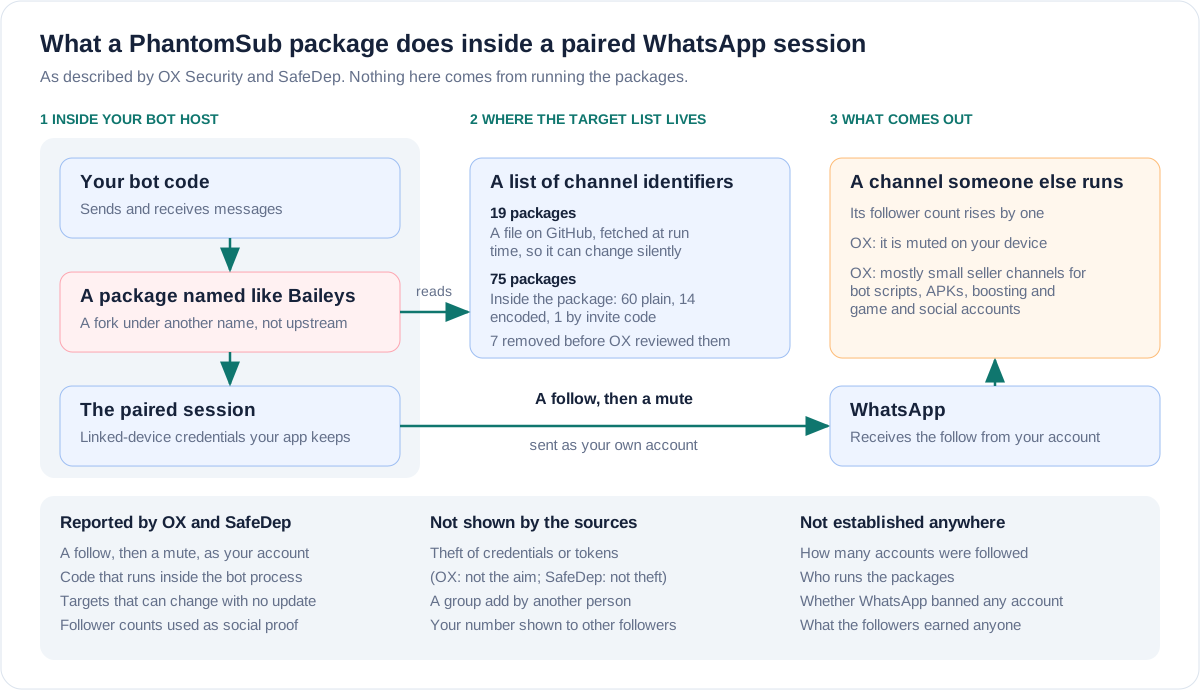
What a fork does with that access is its author's choice. In OX's packages it is a follow. SafeDep found other forks that add an advertising link to every image and video the bot sends, forge a channel attribution on outgoing messages, or send a message from the account and then disable the bot. The forks it analyses for those are not in OX's list, but one of OX's names, alipclutch-baileys, has an OSV record citing the same advertising host, in the same file and lines, that SafeDep decoded in one of them. OSV's automated reading calls that a relay of message traffic; SafeDep's reading of the same code is an advertising link. OX does not mention it, so "follow only" may understate part of the 101. The Amazon Inspector record for saturn-bail adds that any downstream end user paired through a bot built on the library is enrolled, so followed accounts may belong to a bot's users as well as its developer. The same upstream has produced worse: in December 2025 Koi Security reported lotusbail, which, per The Hacker News and The Register (Koi's own post now redirects elsewhere), copied tokens and messages and linked the operator's device to the victim's account.
"Open source WhatsApp library" is a licence, not a publisher
The upstream is real, popular and MIT licensed. WhiskeySockets/Baileys has about 11,200 stars, and npm's API shows @whiskeysockets/baileys at 1,816,599 downloads in the 30 days to 27 September. The licence lets anyone copy the code, change it and republish it under any name. That is the design and also the mechanism: a fork named like the original inherits its trust for the price of a publish. Of the 101 names, 52 are scoped, which reads like an organisation, and the registry lists one maintainer account for each of the 85 still installable. OX reads a shared channel as a shared beneficiary, not a shared author; SafeDep found different accounts and emails and concluded independent operators reusing one technique. Neither names an actor.
OX advises: do not use any package that asks you to connect your private accounts. Read literally, that rules out the genuine library too, because connecting an account is what it is for. The useful rule is narrower: which fork, from whom, and whether a personal WhatsApp account should be paired to software at all. Baileys' README says its maintainers "do not in any way condone" use that breaks WhatsApp's terms. WhatsApp says linking an account to unofficial versions of WhatsApp violates its terms and may bring a ban, "now or in the past"; its pages name apps such as GB WhatsApp, not Baileys. For business messaging, Meta documents the WhatsApp Business Platform.
How big it is, and what the numbers do not say
The per-package column in OX's table sums to 490,189, matching its "about 490,000". One package, ourin-baileys, carries 130,589 of that (26.6 per cent) and the top five carry 67.5 per cent. Fifty-eight names are under 1,000 downloads and twenty show none. Downloads are registry requests, including mirrors, CI reinstalls and scanners; an account is followed only if a paired session runs the code. I could not reproduce OX's figures: npm's API today returns 578,108 lifetime for the 92 names it reports and 156,564 for the last month across 96, against OX's 116,000. Treat all of it as an order of magnitude.
The campaign is also larger than 101. SafeDep's page lists 82 Baileys-based names across 375 versions, plus 15 impersonators of the libsignal-node dependency. Only 10 of its 82 names are in OX's list, so the two vendors name 173 distinct Baileys packages between them (derived: 82 plus 101 minus 10). Xygeni's @dappaoffc/baileys-mod is in SafeDep's set.
OX says the campaign lacks the classic signatures, token theft and heavy obfuscation, so it can stay online longer than most malware. On 28 September it counted 85 names live and 16 removed. A day later the count of installable names had not moved, but the members had: one name went and one came back.
Status of OX's 101 names on the npm registry API, checked at 15:49 UTC on 29 September 2026.
| State on the registry | Names | Note |
|---|---|---|
| Installable, latest version not deprecated | 84 | Includes `kasabaileys`, which OX listed as taken down; it was re-created on 29 September at 06:32 UTC with one version I did not analyse |
| Installable, latest version deprecated | 1 | `oktz-baileys`: "Package no longer supported"; the registry does not say who set it |
| Replaced by npm's security holding package | 4 | `@web2apk/baileys`, `dilxztech`, `kiki-baileys`, `saturn-bail` |
| Unpublished, name still on record | 8 | No installable version |
| Not found | 4 | Three OX lists as removed, and `@lendkzn/xntaabail`, which it listed as live |
The eleven remote list files in OX's indicators, ten of them raw GitHub files, all still returned HTTP 200 at 16:00 UTC, and three hold a different number of entries from OX's counts of 24 September. That is the design working: the operator retargets the 19 packages that fetch a list without publishing to npm, so a blocklist of package names lags. It echoes malicious Terraform providers still live two days after disclosure, and disabled is not removed made the same point for GitHub Actions.
Detection coverage is thin where the downloads are. OSV holds malicious-package records for 18 of the 101 names. Of the five most downloaded, four have no OSV record and no GitHub malware advisory that I could find: ourin-baileys, @badzz88/baileys, @ostyado/baileys and levvleys, together 268,711 of OX's 490,189 downloads (54.8 per cent). OX says its own database holds every name; I cannot see it, so this describes two public feeds.
What nobody has stated
Stated and not stated across OX, SafeDep, Xygeni, WhatsApp, npm and GitHub, as read on 29 September 2026.
| Question | Stated | Not stated |
|---|---|---|
| How many accounts were followed | Downloads per package (OX); follower totals for a sample of channels | Any count of forced follows or affected accounts |
| Who is behind it | Shared channels and lists (OX); different accounts and emails (SafeDep) | An actor. Indonesian sales content marks a beneficiary, not an attribution |
| Whether it paid | Channels advertise accounts, scripts and APKs | Any sale traced to a forced follower |
| Whether WhatsApp acted | Unofficial linking may bring bans in general | Any ban tied to these packages, or any statement from WhatsApp, npm, GitHub or the Baileys maintainers that I could find |
How to check a project, lock installs, and what to do if a WhatsApp account was involved
In the order worth doing. The first two are searches you can run today; the third matters if they find something.
Take this with you
Actions, in order
- Search every manifest, lock file and container build, including nested and monorepo projects, for package names containing baileys or libsignal. Compare each hit with the upstream name @whiskeysockets/baileys and with the list in OX's report.
- Check aliases as well as names: Xygeni found a fork that pointed its libsignal dependency at an attacker's scope. Flag any fork that depends on an unpinned latest tag or a bare git address, which two OSV records cite; a version pin does not fix content that changes underneath it.
- If a hit sits on a host that runs a paired WhatsApp session, treat the session as exposed. In the WhatsApp app open Linked devices, log out the bot and anything you do not recognise, delete the bot's stored session files or database rows, and re-pair only after the dependency is replaced.
- On the account, open the Channels list and look for channels you did not follow. Report and unfollow them with WhatsApp's own steps, and do not act on offers or group invite links inside them.
- Lock installs: commit the lock file, install from it in CI with a command that fails on any mismatch, and review lock file changes for new package names as you would code.
- For anything that touches a messaging account, move from a blocklist to an allowlist: a private registry or proxy that serves only named packages. Names are cheap: 75 of the 101 first appeared on or after 1 August.
- Watch the runtime signal, which an install-time scan will not see: outbound requests from bot processes to raw.githubusercontent.com, and follow actions no application code triggered. Add OX's list URLs and channel identifiers to your threat-intelligence feeds, as OX advises.
- Ask whether a personal WhatsApp account should be linked to software at all. If customer conversations sat on a paired account, involve your data protection lead.
npm ls --all 2>/dev/null | grep -i -E "baileys|libsignal"
grep -n -i -E "baileys|libsignal" package-lock.json
The question that exposes the gap
A fork that follows a channel proves that any fork can act as the account it is paired to. The 101 names show a follow, and a public record of the behaviour sat there for 125 days before a report gave it a count. So the question for a security lead is not whether your projects hold one of the 101. It is who in your organisation can say which WhatsApp accounts are paired to which software, and, if a fork in that process had done more than follow a channel, what would have told you?
Sources
- PrimaryPhantomSub report by Nir Zadok, Moshe Siman Tov Bustan and Vitalii Chepurko, published 28 September 2026 and edited 29 September. The primary research: the 101 package names, the three variants, the download column, the removal status, the remote list URLs and the channel analysis.OX Securityaccessed 2026-09-29
- PrimaryBaileys npm forks farm WhatsApp Channel followers, 10 August 2026. Used for the statement that this is not credential theft, the other fork behaviours, the 82 name list and the finding of independent operators.SafeDepaccessed 2026-09-29
- PrimaryMalicious npm Package in Baileys Fork (Skyzopedia Case), 18 September 2026. Used for the runtime-only trigger, the preinstall script that only checks the Node version and the libsignal alias.Xygeniaccessed 2026-09-29
- Primarynpm registry record for saturn-bail. Used for the version 1.1.12 publish time of 26 May 2026, the security holding package, and the registry timestamps for the other names, all queried on 29 September 2026.npmaccessed 2026-09-29
- Primarynpm registry record for alipclutch-baileys. Used for the registration of 20 October 2025 and the publish times of versions 8.6.58 onward.npmaccessed 2026-09-29
- Primarynpm downloads API for the upstream library: 1,816,599 in the 30 days to 27 September 2026. The same API was used for per-package counts.npmaccessed 2026-09-29
- PrimaryMalicious code in saturn-bail (npm), published 26 May 2026 at 14:01 UTC from an Amazon Inspector analysis. The earliest dated public record of the follow behaviour found among the 101 names.OSVaccessed 2026-09-29
- PrimaryMalicious code in @nexustechpro/baileys (npm). Used for the obfuscated session-state module and the unpinned dependency, which read differently from OX's account.OSVaccessed 2026-09-29
- PrimaryGitHub Advisory Database malware advisory for saturn-bail, published 24 August 2026. Used for the date npm replaced the package and for its generic compromise wording.GitHubaccessed 2026-09-29
- PrimaryThe Baileys repository. Used for the MIT licence, the README's account of linked-device pairing and saved sessions, the non-affiliation disclaimer and the star count.WhiskeySocketsaccessed 2026-09-29
- PrimaryAbout safety and privacy on channels. Used for what channel followers and admins can see of each other.WhatsAppaccessed 2026-09-29
- PrimaryAbout linked devices. Used for the linked-device model, how to review and log out devices, and the ban warning for linking to unofficial apps.WhatsAppaccessed 2026-09-29
- PrimaryAbout unofficial apps. Used for the terms and ban statement and to confirm the page names other apps, not Baileys.WhatsAppaccessed 2026-09-29
- PrimaryHow to change group privacy settings. Used for the statement that the setting applies when someone tries to add you directly to a group.WhatsAppaccessed 2026-09-29
- PrimaryHow to report a channel. Used for the report and unfollow steps.WhatsAppaccessed 2026-09-29
- PrimaryAbout the WhatsApp Business Platform. Used to name the supported route for business messaging.Metaaccessed 2026-09-29
- Reported byCoverage of the OX report, 29 September 2026. Used only as the pointer, and for the groups wording of its headline.The Hacker Newsaccessed 2026-09-29
- Reported byCoverage of Koi Security's lotusbail research, December 2025. Koi's own post could not be read, so the lotusbail account rests on this and The Register.The Hacker Newsaccessed 2026-09-29
- Reported byCoverage of Koi Security's lotusbail research, 22 December 2025. Second secondary source for the same account.The Registeraccessed 2026-09-29