One 29-word Apple sentence names iOS twice and macOS never, yet it sits on all three CoreGraphics advisories
Apple fixed CVE-2026-86950, a CoreGraphics out-of-bounds write, in iOS and iPadOS 26.7.1, macOS Tahoe 26.7.1 and macOS Sequoia 15.8.1, and said it knows of a report of exploitation. The wording is scoped to iOS before iOS 27, no older line has a fix, and CISA has not yet listed it.
By Parminder Kumar Sharma · · 15 min read
Twenty-nine words, printed three times
On 28 September 2026 Apple published three security advisories for one CoreGraphics flaw, CVE-2026-86950. Each carries the same sentence about exploitation, and it is 29 words long. We compared them: the sentence on the iOS 26.7.1 and iPadOS 26.7.1 page, the macOS Tahoe 26.7.1 page and the macOS Sequoia 15.8.1 page is identical, and the same words appear in the NVD record. The sentence names iOS twice. It never names macOS. The count is our arithmetic; the sentence is Apple's.
Apple says it is aware of a report that the issue "may have been exploited in an extremely sophisticated attack against specific targeted individuals on versions of iOS before iOS 27". That is the whole statement.
Here is what those 29 words do not establish.
- They do not establish that a Mac was attacked. The two macOS pages repeat a sentence written about iOS. Apple has done this before: its macOS Tahoe 26.3 page for the February 2026 dyld flaw, CVE-2026-20700, carries "on versions of iOS before iOS 26" in the same way.
- They do not establish that anyone was compromised. The words are "a report" and "may have been".
- They do not say who was targeted, how many, when, or by whom, and they do not say how the file reached a device.
- They give nothing to check a device against. There are no indicators and no detection method in any of the three advisories.
Coverage was less careful than the advisory. The headline on Cybersecurity News says "Actively Exploited", and the first sentence of Help Net Security calls the flaw "an actively exploited zero-day". Apple wrote neither. The Hacker News says the flaw sits in "older versions of iOS, iPadOS, and macOS", which is broader than Apple's words. This briefing follows Apple's page.
What is on the record
The flaw is an out-of-bounds write in CoreGraphics, Apple's graphics framework. Apple's impact line reads "Processing a maliciously crafted file may lead to arbitrary code execution", and the fix is described as improved bounds checking. It is fixed in iOS 26.7.1 and iPadOS 26.7.1 (iPhone 11 and later, plus the iPad families the page lists), macOS Tahoe 26.7.1 and macOS Sequoia 15.8.1, all released on 28 September. The reporter credited is Meta Product Security.
Apple's three advisories for CVE-2026-86950: what they state and what they leave out. Source: Apple security advisories 149226, 149228 and 149229, read 29 September 2026.
| Question | Stated | Not stated |
|---|---|---|
| What is the flaw? | Out-of-bounds write in CoreGraphics; a crafted file may lead to arbitrary code execution | Which file types, how a file reaches the device, whether a user must open it |
| Was it exploited? | Apple is aware of a report that it may have been, against specific targeted individuals | That an attack succeeded, how many, when, or who was targeted |
| On what? | Versions of iOS before iOS 27 | Whether any Mac, iPad or iOS 27 device was attacked, or why iOS 27 is outside the sentence |
| Who found it? | Meta Product Security | How Meta learned of it, or whether a Meta product was involved |
| Fixed where? | iOS and iPadOS 26.7.1, macOS Tahoe 26.7.1, macOS Sequoia 15.8.1 | Any fix for iOS 18, 17, 16 or 15, or macOS Sonoma or earlier |
| How severe? | Nothing: no score or rating in the advisories | A vendor severity; the only score on record is CISA-ADP's |
| What can I check? | Nothing | Indicators, a detection method, or a way to tell whether a device was hit |
Three details from Apple's own notes put the advisory in context.
CoreGraphics is rare in these notes. In the advisories we read, dated 1 March 2025 to 28 September 2026, the previous CoreGraphics CVE is CVE-2025-31209, an out-of-bounds read fixed on 12 May 2025, which is 504 days before this fix. It was credited to Trend Micro's Zero Day Initiative and carried no exploitation wording.
The credit line is new. Ten earlier CVEs in those advisories carry Apple's "aware of a report" wording. Where a credit is given, it is to Apple, to Google's Threat Analysis Group, or to The Citizen Lab, and none is to Meta. That is a fact about the credit, not a clue about the attack. SecurityWeek, a secondary source, recalls a 2025 case in which WhatsApp said a flaw in its own apps was likely used alongside a different Apple flaw, and says it is unclear whether WhatsApp was involved this time.
The timing is arithmetic, not an exploitation window. iOS 27 shipped on 14 September and this fix on 28 September, 14 days later. Apple does not say when the reported attack happened.
A report is not a confirmation, and the score is not Apple's
Three labels in circulation are not in Apple's advisory. "Zero-day" is coverage's word, and it assumes the report is true. "Critical" appears in one outlet's headline, but Apple gave no severity, and the only score on the record is CISA-ADP's 8.8, which is High on the CVSS scale, not Critical. And "actively exploited" is a stronger claim than a report that it "may have been". Each is fine as a reader's shorthand. None should be the sentence a patch policy is written from.
The scoring and listing record for CVE-2026-86950. Source: NVD JSON record and CISA KEV file, both fetched on 29 September 2026, the last time at 10:06 UTC.
| Item | On the record | Assigned by |
|---|---|---|
| CVSS 3.1 base score | 8.8 High: AV:N/AC:L/PR:N/UI:R/S:U/C:H/I:H/A:H | CISA-ADP (NVD source 134c704f-9b21-4f2e-91b3-4a467353bcc0), typed Secondary |
| Weakness | CWE-787, out-of-bounds write | CISA-ADP |
| SSVC decision points | Exploitation none, automatable no, technical impact total; stamped 2026-09-28 | CISA, in the role "CISA Coordinator" |
| Apple's own score | None in the CVE record | Apple, as the CVE numbering authority |
| NVD analysis | Status "Awaiting Analysis"; last modified 29 September, 08:17 UTC | NVD |
| KEV listing | Not in catalogue 2026.09.27, released 27 September at 21:30 UTC | CISA |
CISA's SSVC guide defines the "active" exploitation value as "shared, observable, and reliable evidence that cyber threat actors have used the exploit in the wild". Apple shared no evidence; it said it knows of a report. So an SSVC value of "none" does not contradict Apple. It answers a different question, on a date: the guide says exploitation answers should be time-stamped, and this stamp is a date, not a moment, so it cannot be read as coming after Apple's advisory. We covered the same tension between two agencies in Canada says this flaw is being exploited. CISA's own machine-readable record, three days later, says none.
Absence from KEV says little yet. The file we read was released about a day before Apple's advisory. Each of the ten earlier CVEs carrying Apple's wording in the advisories we read is in KEV. For seven of them, where Apple's advisory carried the wording from its first release inside our window, CISA listed the CVE 0 to 3 days after Apple; the 0 is the one Chromium flaw, which sits under Google's name. The other three cannot be paired from what we read. That is a pattern, not a prediction: CISA decides on its own criteria. Its recent deadlines matter more. Of the 62 entries added since 18 August 2026, 45 carry a 3 day deadline and 17 a 14 day one; the 3 day mechanics are in CISA added 34 flaws to the exploited catalogue in September, and 26 came with a three day deadline. KEV binds US federal agencies, not UK organisations. Treat a listing as a signal.
Which lines did not get a fix
Apple's release list shows this CVE fixed in three builds, all dated 28 September. It shows no fix for the lines below. That is not the same as saying they are unaffected. Apple's advisories are silent on it, and the CVE record lists iOS and iPadOS from version 0 up to but not including 26.7.1, and macOS up to but not including 15.8.1 and 26.7.1, as affected. Read literally, that range includes every 18.x, 17.x, 16.x and 15.x build. It is a range in a record, not a test result, and Apple does not say which older builds contain the flaw.
Release lines on Apple's security releases page with no listed fix for CVE-2026-86950. Source: Apple security releases, read 29 September 2026. Days are derived: 28 September 2026 minus the build's date.
| Line and devices | Latest build, date | Fix listed? |
|---|---|---|
| iOS and iPadOS 18: iPhone XS, XS Max, XR, iPad 7th generation | 18.7.10, 17 Aug 2026 (42 days) | No |
| iPadOS 17: iPad Pro 12.9-inch 2nd generation, iPad Pro 10.5-inch, iPad 6th generation | 17.7.11, 11 May 2026 (140 days) | No |
| iOS and iPadOS 16: iPhone 8, 8 Plus, X and three older iPads | 16.7.16, 11 May 2026 (140 days) | No |
| iOS and iPadOS 15: iPhone 6s, 7, SE 1st generation, iPod touch 7th generation and two iPads | 15.8.8, 11 May 2026 (140 days) | No |
| macOS Sonoma 14 | 14.8.9, 6 Aug 2026 (53 days) | No |
| macOS Ventura 13 | 13.7.8, 20 Aug 2025 (404 days) | No |
| iOS 27, iPadOS 27, macOS Golden Gate 27 | 27.0.1, 28 Sep 2026 | No CVE entries in the 27.0.1 notes; not stated whether 27.0 was affected |
No advisory lists CVE-2026-86950 for watchOS, tvOS or visionOS. Two groups deserve a closer look.
Five iPad models can take 26.7.1 but are not on Apple's iOS 27 list. The iOS 26.7.1 page lists iPad Pro 12.9-inch 3rd generation and later, iPad Pro 11-inch 1st generation and later, iPad Air 3rd generation and later, iPad 8th generation and later, and iPad mini 5th generation and later. The iOS 27 entry starts one generation later for each. Our inference from the two lists: for those five, "before iOS 27" is permanent, and 26.7.1 is the newest build Apple lists.
Intel Macs. The macOS Golden Gate 27 list names MacBook Neo (2026) and otherwise only Macs described as Apple silicon, so an Intel Mac is not on it and stays on an older macOS. Only Tahoe 26.7.1 and Sequoia 15.8.1 carry the fix. We did not read Apple's macOS compatibility pages, so we do not say which Intel Macs can run Tahoe.
What "supported" means is not something Apple states. NCSC's iOS guidance says Apple does not say how long a device will receive updates, and that iOS devices typically receive them for around six years after first release. Cyber Essentials v3.3 asks that in-scope software be "licensed and supported" and removed when it becomes unsupported. So the release list is your evidence. A line with no build since May and no fix here is a decision waiting for an owner.
Targeted individuals: a category you fill in yourself
Apple's phrase "specific targeted individuals" is a category, not a list. Apple's own description of who Lockdown Mode is for gives the flavour: people who, "because of who they are or what they do", might be personally targeted. NCSC's iOS guidance says the same in working form: consider it for users who face a higher threat because of their role or location. Nothing in Apple's notes mentions the UK, any sector or any victim. This is method for your own risk decision, not a claim that anyone here was hit.
Three facts from Apple's and NCSC's pages change how you would act on that.
- Lockdown Mode cannot be pushed by your MDM. Apple's page says it is not a configurable option for administrators, and NCSC's guide says it must be turned on using the device. A device in Lockdown Mode cannot be newly enrolled in MDM, while one already enrolled stays managed. The list of people has to be made before the day, and each person has to switch it on.
- Nothing published shows Lockdown Mode stopping this flaw. Apple says it blocks most message attachment types other than certain images, video and audio, and certain complex web technologies. The advisory says only "a maliciously crafted file": no file type, no route, and no mention of Lockdown Mode. The name is a comfort, not a control against this CVE. Apple's advice is to update before turning it on.
- Apple threat notifications are a separate channel. Apple's page, written about mercenary spyware, says it notifies individually targeted users on the iPhone, by email and on their Apple Account page, and that a genuine notification never asks you to click links, open files or install profiles. Whether any were sent for this issue is not stated.
Days to patch: the deferral setting is the control
The patch is the control that Apple published, so the question is how long your fleet takes to reach it. Cyber Essentials v3.3, dated April 2026, requires updates within 14 days of release where the vendor calls the fixed flaws critical or high risk, where the CVSS v3 base score is 7 or above, or where the vendor gives no level at all. Apple gave no level, so the third condition applies whatever score you accept, and CISA-ADP's 8.8 meets the second as well. Counting from the 28 September release, the limit is 12 October 2026, with 13 days left today. For organisations certified or working to Cyber Essentials that is a requirement; for the rest it is a sensible benchmark.
Apple's device management guide (the page is dated 24 September 2025, so check your MDM vendor for iOS 27 changes) lets administrators defer software updates on supervised devices for 1 to 90 days, applies the deferral to both updates and upgrades on iPhone and iPad, and lets them enforce an update at a chosen date regardless of any deferral. A 30 day deferral would therefore not offer iOS 26.7.1 until 28 October, 16 days past the limit, unless someone sets an enforcement date.
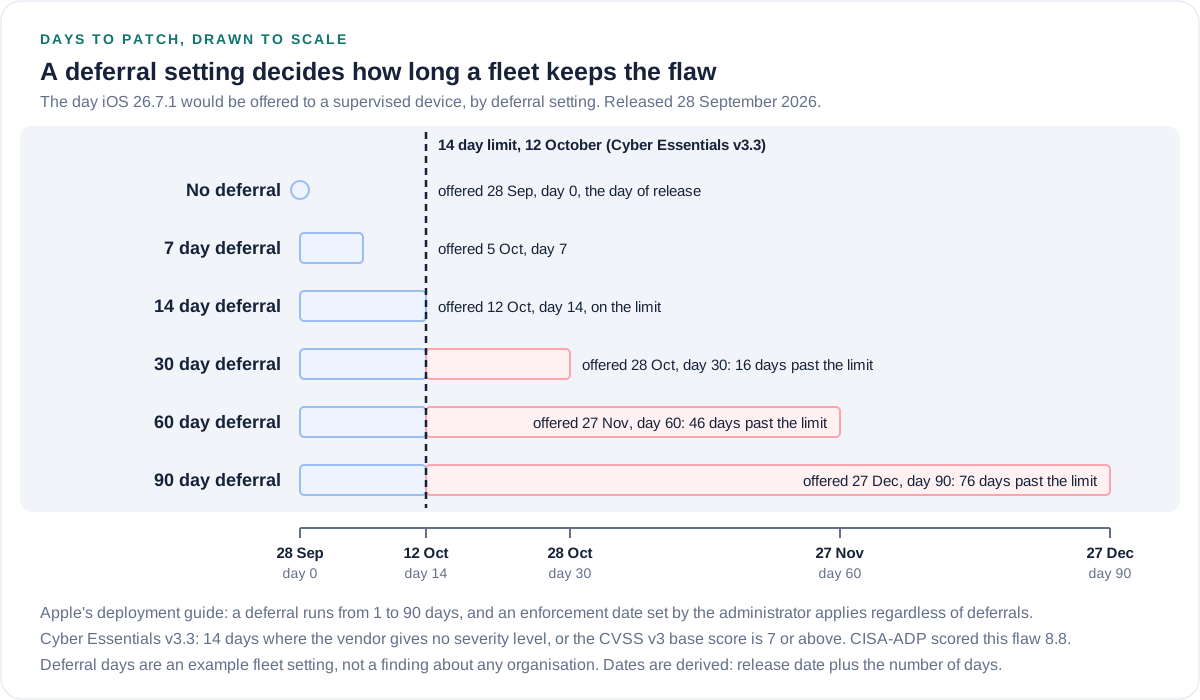
Set your own deferral below. The dates are the release date, 28 September, plus the number of days you choose.
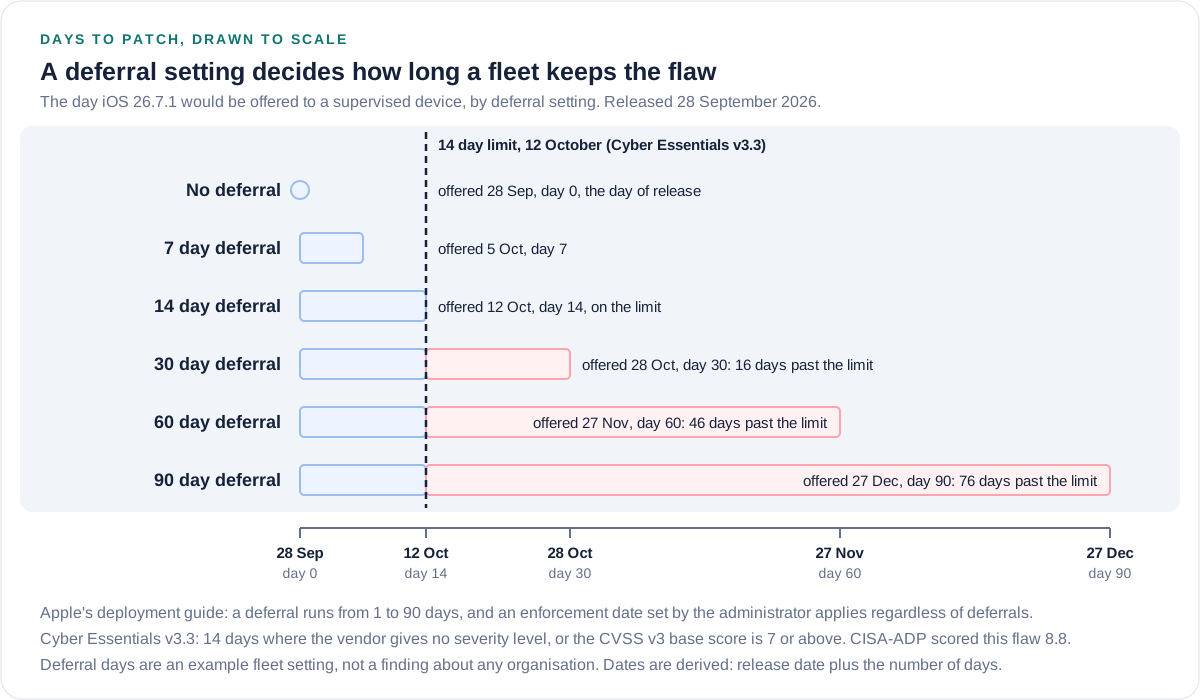
Deferral has a second effect. iOS 27 shipped on 14 September; a fleet holding the upgrade back for the 90 day maximum would not be offered it until 13 December. For those weeks it stays on iOS 26, inside the "before iOS 27" range of Apple's sentence. Enforce 26.7.1 rather than wait for the upgrade decision.
Method and interest
Apple says on its release page that it does not disclose, discuss or confirm security issues until patches are generally available. That policy explains the brevity, and the reuse of one template across platforms is what a template does. It is not evidence about macOS either way. Apple also sells the newer devices and the upgrade path, and, as NCSC notes, it does not state how long a device will receive updates, so the absence of a fix for an older line is a fact about the list, not a stated policy.
Meta is both the reporter and a company with apps on these devices. The credit says who reported, not which product carried the file. Trade coverage has its own incentive too: a headline that says "actively exploited" travels further than one that says "may have been". Separate the method from any of them. The method is to read what the primary page states, write down what it does not, and set your patch clock from your own policy.
What to do, in the order worth doing it
Take this with you
Actions for a UK security lead or IT manager
- Update supervised iPhones and iPads to iOS 26.7.1 or later, and Macs to macOS Tahoe 26.7.1 or macOS Sequoia 15.8.1 or later.
- Confirm from MDM inventory, not user assurance, and list every device still below the fixed builds.
- Set an enforcement date rather than relying on a deferral. For Cyber Essentials scope, 12 October 2026 is the latest; set it earlier for the people you identify in the sixth step.
- Compare your longest security update deferral with 14 days. If it is longer, change it or enforce by date.
- List the devices that cannot take a fix: iOS 18, 17, 16 and 15 devices and Macs on Sonoma or Ventura. Give each an owner and a decision date to replace, restrict or take out of scope.
- Write down, before any incident, which roles would count as targeted individuals for your organisation, and pilot Lockdown Mode with them. Tell them it cannot be managed by MDM and blocks new enrolment. Update first.
- Brief that group on Apple threat notifications: where a genuine one appears, and that it never asks you to click links, open files or install profiles.
- If someone receives a threat notification, treat it as an incident: keep the device, involve your security lead, and get specialist help. Apple's page suggests expert help such as Access Now's Digital Security Helpline.
- Record the date the advisory was received, the date each device class was fixed, and every exception. That is your patch evidence.
- Check the KEV catalogue again in a few days. If the CVE is added, log the date and deadline as a signal, not a UK obligation.
- Do not build detection from coverage speculation about delivery routes. Apple published no indicators, so patching and inventory are the controls available today.
The question that exposes the gap
Apple's advisory describes "specific targeted individuals" and does not say who they are. So ask your own organisation one question. Who in it would that phrase describe, and did anyone decide that before 28 September?
If the honest answer is that nobody has, then the list of people who need Lockdown Mode, an enforced update date and a briefing on threat notifications does not exist yet. The patch closed this flaw. It did not write that list.
Key facts
Sources
- PrimaryAbout the security content of iOS 26.7.1 and iPadOS 26.7.1, released 28 September 2026. Read in full: the CoreGraphics entry, the exploitation sentence, the device list and the credit to Meta Product Security.Appleaccessed 2026-09-29
- PrimaryAbout the security content of macOS Tahoe 26.7.1. Read in full; used to confirm the identical exploitation sentence and the fixed build.Appleaccessed 2026-09-29
- PrimaryAbout the security content of macOS Sequoia 15.8.1. Read in full; used to confirm the identical exploitation sentence and the fixed build.Appleaccessed 2026-09-29
- PrimaryApple security releases. Used for release dates, the latest build on every older line, the device lists for iOS 26.7.1 and iOS 27, and the entries with no published CVE. About 160 linked advisories dated 1 March 2025 onward were also read for earlier CoreGraphics entries and earlier exploitation wording.Appleaccessed 2026-09-29
- PrimaryApple's e-mailed copy of the iOS 26.7.1 and iPadOS 26.7.1 notice, posted 28 September 2026. Posts 90 and 91 carry the two macOS notices. Used to confirm the wording and the posting time.Apple Product Security via Full Disclosureaccessed 2026-09-29
- PrimaryThe NVD record for CVE-2026-86950, read as JSON from the NVD API on 29 September 2026: description, Apple's affected version ranges, and the CISA-ADP CVSS 3.1 score, CWE and SSVC block. Status was Awaiting Analysis.NIST National Vulnerability Databaseaccessed 2026-09-29
- PrimaryThe Known Exploited Vulnerabilities catalogue JSON, version 2026.09.27. Used to confirm the CVE is not listed, to check every earlier Apple CVE with the same wording, and to count recent deadlines.CISAaccessed 2026-09-29
- PrimaryCISA SSVC Guide. Used for the definition of the exploitation values none and active, and for the advice that answers are time-stamped.CISAaccessed 2026-09-29
- PrimaryCyber Essentials: Requirements for IT Infrastructure v3.3, dated April 2026. Used for the 14 day security update rule and its three conditions, and the licensed and supported requirement.NCSCaccessed 2026-09-29
- PrimaryDevice security guidance for iOS, reviewed 13 May 2025. Used for Lockdown Mode not being configurable through MDM and for the statement that Apple does not say how long a device will receive updates.NCSCaccessed 2026-09-29
- PrimaryAbout Lockdown Mode, published 18 September 2026. Used for who it is for, what it changes, and that it is not configurable by MDM administrators.Appleaccessed 2026-09-29
- PrimaryAbout Apple threat notifications and protecting against mercenary spyware, published 13 August 2026. Used for how notifications are delivered and what a genuine one never asks for.Appleaccessed 2026-09-29
- PrimaryInstall and enforce software updates for Apple devices, an Apple Platform Deployment page dated 24 September 2025. Used for the 1 to 90 day deferral range and enforcement dates that override deferrals.Appleaccessed 2026-09-29
- Reported byNews coverage of 28 September 2026 by Ravie Lakshmanan. A pointer to the advisory; used to show that it describes the flaw as in older versions of iOS, iPadOS and macOS, which is broader than Apple's wording.The Hacker Newsaccessed 2026-09-29
- Reported byNews coverage. Used for the note that Apple has not said how the file is delivered and that it is unclear whether WhatsApp was involved, and for the count of Apple KEV additions this year.SecurityWeekaccessed 2026-09-29
- Reported byNews coverage. Used only for its headline, which says Critical and Actively Exploited, wording Apple did not use.Cybersecurity Newsaccessed 2026-09-29
- Reported byNews coverage of 29 September 2026. Used for its opening sentence calling the flaw an actively exploited zero-day, and for its reading that iOS 27.0.1 is unaffected, which Apple does not state.Help Net Securityaccessed 2026-09-29