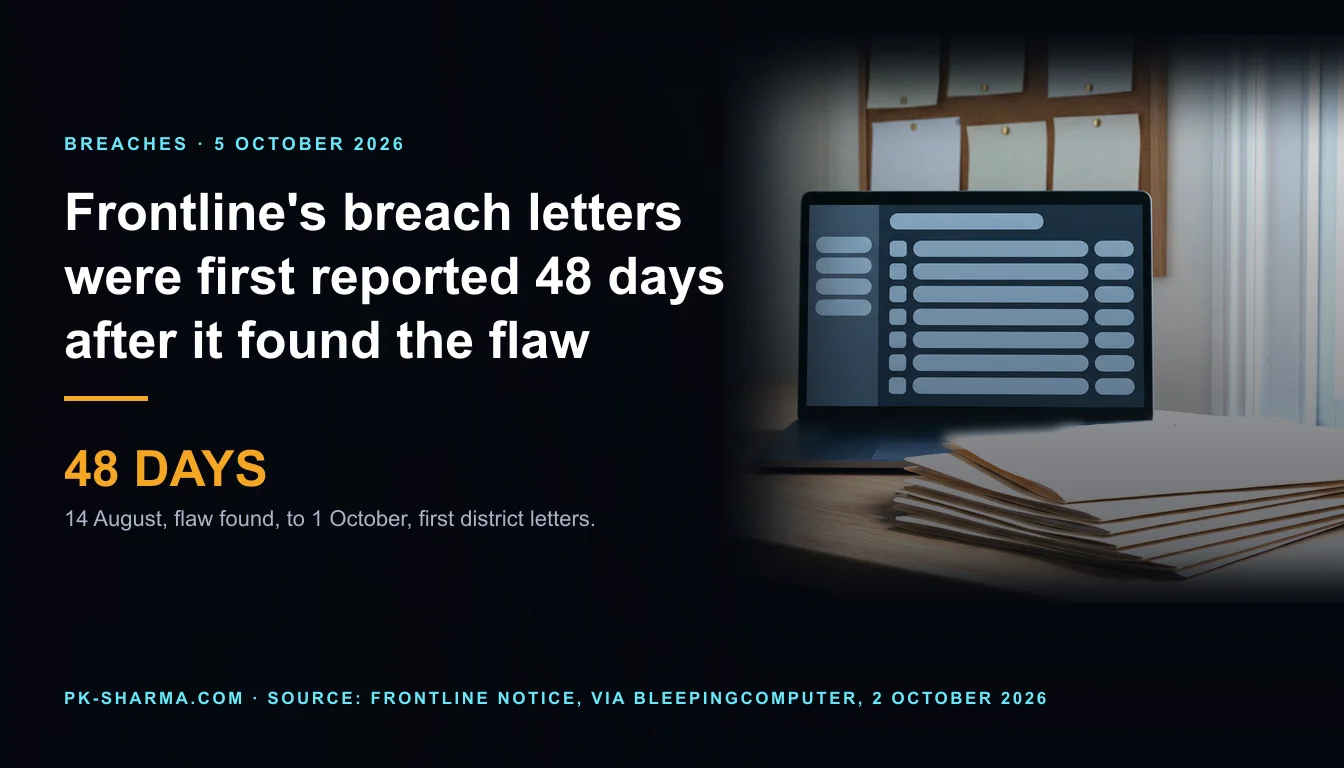
Frontline's breach letters were first reported 48 days after it found the flaw, and name no software
Frontline Education says its security team identified a flaw in third-party software on 14 August; the first district letters were reported on 1 October. The letters name no product, no count of districts and no date the intruders arrived.
By Parminder Kumar Sharma · · 9 min read
48 days from the flaw to the first letters, and what that does not prove
Frontline Education, a supplier of administration and workforce software to US K-12 school districts, says its security team identified a vulnerability in a third-party software product on 14 August 2026. The first district officials to report receiving a notification said it arrived on 1 October. That is 48 days, or 1,152 hours, which is 16 times the 72 hours the UK gives a controller to tell the ICO after becoming aware of a breach. The arithmetic is ours; both dates come from BleepingComputer, 2 October 2026.
What that does not establish. It does not say when the intruders got in: the notice dates the day a flaw was identified, not the day access began. It does not say when any district was first told: 1 October is the first receipt anyone has reported. It does not show a breach of any law, because the UK clock runs from a UK controller's own awareness and does not bind a US supplier. Every state below is a position at about 17:00 BST on Monday 5 October 2026, and several could change within the hour.
How we know. A customer posted the letter on Reddit, which answered our request with a bot check, so we did not read it there and did not try to get round the check. BleepingComputer and Infosecurity Magazine quote the same sentences, and we rely on them for its wording.
What is stated, and what is not
Position at about 17:00 BST on 5 October 2026. Stated: Frontline's notice as quoted by BleepingComputer and Infosecurity Magazine, Frontline's own pages and opt-out portal. Not stated: what we looked for and did not find.
- Item
- Dates
- Stated
- Flaw identified 14 August 2026. Letters first reported received 1 October. Opt-out deadline 16 October (portal).
- Not stated
- When access began. When each district was first told. When individuals will be notified.
- Item
- Software
- Stated
- A "third-party software product we use".
- Not stated
- The product, vendor or CVE, so there is no CVE.org, NVD or KEV record to read.
- Item
- Data
- Stated
- Social Security numbers, email addresses and home addresses. One district's letter reportedly covered all its employees.
- Not stated
- Dates of birth, bank details, applicant or student data. The portal says individuals associated with a district, and minors are offered monitoring: wider than employees, and unexplained.
- Item
- Scale
- Stated
- 1,210 employees at one unnamed district, from a letter an administrator shared.
- Not stated
- How many districts or people. Frontline's site cites over 4.1 million daily users, a customer figure and not a victim count.
- Item
- Misuse and actor
- Stated
- Per Infosecurity, the customer note says Frontline is "not aware of any misuse of the data".
- Not stated
- Any criminal group's claim (neither outlet reports one; we did not search leak sites), and whether data was published or sold.
- Item
- Response
- Stated
- Independent firm engaged, flaw remediated, law enforcement engaged. Two years of TransUnion monitoring for adults. Frontline sends individual notices unless a district opts out, and says it handles attorney general notifications.
- Not stated
- The root cause, and what the application could reach.
- Item
- Public record
- Stated
- Per Infosecurity, a website notice and a press release were promised.
- Not stated
- Neither seen: Frontline's site carries no notice (latest news item 22 April 2026). The Texas (652 entries) and California lists hold no Frontline entry. Maine's database is offline. New Hampshire, Vermont and Montana pages refused our requests.
| Item | Stated | Not stated |
|---|---|---|
| Dates | Flaw identified 14 August 2026. Letters first reported received 1 October. Opt-out deadline 16 October (portal). | When access began. When each district was first told. When individuals will be notified. |
| Software | A "third-party software product we use". | The product, vendor or CVE, so there is no CVE.org, NVD or KEV record to read. |
| Data | Social Security numbers, email addresses and home addresses. One district's letter reportedly covered all its employees. | Dates of birth, bank details, applicant or student data. The portal says individuals associated with a district, and minors are offered monitoring: wider than employees, and unexplained. |
| Scale | 1,210 employees at one unnamed district, from a letter an administrator shared. | How many districts or people. Frontline's site cites over 4.1 million daily users, a customer figure and not a victim count. |
| Misuse and actor | Per Infosecurity, the customer note says Frontline is "not aware of any misuse of the data". | Any criminal group's claim (neither outlet reports one; we did not search leak sites), and whether data was published or sold. |
| Response | Independent firm engaged, flaw remediated, law enforcement engaged. Two years of TransUnion monitoring for adults. Frontline sends individual notices unless a district opts out, and says it handles attorney general notifications. | The root cause, and what the application could reach. |
| Public record | Per Infosecurity, a website notice and a press release were promised. | Neither seen: Frontline's site carries no notice (latest news item 22 April 2026). The Texas (652 entries) and California lists hold no Frontline entry. Maine's database is offline. New Hampshire, Vermont and Montana pages refused our requests. |
A third-party label moves the cause outside the vendor's walls. The duty stays inside
The letter's one explanation is a label. A flaw in "a third-party software product we use" puts the cause in someone else's code, but the sentence also says we use. Frontline chose, deployed and operates the product, and it holds the data. Its privacy policy, updated on 3 September 2025, says it receives employees' Social Security numbers from districts, may share them with third-party service providers, will "remediate any identified security vulnerabilities in a timely manner" and has a plan for "prompt notification of the districts and educators". Its security page claims SOC 2 Type II audits.
Those are promises, and 48 days is a measurement. The dates do not show a promise broken: "prompt" is undefined, and a district may have heard before the first letter anyone has reported. What the label cannot do is move the duty to patch, to notify and to explain. The data holder owns those. For a district, the vendor's breach is the district's to explain to its staff, and the opt-out portal shows how: a district must choose, with no partial option, between Frontline sending the notices and funding monitoring, or sending its own without reimbursement.
US law has the same two-step shape. Texas Business and Commerce Code section 521.053, as published on 5 October 2026, tells a person who maintains data it does not own to notify the owner "immediately" after discovering a breach. The owner has up to 60 days from determining that a breach occurred to tell individuals, and 30 days to tell the Texas Attorney General if 250 or more Texans are affected. From 14 August, day 30 was 13 September and day 60 is 13 October, but the clocks run from a determination, a date the notice does not give, so no compliance conclusion follows. This is not legal advice.
Naming the product is often a later step. Bitget blamed third-party products and named none, and two forensic reports on it name no product. The Dutch DIVD left its flaw unnamed until a later statement named two Zammad flaws. See also a contractor's firewall rule that opened a path to 50 million immigration records, and a processor fined directly in Sweden.
The dates, to scale
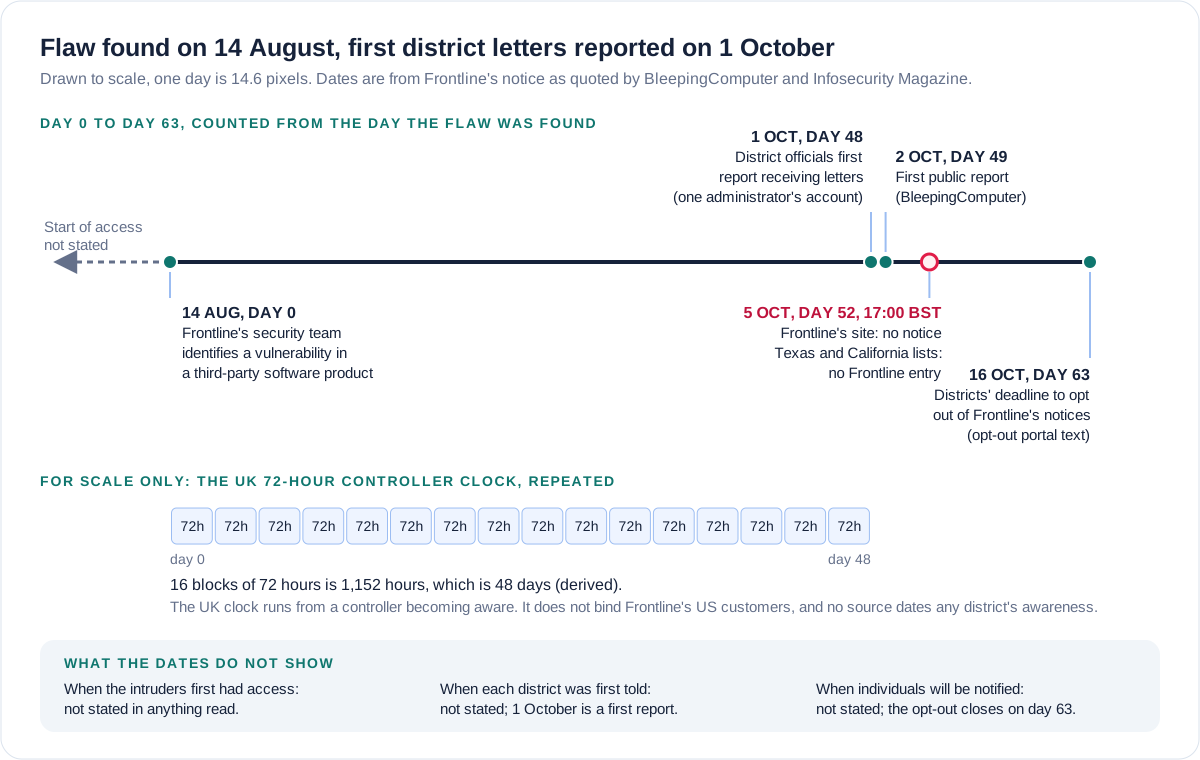
The UK reading: a supplier's delay does not start the school's clock
No source says any UK school or trust is affected, and we name no UK product. Frontline's page says its software supports users "across the US and abroad", which does not say where. The point is the position: a UK school or trust that buys HR, payroll, absence, recruitment or supply-cover software as a cloud service is where the districts are. It is the controller of its staff records, and the supplier is a processor under Article 28 of the UK GDPR.
What the law fixes is thin. Article 33(2) says the processor must tell the controller "without undue delay" after becoming aware, and gives no number of hours. The EDPB guidelines say so in terms and treat the controller, in principle, as aware once the processor has told it. The ICO's guide calls those guidelines still relevant and says breach-reporting terms belong in the Article 28 contract. So nearly seven weeks of supplier silence does not use up the school's 72 hours, and a number of hours can only come from the contract. Our earlier briefing covers that clock.
The duty to tell staff, when the risk is high, sits with the controller. A supplier that offers to send the letters, as Frontline does, assists under Article 28(3)(f) and does not take the duty over. The DfE's cyber security standard says of a cloud service that "the responsibility is on the supplier to license and update the software", and asks for a DPO-led impact assessment. The supplier patches. The school still answers to its staff.
The 2025/26 Cyber Security Breaches Survey education annex (30 April 2026) found 47 per cent of secondary and 42 per cent of primary schools had reviewed the risks from immediate suppliers, and 21 and 27 per cent from wider supply chains. Ofqual's survey of 1 October 2026 found 27 per cent of schools had a cyber incident in 2025 to 2026, and 9 per cent of teachers named senior leadership as primarily responsible. Neither measures a supplier's breach, and the ICO's analysis of 215 education insider-attack reports describes a different failure, 57 per cent caused by students.
What to do, in the order worth doing it
Our judgement on the order, not a regulatory list. The sources for each step are above.
Take this with you
Supplier breach readiness for a UK school or trust
- Map which suppliers hold staff and pupil records and which fields each holds, starting with National Insurance numbers, bank details and dates of birth.
- Read each contract for notice timing. The law gives no number, so ask for hours from the supplier's own awareness, counted from when it identified the problem, not when it finished investigating.
- Ask each supplier for patching evidence: how it tracks flaws in the third-party software it runs and how long fixes take. Compare it with the DfE's 14 days for critical and high flaws in your own estate.
- Agree an incident contact route both ways: a monitored address and phone number at the supplier, and a named person and deputy at the school or trust who reads supplier notices.
- Bring the DPO in on the first supplier notice and record when you became aware. The DfE standard has the DPO establish whether a data breach has occurred.
- Draft the staff message before it is needed: what was taken, what is not yet known, what staff should do, who to ask.
- Decide protection offers in advance. US-style credit monitoring is built around identifiers UK staff do not have, so settle what you would offer, who pays, and whether a supplier may send notices for you.
The question that exposes the gap
A supplier says it found a flaw on one date, its letters surfaced nearly seven weeks later, and the only explanation on the record is that someone else's software was at fault. If your HR supplier found a flaw today, which clause in your contract says how many days it may wait before telling you, and who at your school would read the letter first?
Key facts
Sources
- PrimaryPrivacy policy updated 3 September 2025; used for what Frontline says it holds, its sharing with service providers, and its patching and notification promises.Frontline Educationaccessed 2026-10-05
- PrimaryCommitment to Security page; used for the SOC 2 Type II claim and the 4.1 million daily users figure.Frontline Educationaccessed 2026-10-05
- PrimaryNews page read at 16:50 and again at 17:02 BST on 5 October 2026; latest item 22 April 2026, no incident notice.Frontline Educationaccessed 2026-10-05
- PrimaryOpt-out portal for districts, read from its public script bundle without entering the access-code area; used for the 16 October deadline, the no-partial-opt-out rule and what an opt-out forfeits.Frontline Education and TransUnionaccessed 2026-10-05
- PrimaryData security breach reports list, 652 entries, searched for Frontline at 16:45 and again at 17:02 BST on 5 October 2026; no match.Texas Attorney Generalaccessed 2026-10-05
- PrimaryData security breach list, searched for Frontline on 5 October 2026; no match.California Attorney Generalaccessed 2026-10-05
- PrimaryData security breaches page stating that the public database is offline.Maine Attorney Generalaccessed 2026-10-05
- PrimaryBusiness and Commerce Code chapter 521, section 521.053, notification clocks for owners and maintainers of data.Texas Legislatureaccessed 2026-10-05
- PrimaryKnown Exploited Vulnerabilities catalogue, version 2026.10.04; used only to count additions from 1 July to 14 August 2026.CISAaccessed 2026-10-05
- PrimaryUK GDPR Article 33, notification of a personal data breach.legislation.gov.ukaccessed 2026-10-05
- PrimaryUK GDPR Article 28, processor.legislation.gov.ukaccessed 2026-10-05
- PrimaryPersonal data breaches guide; used for the processor-to-controller duty and the 72-hour clock.Information Commissioner's Officeaccessed 2026-10-05
- PrimaryGuidelines 9/2022 on personal data breach notification, version 2.0; used for the controller's awareness once the processor has informed it.European Data Protection Boardaccessed 2026-10-05
- PrimaryCyber security standard for schools and colleges; used for the 14-day vulnerability fix, cloud supplier responsibility and DPO roles.Department for Educationaccessed 2026-10-05
- PrimaryCyber Security Breaches Survey 2025/2026, education institutions annex, published 30 April 2026; supplier review figures.DSIT and Home Officeaccessed 2026-10-05
- PrimaryPress release of 1 October 2026 on schools' cyber incidents and recovery.Ofqualaccessed 2026-10-05
- Primary11 September 2025 analysis of 215 education insider-attack breach reports.Information Commissioner's Officeaccessed 2026-10-05
- Reported byReport of 2 October 2026 quoting Frontline's notice to a district; used for the 14 August date, the data fields, the 1,210 count, the opt-out terms and the TransUnion offer.BleepingComputeraccessed 2026-10-05
- Reported byReport of 5 October 2026 quoting the same notice; used for the not-aware-of-misuse statement, the promised website notice and press release, and the vendor's unreachable contact page.Infosecurity Magazineaccessed 2026-10-05