Bromcom found a legacy sign-on breach on 6 September; its first dated public post came 18 days later
Bromcom, a UK supplier of school management systems, says it found a breach in a legacy sign-on service on 6 September; its first dated public post is from 24 September. Its FAQ of 30 September cannot yet say whether data was taken, or how many records.
By Parminder Kumar Sharma · · 16 min read
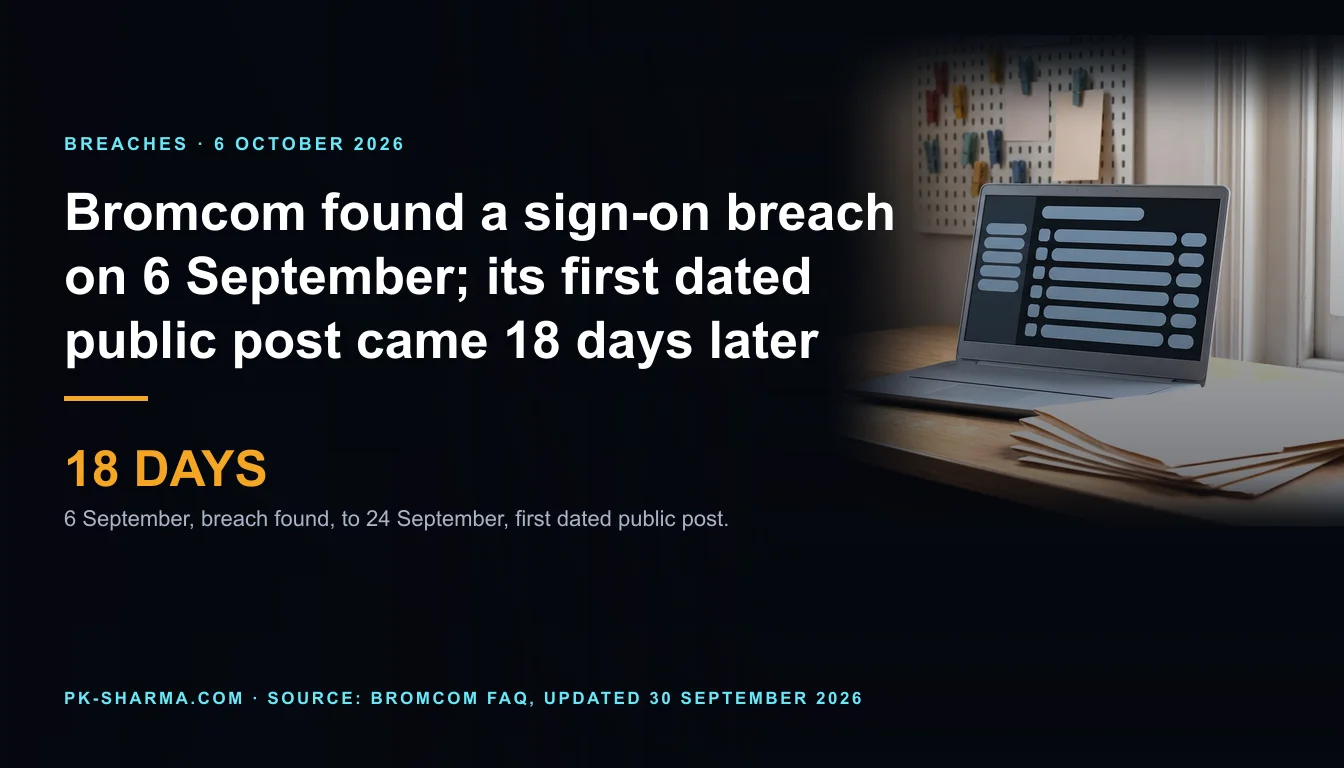
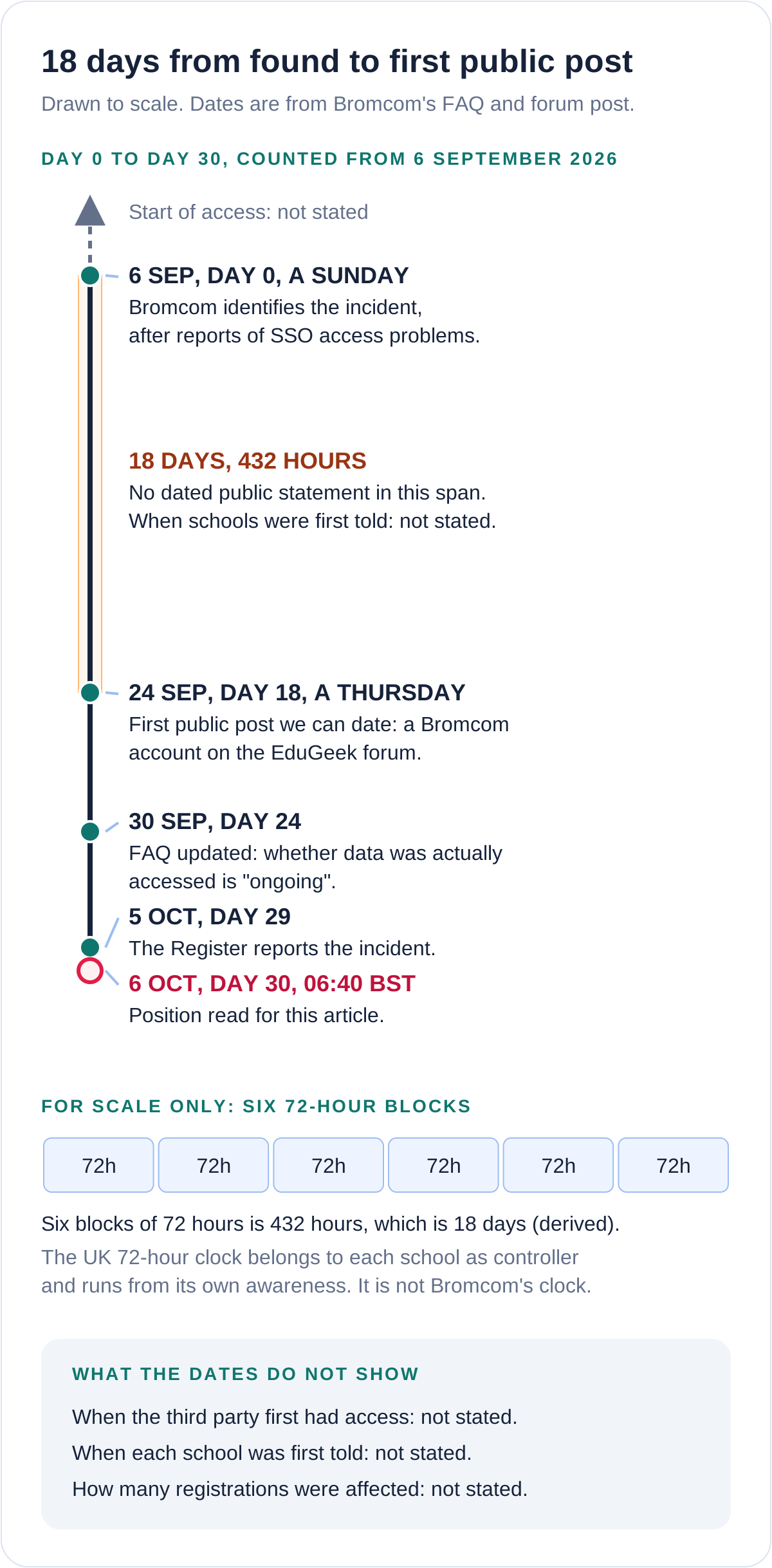
18 days from finding the breach to the first public post, and what that does not prove
Bromcom, a UK supplier of school management information systems, says it first identified a personal data breach in a legacy single sign-on (SSO) service on 6 September 2026, a Sunday. The earliest publicly readable statement we can date is a post by a Bromcom account on the EduGeek forum on 24 September. That is 18 days, or 432 hours, which is six lots of 72 hours. The Register reported it on 5 October, 29 days after identification and 11 after the forum post. The day counts are ours (derived). The dates come from Bromcom's FAQ and the forum thread.
What that does not establish. It does not date the first notice to schools: the FAQ says schools are being contacted and gives no date, and the opening post of the same thread says a trust had already had communications. It does not show a breach of any law: the UK GDPR 72 hours runs for each school, as controller, from its own awareness, and a processor such as Bromcom must tell its controllers "without undue delay", which has no hours. It does not say data was misused, and it does not say when the third party arrived, because Bromcom has not said. Every state below was read between 06:35 and 07:00 BST on Tuesday 6 October 2026, and several could change within the hour.
How we know. Bromcom's documentation site answered a command-line request with a plain 403 and loaded normally in an ordinary browser. No bot check was shown and none was bypassed. We read the FAQ there, and in two Internet Archive captures of it (20:05 UTC on 30 September and 06:40 UTC on 1 October) whose text matches the live page. The Bromcom Community announcement that the forum post links to sits in a members-only space: a logged-out visitor gets a page-not-found message, and we did not sign in. The Register is a pointer to the primaries, and we use it only for the date of its own report.
What is stated, and what is not
Position at about 07:00 BST on 6 October 2026. Stated: Bromcom's FAQ (updated 30 September), the forum post of 24 September, Bromcom's home page and status page. Not stated: what those pages do not say, which we checked for.
- Item
- Dates
- Stated
- Identified 6 September, after reports of SSO access problems. Forum post 24 September. FAQ updated 30 September.
- Not stated
- When access began. When schools were first told. When the legacy service was withdrawn.
- Item
- Component
- Stated
- Legacy SSO registration functionality in the Communication Server environment. Superseded, but kept because "it was still being called by an internal system".
- Not stated
- What that internal system was, or for how long the service had been superseded.
- Item
- Data
- Stated
- Email addresses, the SSO provider (Microsoft or Google), registration and last sign-in dates where held, and internal user and registration reference numbers. No passwords, access, refresh or session tokens.
- Not stated
- Whether the list is complete. Customer posts add school names, school security codes and some PIN identifiers (unverified). The FAQ has a question on PIN-related information but no PIN field in its list.
- Item
- People
- Stated
- The service relates to SSO registrations for "staff and pupil accounts". Parents are not in it: the parent app does not use this service.
- Not stated
- Whether staff, pupils or both were among the affected records, and how many of each.
- Item
- Scale
- Stated
- Bromcom's home page claims 3.3m users, 1.2m+ students, 5.6K+ schools and 390+ MATs. That is the customer base, not a victim count.
- Not stated
- How many registrations, people or schools were affected. A Bromcom forum reply confirms per-school figures went to schools. No total is public.
- Item
- Cause
- Stated
- Fixes listed: additional school and account authorisation checks, self-service removal limited to the signed-in user's own registration, better logging.
- Not stated
- How the third party got in, what was exploited, who it was. A root-cause analysis: Bromcom says it will "consider the appropriate next steps" once the investigation ends.
- Item
- Misuse
- Stated
- No successful unauthorised sign-in to the MIS, MyChildAtSchool or a Bromcom account has been identified. No evidence school MIS data was accessed.
- Not stated
- Whether data was copied, published or misused. Whether all deleted records were restored: the FAQ says the email-address records were recovered.
- Item
- Notification
- Stated
- School controllers are being contacted directly. Bromcom has not notified the ICO, saying it processes this data as a processor.
- Not stated
- The date of the first notice. Whether individuals have been told. Whether any school or trust has told the ICO.
- Item
- Public record
- Stated
- FAQ updated 30 September. Status page at about 06:40 BST: no incident and no announcement listed, with a note that not every incident is listed.
- Not stated
- Any statement from the ICO or the NCSC (none found). The Community announcement, which is members-only.
| Item | Stated | Not stated |
|---|---|---|
| Dates | Identified 6 September, after reports of SSO access problems. Forum post 24 September. FAQ updated 30 September. | When access began. When schools were first told. When the legacy service was withdrawn. |
| Component | Legacy SSO registration functionality in the Communication Server environment. Superseded, but kept because "it was still being called by an internal system". | What that internal system was, or for how long the service had been superseded. |
| Data | Email addresses, the SSO provider (Microsoft or Google), registration and last sign-in dates where held, and internal user and registration reference numbers. No passwords, access, refresh or session tokens. | Whether the list is complete. Customer posts add school names, school security codes and some PIN identifiers (unverified). The FAQ has a question on PIN-related information but no PIN field in its list. |
| People | The service relates to SSO registrations for "staff and pupil accounts". Parents are not in it: the parent app does not use this service. | Whether staff, pupils or both were among the affected records, and how many of each. |
| Scale | Bromcom's home page claims 3.3m users, 1.2m+ students, 5.6K+ schools and 390+ MATs. That is the customer base, not a victim count. | How many registrations, people or schools were affected. A Bromcom forum reply confirms per-school figures went to schools. No total is public. |
| Cause | Fixes listed: additional school and account authorisation checks, self-service removal limited to the signed-in user's own registration, better logging. | How the third party got in, what was exploited, who it was. A root-cause analysis: Bromcom says it will "consider the appropriate next steps" once the investigation ends. |
| Misuse | No successful unauthorised sign-in to the MIS, MyChildAtSchool or a Bromcom account has been identified. No evidence school MIS data was accessed. | Whether data was copied, published or misused. Whether all deleted records were restored: the FAQ says the email-address records were recovered. |
| Notification | School controllers are being contacted directly. Bromcom has not notified the ICO, saying it processes this data as a processor. | The date of the first notice. Whether individuals have been told. Whether any school or trust has told the ICO. |
| Public record | FAQ updated 30 September. Status page at about 06:40 BST: no incident and no announcement listed, with a note that not every incident is listed. | Any statement from the ICO or the NCSC (none found). The Community announcement, which is members-only. |
Bromcom's wording on whether data was taken changed in six days
On 24 September a Bromcom account wrote on the forum that an unauthorised third party "has accessed and retrieved email addresses and limited information associated with SSO registrations". The Register's report repeats that sentence. On 30 September the FAQ was updated. Asked whether the personal data was actually accessed or only potentially exposed, it now answers: "Our investigation is ongoing to determine the nature and scope of the data involved." It gives the same answer to whether the information was copied, downloaded or exfiltrated, and to how many users or records were involved.
Bromcom's own wording on the same questions. Sources: the Bromcom account's posts of 24 and 25 September on the EduGeek thread, and the FAQ updated 30 September. Both read on 6 October 2026.
- Question
- Was data retrieved?
- Forum, 24 and 25 September
- A third party "has accessed and retrieved" email addresses and limited SSO registration information.
- FAQ, 30 September
- Actually accessed or only potentially exposed: investigation ongoing.
- Question
- How many?
- Forum, 24 and 25 September
- Per-school figures were given to schools, "based on a detailed technical investigation", and may change.
- FAQ, 30 September
- How many users or records: investigation ongoing. No total.
- Question
- Was the MIS reached?
- Forum, 24 and 25 September
- No evidence of unauthorised access to the MIS or its data.
- FAQ, 30 September
- No evidence school MIS data was accessed. Unchanged.
| Question | Forum, 24 and 25 September | FAQ, 30 September |
|---|---|---|
| Was data retrieved? | A third party "has accessed and retrieved" email addresses and limited SSO registration information. | Actually accessed or only potentially exposed: investigation ongoing. |
| How many? | Per-school figures were given to schools, "based on a detailed technical investigation", and may change. | How many users or records: investigation ongoing. No total. |
| Was the MIS reached? | No evidence of unauthorised access to the MIS or its data. | No evidence school MIS data was accessed. Unchanged. |
What this does and does not establish. It does not show that the 24 September sentence was wrong: the FAQ does not retract it. It does show that Bromcom's public position on the central question for any controller, was the data taken, moved from a statement to "ongoing" within six days, and the FAQ does not say why. Black Swan Cyber, a UK security consultancy that sells email and account protection to schools, read it the same way on 1 October: its note says the 25 September FAQ "explicitly confirmed unauthorised retrieval" and that the revised wording "does not, by itself, establish that the previous findings were incorrect". We could not read the 25 September FAQ, because no archive capture of it exists, so the earlier wording rests on the forum post and on that note.
One more phrase matters. The FAQ asks "Were all deleted records restored?" and answers that the email-address records "have been recovered". The question presupposes that records were deleted. It does not say how many, by whom or when. That is our reading of the wording, not a stated finding, and it matters because the UK GDPR definition of a personal data breach covers "destruction, loss, alteration, unauthorised disclosure of, or access to" personal data. Deletion alone can be a breach even if nothing was copied.
Two comforting words: legacy, and single sign-on
Legacy. The word describes the age of the code, not its exposure. Bromcom's FAQ says the functionality "had been superseded but remained in production because it was still being called by an internal system". That is a dependency: a live service, reachable and holding data, that one internal system still needed. Superseded means a newer thing exists. It does not mean the old thing is off. Whether the old service sat on any retirement list is not stated, and we do not infer one. The NCSC's guidance on using software as a service tells organisations to prevent bypass of modern authentication by "disabling unused and legacy authentication protocols and interfaces". That is advice to the customer about its own configuration. The same hygiene applies inside a supplier, where the customer cannot see it.
Single sign-on. The phrase suggests one safe front door. Here the component was not the door but the register beside it, the layer that records which email address reaches a Bromcom account through which provider (our reading of the FAQ's field list). Microsoft and Google still authenticated the person, and Bromcom says no password or token was in the component and no Microsoft or Google account was reachable through it. Each registration record is still a small map: this address, with this provider, signs in to a school system. An address at a school's own domain already names the school. For anyone writing a convincing fake sign-in message, that is the useful part. The NCSC says federated sign-on "introduces a large single point of failure". In this case the weak point was the bookkeeping, not the door.
Customers' forum posts, relaying Bromcom's notices and not checked against a primary, add some detail. They say staff and pupil registrations are in scope, including some pupils on personal email addresses, and that the fields include school names, school security codes and some PIN identifiers. One customer says its affected count is nearly double its current active users, which would fit registrations that outlived the people they belonged to. That is one customer's reading, and the FAQ does not say. If it is right, the DfE standard's line on "disabling accounts as soon as someone leaves their role" does not reach a copy held on the supplier's side.
The dates, to scale
Same question, a different supplier
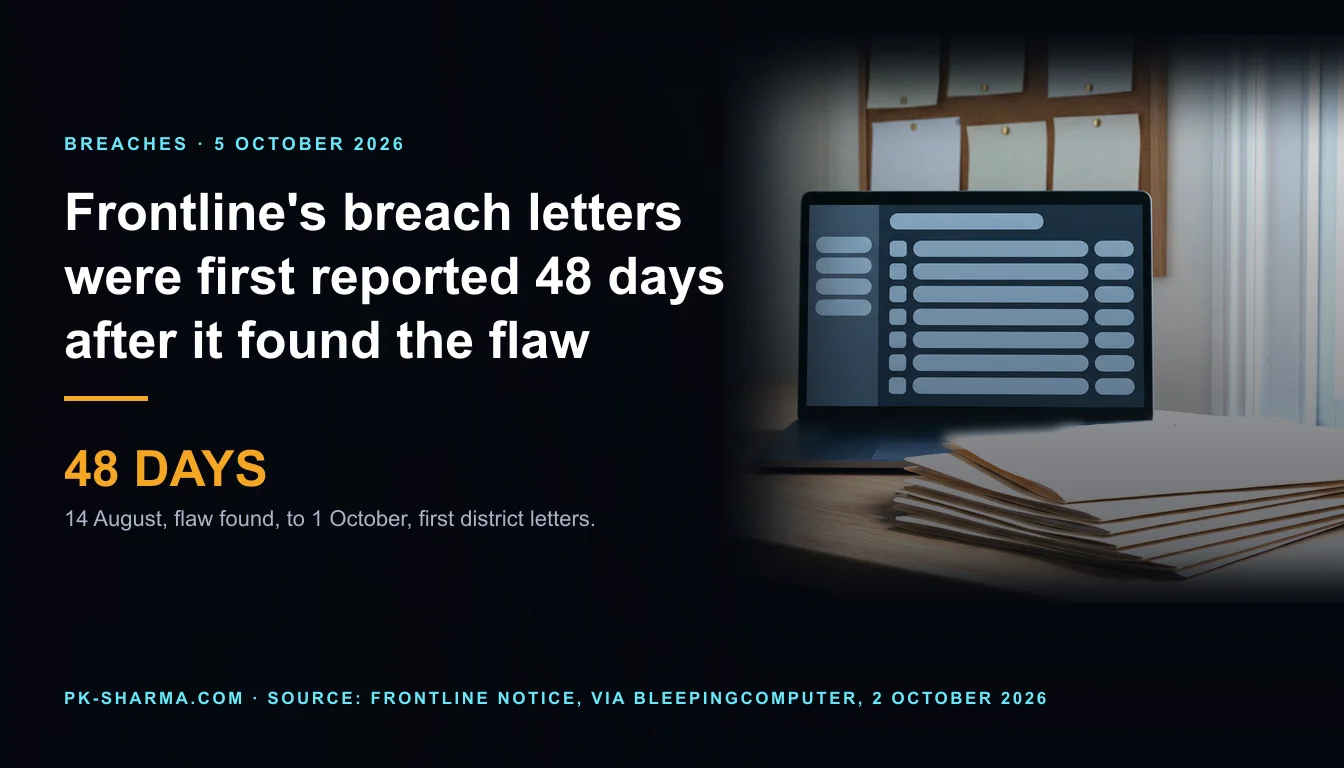
This site's briefing on Frontline Education asked the same question of a US supplier to school districts: how long between the supplier knowing and its customers hearing? Frontline's answer was 48 days, from a flaw found on 14 August to the first district letters reported on 1 October. The two cases are not like for like, and the table says where.
Frontline from our earlier briefing, Bromcom from the sources above. The day counts are derived. Different starting events and different first notices, so treat the comparison as a prompt, not a ranking.
- Measure
- Starting event
- Frontline (US)
- 14 August: security team identified a flaw in third-party software.
- Bromcom (UK)
- 6 September: incident identified after reports of SSO access problems.
- Measure
- First notice we can read
- Frontline (US)
- 1 October: a district's account of a letter, reported by the press.
- Bromcom (UK)
- 24 September: a forum post by a Bromcom account.
- Measure
- Days
- Frontline (US)
- 48
- Bromcom (UK)
- 18
- Measure
- Component named
- Frontline (US)
- No: a "third-party software product".
- Bromcom (UK)
- Yes: legacy SSO registration functionality in the Communication Server environment.
- Measure
- Count of people
- Frontline (US)
- 1,210 at one district. No total.
- Bromcom (UK)
- None in the public FAQ.
- Measure
- Regulator
- Frontline (US)
- Frontline says it handles US state attorney general notices.
- Bromcom (UK)
- Bromcom has not told the ICO. It says schools, as controllers, decide.
| Measure | Frontline (US) | Bromcom (UK) |
|---|---|---|
| Starting event | 14 August: security team identified a flaw in third-party software. | 6 September: incident identified after reports of SSO access problems. |
| First notice we can read | 1 October: a district's account of a letter, reported by the press. | 24 September: a forum post by a Bromcom account. |
| Days | 48 | 18 |
| Component named | No: a "third-party software product". | Yes: legacy SSO registration functionality in the Communication Server environment. |
| Count of people | 1,210 at one district. No total. | None in the public FAQ. |
| Regulator | Frontline says it handles US state attorney general notices. | Bromcom has not told the ICO. It says schools, as controllers, decide. |
Where Frontline named no product, Bromcom named the component and its role in plain words, which is useful to a defender. Where Frontline's clock ends in a letter a district showed a reporter, Bromcom's ends in a forum post, with the fuller notice in a members-only space. Neither case, on the dates alone, shows a breach of law. Both leave the same gap: the customer's own clock starts when the customer knows, and the supplier's dates are the only ones on the public record. We covered the regulator's side of that in an earlier briefing on the 72-hour clock.
The UK reading: the school's clock is its own, and Bromcom's FAQ hands it the decision
Bromcom says the data in this component is data it processes as a processor. Its FAQ says: "We have not notified the ICO about this incident." It is contacting the controllers so that they can assess it. That is consistent with the statute. Article 33(1) puts the duty to notify the regulator on the controller, "not later than 72 hours after having become aware", unless the breach "is unlikely to result in a risk to the rights and freedoms of natural persons". Article 33(2) says the processor "shall notify the controller without undue delay after becoming aware". There is no number of hours. Who the controller is, a school, a trust or a local authority, is for each customer to know. Bromcom says it is still mapping schools to controllers.
That makes the school's own date the one that matters. The EDPB's guidelines, whose earlier version the ICO's guide links and describes as continuing to be relevant, treat the controller, in principle, as aware once its processor has told it. They also say the processor need not assess the risk first: it must establish that a breach occurred and notify, and the EDPB recommends a prompt first notice with detail in phases. Bromcom's FAQ explains its pace by wanting a thorough review "so that you can make an informed decision". As an illustration only: a school that was told on 24 September, with enough detail to know it was affected, would count 72 hours to 27 September. A school first told later counts from then. No source dates any school's notice, and awareness turns on the facts, so this is arithmetic and not a finding.
Being a processor is not a safe harbour. Article 28(3) has the processor take "all measures required pursuant to Article 32" and assist the controller with Articles 32 to 36, and the contract is where breach-reporting terms belong, as the ICO's guide says. For an example of a processor fined directly, see Sweden's fine on Miljodata. Nothing here suggests Bromcom has been or will be.
Two points make this more than "email addresses". First, deletion counts as above. Second, Bromcom says the service relates to "staff and pupil accounts", so children's registration data is inside the component, although the FAQ has not said whether any pupil's record was among those retrieved. The DfE's guidance on managing breaches of data tells schools to establish the types of personal data and who the data subjects are, and contrasts "basic personal details of staff, such as name and email addresses" with full pupil records. An email address is the lower end of that scale, and a pupil's sign-in registration is not a full pupil record. Where it sits is the controller's judgement, and it must be written down either way: Article 33(5) has the controller document every breach, including those it does not report. A forum post relays Bromcom's view that the risk is not high. The FAQ itself gives no rating and answers the risk question with "ongoing".
The FAQ also tells schools: "There are no specific steps that schools need to apply as a result of this incident." In the same answer it urges vigilance for messages asking people to click links, provide credentials, approve sign-in requests or reset passwords. A controller cannot adopt the first sentence as its own conclusion. The assessment under Articles 33 and 34 is the school's. One administrative note: from 30 September 2026 the UK GDPR text on legislation.gov.uk says Article 33 notifications go to "the Commission", and the ICO says it transitioned to the Information Commission that day. Bromcom's FAQ and the regulator's own pages still say ICO, so we do too.
The risk Bromcom names is a believable sign-in email
Bromcom's FAQ names one risk by implication: its advice to be vigilant for suspicious messages, calls or emails, with a list of lures that ends in approving sign-in requests and resetting passwords. The fields it says were involved fit that lure. A person holding a school email address and the provider it uses (Microsoft or Google) can write a message that names the right provider and the right school system, and can cite a recent sign-in problem that staff really did experience. That last step is our inference. The NCSC's phishing guidance says criminals use information about you to make phishing messages more convincing.
That is a risk, not a report. We found no account of a phishing campaign using this data in the sources read. Black Swan Cyber's 1 October update says follow-on phishing "should not be presented as confirmed", and its sample lures are illustrations, not observed messages. It also sells in this space, which is not a reason to doubt the point, only a reason to weigh the framing. The useful reading is narrower: the one thing a controller can do before any evidence arrives is change what staff do with a sign-in prompt.
What to do, in the order worth doing it
Our judgement on the order, not a regulatory list. The first step comes first because a controller's clock cannot be recovered once it has been running unnoticed.
Take this with you
If your school, trust or local authority uses Bromcom, or any supplier's sign-on or MIS service
- Confirm whether you are affected and what you were told. Find the notice (the Community post is members-only, so check the contact address on your contract), and write down the date and time you became aware.
- Ask Bromcom in writing for: your list and count of registrations; whether each was retrieved, deleted or both; staff, pupils or both, including pupils on personal addresses; when access began and the service was withdrawn; the date it first told you; whether any data was copied; what was recovered; and a date for the next update.
- Warn staff to expect lookalike Microsoft or Google sign-in emails, to reach Bromcom only through the school's own portal or bookmark, never to approve an unexpected sign-in prompt, and to report doubtful messages to IT and to the NCSC's scam-email service. Agree the pupil version with the safeguarding lead.
- Check your own logs: sign-in logs in your Microsoft or Google tenant from early September for unusual attempts, and Bromcom user lists for unexpected SSO registrations, or for staff whose SSO link vanished or changed without a request.
- Ask your DPO to decide, and record, whether the school or trust must tell the regulator and the individuals. Record the decision even if the answer is no.
- Ask each supplier that holds staff or pupil data for a list of superseded services still running for you, and the internal systems that still depend on them. Put the answer on the contracts register that the DfE standard has IT support review each term.
- Review contract clauses: supplier notice in hours or days from the supplier's own awareness, a named contact, per-controller lists as they emerge and not only when final, and a root-cause statement when the investigation closes.
The DfE's termly review of the contracts register covers technology a school buys that has become or is about to become unsupported. It does not ask a supplier to list services it keeps running inside its own estate, so step six is our addition, not a DfE requirement. The NCSC's supply chain principles do point the same way: set minimum security requirements and put them in the contract, and build assurance activity, including a right to audit where it is possible, into those contracts (principle 10).
The question that exposes the gap
Bromcom says the old service stayed on because something inside the company still called it. Which superseded services is your own supplier still running on your staff and pupil data for the same reason, and which clause of your contract says you would hear about it before a stranger did?
Key facts
Sources
- PrimarySSO Personal Data Breach FAQs, updated 30 September 2026, read in a browser at 06:36 BST on 6 October 2026; the primary source for the component, the data fields, the staff and pupil scope, the 6 September date, the containment list, the ICO statement and the ongoing-investigation answers.Bromcomaccessed 2026-10-06
- PrimaryForum thread Bromcom SSO breach, 24 and 25 September 2026, read at 06:37 BST on 6 October 2026; used for the Bromcom account's post of 24 September and its reply of 25 September. Other posts are customer reports, unverified, and labelled as such.EduGeekaccessed 2026-10-06
- PrimaryCapture of the Bromcom FAQ at 20:05 UTC on 30 September 2026; text identical to the live page read on 6 October.Internet Archiveaccessed 2026-10-06
- PrimaryCapture of the Bromcom FAQ at 06:40 UTC on 1 October 2026; text identical to the 30 September capture.Internet Archiveaccessed 2026-10-06
- PrimaryHome page read at about 06:48 BST on 6 October 2026; the 3.3m users, 1.2m+ students, 5.6K+ schools and 390+ MATs claims.Bromcomaccessed 2026-10-06
- PrimaryUK status page, with its incidents and announcements pages, read at about 06:40 BST on 6 October 2026; no incident or announcement listed, and a note that not every incident is listed.Bromcomaccessed 2026-10-06
- PrimaryUK GDPR Article 33, as amended with effect from 30 September 2026; the 72-hour controller duty, the processor duty, the documentation duty.legislation.gov.ukaccessed 2026-10-06
- PrimaryUK GDPR Article 28, processor; contract terms and the processor's assistance duties.legislation.gov.ukaccessed 2026-10-06
- PrimaryUK GDPR Article 34, communication of a personal data breach to the data subject.legislation.gov.ukaccessed 2026-10-06
- PrimaryUK GDPR Article 4, definitions of controller, processor and personal data breach.legislation.gov.ukaccessed 2026-10-06
- PrimaryPersonal data breaches: a guide; the processor's duty under Article 33(2), the contract point and the continuing relevance of the EDPB guidelines.Information Commissioner's Officeaccessed 2026-10-06
- PrimaryNews item of 30 September 2026 on the transition to the Information Commission.Information Commissioner's Officeaccessed 2026-10-06
- PrimarySelf-reported personal data breach cases data sets; the latest listed covers January to March 2026, so nothing from this incident could appear.Information Commissioner's Officeaccessed 2026-10-06
- PrimaryGuidelines 9/2022 on personal data breach notification, version 2.0; paragraphs 44 to 46 on the processor, awareness and phased notice.European Data Protection Boardaccessed 2026-10-06
- PrimaryData protection in schools, managing breaches of data, updated 9 July 2026; types of data, data subjects and reporting.Department for Educationaccessed 2026-10-06
- PrimaryCyber security standards for schools and colleges, core standard, updated 16 September 2026; single sign-on, leavers, supplier assessments and the contracts register.Department for Educationaccessed 2026-10-06
- PrimaryUsing SaaS securely, reviewed 7 June 2023; legacy authentication interfaces and the single point of failure in federated sign-on.National Cyber Security Centreaccessed 2026-10-06
- PrimaryCloud security principle 10, identity and authentication; credential lifecycles and leavers.National Cyber Security Centreaccessed 2026-10-06
- PrimarySupply chain security principles, II Establish control; minimum security requirements in contracts.National Cyber Security Centreaccessed 2026-10-06
- PrimarySupply chain security principles, III Check your arrangements; assurance and the right to audit.National Cyber Security Centreaccessed 2026-10-06
- PrimaryPhishing scams: how to spot and report them; criminals use information to make phishing more convincing.National Cyber Security Centreaccessed 2026-10-06
- PrimaryReport a scam email; forwarding suspicious emails and not clicking links.National Cyber Security Centreaccessed 2026-10-06
- PrimaryCyber security for schools; reporting a school incident and the supply chain guidance.National Cyber Security Centreaccessed 2026-10-06
- Reported byReport of 5 October 2026 (10:30 UTC); a pointer to the primaries and the source of the 5,000 schools and 390 trusts figures it quotes.The Registeraccessed 2026-10-06
- Reported byConsultancy note of late September with an update of 1 October 2026; the only account we found of the 25 September FAQ wording and of the change on 30 September. A seller of email and phishing protection, so framing is weighed accordingly.Black Swan Cyber Security Solutionsaccessed 2026-10-06