IBM and Red Hat say Lightwell fixed 400+ Java flaws, and the release names no CVE, library or date
IBM and Red Hat said on 6 October that Lightwell had remediated more than 400 previously unknown flaws in widely used Java libraries. The release gives no CVE, library name, score or period, and Red Hat's own documents show who gets a fix first.
By Parminder Kumar Sharma · · 17 min read
The release gives one figure for 400 flaws, and no way to look up any of them
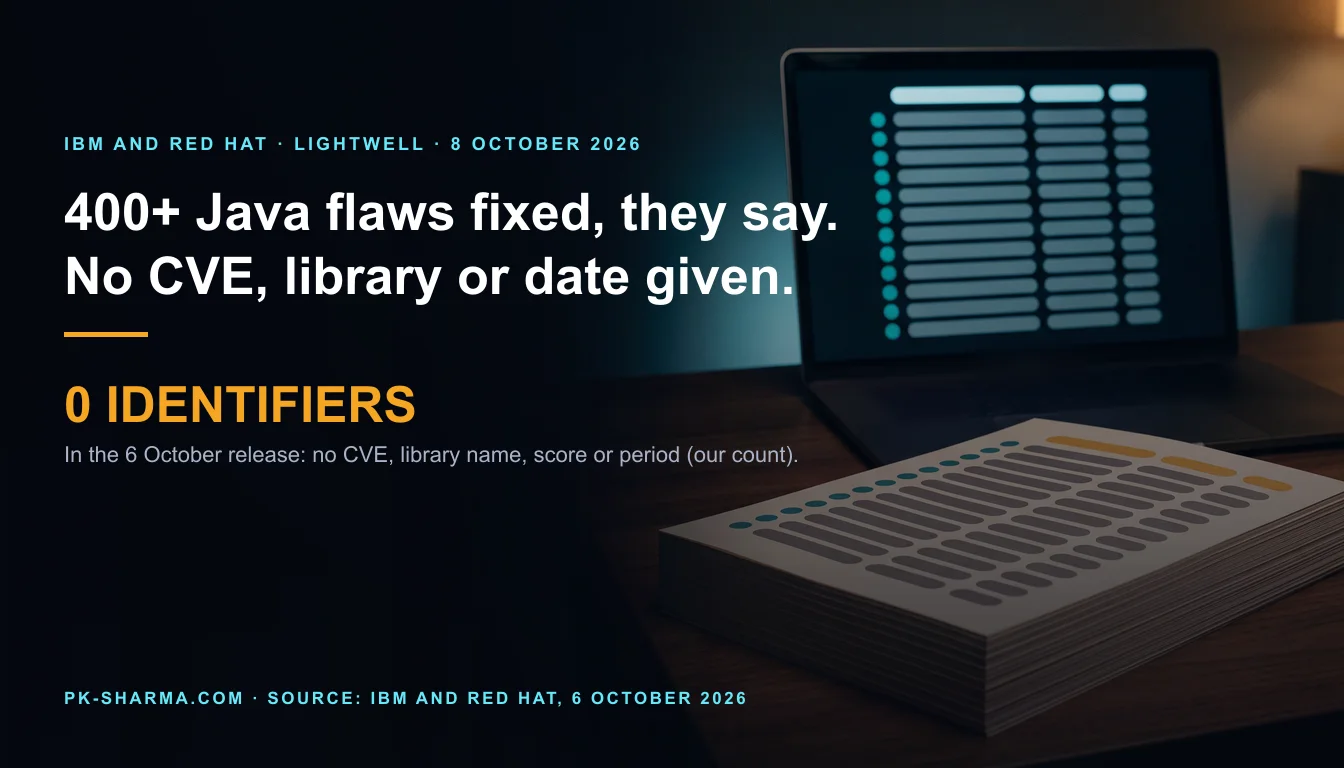
On 6 October 2026, IBM and Red Hat said that Lightwell, their paid service for supplying fixes to open source dependencies, "has identified and remediated more than 400 previously unknown vulnerabilities in widely used Java libraries". The release runs to about 550 words (our count of the IBM Newsroom text, from the dateline to the company boilerplate). It contains one number about the finds. It names no library, gives no CVE or other identifier, no severity score and no period. The words "CVE", "severity" and "advisory" do not appear in it (our search of the text). Help Net Security reported the story on 8 October, two days after the release, so the primary source is dated 6 October, not 8 October.
The 400 is the companies' own count of their own work. It is 131 days (derived) from the 28 May announcement of Lightwell to the release, but the release does not say when the counting began, so no rate follows from 400 and 131. IBM and Red Hat also sell the service: Lightwell is an annual subscription, and the figure sits in an announcement that makes its Clearinghouse tier generally available. None of that says the number is wrong. It means a defender has a claim and no identifier to check it with.
What the release states, and what it leaves out
We read the IBM Newsroom release and Red Hat's copy in full, then the Lightwell pages they point to. The table sets what the release says against what a defender would need.
The IBM and Red Hat release of 6 October 2026: stated and not stated. Quotes are from the IBM Newsroom text; Red Hat's copy matches.
- Item
- The count
- Stated
- "more than 400 previously unknown vulnerabilities" (lead). "bugs" (one body paragraph). "400+ novel vulnerabilities" (a Red Hat executive quote).
- Not stated
- Who counted, by what test, and whether related flaws in one library count once or many times.
- Item
- Libraries
- Stated
- "widely used Java libraries".
- Not stated
- Any library, group, version or count of libraries.
- Item
- Identifiers
- Stated
- None.
- Not stated
- Any CVE, GitHub advisory, OSV or Lightwell advisory ID.
- Item
- Severity
- Stated
- None.
- Not stated
- Any score or rating, or who would assign it.
- Item
- Time
- Stated
- The release date, 6 October 2026.
- Not stated
- When finding began or ended, or when each fix was built.
- Item
- Method
- Stated
- "Advanced AI-assisted engineering workflows", one of four capabilities listed.
- Not stated
- Which people or tools found the flaws, and whether AI was used to find them or only to fix them.
- Item
- Delivery
- Stated
- "secured repositories"; fixes "backported"; Clearinghouse now "generally available".
- Not stated
- Which versions of which libraries are covered, the price, and who is eligible.
- Item
- Upstream
- Stated
- Applicable fixes are "contributed back to upstream open source projects under responsible disclosure protocols", with "embargo protections for Clearinghouse participants".
- Not stated
- Which fixes, which projects, and when any of it becomes public.
| Item | Stated | Not stated |
|---|---|---|
| The count | "more than 400 previously unknown vulnerabilities" (lead). "bugs" (one body paragraph). "400+ novel vulnerabilities" (a Red Hat executive quote). | Who counted, by what test, and whether related flaws in one library count once or many times. |
| Libraries | "widely used Java libraries". | Any library, group, version or count of libraries. |
| Identifiers | None. | Any CVE, GitHub advisory, OSV or Lightwell advisory ID. |
| Severity | None. | Any score or rating, or who would assign it. |
| Time | The release date, 6 October 2026. | When finding began or ended, or when each fix was built. |
| Method | "Advanced AI-assisted engineering workflows", one of four capabilities listed. | Which people or tools found the flaws, and whether AI was used to find them or only to fix them. |
| Delivery | "secured repositories"; fixes "backported"; Clearinghouse now "generally available". | Which versions of which libraries are covered, the price, and who is eligible. |
| Upstream | Applicable fixes are "contributed back to upstream open source projects under responsible disclosure protocols", with "embargo protections for Clearinghouse participants". | Which fixes, which projects, and when any of it becomes public. |
The wording moves inside the release. The lead says "vulnerabilities", one body paragraph says "bugs", and the Red Hat executive's quote says "novel vulnerabilities". Red Hat's own page summarises it as "over 400 novel vulnerabilities fixed". A bug is not necessarily a vulnerability, and the release does not say which of the 400 are which. That is a question about method, not an accusation.
Help Net adds two sentences that the release does not contain. One says companies running the affected libraries "are exposed until they apply the fixes". The other says that if you are not in the programme, your fix will come from the public upstream release, whenever disclosure allows. Both are the reporter's inference. With no library named, nobody can say who is exposed. The second is much closer to Red Hat's own documentation, covered below.
One outlet, Phoronix, reported on 6 October that an embargoed draft of the release had cited 300 or more flaws before the figure became 400 or more. We could not verify that and do not rely on it. It is a reminder that the 400 is a press-release number.
What Lightwell is, how it is sold, and which numbers are which
IBM and Red Hat announced Project Lightwell on 28 May 2026 as "a $5 billion commitment" backed by more than 20,000 engineers. The commercial launch followed on 8 July with two offerings. Lightwell Network gave customers "a launch catalog of 6,500+ remediated, digitally signed, and certified application-layer dependencies". Lightwell Clearinghouse Premier started in a limited-availability phase, initially for financial services only.
Red Hat's Lightwell page describes the product as "structured as an annual subscription with two offering paths". The Network path is "consolidated self-service access to signed libraries, remediations, and patched artifacts". The Clearinghouse is "a selective, higher-touch offering generally available to eligible organizations". No price appears on any page we read: the route is "Contact sales". IBM's product page says patches come "with SLAs", but the support policy page we read gives no service levels and says Lightwell Network "does not include traditional Red Hat technical support". IBM and Red Hat are the sellers, and the 6 October figure is also their marketing for it.
Four numbers circulate and they count different things.
Four numbers about Lightwell and Java advisories, and what each counts. Derived: 400 is about 77% of 522 (400 divided by 522).
- Number
- 6,500+
- What it counts
- Catalogue entries at the 8 July launch: "remediated, digitally signed, and certified" dependencies. Not flaws.
- Source
- IBM release, 8 July 2026
- Number
- 400+
- What it counts
- "Previously unknown vulnerabilities" found and remediated, with no period given.
- Source
- IBM and Red Hat release, 6 October 2026
- Number
- 44
- What it counts
- Records in a public advisory feed that describes itself as Lightwell's, read at 7 October 18:31 UTC. Each cites an upstream CVE that was already public.
- Source
- GitHub repository, read 8 October
- Number
- 522
- What it counts
- Reviewed Maven advisories GitHub published from 28 May to 8 October (the newest is dated 7 October), for scale only. Not a Lightwell figure.
- Source
- GitHub advisory API, 8 October
| Number | What it counts | Source |
|---|---|---|
| 6,500+ | Catalogue entries at the 8 July launch: "remediated, digitally signed, and certified" dependencies. Not flaws. | IBM release, 8 July 2026 |
| 400+ | "Previously unknown vulnerabilities" found and remediated, with no period given. | IBM and Red Hat release, 6 October 2026 |
| 44 | Records in a public advisory feed that describes itself as Lightwell's, read at 7 October 18:31 UTC. Each cites an upstream CVE that was already public. | GitHub repository, read 8 October |
| 522 | Reviewed Maven advisories GitHub published from 28 May to 8 October (the newest is dated 7 October), for scale only. Not a Lightwell figure. | GitHub advisory API, 8 October |
The scale comparison is arithmetic, not a finding. If the 400 were all published as Maven advisories they would add up to about three quarters of everything GitHub published for that ecosystem in about 133 days (derived). The release does not say they will be published, or when.
This site has seen the shape before: a count or a fix with no identifier attached. OpenSSH 10.6's notes cited no CVEs, yet MITRE issued 11 within 12 hours. Roundcube fixed eight flaws in one release and named none. Kiteworks said it fixed a critical flaw and published no CVE, score or version. The difference here is the size: 400 flaws, no identifiers. Counts that can be checked line by line look different: one Debian kernel update lists 1,313 CVEs, and Chrome 155's notes carry 14 credits that name an AI tool.
What "backported" means, and what a scanner will make of a fixed library
In plain terms, a backport is the vendor's own version of a fix, written to fit an old release that the upstream project may no longer update. The customer keeps the version they run. The vendor ships a rebuilt copy with the fix in it. The release says Lightwell "rapidly develops version-specific fixes", and the July release gives the reason: major upgrades bring "lengthy regression testing and breaking changes".
Red Hat's documentation shows what the fixed copy looks like. A Lightwell Java artifact keeps the upstream version and adds a suffix: "5.3.17.rhlw-00001" is the first Lightwell build with security patches for upstream 5.3.17, and the next fix to that version would be "5.3.17.rhlw-00002". The counter is cumulative, so the suffix says some fixes were applied. It does not say all known flaws are fixed: Red Hat's support policy says patched artifacts are provided "at Red Hat's discretion based on vulnerability severity, exploitability, and ecosystem impact".
The known risk is in how scanners read version numbers. Red Hat's own Security Backporting Practice page, written for Red Hat Enterprise Linux, says "just looking at the version number of a package will not tell them if they are vulnerable or not". It adds that some scanning tools decide "based solely on the version number" and so report false positives for backported fixes. For Enterprise Linux, Red Hat says it has attached CVE names to its advisories since January 2000 and supplies OVAL definitions so tools can read the status. The Lightwell pages we read promise "VEX and OSV data" "as appropriate", not a CVE name on every advisory.
There is a live example of the problem. On 30 September a submission to the OSV database asked for Lightwell advisories to be added as a data source. An osv.dev contributor replied that records should sit in a Lightwell ecosystem of their own, because "Lightwell is a commercially gated service" and generic Maven tags would flag upstream records "even when the issue is fixed upstream". The submitter answered on 6 October that, for now, "Lightwell-aware scanner logic" has to be built so that scanners recognise the suffix. The issue was still open on 8 October, and osv.dev returned "not found" for a Lightwell record ID. The release says fixes arrive without replacing "current security scanners". The thread shows what a scanner has to learn to know a suffixed version holds a fix. Test yours.
"Fixed" for a subscriber is not "fixed" for everyone
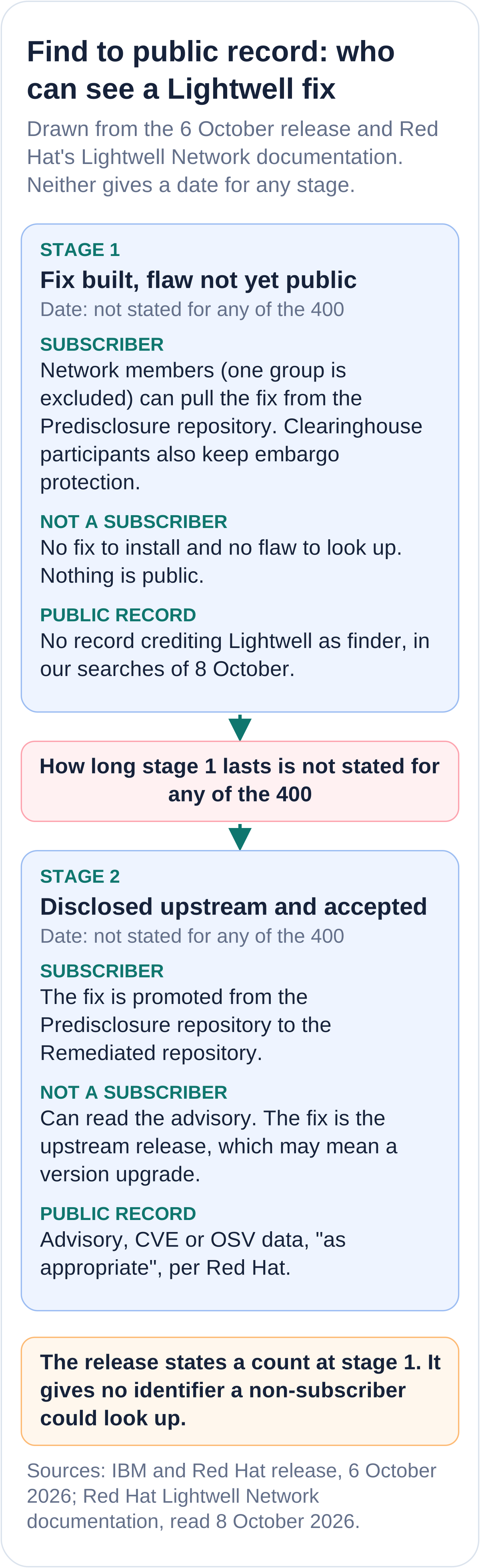
The release says fixes are contributed upstream "under responsible disclosure protocols" while "maintaining embargo protections for Clearinghouse participants". Red Hat's Lightwell Network documentation is more specific, and it describes a gap. Subscribers get three repositories. The third, Predisclosure, "houses libraries that contain security fixes for novel vulnerabilities that are not publicly disclosed or have not been accepted by the upstream communities". As Red Hat discloses and addresses a flaw upstream, the fix is "promoted from the Predisclosure repository to the Remediated repository". The documentation says plainly: "Red Hat includes fixes for novel vulnerabilities before public disclosure."
Two details matter. The documentation places the Predisclosure repository in Network membership, not only in the Clearinghouse tier, with one stated exception, "R1 Institutions", a term the page does not define. And it says the repository is "maintained with moderate and higher severity CVE fixes", which suggests, though no page states it for the 400, that a severity is assigned somewhere inside the programme.
So for some period a fix exists that a subscriber can install and a non-subscriber cannot see, for a flaw that has no public record. How long that period lasts is not stated for any of the 400, so we compute nothing.
That is the friendly-name problem. Four labels in the announcement each hide a condition.
Labels in the Lightwell announcements, what they can mean, and what they do not establish.
- Label
- "Fixed" or "remediated"
- What it can mean
- A fix exists in a Lightwell repository for a named upstream version.
- What it does not establish
- That the flaw is fixed in your build, or fixed in public.
- Label
- "Generally available" (Clearinghouse)
- What it can mean
- Red Hat: "generally available to eligible organizations". IBM's page: "preselected customers in critical infrastructure areas". July release: initially financial services only.
- What it does not establish
- That you can buy it.
- Label
- "Previously unknown"
- What it can mean
- Unknown to the companies before they found it (our reading).
- What it does not establish
- Unknown to attackers or to the upstream project.
- Label
- "Backported"
- What it can mean
- The fix was rewritten for an older version.
- What it does not establish
- The upstream fix, or a version your scanner recognises.
| Label | What it can mean | What it does not establish |
|---|---|---|
| "Fixed" or "remediated" | A fix exists in a Lightwell repository for a named upstream version. | That the flaw is fixed in your build, or fixed in public. |
| "Generally available" (Clearinghouse) | Red Hat: "generally available to eligible organizations". IBM's page: "preselected customers in critical infrastructure areas". July release: initially financial services only. | That you can buy it. |
| "Previously unknown" | Unknown to the companies before they found it (our reading). | Unknown to attackers or to the upstream project. |
| "Backported" | The fix was rewritten for an older version. | The upstream fix, or a version your scanner recognises. |
Is there any public record? What we searched on 8 October
Zero results is a result, so here is exactly what we searched, between about 12:00 and 12:15 BST on 8 October 2026.
Searches for Lightwell in public vulnerability records, with a positive control where one was available.
- Where
- NVD API, keyword search of CVE descriptions
- Query
- "Lightwell", "Red Hat Lightwell", "IBM Lightwell", "Project Lightwell"
- Result
- 0 results for each. Control "Log4j": 34.
- Where
- CVE.org record search
- Query
- "lightwell"
- Result
- No results. Control "log4j": 106.
- Where
- GitHub code search in the CVE List repository and GitHub's advisory database
- Query
- "lightwell"
- Result
- 0 in each. Controls "log4j": 113 and 46. The index is partial.
- Where
- GitHub Advisory Database, 522 reviewed Maven advisories published 28 May to 8 October, newest dated 7 October (4 withdrawn)
- Query
- The text "lightwell" anywhere; credit usernames containing "redhat", "red-hat", "red_hat" or "ibm"
- Result
- 0 and 0, across 426 credit entries from 196 usernames.
- Where
- osv.dev search
- Query
- "lightwell", all ecosystems and Maven only
- Result
- No results. A direct request for a Lightwell record ID returned "not found".
- Where
- The 62 upstream CVE.org records that Lightwell's own feed cites
- Query
- "lightwell" anywhere; credit fields (23 of the 62 records have one)
- Result
- 0 mention Lightwell. One 2024 record, assigned by Red Hat, carries Red Hat's standard thanks to outside reporters. Otherwise Red Hat appears only in affected-product lists.
| Where | Query | Result |
|---|---|---|
| NVD API, keyword search of CVE descriptions | "Lightwell", "Red Hat Lightwell", "IBM Lightwell", "Project Lightwell" | 0 results for each. Control "Log4j": 34. |
| CVE.org record search | "lightwell" | No results. Control "log4j": 106. |
| GitHub code search in the CVE List repository and GitHub's advisory database | "lightwell" | 0 in each. Controls "log4j": 113 and 46. The index is partial. |
| GitHub Advisory Database, 522 reviewed Maven advisories published 28 May to 8 October, newest dated 7 October (4 withdrawn) | The text "lightwell" anywhere; credit usernames containing "redhat", "red-hat", "red_hat" or "ibm" | 0 and 0, across 426 credit entries from 196 usernames. |
| osv.dev search | "lightwell", all ecosystems and Maven only | No results. A direct request for a Lightwell record ID returned "not found". |
| The 62 upstream CVE.org records that Lightwell's own feed cites | "lightwell" anywhere; credit fields (23 of the 62 records have one) | 0 mention Lightwell. One 2024 record, assigned by Red Hat, carries Red Hat's standard thanks to outside reporters. Otherwise Red Hat appears only in affected-product lists. |
The search that found something is a public GitHub repository, project-lightwell/lightwell-osv, whose README calls it the "public home database" for Red Hat Lightwell advisories. We could not find a Red Hat or IBM page that links to it, and the organisation account is unverified, so treat its ownership as self-described. Red Hat's documentation does say it releases "VEX and OSV data to the broader ecosystem as appropriate", which fits. On 8 October, at the commit of 7 October 18:31 UTC, it held 44 records: 43 for Maven and one for Python, across 30 packages, published from 14 July to 30 September.
What the 44 say matters more than their number. Every record cites at least one upstream CVE, 62 different CVEs in all, and all 80 citations point to a CVE that CVE.org had published on or before the date of the Lightwell record. Every record credits "Red Hat Lightwell" in one role, remediation developer. None credits Lightwell as the finder of anything. The feed does not say which of its records, if any, belong to the 400, and the release does not link to it. So the only public Lightwell records we found describe backports of flaws that already had public numbers.
Limits. The NVD keyword search covers description text, not credit fields. The osv.dev search matches IDs, packages and summaries. GitHub credits are usernames, not company names. A credit written as a name inside a CVE record is only searchable if CVE.org indexes that field, which we could not confirm. And the feed moves: the count of 44 is as of the commit we read. The finding is "no record we could find", not "no record exists".
For UK organisations running Java: what Cyber Essentials and the NCSC say
Cyber Essentials requirements v3.3, published in April 2026, define software to include "libraries". Its security update rule says updates must be installed within 14 days of release where the vendor calls them "critical" or "high risk", where the CVSS v3 base score is 7 or above, or where "there are no details of the level of vulnerabilities that the update fixes provided by the vendor". Our reading: a supplier fix that arrives with no severity falls into the third case, and the 14 days run from its release. That is the clause an unscored backport lands in.
The same document defines "licensed and supported software" as software a vendor has committed to support with regular vulnerability fixes, with a future end date for those fixes. It adds that "the vendor doesn't need to have created the software originally, but they must be able to modify the original software to create fixes". Our reading: a backport supplier could make an end-of-life library version count as supported, provided the supplier states an end date. The Lightwell support policy page we read gives no end date for any library.
Where Java libraries sit under Cyber Essentials v3.3 (April 2026), as the text reads. Our reading, not an assessor's ruling.
- Case
- A library inside a commercial application you bought
- What v3.3 says
- Commercial off-the-shelf applications are software, and vendor updates are subject to the 14-day rule.
- What it leaves open
- Which vendor update carries a given library fix. Ask the vendor.
- Case
- A library in software you wrote or commissioned
- What v3.3 says
- "Bespoke and custom components of web applications are out of scope", with a pointer to the Software Security Code of Practice.
- What it leaves open
- Whether open source libraries inside a bespoke build are covered. The text does not say. Ask your certification body.
- Case
- A library installed on an in-scope server
- What v3.3 says
- Software includes libraries, and all software on in-scope devices must be supported and updated.
- What it leaves open
- Nothing specific to backports.
| Case | What v3.3 says | What it leaves open |
|---|---|---|
| A library inside a commercial application you bought | Commercial off-the-shelf applications are software, and vendor updates are subject to the 14-day rule. | Which vendor update carries a given library fix. Ask the vendor. |
| A library in software you wrote or commissioned | "Bespoke and custom components of web applications are out of scope", with a pointer to the Software Security Code of Practice. | Whether open source libraries inside a bespoke build are covered. The text does not say. Ask your certification body. |
| A library installed on an in-scope server | Software includes libraries, and all software on in-scope devices must be supported and updated. | Nothing specific to backports. |
The NCSC's Software Security Code of Practice, version 1.0 of 7 May 2025, is written for software vendors, which includes you if you build software. Principle 1.2 says the first step is to "identify all the components used across all your software", names an SBOM as one possible format, and expects components to be "regularly checked for vulnerabilities for the lifespan of the product". The NCSC's blog on SBOMs, of 11 September 2024, adds the limit that matters here: "SBOMs paired with vulnerability scanners will only show results for known vulnerabilities." An inventory finds a library. It cannot find a flaw that has no identifier.
To find which Java libraries and versions you run, start with the build and then check the artefacts, because shaded and bundled libraries do not always show in the build file.
mvn dependency:tree
./gradlew dependencies --configuration runtimeClasspath
unzip -l application.jar | grep 'META-INF/maven/.*pom.properties'
Take this with you
Put these to a supplier in writing
- Which of our Java libraries and versions does a Lightwell or other backported fix cover, named by group, artefact and version?
- What is the CVE, GitHub advisory or other advisory ID for each fix, and where is it published?
- What severity does each carry, who assigned it, and on what date did the fix first become available to you?
- Which repository tier do you pull from, and what is the end date for supporting each fixed version?
- What evidence will you give us that a suffixed version contains the fix: an advisory, a VEX statement or an OSV record?
What to do, in order
None of this needs the 400 to be named. It needs your estate to be known, and your suppliers to be asked in a form you can keep.
Take this with you
Defender actions, in the order worth doing
- Inventory every Java library and version in production, including transitive dependencies, shaded jars, application-server modules and container images, and keep a build-time SBOM.
- Ask your platform vendor, distribution and software suppliers in writing whether they use Lightwell or any other backport service, and which repository tier they pull from.
- For any fix a supplier calls a Lightwell or backport fix, ask for the CVE or advisory ID, the affected and fixed versions, the severity and who assigned it, and the date it first reached them.
- Treat a fix with no stated severity as inside the Cyber Essentials 14-day rule, and record the date it was released to you.
- Do not mark a library fixed on a version number alone. Test how your scanner treats a suffixed version, and keep the evidence (advisory, VEX or OSV record) beside the exception.
- Ask what happens to your fixed builds when a subscription or support ends, and write down the version you would move to.
- Plan for the upstream release: watch advisories for your libraries, and decide in advance whether you will move to the upstream version or stay on the backport.
- Record the unnamed 400 in your risk register as a vendor claim without identifiers, with a review date, and revisit it when identifiers appear.
The question that exposes the gap
If a supplier told you tomorrow that a library in your production estate was one of the 400, which identifier would you ask for, and who outside the programme could give it to you?
Until the answer is an ID that anyone can look up, the figure is a claim. It may be a true one. A defender still cannot act on it.
Key facts
Sources
- PrimaryRelease of 6 October 2026, read in full: the 400+ claim, the wording vulnerabilities, bugs and novel, the four capabilities, the upstream and embargo sentence, the executive quote; our count of 548 words and zero CVE, severity, advisory or library namesIBM Newsroomaccessed 2026-10-08
- PrimaryRed Hat copy of the 6 October 2026 release, read in full: same text, the "In short" summary "over 400 novel vulnerabilities fixed", page date 6 October 2026Red Hataccessed 2026-10-08
- PrimaryLightwell product page: annual subscription with two offering paths, Clearinghouse "generally available to eligible organizations", Contact sales, no price, video caption on AI agentsRed Hataccessed 2026-10-08
- PrimaryLightwell product page: Clearinghouse Premier for preselected customers in critical infrastructure areas, patches "with SLAs", Maven and Java as the initial focusIBMaccessed 2026-10-08
- PrimaryRelease of 28 May 2026 announcing Project Lightwell: the $5 billion commitment, 20,000 engineers, commercial subscriptionsIBM Newsroomaccessed 2026-10-08
- PrimaryRelease of 8 July 2026: Lightwell Network and Clearinghouse Premier, the 6,500+ launch catalogue, financial services first, backports to avoid breaking upgradesIBM Newsroomaccessed 2026-10-08
- PrimaryPost of 15 June 2026 by the chief technology officer: AI for threat ingestion with human engineering, members receive coordinated patches before public disclosureRed Hat blogaccessed 2026-10-08
- PrimaryLightwell Network repositories, read in a browser tab: the Validated, Remediated and Predisclosure repositories and what the Predisclosure repository holdsRed Hat Documentationaccessed 2026-10-08
- PrimaryRepository version suffixes, read in a browser tab: the rhlw counter and the predisclosure suffixRed Hat Documentationaccessed 2026-10-08
- PrimaryPatch delivery lifecycle, read in a browser tab: AI assistance for patch generation, upstream contribution, disclosure with VEX and OSV data as appropriateRed Hat Documentationaccessed 2026-10-08
- PrimaryWhat is new, read in a browser tab: Predisclosure repository added, moderate and higher severity CVE fixes, promotion to the Remediated repositoryRed Hat Documentationaccessed 2026-10-08
- PrimaryLightwell support policy, read in a browser tab: scope of coverage, patches provided at Red Hat's discretionRed Hat Customer Portalaccessed 2026-10-08
- PrimarySecurity Backporting Practice, undated, for Red Hat Enterprise Linux: definition, version numbers and scanners, CVE names on advisories since January 2000, OVAL definitionsRed Hat Customer Portalaccessed 2026-10-08
- PrimaryPublic repository describing itself as the home database of Red Hat Lightwell advisories; 44 records read at the commit of 7 October 2026 18:31 UTC; credits and upstream CVE citations analysedGitHub (project-lightwell organisation, unverified)accessed 2026-10-08
- PrimaryIssue 6105, New data source: Red Hat Lightwell, opened 30 September 2026 and open on 8 October: ecosystem naming, scanner false positives, Lightwell-aware logicGitHub (google/osv.dev)accessed 2026-10-08
- PrimaryNVD API keyword searches for Lightwell, Red Hat Lightwell, IBM Lightwell and Project Lightwell on 8 October 2026: 0 results each; control Log4j 34NIST NVDaccessed 2026-10-08
- PrimaryCVE.org record search for lightwell on 8 October 2026, read in a browser tab: no results; control log4j 106 resultsCVE Program (MITRE)accessed 2026-10-08
- PrimaryAPI query of reviewed Maven advisories published 28 May to 7 October 2026: 522 advisories, none mentioning Lightwell, no credit usernames matching Red Hat or IBMGitHub Advisory Databaseaccessed 2026-10-08
- Primaryosv.dev search for lightwell on 8 October 2026: no results in any ecosystem; a request for a Lightwell record ID returned not foundOSV (osv.dev)accessed 2026-10-08
- PrimaryCyber Essentials: Requirements for IT Infrastructure v3.3, April 2026: definition of software and of licensed and supported software, scope of bespoke components, the 14-day ruleNational Cyber Security Centreaccessed 2026-10-08
- PrimarySoftware Security Code of Practice implementation guidance, Theme 1, Principle 1.2 on third-party components, version 1.0 of 7 May 2025National Cyber Security Centreaccessed 2026-10-08
- PrimaryBlog post of 11 September 2024 on SBOMs: benefits and limits, scanners show only known vulnerabilitiesNational Cyber Security Centreaccessed 2026-10-08
- Reported byNews pointer of 8 October 2026; its sentences on exposure and on non-participants waiting for the upstream release are the reporter's inference and are marked as suchHelp Net Securityaccessed 2026-10-08
- Reported byNews pointer on the 28 May 2026 launch; checked against the IBM releaseHelp Net Securityaccessed 2026-10-08
- Reported byNews pointer of 6 October 2026, read in a browser tab: reports an embargoed draft cited 300 or more flaws; not verified and not relied onPhoronixaccessed 2026-10-08