Kiteworks says it fixed a critical flaw. It has published no CVE, score or version
Kiteworks lifted its shutdown recommendation on 27 September and says it fixed a previously unknown critical vulnerability. The public record names no CVE, no severity score and no fixed version, and the six-hour or nine-hour question from our first briefing is still open.
By Parminder Kumar Sharma · · 8 min read
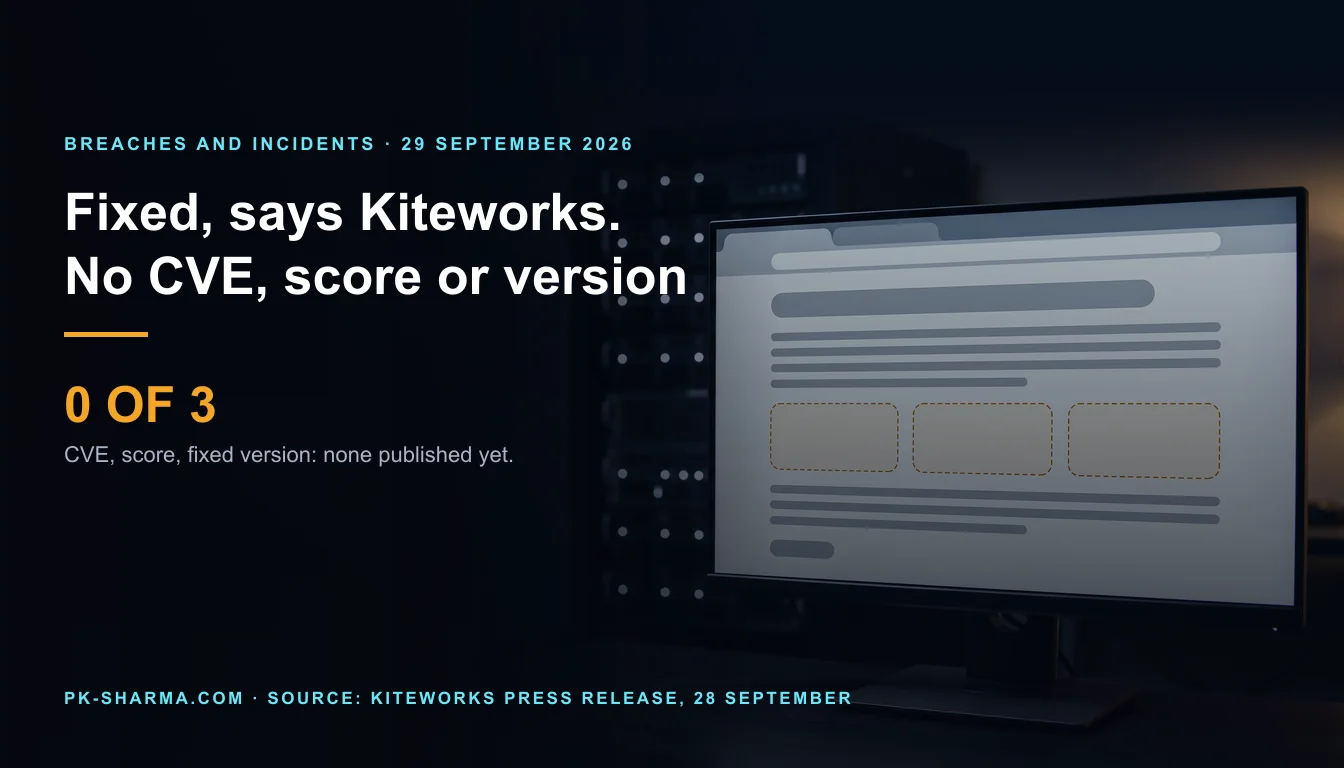
Fifty-five words, and no CVE
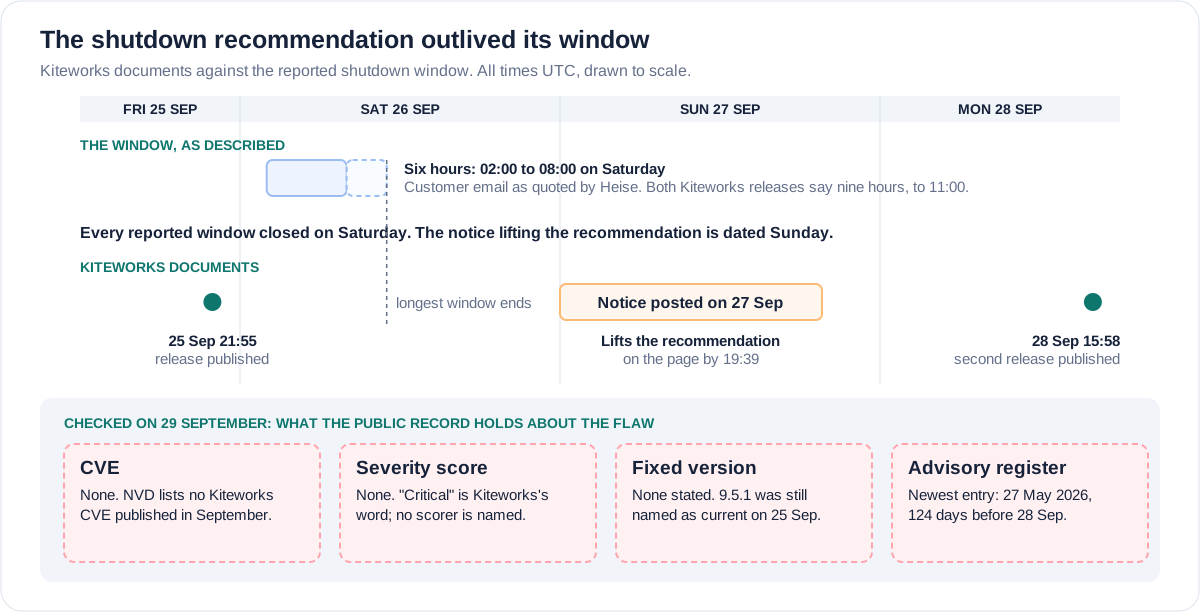
Kiteworks lifted its shutdown recommendation in a notice of 55 words, dated 27 September 2026. The next day a press release said work during the shutdown had led to the discovery of "a previously unknown critical vulnerability" and that Kiteworks had "developed and deployed a fix". Neither document carries a CVE identifier, a severity score or a fixed version number, and the 28 September release names no product.
The vendor's own advisory register on GitHub, read on 29 September, holds 23 published advisories. The newest was published on 27 May 2026, 124 days before that release. The National Vulnerability Database returns no Kiteworks CVE published in September, and CISA's Known Exploited Vulnerabilities catalogue has no Kiteworks entry since 2021.
This follows Kiteworks told customers to shut down for six hours. Its own press release says nine, twice, which covered the shutdown request and is not repeated here.
What that does not establish. It does not show the fix is absent, that anyone was harmed, or that a CVE will not follow: advisories can lag notices. It does not show exploitation, or its absence. A missing score is not a low score. It does establish something narrower: on 29 September a defender cannot look the flaw up, scan for it, or tell an auditor which fix was applied, using anything Kiteworks has made public.
What the closing documents say, and leave out
Both Kiteworks documents were read directly. The customer email is not public, and the Reddit copy SecurityWeek cites could not be reached, so anything from it is attributed to the reporting that quoted it.
Kiteworks's 27 September notice and 28 September release, read directly.
| Item | Kiteworks has stated | Not stated |
|---|---|---|
| Recommendation | "As of September 27th" lifted for all customers; hosted systems back up | The hour of the notice; how long it stood for self-managed customers |
| The flaw | "Previously unknown" and "critical", in a capability enabled for under 1% of customers | Name, class, versions, score, when it entered the code |
| The product | Notice only: self-hosted "Advanced Forms" customers should contact Customer Support | Whether that is the flawed capability; the release does not name it |
| The fix | "Developed and deployed" during the window, plus an "additional protective layer" | Version or hotfix identifier; whether self-managed customers hold it |
| Exploitation | "No indication"; monitoring "showed no abnormal activity" | What was monitored, on whose systems, from which date |
| Link to the tip | The response "led to the discovery" | Whether this is the flaw the threat actor meant to use |
Two words carry the weight. Critical first. Kiteworks's GitHub register holds 12 advisories for Secure Data Forms, which Computer Weekly and Arabian Post equate with Advanced Forms. They were fixed in 9.2.1 and 9.3.0 and scored between 3.7 and 8.2. None reached 9.0. If "critical" carries its CVSS meaning, 9.0 or above, it is a step above anything previously rated in that product. Kiteworks does not say which meaning it intends, and gives no number and no named scorer.
Then patched, BleepingComputer's headline verb. Kiteworks's words are a fix and an unspecified "additional protective layer", and it tells self-hosted Advanced Forms customers to contact support. A fix whose only stated route is a support call has no public identifier, and a comforting word is not a control.
The recommendation outlived its window
Heise, which obtained the email, and BleepingComputer report a six-hour window: 04:00 to 10:00 on Saturday 26 September in central Europe, 22:00 Friday to 04:00 Saturday in New York. Both are 02:00 to 08:00 UTC, as Computer Weekly also reports. Kiteworks's English and German releases still say nine hours, and nothing reconciles the figures. Even nine hours ends at 11:00 UTC on Saturday.
The notice is dated Sunday, and its own wording, "If you have not already restarted", implies some customers were still down. A recommendation being lifted on 27 September had outlived the six or nine hours both documents describe (derived from the dates). The release page was last edited at 19:39 UTC that day, 41 hours 39 minutes after a 02:00 window opened, and the 28 September release has the chief executive thanking customers who "gave up their weekend".
Brief 126 reasoned that a fixed-length window implied the tip carried timing. The 28 September release does say "The threat window has passed without incident", so a timed threat is now the vendor's own framing, but it gives that window no length. Two things are being run together: a threat with a time window, and a flaw, which has none. That may be why self-hosted Advanced Forms customers were sent to support rather than told to restart. It is inference; the release does not separate them.
Brief 126's open questions, checked against what Kiteworks has published since.
| Question from brief 126 | Status | What settles it, or does not |
|---|---|---|
| Six hours or nine? | Still open | Both releases say nine; the email, as quoted by Heise, says six. |
| Federal intelligence authorities or law enforcement? | Still open | The releases say the first; the CISO's Friday statement to Cybersecurity Dive used both terms. No agency is named. |
| Which vulnerability, and a CVE? | Partly answered | A critical flaw in an unnamed capability. The email, as quoted, names Advanced Forms. No CVE. |
| Was anything compromised? | Vendor says no | "No indication", from its own monitoring. Not independently checkable. |
| Did the tip carry timing? | Partly answered | A "threat window" that "has passed", length not given. |
Was the shutdown proportionate?
On what Kiteworks knew on Friday, the call is defensible. TechCrunch reports the customer email cited vulnerabilities unknown to Kiteworks and said the company could not confirm what other routes for improper access existed. When you do not know where a flaw is, telling everyone to stop is the only instruction that covers it.
On what is known now, the fit is worse. The email, as SecurityWeek quotes it, says the feature is enabled for "under 50 organizations". Kiteworks's own product page cites more than 3,800 enterprise customers, so "fewer than 1%" implies fewer than 38 (derived). The recommendation went to every self-managed customer to cover a flaw that, by Kiteworks's account, sits in under 1% of them, and neither release says why finding a flaw in code needed customers offline.
Neither reading can be graded from outside. A quiet weekend fits a threat that was real and stopped, and one never there. The grader is also the vendor, whose release is headed as a decision that "Successfully Navigates Credible Threat". Kiteworks, like any vendor, has a commercial interest in how the decision is remembered.
What was exposed before the fix
The customer's question is not the weekend: "previously unknown" means the flaw predates it. Exposure runs from when the flaw entered the code to when the fix reached your system. Kiteworks states neither date, nor the affected versions. Its "continuous monitoring throughout the period" does not define the period, or say whether it covers customer-hosted systems.
Scope is the other gap. "Confined to" one capability says where the flaw sits, not what it could reach. Kiteworks's own Secure Data Forms page says submitted data flows into downstream workflows through "integrated file sharing, email, MFT, SFTP, and APIs". Whether the flaw could reach that data is not stated.
Take this with you
In the order worth doing
- Establish whether Advanced Forms, also called Secure Data Forms, is enabled on any Kiteworks instance you run or depend on, and record the answer either way.
- If it is, ask Kiteworks in writing for the fix identifier, affected versions, the date the flaw entered the code, and whether a CVE will follow.
- Preserve logs for the forms component and its host from before 25 September, not only the weekend, and review them for unexpected accounts, role changes, uploaded files and outbound connections. Vendor monitoring is not evidence about a system you host.
- Treat data submitted through the forms since it was enabled as in scope for your data protection review until the flaw is dated.
- Record the hours you were down and what you were told, so the next unattributed shutdown request meets a written rule.
The question this leaves
Kiteworks may be right on every point: the intelligence sound, the flaw fixed, nobody touched. None of that can be checked from what the company has published, and the one thing that would let an outsider check it, a CVE with a fixed version against it, is missing.
So the question, for any supplier that says it has fixed something critical: what would it have to publish before your risk register may say "remediated", and who in your organisation can refuse the word until it does?
Sources
- PrimaryThe company's 28 September 2026 press release, read in full, used for the previously unknown critical vulnerability, the fix deployed during the window, the no indication of exploitation statement, the threat window wording and the chief executive's quotationKiteworksaccessed 2026-09-29
- PrimaryThe original 25 September 2026 release with the 27 September notice added at the top, read in full, used for the lift date, the Advanced Forms support instruction, the nine-hour wording and the 9.5.1 statementKiteworksaccessed 2026-09-29
- PrimaryThe German-language version of the release, used to confirm the same notice and the same nine-hour wordingKiteworksaccessed 2026-09-29
- PrimaryThe vendor's own advisory register, read through the GitHub API on 29 September, used for the 23 published advisories, the 12 for Secure Data Forms, their scores and fixed versions, and the newest publication date of 27 May 2026Kiteworks on GitHubaccessed 2026-09-29
- PrimaryKeyword search for Kiteworks, used to confirm that no Kiteworks CVE was published in September 2026NIST National Vulnerability Databaseaccessed 2026-09-29
- PrimaryKnown Exploited Vulnerabilities catalogue, version 2026.09.27, used to confirm the only Kiteworks or Accellion entries are the four 2021 FTA vulnerabilitiesCISAaccessed 2026-09-29
- PrimaryThe vendor's Secure Data Forms product page, used for the 3,800 customer figure and the statement that submitted data flows into downstream workflowsKiteworksaccessed 2026-09-29
- Reported byThe pointer article of 29 September, used for the patched headline and the Monday dating of the hosted restorationBleepingComputeraccessed 2026-09-29
- Reported byUsed for the customer email as shared on Reddit and quoted, naming Advanced Forms and the under 50 organisations scopeSecurityWeekaccessed 2026-09-29
- Reported byUsed for the six-hour window in UTC and for equating Advanced Forms with Secure Data FormsComputer Weeklyaccessed 2026-09-29
- Reported byUsed only for equating Advanced Forms with Secure Data Forms; its other claims are not relied onArabian Postaccessed 2026-09-29
- Reported byThe first report, which obtained the customer email, used for the six-hour wording, the central Europe window and the support statement about access routesheise onlineaccessed 2026-09-29
- Reported byUsed for the New York and central Europe windowsBleepingComputeraccessed 2026-09-29
- Reported byUsed for the customer email's concern about vulnerabilities not yet known to KiteworksTechCrunchaccessed 2026-09-29
- Reported byUsed for the CISO's Friday statement, which uses both federal intelligence authorities and law enforcement partnersCybersecurity Diveaccessed 2026-09-29