Kiteworks told customers to shut down for six hours. Its own press release says nine, twice
The advisory names no vulnerability, no CVE and no confirmed breach. It does carry an operational instruction, and that instruction has two different values depending on which Kiteworks document you read.
By Parminder Kumar Sharma · · 8 min read
One instruction, two numbers
On 25 September 2026 Kiteworks, which sells managed file transfer to banks, insurers, hospitals and government departments, told its customers to turn the product off for the weekend.
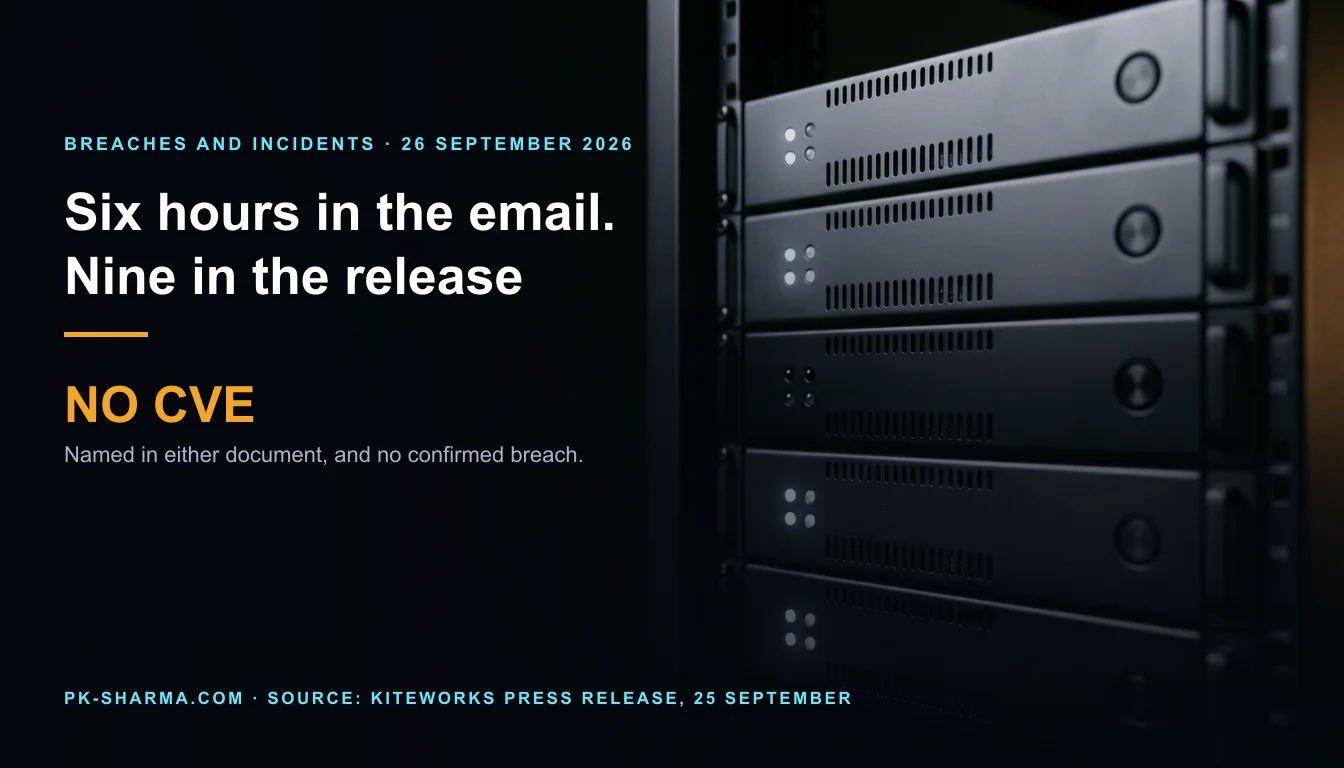
The company's press release, datelined San Mateo and published the same day, says this: customers are advised "to facilitate a nine-hour precautionary shutdown window this weekend, in their local time zone". Further down, it repeats the figure, referring to "the recommended nine-hour timeframe".
The email that went to customers, as quoted by BleepingComputer, says something else. "We strongly recommend you shut down your Kiteworks system for six hours." The regional windows reported alongside it are six hours each: New York from 22:00 on Friday to 04:00 on Saturday, central Europe from 04:00 to 10:00 on Saturday.
There is no CVE in either document. There is no vulnerability named. There is no confirmed compromise. The only operational instruction in the whole advisory is a duration, and it has two values.
What that does not establish. It does not establish that anybody was misled: a customer acts on the email, not on the press release, and six hours inside a nine hour envelope would satisfy both readings. It does not establish carelessness, because two documents written the same day under time pressure for two different audiences routinely differ. It does not establish that a zero day exists. And it does not establish that either number corresponds to anything anybody has measured, which is the part worth staying with.
What it does establish is narrower and harder to argue with. The number a defender acts on depends on which Kiteworks document they read, and the site's own public statement is not the one that carries the operative instruction.
The two documents, field by field
The press release was read in full for this piece. The customer email was not: it went to customers, and what follows is how it has been quoted in reporting, labelled as such in every row.
Kiteworks' public press release of 25 September 2026, read in full, against the customer email as quoted by BleepingComputer and TechCrunch.
| Field | Press release, read directly | Customer email, as quoted |
|---|---|---|
| How long to stay down | Nine hours, stated twice | Six hours |
| Who supplied the intelligence | Federal intelligence authorities | Law enforcement |
| Whether anything is compromised | No indication, preventative | Not contradicted |
| Which version to run | 9.5.1, all known vulnerabilities accounted for | 9.5.1 |
| Which vulnerability | Not named | Not named |
| Regional windows | Not given | Given, six hours each |
Two of those rows differ, and the second one matters as much as the first. Federal intelligence authorities and law enforcement are not the same institutions in the United States, and a reader trying to work out how much weight to put on an unnamed tip is entitled to know which kind of body produced it. TechCrunch reports that the FBI declined to comment and that CISA would not comment on the record, so neither characterisation can be checked from the outside.
The rest of the advisory is consistent and unusually clear. Chief information security officer Frank Balonis is quoted saying the company has "no indication that Kiteworks or our customers' systems have been compromised", and that Kiteworks "has accounted for all known vulnerabilities in our current release, 9.5.1". Customers who self-manage, on premises or on AWS or Azure, shut down themselves. Kiteworks shuts down the systems it hosts on the customer's behalf, in the same window, so those customers need do nothing. Eight named subsidiaries, including ownCloud and DRACOON, are stated not to be affected by this threat.
What a fixed window implies about the tip
Set the discrepancy aside and look at the shape of the control, because it tells you something about the intelligence that neither document states.
A vulnerability does not expire. If an attacker holds an unpatched flaw in a file transfer product, that capability is just as good on Monday as it was on Saturday. Shutting down for a fixed number of hours defends against exactly one thing: an attack that was going to arrive inside those hours.
So the advisory implies, without saying, that the tip included timing. That is an inference and it is labelled as one. But it is the most useful thing a reader can take from the whole episode, because it distinguishes between the two kinds of warning a company in this position can receive. One is "somebody has a capability against your product", which a shutdown window does almost nothing about. The other is "something is scheduled against your customers this weekend", which a shutdown window addresses precisely. The instruction is only rational under the second, and the second is the one the advisory does not describe.
Why this vendor, and why the reflex is defensible
Managed file transfer is the product category with the worst record in enterprise software, and Kiteworks sits at the centre of that history. The company was Accellion until 2021, and the mass exploitation of Accellion's file transfer appliance at the turn of 2020 into 2021 is one of the defining supply chain extortion events of the period. Reporting on this advisory also lists GoAnywhere, SolarWinds Serv-U, Cleo and MOVEit, all of which have been through the same thing.
That history is context for why a vendor here might act on a tip rather than wait for confirmation, and it deserves to be stated plainly rather than used as a jab. It is not evidence about this weekend. Nothing in the advisory connects the two, and a briefing that implies otherwise is doing the thing this site criticises in others.
The product category matters for a second reason. A file transfer system is, by design, the place an organisation puts the data it has decided is too sensitive for ordinary channels. That is why it is attacked, and it is also why turning it off for six or nine hours is more expensive than turning off almost anything else: the work that stops is the work somebody already judged to be sensitive and time critical.
What to do about it
Take this with you
In the order worth doing
- Act on the email, not on the press release, and confirm the window with Kiteworks support for your own time zone rather than inferring it from either document.
- Confirm whether your instance is self-managed or Kiteworks-hosted, because the company shuts down the systems it hosts and does not shut down yours.
- Verify you are on 9.5.1 before the window rather than after, since that is the only concrete remediation in the advisory and it is the one thing that persists beyond the weekend.
- Preserve logs across the shutdown and the restart. An advisory that turns out to have been about something real is answered from telemetry, and a system that is off produces none, so the hours either side are the evidence you will have.
- Write down, now, what you would do if the same email arrived on a Tuesday about a system you cannot switch off. That is the decision this advisory is rehearsing, and the answer is a policy question rather than a technical one.
- When it is over, record which of the two numbers your organisation used and why, because the next unattributable tip will land in the same inbox.
The question this leaves
There is a version of this story in which a vendor is criticised for overreacting, and another in which it is praised for moving fast on a warning it could not publish. Neither is available on the evidence, and both would be written before the weekend has happened.
What can be said is smaller. A company received something it found credible, could not describe it, and asked thousands of organisations to stop moving sensitive data for the length of a working morning. It then published that instruction with a different number on it from the one it sent to the people who had to carry it out.
So the question, and it is not really about Kiteworks: when a supplier tells you to switch something off and cannot tell you why, what is the standard of evidence at which your organisation complies, and who in your organisation is allowed to decide it at ten o'clock on a Friday night?
Sources
- PrimaryThe company's own press release of 25 September 2026, read in full, used for the nine hour window, the Balonis quotation, the hosted and self-managed split and the subsidiary listKiteworksaccessed 2026-09-26
- Reported byUsed for the customer email wording and the regional shutdown windows, neither of which appears in the press releaseBleepingComputeraccessed 2026-09-26
- Reported byUsed for the law enforcement wording in the email, the FBI and CISA declining to comment, and the exposure estimateTechCrunchaccessed 2026-09-26
- Reported byUsed to corroborate the nine hour figure and the subsidiary listThe Hacker Newsaccessed 2026-09-26