PoeLLM hides its address in a poem, but the LiteLLM flaw Lumen names was fixed 177 days before its report
Lumen's Black Lotus Labs says PoeLLM has hit more than 3,400 exposed servers and hides its command address in a poem. The poem is the disguise, not the way in: the LiteLLM flaw Lumen links to it had a fixed release 177 days before the report.
By Parminder Kumar Sharma · · 20 min read
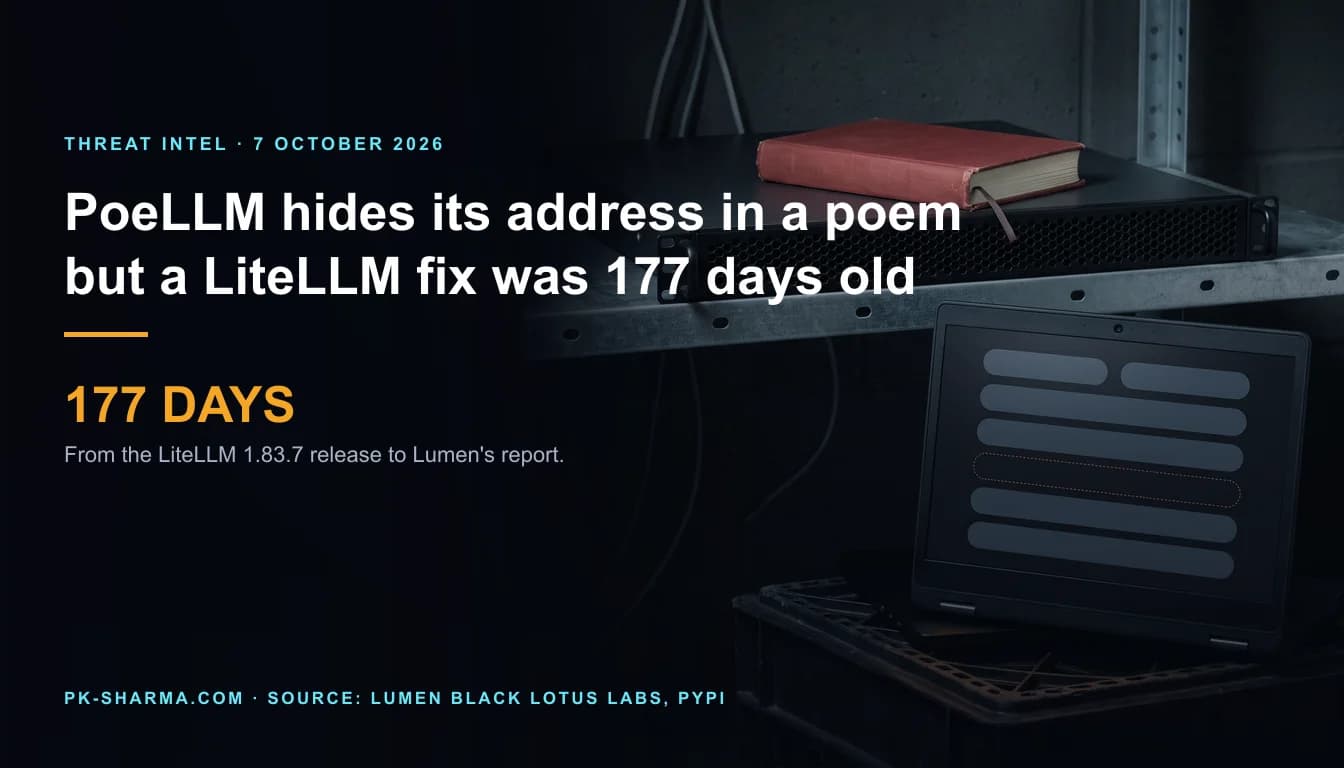
177 days between the fix and the report
LiteLLM 1.83.7, the release that fixes the flaw Lumen links to the PoeLLM botnet, was uploaded to PyPI on 13 April 2026. Lumen's Black Lotus Labs published its report on 7 October 2026. That is 177 days (derived). The vendor's stable release followed on 19 April, 171 days before the report, and the GitHub advisory on 25 April, 165 days before it. The CVE record, CVE-2026-42271, came on 8 May: 152 days.
Lumen says PoeLLM, active since at least April, has hit more than 3,400 servers. Most appear to run exposed AI services, LiteLLM and Ollama, and hundreds ran Gotenberg or Gitea. It mines cryptocurrency on them and turns some into scanners. Its distinctive trick is that the address of its command server is worked out from a poem posted on GitHub. For LiteLLM, Lumen says the endpoint in one malware sample was "likely the exploitation path" for CVE-2026-42271, a command-execution flaw in LiteLLM, an open-source proxy that works as an AI gateway to model providers. CyberScoop, The Hacker News, BleepingComputer and The Register all carried the story on 7 October. This briefing reads Lumen's post in full and treats the press as pointers.
Lumen is a network operator that also sells security services. Its post says Lumen Defender customers have been protected since the discovery, and it suggests a managed secure access service as one mitigation. That is a commercial interest to note, not a reason to doubt the telemetry. It is a reason to keep what Lumen observed apart from what it recommends.
What the number does establish is narrower. For the one LiteLLM flaw Lumen names, a fix, an advisory and a CVE record were public for months before the report, and CISA listed the flaw in its Known Exploited Vulnerabilities (KEV) catalogue on 8 June, 121 days before it. The rest of this briefing sets out what Lumen states and leaves open, service by service, then the UK clock and a checklist in the order worth doing. Sources were read between about 17:50 and 18:10 BST on 7 October 2026; Lumen's text and the KEV catalogue can change.
One report, two victim counts
Four outlets reported the larger figure (The Register rounded it to more than 3,000). Lumen's own post carries two. Its key takeaways say PoeLLM has impacted more than 3,400 victim servers. Its body says almost 2,200 twice: once as the number of affected servers at the mid-June peak, and once as the total since April. BleepingComputer's correction note says the report it first received gave 2,100, and that the researchers raised the figure to 3,400 in the live report. This site's reading, which is inference, is that the headline figure was revised after the body was written and the body was not brought into line. The gap is 1,200 servers, 55 per cent more than the lower figure (derived).
Lumen's wording on the count and the peak, and what each line does not establish. Read from Lumen's post of 7 October 2026 and its Figure 2.
- Where
- Key takeaways
- What Lumen says
- More than 3,400 victim servers; peak activity exceeding 800 active servers per day
- What it does not establish
- The counting unit (IP addresses, hosts or infections) or the period
- Where
- Body, timeline
- What Lumen says
- At the mid-June peak, almost 2,200 affected servers, nearly 800 active per day
- What it does not establish
- Whether that is a running total at mid-June or the whole campaign
- Where
- Body, command section
- What Lumen says
- Since April, almost 2,200 victim servers; at its peak almost 800 a day
- What it does not establish
- Anything above 2,200. It reads as a total, so it conflicts with the first row unless it is stale
- Where
- Figure 2
- What Lumen says
- A line chart titled as active victims per day, captioned as a victim count for April to September. The top is close to 800 in mid-June; a late rise reaches about 380 in early October (read by eye)
- What it does not establish
- A cumulative total: it is a daily figure, and a September end date does not match a line that runs into October
- Where
- Telemetry text
- What Lumen says
- Netflow showed over 1,000 additional IP addresses contacting one command address, most running AI or developer tools
- What it does not establish
- Whether an IP address is a server, or what share of the total those 1,000 are
| Where | What Lumen says | What it does not establish |
|---|---|---|
| Key takeaways | More than 3,400 victim servers; peak activity exceeding 800 active servers per day | The counting unit (IP addresses, hosts or infections) or the period |
| Body, timeline | At the mid-June peak, almost 2,200 affected servers, nearly 800 active per day | Whether that is a running total at mid-June or the whole campaign |
| Body, command section | Since April, almost 2,200 victim servers; at its peak almost 800 a day | Anything above 2,200. It reads as a total, so it conflicts with the first row unless it is stale |
| Figure 2 | A line chart titled as active victims per day, captioned as a victim count for April to September. The top is close to 800 in mid-June; a late rise reaches about 380 in early October (read by eye) | A cumulative total: it is a daily figure, and a September end date does not match a line that runs into October |
| Telemetry text | Netflow showed over 1,000 additional IP addresses contacting one command address, most running AI or developer tools | Whether an IP address is a server, or what share of the total those 1,000 are |
Three points hold across every version. The peak is dated mid-June and is about 800 active servers in a day, which is a daily figure and not a total. Lumen does not state its counting unit, and counting IP addresses seen in network telemetry, as its description of the netflow work suggests, can overstate or understate servers when addresses change or sit behind a shared one (inference). And the shares are unknown: Lumen says most victims "appear" to run LiteLLM or Ollama and that hundreds ran Gotenberg or Gitea, with no split. This briefing quotes the numbers and uses neither as an estimate for any UK organisation.
The poem hides an address. It is not an attack on AI
Lumen's account of the trick is short. The malware reads a poem hosted in a repository on GitHub, picks keywords out of it, and converts them through a table built into the malware into the address of its current command server. When the operator wants a new server, the operator edits the keywords, and every infected host works out the new address by itself with no malware update. Lumen counts 11 edits since the first commit on 13 April and says the way the poem is read has not changed. This briefing gives the idea and not the scheme.
The design earns its attention. A Lumen researcher told CyberScoop that to anyone who comes across it, "this is simply a poem on GitHub", with no links, no files and no encrypted text for a scanner to flag. His point is that there is no reason to call the poem malicious without the malware that reads it. The design has a cost too, and it is on the record. Lumen lists 12 command addresses, one more than its count of edits, which fits an initial address plus 11 changes (inference). Nine had ended by publication, with observed spans of 4 to 122 days (derived from Lumen's list), and three were still active. Rotation by poem makes an address list a weak control, so the behaviours later in this briefing matter more than the indicators.
The same split between a clever disguise and an ordinary way in ran through the Cling botnet briefing. The disguise is what gets written about. The door is what a defender can still close.
How servers get in, service by service
Lumen's post names five kinds of target and gives a way in for only some of them. The table keeps stated and not stated apart.
Entry points by service, as Lumen states them (post of 7 October 2026), with what the public records read for this briefing add.
- Service
- LiteLLM, an AI gateway
- What Lumen states
- Most victims appear to run vulnerable LiteLLM or Ollama. Scanning targets port 4000. One sample's target endpoint was likely the path for CVE-2026-42271
- Not stated
- How the exploit met the CVE's need for a valid API key; which builds victims ran
- Service
- Ollama, a local model server
- What Lumen states
- Named with LiteLLM as the most common victim
- Not stated
- Any flaw, port or method. Ollama's FAQ says it listens on loopback by default
- Service
- Gotenberg, a PDF converter
- What Lumen states
- Hundreds of servers, with Gitea. Scanning targets port 3000. Its install guidance warns against internet exposure
- Not stated
- Any flaw. Exposure itself looks to be the issue (inference)
- Service
- Gitea, code hosting
- What Lumen states
- Hundreds of servers, with Gotenberg
- Not stated
- Any flaw, port or method
- Service
- Ivanti Sentry, a mobile gateway
- What Lumen states
- Where Lumen first met the infrastructure: a compromised Sentry victim contacted a command server, then began scanning. CVE-2026-10520. Targeting is "possible"
- Not stated
- How many, and whether PoeLLM or another actor compromised the Sentry first
- Service
- Routers, as command hosts
- What Lumen states
- Several command servers were routers with a vulnerable admin web server. CVE-2018-21027 and CVE-2018-21028 named
- Not stated
- Any evidence of exploitation (Lumen found none); who owns the routers
| Service | What Lumen states | Not stated |
|---|---|---|
| LiteLLM, an AI gateway | Most victims appear to run vulnerable LiteLLM or Ollama. Scanning targets port 4000. One sample's target endpoint was likely the path for CVE-2026-42271 | How the exploit met the CVE's need for a valid API key; which builds victims ran |
| Ollama, a local model server | Named with LiteLLM as the most common victim | Any flaw, port or method. Ollama's FAQ says it listens on loopback by default |
| Gotenberg, a PDF converter | Hundreds of servers, with Gitea. Scanning targets port 3000. Its install guidance warns against internet exposure | Any flaw. Exposure itself looks to be the issue (inference) |
| Gitea, code hosting | Hundreds of servers, with Gotenberg | Any flaw, port or method |
| Ivanti Sentry, a mobile gateway | Where Lumen first met the infrastructure: a compromised Sentry victim contacted a command server, then began scanning. CVE-2026-10520. Targeting is "possible" | How many, and whether PoeLLM or another actor compromised the Sentry first |
| Routers, as command hosts | Several command servers were routers with a vulnerable admin web server. CVE-2018-21027 and CVE-2018-21028 named | Any evidence of exploitation (Lumen found none); who owns the routers |
The CVEs Lumen names, as recorded. Dates from CVE.org, the GitHub advisory, PyPI and CISA KEV version 2026.10.04; ages to 7 October 2026 are derived.
- CVE and product
- CVE-2026-42271, LiteLLM command execution, CVSS 8.8. Fixed in 1.83.7
- Dates, with age
- PyPI 13 Apr (177 days); advisory 25 Apr (165); CVE record 8 May (152); KEV 8 Jun (121)
- Lumen's link to PoeLLM
- Endpoint in one sample was "likely the exploitation path"
- CVE and product
- CVE-2026-10520, Ivanti Sentry command injection, CVSS 10.0 set by Ivanti. Fixed in R10.5.2, R10.6.2, R10.7.1
- Dates, with age
- CVE record 9 Jun (120 days); KEV 11 Jun (118)
- Lumen's link to PoeLLM
- How Lumen first met the infrastructure; Sentry targeting is "possible"
- CVE and product
- CVE-2018-21027 and CVE-2018-21028, Boa web server: out-of-memory and memory leak
- Dates, with age
- Both records 11 Oct 2019 (2,553 days); not in KEV
- Lumen's link to PoeLLM
- Router admin page was vulnerable; no direct evidence of exploitation
| CVE and product | Dates, with age | Lumen's link to PoeLLM |
|---|---|---|
| CVE-2026-42271, LiteLLM command execution, CVSS 8.8. Fixed in 1.83.7 | PyPI 13 Apr (177 days); advisory 25 Apr (165); CVE record 8 May (152); KEV 8 Jun (121) | Endpoint in one sample was "likely the exploitation path" |
| CVE-2026-10520, Ivanti Sentry command injection, CVSS 10.0 set by Ivanti. Fixed in R10.5.2, R10.6.2, R10.7.1 | CVE record 9 Jun (120 days); KEV 11 Jun (118) | How Lumen first met the infrastructure; Sentry targeting is "possible" |
| CVE-2018-21027 and CVE-2018-21028, Boa web server: out-of-memory and memory leak | Both records 11 Oct 2019 (2,553 days); not in KEV | Router admin page was vulnerable; no direct evidence of exploitation |
The record for CVE-2026-42271 says the two affected test endpoints were gated only by a valid proxy API key, with no role check, so any authenticated user, including a holder of a low-privilege key, could run commands on the host. A scanner with no key could not use that on its own, and Lumen does not say how PoeLLM's exploit servers obtained one, or whether their targets ran without authentication. Other records narrow the gap without closing it. CISA lists two more LiteLLM flaws as exploited that Lumen does not mention: an SQL injection in API key verification, CVE-2026-42208, added to KEV on 8 May and fixed in the same 1.83.7 according to its record's affected range, and an authentication bypass in the MCP endpoint, CVE-2026-59822, added on 2 September and affecting builds below 1.84.0. CISA's KEV entry for a Starlette flaw, CVE-2026-48710, says it could be chained with CVE-2026-42271, and BleepingComputer reports that Horizon.ai confirmed the chain. None of this says PoeLLM uses any of them. It does say that "patched against the one CVE in the report" is not the same as "patched".
Gotenberg is the clearest case of exposure as the problem. Lumen names no flaw for it, and shows a screenshot of the installation guide, which says: "Don't expose Gotenberg to the public internet." The same sentence is on the page today. Ollama's FAQ says it binds to the loopback address by default and that the bind address is changed by a setting, so an exposed Ollama is one that someone chose to expose, or whose port a container or proxy published (inference from the FAQ; Lumen does not say how any victim was exposed). For Gitea, Lumen names no flaw and no port. CISA's catalogue lists one Gitea flaw, CVE-2026-60004, added on 25 August; Lumen does not mention it.
The command servers are the other half of the entry story. Lumen says several were routers whose admin pages ran a vulnerable Boa web server, and names CVE-2018-21027 and CVE-2018-21028 for the first of them, adding that it found no direct evidence of exploitation. Both records were published on 11 October 2019, 2,553 days before the report, and describe an out-of-memory condition and a memory leak, not code execution. NVD scores them 9.8 and 7.5, which is one more reason a score does not rank a flaw for you. The owners of those routers are victims too, and Lumen does not say anyone told them.
The dates, to scale
The diagram puts the public record and Lumen's account on one axis. Two things show. The fixed release and the advisory both sit before May, the month Lumen gives for the start of broad scanning and exploitation; the CVE record, on 8 May, sits inside it. And the first poem commit shares a date, 13 April, with the PyPI upload. No source connects the two events, and this briefing does not.
How an infected server is controlled, and where to cut it
Lumen's account of the control path is consistent across its text and its Figure 4. A scanner or an exploit server sends a crafted request to a vulnerable service, telling it to download a file from a command server. Once the payload runs, it checks in with one of several command ports and starts mining: bots have been seen contacting a Kryptex mining pool, presumably through the XMRig and Iron miners in the payload. Some victims are then conscripted as scanners and exploit servers, which is how the botnet grows. Pools of victims have recently been seen probing SSH and other login portals, which Lumen reads as experiments in distributed brute force of uncertain maturity; many of those targets were dedicated servers in Italy. Lumen assesses with moderate confidence that an Italy-based server, which contacted several command addresses and once hosted monitoring dashboards, is the actor's administrative interface.
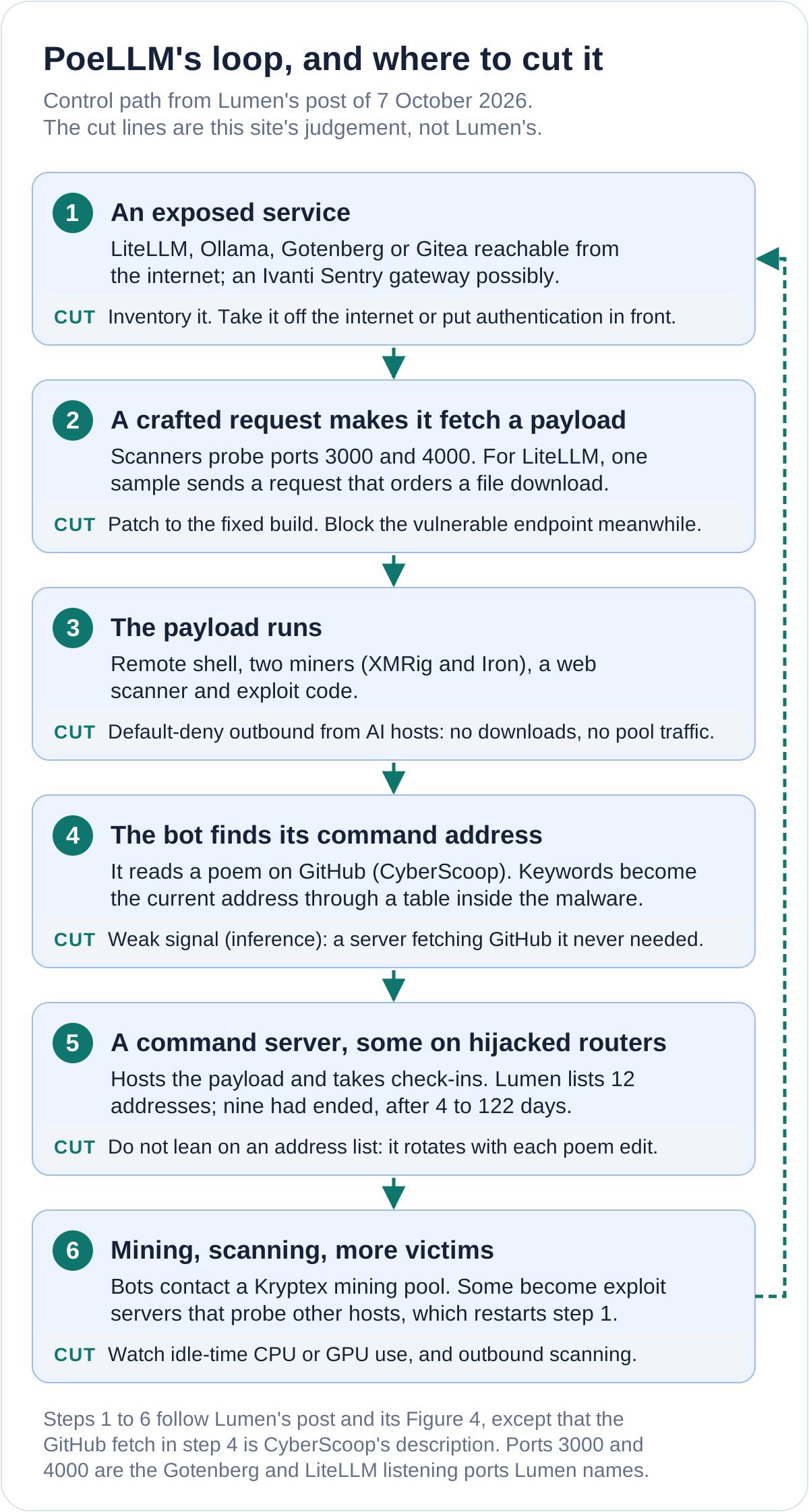
The cut lines are where a defender has leverage that does not depend on a list of addresses. The first two are about the host, the next two about what it talks to, and the last about what it does when nobody is using it. None is a vendor instruction. Lumen's own recommendations are shorter: check logs for connections to its indicators, audit external exposure after installing new open-source tools, follow router and firewall hygiene, consider a managed secure access service, and use attack surface management.
What Lumen did, and what it left out
Lumen says it has blocked all traffic to and from the PoeLLM command servers, will keep monitoring, and that Lumen Defender customers have been protected since it found the malware. The same post lists three of 12 command addresses as still active at publication, so a block is not a takedown.
Stated and not stated, checked against Lumen's post of 7 October 2026, with CyberScoop and The Register where marked.
- Question
- Lumen's response
- Stated
- Blocked all traffic to and from the command servers; continuing to monitor; Defender customers protected from discovery
- Not stated
- How far the block reaches, or any takedown. Three of 12 addresses were active at publication
- Question
- Who was told
- Stated
- Nothing on this in the post
- Not stated
- Whether victims or router owners were notified, or the poem repository reported or removed
- Question
- Where victims are
- Stated
- Predominantly the United States and Western Europe, shown on a heat map
- Not stated
- Any UK figure. The map has no scale, and Western Europe is undefined (the UN groups the UK under Northern Europe)
- Question
- Who runs it
- Stated
- Associated with an Italian-speaking actor; Italian comments in the code; moderate confidence an Italy-based server is its admin interface
- Not stated
- Identity, group size or links to others. CyberScoop says the researchers do not know how many people are involved and have seen no links
- Question
- The money
- Stated
- Financially motivated; XMRig and Iron miners; a Kryptex pool
- Not stated
- Which coin, hash rate or earnings, or how much GPU time was used. Lumen says GPU hardware may also have been a draw
- Question
- Harm beyond mining
- Stated
- Remote shell, scanning, and early distributed brute force of uncertain maturity
- Not stated
- Data theft, key theft or model abuse as observed events. Lumen lists data loss, LLM jacking and lateral movement as risks of exposed AI tools, and CyberScoop reports Lumen saying other achievements remain under investigation
- Question
- Who wrote the poem
- Stated
- Nothing in the post
- Not stated
- The Register says the researchers believe the poem was written by AI; the post does not say so
| Question | Stated | Not stated |
|---|---|---|
| Lumen's response | Blocked all traffic to and from the command servers; continuing to monitor; Defender customers protected from discovery | How far the block reaches, or any takedown. Three of 12 addresses were active at publication |
| Who was told | Nothing on this in the post | Whether victims or router owners were notified, or the poem repository reported or removed |
| Where victims are | Predominantly the United States and Western Europe, shown on a heat map | Any UK figure. The map has no scale, and Western Europe is undefined (the UN groups the UK under Northern Europe) |
| Who runs it | Associated with an Italian-speaking actor; Italian comments in the code; moderate confidence an Italy-based server is its admin interface | Identity, group size or links to others. CyberScoop says the researchers do not know how many people are involved and have seen no links |
| The money | Financially motivated; XMRig and Iron miners; a Kryptex pool | Which coin, hash rate or earnings, or how much GPU time was used. Lumen says GPU hardware may also have been a draw |
| Harm beyond mining | Remote shell, scanning, and early distributed brute force of uncertain maturity | Data theft, key theft or model abuse as observed events. Lumen lists data loss, LLM jacking and lateral movement as risks of exposed AI tools, and CyberScoop reports Lumen saying other achievements remain under investigation |
| Who wrote the poem | Nothing in the post | The Register says the researchers believe the poem was written by AI; the post does not say so |
What this means for a UK estate
Neither Lumen nor the four outlets name a UK victim or give a UK count, so what follows is inference, labelled. Lumen's map says victims are predominantly in the United States and Western Europe, with no scale. Under the UN M49 grouping the UK is in Northern Europe, and Western Europe means nine countries: Austria, Belgium, France, Germany, Liechtenstein, Luxembourg, Monaco, the Netherlands and Switzerland. Lumen does not say which grouping it uses, so its map neither places the UK in nor rules it out.
Who in the UK might run these services follows from what they are for. LiteLLM is a gateway in front of model providers, Ollama runs models on your own hardware, Gotenberg converts documents to PDF and Gitea hosts code. Lumen's researchers told The Register that AI makes tools such as LiteLLM, Ollama and Gotenberg easier to deploy, without anything checking that they are patched. The likely owners are therefore teams rather than central IT: a university research group, a start-up's engineering team, a council digital team trialling an assistant, a department's data science group (inference; no source gives a UK count or names a UK operator). That is the estate an asset register tends to miss.
Cyber Essentials gives a dated rule. The NCSC's requirements for IT infrastructure v3.3, April 2026, apply to software in scope that can accept incoming connections from internet-connected devices. They require updates that fix vulnerabilities the vendor calls critical or high risk, or that score 7 or above on CVSS v3, within 14 days of release. CVE-2026-42271 scores 8.8. Counting 14 days from the PyPI release of 13 April gives 27 April; from the stable release of 19 April it gives 3 May (derived). Lumen dates broad scanning and exploitation to May without a day. If the gateway was in scope and the rule was kept, it was on the fixed build by 3 May at the latest.
Scope is the catch. The scope text says publicly available commercial web applications are in scope by default and bespoke or custom components are not. It does not mention open-source services, so whether a self-hosted gateway is in scope is a decision to settle with the assessor (inference). The firewall requirement is plainer: block unauthenticated inbound connections by default, and have each inbound rule approved and documented.
The NCSC's vulnerability management guidance, version 2.1, reviewed 1 May 2026, sets out a policy of updating by default, a response to active exploitation and identifying your assets, which is where the checklist below starts. The free NCSC Early Warning service takes an organisation's public IP addresses and domain names and sends alerts about malware and vulnerabilities affecting its network; the NCSC says it should not be the only layer of defence. For an AI gateway with a self-hosted patch clock, see GitLab's AI Gateway has a second 9.9. For an earlier botnet that went for exposed hosts and AI keys, see the Docker botnet that installed an open source AI agent.
Cost is left out on purpose. Lumen gives no power draw, GPU utilisation, hash rate or earnings figure, and neither does any outlet, so this briefing offers no estimate of what a hijacked server cost in electricity or cloud bills. The only cost-shaped evidence is Lumen's hedged remark that GPU hardware may have been part of the appeal.
What to do, in the order worth doing
Take this with you
A UK security lead's order of work
- Inventory first. List every AI and developer service reachable from the internet: LiteLLM, Ollama, Gotenberg and Gitea first, then anything else that serves an API. Check your public address ranges from outside and your cloud security groups from inside, and include pilots, research servers and abandoned trials. Register your public addresses with NCSC Early Warning.
- Put authentication in front, or take the service off the internet. Gotenberg's own guidance says not to expose it to the public internet. Ollama listens on loopback by default, so find out who changed that and whether a container or proxy publishes it. Put gateways and model servers behind a VPN or an authenticating reverse proxy with an allow-list, and keep admin interfaces off the internet.
- Patch to the fixed build, then to current. For LiteLLM that is at least 1.83.7 for CVE-2026-42271, and 1.84.0 or later for the MCP authentication flaw in CISA's catalogue, so take the vendor's current release. If you cannot upgrade today, the vendor's workaround is to block the two MCP test endpoints named in its advisory at the reverse proxy or gateway. For Ivanti Sentry the fixed versions are R10.5.2, R10.6.2 and R10.7.1. Set a date: Cyber Essentials allows 14 days for a fix at CVSS 7 or above.
- Hunt for the behaviours Lumen describes, not only its indicators. Look for outbound connections from AI and developer hosts to many unrelated addresses on ports 3000 and 4000, which is the scanning Lumen describes; crafted requests to the LiteLLM test endpoints from addresses you do not know; downloads by AI hosts from unfamiliar servers; connections to a mining pool; and, as a weak signal (CyberScoop's description, this site's inference), a server fetching GitHub pages it has no reason to. Lumen publishes its indicator list. Use it as a floor, because the command addresses rotate.
- Check GPU utilisation and outbound connections. Look for sustained CPU or GPU load with no job scheduled, new long-running processes under the service account, and outbound traffic that does not match your list of model providers. Move AI hosts to default-deny outbound with an allow-list of the providers and update sources they need. That is this site's judgement, and it would have cut the payload download, the pool connection and the scanning in Lumen's description (inference).
- Rotate and rebuild. For any instance that was reachable and ran an affected build, rotate the API keys, tokens and credentials it held, and rebuild from a known-good image rather than cleaning in place. Lumen does not say keys were taken. This is the cost of not knowing, and it is judgement, not a finding.
- Put AI and developer tools into the same patch and exposure cycle as the rest of the estate. Lumen's own advice is to audit exposure after installing new open-source tools and to use attack surface management. In Cyber Essentials terms, each is software that accepts connections from the internet unless you have made sure it does not.
The question the count leaves
Lumen found the victims it describes in netflow telemetry on its own network, and the post does not mention any victim reporting a compromise. If one of your AI servers began talking to a botnet tonight, whose telemetry would show it first: yours, or your carrier's?
Key facts
Sources
- PrimaryCanto incognito: tracking the PoeLLM malware, 7 October 2026. Read in full: key takeaways, both victim counts, the command mechanism, the named CVEs, the 12 command addresses, Lumen's response, Figures 1, 2 and 4.Lumen Black Lotus Labsaccessed 2026-10-07
- Primarylitellm 1.83.7: upload time 13 April 2026, 17:34 UTC, read through the PyPI JSON record. Used for the fix date.Python Package Indexaccessed 2026-10-07
- PrimaryGHSA-v4p8-mg3p-g94g for CVE-2026-42271, published 25 April 2026: the two test endpoints, the valid API key requirement, the fix in 1.83.7 and the workaround.BerriAI (GitHub Security Advisory)accessed 2026-10-07
- PrimaryLiteLLM v1.83.7-stable release, 19 April 2026, whose notes list the fix for command execution through the stdio transport.BerriAI (GitHub release)accessed 2026-10-07
- PrimaryCVE record for the LiteLLM command execution flaw: published 8 May 2026, affected range 1.74.2 to before 1.83.7, CISA-ADP KEV entry of 8 June 2026.CVE Programaccessed 2026-10-07
- PrimaryNVD record for CVE-2026-42271: CVSS 3.1 base score 8.8 and CVSS 4.0 score 8.7.NIST NVDaccessed 2026-10-07
- PrimaryCVE record for the Ivanti Sentry command injection: published 9 June 2026, fixed in R10.5.2, R10.6.2 and R10.7.1, CVSS 10.0 set by Ivanti.CVE Programaccessed 2026-10-07
- PrimaryCVE record for the Boa out-of-memory flaw, published 11 October 2019.CVE Programaccessed 2026-10-07
- PrimaryCVE record for the Boa memory leak flaw, published 11 October 2019.CVE Programaccessed 2026-10-07
- PrimaryNVD record for CVE-2018-21027: NIST CVSS 3.1 score 9.8. The sibling record CVE-2018-21028 is scored 7.5.NIST NVDaccessed 2026-10-07
- PrimaryCVE record for the LiteLLM SQL injection in API key verification: published 8 May 2026, affected range 1.81.16 to before 1.83.7. Not named by Lumen.CVE Programaccessed 2026-10-07
- PrimaryCVE record for the LiteLLM MCP authentication bypass: published 8 July 2026, affecting versions below 1.84.0. Not named by Lumen.CVE Programaccessed 2026-10-07
- PrimaryCVE record for the Starlette Host header flaw: published 26 May 2026, fixed in Starlette 1.0.1. Not named by Lumen.CVE Programaccessed 2026-10-07
- PrimaryCVE record for the Gitea code injection flaw: published 26 August 2026, affecting Gitea below 1.27.1. Not named by Lumen.CVE Programaccessed 2026-10-07
- PrimaryKnown Exploited Vulnerabilities catalogue, version 2026.10.04, 1,734 entries. Used for the KEV dates of CVE-2026-42271, CVE-2026-10520, CVE-2026-42208, CVE-2026-59822, CVE-2026-60004 and CVE-2026-48710, and for the absence of the Boa CVEs, Ollama and Gotenberg.CISAaccessed 2026-10-07
- PrimaryCyber Essentials: Requirements for IT Infrastructure v3.3, April 2026. Used for the scope conditions, the web application scope note, the firewall rule and the 14 day update rule.NCSCaccessed 2026-10-07
- PrimaryVulnerability management guidance, version 2.1, reviewed 1 May 2026: update by default and identify your assets.NCSCaccessed 2026-10-07
- PrimaryEarly Warning service page: free for UK organisations, sign-up by public IP addresses and domain names.NCSCaccessed 2026-10-07
- PrimaryInstallation page: the current warning not to expose Gotenberg to the public internet.Gotenbergaccessed 2026-10-07
- PrimaryFAQ: Ollama binds to the loopback address by default and the bind address is changed by a setting.Ollamaaccessed 2026-10-07
- PrimaryM49 geographic regions: which countries the UN places in Western Europe and in Northern Europe.United Nations Statistics Divisionaccessed 2026-10-07
- Reported byPoeLLM malware has assembled a sweeping botnet, 7 October 2026. A pointer; used for the interview quotes, the GitHub fetch description and the statement that the researchers do not know how many people are involved.CyberScoopaccessed 2026-10-07
- Reported byPoeLLM malware infects 3,400+ servers, 7 October 2026. A pointer only; its moderate confidence wording attaches to the actor, where Lumen's post attaches it to the admin server.The Hacker Newsaccessed 2026-10-07
- Reported byPoeLLM malware infects exposed AI servers, 7 October 2026. A pointer; used for its correction note (2,100 raised to 3,400) and the Horizon.ai chain claim.BleepingComputeraccessed 2026-10-07
- Reported byPoetry is the new AI security threat as PoeLLM malware infects 3K+ servers, 7 October 2026. A pointer; used for the adversarial poetry framing and the researchers' emailed remarks.The Registeraccessed 2026-10-07