GitLab's AI Gateway has a second 9.9 in 235 days, and only self-hosted gateways must patch
GitLab says a logged-in user with Duo Agent Platform access could run commands on a self-hosted AI Gateway, under conditions it has not described. It is the gateway's second 9.9 in 235 days, and the fixed version numbers already mean something else on a GitLab instance.
By Parminder Kumar Sharma · · 18 min read
A login is worth 0.1 of a point
GitLab has scored the new AI Gateway flaw 9.9 out of 10, not 10.0, and the entire difference is the login. Take GitLab's own vector, CVSS:3.1/AV:N/AC:L/PR:L/UI:N/S:C/C:H/I:H/A:H, change the privileges required metric from low to none, and the CVSS 3.1 formulas return 10.0. The advisory says an authenticated user with Duo Agent Platform access could, "under certain conditions", escape a prompt template sandbox through a specially crafted flow configuration and run arbitrary commands on the gateway. The conditions are not described in anything GitLab has published.
That score does not establish that anyone has used the flaw. CISA's coordinator assessment, added to the CVE record at 16:47 UTC on 2 October, lists exploitation as "none", and CVE-2026-90970 was not in CISA's Known Exploited Vulnerabilities catalogue (version 2026.10.02, 1,733 entries) when we checked at 11:32 BST on Saturday 3 October. It does not say how many gateways exist, how many a logged-in user can reach, or what the commands would run as. And it does not put every GitLab server at risk: GitLab says only organisations that host their own gateway need to act.
This briefing reads GitLab's advisory, the CVE record and the NVD entry in full, then GitLab's own documentation for what the advisory leaves out. It stays at defender level: what to patch, how to find your version, and who can reach the thing. No exploit steps are published in the sources we read, and none appear here. It is written for UK teams that self-host GitLab with Duo.
What GitLab, the CVE record and CISA each say
The CVE record was published at 14:34 UTC on 2 October, which is 15:34 BST, and the NVD entry followed at 15:17 UTC. GitLab's patch release feed dates the advisory 2 October, a Friday. The CVE ID had been reserved on 14 September, 18 days earlier. A reservation is not a discovery date, but it suggests GitLab had the report by then. That is our inference, not GitLab's statement. The advisory gives no date for the fix, none for the fix to the hosted gateways, and none for the "targeted outreach" to self-hosted customers that it says came before the post. So the days between fix and advisory cannot be computed from anything published. The interval we can compute is the one that matters to you: one day since the advisory, as at Saturday morning.
Stated and not stated, from GitLab's advisory of 2 October 2026, the CVE record and NVD entry, and CISA's entry in the record, all read on 3 October
- Point
- The flaw
- Stated
- An authenticated user with Duo Agent Platform access could, under certain conditions, escape the prompt template sandbox with a crafted flow configuration and run arbitrary commands on the gateway.
- Not stated
- The conditions. The template engine. The role the user needs.
- Point
- Severity
- Stated
- CVSS 9.9, assigned by GitLab as the CNA. CWE-1336, template engine neutralisation. CISA: exploitation none, automatable no, technical impact total.
- Not stated
- An NVD score: the entry reads Awaiting Analysis. What lies beyond the gateway that a command could reach.
- Point
- Affected versions
- Stated
- AI Gateway 18.1.6 up to, not including, 19.2.4; 19.3 before 19.3.2; 19.4 before 19.4.1.
- Not stated
- Whether older lines will be fixed. Whether anything before 18.1.6 was assessed.
- Point
- Who must act
- Stated
- Self-hosted gateways. GitLab.com, Dedicated and self-managed instances on the GitLab-hosted gateway need no action.
- Not stated
- When the hosted gateways were fixed. Whether they were abused first. Whether Dedicated for Government is covered.
- Point
- Exploitation
- Stated
- CISA's assessment on 2 October: none. Not in the KEV catalogue.
- Not stated
- Anything from GitLab. A way to tell whether a gateway was attacked.
- Point
- Reporter
- Stated
- invisiblemeerkat, through HackerOne, thanked for responsible disclosure.
- Not stated
- When it was reported.
- Point
- Workaround
- Stated
- None listed. The fix is an update.
- Not stated
- Whether any setting limits the exposure.
- Point
- Exposure
- Stated
- No count, scan or telemetry appears in any source.
- Not stated
- How many gateways exist or face a network. What the commands run as. Whether code, prompts or keys are reachable.
| Point | Stated | Not stated |
|---|---|---|
| The flaw | An authenticated user with Duo Agent Platform access could, under certain conditions, escape the prompt template sandbox with a crafted flow configuration and run arbitrary commands on the gateway. | The conditions. The template engine. The role the user needs. |
| Severity | CVSS 9.9, assigned by GitLab as the CNA. CWE-1336, template engine neutralisation. CISA: exploitation none, automatable no, technical impact total. | An NVD score: the entry reads Awaiting Analysis. What lies beyond the gateway that a command could reach. |
| Affected versions | AI Gateway 18.1.6 up to, not including, 19.2.4; 19.3 before 19.3.2; 19.4 before 19.4.1. | Whether older lines will be fixed. Whether anything before 18.1.6 was assessed. |
| Who must act | Self-hosted gateways. GitLab.com, Dedicated and self-managed instances on the GitLab-hosted gateway need no action. | When the hosted gateways were fixed. Whether they were abused first. Whether Dedicated for Government is covered. |
| Exploitation | CISA's assessment on 2 October: none. Not in the KEV catalogue. | Anything from GitLab. A way to tell whether a gateway was attacked. |
| Reporter | invisiblemeerkat, through HackerOne, thanked for responsible disclosure. | When it was reported. |
| Workaround | None listed. The fix is an update. | Whether any setting limits the exposure. |
| Exposure | No count, scan or telemetry appears in any source. | How many gateways exist or face a network. What the commands run as. Whether code, prompts or keys are reachable. |
Attribution matters here. The 9.9 and the vector are GitLab's: the CVE record and the NVD entry both credit them to cve@gitlab.com, GitLab acting as the CVE Numbering Authority. NVD has not scored it itself. The only other party in the record is CISA's ADP entry, which carries an SSVC assessment and no CVSS score. All of this is a snapshot of 2 and 3 October. NVD can analyse the entry, and CISA can change its own, at any time.
What the 9.9 is made of
Three metrics in GitLab's vector decide the headline. Privileges required is low, which the CVSS specification defines as basic user capabilities. Scope is changed, which it defines as a flaw that can affect resources beyond the security scope of the vulnerable component. Confidentiality, integrity and availability impact are all high. We ran the CVSS 3.1 formulas four ways.
GitLab's vector with two metrics varied, computed by us from the formulas in the CVSS 3.1 specification. Only the first row is a published score
- Variant of the vector
- As published by GitLab
- Privileges required
- Low
- Scope
- Changed
- Score
- 9.9
- Variant of the vector
- Login not required
- Privileges required
- None
- Scope
- Changed
- Score
- 10.0
- Variant of the vector
- Scope unchanged
- Privileges required
- Low
- Scope
- Unchanged
- Score
- 8.8
- Variant of the vector
- Both changed
- Privileges required
- None
- Scope
- Unchanged
- Score
- 9.8
| Variant of the vector | Privileges required | Scope | Score |
|---|---|---|---|
| As published by GitLab | Low | Changed | 9.9 |
| Login not required | None | Changed | 10.0 |
| Scope unchanged | Low | Unchanged | 8.8 |
| Both changed | None | Unchanged | 9.8 |
Read it two ways. First, the login is cheap in score terms: removing it moves 9.9 to 10.0. Second, the scope call is the larger adjustment: without it the same flaw scores 8.8, which is 1.1 lower. A changed scope is GitLab's judgement that a command on the gateway can affect something beyond the gateway. The advisory does not say what. Neither row tells you how easy the login is to obtain. That is a fact about your accounts, not about CVSS.
Who needs to act, and on which versions
GitLab says a fix "has already been deployed" for gateways it hosts, and that customers on GitLab.com, GitLab Dedicated and self-managed instances using a GitLab-hosted gateway do not need to act. The case that needs care is self-managed. GitLab's documentation lists the cloud-based gateway as the default, and a self-hosted gateway as the option for customers who want request and response data to stay in their own environment. Self-hosted models are listed for Premium and Ultimate. In GitLab's hybrid configuration some features go to the hosted gateway and the rest to yours, which means your own gateway is still running, still called by your instance and still on whatever version you last installed.
Gateway versions from GitLab's advisory and the CVE record. These are AI Gateway versions, not GitLab instance versions
- Gateway version in use
- Before 18.1.6
- In the advisory
- Not listed. Not stated whether that means unaffected or not assessed
- First fixed version
- Not stated
- Gateway version in use
- 18.1.6 up to 19.2.3
- In the advisory
- Affected
- First fixed version
- 19.2.4
- Gateway version in use
- 19.3.0 and 19.3.1
- In the advisory
- Affected
- First fixed version
- 19.3.2
- Gateway version in use
- 19.4.0
- In the advisory
- Affected
- First fixed version
- 19.4.1
- Gateway version in use
- 19.2.4 or later, 19.3.2 or later, 19.4.1 or later
- In the advisory
- Fixed
- First fixed version
- None needed
| Gateway version in use | In the advisory | First fixed version |
|---|---|---|
| Before 18.1.6 | Not listed. Not stated whether that means unaffected or not assessed | Not stated |
| 18.1.6 up to 19.2.3 | Affected | 19.2.4 |
| 19.3.0 and 19.3.1 | Affected | 19.3.2 |
| 19.4.0 | Affected | 19.4.1 |
| 19.2.4 or later, 19.3.2 or later, 19.4.1 or later | Fixed | None needed |
The gap below 19.2 is the practical problem. Nothing is listed as fixed before 19.2.4, so a gateway on any 18.x, 19.0 or 19.1 release has no patch in its own line. GitLab's install guide says to run the gateway image whose tag matches your GitLab minor version, and the advisory does not say whether a 19.2.4 gateway works against an older instance. GitLab's maintenance page, as read on 3 October, lists 19.4, 19.3 and 19.2 as the maintained versions. On the face of it, then, an instance on 19.1 or earlier must upgrade to reach a patched gateway. That is our reading of the guide, not a statement from GitLab.
There is a precedent for asking for more. On 23 September GitLab backported the fixes for the critical path traversal CVE-2026-85706 to 19.0.9 and 18.11.12 "outside of our standard maintenance policy" so that administrators could skip an upgrade. Nothing similar is announced for the gateway.
The fixed numbers already mean something else
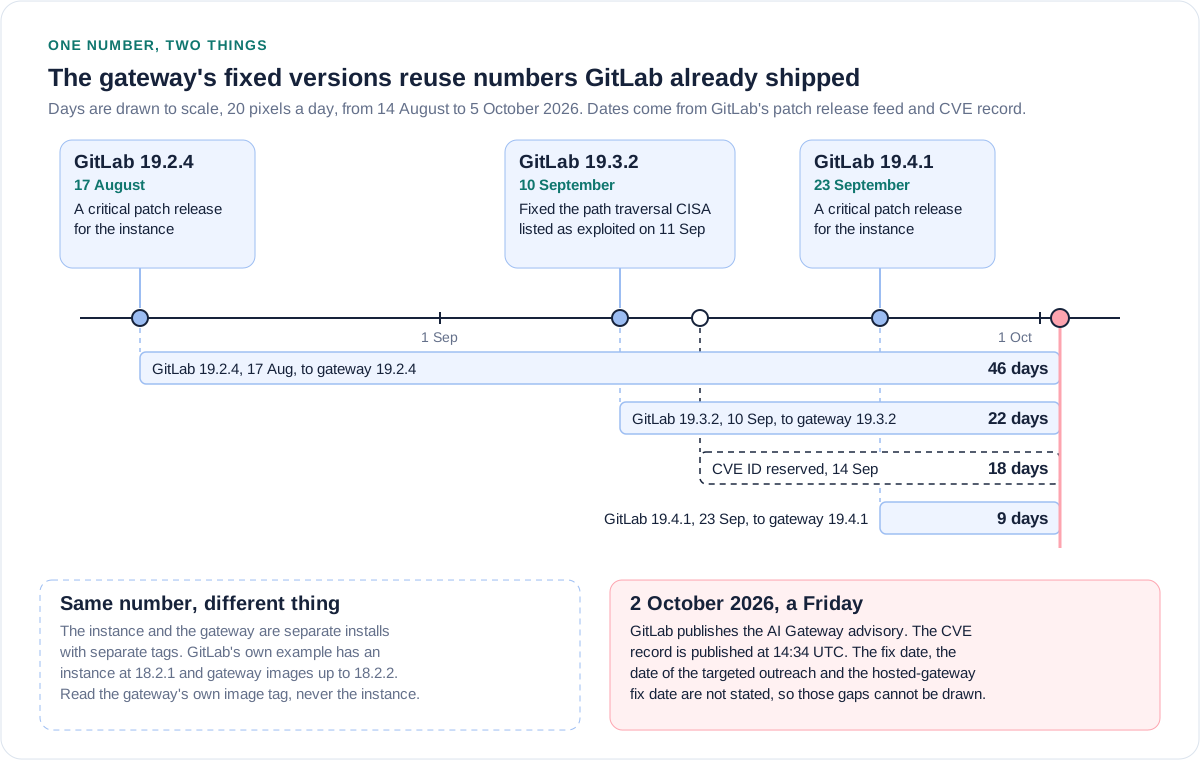
GitLab numbers its gateway releases to match its instance releases, but the patch numbers run separately. The install guide's own example has an instance on 18.2.1 and gateway images up to 18.2.2. That makes the fixed gateway versions easy to misread, because each one is also the number of a GitLab release that shipped earlier, and each of those was a critical patch release for the instance.
Dates from GitLab's patch release feed. Days computed by us, from the feed date to the gateway advisory on 2 October 2026
- Fixed gateway version
- 19.2.4
- Earlier GitLab release with that number
- 17 August 2026, a critical patch release
- Days before the advisory
- 46
- Fixed gateway version
- 19.3.2
- Earlier GitLab release with that number
- 10 September 2026, a critical patch release that fixed a flaw CISA lists as exploited
- Days before the advisory
- 22
- Fixed gateway version
- 19.4.1
- Earlier GitLab release with that number
- 23 September 2026, a critical patch release
- Days before the advisory
- 9
| Fixed gateway version | Earlier GitLab release with that number | Days before the advisory |
|---|---|---|
| 19.2.4 | 17 August 2026, a critical patch release | 46 |
| 19.3.2 | 10 September 2026, a critical patch release that fixed a flaw CISA lists as exploited | 22 |
| 19.4.1 | 23 September 2026, a critical patch release | 9 |
So 19.3.2 on a ticket can mean the instance was patched for an exploited flaw on 10 September, or that the gateway was patched for this one on 2 October. They are different installs. An instance on 19.2.7 has a higher number than the fixed gateway 19.2.4 and tells you nothing about the gateway beside it. The only record that counts is the gateway's own image tag, which GitLab's docs give in the form self-hosted-vX.Y.Z-ee. An image started from a floating tag, or pinned by digest, hides it, and GitLab's docs say to use stable releases with an explicit version tag.
What "AI Gateway" actually names
The name does the first piece of misdirection. A gateway sounds like a pipe: requests go in, requests come out. GitLab's install guide describes something else, "a combination of two services": an AI Gateway service and a GitLab Duo Agent Platform service. They listen on HTTP port 5052 and gRPC port 50052, each has its own pair of signing keys, and the guide says the keys must be "treated as sensitive credentials". The gateway reaches your GitLab instance and your model providers, and the guide asks you to restrict its outbound traffic to those and to GitLab's licence server. That is a server that interprets configuration written by users.
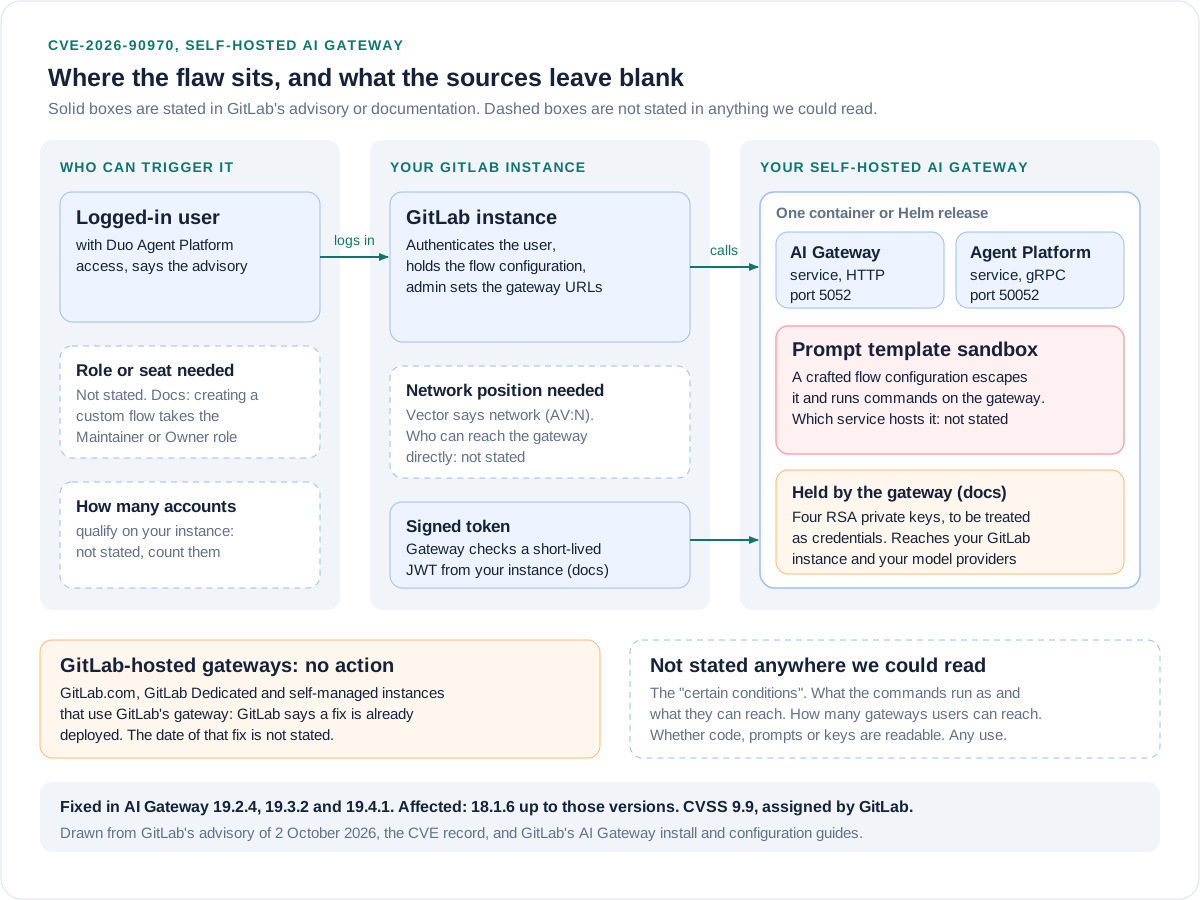
The advisory's second friendly word is sandbox. A sandbox is a control, and the advisory describes its failure: a crafted flow configuration escapes the prompt template sandbox. The weakness class, CWE-1336, is improper neutralisation of special elements in a template engine. GitLab does not name the engine, and a prompt template sounds like text rather than something that can end in a command. February's flaw was the same class in the same component, as the next section shows.
The third friendly phrase is logged-in user. The advisory names no role, so the bar is whatever "Duo Agent Platform access" means on your instance. GitLab's documentation, read on 3 October, says this.
What GitLab's documentation says about access to the Agent Platform and custom flows, set against what the advisory says
- Question
- Which accounts get the Agent Platform
- What GitLab's docs say
- It is on by default. The prerequisites list Duo turned on, plus Duo Pro or Enterprise, or Duo Core turned on for the instance or top-level group. Duo Core is included with Premium and Ultimate and is turned on automatically for new customers from 18.0.
- What the advisory says
- Only "Duo Agent Platform access".
- Question
- Which tiers
- What GitLab's docs say
- Custom flows are listed for Free, Premium and Ultimate, with credits needed on Free. Self-hosted models are listed for Premium and Ultimate.
- What the advisory says
- Nothing.
- Question
- Who can create a custom flow
- What GitLab's docs say
- Maintainer or Owner on the managing project.
- What the advisory says
- Not stated whether the exploit needs this step.
- Question
- Who can run one
- What GitLab's docs say
- Developer, Maintainer or Owner, with the flow enabled in the project.
- What the advisory says
- Not stated.
- Question
- Can an administrator switch it off
- What GitLab's docs say
- Yes: the Agent Platform can be turned off for the instance, and custom flows separately. Custom flows are on by default.
- What the advisory says
- Does not say either setting prevents this flaw.
| Question | What GitLab's docs say | What the advisory says |
|---|---|---|
| Which accounts get the Agent Platform | It is on by default. The prerequisites list Duo turned on, plus Duo Pro or Enterprise, or Duo Core turned on for the instance or top-level group. Duo Core is included with Premium and Ultimate and is turned on automatically for new customers from 18.0. | Only "Duo Agent Platform access". |
| Which tiers | Custom flows are listed for Free, Premium and Ultimate, with credits needed on Free. Self-hosted models are listed for Premium and Ultimate. | Nothing. |
| Who can create a custom flow | Maintainer or Owner on the managing project. | Not stated whether the exploit needs this step. |
| Who can run one | Developer, Maintainer or Owner, with the flow enabled in the project. | Not stated. |
| Can an administrator switch it off | Yes: the Agent Platform can be turned off for the instance, and custom flows separately. Custom flows are on by default. | Does not say either setting prevents this flaw. |
Two readings follow, and both are inference. If the exploit needs the flow-authoring step, the population is everyone holding Maintainer or Owner on any project where custom flows are on: count it on your instance rather than assume it is small. If it needs less, the population is wider. The advisory supports nothing more specific than "an authenticated user". What the documentation does show is that Duo access is governed by instance, group and project settings, and is on by default in places, rather than being a short named list.
GitLab's identity controls do not obviously help here. Composite identity, which GitLab documents as ensuring a flow "can never access more than the user who runs the flow", scopes what a flow can do through GitLab's API. The advisory describes commands on the gateway itself. The docs also say the flow's OAuth token is passed to the gateway to run the flow. Nothing in the sources says whether a process on the gateway can read it, or what the commands run as. Treat that as unknown, not as reassurance.
The second 9.9 in 235 days
As far as GitLab's feed and the CVE records show, this is the second 9.9 in this component. CVE-2026-1868, published on 9 February, carried the same score and the same vector, was filed under the same weakness class, CWE-1336, and concerned crafted flow definitions reaching template expansion in the gateway's Duo Workflow Service. The two CVE records are 235 days apart, 9 February to 2 October. GitLab's patch release feed, which goes back to May 2023, has two standalone AI Gateway patch releases, 6 February and 2 October, both critical.
From GitLab's two AI Gateway advisories as carried in its patch release feed, and the two CVE records
- Detail
- CVE record published
- February: CVE-2026-1868
- 9 February 2026
- October: CVE-2026-90970
- 2 October 2026
- Detail
- Score and weakness
- February: CVE-2026-1868
- 9.9, same vector, CWE-1336
- October: CVE-2026-90970
- 9.9, same vector, CWE-1336
- Detail
- Fixed in gateway
- February: CVE-2026-1868
- 18.6.2, 18.7.1, 18.8.1
- October: CVE-2026-90970
- 19.2.4, 19.3.2, 19.4.1
- Detail
- Found by
- February: CVE-2026-1868
- A GitLab team member, internally
- October: CVE-2026-90970
- invisiblemeerkat, through HackerOne
- Detail
- What it could do
- February: CVE-2026-1868
- Denial of service or code execution on the gateway
- October: CVE-2026-90970
- Arbitrary command execution on the gateway
- Detail
- Access needed, as worded
- February: CVE-2026-1868
- "Authenticated access to the GitLab instance is required"
- October: CVE-2026-90970
- An authenticated user with Duo Agent Platform access, under certain conditions
- Detail
- Notice before the post
- February: CVE-2026-1868
- Not mentioned
- October: CVE-2026-90970
- Targeted outreach to self-hosted customers
| Detail | February: CVE-2026-1868 | October: CVE-2026-90970 |
|---|---|---|
| CVE record published | 9 February 2026 | 2 October 2026 |
| Score and weakness | 9.9, same vector, CWE-1336 | 9.9, same vector, CWE-1336 |
| Fixed in gateway | 18.6.2, 18.7.1, 18.8.1 | 19.2.4, 19.3.2, 19.4.1 |
| Found by | A GitLab team member, internally | invisiblemeerkat, through HackerOne |
| What it could do | Denial of service or code execution on the gateway | Arbitrary command execution on the gateway |
| Access needed, as worded | "Authenticated access to the GitLab instance is required" | An authenticated user with Duo Agent Platform access, under certain conditions |
| Notice before the post | Not mentioned | Targeted outreach to self-hosted customers |
What this does not establish: it does not say the October flaw is a bypass of the February fix, or a regression. GitLab does not say so, and the October advisory does not mention February. Two CVEs in one class can have different roots. What the shared record does show is a component whose job is to render user-written configuration, hit twice by the class of bug CWE-1336 describes. GitLab's own feed lists 15 CVE headings that name Duo or the AI Gateway among 218 for 2026 up to 2 October. That count is ours, by title keyword, and it measures headlines in a feed, not the rate of flaws.
On method, not accusation: GitLab found the February flaw itself, patched its hosted gateways before announcing both flaws, and in October contacted self-hosted customers before the post. It also sells Duo, and its documentation presents the self-hosted gateway as the way to keep request and response data in your own environment. The same documentation says what that costs: "You set up your infrastructure, and do your own maintenance." Self-hosting buys data control and passes the patching duty to you. Neither party's interest changes the version numbers above.
The UK clock, if the gateway is in scope
Nothing in the sources is specific to the UK, and we found no UK body that has published on this flaw. The UK relevance is a rule many UK organisations already carry. NCSC's Cyber Essentials requirements, version 3.3 of April 2026, say software in scope must be updated within 14 days of release where the update fixes vulnerabilities the vendor calls critical or high risk, or that score 7 or above on CVSS v3. GitLab calls this one critical and scores it 9.9. Counting from the advisory date of 2 October, 14 days ends on Friday 16 October 2026. IASME, which runs the scheme, says two questions on timely installation of high-risk or critical updates are automatic-fail questions for assessment accounts created after 26 April 2026, one of them covering applications.
Whether a self-hosted gateway sits inside your Cyber Essentials scope is a scoping decision, and no source decides it. The advisory carries only a date, so 16 October is our reading of the clock, not an assessor's.
What to do, in order
Ordered for a UK organisation that self-hosts GitLab with Duo. Steps one to four establish what you run and fix it. Step five covers lines that have no fix. Steps six to eight limit exposure and check. Step nine records it. The commands below are our own convenience, not GitLab's. If you run GitLab, our earlier briefing on the issue by email token is a separate matter and unrelated to this flaw.
docker ps --no-trunc | grep -i model-gateway
kubectl get deployments --all-namespaces -o wide | grep -i gateway
Take this with you
Self-hosted GitLab with Duo: nine steps
- Find out whether you run a gateway. In Admin, open GitLab Duo, then Change configuration, and look for a Local AI Gateway URL and a local URL for the Agent Platform service. GitLab's guide says an older AI_GATEWAY_URL environment variable is still supported, so check the instance configuration too. Include test, pilot and abandoned gateways: an old trial is as affected as production.
- Record each gateway's own version: the image tag, in the form self-hosted-vX.Y.Z-ee, or the Helm image tag value. Do not use the GitLab instance version. If you run a floating tag or a digest, resolve it to a version now.
- Compare it with the advisory. Fixed means 19.2.4 or later in the 19.2 line, 19.3.2 or later in 19.3, or 19.4.1 or later in 19.4. Anything older is affected, including every release from 18.1.6 up to 19.2.3.
- Update with GitLab's gateway install guide, not the instance upgrade. For Docker, stop and remove the container, then pull and run the new tag. For Helm, set the new image tag. The guide warns that the default pull policy can skip a changed image, so pin by digest or set the pull policy to always, and confirm the running tag afterwards. Do not run nightly builds.
- If you are on 19.1 or earlier, no fixed release exists in your line. Ask GitLab support whether a patched gateway can run against your instance version, and ask for a backport as GitLab did for CVE-2026-85706 on 23 September. Until then, treat the gateway as exposed and do steps six and seven first.
- Cut the audience while you wait. List who has Duo Agent Platform access, including through Duo Core being on for the instance, and who holds Maintainer or Owner where custom flows are on. GitLab's docs describe switches to turn the Agent Platform off for the instance and to turn custom flows off. GitLab has not said either stops this flaw, so record any change as exposure reduction, not a fix.
- Check the network around the gateway. GitLab's guide asks you to restrict its outbound traffic to your GitLab instance, your model provider endpoints and its licence server. Confirm that ports 5052 and 50052 are reachable only from the places that need them. This does not fix the flaw. It limits what a command on the gateway could reach, and it answers the exposure question the advisory leaves open.
- Decide whether to treat the gateway's secrets as exposed. The advisory gives no way to tell whether a gateway was attacked. For a gateway that ran an affected version while accounts you do not fully trust had access, consider rotating its four signing and validation keys and any model provider credentials its container holds, and review who created or edited custom flows, and when. That is our judgement, not GitLab's advice.
- Record it. If the gateway is in your Cyber Essentials scope, log the 14-day clock (16 October by our count), the version found, the date you updated and the evidence. Put three questions to your GitLab contact: what the certain conditions are, whether older lines will be fixed, and what the commands run as.
The question this leaves
GitLab has told you who the flaw needs: a logged-in user with Duo Agent Platform access, under conditions it has not described. It has told you which builds fix it. It has not told you whether anyone used it, what the commands would have run as, or how long a gateway sat reachable before 2 October.
Which of your accounts count as Duo Agent Platform access, and how long would it take you to produce that list?
Sources
- PrimaryGitLab AI Gateway Critical Patch Release: 19.2.4, 19.3.2, and 19.4.1, the advisory read in full on the page and in the patch release feed. Used for the flaw description, affected and fixed versions, the CVSS 9.9 vector, who needs to act, the targeted outreach and the credit.GitLabaccessed 2026-10-03
- PrimaryThe CVE record for CVE-2026-90970 (CNA GitLab, with a CISA ADP container). Used for the reservation date, publication time, CWE-1336, the vector and its assigner, the credit, the solution text and CISA's SSVC entry.CVE Programaccessed 2026-10-03
- PrimaryThe NVD entry for CVE-2026-90970. Used for the publication time, the status Awaiting Analysis, and the attribution of the 9.9 to cve@gitlab.com.NIST National Vulnerability Databaseaccessed 2026-10-03
- PrimaryThe Known Exploited Vulnerabilities catalogue, version 2026.10.02. Used to confirm CVE-2026-90970 is not listed, and for the September listing of CVE-2026-85706.CISAaccessed 2026-10-03
- PrimaryGitLab's patch release feed (107 entries, 23 May 2023 to 2 October 2026). Used for the release dates of GitLab 19.2.4, 19.3.2 and 19.4.1, the February AI Gateway advisory, the 23 September backports, and the count of Duo and AI Gateway CVE headings in 2026.GitLabaccessed 2026-10-03
- PrimaryThe CVE record for CVE-2026-1868, the February AI Gateway flaw. Used for its dates, vector, weakness class, fixed versions and credit.CVE Programaccessed 2026-10-03
- PrimaryInstall the GitLab AI Gateway. Used for the two services and their ports, the signing keys, image tags and the matching rule, outbound restrictions, the upgrade steps and pull policy warning.GitLabaccessed 2026-10-03
- PrimarySelf-hosted models. Used for the tier, the hybrid configuration, the data statements and the responsibilities row.GitLabaccessed 2026-10-03
- PrimaryConfigure GitLab to use self-hosted models. Used for where an administrator sets the Local AI Gateway URL and the Agent Platform service URL.GitLabaccessed 2026-10-03
- PrimaryConfigure GitLab Duo on a self-managed instance. Used for the cloud-based gateway being the default and for runner and client connection routes.GitLabaccessed 2026-10-03
- PrimaryCustom flows. Used for tiers and offerings, the roles that create, enable and run a flow, the default setting and where an administrator turns custom flows off.GitLabaccessed 2026-10-03
- PrimaryControl GitLab Duo Agent Platform availability. Used for the Agent Platform being on by default, the instance switch, and Duo Core's inclusion and default.GitLabaccessed 2026-10-03
- PrimaryGitLab Duo Agent Platform. Used for the prerequisites and the feature table listing custom flows on the Free, Premium and Ultimate tiers.GitLabaccessed 2026-10-03
- PrimaryComposite identity. Used for what the flow token and service account are scoped to, and the statement that the OAuth token is passed to the gateway.GitLabaccessed 2026-10-03
- PrimaryGitLab release and maintenance policy. Used for the maintained versions as read on 3 October 2026 and the backport policy.GitLabaccessed 2026-10-03
- PrimaryThe CVSS v3.1 specification. Used for the definitions of privileges required low and scope changed, and the formulas behind the four computed scores.FIRSTaccessed 2026-10-03
- PrimaryCyber Essentials: Requirements for IT Infrastructure v3.3, April 2026, section 3 Security Update Management. Used for the 14 day rule and its critical, high risk and CVSS 7 wording.NCSCaccessed 2026-10-03
- PrimaryImportant update: changes to Cyber Essentials for April 2026. Used for the two automatic-fail questions on timely installation of high-risk or critical updates.IASMEaccessed 2026-10-03
- Reported byGitLab Patches Critical 9.9 AI Gateway Flaw Allowing Command Execution on Self-Hosted Servers, 2 October 2026. A pointer to the primary sources, each claim re-checked there.The Hacker Newsaccessed 2026-10-03
- Reported byGitLab warns of critical RCE vulnerability in AI Gateway service, 2 October 2026, read in a browser because curl is refused. A pointer to the primary sources.BleepingComputeraccessed 2026-10-03