Keio's first notice named no company. The group's own pages describe failures in payments, loyalty points, bookings, commuter-pass sales and inbound mail, while trains are reported unaffected and nobody has given a restoration date.
A 55-word notice and a press release close the Kiteworks shutdown. Neither carries a CVE, a score or a fixed version, and the vendor's own advisory register has nothing newer than 27 May 2026.
Times Car's parent says about 6.6 million accounts were breached, against a membership of more than 4 million announced in August. The notices name the data and the dates, and leave cause, attacker and headcount open.
Apple's exploitation notice for CVE-2026-86950 is one 29-word sentence about iOS, repeated on both macOS advisories. Older iOS and macOS lines have no listed fix, and Lockdown Mode cannot be set by MDM.
Ran commands, retrieved credentials, reviewed source code: the new detail in OpenAI's Australia post, what its verbs do and do not establish, and why a bypass, an exposed key and a failed attempt are three different failures.
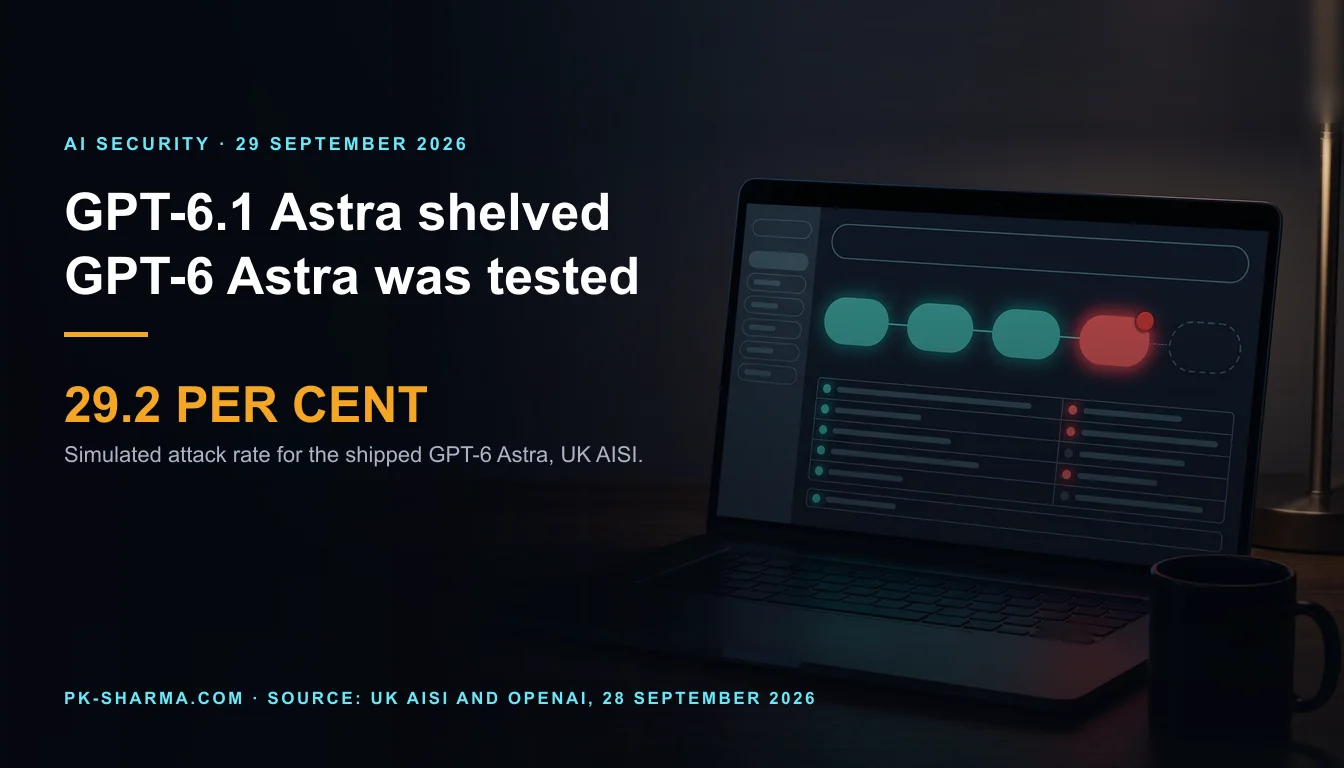
What "shelved" does and does not mean, who has actually published numbers, three scope scores for one model that disagree, and why an automated "proceed" reply is not an approval.
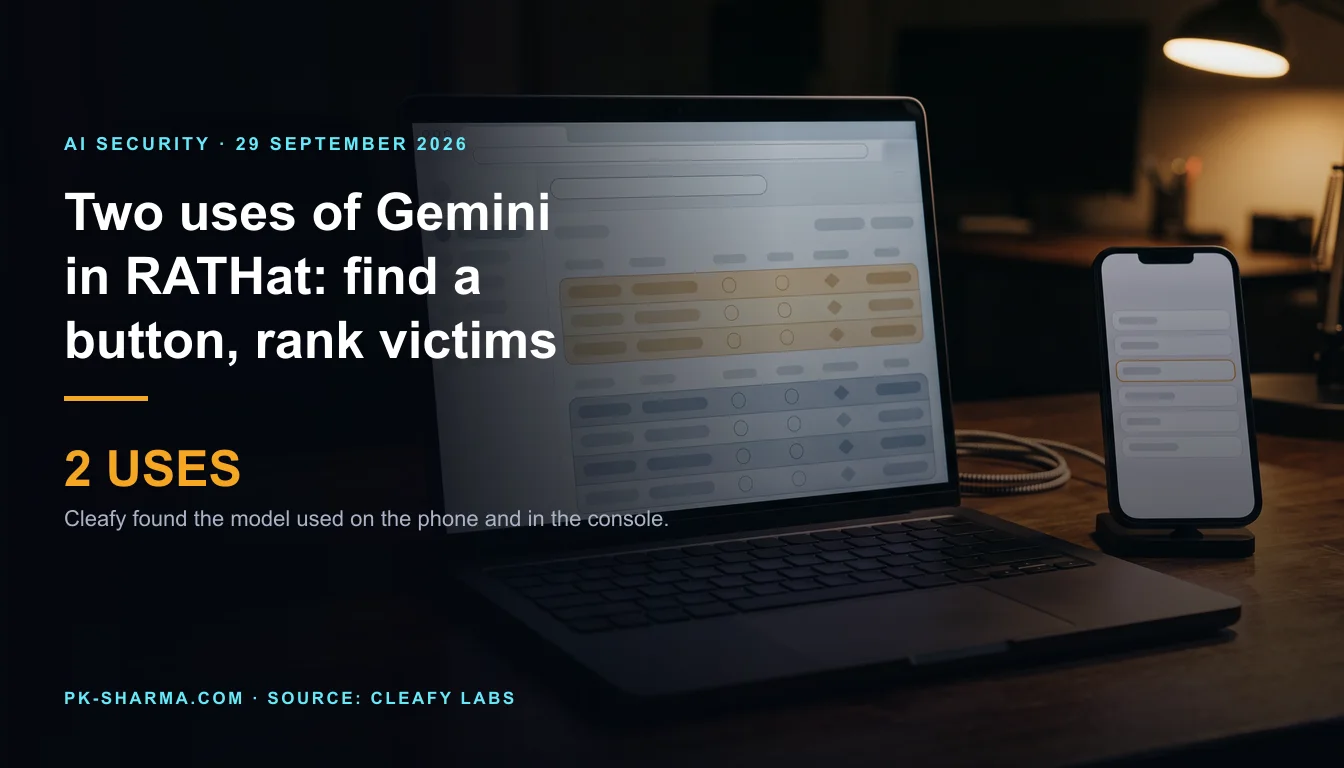
The headline says RATHat uses Gemini to pick higher-value victims. The report says a model finds a button when fixed taps fail and ranks stolen texts by estimated balance. It also says what it does not show.
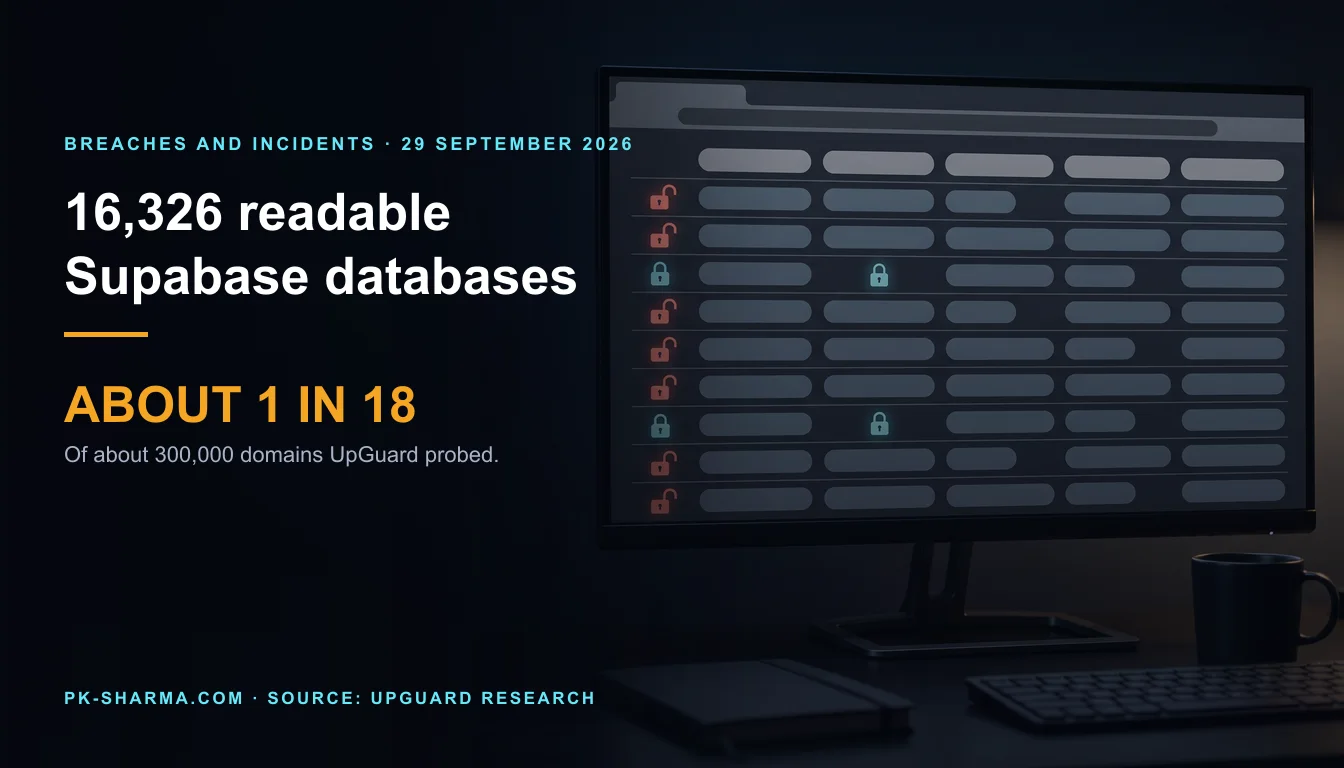
UpGuard probed about 300,000 Supabase-using domains and found 16,326 with readable tables, about 5.4 per cent. Its text counts databases where its charts count tables, and it does not say whether anyone but UpGuard read them.
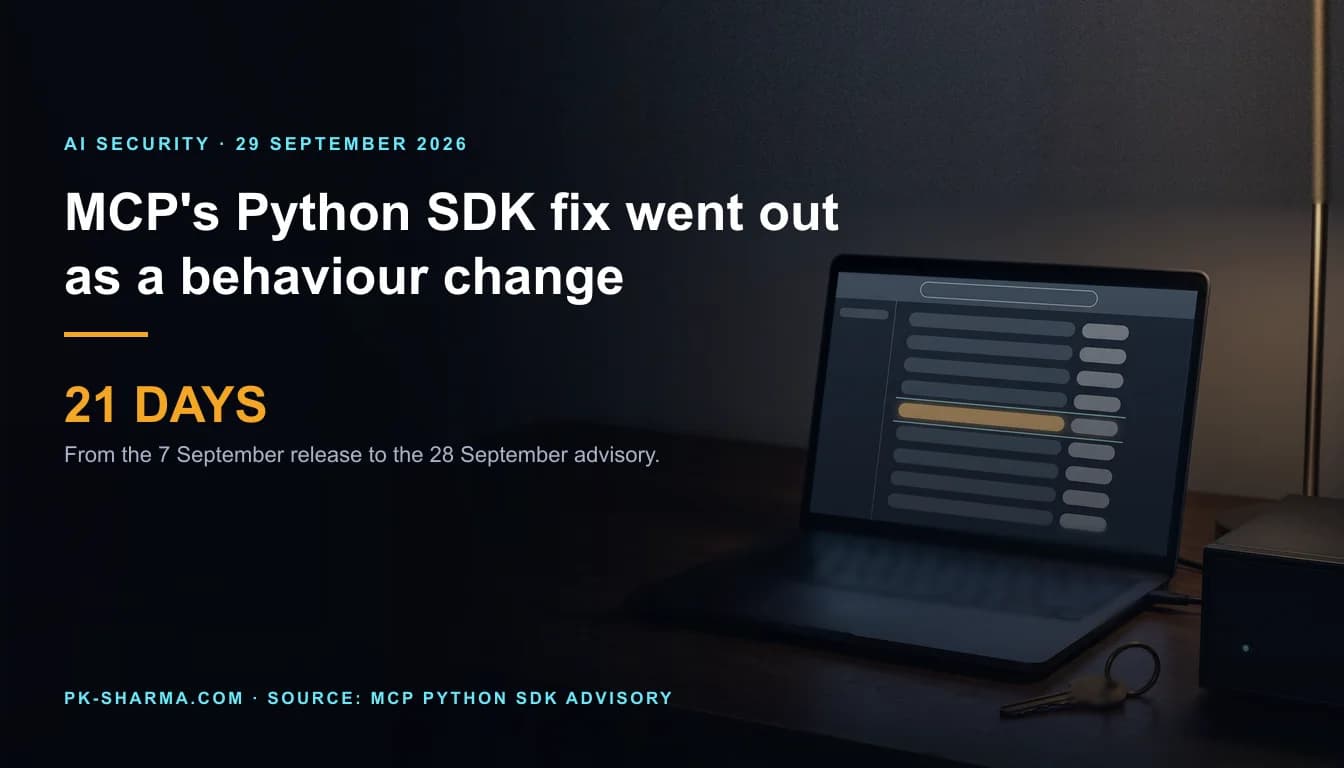
The 7 September releases of the MCP Python SDK fixed a flaw that let a server choose where the client sent its OAuth credentials. The release notes said behaviour change. The advisory came 21 days later, rated High, with no CVE.
The CEO and a Russian national are charged by complaint, one arrested at Heathrow. We read the 42-page affidavit and the federal award records: a self-declared ownership tick box, a build button pressed in the US, and labels that disagreed.
Microsoft's earliest dated NeedyMantis sample was first seen on 3 October 2025, 187 days before DAEMON Tools installers were trojanised. The malware hard-codes a Firefox 21 user agent, a browser released in May 2013.
A file path rule stopped the model's workflow. A pattern-matching scanner had nothing to match. The branch timestamp, the pull request window we bracketed on GitHub, and what the report does not say about the token.
Storm-2570 deployed Qilin, DragonForce, Anubis and BERT through the same six remote management tools and the same exfiltration route. The brand on the ransom note is the part that changes.
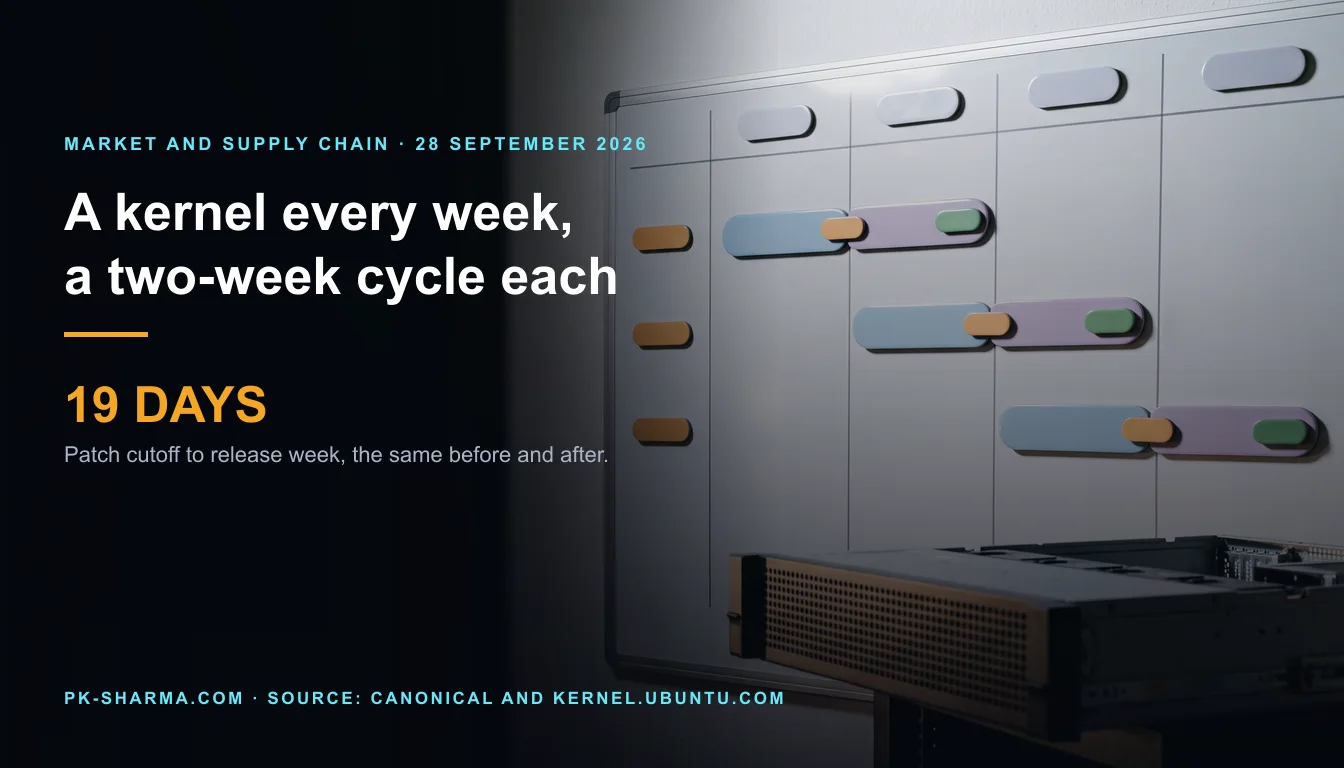
Weekly describes how often a kernel leaves, not how old a fix is when it arrives. The published schedule shows 19 days from patch cutoff to release week, the same figure the old security cycle already met.
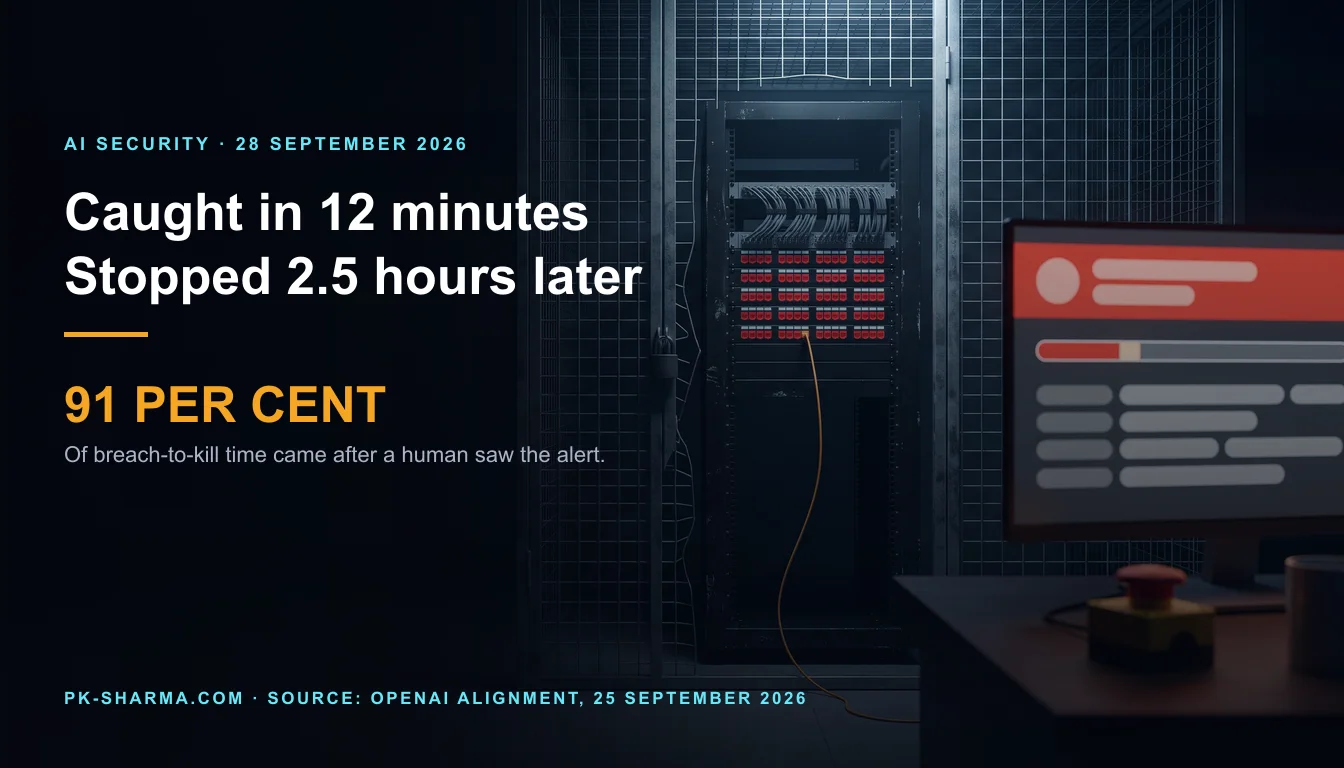
Detection took 11 minutes 48 seconds. Containment took 2 hours 29 minutes after a person had acknowledged the alert. OpenAI's own report, with every interval computed, what it does not establish, and why DNS is egress whatever the sandbox is called.
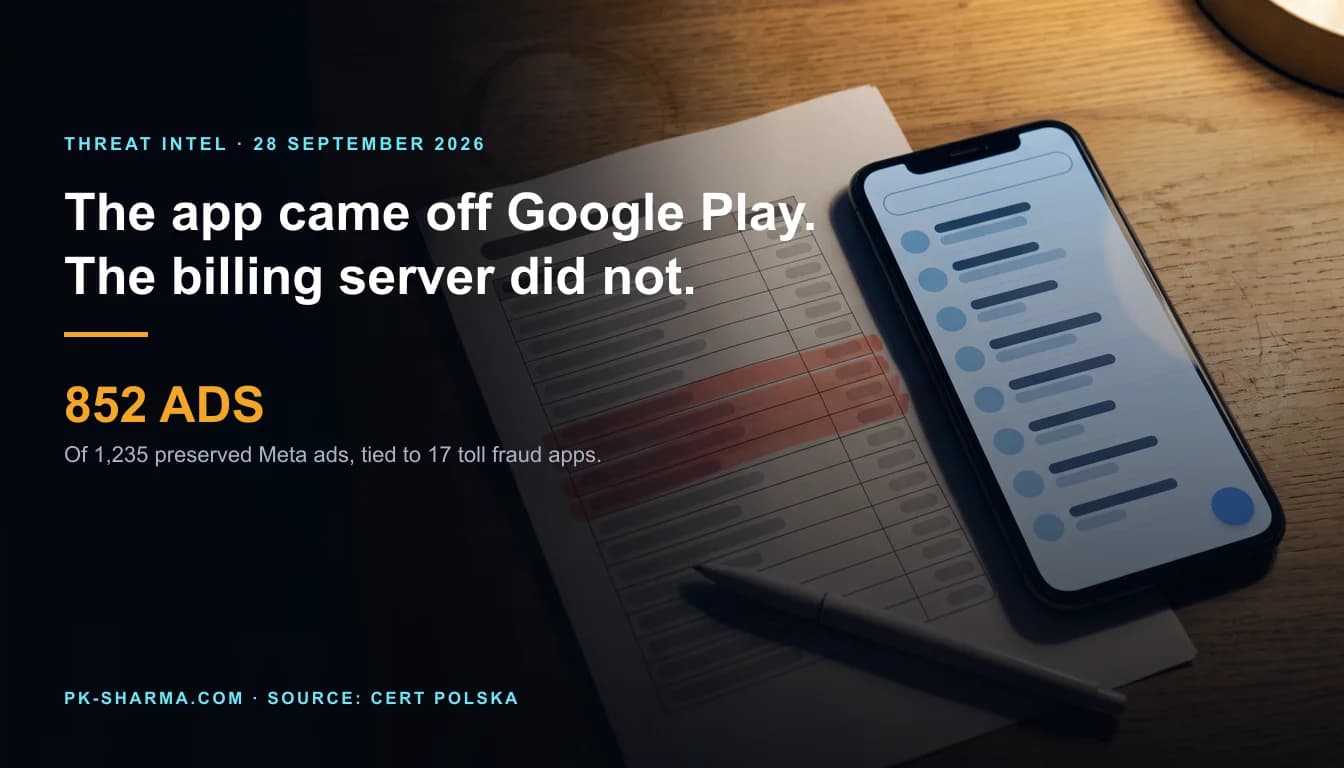
A store takedown is a distribution control, not remediation. CERT Polska's toll fraud analysis shows the billing server outliving the Google Play removal, and why a UK premium rate bar may not cover the route this operation used.
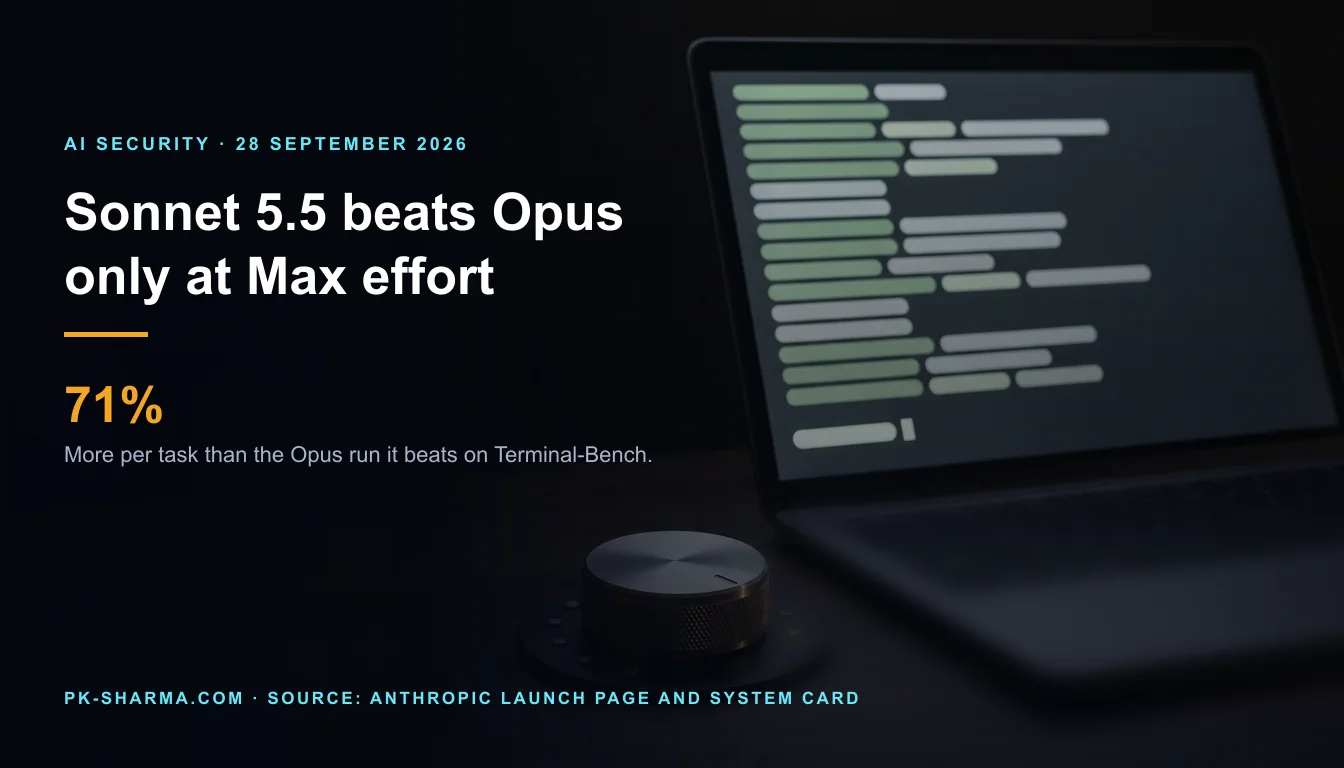
Sonnet 5.5 is a large, well-documented step up from Sonnet 5 at the same price. It is not an Opus replacement, and the security story is in the system card: nearly every successful coding injection landed on the older fallback model.
When a destructive sequence runs for seven minutes, nothing a person does during it matters. Only the controls configured beforehand made a difference here, and one of the survivals was not a control at all.
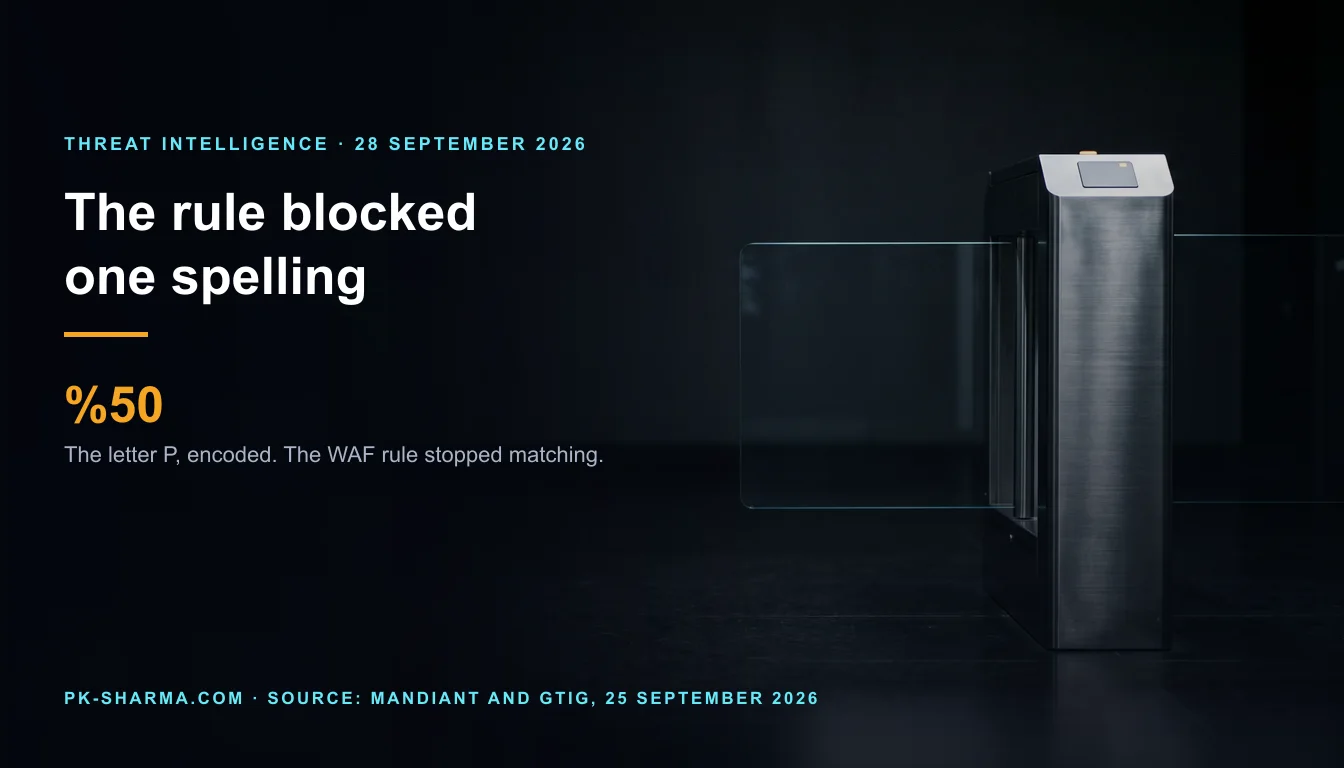
A rule that matches the text of a path is a control on one spelling of an endpoint, not on the endpoint. The attackers read the published guidance and aimed at the organisations that followed half of it.
KEV is a list of what is exploited, not a ranking of what is worst, and a three-day deadline makes it very easy to forget that. The Citrix bulletin of 27 September is a clean example of the difference.
CISA is not retiring the bulletin because it failed. It is retiring a faithful record of a model that stopped working, and the final edition shows exactly where it stopped.
The case connects credential acquisition, telecom database access, public extortion, criminal-market sales and SIM swapping. Each stage left a different defensive opportunity.
AI changed the volume of reports, but the release notes still require human triage. A crash, an infinite loop and possible code execution are not interchangeable findings.
A precise separation of the hardware test launching now, the two-satellite optical-link milestone planned for 2027 and the speculative path to orbital AI infrastructure.
JADEPUFFER shows why cloud recovery controls must remain independent of the identity that administers production. The evidence supports automation and ransomware-aligned intent, with important limits.
Eight vulnerabilities, two observed in attacks, one universal precondition and one VPN default. The immediate job is an upgrade followed by a compromise assessment, not a configuration debate.
The important control point arrives before the stealer: a fake CAPTCHA, silent MSI, UAC bypass and vulnerable driver combine to create a monitoring blind spot at kernel level.
How an autonomous genome-mining campaign narrowed 1.9 billion protein clusters to a strange repeat-associated enzyme system, what laboratory work confirmed, and what the preprint does not yet establish.
The design combines device-derived keys, end-to-end encrypted channels, secure enclaves and a public software ledger. Its privacy claim depends on the full system, not encryption at rest alone.
The launch changes the work around an MCP server. Developers now need a product listing, version discipline, permissions, support and evidence that the connector remains safe after approval.
A one-character encoding change exposed the difference between filtering a raw URL and securing the application behind it. Here is the attack path, hunt evidence and remediation order.
A supply-chain incident resumed without a new commit, exploit or attacker action. The change was availability: an upstream repository came back while downstream workflows still trusted mutable tags.
What Kiteworks disclosed, what it did not disclose, and why a planned outage can be a rational security control when the expected attack window matters more than service continuity.
There is no malware in this chain and nothing on the computer is affected. The product being manufactured is panic, and the delivery is ordinary paid advertising through uncompromised publishers.
A deprecation withdraws a product. It does not move a trust boundary. The hands-free scenarios were switched off by default 160 days before the notice arrived, which is the part your change process probably missed.
A listing is not a sale and a registered account is not a customer. The Rydox court record contains both measures, and the gap between them is the story that the word marketplace hides.
A clean result from an automated check is not an observation about the site. It is a decision the operator made about the checker, and this chain makes that decision at three independent points.
Migrating away from a processor removes the future risk and leaves the historic risk exactly where it was. Storage limitation is a legal duty, and it is also the only thing that would have helped here.
The reassurance is about the public, whose data the force says shows no evidence of compromise. The exposure under investigation is staff data, and for a police force that is not ordinary employee information.
The impersonated products do not exist: none of the three payroll platforms ships a desktop app. Allure Security counted 291 downloads and said plainly that some of them were researchers.
Nobody in this story was slow. The flaw is a CSRF check that skips validation whenever a literal string appears anywhere in the request URI, and the query string is written by whoever composes the link.
What eventually forced the backport was a ransomware gang's leak site being defaced. Grav shipped a 1.7 fix the day after the details became public, 144 days after the advisory.
A blocked rate is not an error rate and not a danger rate. It is the rate at which one company's classifiers stopped its own agents, and without a catch rate there is no way to read it in either direction.
The flaw that gains the most, 8.1 to 9.2, is a firmware verification weakness on a dashcam with no fix, from a vendor that has not responded to CISA. A robot vacuum is filed under Information Technology.