Google is putting a TPU in orbit next week. That is still a long way from a space data centre
The first Project Suncatcher mission tests launch vibration, radiation and vacuum cooling on real AI hardware. Laser-linked satellite clusters come later, and the largest economic claims remain projections.
By Parminder Kumar Sharma · · 6 min read
The mission starts with a survival test, not a data centre
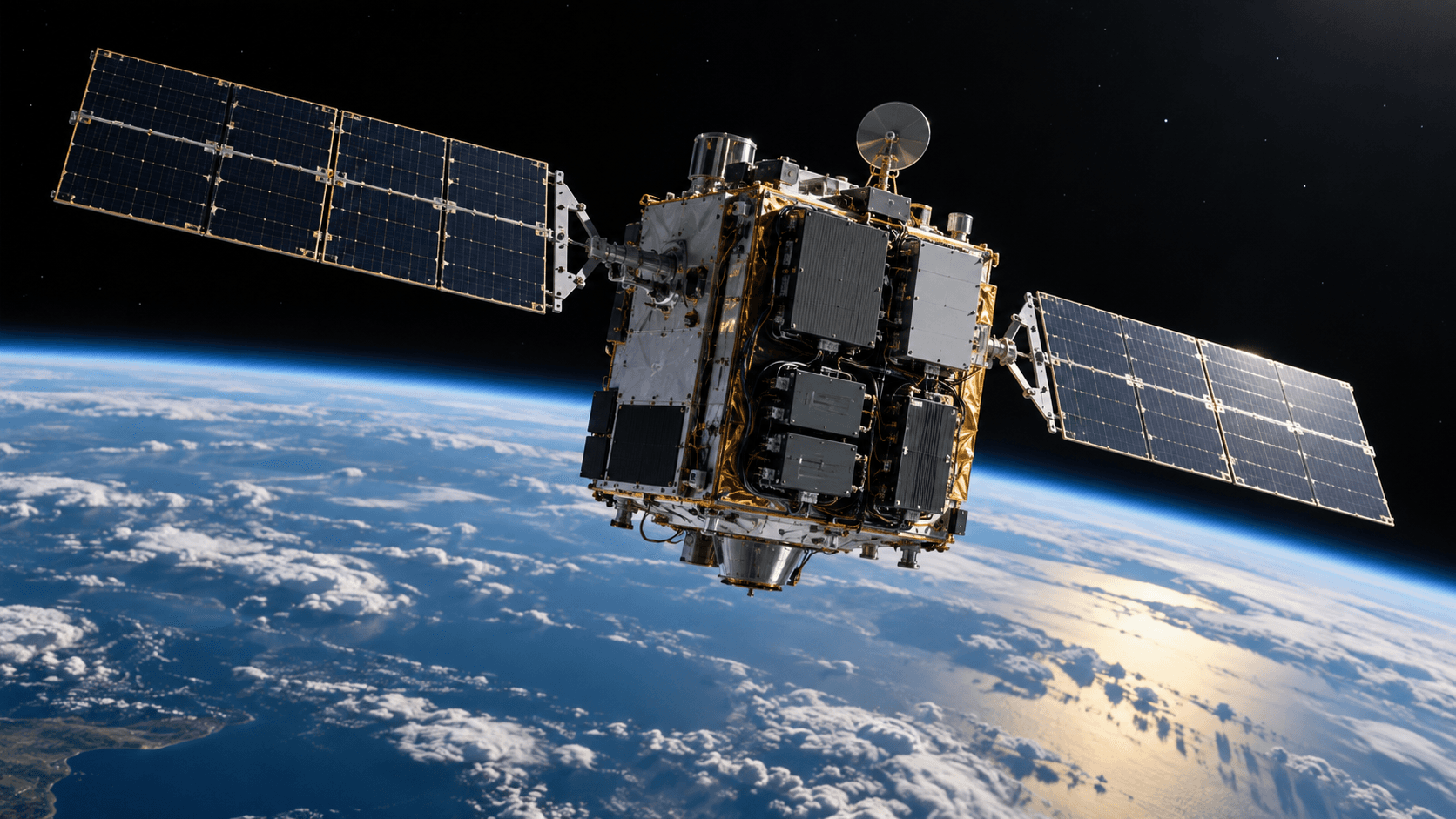
Google says the first Project Suncatcher prototype will launch into low Earth orbit next week on SpaceX's Transporter-18 rideshare mission, in partnership with Planet. Its purpose is deliberately narrow: collect in-orbit evidence about how Google Tensor Processing Units behave during launch and under the radiation and thermal conditions of space.
The payload is not a production AI cluster and it will not establish the economics of orbital computing. It answers an earlier question: can the hardware survive the trip, operate in a vacuum and return useful data?
That question matters because every later part of the proposal depends on it. A terrestrial accelerator lives in a controlled data centre with filtered power, forced-air or liquid cooling, technicians, spare parts and a network that can be repaired. An orbital accelerator gets one launch, radiates heat into a vacuum and must tolerate faults without a person replacing a board.
The first ten minutes test mechanical engineering before they test machine learning
Google says the ride to low Earth orbit lasts about ten minutes and exposes the spacecraft to sustained acceleration of up to ten times Earth's gravity. Individual components can experience 50 to 100g. The team reproduced launch-frequency vibration by shaking the satellite across all three axes, and reports that the hardware survived.
Mechanical survival is only the first gate. Outside the protection of Earth's atmosphere, solar events and cosmic radiation can flip bits, corrupt memory or permanently damage electronics. Google exposed Trillium TPUs to a 67 MeV proton beam at the Crocker Nuclear Laboratory while the chips ran AI workloads.
The earlier research report says high-bandwidth memory showed irregularities after a cumulative dose of 2 krad(Si), close to three times the projected shielded dose over a five-year mission. It reports no hard failure attributable to total ionising dose at up to 15 krad(Si) on one chip. Those laboratory results are promising evidence about the tested hardware and conditions. They are not the same as five years of combined radiation, thermal cycling and operational load in orbit.
What has been tested and what the orbital mission adds
| Engineering question | Evidence before launch | Evidence still needed |
|---|---|---|
| Launch vibration | Three-axis vibration testing; hardware survived | Behaviour during the actual launch profile |
| Radiation | Proton-beam testing while running workloads | Long-duration mixed radiation and accumulated faults |
| Cooling | Heat pipes and radiators tested in a thermal-vacuum chamber | Thermal behaviour in orbit across real duty cycles |
| Compute | Trillium TPU workloads during ground tests | Stable operation and recoverable errors in orbit |
In a vacuum, cooling becomes a radiator problem
A powerful chip concentrates heat into a small area. On Earth, a data centre can carry that heat away with moving air or liquid. Space has no surrounding air, so convection is unavailable. Heat must travel through the spacecraft and leave through radiation.
Google says the prototype combines heat pipes and radiators and has been tested in a thermal-vacuum chamber. The orbital flight will show whether the design keeps the TPU inside its operating envelope as sunlight, shadow, workload and spacecraft orientation change.
This is one reason that the phrase "space data centre" can obscure more than it explains. The energy source may be abundant, but turning electricity into computation creates waste heat. Solar generation, compute density and radiator area form one system. Increasing one without the others does not produce more usable AI capacity.
The 2027 problem is connecting moving accelerators at data-centre speeds
Distributed machine-learning workloads depend on high-bandwidth, low-latency links between accelerators. Project Suncatcher proposes free-space optical links between satellites flying in unusually close formation. The 2025 research describes target bandwidth in the tens of terabits per second and reports a bench demonstration of 800 Gbps in each direction using one transceiver pair.
The link budget improves when satellites are close, but proximity creates an orbital-control problem. Google's illustrative model placed 81 satellites in a cluster with a radius of one kilometre, with some neighbouring distances moving between roughly 100 and 200 metres. Every optical terminal must keep a narrow beam pointed at another moving satellite while the entire formation travels around Earth.
Google's public update says future satellites could carry dozens of TPUs and communicate by laser. The planned 2027 milestone is two satellites, which is the appropriate next experiment. Two endpoints can test pointing, acquisition, tracking and bandwidth. They do not prove that an 81-satellite formation can operate safely or deliver cluster-scale training.
Eight times the solar productivity does not mean eight times cheaper compute
Google's central attraction is persistent solar energy. In an appropriate orbit, it says a panel can be up to eight times more productive than on Earth and generate power almost continuously. That reduces the need for batteries and avoids some terrestrial constraints on grid connection, land and water.
The cost argument depends on several other curves moving in the right direction. The 2025 analysis projects that launch prices could fall below 200 dollars per kilogram by the mid-2030s and says orbital compute could then approach reported terrestrial energy costs per kilowatt-year. This is a modelled scenario, not a current price. It excludes the simplicity of walking into a building to replace a failed server and shifts reliability, maintenance, communications and end-of-life disposal into space operations.
The defensible conclusion today is not that data centres are moving to orbit. It is that Google has reduced one ambitious system proposal to a sequence of falsifiable engineering tests.
Evidence ladder for Project Suncatcher
| Claim | Status on 28 September 2026 |
|---|---|
| A TPU can survive laboratory vibration and proton testing | Tested by Google on the selected hardware |
| A TPU and radiator can operate through an orbital mission | Prototype launch is intended to test this |
| Two satellites can exchange AI-relevant data optically | Planned 2027 experiment |
| A close formation can behave like an accelerator cluster | Modelled and partly demonstrated on a bench |
| Orbital AI compute can compete economically with terrestrial capacity | Projection dependent on future launch and system costs |
The useful measurements are the ones that can make the project fail
Take this with you
What to look for in the flight results
- The actual TPU workload and duty cycle used in orbit rather than a generic claim that the chip powered on
- Corrected and uncorrected memory errors, resets and any degradation over time
- Radiator temperatures across sunlight, shadow and different compute loads
- Power generated, power consumed and the duration of stable operation
- Whether the hardware can recover autonomously from a fault without a ground intervention
- The mass devoted to shielding, cooling and power compared with the mass of useful compute
- For the 2027 mission, sustained optical throughput, latency, pointing interruptions and recovery time
- A clear separation between measured flight data and projections for a future constellation
Key facts
Sources
- PrimaryBehind Project Suncatcher, our moonshot to put AI in spaceGoogleaccessed 2026-09-28
- PrimaryExploring a space-based, scalable AI infrastructure system designGoogle Researchaccessed 2026-09-28
- PrimaryTowards a future space-based, highly scalable AI infrastructure system designarXivaccessed 2026-09-28