The WAF blocked /PSEMHUB/. ShinyHunters sent /%50SEMHUB/ instead
Mandiant says renewed exploitation of CVE-2026-35273 reached dozens of PeopleSoft systems because some perimeter rules inspected the literal path before WebLogic decoded it. Encoding one character restored access to the vulnerable servlet.
By Parminder Kumar Sharma · · 5 min read

The renewed campaign targeted the gap between the security rule and the application
On 25 September 2026, Mandiant and Google Threat Intelligence Group reported renewed mass exploitation of CVE-2026-35273 by UNC6240, also known as ShinyHunters. The vulnerability affects Oracle PeopleSoft Enterprise PeopleTools and allows unauthenticated remote code execution. Oracle assigns it a CVSS 3.1 score of 9.8 and released an out-of-band security alert on 10 June.
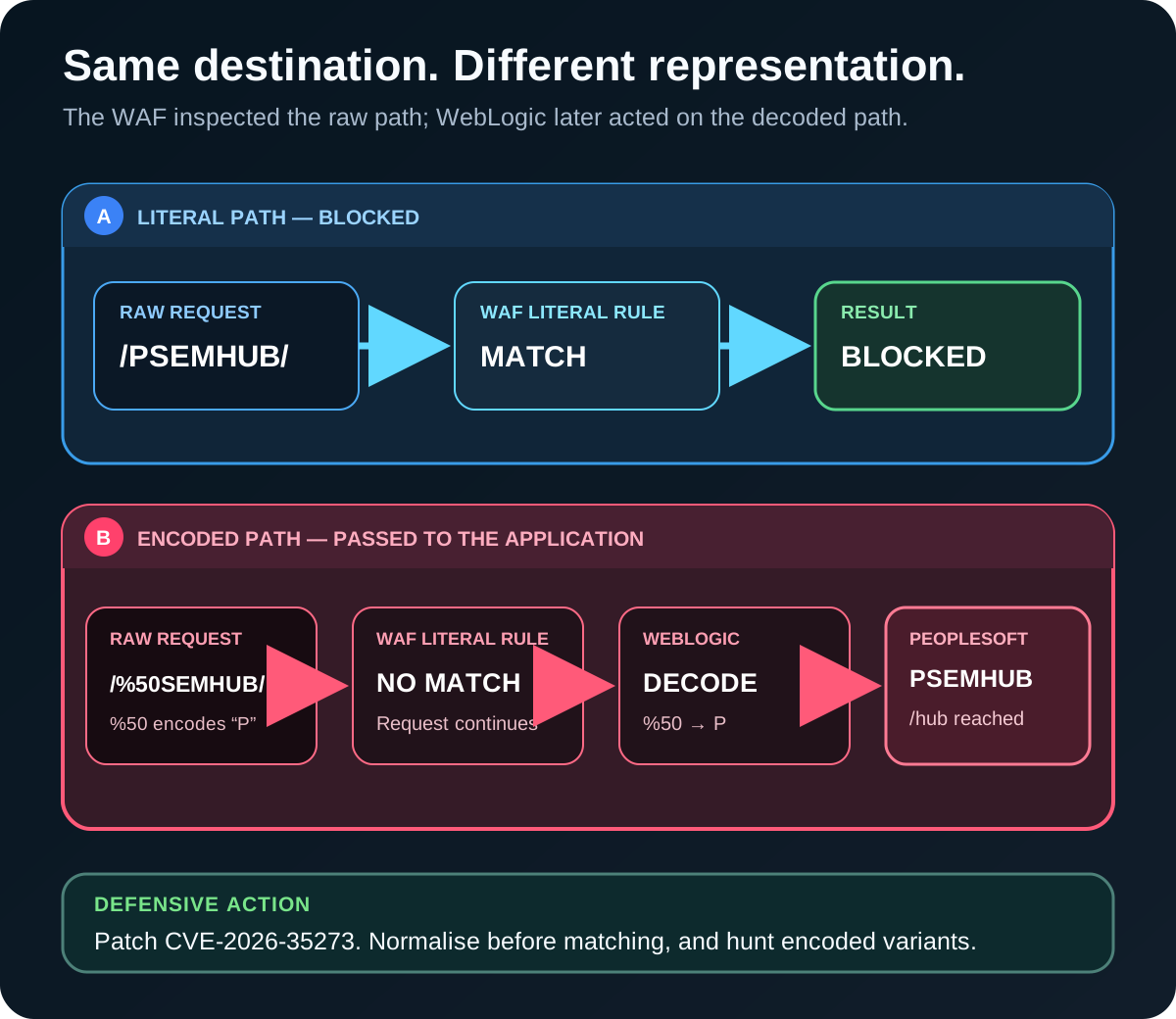
The earlier defensive guidance included blocking external access to /PSEMHUB/* when immediate patching or service removal was not possible. The new campaign changed the request to /%50SEMHUB/, where %50 is the URL-encoded representation of the letter P. Some WAF and reverse-proxy rules compared the raw request against the literal string /PSEMHUB/, so the encoded form did not match. WebLogic then decoded the URL and routed it to the vulnerable servlet.
Mandiant says the actor deployed web shells on dozens of systems worldwide across higher education, technology, IT services, healthcare, agriculture, transportation and government. The exact victim count and any stolen datasets were not published.
One decoding step explains the bypass
HTTP infrastructure may inspect a request at several stages. The edge receives a raw path. A WAF may compare that path to block patterns. A reverse proxy or application server may later normalise case, resolve encoded characters and route the decoded result. If the filter and destination do not evaluate the same canonical form, two different strings can become the same application request.
That is what Mandiant observed. The literal path was blocked; the encoded path passed the earlier comparison; WebLogic converted %50 back to P; PeopleSoft served /PSEMHUB/hub. Defenders should assume that attackers will try other percent-encoded, mixed-case or otherwise non-normalised variants rather than treating %50 as the only bypass.
Verification could be quiet; exploitation could be fileless or persistent
Mandiant observed targeted servers receiving five to fifteen POST requests to /%50SEMHUB/hub containing a serialized Java object. An unpatched server could return its operating system without writing a file or disrupting the service, allowing the actor to verify exploitability before choosing the next step.
The exploitation paths then diverged. In one, repeated requests attempted to place JSP web shells such as x.jsp on multiple nodes behind a load balancer. In another, commands executed through the WebLogic Java process and returned output directly in the HTTP response, leaving no JSP file behind. File-creation detections alone therefore miss part of the observed behaviour.
Across compromised instances, Mandiant says one quarter of observed commands ran as root or NT Authority\SYSTEM. Commands running as PeopleSoft or WebLogic service accounts could still reach configuration files, database connection strings and application data.
Observed stages and useful evidence
| Stage | Observed behaviour | Evidence to review |
|---|---|---|
| Verification | Five to fifteen POST requests to the encoded hub path | WebLogic access logs, source IP, response pattern |
| Exploit | Java deserialization through the PSEMHUB hub servlet | External POST bodies and Java child processes |
| Persistence | JSP web shells written into application directories | Unexpected JSP, JSPX or executable files on every node |
| Fileless execution | Command output returned in the HTTP response | cmd.exe, /bin/sh or bash spawned by WebLogic Java |
| Follow-on access | Tunnelling, credential access and MeshCentral tooling | Outbound connections, new agents and credential use |
Patch first, then hunt as though the WAF may have failed
Take this with you
Immediate PeopleSoft response
- Apply Oracle's security update for CVE-2026-35273 on supported PeopleTools versions
- Disable Environment Management Hub where it is not required or remove the PSEMHUB application as Oracle directs
- Restrict administrative and system-to-system components from the public internet
- Search WebLogic access logs for literal, percent-encoded, mixed-case and other normalised variants of PSEMHUB
- Inspect every node behind load balancers for unexpected JSP, JSPX and executable files
- Alert on shells spawned by the WebLogic Java process, including fileless command execution
- Review for unexpected MeshCentral agents, tunnels, archives and sustained outbound transfers
- Rotate database, Integration Broker, cloud and other credentials reachable from the PeopleSoft service tier
The durable engineering lesson is canonicalisation before enforcement
Security controls should make access decisions over the same canonical representation used by the protected application. That means normalising and decoding safely before comparison, rejecting ambiguous encodings where possible, and testing alternate representations during validation. It also means accepting the limit of a perimeter rule: even a perfectly normalised block does not repair unsafe deserialization behind it.
The campaign demonstrates why mitigations need expiry dates and owners. An emergency WAF rule should create time to patch, not become a permanent substitute for patching. When the temporary control becomes the long-term plan, attackers can focus on differences between what the filter recognises and what the application accepts.
Key facts
Sources
- PrimaryShinyHunters Renewed Mass Exploitation Campaign Targeting Oracle PeopleSoftGoogle Threat Intelligence Group and Mandiantaccessed 2026-09-27
- PrimaryOracle Security Alert Advisory CVE-2026-35273Oracleaccessed 2026-09-27