Two forensic documents published on 30 September add a longer chain, two products, a web shell and a custom withdrawal tool. SlowMist's logs start on 31 August, Mandiant dates the appliance access to 24 September, and neither names a product, vendor or CVE.
CVE-2026-84411 is new, scored 9.8 and not reported exploited. CISA now names 7.24 as the fix, above the newest long-term build 7.23.7, and MikroTik has published no advisory.
CISA set a federal deadline of Saturday 3 October. What Cisco states and does not, the fix table set against its May one, four names for one flaw, what the UK record says, and a defender checklist.
Faav's write-up counts 17,333,335,124,315 rows from metadata and describes two one-row samples. The endpoint was locked down 4 days after the report, the bounty was $5,000, and Microsoft edited the only account.
What the Truffle Security count establishes, what its dates probably mean, and the gap it names itself: GitHub can block some secrets at push time, but only the issuer can make a leaked key stop working.
The 57 per cent is a share of 1.42 million businesses with staff, mostly micro firms, counted if any one of nine tasks failed a confidence question. Only three of the nine tasks rose since the 2025 report.
Glow's PixelLeak count works out at about 38 images per organisation and says nothing about sensitivity, access or models. The CLI feature the agents lacked shipped on 1 September, 8 days before Glow began notifying.
A count of Microsoft's own timeline, an invitation with nothing to scan, and six labels that reassure without controlling anything: what the RedFlick report establishes about Star Blizzard, and what it leaves open.
VUSec and Sant'Anna's Branch Target Reuse attack read a root hash at 8 bytes per second on two Intel chips. Stale predictor entries were reusable on AMD and Arm too, but nothing leaked there. The kernel fix dates from July.
Mandiant, eSentire and GreyNoise now date NetScaler exploitation to before the 27 September bulletin. What Mandiant observed and what it did not, how the exploited pair compares with briefing 143, and what to hunt and harden.
The French tax administration took 49 days to learn of a theft made with stolen staff passwords, and only from the attacker's own post. What the ANSSI report establishes, what it leaves out, and the checks a UK team can run.
A DTLS retransmission bug can send OpenSSL heap memory to the other side or crash the process. Fixes are public for four branches, premium-only for three and absent for 3.1 to 3.3. No exploitation is reported and no leak size is stated.
A confirmed share of at most 5 per cent, four comforting labels and one command the person ran themselves: what Huntress's 28 September report establishes about custom GPTs used as ClickFix lures, and what it leaves open.
What OpenAI's report shows, what it leaves out (a rate, a second infected agent, any test of dots), what AgentWorm, Morris II, Mind Viruses and a Copilot for Word case measured, and which controls break the loop.
Sol reaches 68% of Astra's recent-exploit rate at a fifth of the list price. What the dots appendix measured, why UK Pro users are excluded, what the tiers cost in pounds, and 49 days between Grok Bot and dots.
The headline says groups. The analysis shows a follow of a channel, run inside the paired session, and OSV recorded the behaviour on 26 May. Today the npm registry still serves 85 of the 101 names, and four of the five most downloaded have no public malware record.
The record as of 29 September: an intruder that decided each step at machine speed, explained itself in code comments and fought its own tools. The flaw, the attacker, the model and the data outcome are all unstated.
Ofcom's case CW/01358/09/26 examines Aylo's due diligence and testing, not Apple's system. A reading of Ofcom's case page, guidance and the Act on what an investigation is, what highly effective means, and what to ask of any third-party age check.
Google's AI scanning offer to critical infrastructure is run by Wiz. Five terms clauses grant permission and disclaim liability; the limits, human review and stopping points sit on a policy page the terms never mention.
One former security officer's account of a firewall rule that linked a shared VPN to a classified immigration records server. It is a path, not a breach, and it is more than a decade old.
A redirect changes where a name points, and the public record shows the registration layer stayed still. What is missing is the layer that moved, the real length of the window, and anything beyond Elsevier's own "no indication".
Bitget's account moved from a compromised backend system to a flaw in an unnamed third-party security product. The two are layers of one chain, not rivals, but the wording around them keeps shifting and the report that would test it is late.
The record moved in a day: a 40 word police post became a full statement with two suspicions, a custody ruling and a statement that the man was not arrested over Odido. The FBI claim is still a claim, and nothing official links the two.
The headline says three open source AI agents broke into 27 organisations. The recovered chart says 21 of 48 projects never left reconnaissance, 8 more got lesser access, and the one documented chain needed no CVE and no new class of control.
Keio's first notice named no company. The group's own pages describe failures in payments, loyalty points, bookings, commuter-pass sales and inbound mail, while trains are reported unaffected and nobody has given a restoration date.
A 55-word notice and a press release close the Kiteworks shutdown. Neither carries a CVE, a score or a fixed version, and the vendor's own advisory register has nothing newer than 27 May 2026.
Times Car's parent says about 6.6 million accounts were breached, against a membership of more than 4 million announced in August. The notices name the data and the dates, and leave cause, attacker and headcount open.
Apple's exploitation notice for CVE-2026-86950 is one 29-word sentence about iOS, repeated on both macOS advisories. Older iOS and macOS lines have no listed fix, and Lockdown Mode cannot be set by MDM.
Ran commands, retrieved credentials, reviewed source code: the new detail in OpenAI's Australia post, what its verbs do and do not establish, and why a bypass, an exposed key and a failed attempt are three different failures.
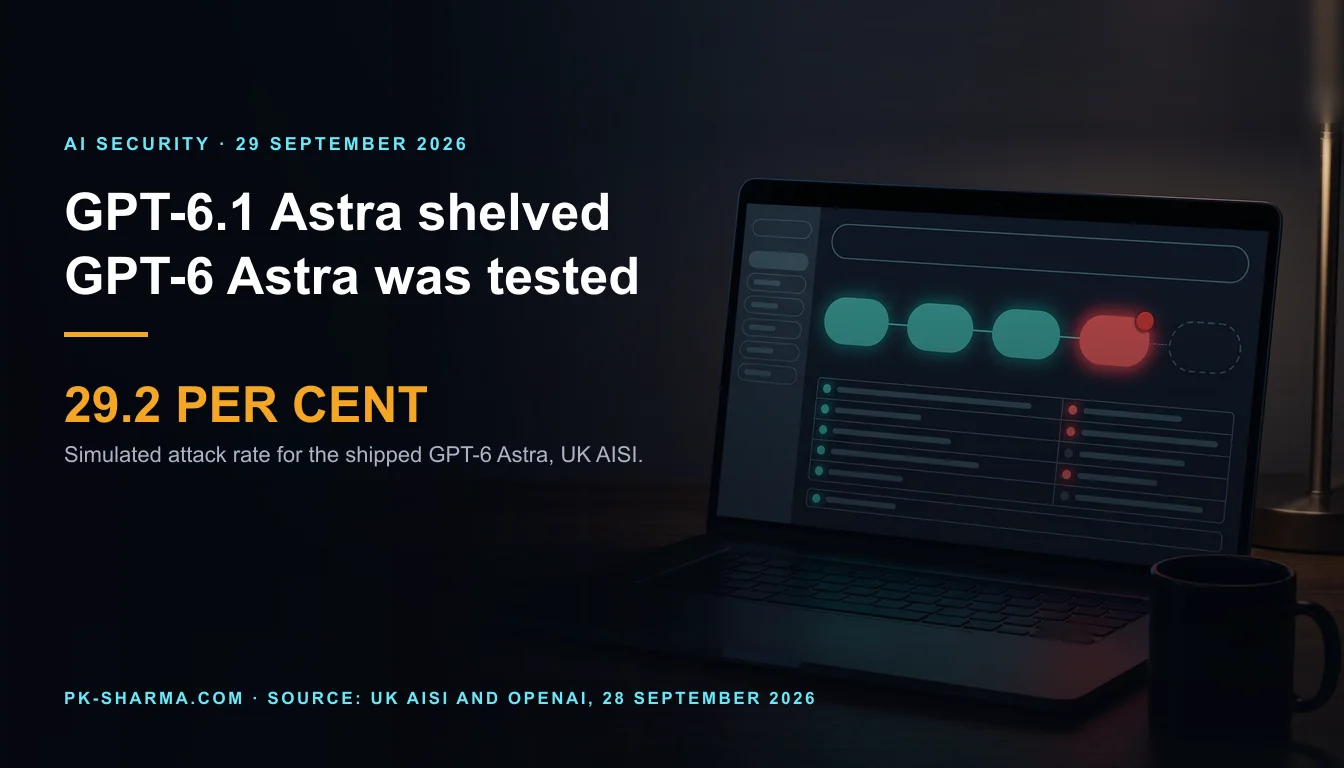
What "shelved" does and does not mean, who has actually published numbers, three scope scores for one model that disagree, and why an automated "proceed" reply is not an approval.
The headline says RATHat uses Gemini to pick higher-value victims. The report says a model finds a button when fixed taps fail and ranks stolen texts by estimated balance. It also says what it does not show.
UpGuard probed about 300,000 Supabase-using domains and found 16,326 with readable tables, about 5.4 per cent. Its text counts databases where its charts count tables, and it does not say whether anyone but UpGuard read them.
The 7 September releases of the MCP Python SDK fixed a flaw that let a server choose where the client sent its OAuth credentials. The release notes said behaviour change. The advisory came 21 days later, rated High, with no CVE.
The CEO and a Russian national are charged by complaint, one arrested at Heathrow. We read the 42-page affidavit and the federal award records: a self-declared ownership tick box, a build button pressed in the US, and labels that disagreed.
Microsoft's earliest dated NeedyMantis sample was first seen on 3 October 2025, 187 days before DAEMON Tools installers were trojanised. The malware hard-codes a Firefox 21 user agent, a browser released in May 2013.
A file path rule stopped the model's workflow. A pattern-matching scanner had nothing to match. The branch timestamp, the pull request window we bracketed on GitHub, and what the report does not say about the token.