The 9.9-rated flaw is about an authenticated flow configuration crossing a server-side boundary, and only self-hosted AI Gateways require the published upgrades.
The overlooked issue is the boundary between retrieving public data and probing a site for alternative behaviour. Request counts, failed tests and attribution need separate labels.
The accessibility control is valuable, but users and responders need to distinguish the Android version, Device protection and a separate 12-month forensic log.
The operational hazard is not only the IBE file-write flaw. Two official version lists disagree and Fortinet's fixed releases are still marked upcoming.
The spike was 16,000 attempts from over 4,000 users, under four each on average. What that does and does not establish, why a terms-of-service violation is not a breach, and what UK providers and buyers should check about extraction at the API layer.
Three provisional arrests, five servers, five domains and 110 TB, in a case led from Hamburg with one arrest in the UK. The counts do not match, and no release describes how victims will be told or what happens to files already published.
The 10.0 flaw has a CVE, a score and a fixed version. The flaw Kiteworks said it found during the shutdown has none that any record attaches to it, and no advisory in the batch says whether it is there.
All three attacker sender addresses in Proofpoint's July list are consumer webmail. A reading of its 1 October report on TA419: what it states, what it leaves out, why MFA and DMARC miss the chain, and an ordered checklist for UK organisations.
The alert is one page and about 470 words. It asserts the funding chain at both ends, says nothing about what UK work gave China's MSS, and asks institutions to establish a funder that NPSA's own collaboration checklist never asks about.
Eight files, a database row, a shared-memory segment and scheduled tasks: eleven places in Sucuri's own account of a WordPress backdoor that returns within seconds. What the report states, what it leaves out, and the order to clear it.
One signed MSP360 installer, five example filenames, a second remote tool, and 60 to 90 days between Microsoft's July sightings and its post. The signer was real; whether you approved it is the control.
Five flaws, one fixed build, zero days between release and bulletin. A client updated in August is still listed as affected, and for UK organisations the Cyber Essentials 14-day clock on these fixes ends on 13 October.
Six vendor reports describe four disguises for a NetScaler web shell, and LevelBlue's is the newest. What it states, what it leaves out, why one vendor's file names will not find another's, and what an update does not do.
The beacon chain shows 226,112 ETH of Lido stake queued to exit 6 to 12 hours before MetaMask's first notice. The notice and Lido's post name no cause, no count and no key status, and no funds lost are reported.
Ten days on, DIVD's breach has a root cause: two Zammad flaws, one with no fix on record. The evidence for an AI agent is still tempo and comments in scripts, and the Zammad finding does not add to it.
From mid-October 2026 the Entra sign-in page will run only Microsoft scripts. Users can still sign in, so a failing tool raises no outage, and Microsoft describes no tenant report. The policy also guards one page only.
The Pentagon's personnel data centre dated its breach letter 64 days after discovering the flaw, after at least 258 days of access. What the notice states, what it leaves out, and the checks a UK team can run.
A public CoreGraphics crash test is not proof of exploitation, and the WhatsApp path rests on a line the researchers removed. CISA had already moved to active a day earlier. What UK teams should do about iPhones and Macs.
What Google's launch post, methodology PDF and images say, checked against Vals, CWE-bench and Artificial Analysis: who ran each number, what the 68% cyber tie cost, and what is not stated about access and safety.
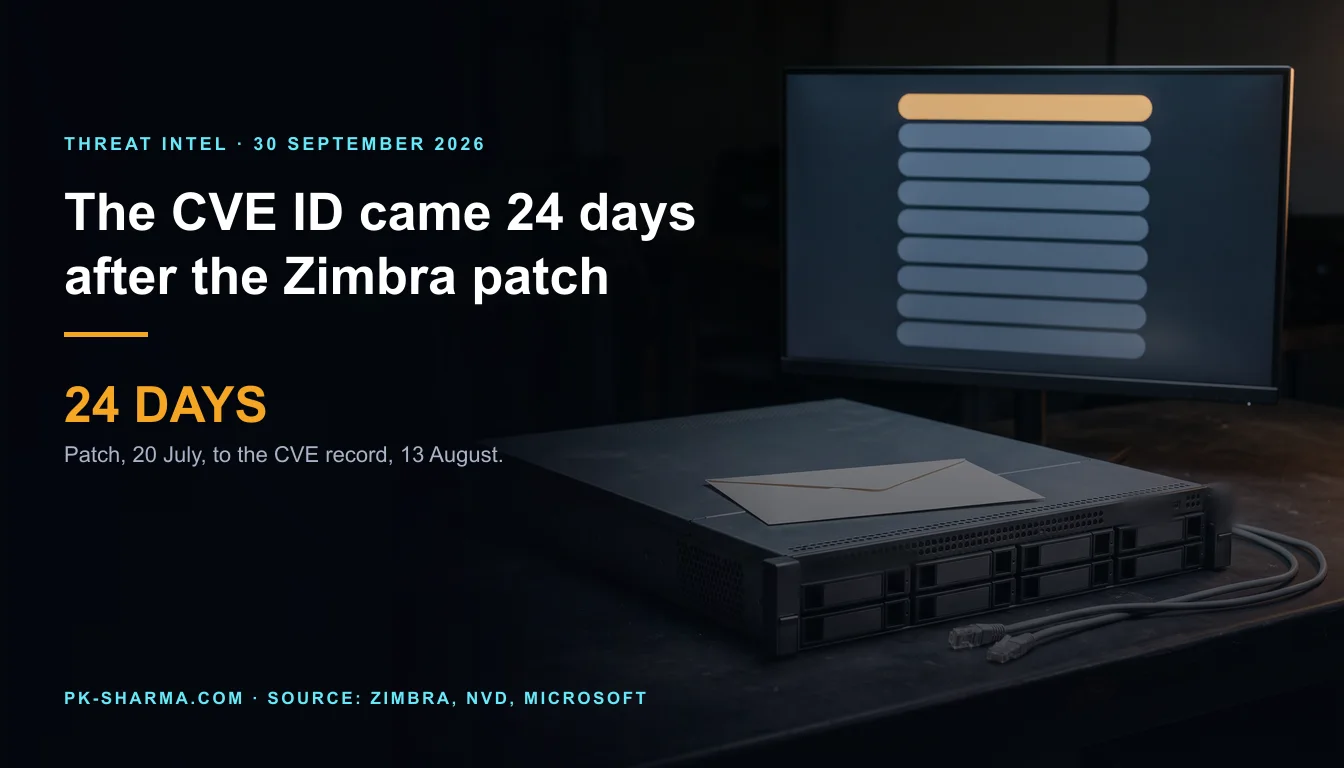
The dates, the score and the versions checked against Zimbra, NVD, CISA and Microsoft. What a patch does not remove from a hit mail server, the one victim count that exists, and a defender checklist.
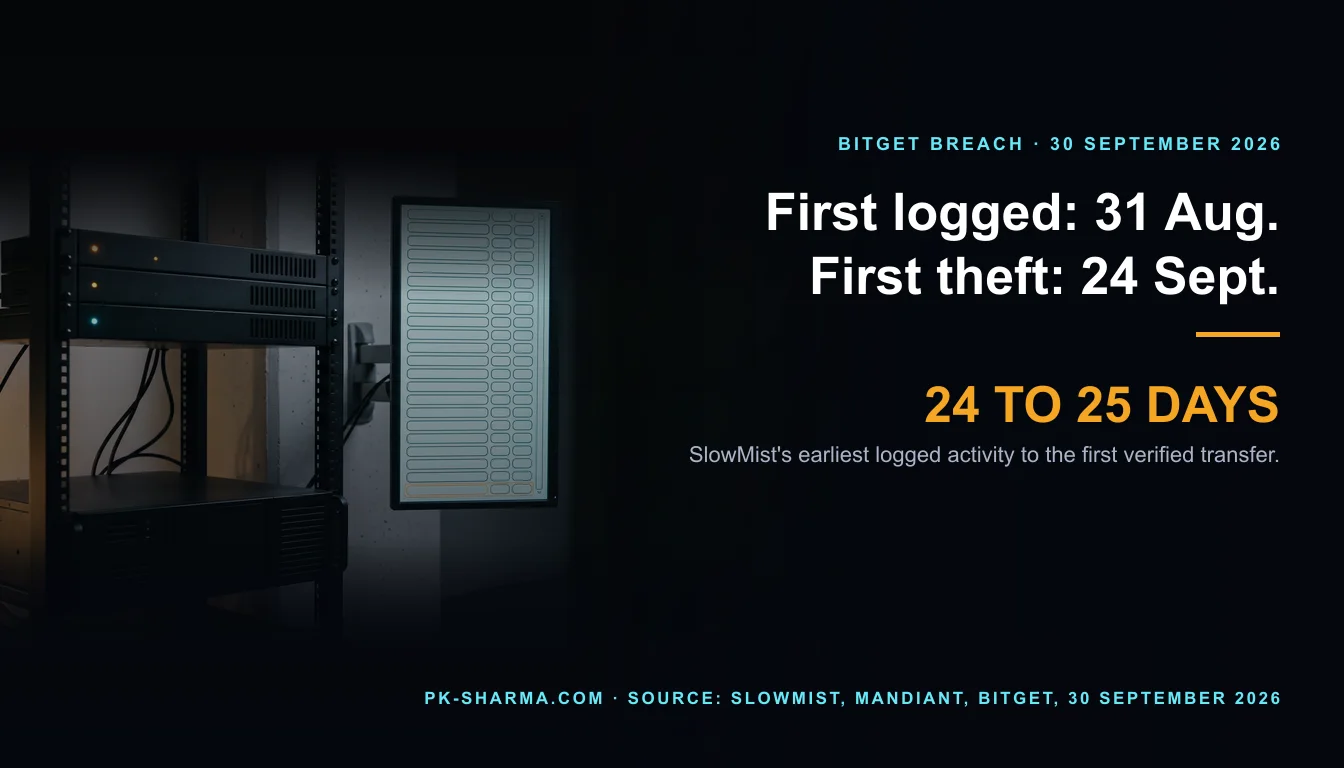
Two forensic documents published on 30 September add a longer chain, two products, a web shell and a custom withdrawal tool. SlowMist's logs start on 31 August, Mandiant dates the appliance access to 24 September, and neither names a product, vendor or CVE.
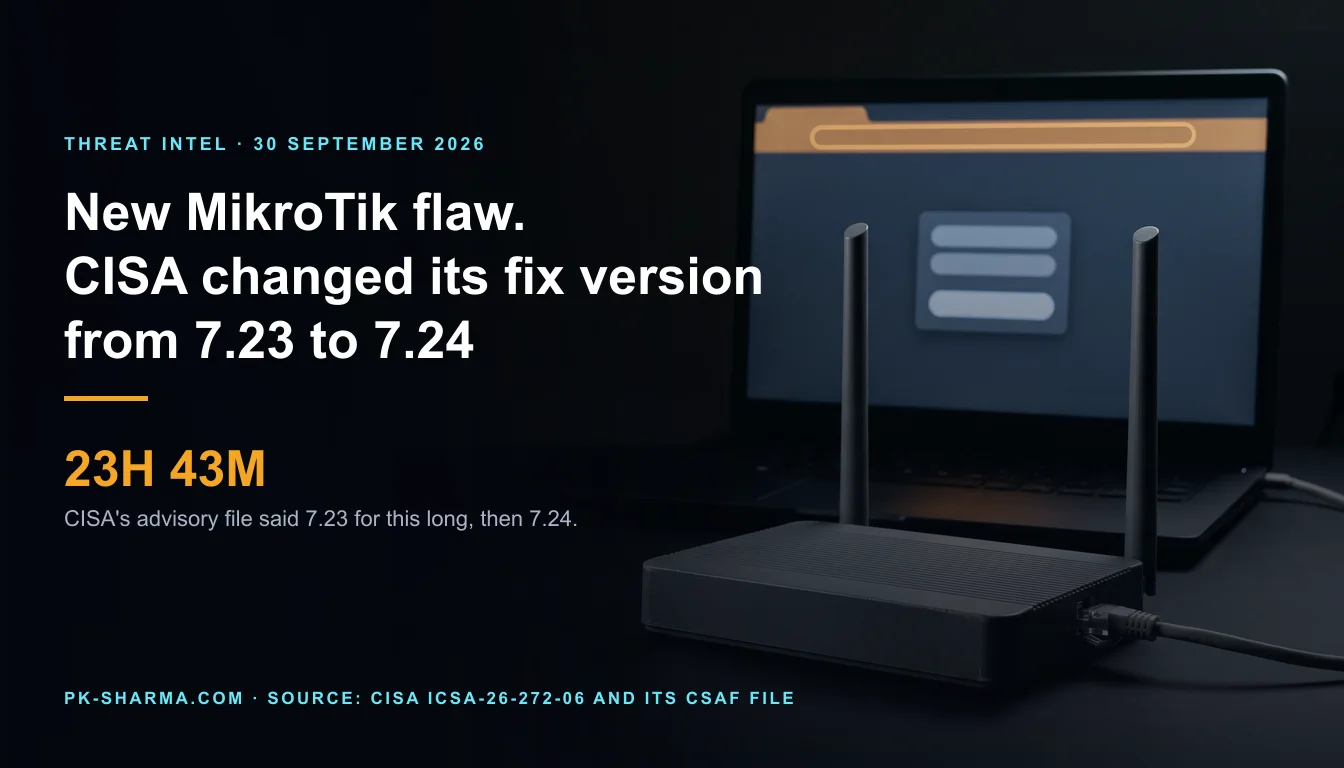
CVE-2026-84411 is new, scored 9.8 and not reported exploited. CISA now names 7.24 as the fix, above the newest long-term build 7.23.7, and MikroTik has published no advisory.
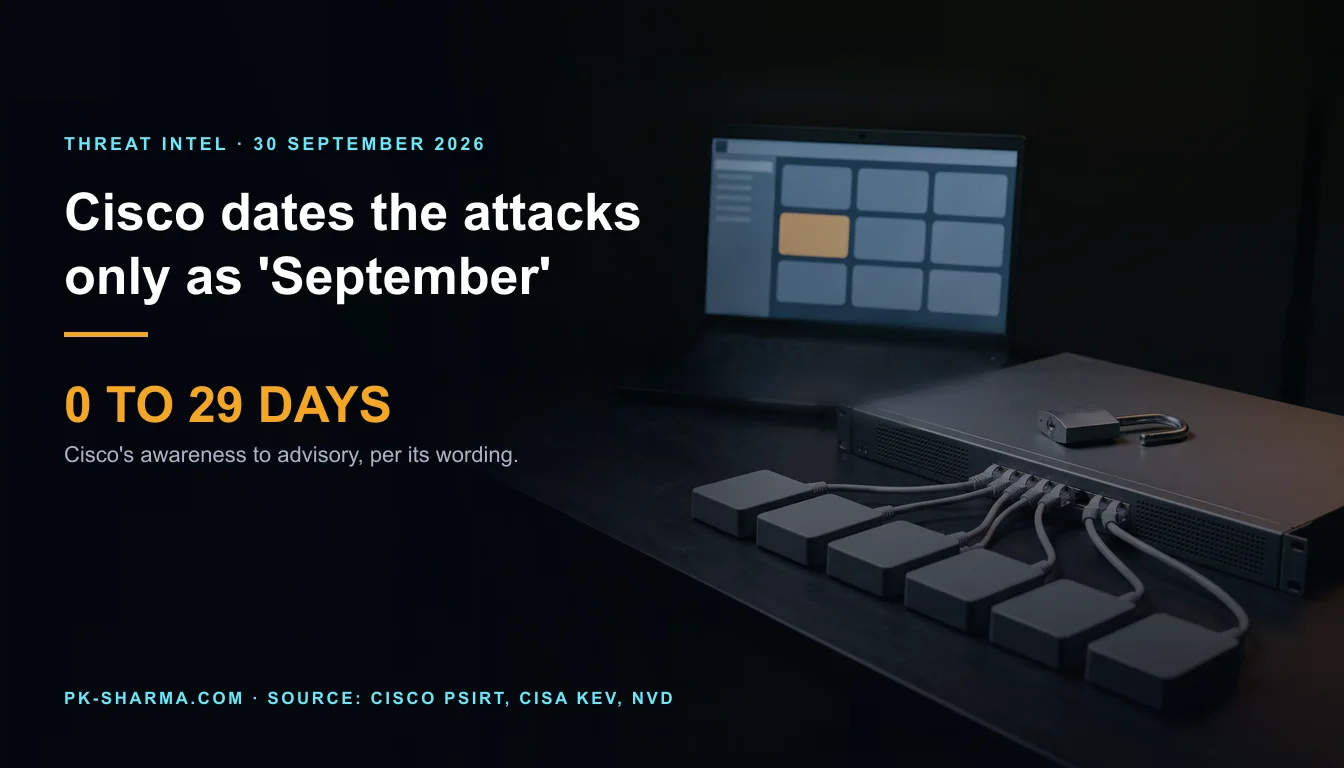
CISA set a federal deadline of Saturday 3 October. What Cisco states and does not, the fix table set against its May one, four names for one flaw, what the UK record says, and a defender checklist.
Faav's write-up counts 17,333,335,124,315 rows from metadata and describes two one-row samples. The endpoint was locked down 4 days after the report, the bounty was $5,000, and Microsoft edited the only account.
What the Truffle Security count establishes, what its dates probably mean, and the gap it names itself: GitHub can block some secrets at push time, but only the issuer can make a leaked key stop working.
The 57 per cent is a share of 1.42 million businesses with staff, mostly micro firms, counted if any one of nine tasks failed a confidence question. Only three of the nine tasks rose since the 2025 report.
Glow's PixelLeak count works out at about 38 images per organisation and says nothing about sensitivity, access or models. The CLI feature the agents lacked shipped on 1 September, 8 days before Glow began notifying.
A count of Microsoft's own timeline, an invitation with nothing to scan, and six labels that reassure without controlling anything: what the RedFlick report establishes about Star Blizzard, and what it leaves open.
VUSec and Sant'Anna's Branch Target Reuse attack read a root hash at 8 bytes per second on two Intel chips. Stale predictor entries were reusable on AMD and Arm too, but nothing leaked there. The kernel fix dates from July.
Mandiant, eSentire and GreyNoise now date NetScaler exploitation to before the 27 September bulletin. What Mandiant observed and what it did not, how the exploited pair compares with briefing 143, and what to hunt and harden.
The French tax administration took 49 days to learn of a theft made with stolen staff passwords, and only from the attacker's own post. What the ANSSI report establishes, what it leaves out, and the checks a UK team can run.
A DTLS retransmission bug can send OpenSSL heap memory to the other side or crash the process. Fixes are public for four branches, premium-only for three and absent for 3.1 to 3.3. No exploitation is reported and no leak size is stated.