CoreGraphics flaw: a public crash test 46 hours after Apple's CVE record, and no proof of a WhatsApp route
Calif published a crash test for CVE-2026-86950 on 30 September and removed its WhatsApp speculation 84 minutes after its first commit. A public test changes who can reach the trigger, not the evidence on who was attacked or how the file arrived.
By Parminder Kumar Sharma · · 17 min read
Two commits, 84 minutes apart
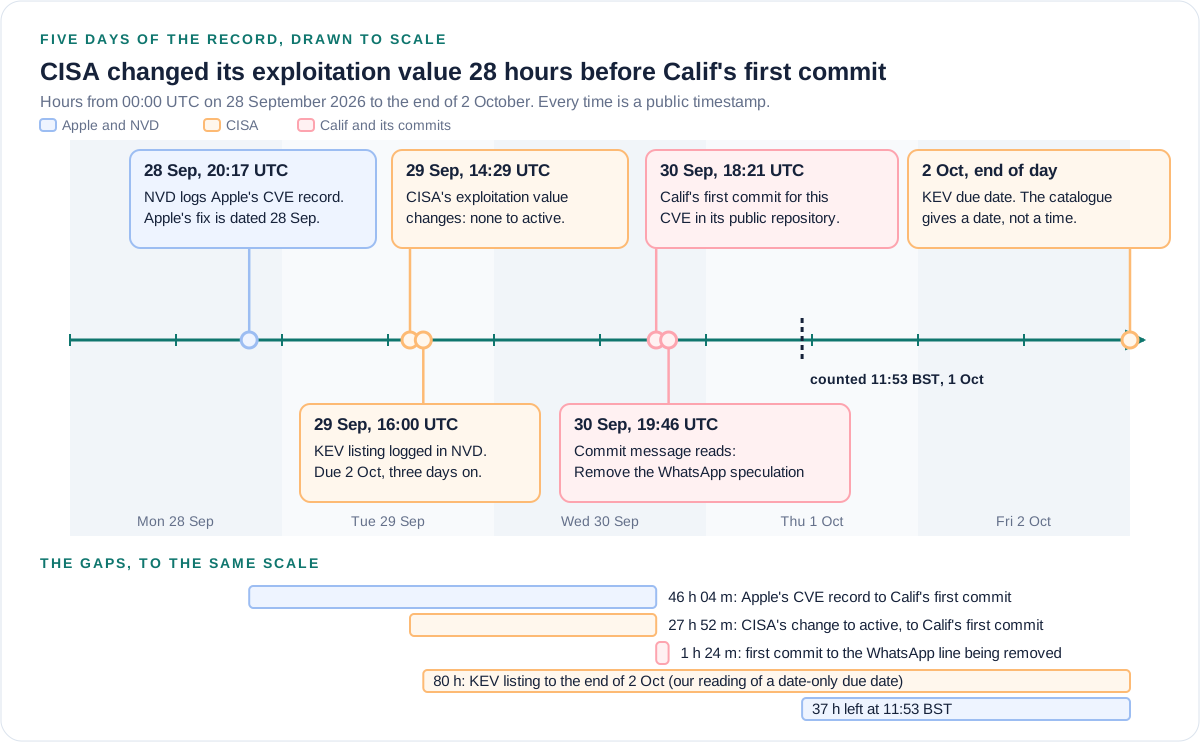
Calif, a security research firm, made the first commit of its write-up on CVE-2026-86950 at 18:21 UTC on 30 September 2026. At 19:46 UTC the same author committed a change whose message reads "Remove the WhatsApp speculation". That is 84 minutes 22 seconds. The first commit came 46 hours 4 minutes after the National Vulnerability Database logged Apple's CVE record at 20:17 UTC on 28 September. Both gaps are our arithmetic from public timestamps; Apple's own advisories carry only the date, 28 September.
Here is what those timestamps do not establish.
- They do not establish that WhatsApp delivered the original attacks, or that it did not. The sentence that was removed is known to us only through The Hacker News (THN), a secondary source. What is on the record is the message line and the time.
- They do not establish that any attack used the published test. Calif's write-up asks for the in-the-wild sample to be taken apart, which indicates it does not hold one, and The Hacker News says so outright.
- They do not show code execution. The test produces a crash, and Calif says going further is a separate effort it has not made.
- They do not establish that a Mac was attacked. Apple's exploitation sentence is unchanged on all three advisories: iOS before iOS 27, and macOS named nowhere in it.
What has changed since our briefing on 29 September
Our earlier briefing covered Apple's 29-word exploitation sentence, which names iOS twice and macOS never. Here is what has moved since, and what has not.
CVE-2026-86950 as read on 29 September and on 1 October 2026. Sources: NVD record and change history, CISA KEV file, Apple advisories and security releases page, Calif write-up, WhatsApp advisories pages.
| Item | 29 September | 1 October |
|---|---|---|
| Public technical analysis | None read | Calif write-up and test, dated 30 September |
| CISA's exploitation value in the NVD record | none | active, set 29 September at 14:29 UTC |
| NVD analysis status | Awaiting Analysis | Analyzed, from 29 September at 16:08 UTC |
| KEV entry | Listed 29 September, due 2 October | Same entry; catalogue 2026.09.30 holds 1,730 entries |
| Apple's wording on the three advisories | Names iOS only | Unchanged |
| Fix for older iOS and macOS lines | None listed | None listed; no new build since 28 September |
| WhatsApp or Meta statement | None found | None found; THN says Meta did not respond |
Our earlier table is out of date on one row. It showed CISA's exploitation value as none. That field is CISA's SSVC block in the NVD record, and its values run none, public PoC, active. That value was right for the record we read at 10:06 UTC on 29 September. NVD's change history shows CISA's coordinator block was replaced at 15:17 UTC the same day, with a new value, active, stamped 14:29 UTC. That stamp is 18 hours 12 minutes after the CVE record and 27 hours 52 minutes before Calif's first commit. The public test did not move CISA.
CISA's own KEV criteria say that listing needs reliable evidence of exploitation in the wild, and that a proof of concept is not itself exploitation. CISA has not said what its evidence is. The KEV notes for this entry link Apple's advisories and CISA's directive pages, and carry no indicators, although the entry is marked for forensic triage.
The stamp on that value is not the time of the judgement. The record now reads exploitation active with a stamp of 28 September, 00:00 UTC, 38 hours 29 minutes before the change history shows that value existed. The history holds four versions of the block: two with exact stamps and two normalised to midnight on 28 September, each normalising swap made at about 04:18 UTC. Our reading, which is inference, is that a daily sync rewrites the stamp to the publication date. CISA's SSVC guide says exploitation answers should be time-stamped, so for this field read the history, not the field. We met the same field when two agencies disagreed about a Roundcube flaw.
What the public test is, at defender level
Calif's write-up is by Dion Blazakis, Josh Maine and Anna Groza and is dated 30 September. The authors say they found the bug by comparing CoreGraphics in iOS 26.7 with 26.7.1, then wrote a test that triggers it. Five points matter to a defender.
- Platforms. The authors say the test triggers the bug on both macOS and iOS. THN adds that the macOS result comes with a debugger call stack and that the iOS claim has no separate trace. We checked neither.
- Outcome. A crash. Calif says taking it to code execution is a separate effort, and it did not have the in-the-wild sample.
- User interaction. Not stated in the write-up's prose. The CVSS vector on the NVD record, scored by CISA-ADP, says user interaction is required. The write-up closes by asking whether the flaw was combined with other WhatsApp flaws to reach parsing with less user interaction, which reads as if the path it studied needs more.
- Route in. THN says the researchers' harness goes through the system's own thumbnail routine for received attachments. That detail is not in the prose we read and may be in the code we did not, so treat it as unverified.
- What a patched system looks like. An operating system build at or above the fixed one. Nobody has published anything else: no indicators, no file-level check, no network signature.
The test was built from the patch, not from the attack. That matters because it is the normal order of events: once a fix ships, its changes can be compared with the old build, and a capable team can find the trigger. Our inference is that a reliable crash on a known build is the first step of exploit development, not the last. The public test moves the question for an attacker from "can I trigger it" to "can I make it do something", which Calif says it did not do. That is a statement about effort, not about anyone's intent.
What a public test changes for patch urgency, and what it does not
What a public test for CVE-2026-86950 changes and does not change. Sources: CISA KEV criteria and file, Apple advisories, Calif write-up, NCSC Cyber Essentials v3.3.
| Question | What it changes | What it does not change |
|---|---|---|
| Who can reach the trigger | The patch-analysis step is gone, on the researchers' claim | The step from a crash to code execution, which Calif did not take |
| Whether it is exploited | Nothing: a public test is not exploitation under CISA's criteria | The KEV listing and the active value, both set before the test |
| The fix | Nothing | iOS and iPadOS 26.7.1, macOS Tahoe 26.7.1, macOS Sequoia 15.8.1 |
| The deadlines | Nothing | KEV due 2 October; Cyber Essentials 14 days ends 12 October |
| Detection | Nothing: no indicators from Apple, Calif, CISA or THN | Version inventory is still the only check |
| The case for deferral | It weakens it: waiting now buys no new information | A deferral still holds the update back until you enforce a date |
CISA's KEV criteria make two points about public tests, and both apply. Making one public can raise the likelihood that an attacker exploits the flaw. Its availability also does not by itself show that the flaw has been or will be exploited. The first is the reason to stop treating a 30 day deferral as safe. The second is the reason not to read the test as proof about the original attacks.
The federal clock. CISA added the flaw to KEV on 29 September with a due date of 2 October, three calendar days later. The public test appeared on 30 September, the day after the listing. The catalogue gives a date, not a time. Counted to the end of 2 October in UTC, which is 01:00 BST on 3 October, about 37 hours remained at 11:53 BST on 1 October; counted to the end of the day in US Eastern time it is about 41. KEV binds US federal agencies, not UK organisations, and BOD 26-04 is the directive behind it. Treat the date as a signal. For a UK organisation certified to Cyber Essentials the requirement is 14 days from the 28 September release, which ends on 12 October, 11 days from today. The mechanics of three day deadlines are in our September count.
What not to do with it. Do not run the researchers' file on production devices as a patch test. A crash on an unpatched device proves little about a patched one, and testing says nothing about the devices you have not inventoried. Check the build number. Our inference: a crash is how many memory corruption attacks fail, so with a public test in circulation an unexplained crash in system rendering on an unpatched device is no longer a sign of targeted use.
The WhatsApp question: what is and is not on the record
Three things would link WhatsApp to this flaw: a statement from Apple, Meta or WhatsApp; a WhatsApp advisory; or a demonstration by someone who holds the attack file. None exists. What exists is a researcher's inference from a comparison of two WhatsApp builds.
What each party has said about WhatsApp and CVE-2026-86950. Sources: Apple advisories, Calif write-up, WhatsApp advisories pages, Meta Engineering post of 27 January 2026, THN. Read on 1 October 2026.
| Source | Stated | Not stated |
|---|---|---|
| Apple | Credits Meta Product Security; the trigger is a crafted file | Any app, route or product in the attacks |
| Calif | Compared WhatsApp builds 26.37.73 and 26.38.74 and found an optional strict PDF mode, as clues to file formats; asks whether other WhatsApp flaws were chained | A tested or shown WhatsApp delivery path |
| Two 2026 advisories, CVE-2026-23866 and CVE-2026-23863, neither about this flaw | Any statement on CVE-2026-86950 | |
| Meta | In January its Kaleidoscope checks included PDF risk checks, and format checks will not stop every attack | Anything on this CVE; THN says Meta did not respond |
| The Hacker News | Calls the build changes circumstantial evidence | A WhatsApp statement or a tested path |
What the removal tells you. THN reports that the first version of Calif's post described WhatsApp delivering the file when a victim opened a chat from a trusted contact with automatic media download on. The commit log fits that: a commit with the word "Remove" in its message came 84 minutes after the first. But we have the removed words only from THN. When we read it at 10:40 UTC on 1 October, and again at 10:52, Calif's page still carried the subtitle "An in-the-wild iOS bug with a possible WhatsApp zero-click path", while its body offers build changes as clues and closes by asking whether other WhatsApp flaws were chained. The WhatsApp content left in the body is a set of clues and a question, and the subtitle is stronger than the body.
The 2025 precedent cuts both ways. WhatsApp's own advisory page shows what a WhatsApp-involved case looks like. In August 2025 it published CVE-2025-55177 and said that flaw, "in combination with an OS-level vulnerability on Apple platforms" (CVE-2025-43300), may have been exploited against specific targeted users. That makes Calif's hypothesis reasonable. In 2026 there is no entry of that kind. This is weak evidence, not a negative: WhatsApp's page says it does not disclose until fixes are widely available, and Meta's January post says WhatsApp publishes CVEs even without evidence of exploitation. The absence fits a WhatsApp flaw not yet fixed, no WhatsApp flaw at all, and WhatsApp not being involved. We cannot tell them apart, and neither can anyone outside Meta.
Two phrases that sound like answers
"WhatsApp PDF checks". A check in an attachment pipeline sounds like a control. It is a scoring layer. Meta's January engineering post describes Kaleidoscope as an ensemble of file-format checks that grew out of a media-checking library written after the 2015 Stagefright flaw, when WhatsApp could not patch the operating system and could only try to catch hostile files before the system handled them. The same post says format checks will not stop every attack. Calif calls the new PDF analysis optional, behind a feature flag, and says a risky score prevents automatic parsing. None of that changes Apple's code. That design intent is also why Calif's inference is reasonable, since a check of this kind is what Meta would add against a known operating system flaw, and why the change proves nothing about delivery, since it is what the layer routinely does. The diagram shows where each control sits.
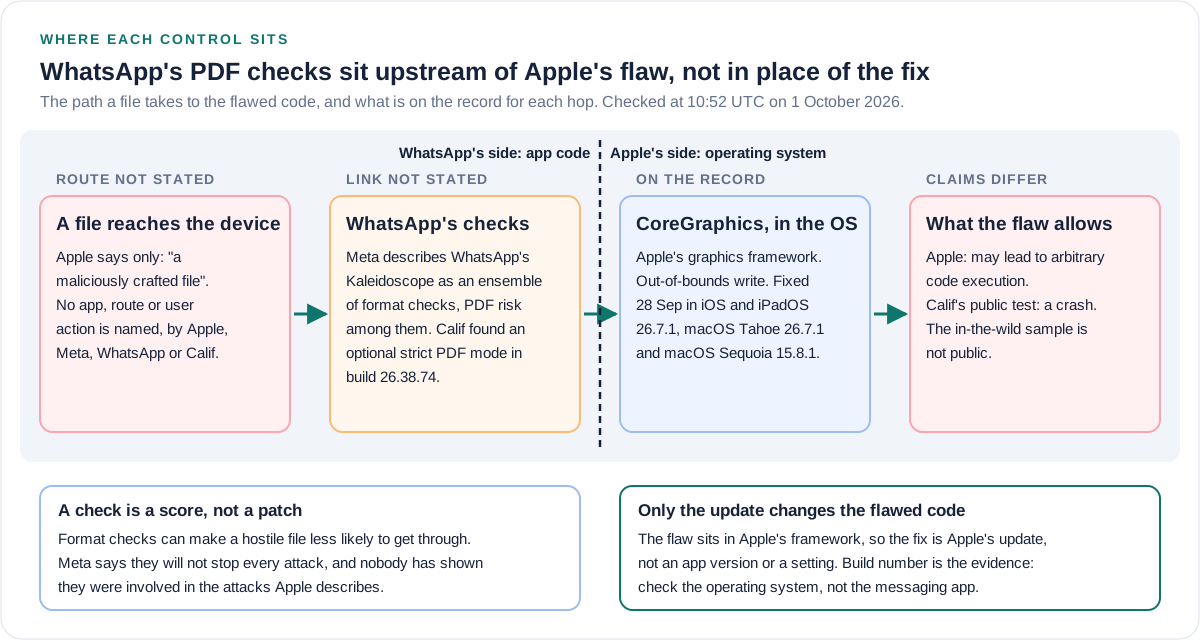
Headlines show the same gap. THN's "WhatsApp PDF Checks Hint at Possible Delivery Path" is stronger than its own text, which calls the build changes circumstantial. The Register's "already exploited in targeted attacks" is stronger than Apple's "may have been". And Calif reads Apple's sentence as meaning the bug was exploited in the wild.
Four statements about exploitation of CVE-2026-86950 and the evidence published with each. Sources: Apple advisories, CISA KEV file and NVD record, Calif write-up, The Register of 29 September 2026.
| Who | What they say | Evidence published |
|---|---|---|
| Apple | It is aware of a report that the issue may have been exploited against specific targeted individuals on iOS before iOS 27 | None |
| CISA | Listed in KEV on 29 September; exploitation value active; forensic triage marked yes | None; the KEV notes carry no indicators |
| Calif | Reads Apple's sentence as meaning exploitation in the wild | None; it lacks the sample |
| The Register | Headline: already exploited in targeted attacks | None beyond Apple's sentence |
These are four strengths of sentence about one unpublished fact. A patch policy that triggers on "actively exploited" is triggered by three of them and not by the one from the vendor that holds the report.
"Specific targeted individuals". Apple's phrase describes who was reportedly attacked, not who can be. A public test concerns the future audience, and Apple's phrase the past one. Until someone completes the chain, which Calif did not, the public test is a crash and not a compromise. But "we are not that sort of target" has lost its footing as a reason to wait, because the trigger is no longer held only by whoever attacked first. That is inference, not a finding. The earlier briefing covered who the phrase might describe inside an organisation.
macOS: one question narrowed, one left open
Apple's sentence still scopes exploitation to iOS before iOS 27 on all three advisories, including the two macOS ones. Two things have moved around it. CISA's KEV description says Apple iOS, macOS and iPadOS contain the flaw. And Calif and THN say the crash reproduces on macOS. Neither is news about exploitation: Apple's own macOS fixes already showed that macOS contained the flaw. What is still not stated by anyone is that a Mac was attacked.
The unsupported lines have not moved either. The earlier briefing lists them: no fix for iOS 18, 17, 16 or 15, or for macOS Sonoma or Ventura, and Apple's release list has shown no new build for any of them since 28 September. NVD's configuration, added on 29 September, matches every macOS build below 15.8.1 and every iOS or iPadOS build below 26.7.1. That is a range in a record, not a test result.
Method and interest
Calif is a commercial security firm and says on its site that it helps customers defend themselves. A write-up with WhatsApp in its subtitle travels further than one without, and Calif's own commit shows it judged the claim to be speculation within 84 minutes. That is the method working, and the subtitle is what remains. THN wrote a headline for the click and a text for the record. Meta is the credited reporter, owns WhatsApp and publishes engineering posts that present WhatsApp's checks as protection; it is also the party best placed to settle the question and, in what we found, has not. Apple sells the devices that need the update and says little about its reasons. CISA lists without publishing its evidence. None of that is an accusation. Each is a reason to read the primary line and not the headline.
What to do, in the order worth doing it
Take this with you
Actions for a UK security lead or IT manager with iPhones and Macs
- Inventory first: list every iPhone, iPad and Mac with its operating system build from MDM, not from user replies.
- Update supervised iPhones and iPads to iOS 26.7.1 or later. Apple's release list shows iOS 27.0.1 as the newest build with no CVE entries; whether 27.0 was affected is not stated, so move 27.0 devices to 27.0.1.
- Update Macs to macOS Tahoe 26.7.1 or macOS Sequoia 15.8.1 or later.
- Verify the build after the update from MDM inventory, and sample a few devices by hand. Do not use the researchers' test file as the check.
- Compare your longest security update deferral with 14 days. If it is longer, change it or set an enforcement date; Apple's device management guide says an enforcement date applies regardless of a deferral.
- Set the date by risk: now for staff you would call at risk, and for everyone else no later than 12 October, the end of the Cyber Essentials 14 days. The US federal date of 2 October is a signal, not a UK duty.
- Keep WhatsApp up to date, as WhatsApp asks, but record it as hygiene. No source says a WhatsApp version or setting protects against CVE-2026-86950, so it is not a mitigation in your patch evidence.
- List the devices that cannot take a fix: iOS 18, 17, 16 and 15, and macOS Sonoma and Ventura. Give each an owner and a decision date to replace, restrict or remove from scope.
- Decide who your specific targeted individuals are before anyone asks. For them, consider Lockdown Mode, which Apple's page offers to people who might be personally targeted and says to switch on after updating. It cannot be set by MDM, and a device in it cannot be newly enrolled. No source shows it blocks this flaw.
- Brief that group on Apple threat notifications: they arrive on the iPhone, by email and on the Apple Account page, and never ask you to click links, open files or install profiles. If one arrives, keep the device and treat it as an incident.
- Do not build detection from the researchers' crash or from coverage of a WhatsApp path. Nobody has published indicators, so patching and inventory are the controls available.
- Re-check four pages daily until the question settles, and log the time: Apple's security releases page for an older line fix, WhatsApp's advisories page for a related CVE, the KEV entry for triage notes, and Calif's post for further edits.
- Keep patch evidence: the date the advisory arrived, the date each device class was fixed, and every exception.
The question that exposes the gap
Four sentences about one unpublished fact are now in circulation: Apple's "may have been", CISA's listing, a researcher's "in the wild" and a headline's "already exploited". Which of them does your patch policy trigger on, and who decided that? If nobody did, a deferral setting is deciding it for you, and the setting you have is the one you chose before this flaw had a number.
Key facts
Sources
- PrimaryAbout the security content of iOS 26.7.1 and iPadOS 26.7.1, released 28 September 2026. Read in full: the CoreGraphics entry, the exploitation sentence, the device list and the credit to Meta Product Security.Appleaccessed 2026-10-01
- PrimaryAbout the security content of macOS Tahoe 26.7.1. Read in full; used to confirm the identical exploitation sentence, which names iOS only.Appleaccessed 2026-10-01
- PrimaryAbout the security content of macOS Sequoia 15.8.1. Read in full; used to confirm the identical exploitation sentence.Appleaccessed 2026-10-01
- PrimaryApple security releases. Used to confirm that no build newer than 28 September 2026 is listed, that iOS 27.0.1 carries no CVE entries, and that no older line has a fix.Appleaccessed 2026-10-01
- PrimaryThe NVD record for CVE-2026-86950 read as JSON from the NVD API, with its change history: status Analyzed, the CISA-ADP CVSS 3.1 vector and CWE, the SSVC block (exploitation none, then active), the CPE configuration and the KEV fields.NIST National Vulnerability Databaseaccessed 2026-10-01
- PrimaryThe Known Exploited Vulnerabilities catalogue JSON, version 2026.09.30 with 1,730 entries: the CVE-2026-86950 entry, its due date, forensic triage flag, description and notes.CISAaccessed 2026-10-01
- PrimaryKEV catalogue criteria page. Used for the criterion of reliable evidence of exploitation in the wild and for CISA's statement on what a public proof of concept does and does not show.CISAaccessed 2026-10-01
- PrimaryBOD 26-04, issued 10 June 2026. Used for the calendar-day rule, the three day forensic triage timeline, and its scope as binding on US federal civilian agencies.CISAaccessed 2026-10-01
- PrimaryBOD 26-04 implementation guidance. Used for how the KEV due date is set and for the statement that CISA adds indicators to a KEV entry when it has them.CISAaccessed 2026-10-01
- PrimaryCISA SSVC Guide. Used for the none, public PoC and active exploitation values and the advice that answers are time-stamped.CISAaccessed 2026-10-01
- PrimaryThe researchers' write-up dated 30 September 2026. Its prose was read for platforms, outcome, user interaction, the in-the-wild sample and WhatsApp; the test files and code were deliberately not read, run, saved or linked.Califaccessed 2026-10-01
- PrimaryWhatsApp security advisories for 2026: two CVEs, neither about CoreGraphics. Used to show that WhatsApp has published nothing on CVE-2026-86950.WhatsAppaccessed 2026-10-01
- PrimaryWhatsApp security advisories for 2025. Used for the August 2025 entry CVE-2025-55177, which named an Apple flaw it may have been combined with, and for contrast with 2026.WhatsAppaccessed 2026-10-01
- PrimaryRust at Scale: An Added Layer of Security for WhatsApp, 27 January 2026. Used for what Kaleidoscope is, that it includes PDF risk checks, and that format checks will not stop every attack.Meta Engineeringaccessed 2026-10-01
- PrimaryAbout Lockdown Mode, published 18 September 2026. Used for who it is for, what it limits, advice to update first, and that it is not configurable by MDM administrators.Appleaccessed 2026-10-01
- PrimaryAbout Apple threat notifications and protecting against mercenary spyware, published 13 August 2026. Used for how notifications are delivered and what a genuine one never asks for.Appleaccessed 2026-10-01
- PrimaryInstall and enforce software updates for Apple devices, Apple Platform Deployment, dated 24 September 2025. Used for the 1 to 90 day deferral range and for enforcement dates that apply regardless of deferrals.Appleaccessed 2026-10-01
- PrimaryCyber Essentials: Requirements for IT Infrastructure v3.3. Used for the 14 day rule and its three conditions.NCSCaccessed 2026-10-01
- PrimaryNCSC device security guidance for iOS. Used for Lockdown Mode not being configurable through MDM and for who it suits.NCSCaccessed 2026-10-01
- Reported byNews coverage of 1 October 2026 by Swati Khandelwal. A pointer to Calif's work, and the only source for the content of the removed WhatsApp sentence, for the macOS call stack and for Meta not responding.The Hacker Newsaccessed 2026-10-01
- Reported byNews coverage of 29 September 2026 by Carly Page. Used for its headline wording, which is stronger than Apple's, and for the Meta-reported framing.The Registeraccessed 2026-10-01