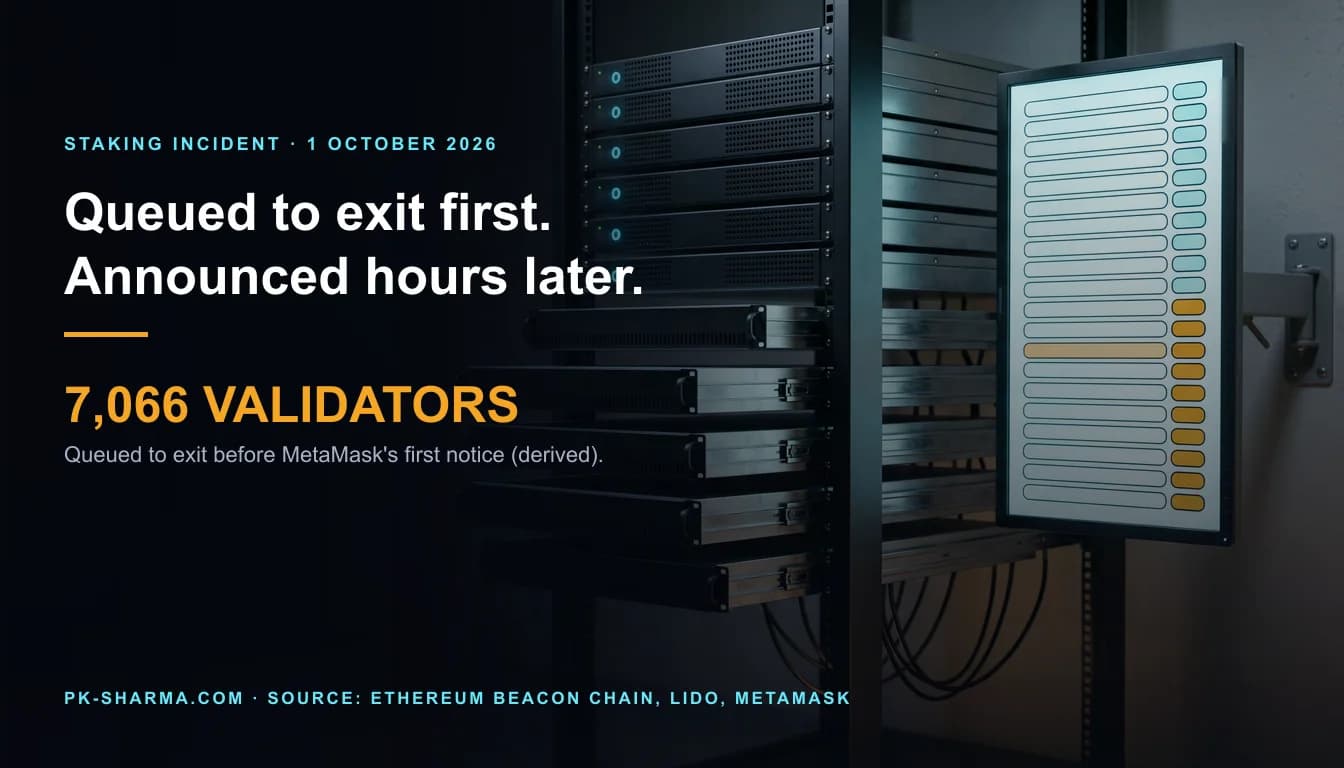
By our count, MetaMask Staking queued 7,066 Lido validators to exit hours before its notice, naming no cause
On 30 September, exit messages for all 7,066 still-running validators that Lido lists under MetaMask Staking's operator were on the chain by 17:29 UTC. MetaMask's first time-stamped notice came at 23:38 UTC and gives no count, cause or key status.
By Parminder Kumar Sharma · · 18 min read
Every running validator was queued to exit before MetaMask said anything
Every one of the 7,066 running validators among the keys that Lido's registry lists under the operator named Consensys had an exit message in an Ethereum block hours before MetaMask's first time-stamped public word about its incident. The first message was included at 11:53:59 UTC on 30 September (12:53 BST). The last was included at 17:28:59 UTC (18:28 BST). MetaMask's notice page carries a date but no time, so the earliest time-stamped notice we can find is its post on X, at 23:38:56 UTC (00:38 BST on 1 October): 6 hours 10 minutes after the last exit message and 11 hours 45 minutes after the first. At 32 ETH each, the 7,066 validators hold 226,112 ETH, about 2.3 per cent of the ETH Lido reports as pooled. MetaMask's notice gives no number, no amount and no list.
What this does not establish matters as much. It does not say why the exits were ordered, whether any validator key was exposed, or whether anyone has lost money. MetaMask says it has "identified no immediate threat to MetaMask wallets"; Lido says the cost is "foregone rewards as well as possible downtime penalties". The chain cannot say who submitted the exits, only that each was signed with the validator's own key. The match between the registry's operator number 21 and MetaMask Staking is our inference, from the operator's name, from Lido's wording and from a 2023 exit that the chain matches exactly to this operator (see "The numbers the notices leave out"); neither MetaMask nor Lido gives the operator number. And the figure covers only validators run under Lido. MetaMask also sells pooled and validator staking outside Lido, and none of that is visible here.
What happened, in the order the clocks say
The chain and the notices give two different starts to this story, and the chain is earlier. Lido's forum post, created at 23:40:49 UTC on 30 September, says relevant validators "have begun the exit process". By then the whole set had been queued for more than six hours. The first figure draws the two records to scale.
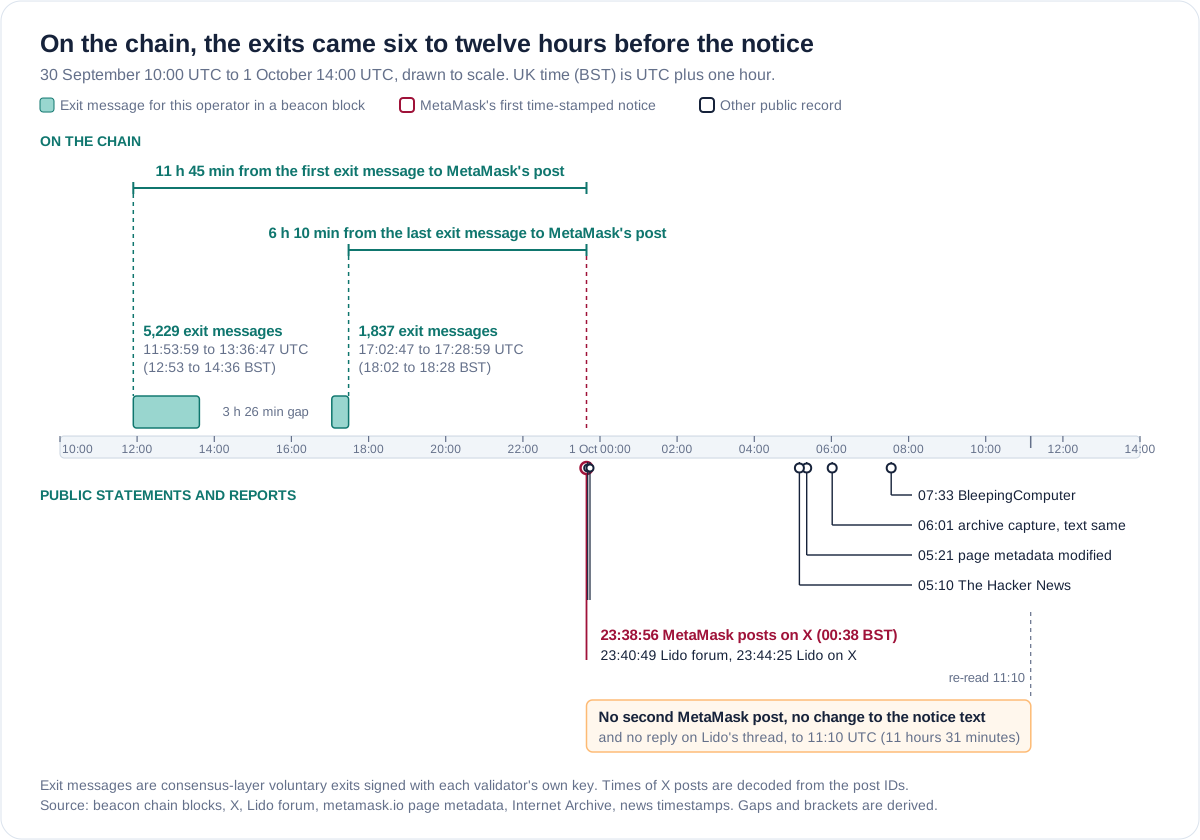
Public and on-chain events in UTC, with UK time. Sources: beacon node API, X, research.lido.fi, metamask.io page metadata, Internet Archive, news timestamps. Read 10:35 to 11:00 UTC on 1 October.
| Event | UTC (BST) | Source |
|---|---|---|
| First of 7,066 exit messages included in a block (slot 15,328,768) | 30 Sep 11:53:59 (12:53) | Beacon chain |
| End of the first burst: 5,229 validators in 1 h 42 min | 30 Sep 13:36:47 (14:36) | Beacon chain, derived |
| Second burst, 1,837 validators in 26 min; last message at slot 15,330,443 | 30 Sep 17:02:47 to 17:28:59 (18:02 to 18:28) | Beacon chain |
| MetaMask's post on X: security update, no immediate threat to wallets | 30 Sep 23:38:56 (1 Oct 00:38) | X, time from the post ID |
| Lido forum post: precautionary out of order exits | 30 Sep 23:40:49 (1 Oct 00:40) | research.lido.fi |
| Lido's post on X, same text | 30 Sep 23:44:25 (1 Oct 00:44) | X, time from the post ID |
| The Hacker News publishes | 1 Oct 05:10 (06:10) | RSS feed, 10:40 IST |
| MetaMask notice page: modified-time metadata; text identical in a 06:01 UTC archive capture and at 10:35 UTC | 1 Oct 05:21:28 (06:21) | Page metadata, Internet Archive |
| BleepingComputer publishes | 1 Oct 07:33 (08:33) | Page stamp, 03:33 EDT |
Two features of the chain record are worth drawing out. The messages came in two bursts, with 3 hours 26 minutes between them in which 2,432 exit messages for other validators were included, so the exit queue is shared with other stakers. And nothing has been added since: from 17:29 UTC on 30 September to our last scan at 11:09 UTC on 1 October, no further exit message for this operator appears in any block. The on-chain action was complete before the first public word.
MetaMask's page is dated 30 September and gives no time. In the UK its first post and both of Lido's posts fall just after midnight on 1 October, so a UK reader will find no time-stamped statement from either organisation before 00:38 BST on the 1st. From 23:38:56 UTC to 11:10 UTC (12:10 BST), MetaMask has published no second post on X, the notice text is unchanged from the 06:01 UTC archive capture, and Lido's forum thread has one post and no replies. The notice promises "further updates as appropriate".
What the two statements say, and where they differ
MetaMask's notice is six sentences. It says the company is "responding to an ongoing security incident affecting part of our infrastructure", is remediating it "in coordination with external partners and security advisors", has "identified no immediate threat to MetaMask wallets", is "proactively exiting affected validators" as a precaution, and that its staking is non-custodial because "we do not manage withdrawal keys for stake on behalf of our clients". It gives no number, no system, no start time and no instruction to anyone.
Lido's post, written after what it calls "an investigation into an infrastructure compromise", adds what MetaMask does not: the word compromise, a cost ("foregone rewards as well as possible downtime penalties"), a timetable ("by the end of October 7th, 2026"), a return of the ETH over "approximately up to 45 days due to the extended entry queue", and a reserve fund of "over 6,750 stETH". It tells stETH holders "No action is required". It refers readers to MetaMask for details, and MetaMask has given none.
The two organisations describe the same event differently: MetaMask says an incident affecting infrastructure, Lido says a compromise. Neither says what was compromised. Asked by BleepingComputer which part of its infrastructure was affected and whether any systems or data were accessed, a MetaMask spokesperson pointed the reporter back to the public statement.
One word is shared and undefined: "affected". MetaMask is exiting "affected validators". The chain shows the exits covered every one of the 7,066 still running in Lido. So either every validator was treated as affected, or the exit was an operator-wide precaution. The statements do not say which, and it matters: the first would put the whole fleet inside the incident.
The numbers the notices leave out
Ethereum is a public ledger, so some of what a notice omits can be computed. The operator numbers come from Lido's NodeOperatorsRegistry contract, read through a public RPC at block 26,096,908 (10:35:47 UTC). Its signing keys, 11,213 in all, were matched against the beacon chain's validator set, and the 8,594 slots from 06:00 UTC on 30 September to 10:38 UTC on 1 October were scanned for voluntary exits. Everything marked derived is our arithmetic.
What the chain shows about the operator Lido registers as Consensys (operator 21). Sources: Lido registry and stETH contract via public RPC; beacon node API (second node used as a cross-check); Coinbase spot price. Read 10:35 to 11:00 UTC on 1 October, status rows re-read at 11:10 UTC (12:10 BST).
| Figure | Value | Where it comes from |
|---|---|---|
| Keys deposited under operator 21 | 11,213, of which 4,009 had exited before 30 September | Lido registry |
| Validators on the beacon chain | 11,075; the other 138 keys (4,416 ETH) are still in the deposit queue | Beacon node; 11,075 plus 138 equals 11,213 |
| Queued to exit on 30 September | 7,066 (5,229 plus 1,837), which is every validator not already exited | 8,594 slots scanned; derived |
| ETH held by the 7,066 | 226,112 ETH, about $610 million or £462 million | Derived: 7,066 x 32 at $2,696.84 and £2,041.41 per ETH, Coinbase spot, 10:47 UTC |
| Share of ETH Lido reports as pooled | 2.3 per cent of 9.84 million ETH | stETH contract, 11:00 UTC; derived |
| Where the withdrawals are paid | All 11,075 carry Lido's withdrawal address, not MetaMask's | Beacon node; matches the stETH contract's withdrawal credentials |
| Slashed validators | 0 of 11,075 | Beacon node |
| Share of the whole exit queue | 6,754 of 23,016 exiting validators on the network (29.3 per cent) at 10:47 UTC | Beacon node; derived |
| Status now | 4,009 withdrawn earlier; 344 exited and waiting; 6,722 still active and exiting; none active and not exiting | Beacon node, 11:10 UTC (12:10 BST) |
| Lido's reserve against the exposure | Over 6,750 stETH, about 3.0 per cent of 226,112 ETH | Lido forum post; ratio derived |
How long the exit takes, computed from the protocol
Ethereum limits how fast validators can leave. The beacon node reports an exit limit of 256 ETH per epoch, which is eight 32 ETH validators every 6.4 minutes, 1,800 a day. Alone in the queue, 226,112 ETH would need 883.25 epochs, 3 days 22 hours. It was not alone. The last of the 7,066 is scheduled to exit at epoch 480,501, which is 01:26:47 UTC on 7 October (02:26 BST), 6 days 13 hours 33 minutes after the first message. That sits inside Lido's "by the end of October 7th". Our count by day is in the second figure, and it matches the bursts exactly: the first burst's 5,229 validators fill 1 to 4 October (1,241, 1,228, 1,596 and 1,164) and the second burst's 1,837 take 6 and 7 October (1,733 and 104). 5 October has none of this operator's exits at all: the queue is first come, first served, and 2,432 other validators' exit messages were included between the two bursts, which is consistent with that day's capacity going to them (our inference).
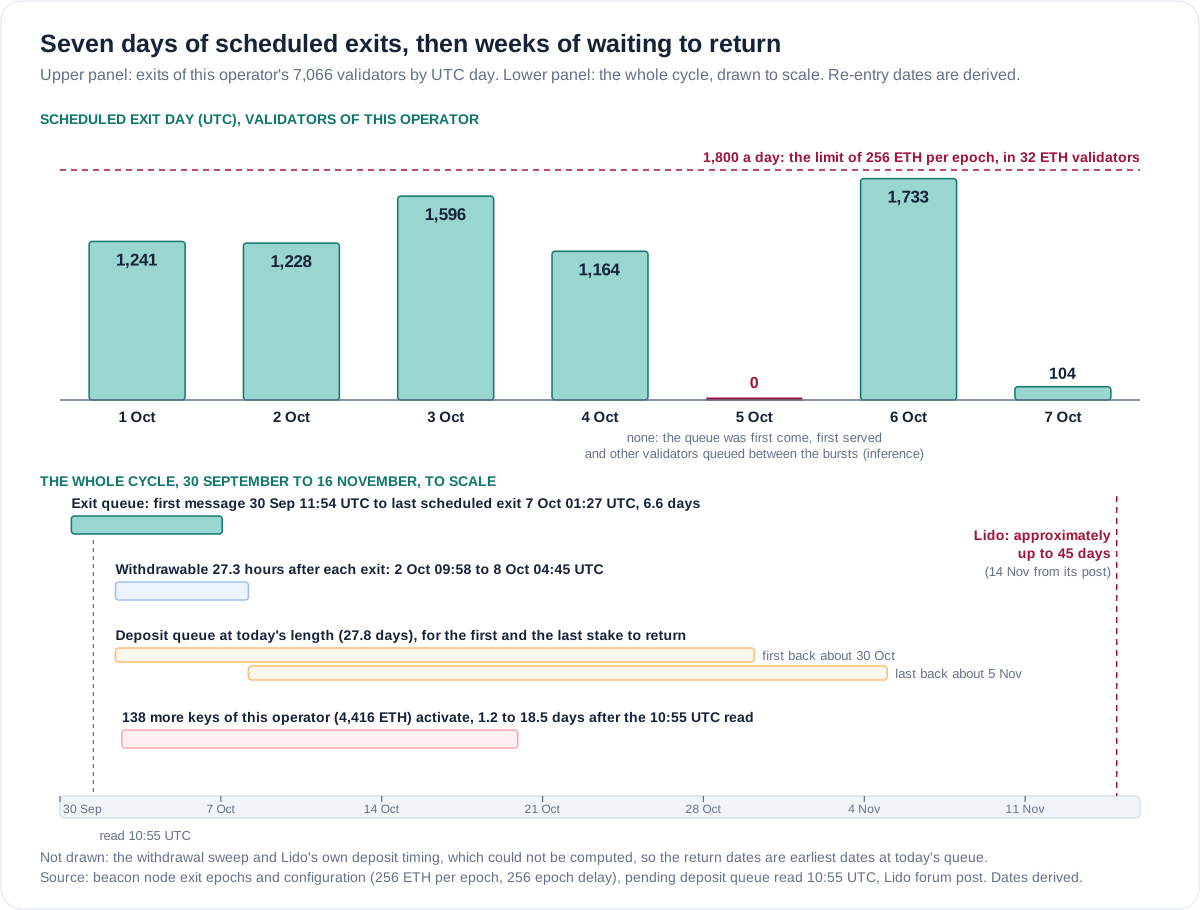
The exit is not the end. A validator can be withdrawn only 256 epochs, 27.3 hours, after its exit epoch, then waits for the withdrawal sweep, which we did not compute, and the ETH returns through the deposit queue. That queue held 20,935 pending deposits totalling 1,602,437 ETH at 10:55 UTC, and the same at 11:10 UTC (12:10 BST). At 256 ETH per epoch a deposit joining now waits 27.8 days. At that length, re-entry of the first exited stake would start around 30 October and the last around 5 November, before the sweep and Lido's own deposit timing. Lido's "approximately up to 45 days", about 14 November if counted from its post, is a ceiling and does not conflict with that. The queue's own history agrees that it can be longer: the oldest deposit still waiting was submitted 37.9 days ago, on 24 August.
Lido's deposit queue also holds 138 more keys of this operator, 4,416 ETH, submitted between 25 August and 17 September. They sit at positions 461 to 14,909 of the queue, which at today's pace means activation in about 1.2 to 18.5 days. Neither notice says what is planned for validators that would start running on the same operator's infrastructure after the exit.
Two friendly labels: infrastructure incident and non-custodial
Both labels are accurate and both are asked to carry more than they can. A comforting phrase is not a control, and neither of these tells a staker or a security lead what to check.
Phrases in the two statements and on MetaMask's product pages, and what each does and does not establish. Sources: metamask.io notice and earn page, Lido forum post, MetaMask Staking disclosures (last updated December 2023), June 2024 pooled staking post. Read 1 October.
| Phrase | What it establishes | What it does not |
|---|---|---|
| A security incident affecting part of our infrastructure (MetaMask) | A security event, in some systems, still under way when posted. | Which systems, how it started, when, whether data or keys were touched, or whether those systems are shared with the wallet or Infura. |
| An infrastructure compromise (Lido) | Lido's word, after an investigation, for the event. | Any detail. Lido points back to MetaMask's release, which has none. |
| Non-custodial; we do not manage withdrawal keys | The operator cannot move the principal: all 11,075 validators pay out to Lido's address. | Anything about signing keys, which the operator does hold. Those keys queued 226,112 ETH of stake for exit in under six hours and, if misused, could cause slashing or downtime. |
| No immediate threat to MetaMask wallets | No threat to the wallet product had been identified at the time of posting. | That the wallet is unaffected for good: the sentence is limited by immediate and by at this time, and the wallet is a different product from staking under the same brand. |
| Zero slashes since 2020; ISO 27001 and SOC 2 Type II (product pages) | A track record and audited management systems. The chain shows no slashed validator in this Lido set. | That any of it protects against this event. Exits are not slashing, and a clean slashing record is silent on whether keys were exposed this week. |
Take non-custodial first. It is true on the chain: every one of the 11,075 validators carries Lido's withdrawal address, so MetaMask cannot redirect the principal. What it does not cover is everything else a signing key does. MetaMask's own disclosures page, last updated in December 2023, says a user "alone" accepts responsibility for losses "regardless of how they occur". The product page says "Unstake at any time". The protocol decides when: for this set the exit queue alone runs to 7 October, and the full cycle may pass a month. "Any time" means any time you ask, not any time you are paid.
What is stated and what is not, at 11:10 UTC on 1 October
Questions a defender would ask, with what MetaMask, Lido and the chain state and what they do not. Sources: MetaMask notice and X post, Lido forum and X posts, BleepingComputer, beacon chain. First read about 10:40 UTC and re-read at 11:10 UTC (12:10 BST).
| Question | Stated | Not stated |
|---|---|---|
| What is affected | Part of MetaMask's infrastructure; its non-custodial staking operations; validators it operates for Lido. No immediate threat to MetaMask wallets. | Which systems. Whether Infura or any other service is involved. Infura's status page read all systems operational at 11:06 UTC, which is availability, not security. |
| How many validators, how much ETH | Nothing in either statement. | Whether affected means all. The chain shows 7,066 and 226,112 ETH in Lido (derived), and nothing outside Lido. |
| What users should do | Lido: no action is required from stETH holders. | Any instruction for wallet users, pooled stakers or validator-staking clients. MetaMask: further updates as appropriate. |
| Funds lost or at risk | MetaMask: no immediate threat to wallets. Lido: foregone rewards and possible downtime penalties. No source reports a loss. | Whether any user funds are at risk. The size of the penalties. |
| Cause and start | Lido: a compromise, after an investigation. MetaMask: a security incident, ongoing when posted. | How access was gained, when it began, when it was found, whether data was accessed. |
| Whether keys were exposed | MetaMask does not manage withdrawal keys; the chain confirms Lido's address on every validator. | Anything about signing keys. The chain shows the exits were signed by them. |
| Who did it | No actor is named by MetaMask, Lido, The Hacker News or BleepingComputer. | Any actor, or evidence for one. |
| Whether staking and the rest are separate | MetaMask's notice separates the wallet from the staking action. | Whether staking shares systems, credentials or staff with the wallet or Infura, or which company runs it after the 9 September split of Consensys Software Inc. |
| When the cause will be known | Lido: a full investigation is underway. MetaMask: updates as appropriate. | Any date. In Kiln's 2025 case the postmortem came 105 days after detection. |
Read the middle column as the whole of the public record. The two rows a customer needs first, how many validators and what to do, are the two where the companies say least, and the only numbers in the table come from the chain, not from either company.
Two earlier exits in the same ecosystem, and the other incident this week
Earlier out of order exits recorded on Lido's forum. Sources: research.lido.fi topics 5278 and 10654, and the Lido registry. A difference in cause is stated where the record states one.
| Event | What the record says | Cost and timing |
|---|---|---|
| Consensys Staking, 17 July 2023 | 125 validators exited by mistake; added safeguards. | About 39 days out of the active set; 19.732 ETH offered. |
| Kiln, September 2025 | A compromised engineer's access token, then cloud credentials and an altered API response; treated as a full infrastructure compromise; exit began 9 September. | Lido analytics: 207.312 ETH of missed rewards on 5,726 validators, about 13.5 days each. Postmortem posted 22 December, 105 days after detection on 8 September. |
The Kiln record is the closest precedent for the shape of this week: a precautionary exit, a short notice, a cause that arrived months later. Whether MetaMask's cause resembles Kiln's is unknown and should not be assumed. The registry shows Kiln has since exited all 10,579 of its Lido validators, so the precedent also shows how an operator leaves.
The other crypto compromise we covered this week is Bitget's: see the forensic reports of 30 September and the root cause described three days late. Bitget is an exchange and this is a staking operator. No source we read links the two, and we do not. What they share is a wording habit, the name of a place in place of a cause. Our earlier piece on Bitget's claim that its private keys were never compromised is about the same gap between a statement about keys and what a key did.
What to do, in the order worth doing
Take this with you
Actions for anyone with exposure to MetaMask, Lido or a staking provider
- Name the product, not the brand. Wallet only, Lido stETH, MetaMask pooled staking or MetaMask validator staking: the notices treat them differently or not at all.
- If you hold stETH, note Lido's statement that no action is required, record the date, and expect lower rewards while about 226,000 ETH leaves and returns. Watch the Lido forum thread for updates.
- If you use MetaMask validator staking, look up your validators by index in a beacon explorer. Record the status and exit epoch, and confirm the withdrawal address is yours.
- Ask MetaMask in writing, if you stake with it directly: is my validator in the exit set, what rewards or penalties will I bear, and what happened to my signing keys. Keep the reply.
- If you only use the wallet, nothing in the notices asks you to act. Do not move funds or type a recovery phrase because of a message about this incident; take updates only from metamask.io and the Lido forum.
- In your third-party register, log the event with UTC times. Ask providers who run keys for you how fast they notify, and which keys they hold: signing keys, withdrawal keys, or both.
- Diary the dates the chain gives: 7 October for the last scheduled exit, 8 October for the last of the 7,066 to become withdrawable, and 30 October to 5 November for re-entry at today's queue length.
- Ask for the cause and a date. Kiln's took 105 days; no date has been given here.
The question this leaves
MetaMask says it does not manage withdrawal keys. The chain shows what it does manage: signing keys, which put 226,112 ETH of other people's stake into the exit queue in under six hours. If an operator can do that before it speaks, the question for any staking provider is not whether it is non-custodial. It is which key the incident was about, and who will tell you before the chain does.
Key facts
Sources
- PrimaryThe MetaMask user update, dated 30 September 2026: the full notice, read at 10:35 UTC and in a 06:01 UTC Internet Archive capture. Used for every MetaMask statement and the page metadata times.MetaMaskaccessed 2026-10-01
- PrimaryMetaMask's security update post; its time (23:38:56 UTC) is decoded from the post ID and matches the 00:38 BST shown on the page. Used for the first dated public notice.MetaMask on Xaccessed 2026-10-01
- PrimaryLido's security disclosure, created 23:40:49 UTC on 30 September. Used for infrastructure compromise, the 7 October timetable, the 45 day estimate and the 6,750 stETH reserve.Lido governance forumaccessed 2026-10-01
- PrimaryLido's post of the same text, 23:44:25 UTC from the post ID.Lido on Xaccessed 2026-10-01
- PrimaryConsensys Staking's account of its 17 July 2023 mistaken exit of 125 Lido validators; used to match the registry operator to Consensys Staking.Lido governance forumaccessed 2026-10-01
- PrimaryKiln's September 2025 precautionary exits, its 22 December 2025 postmortem and Lido analytics' 207.312 ETH estimate; used as the precedent.Lido governance forumaccessed 2026-10-01
- PrimaryThe Lido operator registry contract, read through a public JSON-RPC at block 26,096,908: operator 21 named Consensys, 11,213 keys deposited, 4,009 exited.Ethereum mainnet, Lido NodeOperatorsRegistryaccessed 2026-10-01
- PrimaryThe stETH contract, read through a public JSON-RPC: withdrawal credentials and total pooled ether of about 9.84 million.Ethereum mainnet, Lido stETHaccessed 2026-10-01
- PrimaryPublic beacon node: exit and deposit churn limits, validator statuses, exit epochs, the pending deposit queue and every block scanned for exit messages.PublicNode beacon APIaccessed 2026-10-01
- PrimaryA second beacon node used to cross-check validator statuses and the pending deposit count.ChainSafe Lodestar public beacon APIaccessed 2026-10-01
- PrimaryStaking product page: pooled, validator and liquid staking; zero ETH slashed; unstake at any time.MetaMaskaccessed 2026-10-01
- PrimaryWhat validator staking is: Consensys Staking runs the validators; self-custody claim.MetaMask Help Centeraccessed 2026-10-01
- PrimaryMetaMask Staking Disclosures, last updated December 2023: non-custodial wording and the user bears losses regardless of how they occur.Consensysaccessed 2026-10-01
- PrimaryJune 2024 launch post for pooled staking: runs on Consensys Staking, 33,000 validators, ISO 27001 and SOC 2 Type II claims.MetaMaskaccessed 2026-10-01
- Primary9 September 2026 announcement that Consensys Software Inc. becomes MetaMask and a new Consensys takes the institutional business; no mention of staking or Infura.MetaMaskaccessed 2026-10-01
- PrimaryAll systems operational at about 10:36 UTC on 1 October; a service status, not a security statement.Infura statusaccessed 2026-10-01
- PrimaryCapture of the MetaMask notice at 06:01:12 UTC on 1 October, text identical to the later read.Internet Archiveaccessed 2026-10-01
- PrimaryETH spot price in US dollars and pounds at 10:47 UTC, used only to give the 226,112 ETH a scale.Coinbaseaccessed 2026-10-01
- Reported byReport of the notice and Lido's statement, published 05:10 UTC on 1 October. Used as a pointer to the primary sources only.The Hacker Newsaccessed 2026-10-01
- Reported byReport published 07:33 UTC on 1 October; read in a browser (curl returns 403). Used for MetaMask's spokesperson declining to say which systems were affected.BleepingComputeraccessed 2026-10-01