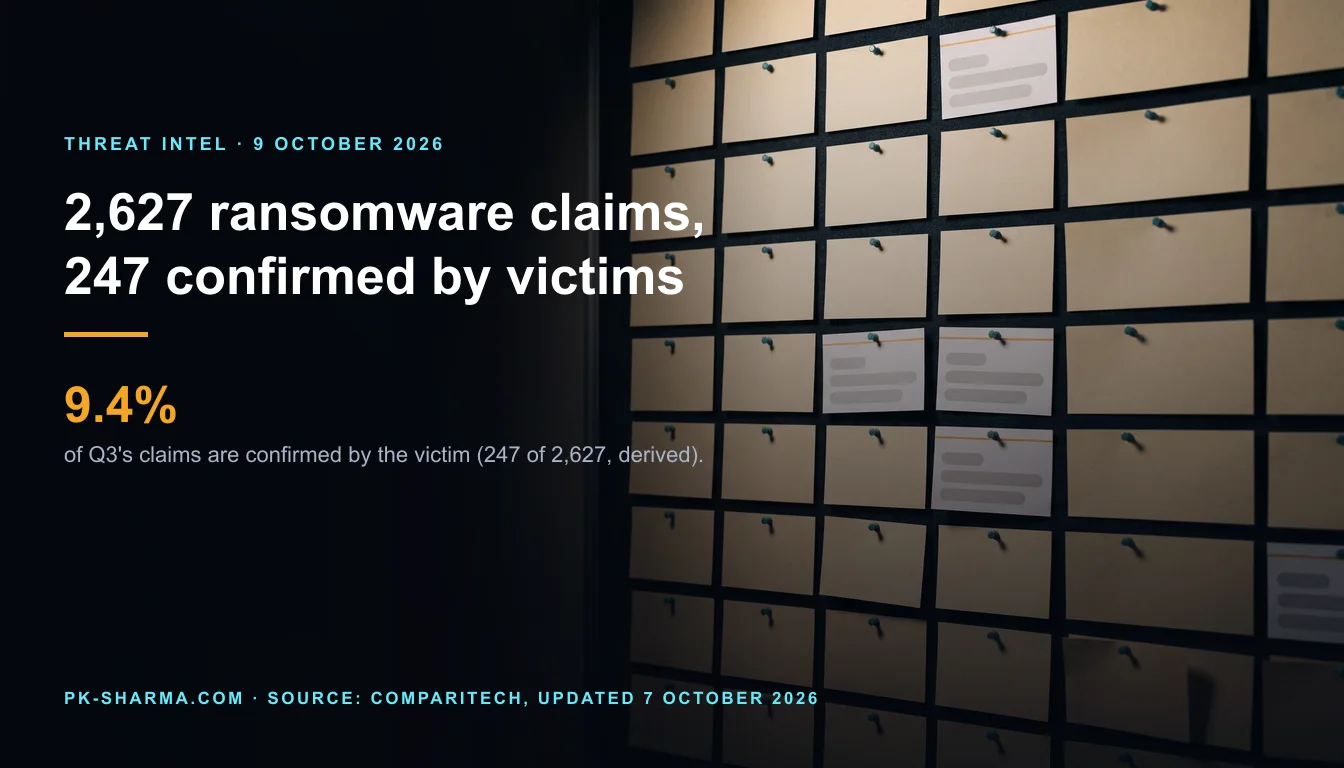
Recounting Comparitech's Q3 2026 ransomware record from its own tables: 247 of 2,627 confirmed, a Q2 that was a dip, 517 of the 597 extra claims from strains with no Q2 claims, and two other trackers that agree on direction and not size.
A computed gap, one build that two vendors described in opposite ways until the vendor changed its answer, and a backup console that MSPs expose to clients. What the record, Huntress and Ahsay state, what is not stated, UK clocks for MSPs and the order of actions.
Three NetScaler bulletins in 11 days, ten CVEs, and a new SAML flaw whose affected range ends at the previous fix build. What Citrix states and leaves out, the UK patching clocks and what to check.
OpenAI says it banned two influence operations that used ChatGPT and rates their reach Category 5 and 4 of 6. What the page states and omits, how Anthropic's reports compare, and what UK publishers and security teams can check.
What the 8 October seizure papers, the 58-page joint advisory and the NCSC's own item establish: two alleged breaches, six scan targets not said to be breached, 20 universities or six, and a UK checklist.
Of 83 CVEs in Splunk's five 7 October advisories, three Splunk Enterprise flaws score 9.0 or more. One is explained. Two are a weakness class and a score, and the October affected ranges end at August's fix builds.
What CrowdStrike's 7 October post establishes and what it leaves out: AI tooling from the actor's files, no named bank, no victim count, no Anthropic model named, a stack 3 to 63 days old, and a UK checklist.
What Talos's 8 October post on UAT-11985 establishes and what it leaves out: three emails behind the AI-assisted label, a relay that forwards typed codes and taps, no victim count, and what UK organisations on Google can do.
What the 14 AI credits establish and do not, SecurityWeek's figures checked against the notes, how 247 compares with earlier Chrome releases, the bounty column, and a UK checklist.
The build that fixed September's exploited SMA1000 flaws is still affected by the 6 October 10.0 flaw. Both earlier advisories that reported exploitation reached CISA's catalogue within a day, and this one is not listed in the version read, which predates it.
Lumen's report on the PoeLLM botnet gives its victim count as more than 3,400 in one place and almost 2,200 in two others. The poem hides a command address; the doors are exposed AI services and a LiteLLM flaw that had a fix for 177 days.
What the 10.6 notes state about AI-found reports and release cadence, the 11 CVE records and who scored them, the ML-DSA signature versus key exchange, Debian, Ubuntu and Red Hat status, and a UK checklist in the order worth doing.
Patchstack recorded the first attempt on Ninja Forms CVE-2026-94504 on 5 October, 14 days after the 3.15.4 fix. The campaign leaves four ways back in, only one visible in the dashboard, and two figures in circulation, 600,000 and 3,600, belong to other things.
FBI and USSS advisory JCSA-20261006-01: no CVE, a count credited to SOCRadar (30,791 on 17 June, 86,644 a day later), lockouts and ransomware reporting without numbers. What it does not establish, the UK position, and a checklist.
The window is drawn, the address bar is copied and a typed code is relayed live. Island reports hundreds of submissions, but states no victim count, loss, operator or UK reach.
Reports rose 34 per cent but victims reporting a loss rose 10.3 times, and no document says how the accounts were taken. A passkey closes one door; recovery and fallback sign-in are others.
The LibreOffice fix shipped on 24 July and the advisory on 5 October. OpenOffice still has no released fix and a public proof of concept has existed since 5 October. What each project documents, and what to do first.
Eight Atlassian Data Center products, 19 fixed builds, a 9.3 that computes to 8.7 without its downstream assumptions, and a CVE record whose Crowd and Bamboo builds disagree with the bulletin. What the sources state, and what they do not.
Divide Treasury's headline loss by its own attack count and the average is at most about $27,000. The DOJ, FBI and ATM makers all put the real control at the cabinet door, the keys, the alarm response and the disk, not at the arrest.
At least 476 days between the CVE record and the incident, three AnyDesk download attempts, eight days between two reports on one endpoint. What Huntress states, what it does not, and the order of checks for signage servers.
A Linux botnet dresses its command traffic as STUN, the NAT-traversal protocol behind video calls, but it gets in through flaws first recorded between 2015 and 2026. The disguise is the news; the doors are the part a UK security lead can still control.
The lead flaw is scored Network with no privileges, so it is not a local escalation by Dell's own scoring, but all five need user interaction Dell never explains. One fix, no workaround, nothing on exploitation.
Google's accessibility restriction needs three things at once: Android 17, Advanced Protection switched on, and an app that is not a verified accessibility tool. Only the first has a published figure, and it is a third party's estimate.
A research technique, not an exploited flaw: what the write-up states, how Kettle's 2020 paper named the same bug class, what five vendors' documents say about how keys are joined, and a UK checklist for cached personalised pages.