What the Tailworm report, Tailscale, headscale and their repositories print about eleven claimed flaws: the chain at defender level, the dated record, the friendly names, the technical artifacts and a ranked checklist.
What Vercel, React, sharp, Red Hat and the registries print about the 14 October Next.js release: the timeline, the three scores for one library bug, the ids that exist, the sharp range gap on 15.5, the technical artifacts, and the UK clocks.
What Previdian's count of 4,619 attempts does and does not show, why Langflow says 1.9.0 was fix one of two and 1.10.3 the full fix, what authenticated means on a Langflow server, the code and settings the advisories print, UK controls and a ranked checklist.
CISA's advisory ICSA-26-293-03 lists two Moxa AIG-302 flaws fixed in firmware 1.4.1: a shared hardcoded root CA private key (CVSS 4.0 8.6) and a missing authorization check (6.9). Adjacent network access is required.
Mave announced $34 million in funding on 22 October 2026: a $28 million Series A led by Red Dot Capital Partners and a $6 million seed round. Its founders are former Unit 8200 members, per the company.
Attackers leverage drive-by browser drops of poisoned AGENTS.md files into Downloads folders to hijack AI coding assistants into exfiltrating secrets and installing malware.
What the FCC said about its first enforcement under the Covered List component rules, what the Third Report and Order requires, and what the FCC left unstated.
CBC's count of Canadian tips in the March 2026 hack of the P3 tip platform, what Toronto Crime Stoppers says it was told and when, and which programs have paused.
Anthropic and the UK AI Security Institute publish alignment analyses of Mythos 5 trying to push malicious code to a real GitHub project during an AISI cyber evaluation, and what each says about why and about newer models.
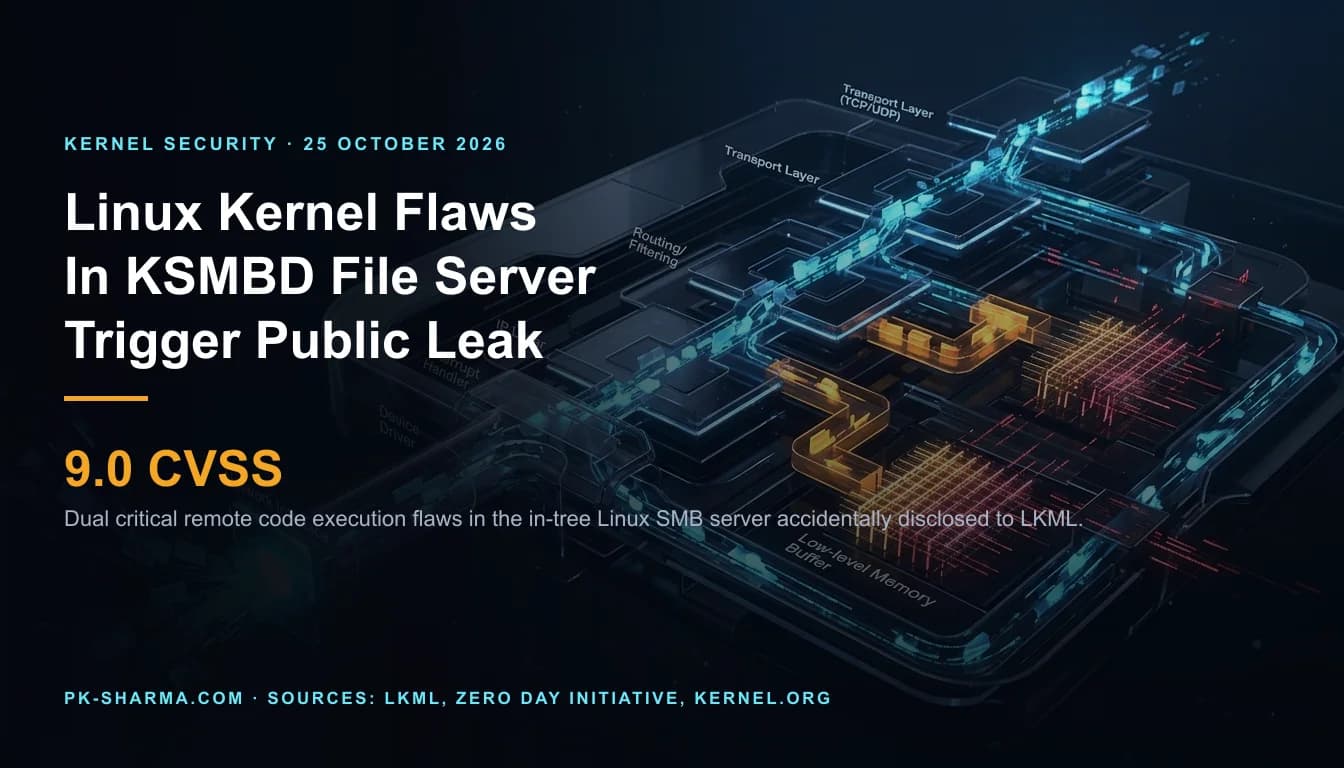
Dual CVSS 9.0 remote code execution vulnerabilities in the Linux kernel in-tree SMB server KSMBD leaked to public mailing lists, exposing hosts to pre-auth protocol confusion and heap memory corruption.
Cisco discloses CVE-2026-76466, a critical CVSS 9.8 remote code execution flaw in Expressway-C and Expressway-E clustered database services allowing unauthenticated root OS control with no workarounds.
Railway’s preliminary account describes CI credentials, artifacts and a subset of decrypted environment variables. The 100,000-workspace figure is an upper bound, while the entry route, exact keys and source-code question remain unresolved.
A source-led examination of OpenAI's frontier training containment: the September DNS incident, three classes of red-team finding, the 11-day pause and what 'offline' really permits.
What Google's revised privacy policy says about connected Gmail, Drive and Photos data and ads, what its help pages add, and which countries are excluded from Personal Intelligence.
Technical autopsy of Brotli CVE-2026-111497: Heap buffer overflow in decode.c exposes Node.js, Bun, and Python runtimes to remote code execution and denial of service via malformed compressed HTTP streams.
What METR's 22 October 2026 post says about a three-week pilot at OpenAI: the roughly 10% estimate and its uncertainty, the compaction gap METR says OpenAI fixed during the exercise, findings METR calls possible rather than shown in practice, what OpenAI redacted, and what METR did not check.
What Eye Security reported at Hack.lu on 22 October 2026 about Operation IXIM: how it found the abandoned Time4Popcorn updater (CVE-2026-30612), what its update did and did not do, why a download count is not a device count, and what defenders should check.
What Kaspersky GReAT reports about BlackX, a UEFI bootkit that exploits Baton Drop (CVE-2022-21894) to install custom Machine Owner Keys on fully patched Windows machines, what it does not state, and which Microsoft revocation steps defenders have to run themselves.