Alleged OpenAI room recorder: 9 days from discovery to arrest, and no motive, recipient or captured audio stated
A US complaint alleges an OpenAI engineer hid a thumb-sized recorder behind a meeting-room television. The dates are sworn; the motive, any recipient and any captured audio are not stated.
By Parminder Kumar Sharma · · 27 min read
Nine days from discovery to arrest, and what those days do not show
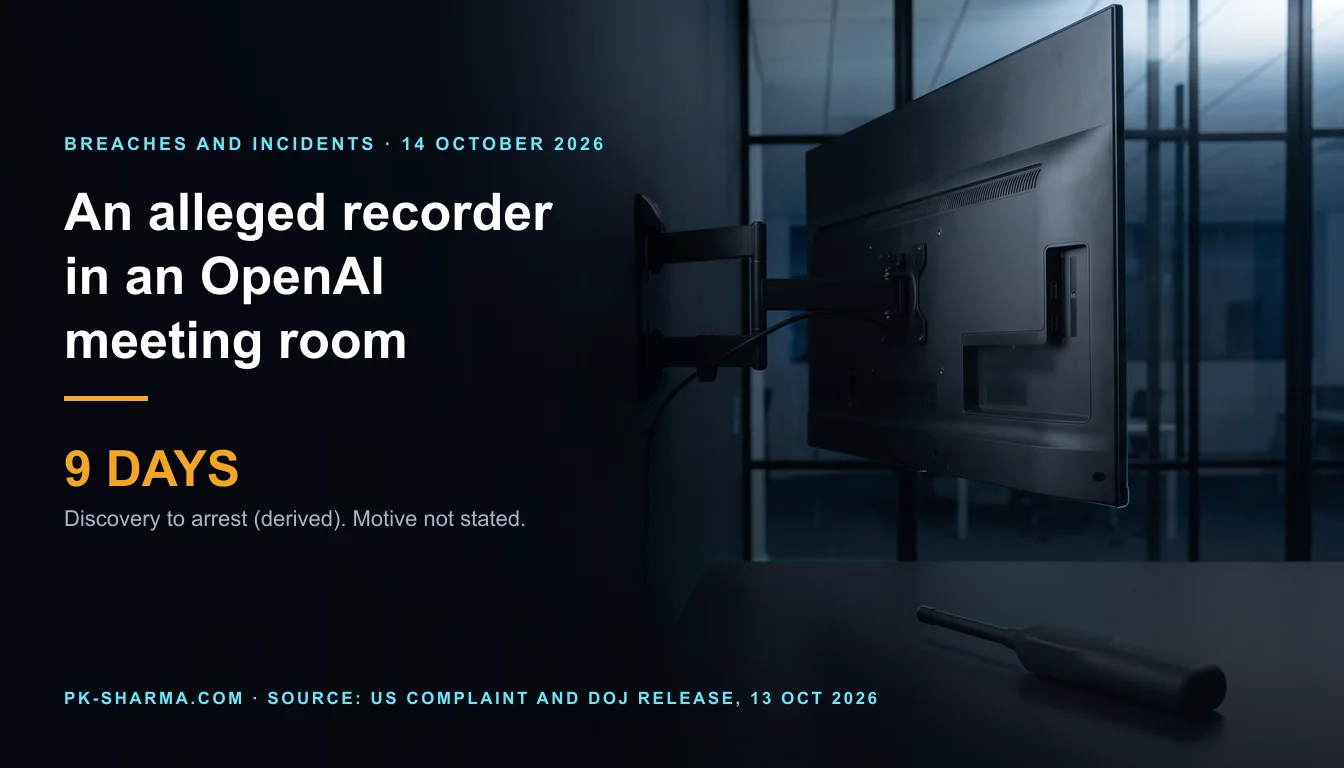
Nine days. That is the gap between 30 September, the day on or about which, on the complaint's account, OpenAI's people found a recording device behind a television in an executive conference room, and 9 October, the day the US Department of Justice says the engineer accused of putting it there was arrested (derived: 30 September to 9 October). The first court appearance, on 13 October, came 13 days after the discovery (derived). The complaint carries a filing stamp of 8 October, and the Justice Department says it was "unsealed" on 13 October, so it was under seal for 5 days (derived). Everything below is an allegation unless it is a plain date, and nobody has been convicted.
The sworn dates also cut the other way. The complaint says the device's firmware appeared to have been compiled on 28 September, "suggesting it was installed on or about that date". If so, the device had been in the room for about two days when it was found (derived: 28 to 30 September), against a lead-up the complaint sets out over six weeks (derived: 17 August to 28 September is 42 days). That lead-up is made of assistant queries from 17 August, ten dates near the room from 8 September and chatbot prompts from 24 September.
What those dates do not establish is most of what readers have been told. The complaint states no motive, no recipient and no buyer. It does not say any audio was captured: no file on the memory card could be recovered or decrypted. It does not say the device ever sent anything anywhere: it says the device's USB adapter "may have been modified to prevent data transfer". It does not say who typed the chatbot prompts it relies on. OpenAI's statement that it has "no indications" of access to model weights, source code or customer data is a company statement about the absence of a finding, and the complaint does not address it.
How this was read. The primary sources are the complaint itself (11 pages, copied from the court's file by CourtListener; the affidavit pages are scanned images, read by character recognition and checked by eye against the page images), the Justice Department's press release, and OpenAI's post on X, read logged out. The court docket as copied by CourtListener was read to corroborate the dates. The press accounts (the Associated Press in two versions, SecurityWeek's copy of the AP story, the Guardian, BleepingComputer, The Hacker News, TechCrunch, Reuters as carried by CBC, and Fox Business) are used as pointers and as the other side of the comparisons below. All of it was read between 06:19 and about 06:50 BST on Wednesday 14 October 2026, so anything about hearings or further charges may have moved since. This briefing does not name the defendant or give personal details: the case is at the complaint stage, and nothing a defender needs depends on them. It is written for UK organisations that run AI or R&D labs, and the UK reading is in its own section.
What the sworn record says, in order
The affidavit, sworn by an FBI special agent before a magistrate judge on 8 October, supports one count under 18 U.S.C. section 2511(1)(b): "intentionally endeavoring to use" an electronic, mechanical or other device to intercept oral communications. The charged period runs from "a date unknown but no later than on or about September 28, 2026" to a date "no earlier than October 5, 2026". The Justice Department release gives the maximum penalty as 5 years in prison and a 250,000 dollar fine, followed by 3 years of supervised release. The complaint calls the company "Company 1". The release, issued the day the complaint was unsealed, names OpenAI, and the company confirmed the matter in a post on X the same day.
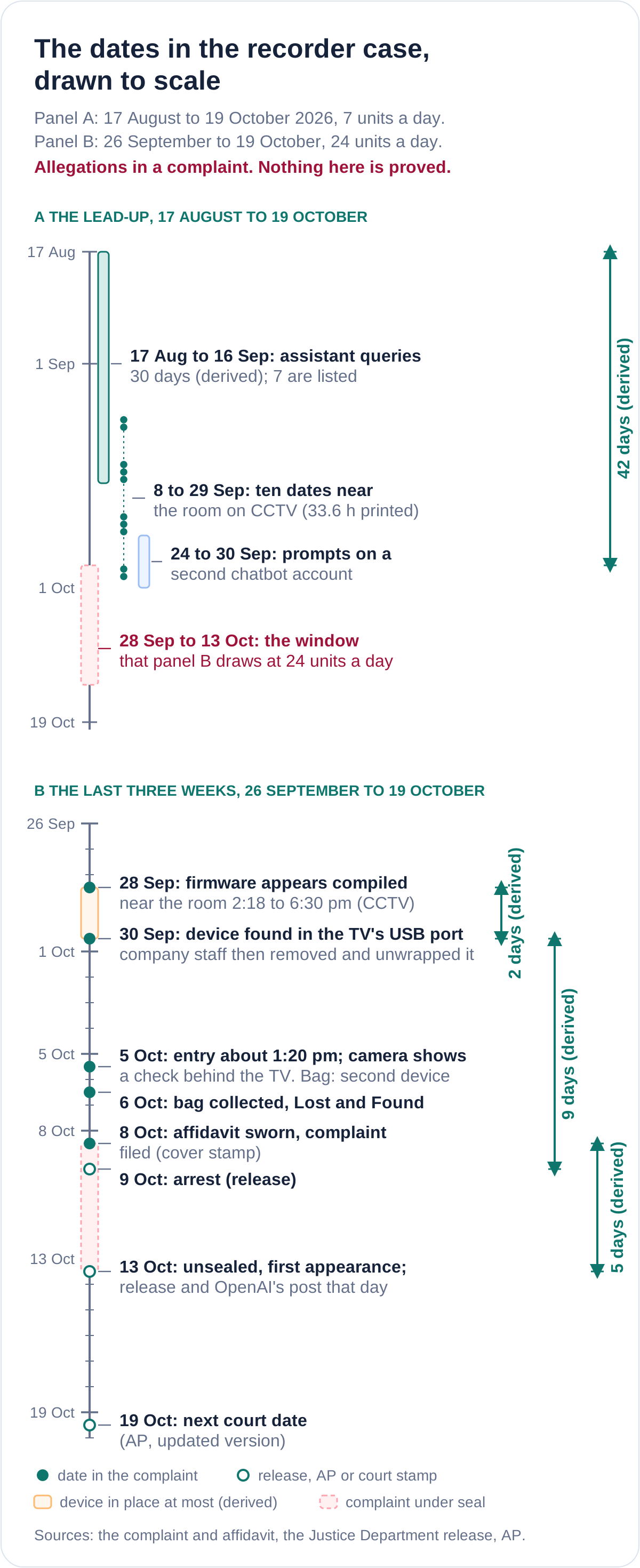
The diagram and the table below separate two kinds of number: dates the complaint prints, and intervals computed from them. Each interval is labelled derived and its inputs are in the table.
Intervals computed from dates in the complaint, the Justice Department release and the court's file. Every figure in the middle column is derived.
| Interval | Days (derived) | From and to |
|---|---|---|
| Firmware compile date to discovery | 2 | 28 September to 30 September (complaint, paragraphs 11 and 13) |
| Discovery to the camera sighting in the room | 5 | 30 September to 5 October (complaint, paragraph 19) |
| Discovery to complaint sworn and filed | 8 | 30 September to 8 October (complaint cover and signature page) |
| Discovery to arrest | 9 | 30 September to 9 October (Justice Department release) |
| Complaint filed to unsealed | 5 | 8 October to 13 October (complaint stamp; release says unsealed) |
| Discovery to first court appearance | 13 | 30 September to 13 October (release) |
| Assistant queries listed in the complaint | 30 | 17 August to 16 September (complaint, paragraph 15) |
| First CCTV date to compile date | 20 | 8 September to 28 September (complaint, paragraphs 13 and 14) |
The complaint's own table of dates is the other number worth setting out. The Associated Press first reported the defendant near the room on "a half-dozen occasions"; its updated story says "nearly a dozen". The complaint prints ten dates, all weekdays (derived).
The complaint's table of dates on which CCTV shows the defendant "near" the executive conference room (paragraph 14). The first two columns are as printed; the last column and the weekday are derived.
| Date (weekday derived) | Interval as printed | Length (derived) |
|---|---|---|
| Tue 8 September | 4:35 pm to 7:01 pm | 2 h 26 min |
| Wed 9 September | 12:11 pm to 12:12 pm | 1 min |
| Mon 14 September | 12:08 pm to 12:09 pm | 1 min |
| Tue 15 September | 12:30 pm to 12:31 pm | 1 min |
| Wed 16 September | 12:36 pm to 6:51 pm | 6 h 15 min |
| Mon 21 September | 11:31 am to 6:12 pm | 6 h 41 min |
| Tue 22 September | 12:14 pm to 7:22 pm | 7 h 08 min |
| Wed 23 September | 12:35 pm to 7:27 pm | 6 h 52 min |
| Mon 28 September | 2:18 pm to 6:30 pm | 4 h 12 min |
| Tue 29 September | 3:35 pm to 3:37 pm | 2 min |
Near the room is not in the room. The complaint's word is "near", and for these ten dates it does not say the defendant entered the room. Four entries are one or two minutes. Six run from 2 hours 26 minutes to 7 hours 8 minutes, and the ten together print 33.6 hours (derived). The complaint does not say where the defendant's own workspace is, so the table cannot be read as time spent in the room. The only entry into the room the complaint describes is on 5 October, at about 1:20 pm, when it says the defendant went in and checked behind the television. That is five days after the device was found, and by then "a camera had been placed in Conference Room 1".
What the complaint says the device was
The complaint's description is plainer than the company's. Paragraph 12 calls the device "a thumb-sized development board with a detachable camera sensor, digital microphone, and microSD storage", concealed in toilet paper and inserted into a USB port on the back of the television. The paragraph names the board's model and its maker, which this briefing does not repeat: for a defender the point is the class of object, a cheap, commercially sold, programmable board, not the part number. Company 1 personnel removed it from the television and unwrapped it.
Paragraph 13 then hedges in ways the press accounts do not. Company 1's investigation "determined that" the USB adapter on the device "may have been modified to prevent data transfer" between it and the television, and that the contents of the microSD card "may have been encrypted". A forensic image of the card, made by Company 1 personnel, produced no recoverable or decryptable files. The limited information it did produce was a network adapter's identifier (the affidavit's footnote defines a MAC address) and a custom header that, in the affiant's experience, is "consistent with a potentially encrypted file system". So "encrypted", as the Justice Department release and Reuters put it, is stronger than the sworn text. The forensic work, the firmware date and the assessment of the second device are all described as findings of Company 1 personnel, relayed by the affiant; the complaint mentions no FBI laboratory analysis.
What the device was meant to do comes from a list of prompts, not from the device. Paragraph 17 says a chatbot account associated with another person, which shared installation identifiers, logged IP usage and user path name references with the defendant's own account, submitted prompts between 24 and 30 September. Prompts on 27 and 28 September carried the device's custom header and unique network identifier. The topics listed include building a continuous recorder that saves to a memory card, adding browser access and live listening, customising Wi-Fi identity and connectivity, encrypting the card, protecting the firmware and restricting USB output (including a "USB power-only" change), and developing a second and a third unit. Paragraph 18 says the affiant's training and experience, the device's configuration and these written prompts, "attributable to" the defendant "and/or" another person, indicate that the defendant inserted the device. Those prompts are evidence about intent and design. They do not show what the recovered device did, and the complaint does not say which person typed them.
One inference, labelled as such. If the device was set up for USB power only, as the prompt list suggests, it drew power from the television's port and exchanged no data with it. A television does not usually run an endpoint agent, so USB policy on laptops would not have seen such a device either way. The complaint does not say this in terms. It says only that the adapter "may have been modified".
OpenAI calls the device "sophisticated". It told TechCrunch that the device contained "advanced encryption, audio monitoring capabilities, and a mechanism for transferring data designed to evade monitoring"; TechCrunch noted it was unclear how it differed from other recording devices. The complaint describes a commercial development board whose sworn capabilities are a microphone, a detachable camera sensor, memory-card storage and a possibly encrypted file system. It does not describe a data-transfer mechanism on the recovered unit; the Wi-Fi and live-listening items are prompt topics. On the sworn text, the sophistication is in the configuration (the prompts list encryption, firmware protection and silenced start-up output), not in rare hardware. That is better and worse for a defender: nothing about the parts is exotic, and nothing about them is hard to buy.
Where the accounts differ
The Associated Press story was revised the same day. The first version (stamped 5:10 pm on ABC News's copy, zone not stated; SecurityWeek republished the same text) says the defendant was near the room on "a half-dozen occasions last month". The updated version (8:29 pm on a local station's copy) says "nearly a dozen occasions" and adds that he is due back in court on 19 October. The complaint lists ten dates. Neither AP figure is the complaint's, and the Justice Department release says only "multiple dates". The table sets out this and the other places the sources part company; where the complaint and a report disagree, the complaint is followed.
Points on which the sources differ, with what the complaint says. Quotation marks show exact wording from the source named.
| Point | Reports and statements | The complaint |
|---|---|---|
| How often near the room | AP, first version: "a half-dozen occasions". AP, updated: "nearly a dozen". Release: "multiple dates". | A table of ten dates, 8 to 29 September (paragraph 14). |
| Whether the company is named | AP: the complaint "did not identify the company". The release names OpenAI. | "Company 1", a company that "employs thousands of people" (paragraph 8). |
| How the device was found | Fox Business: OpenAI said its technical surveillance countermeasures team found it in a 30 September sweep. Guardian: a "security sweep", attributed to the Justice Department, whose release has no sweep. | "Company 1 personnel discovered" it (paragraph 11). No sweep is mentioned. |
| When it was installed | Release: OpenAI "determined" it was installed on or about 28 September. Guardian: plugged in on 28 September. | The firmware "appeared to have been compiled" on 28 September, "suggesting" installation then (paragraph 13). |
| Encrypted or not | Release: "its contents were encrypted". Reuters: stored data "was encrypted and inaccessible". | Contents "may have been encrypted"; no files could be recovered or decrypted (paragraph 13). |
| What kind of charging document | Guardian: "the indictment". | A criminal complaint with an FBI affidavit, sworn 8 October. The court's file as copied by CourtListener shows no indictment entry. |
| The second device | Guardian: "identical". Release and AP's updated story: "similar". | Made by the same maker; Company 1 "assessed" it had a recording microcontroller and had been customised to obfuscate what was stored (paragraph 20). |
| The assistant queries | Release: "prior to Sept. 28". Reuters: "about a month through Sept. 16". The Hacker News: "an unspecified productivity tool". | A "productivity agent", 17 August to 16 September; seven queries listed "among others" (paragraph 15). |
| Who typed the chatbot prompts | Release: an account "associated with" another person. Guardian: that person "allegedly submitted" them. | Prompts "attributable to" the defendant "and/or" that person (paragraph 18). |
| What OpenAI's models did | OpenAI: "We used our models to understand the device and where it had come from." | No mention of models. Attribution rests on CCTV, queries, prompts and a bag (paragraphs 14 to 20). |
| Time to arrest | AP: arrested "a week after" the discovery. | 30 September to 9 October is 9 days (derived). |
| Access after discovery | Fox Business: OpenAI said it "gradually restricted" access to systems and offices before leave, and ended his employment on the day of the arrest. | The defendant was observed entering the building and the room on 5 October and collected a bag from Company 1's Lost and Found on 6 October (paragraphs 19 to 21). |
What the record states, and what it does not
The FBI Director's statement in the release says the defendant "allegedly concealed a covert recording device" in order "to secretly capture sensitive communications about the company's super intelligence technology". That describes what a recorder in that room would be for. It does not say who wanted the recordings or why, and AP reports that the complaint does not detail what the defendant might have wanted to do with any captured communications. Several of the complaint's facts are also given "according to Company 1 representatives": the room's booking rule, the defendant's lack of authority to enter it, and the finding of the second device (paragraphs 9, 10 and 20). Those are the victim's statements, relayed by the affiant. The table sets the stated against the not stated, question by question.
What the complaint, the Justice Department release and the company's statements state, and what they do not. Read on 14 October 2026.
| Question | Stated on the record | Not stated |
|---|---|---|
| Who put it there | The complaint alleges the defendant did, on the affiant's reading of CCTV, assistant queries, chat prompts and the 5 October footage (paragraph 18). | Footage of the installation (there was no camera), a purchase record, a fingerprint, or any entry into the room before 5 October. |
| Was anything recorded | A forensic image of the card was made; only a network identifier and a custom header could be recovered. | Any audio, any recovered file, any recording date, or whether a meeting took place in the room while the device was there. |
| Did it transmit | The USB adapter "may have been modified to prevent data transfer"; prompts mention Wi-Fi and live listening. | That the recovered unit joined any network or that anything left the building. OpenAI's "mechanism for transferring data" is not in the complaint. |
| Why, and for whom | The FBI Director: "to secretly capture sensitive communications" about the company's technology. | A motive, a recipient, a payment, a principal or any other person's act. |
| Who wrote the prompts | Prompts on an account associated with another person, sharing identifiers with the defendant's account. | Which person typed them, which provider's logs these are, and how they were obtained. |
| What OpenAI's models did | OpenAI says it "used our models to understand the device and where it had come from". | What was asked, what came back, how far people checked it. The complaint mentions no model. |
| Were weights, code or customer data reached | OpenAI: "At this time, we have no indications" of access or exfiltration. | A finding that they were not. The method, scope and period of the check are not given. |
| How he reached the room | The room "can be reserved only by executives and executive assistants"; the defendant "had no authority" to access it. | Whether the door was locked, badge-controlled or logged, or how the 5 October entry was possible. |
| Were there more devices | A second, similar device was found in a bag on 5 October. OpenAI said, per Reuters and Fox Business, that it had evidence he intended more. | Any further device placed or found, and the evidence behind "intended". |
OpenAI's statement is a company statement, made by a company with an interest in it: OpenAI sells the models it says it used, and its post ends by calling the case "an example of how AI can help address these sophisticated security threats". The AP copy that SecurityWeek carried leaves that sentence out; the Guardian and The Hacker News print it. Nothing public says how the models were used or what they concluded. The complaint attributes the identification to CCTV, assistant queries, chat prompts carrying the device's identifiers and a bag, and describes none of them as a model's output. The same method was applied to OpenAI's statements on a different matter this month, in the briefing on the three dismissed safety researchers.
Six labels that did the work of controls
Each label below is accurate and, in this record, comforting. In every row the complaint shows what the label did not give the organisation. The pattern is not new on this site: the Ledger implant briefing turned on one confirmed implanted device and a set of loss figures that no source confirmed.
Labels that stand in for controls, what the complaint shows about each, and what the label does not give you. Inferences are marked.
| The label | What the record shows | What it does not give you |
|---|---|---|
| "Executive conference room" | It "can be reserved only by executives and executive assistants" and the defendant "had no authority" to access it. On 5 October he entered at about 1:20 pm. | A booking rule is not a door. The complaint does not say the door was locked, badge-controlled or logged. |
| "A room with no camera" | Company 1 "did not have a camera within Conference Room 1" when the device was installed. A camera was there by 5 October. | Detection at the moment of placing. The camera recorded an entry and a check behind the television five days after discovery (derived). |
| "A television with a USB port" | The device was inserted into a USB port on the back of the television; its adapter may have been modified to pass no data. | A television is a powered object with open sockets that usually runs no endpoint agent. The complaint does not say whether the room's displays were inventoried or inspected. |
| "An employee with building access" | The defendant is described as an engineer; the complaint has him near the room on ten dates, entering the building and the room on 5 October and collecting a bag on 6 October. | NPSA defines an insider by "authorised access to or knowledge of" the organisation's resources, facilities included. Building access and room access are different permissions; the record does not say what kept the first from becoming the second. |
| "A productivity assistant" | Seven queries are listed from 17 August to 16 September, five of them on 16 September: room capacity, today's meetings in a room, where the calendar came from, leadership and exec, external partners. | A view of what the assistant can see. The affiant says the queries "suggest" room research; the complaint also lists an ordinary mailing question. |
| "Sophisticated" | OpenAI's word for the device. The complaint describes a commercial development board. | A threat model. A victim's adjective says how the finding felt, not what to defend against. |
The assistant that answered questions about rooms
The complaint's paragraph 15 is the part of the record most specific to AI. Between 17 August and 16 September the defendant is alleged to have used "a productivity agent" to ask about building addresses, meeting rooms, room capacities and calendars, and external-partner meeting venues. The seven queries it prints are short and conversational. One asks what meeting something was presented at and when it was recorded; one asks how to send post to a building and notes it is not the front desk. Five on 16 September ask the assistant to list meeting rooms that are "6+", to list today's meeting "in this room", where it found the room's calendar, whether another building is now the mailing building and "how about leadership and exec", and where external partners usually meet. The affiant's reading, in paragraph 16, is that the queries "suggest" the defendant was "researching Company 1's conference rooms, meeting calendars, and potential attendees" to decide where to place the device.
Three things follow, and none is a verdict on the person. First, each query is ordinary on its own; room capacity and mailing addresses are things staff ask. A rule that flagged individual questions would, on this reading, drown in false positives (inference); the complaint reads the queries in hindsight, joined to CCTV and prompts. Second, the assistant appears to have answered, at least in part: the wording of "can you list today's meeting in this room" and "where did you find room's calendar" suggests a tool that could see calendars (inference). The complaint does not say whether the assistant told him anything he could not have seen in a calendar. Third, the queries were logged and later read. The complaint does not say whose logs these are, whether the company or a provider kept them, or how they were obtained. That matters for the UK reading below.
For a defender the lesson is about scope. An internal assistant that can read room calendars, building directories and leadership locations is a reconnaissance source for any authorised user, whatever model sits behind it. The NCSC's advice on agentic AI is general but fits: give an AI tool "only the minimum access they need", "limit scope" and "monitor behaviour". The question for each room is what the assistant should be able to say about it.
The UK reading: NPSA, NCSC, the ICO and the statute book
Everything in this section is read from the pages named, on 14 October 2026, and none of it is legal advice. Where a UK page is silent on something, the table says so. This briefing did not find a page from the National Protective Security Authority (NPSA) or the NCSC that sets out a technical surveillance countermeasures sweep procedure or a port-control standard for room equipment. NPSA's own site search for "eavesdropping" returned its state-threats physical security page among others, and the NCSC page for the UK National Authority for Counter Eavesdropping describes electromagnetic security and TEMPEST training, not sweeps.
What UK pages say that bears on this case, and what they do not give you. Dates are the pages' own last-updated or published dates where printed.
| Source as read | What it says | What it does not give you here |
|---|---|---|
| NPSA, insider risk guidance (updated 28 July 2026) | Defines an insider as anyone with "authorised access to or knowledge of" the organisation's resources, including technology and facilities. | Nothing on rooms, displays or sweeps in the definition. |
| NPSA, Physical and Technical Measures (updated 17 February 2020) | For surreptitious attacks, measures should be assessed with BAD (Barriers, Access, Detection) from the Surreptitious Threat Mitigation Process, and recorded in an operational requirement. | No procedure; it lists access control, CCTV and secure working areas as existing products. |
| NPSA, 10 steps to mitigate state threats (updated 8 February 2023) | Step 4: state actors may install "eavesdropping devices"; zone sensitive areas and restrict sensitive conversations to zones. Steps 2, 3 and 7: review access control, screen for unauthorised devices, use tamper indication. | Written about state threats. The OpenAI complaint alleges no state, recipient or motive. |
| NPSA, Secure Working Areas (updated 18 December 2020) | Separates secure working areas, secure rooms and secure speech rooms "used for holding very sensitive discussions"; calls for barriers, access control and detection. | Physical aspects only; no sweep guidance. |
| NCSC, 10 Steps: Asset management (published 11 May 2021) | Record "hardware, software, firmware, peripheral devices and removeable [sic] media" with an owner; use discovery tools; "test your system to ensure unauthorised devices or non-compliant software configurations can be detected"; expect an incomplete picture in "research labs". | Does not mention room displays or power-only USB devices. |
| NCSC, CAF A3 and Cyber Essentials v3.3 (April 2026) | CAF A3 asks that assets relevant to an essential function are inventoried and that responsibility is assigned for "all assets, including physical assets". Cyber Essentials applies to in-scope devices that accept or make internet connections or control data flow, and says asset management "isn't a specific Cyber Essentials control". | Neither names room displays; on this reading a television holding a power-only USB device falls outside what Cyber Essentials tests (inference). In its text USB appears only for backups and security keys. |
| NCSC, malicious insiders and agentic AI | Monitoring should be "legal and proportionate" and staff should know it exists. For AI tools: least privilege, limited scope, monitor behaviour. | The insider page is about data exfiltration, not physical eavesdropping; neither mentions room data. |
| ICO, monitoring workers (under review after the Data (Use and Access) Act) | Covert monitoring is "unlikely" to be justifiable in most circumstances; a DPIA is required for it. Of meeting-room recording kit: "You should switch off by default any capability to record audio." Visitors caught by monitoring must be told. | No guidance on investigating a hidden device or on reading assistant logs. |
| ICO, personal data breaches | A breach includes "unauthorised disclosure of, or access to, personal data"; notifiable breaches go to the ICO within 72 hours of becoming aware, where feasible. | No view on whether a covert room recording is one. Ask your DPO. |
| Investigatory Powers Act 2016, section 3 | Offence of intentionally intercepting a communication "in the course of its transmission" by a public or private telecommunication system or a public postal service; on indictment, up to 2 years. | It is defined by transmission over a system. On the pages read, no UK offence is worded like the US charge for an in-room recorder. |
| Data Protection Act 2018, section 170 | Offence to "obtain or disclose personal data without the consent of the controller", knowingly or recklessly, with defences. | Whether a given recording is personal data, and who the controller is, are questions of fact and law. |
Read together, the UK pages cover the layers the complaint exposes: who counts as an insider, zoning and access control for sensitive conversations, tamper indication, an inventory that includes peripherals, least privilege for AI tools, and the data-protection limits on watching staff. They do not give a sweep standard or a rule for display ports, and the one UK interception offence read is tied to transmission over a communications system. A UK organisation that finds a device like this should take legal advice on the offences available and on handling evidence before it acts, and should not run any covert monitoring of its own without the data protection steps the ICO sets out. NPSA and the NCSC also run the Secure Innovation campaign for start-ups in emerging technology, which is the nearest UK pointer for a young AI lab.
An ordered checklist for a UK organisation with an AI or R&D lab
In the order worth doing: cheap physical checks first, then controls that need design, then the decisions to settle before an incident. Defender level only; none of it needs more than the facts above.
Take this with you
Ordered actions, from this week to this quarter
- This week, look at the back of every display, speakerphone, soundbar and wall box in your most sensitive meeting rooms: any unused USB or HDMI port, any powered or socketed object, anything wrapped, taped or plugged in that nobody can name. Photograph what you find and give it an owner.
- Add room equipment to the asset inventory with a named owner: displays, conferencing kit, docks, wall plates and what each plugs into. NCSC's asset management guidance lists peripheral devices, not only computers.
- Block what you do not use. Fit port blockers or tamper-evident seals over unused USB and HDMI ports on room displays, switch off or protect any media or service port in the display's own settings where one exists, and record seal references so a broken seal is a finding, not a guess.
- Assume endpoint USB control will not see this. A power-only device on a television does not appear on a laptop, so rely on inspection, seals and sweeps for room equipment (inference from the complaint's wording).
- Separate who can book a room from who can enter it. Put sensitive rooms behind door access control that logs entries, review who can open them against role, and alert on repeat or after-hours entries by people with no meeting booked.
- Decide what a camera is for and keep audio off. Cover the door and the approach, not the conversation. Assess any new room camera under the UK GDPR first, tell staff and visitors, and leave continuous audio off, as the ICO advises for audio capability on room equipment.
- Schedule technical surveillance countermeasures sweeps of rooms used for sensitive meetings, before major meetings and after any unexplained access, using a provider whose competence you have checked, and keep the record. OpenAI told Fox Business a sweep found this device. No UK page read for this briefing sets a standard, so take specialist advice.
- Limit what your internal assistant can say about rooms. Show free or busy only, or invitees only, for sensitive rooms, and keep leadership locations and external-partner venues out of its scope, in line with the NCSC advice to give AI tools minimum access and limited scope.
- Log assistant and directory queries as security data with a named owner and review triggers. Tell staff, complete a DPIA, and join physical, access and assistant signals rather than flagging single ordinary questions. NPSA advocates bringing physical, electronic audit and personnel data under one accountable owner.
- Write down what you will do if a device is found: photograph it in place, preserve it and its wrapping with a record of who handled it, have storage imaged by a forensic examiner and do not assume it is unreadable, involve the police early, and record who decided between containing at once and gathering evidence. In this case the complaint has the defendant in the building and the room five days after discovery.
- Put the data protection question to your DPO on day one: if audio had been captured, would it be a personal data breach with a 72 hour clock under the UK GDPR? Settle that before you know how much was recorded.
- Test it every quarter. With authority, have someone place a harmless dummy object behind a display in a sensitive room and see which control notices, how long it takes and who is told. NCSC's guidance asks you to test that unauthorised devices can be detected.
The question that exposes the gap
The complaint's most useful sentence for a defender is a quiet one: Company 1 "did not have a camera within Conference Room 1" when the device went in. The room had a booking rule, a television, a USB port and frequent confidential meetings, and none of those is a control that notices an object being added. What found it, on the company's account, was a sweep.
So here is the question to take into the next security review. If someone left a thumb-sized object behind a television in your most sensitive meeting room tonight, which of your controls would notice, and when did you last test it?
Key facts
Sources
- PrimaryPress release of 13 October 2026 on the arrest and charge of an OpenAI employee, number 26-1173: the arrest date, the charge, the maximum penalty, the paragraph-level summary of the complaint, and the statements by officials. Read in fullUS Department of Justice, Office of Public Affairsaccessed 2026-10-14
- PrimaryThe criminal complaint and FBI affidavit, 11 pages, sworn 8 October 2026 and replaced on the court's file on 13 October: the device description, the CCTV table, the assistant queries, the chatbot prompt topics, the 5 and 6 October events. Read in full; the affidavit pages are scanned images, read by character recognition and checked against the page imagesUS District Court, Northern District of California (copy held by CourtListener)accessed 2026-10-14
- PrimaryOpenAI's statement posted 13 October 2026, read logged out: 'a sophisticated recording device', 'We used our models', 'no indications', and the closing sentence about AI. A company statement from a vendor with an interestOpenAI Newsroom (X)accessed 2026-10-14
- PrimaryNPSA insider risk guidance page, last updated 28 July 2026: the definition of insider, insider risk, insider threat and insider eventNational Protective Security Authorityaccessed 2026-10-14
- PrimaryNPSA Physical and Technical Measures, last updated 17 February 2020: BAD (Barriers, Access, Detection) from the Surreptitious Threat Mitigation Process for surreptitious attacksNational Protective Security Authorityaccessed 2026-10-14
- PrimaryNPSA 10 Steps to Mitigate State Threats, last updated 8 February 2023: zoning for eavesdropping devices, access control, visitor screening, tamper indicationNational Protective Security Authorityaccessed 2026-10-14
- PrimaryNPSA Secure Working Areas, last updated 18 December 2020: secure working areas, secure rooms and secure speech roomsNational Protective Security Authorityaccessed 2026-10-14
- PrimaryNPSA Monitoring and Assessment, last updated 9 February 2023: bringing physical, electronic audit and personnel data under one accountable ownerNational Protective Security Authorityaccessed 2026-10-14
- PrimaryNPSA Secure Innovation campaign page, a Five Eyes campaign delivered in the UK by NPSA and NCSC for emerging technology companies. Used as a pointer onlyNational Protective Security Authorityaccessed 2026-10-14
- PrimaryNCSC page for the UK National Authority for Counter Eavesdropping: it describes electromagnetic security and TEMPEST training, not sweeps. Used to say what the page does not coverNational Cyber Security Centreaccessed 2026-10-14
- PrimaryNCSC 10 Steps to Cyber Security, Asset management, published 11 May 2021: peripheral devices, discovery tools, testing that unauthorised devices can be detectedNational Cyber Security Centreaccessed 2026-10-14
- PrimaryCAF principle A3, asset management: the inventory and responsibility outcomes, including physical assetsNational Cyber Security Centreaccessed 2026-10-14
- PrimaryRequirements for IT Infrastructure v3.3, April 2026: the scope conditions for devices, asset management not being a specific control, and USB mentioned only for backups and security keysNational Cyber Security Centre, Cyber Essentialsaccessed 2026-10-14
- PrimaryNCSC guidance on reducing data exfiltration by malicious insiders: monitoring that is legal and proportionate, and staff awareness of monitoringNational Cyber Security Centreaccessed 2026-10-14
- PrimaryNCSC blog on adopting agentic AI: least privilege, limited scope and monitoring behaviourNational Cyber Security Centreaccessed 2026-10-14
- PrimaryICO guidance on monitoring workers (marked under review after the Data (Use and Access) Act): covert monitoring, DPIAs and transparencyInformation Commissioner's Officeaccessed 2026-10-14
- PrimaryICO guidance on specific methods of monitoring workers: audio capability in meeting rooms switched off by defaultInformation Commissioner's Officeaccessed 2026-10-14
- PrimaryICO guide to personal data breaches: the definition and the 72 hour reporting dutyInformation Commissioner's Officeaccessed 2026-10-14
- PrimaryInvestigatory Powers Act 2016, section 3, offence of unlawful interception, shown as up to date to 14 October 2026legislation.gov.ukaccessed 2026-10-14
- PrimaryData Protection Act 2018, section 170, unlawful obtaining of personal data, shown as up to date to 14 October 2026legislation.gov.ukaccessed 2026-10-14
- Reported byAP story as first published, stamped 5:10 PM on 13 October: 'a half-dozen occasions', 'The complaint did not identify the company'. Used for what AP reported and where it differs from the complaintAssociated Press (via ABC News)accessed 2026-10-14
- Reported byAP story as updated at 8:29 PM on 13 October: 'nearly a dozen occasions', next court date 19 October, the company's further statements. Used for the revisionAssociated Press (via News4Jax)accessed 2026-10-14
- Reported bySecurityWeek's copy of the first AP version: the OpenAI statement without its closing sentence. Used for the comparison of versionsSecurityWeek (AP copy)accessed 2026-10-14
- Reported byGuardian report of 13 October: the 'indictment' wording, 'identical' second device, a 'security sweep' attributed to the Justice Department. Used for the differencesThe Guardianaccessed 2026-10-14
- Reported byBleepingComputer report of 13 October quoting the Justice Department release and OpenAI's post. Used as a pointer and for the release's wordingBleepingComputeraccessed 2026-10-14
- Reported byThe Hacker News report of 14 October: the complaint's summary, the 'unspecified productivity tool' wording and OpenAI's closing sentence. Used for the differencesThe Hacker Newsaccessed 2026-10-14
- Reported byTechCrunch report of 13 October: OpenAI's description to TechCrunch of 'advanced encryption, audio monitoring capabilities, and a mechanism for transferring data designed to evade monitoring'. Used for that quoteTechCrunchaccessed 2026-10-14
- Reported byReuters report carried by CBC, 13 October: 'stored data was encrypted and inaccessible', the 'about a month through Sept. 16' wording and OpenAI's further statement on intent. Used for the differencesReuters (via CBC News)accessed 2026-10-14