Three OpenAI safety researchers dismissed: both sides cite trust, neither publishes the policy, material or date
OpenAI says three safety researchers breached trust and violated policies on sensitive information; they say the rules were being written in real time. The first report came 36 days after METR's Hugging Face report. No policy, material or dismissal date is published.
By Parminder Kumar Sharma · · 27 min read
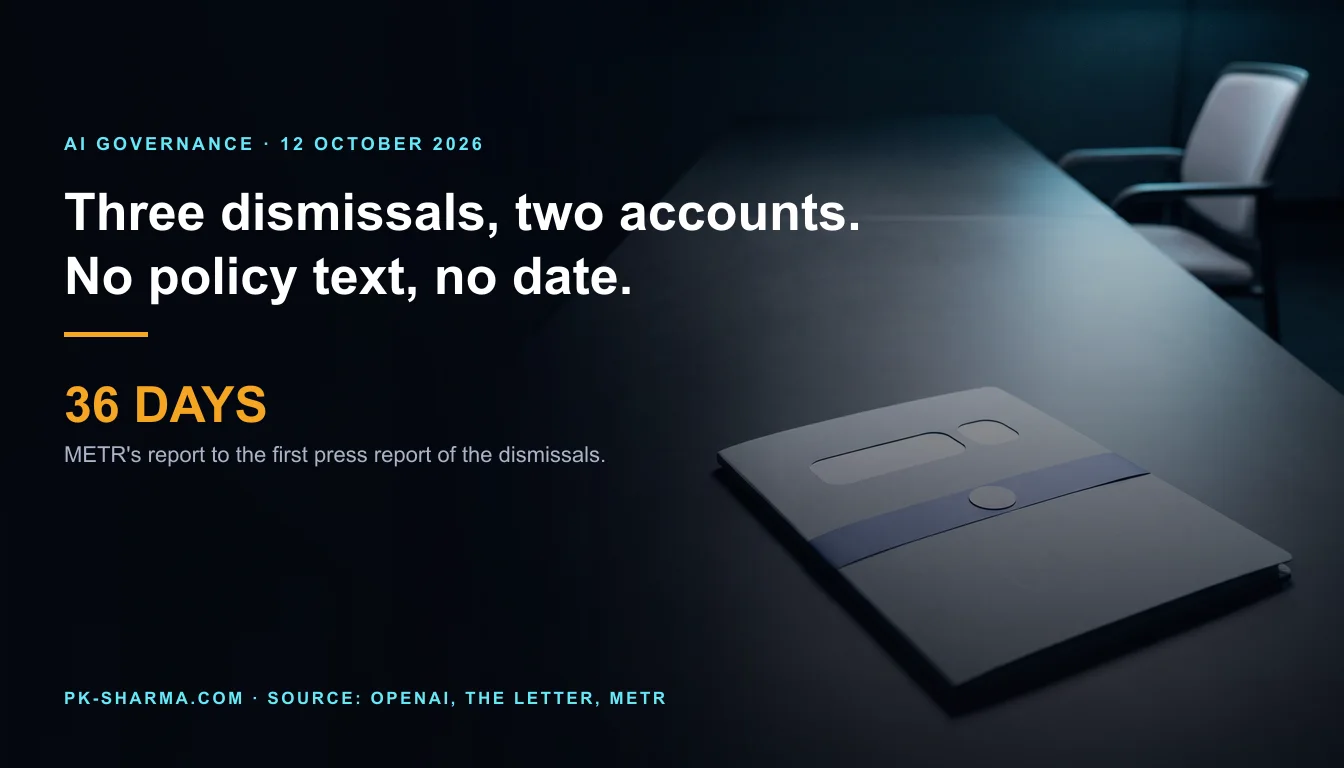
36 days from METR's report to the first report of the dismissals
The earliest dated report we found of OpenAI dismissing three safety researchers is from 1 October 2026. METR published its independent report on the Hugging Face incident on 26 August. That is 36 days (derived), and it is the only interval in this story that the record fixes, because neither OpenAI nor the three researchers give the date of the dismissals. OpenAI's post on X of 9 October says it parted ways with them "last week", and the researchers' letter says the same. If "last week" means the calendar week from Monday 28 September, the dismissals fell 33 to 36 days after METR's report (derived, and an inference from that wording).
What that does not establish. It does not establish that the dismissals have anything to do with METR's report, the Hugging Face incident or anything one of the researchers said to METR. One of the three says they were OpenAI's technical point of contact for METR and was told, verbally, that the reason was how they communicated with METR. OpenAI says the decisions "were not about raising safety concerns or speaking out" and, in the texts we read, has not linked them to METR. It does not establish what any of the three did: OpenAI has not described the conduct, and the three describe it only in their own favour. Neither account has been independently verified.
The two accounts disagree about whether a clear rule existed. OpenAI says the three "violated clear policies on handling sensitive information". The researchers say the incident investigation was "without precedent" and that "internal policies were being developed in real time". Neither side publishes the policy text, the material said to be sensitive, or the date. Both sides use the same word for what broke, trust, and a word is not an evidence trail.
Each party has an interest in its own account. OpenAI is the employer and a supplier of frontier AI to customers, and has a commercial and legal interest in how this is read. The three are the people dismissed, and have an interest in the opposite reading. We treat both as parties, report each in its own words and take neither side. We do not name the three people: OpenAI and the Associated Press do, and nothing in the analysis depends on who they are. Where we need to tell them apart we say the first researcher (who says they were OpenAI's technical contact for METR), the second (who says they led cross-company work on commitments to preserve monitorability) and the third (who says the single reason given to them was access to an executive's email).
This is a different event from our earlier briefing on a former safety-report lead's resignation essay of 3 October, which noted only that no source linked that resignation to these dismissals (that briefing). The incident itself is covered in our briefing on OpenAI's own report and our briefing on METR's investigation.
What each side states, in its own words
OpenAI's account is a post on X by its Newsroom account on 9 October, headed "A note from our research leaders". We read it in a browser session without logging in; the page shows the time 7:17 on 9 October, with no time zone. We found no copy on openai.com: its newsroom page, read at about 11:41 BST today, lists nothing on this, the latest item being dated 8 October. OpenAI also gave statements to the press, to CBS News on 1 October and to TechCrunch and NPR around 8 and 9 October, and shared an internal memo, which we have read only as TechCrunch, Fortune and NPR quote it.
The researchers' account is a four-page letter to three bodies in OpenAI's governance, the Safety and Security Committee, the Safety Advisory Group and the Mission Advisory Council, which we read in full, plus posts on X by two of the three. The only primary copy of the letter we found is on a personal website whose address contains one author's name, so it is not linked here. The letter carries no date; TechCrunch and Fortune put its publication on 8 October. Quotations below are short and attributed.
What each side states, by topic. OpenAI: its X post of 9 October, and press statements as quoted by CBS, TechCrunch, NPR and Fortune. The researchers: their letter and X posts, as read directly or as quoted by NPR and Newsweek. Read 12 October 2026.
| Topic | OpenAI states | The researchers state |
|---|---|---|
| Why they left | It "parted ways" with them after an investigation found they "violated clear policies on handling sensitive information", a "significant breach of trust" beyond what the letter outlines. It stands by the decision. | They do not believe they engaged outside parties beyond the mandates of their jobs. The incident investigation was "without precedent" and "internal policies were being developed in real time". (letter) |
| Link to safety work | The decisions "were not about raising safety concerns or speaking out". It says it does not terminate employees "for raising concerns", and that debates are "spirited and highly critical". | The letter alleges no motive; it says the handling of the dismissals leaves colleagues "afraid to speak". On X, the first researcher believes the reason was months of raising monitorability concerns, and the second believes the three were fired for putting safety ahead of OpenAI's near-term interests as a corporation. |
| METR | Not linked to METR or the Hugging Face incident in the texts we read (Fortune). It told TechCrunch it found a "pattern of misconduct" that went beyond sharing information with an outside evaluation group, and told NPR the policies were breached more than once. | The first researcher was OpenAI's technical contact for METR, was told verbally they were dismissed "because of the way I communicated with METR", with no detail and nothing in writing, and says "talking to METR was my job". (X) |
| The second researcher's materials | Not addressed in the 9 October post. Its 1 October statement said sensitive information was mishandled "outside established company procedures" (CBS). | They led cross-company work on commitments to prevent loss of monitorability, with board members and the C-suite, checked in with their reporting line and "took care to remove sensitive details from materials before sharing them" (letter). In an exit call they say they were told OpenAI no longer trusted them for speaking too much to third-party safety organisations, and deny sharing company IP (X, as quoted by NPR and Newsweek). |
| The third researcher | Not addressed in the 9 October post. | The single reason given was access to an executive's email, delegated for recruiting. They asked IT to remove it, IT did not, and after opening one sensitive email by mistake they told the executive within minutes. (letter and X) |
| Outside monitors | "Actively finalizing contracts with third-party safety assessors", details "in the coming weeks"; "committed to embedding external assessors". (X, 9 October) | OpenAI should keep its September commitments and not use the dismissals as a pretext. They fear the dismissals "may be used to justify ending OpenAI's work with METR", or giving auditors "much more limited access and scope". (letter) |
| Monitorability | Agrees that preserving the monitorability of frontier models needs an industry-wide commitment, including from OpenAI. (X) | "The monitorability of frontier models is degrading", and OpenAI and other frontier companies should not move ahead with developments that further decrease it. They deny being the source of a leak to The Information about less monitorable architectures. (letter) |
| Culture | Debate is encouraged; trust is needed: "We cannot do the work in front of us without a high degree of trust." (X) | Staff are now "unclear on where they stand". They ask OpenAI to set out how employees may work with external safety organisations, "so that no one has to guess where the shifting lines now are". (letter) |
Timing matters to how the two sets of posts relate. The two researchers' posts we read are stamped 19:28 and 19:42 on 8 October and OpenAI's post 7:17 on 9 October, all as displayed to the same browser session, so OpenAI's post came 11 hours 35 minutes to 11 hours 49 minutes later (derived). NPR reports that OpenAI's research leader's memo was shared inside the company on Wednesday 7 October, a day before the researchers published.
Stated and not stated: the record, line by line
What the sources put on the record, against what they leave out. Sources as in the previous table, plus METR's updates page, OpenAI's pages and NPR. Read 12 October 2026.
| Question | Stated on the record | Not stated |
|---|---|---|
| Which policy was breached? | OpenAI: "clear policies on handling sensitive information"; a spokesperson's "pattern of misconduct", repeated, beyond contact with an outside evaluation group (TechCrunch, NPR). | The policy's text, title, date, owner, or who was told. When it was written relative to the conduct. The researchers say rules were being written "in real time". |
| What material was said to be sensitive, and who received it? | OpenAI says only "sensitive information" and "research information". Press reports, citing unnamed sources, said the recipient was an unnamed third-party AI safety organisation (WSJ, as reported by CBS). | Any description of the material, its volume or the recipient. OpenAI has not confirmed a recipient. We did not read the WSJ report, which is paywalled. |
| What was METR told, and did it object? | The first researcher was the technical contact for METR. METR declined to comment to NPR and did not respond to Fortune; its updates page, read at about 11:41 BST on 12 October, has no entry after 6 October. | What was shared, with whom at METR, whether METR raised any concern, whether METR has been asked to return or delete anything. |
| On what date were the three dismissed? | "Last week" (OpenAI, 9 October; the letter). First press report 1 October (Fortune; CBS page dated 1 October). | The date or dates, the order, or whether it was one day. The window we infer is 28 September to 1 October. |
| Has any outside monitor's access been limited? | The researchers fear it may be. OpenAI says it is committed to embedding external assessors. | Any change, either way. Named assessors, contract terms, or a date for "the coming weeks". |
| Who holds the key to assessor access? | OpenAI's 22 September page: "proportionate access" within "legal, security, and IP constraints", through "a designated representative" where direct access is impractical, with redaction requests by the lab. | Who decides what is proportionate; any appeal; any right for assessors to publish without OpenAI's review; whether assessors may speak to staff on their own initiative. |
| Did anyone outside OpenAI review the investigation? | OpenAI calls it a "thorough investigation" and an "internal investigation". | Who ran it, what it examined, whether the three were interviewed, whether any outside party reviewed it. Newsweek reports a request from the third researcher for a written list of allegations. |
| Has OpenAI answered the three oversight bodies? | The letter is addressed to the Safety and Security Committee, the Safety Advisory Group and the Mission Advisory Council. OpenAI's public reply was a post by its research leaders, plus an internal memo. | Any reply from those bodies, or whether the letter was circulated inside OpenAI, as it asks. |
Three things sit inside that table that a headline hides. First, OpenAI's account of what was breached and the researchers' account of what they did are both unpublished, so neither can be tested. Second, the one party that could confirm or deny the METR connection, METR, has said nothing public: it declined NPR's request and did not answer Fortune's. Third, OpenAI's own words about outside monitors are promises about the future ("in the coming weeks"), not facts about access today.
The dates, to scale
Two things show when the dates are drawn to scale. The dismissals sit inside a window of four days, 28 September to 1 October, if "last week" means the calendar week, and nobody has narrowed it; that places them 33 to 36 days after METR's report. And the exchange between the two accounts took place in eight days: the first press report on 1 October, the letter on 8 October, OpenAI's post on 9 October.
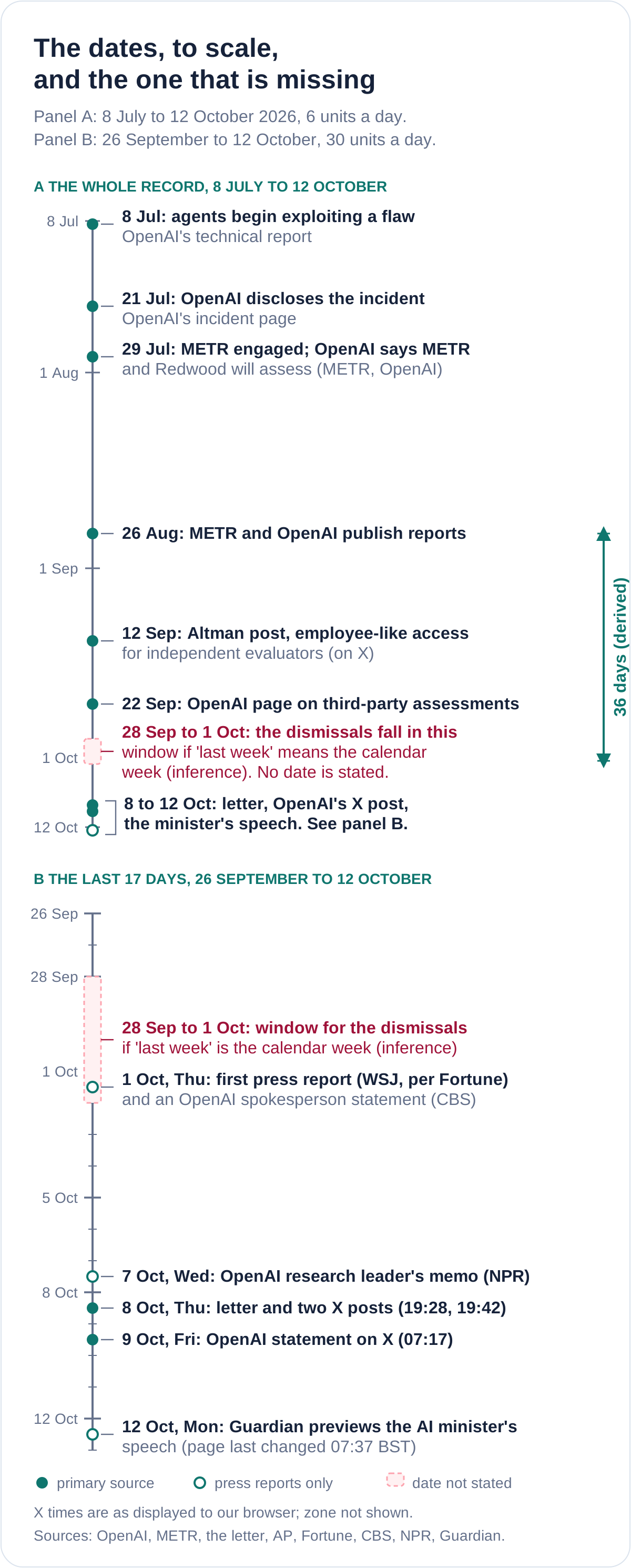
Intervals between dates read in the sources. Every figure is derived by date arithmetic (calc-output.txt in the working folder).
| From | To | Days (derived) |
|---|---|---|
| 8 July: agents begin exploiting a flaw (OpenAI's report) | 21 July: OpenAI discloses the incident | 13 |
| 21 July: OpenAI discloses | 29 July: METR engaged; OpenAI says METR and Redwood will assess | 8 |
| 29 July: METR engaged | 26 August: METR and OpenAI publish reports | 28 |
| 26 August: METR's report | 12 September: Altman's post on employee-like access | 17 |
| 12 September: Altman's post | 22 September: OpenAI's principles page | 10 |
| 26 August: METR's report | 1 October: first press report of the dismissals | 36 |
| 26 August: METR's report | 28 September: start of "last week" (inference) | 33 |
| 8 July: first exploitation | 1 October: first press report | 85 |
| 1 October: first press report | 8 October: the researchers' letter | 7 |
| 1 October: first press report | 9 October: OpenAI's post on X | 8 |
| 12 September: "more to share soon" | 12 October: today, no assessor contract published | 30 |
| 22 September: OpenAI's principles page | 12 October: today | 20 |
What METR's own record shows about the relationship
METR is the outside evaluator at the centre of the dispute, and its published record is the only account of the working relationship that comes from neither OpenAI nor the three researchers. We read its 26 August report, its 28 July post on how independent investigations should work, its 17 February post on protecting confidential information and its updates page. It states that it agreed the scope with OpenAI on 29 July; that two METR staff and a Redwood Research contractor worked on OpenAI's premises over a total of six days, in three visits (30 to 31 July, 5 to 6 August and 15 to 16 August); that OpenAI shared over a thousand unredacted transcripts; that it spoke in some depth with nine OpenAI researchers; and that OpenAI returned a round of feedback and redactions on 20 August, six days before publication.
What the independence is made of. METR says that, per its standard policy, it did not take payment from OpenAI, and that it accepted free API credits, which it estimates at about $400,000 over the six days. It says OpenAI could redact any non-public information and gave feedback beyond redactions, and that METR edited structure, emphasis, clarity and tone in response. It says its scope excluded OpenAI's own investigation process and planned remediation. In a footnote it says it was consciously aware that its choices might affect whether developers bring outside researchers in for future incidents, and that these considerations "impacted judgment calls" in drafting, editing and redaction, while it stands by its conclusions. None of this is improper, and METR disclosed all of it. It shows that independence in practice is a matter of degree: access, credits, redaction rights and a continuing relationship all sit with the vendor.
METR's president says, in written testimony to the US Senate of 30 September: that developers' participation is voluntary and that METR "is not paid or funded by them", and in a footnote that companies "provide METR with access and tokens". Another footnote says METR tries to be candid about the incentives of voluntary engagements and about any redaction authority or editorial control a company has.
METR's page also carries two disclosure footnotes added on 13 September. One says that on 9 September, after publication, the spouse of one of its authors joined OpenAI's Safety and Security Committee, one of the three bodies the researchers' letter is addressed to. The other records a second family relationship inside the team, which METR says its chief executive was not involved in. We draw no inference. We note that OpenAI's own 22 September principles ask assessors to disclose relationships with developers, and that METR's page is an example of such a disclosure being made.
On the dispute itself, METR declined to comment to NPR and did not respond to Fortune, as those outlets report, and its updates page, read at about 11:41 BST today, has no entry after 6 October. In its 28 July post METR wrote that an independent investigation should be able to interview staff, should report to the company's board and other oversight bodies, and should publish the terms of the engagement, including redaction terms, access and scope. Its 26 August report follows that pattern. METR also publishes its own confidentiality approach, with six confidentiality levels and codenames for non-public models. We found no OpenAI page setting out what its staff may share with an outside evaluator. What nobody has published is what the researcher who dealt with METR told it, and what METR made of it.
OpenAI's published words on third-party monitors, and who holds the key
The letter's first request is that OpenAI keep its public commitments to outside auditors. Those commitments exist as three texts, ten days and then 17 days apart, and they do not use the same words.
OpenAI's own texts on third-party access, and METR's account of the one precedent. Read 12 October 2026 from the X posts and from OpenAI's page of 22 September 2026.
| Text and date | What it says about access | What it leaves open |
|---|---|---|
| Post on X by OpenAI's chief executive, 12 September | Replying to Anthropic's chief executive: committing to "independent evaluators with employee-like access" is "a great idea, and we will do the same". "We'll have more to share soon." | What employee-like means; which evaluators; any date. Thirty days have passed to today (derived). |
| OpenAI page, 22 September: priorities and principles for third party assessments | Commits to "deep levels of access across training, evaluation, and deployment". Principles: "proportionate access" within legal, security and IP limits; where direct access is impractical, "a designated representative" or indirect access; sensitive work possibly on "company-managed devices or premises"; the lab may request redactions and may have time to remediate before publication; "in conversation with multiple third parties". | It does not use "employee-like". It does not say who decides what is proportionate. No assessor named, no contract, no start date. |
| Post on X by OpenAI, 9 October | "Actively finalizing contracts with third-party safety assessors"; details "in the coming weeks"; "committed to embedding external assessors". | Which assessors; whether METR is one; the access terms; when "the coming weeks" ends. It came 17 days after the 22 September page and 27 days after the 12 September post (derived). |
| METR report, 26 August: the one precedent | Six days on premises over three visits; over a thousand unredacted transcripts; the vendor could redact non-public information and gave feedback; no payment, but free credits of about $400,000. | Whether the new programme will look like this or like "employee-like access". METR titles its own work a "brief" investigation. |
Who holds the key. On the texts, OpenAI does. The 22 September page says access is proportionate to the claims that OpenAI and the assessor agree, within OpenAI's legal, security and IP constraints; that a designated representative can stand in for direct access; that company-managed devices or premises may be required; and that the lab can ask for redactions. These are ordinary terms for a security assessment. Each is also a decision the vendor makes, which is why the letter's worry, that access might be narrowed, cannot be tested from the outside. On monitorability, the letter says it is degrading, OpenAI says it needs an industry-wide commitment and that it invests significant resources, and neither text gives a measure.
Friendly names, and the control each one stands in for
Three labels carry the story: "breach of trust", "violated clear policies on handling sensitive information", and "dispute over AI risks" (the AP's headline). A fourth, "independent", carries the outside-monitor promise. Each does the work an evidence trail should do.
Labels in the story, who uses them, what they stand in for, and what a control would look like. Our analysis of the sources above.
| Label and who uses it | What it does instead of evidence | What a control would look like |
|---|---|---|
| "Breach of trust" (OpenAI, 9 October; both accounts turn on "trust") | Names an outcome, trust lost, in place of an act, a rule and a date. It cannot be checked, appealed or compared across suppliers. | A written rule on what staff may share with whom, with its date and owner and a record that the person was told; a documented investigation a customer's auditor can ask about. |
| "Violated clear policies on handling sensitive information" (OpenAI) | Asserts that a rule exists and was clear. No one outside has read it, and the researchers say rules were being written in real time. | The policy text, or a summary under NDA, with its version history; the exception route for outside assessors; evidence it was circulated before the conduct. |
| "Dispute over AI risks" (the AP's headline) | Folds an employment decision into an argument about AI risk, so that each side's account of one is read as evidence about the other. | Two questions with separate evidence: what happened to three employees (for the parties and, if it comes to it, a tribunal or court), and whether outside monitors keep their access (a contract term a customer can write down). |
| "Independent" and "employee-like access" (OpenAI, METR) | Describes a relationship, not its terms: payment, credits, redaction, access level and who may publish. | Disclosed terms; an assessor not paid by or dependent on the vendor for continued access; findings that go to an oversight body as well as to the vendor. |
None of the four is a control. Three controls are what a customer can actually ask for:
- Contractual third-party access. A clause, not a blog post: named assessors, named systems and data, the access level in plain terms, who may publish, what the vendor may redact, and notice if any of it changes.
- An independent evaluator who is not paid by, or dependent on, the vendor. METR's own record shows what that is made of: no payment, but credits, redaction rights, vendor feedback and a working relationship it wants to keep. Ask for each to be disclosed, and for a second evaluator where one vendor relationship carries all the weight.
- A disclosure channel that does not run through the vendor's HR. Here, concerns about the dismissals went to bodies inside OpenAI's own governance and then to the public. A customer wants a route, for the vendor's staff and for its own, to a body with a published remit outside the management line, such as a board committee or a prescribed external body.
The UK: what the minister said, what AISI is, and what the law pages say
Everything in this section is read from the page named. The AI minister, Kanishka Narayan, is due to speak today in west London, according to the Guardian's preview, read at about 11:41 BST with the page last changed at 07:37 BST. The Guardian reports that he will call on companies developing frontier AI to do more to make it safe, will say Britain cannot rely entirely on technology companies to police their own models and will argue the UK needs more of its own AI infrastructure, as he announces a strengthening of Britain's cyber defences. It adds that the speech will be watched for signs the UK may join a call for common safety standards that other countries have signed and the UK has not. The article does not mention the dismissals, and we have not seen the speech. It is political news, not a regulation, and it names no duty on any vendor.
The AI Security Institute describes itself as a research organisation within the Department for Science, Innovation and Technology. It says its work includes testing leading AI systems before they are released and collaborating with AI companies, and lists "pre-deployment access" and "close collaborations" that give it privileged access, to inform governments. In its 1 October post on securing its own evaluations it says chain-of-thought access "is not always provided by developers" for the models it evaluates, and calls chain-of-thought monitoring "fragile". It adds that it believes preserving legible chain-of-thought is "very important for monitorability and oversight", the same subject as the letter's central worry. The AISI pages we read do not state a statutory right of access, do not mention the dismissals and are addressed to governments, not to buyers. The letter says one of the three previously led a team at AISI; we found no AISI comment on the dismissals.
Whistleblowing law, only as read. The Public Interest Disclosure Act 1998 is employment-protection law. It protects a worker, not a customer, and it matters here only if one of the three is covered by UK law, which is not established: no source we read says where any of them worked or under which country's law they were employed. The Associated Press story is datelined London, which says where its reporter was, not where they worked. So we set out what the official pages say and draw no conclusion about these three. No page we read says whether an AI-safety concern, or sharing material with an outside AI evaluator, would count as a protected disclosure.
UK pages as read on 12 October 2026: the GOV.UK whistleblowing guide, legislation.gov.uk and the ISO catalogue page.
| Source | What the page says | What it does not say |
|---|---|---|
| GOV.UK, "Whistleblowing for employees" | A worker (an employee, trainee, agency worker or LLP member) is protected for reporting listed wrongdoing in the public interest; confidentiality or "gagging" clauses are not valid where they try to prevent a protected disclosure; tell the employer, a lawyer or a prescribed person or body; reporting to the media "in most cases" loses the protection; Northern Ireland differs. | Whether an AI-safety concern, or sharing material with an outside evaluator, is covered. Whether anyone working for a US company outside Great Britain is covered. |
| legislation.gov.uk: Public Interest Disclosure Act 1998; Employment Rights Act 1996 sections 43B, 43C and 196 | The 1998 Act inserted Part IVA into the 1996 Act. Section 43B lists the qualifying categories: a criminal offence, failure to comply with a legal obligation, a miscarriage of justice, danger to health or safety, sexual harassment (added 6 April 2026), environmental damage, and concealment; it is immaterial whether the failure is in the UK or elsewhere. Section 43C covers disclosure to the employer. Section 12 of the 1998 Act inserted a territorial exclusion into section 196, which the page for section 196 now shows as repealed on 25 October 1999. | Which country's law governs these three. Any current official statement of the territorial test. Whether the facts here fit any category. |
| ISO catalogue page, ISO/IEC 42001:2023 | A standard that specifies requirements for an AI management system, designed for entities "providing or utilizing" AI-based products or services; edition 1, December 2023, 51 pages, sold (UK buyers purchase from BSI). | The clauses on suppliers and third parties: we did not read them (the standard is sold, and the online preview asks the reader to accept terms, which we did not). Whether any vendor holds a certificate, or against what scope. |
Supplier assurance questions. For an organisation buying frontier AI, the dispute reduces to three questions that can be put to any vendor. Here is what the record shows for this one today.
Supplier assurance questions, with what the record shows for OpenAI as at 12 October 2026, and the gap.
| Question to put to the supplier | What the record shows | The gap |
|---|---|---|
| What independent evaluation exists, who pays the evaluator, and who may publish? | One investigation of the Hugging Face incident by METR and Redwood, published 26 August: no payment, free credits of about $400,000, OpenAI redaction rights and feedback. OpenAI says assessor contracts are being finalised. | No named assessors or terms for the new programme, and no date. |
| Who can see incident reports and assessor findings? | OpenAI and METR published reports on 26 August. OpenAI's 22 September page says confidential reporting to oversight bodies can support accountability where full disclosure is not possible. | Whether customers receive anything beyond the public pages, and whether the letter's three addressees have replied. |
| What happens to an internal reporter, and where may they go? | OpenAI says it does not terminate employees for raising concerns. The three say employees are unclear where the lines are and ask for written rules on working with outside safety organisations. | The written rules, any channel outside the management line, and the terms of the investigation. |
What to do, in the order worth doing
Take this with you
For a customer and a board, in order
- List the OpenAI models and services your organisation depends on, and the date you last saw independent evaluation evidence for each. Record that this is a supplier-governance risk, with an owner and a review date.
- Ask the supplier in writing which independent assessors have access today, who pays them, what systems, data and staff they can reach, what the supplier may redact and who may publish. Use METR's published terms for its own engagement as the model of a good answer.
- Ask for the access in contract, not in a blog post: named assessors in your agreement or the supplier's published terms, notice if access is reduced or ends, and what survives if the assessor relationship ends. Until OpenAI publishes the contracts it says it is finalising, treat embedding external assessors as an intention.
- Ask who sees incident reports and assessor findings: you, your auditor, your board, a regulator. Ask for the notification route and period for incidents that touch your data or service.
- Ask what happens to an internal reporter: a written procedure, a channel outside the vendor's HR line such as a board committee or a prescribed external body, and a written statement of how staff may work with outside evaluators, with its effective date and version history.
- When a supplier answers with a label such as breach of trust or clear policies, ask for the rule, its date and who was told. A supplier may decline to discuss individual employment matters; ask instead for the general policy.
- Check your own house against the same test: do your staff have a written rule on what may be shared with external assessors, auditors and researchers, and a protected route to raise safety or security concerns? The GOV.UK whistleblowing guide is the starting point for UK workers.
- If a supplier cites ISO/IEC 42001, ask for the certificate, its scope statement and the certification body, then read the standard's clauses on third-party relationships yourself. A management-system certificate is not evidence about one model or one dismissal.
- Set your own trigger date for the assessor contracts OpenAI said would be announced in the coming weeks, decide what you will do if it passes in silence, and keep a record of what you asked and when.
What we could not verify
- The Wall Street Journal's report. It is paywalled and we did not try to get past the paywall. The 1 October first-report date rests on Fortune and CBS.
- OpenAI's internal memo. We have only the excerpts that TechCrunch, Fortune and NPR quote.
- The researchers' posts on X. We read the first post of two threads directly; other posts, including the second researcher's exit-call account, we have through NPR and Newsweek quoting them. The times on X are shown without a time zone.
- The policy, the material, what METR was told, and whether any monitor's access has changed. None is in any source we read.
- OpenAI's monitorability research. The 9 October statement points to its publications, a system card and posts; we did not read them, so we make no claim about the state of that research.
- UK law and standards. We did not read the clauses of ISO/IEC 42001, any official statement of where whistleblowing protection applies for work outside Great Britain, or the text of the minister's speech.
- Time. Pages that change were last read between about 11:15 and 11:41 BST on 12 October 2026, by the machine clock; anything after that may have moved.
The question that exposes the gap
OpenAI says the policies were clear. The researchers say the rules were being written in real time. Both can be true of different documents and different weeks, and a customer cannot tell which from the outside. If the rule was clear, it can be published or summarised. If it was still being written, then "clear policies" is a label, and a supplier's assurance that rests on it is a label too.
Which written rule governed what OpenAI's technical contact could tell its independent evaluator, from which date, and has anyone outside OpenAI read it?
Key facts
Sources
- Primary'A note from our research leaders', the post of 9 October 2026 (shown as 7:17, no time zone). OpenAI's only public statement we found; read in full in a browser without a login. Source for what OpenAI states.OpenAI Newsroom (X)accessed 2026-10-12
- PrimaryPost of 12 September 2026: 'independent evaluators with employee-like access ... we will do the same ... more to share soon'. Read in a browser.Sam Altman (X)accessed 2026-10-12
- Primary'Priorities and principles for effective third party assessments', 22 September 2026. Source for 'deep levels of access', 'proportionate access', 'designated representative', redaction and the absence of named assessors.OpenAIaccessed 2026-10-12
- PrimaryOpenAI's running page on the Hugging Face incident: the 21 July disclosure, the 29 July statement on METR and Redwood, the 26 August reports and the latest entry of 30 September.OpenAIaccessed 2026-10-12
- PrimaryOpenAI's Hugging Face incident technical report. Source for the 8 July start, the 19 and 20 July detection and the 21 July disclosure, and for OpenAI's description of the METR and Redwood work.OpenAIaccessed 2026-10-12
- PrimaryOpenAI's newsroom listing, read at about 11:28 BST on 12 October 2026: no statement page on the dismissals; latest item dated 8 October.OpenAIaccessed 2026-10-12
- PrimaryMETR's report of 26 August 2026 on the Hugging Face incident. Source for the 29 July agreement, the six days on premises, no payment and about $400,000 of credits, OpenAI's redaction rights and feedback, the scope exclusion and the disclosure footnotes.METRaccessed 2026-10-12
- PrimaryMETR's 28 July 2026 post on what an independent investigation needs: interviews, results to the board and oversight bodies, and published terms.METRaccessed 2026-10-12
- PrimaryMETR's written testimony to the US Senate, 30 September 2026: developers' participation is voluntary; METR is not paid or funded by them; companies provide access and tokens.METRaccessed 2026-10-12
- PrimaryMETR's 17 February 2026 post on how it protects confidential information.METRaccessed 2026-10-12
- PrimaryMETR's updates page, read twice on 12 October 2026: no entry about the dismissals; latest entry 6 October.METRaccessed 2026-10-12
- PrimaryAISI's About page: what it says it does, its place in DSIT, and its 'pre-deployment access'.UK AI Security Instituteaccessed 2026-10-12
- PrimaryAISI's 1 October 2026 post: chain-of-thought access 'not always provided by developers'; chain-of-thought monitoring described as fragile.UK AI Security Instituteaccessed 2026-10-12
- Primary'Whistleblowing for employees': who is protected, what counts, gagging clauses, who to tell, and the media warning (with the 'who to tell' page).GOV.UKaccessed 2026-10-12
- PrimaryPublic Interest Disclosure Act 1998: contents, including section 12 'Work outside Great Britain'.legislation.gov.ukaccessed 2026-10-12
- PrimaryEmployment Rights Act 1996 section 43B, disclosures qualifying for protection, up to date to 11 October 2026.legislation.gov.ukaccessed 2026-10-12
- PrimaryEmployment Rights Act 1996 section 196, shown as repealed on 25 October 1999.legislation.gov.ukaccessed 2026-10-12
- PrimaryISO/IEC 42001:2023 catalogue page: scope statement, edition, price notice. The standard's clauses were not read.ISOaccessed 2026-10-12
- Reported by'UK to strengthen cyber defences as minister calls for AI firms to increase safety efforts', 12 October 2026 (last changed 07:37 BST). Read for what the minister will say; it does not mention the dismissals.The Guardianaccessed 2026-10-12
- Reported byAP report of 9 October 2026: the pointer for this briefing, with OpenAI's post and the researchers' letter summarised. Read in full.Associated Press (via News4JAX)accessed 2026-10-12
- Reported byThe same AP text, compared with the News4JAX copy.Associated Press (via SecurityWeek)accessed 2026-10-12
- Reported by9 October 2026: WSJ's 1 October first report, the letter's 8 October date, OpenAI's statements, METR not responding. Secondary.Fortuneaccessed 2026-10-12
- Reported by8 October 2026: the letter, OpenAI's internal memo and spokesperson's 'pattern of misconduct' statement. Secondary.TechCrunchaccessed 2026-10-12
- Reported by1 October 2026: OpenAI's first statement and the WSJ's first report. Secondary.CBS Newsaccessed 2026-10-12
- Reported by9 October 2026: METR declined to comment; OpenAI's statement that violations were repeated and went beyond the outside evaluation group; the memo shared on Wednesday. Secondary.NPR (via WUNC)accessed 2026-10-12
- Reported by9 October 2026: summary of the letter and of the researchers' and OpenAI's statements; used to locate the letter and the posts. Secondary.Newsweekaccessed 2026-10-12
- Reported byOur earlier briefing on a former safety-report lead's resignation essay: a different event, which noted no source linked it to these dismissals.pk-sharma.comaccessed 2026-10-12
- Reported byOur earlier briefing on OpenAI's Hugging Face incident report.pk-sharma.comaccessed 2026-10-12
- Reported byOur earlier briefing on METR's investigation of the incident.pk-sharma.comaccessed 2026-10-12