Ransomware-response executive reportedly arrested in ShinyHunters case: five docket lines, none describing an act
Press reports say a Canadian ransomware-response executive was arrested on 8 October in the ShinyHunters investigation, but the public court record is five docket lines and describes no act. What is stated, what is not, and what UK organisations should control at the supplier's seat.
By Parminder Kumar Sharma · · 26 min read
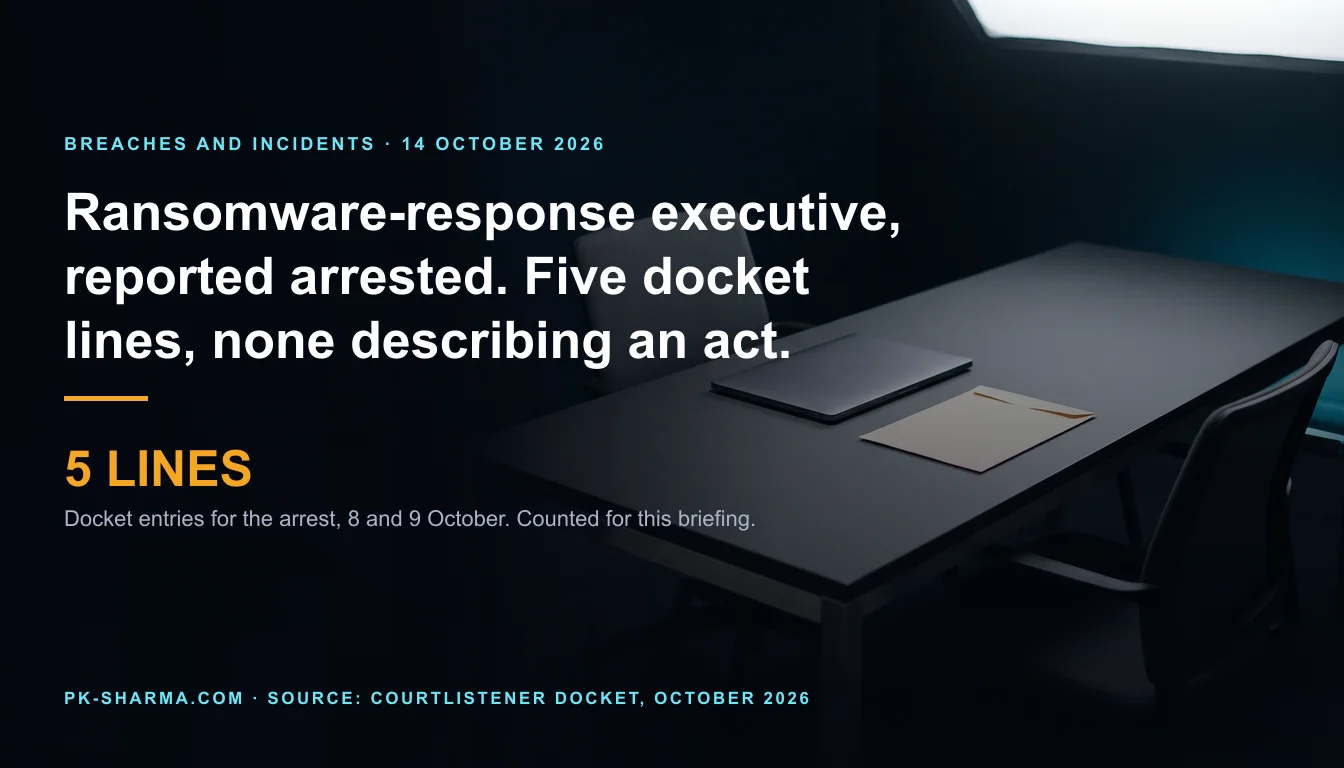
Five docket lines, 23 days after the Dutch arrest, and no act described
On Thursday 8 October 2026 a man was arrested in the Eastern District of Pennsylvania on a charge brought in the Eastern District of Texas. Press reports describe him as a Canadian ransomware-response executive and tie the arrest to the ShinyHunters extortion investigation. No court document I could read says either. The public court record of the arrest, as CourtListener holds it for the Pennsylvania court (case 2:26-mj-01973), is five lines over two days: one arrest line and four numbered entries, dated 8 and 9 October. Two of them, a bail order and a commitment order, can be downloaded free, and I read both in full. None of the five lines says what the man is alleged to have done.
The arrest came 23 days (derived) after the Dutch arrest of 15 September, and on the reported dates 9 or 10 days after a detention in Jordan. SecurityWeek counts it as the third ShinyHunters suspect arrested in recent weeks. The Dutch arrest and the group's claim against the FBI are in an earlier briefing, written before the Jordan detention was reported, and are not repeated here. This one is about what is new: a third arrest, and a person whose reported work puts him between a victim and an extortionist.
Three rules govern what follows. The man is presumed innocent, and a charge in a complaint is an allegation. No person is named: the FBI Director's announcement named no one, and the press has named a man and linked him to firms from a social media profile and a conference sponsor list. No official record I read names an employer, so no firm is named here either. And every press report is labelled as one, with who is vouching for it.
What the record establishes is narrow: an arrest, a transfer to Texas, a custody order and a list of charge titles. What it does not establish is any specific act by the man, any victim, whether a negotiation business had any role, or whether any other firm is involved. The sections below set that out in tables, look at what the labels "incident response" and "negotiation" do and do not tell a buyer, read the UK pages that govern choosing and supervising such a supplier, and end with an ordered checklist.
The dates, computed
The table puts the dates in order and gives the gap from each row to the one above, counted for this briefing (derived). Where sources disagree, both dates are shown.
Dates in 2026, with who vouches for each. Gaps are derived. Sources: ic3.gov (FBI), CourtListener, the FBI Director's post on X, BleepingComputer, SecurityWeek, CBS News, and the earlier briefing for the Dutch police statement.
| Event, and who vouches for it | Date | Days from the row above (derived) |
|---|---|---|
| FBI public service announcement on ShinyHunters, read in full on ic3.gov. Official. | Fri 15 May | start |
| Dutch arrest of a 24-year-old man. The date is from the Dutch police statement of 29 September, as read in the earlier briefing. Official. | Tue 15 Sep | 123 |
| The group says it used a flaw on FBI systems "Monday night" (BleepingComputer, 22 September). The group's own claim. | Mon 21 Sep | 6 |
| Detention in Jordan, reported as cooperating with the FBI. SecurityWeek says the 28th. BleepingComputer, citing two sources it attributes to Reuters, says the Tuesday. Not confirmed on the record. | Mon 28 or Tue 29 Sep | 7 or 8 |
| The arrest on the Pennsylvania docket: arrest line, minute entry and bail order. Official court record. | Thu 8 Oct | 10 or 9 |
| The FBI Director's post announcing an arrest, and the commitment order sending the case to Texas. Official. | Fri 9 Oct | 1 |
Counted from the Dutch arrest, the Jordan detention is 13 or 14 days later, this arrest is 10 or 9 days after that, and this arrest is 23 days after the Dutch one. The 15 September date is carried by CBS, SecurityWeek and BleepingComputer, and by the Dutch police statement as the earlier briefing read it in Dutch; politie.nl refused my own request, so I cite it through that briefing. The Jordan date is not settled. SecurityWeek (12 October) says 28 September. BleepingComputer (3 October), relaying two sources it attributes to Reuters, says Tuesday of that week, which is 29 September. I could not read Reuters, which returned an authorisation error. I found no official statement confirming the Jordan detention; the FBI declined to comment on it to CBS. For the docketed arrest, the docket says 8 October. The Canadian Press wire says the Director said it "had taken place earlier this week"; the post as I read it gives no date.
The FBI alert is dated 15 May. On 22 September the group told BleepingComputer it had used a flaw on FBI systems "Monday night", which is 21 September: 129 days (derived) after the alert. That is a gap between an official date and a date the group itself claims, and the FBI has not dated the intrusion in anything I read. The group has said it acted because of the alert, which the earlier briefing covers. The count shows that the claimed action came about four months after the alert. It does not show that the alert caused it.
What the official record says, and what it does not
Six official or quoted-official records bear on the arrest. The table gives each, what it states, and what it does not. The last column is the point of the table.
The official record on the arrest, read between 06:20 and 06:45 BST on 14 October 2026. Quotes are fragments of each record's own words.
| Record | What it states | What it does not state |
|---|---|---|
| FBI Director's post on X, 9 October (108 words, derived) | Agents "arrested another suspected co-conspirator of the ShinyHunters group", the group "believed to be responsible for the recent FBIjobs.gov incident". It calls this "the latest arrest this FBI has made in a matter of days involving this network". | A name, nationality, place, charge, arrest date or role. It does not say the person took part in that incident, only that the group is believed responsible for it. It does not say the person is the defendant on the Pennsylvania docket. |
| Federal docket, Eastern District of Pennsylvania, 2:26-mj-01973 (CourtListener copy, last updated 13 October) | An arrest under Rule 40 on 8 October; a transfer hearing the same day; a motion for appointed counsel and for pretrial detention; a bail order; a commitment to the Eastern District of Texas on 9 October. The parties page lists the charge titles under "Complaint". CourtListener marks the Pennsylvania docket terminated on 9 October, the date of the commitment order. | The complaint, any act, any victim, any date of conduct. CourtListener says its copy "may not be up to date". Entries 1 and 2 are not on the free archive, only their titles. |
| Bail status order, 8 October (three pages, read in full) | A Federal Defender is appointed. The government moved for detention. The form records that the defendant "stipulated to identity and probable cause" and "elected to have his detention hearing in the charging district", and he is detained until that hearing. | A plea (the not-guilty box is not ticked), a finding, or any conduct. The stipulation is the form's transfer language, not an account of facts. |
| Commitment to another district, 9 October (one page, read in full) | He is committed to the Eastern District of Texas, charging district case number 26mj168, and "remains in custody after the initial appearance". | A date or place for the Texas hearing, or anything in the Texas case. |
| RCMP statement to CBS News, 9 October, as quoted (The Canadian Press carries the same) | The RCMP "is aware of the arrest of a Canadian in the US in connection with the ShinyHunters hack". | A name, an occupation or any role. The RCMP "does not comment on investigations being conducted by other countries" and sends questions to the FBI. |
| FBI cyber chief's statement, as quoted on 6 October by Nextgov/FCW (CBS and SecurityWeek quote it too) | The incident "occurred as the result of a security failure of a platform managed by a third-party organization", after a contractor "failed to implement a security patch". The contractor was removed. | The contractor's name (given by Reuters's sources, not by the FBI), or anything about the arrested man. |
What the press adds, and who is vouching
The press goes further than the record. Each claim below is a report, not a finding, and the table says whose report it is. I read these in full: KrebsOnSecurity's story, SecurityWeek's story, CBS News, The Canadian Press wire, BleepingComputer and Nextgov/FCW.
Press claims about the arrest, who makes each, and how far each goes. Read 14 October 2026.
| Claim | Who says it | How far it goes |
|---|---|---|
| The man is a Canadian cybersecurity executive in ransomware response and negotiation, arrested while visiting the Philadelphia area for a conference. | KrebsOnSecurity (unnamed sources, public profiles, court records), SecurityWeek and Nextgov/FCW. CBS News supports only Pennsylvania (a US official and another source) and Canadian citizenship (a law-enforcement source). | Consistent across outlets. Not in any court document I read. The occupation and the conference come from sources and public profiles. |
| He is "believed to be directly involved in the hack of the FBI's website". | One anonymous law-enforcement source, to CBS News. | A single anonymous claim. No document supports it, and the Director's post does not say it. |
| He is a primary co-conspirator. | The New York Times, as relayed by BleepingComputer. The Times article was not read. | A relay of unnamed people's account, not read at source. Unverified. |
| The complaint is sealed. | KrebsOnSecurity, Nextgov/FCW and BleepingComputer. | Plausible: the docket I read lists no complaint document. I could not confirm it from a court source. |
| Texas is the centre of the FBI's ShinyHunters investigation. | KrebsOnSecurity's anonymous sources. | Anonymous. The commitment to the Eastern District of Texas is a fact. Its being the centre is not. |
| Charges against principals at other negotiation firms "may be forthcoming". | KrebsOnSecurity, citing sources. SecurityWeek repeats Krebs. | One anonymous-source claim. SecurityWeek's repeat is not a second source. Nothing official supports it. No conclusion is drawn from it here. |
| His firm, title and past roles. | Press, from a social media profile, a conference sponsor list and a company announcement. SecurityWeek says he "appears to be affiliated" with a firm, which is its own inference. | Contested: a spokesperson for one firm told Krebs on 10 October that a title on his profile was inaccurate. No official record I read names an employer. This briefing names none. |
The charge titles, read plainly
The CourtListener parties page lists, under "Complaint" and in capitals, conspiracy "to threaten to impair the confidentiality of information with the intent to extort money" (18 U.S.C. section 371 and section 1030(a)(7)(B)), and "interference with commerce by threats", described as Hobbs Act extortion and conspiracy to commit it (section 1951(a) and (b)(2)). I read the three statutes at Cornell's Legal Information Institute. They describe offences in general terms:
- Section 371 covers two or more people who conspire to commit an offence against the United States, where "one or more of such persons do any act to effect the object of the conspiracy".
- Section 1030(a)(7)(B) concerns a person who, "with intent to extort", transmits a communication containing a threat of a stated kind, here a threat "to impair the confidentiality of information obtained from a protected computer" without authorisation.
- Section 1951(a) covers anyone who "obstructs, delays, or affects commerce" "by robbery or extortion or attempts or conspires so to do". Subsection (b)(2) defines extortion as obtaining property with consent "induced by wrongful use of actual or threatened force, violence, or fear".
These are the words of the law. They say what the offences are. They do not say who sent which message to whom, what was taken, when, or what the man did, and the docket's titles add nothing to them. A charge in a complaint is an allegation, and the defendant is presumed innocent. This briefing draws no inference about his role, motive or the evidence.
What the record does not establish
A reader will ask six questions. The record, as I could read it, answers few of them.
Six questions, what the record shows, and what is not stated. Court records read on 14 October 2026; press quotes as attributed.
| The question | What the record shows | Not stated |
|---|---|---|
| What is he alleged to have done? | Charge titles only: conspiracy to threaten to impair the confidentiality of information with intent to extort money, and interference with commerce by threats. | Any act, date, message, recipient or amount. The complaint was not reachable. |
| Is the docketed defendant the person in the Director's post? | Same week. The Director announced an arrest on 9 October. The docket shows an arrest on 8 October and a transfer to Texas, where the press says the investigation is run. | An FBI statement that they are the same. BleepingComputer says the FBI "has not publicly confirmed" it. |
| Is there a victim? | The Director's post ties the group to "the recent FBIjobs.gov incident". | Whether any victim, the FBI or anyone else, is named in this complaint. Nextgov: his alleged conduct, "including any role in the FBI intrusion linked to ShinyHunters, has not been publicly established". |
| Did a negotiation business have any role? | The press describes his occupation. | Any link between the occupation and the charges, any client, any engagement. BleepingComputer: "it is still unclear what he is accused of doing or whether the case is connected to the FBI breach". |
| Are other firms or people involved? | The Director says "co-conspirator". CBS's anonymous source says other suspected co-conspirators remain at large. | Any named person or firm. See the single-source claim in the press table. |
| Who employs him? | Nothing official. The press infers it from public profiles and a conference sponsor list. | Any employer in a court record or an FBI statement. A spokesperson for one firm told Krebs a title on his profile was inaccurate. No firm is named here. |
The friendly-name fallacy: a role name is not a control
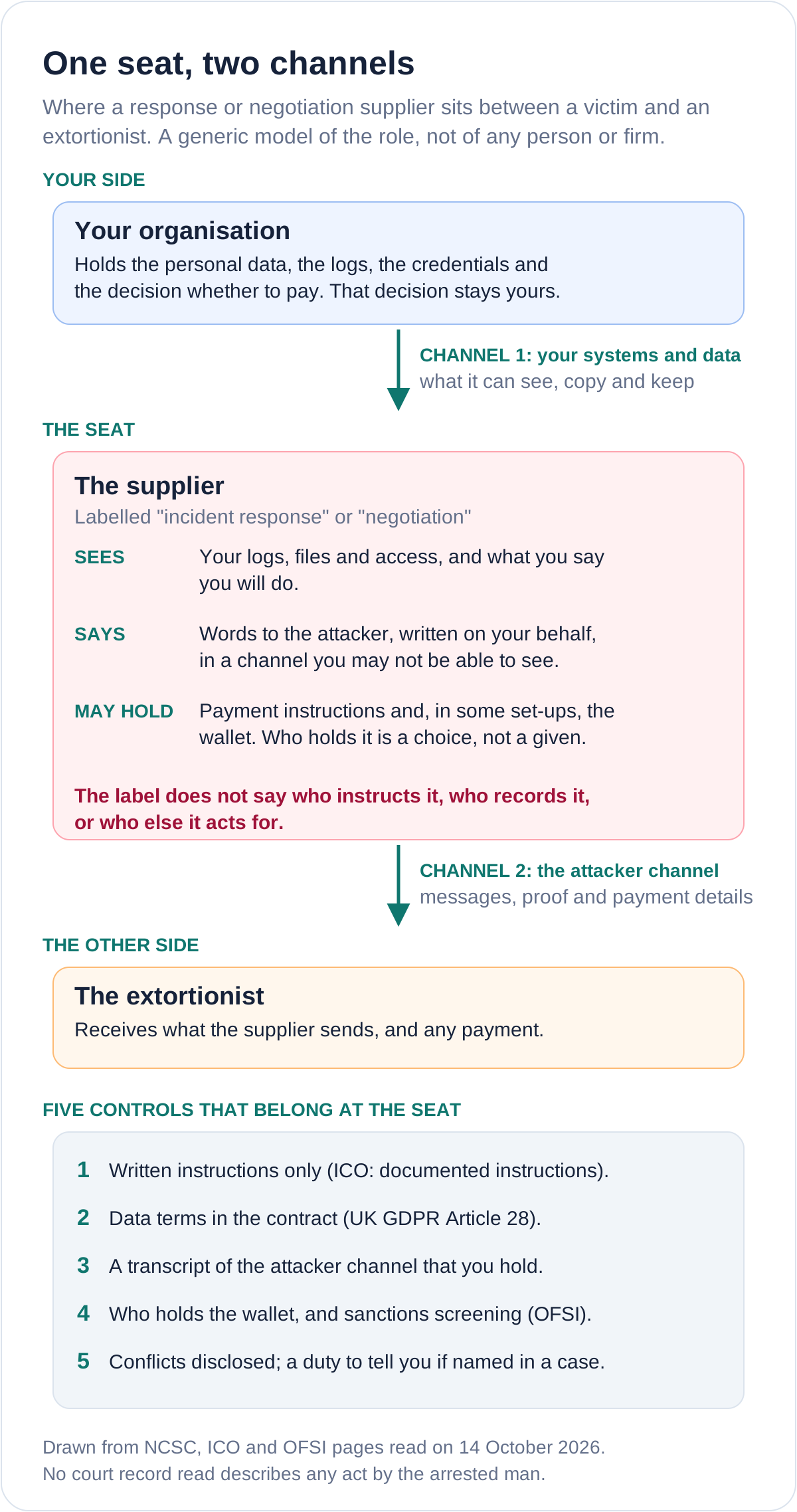
Two labels do most of the work in this story. "Incident response" and "negotiation" read like a neutral third party standing beside the victim. They are names for a seat in the room, and the seat has a particular shape. It touches the victim's side, with its data, logs, access and the decision whether to pay, and the attacker's side, with the channel, any proof of stolen data and any payment details, at the same time. The label says nothing about who instructs the person in that seat, who records what they do, who else they act for, or who holds the money. That is true of whoever sits there. It is not an allegation about the arrested man, whose work the record does not describe.
The UK pages I read use plain descriptions rather than the labels. The NCSC and insurance-industry guidance speaks of "partner organisations supporting" a victim. OFSI, the Treasury's sanctions office, speaks of "any person or entity that facilitates or processes ransomware payments". The Home Office response speaks of "any payment broker or facilitator". None of the three defines a negotiator, and none sets a standard for one.
A badge is a label too. The nearest UK thing to one is the NCSC's Cyber Incident Response scheme, and its own buyer's guide says not to treat membership as a guarantee. I searched the text of the seven scheme documents and pages I could read for the words "negotiat" and "payment". Neither appears in any of them (derived from a text search). That says what the scheme documents list as assessed. It does not say what any assured provider does or does not do.
UK: how a supplier is assured, listed and chosen
These pages were read between 06:20 and 06:45 BST on 14 October 2026. They are quoted for what they say. None was written about this case, and none mentions it.
Choosing and appointing a response supplier: what the NCSC pages say, and what they do not. Read 14 October 2026.
| Page | As read | Not stated |
|---|---|---|
| NCSC [Cyber Incident Response scheme](https://www.ncsc.gov.uk/schemes/cyber-incident-response/introduction) and [Buyer's Guide](https://www.ncsc.gov.uk/schemes/cyber-incident-response/information-for-buyers) (guide cover: v1.0, March 2025) | The NCSC recommends that all UK organisations use an NCSC-assured provider. There are two levels: Enhanced, assessed by an NCSC panel, and Standard, delivered for the NCSC by CREST and IASME. Companies are assessed on joining and reviewed at least every two years. The NCSC is not party to the contract and advises stipulating the scheme's terms and conditions. | Ransomware negotiation or payment handling as an assessed capability. The guide warns against relying on membership "as being a guarantee" that use of a provider "will be risk-free from a security perspective". |
| How listed providers are checked (the Buyer's Guide and the [service-provider page](https://www.ncsc.gov.uk/schemes/cyber-incident-response/information-for-service-providers)) | Standard Level: the delivery partners check there is no reputational risk to the NCSC and that the company is "a reputable Company of good standing", and it needs Cyber Essentials. Enhanced Level: checks on convictions of the company or its officers for offences that could bar it from government contracts, a Dun and Bradstreet risk indicator, a cleared senior team member, Cyber Essentials Plus, and a Head Consultant with a Chartered incident response title. | Any check of conflicts of interest, of who else the company acts for, or of how it handles a payment. The guide calls its financial check "only a basic creditworthiness check" and a "snapshot". Buyers "will need to do their own due diligence". |
| [NCSC and insurance bodies' guidance on ransom payments](https://www.ncsc.gov.uk/guidance/organisations-considering-payment-in-ransomware-incidents) (with ABI, BIBA and IUA; 14 May 2024) and the [NCSC cyber insurance guidance](https://www.ncsc.gov.uk/guidance/cyber-insurance-guidance) | Consult experts, including CIR companies. "Insurance providers will often provide recommended CIR companies." Some insurers "may put your organisation in touch with a Cyber Incident Response (CIR) organisation". Record decision-making "offline, or on systems that are not impacted by the incident". "The ultimate decision whether to pay the ransom is with the victim." | Who an insurer's recommended firms are, how they are chosen, who pays them, or what they may do on your behalf. These are the only insurer-panel statements I found in a primary source. |
| NCSC [supply chain security guidance](https://www.ncsc.gov.uk/collection/supply-chain-security) (reviewed 22 October 2025) | Twelve principles in four stages: understand the risks, establish control, check your arrangements, continuous improvement. | Anything specific to a response or negotiation supplier. The guidance says it was not written for high assurance national security requirements. |
The CIR Standard Level also says what a provider must do while it works. It must "always act in accordance with the instructions of the Target Organisation", and it must have "a repeatable methodology for capturing and recording every substantive step of the incident including actions, findings and recommendations". Those two lines are the scheme's nearest statement of two controls the diagram shows: written instructions, and a record. They are requirements on the provider. Whether you hold the record yourself is a separate choice, and the checklist makes it.
UK: what you owe, whoever does the work
Obligations that stay with the organisation: what the ICO, OFSI, Home Office and FCA pages say, and what they do not. Read 14 October 2026.
| Page | As read | Not stated |
|---|---|---|
| ICO, [ransomware and data protection compliance](https://ico.org.uk/for-organisations/uk-gdpr-guidance-and-resources/security/a-guide-to-data-security/ransomware-and-data-protection-compliance/) (marked as under review after the Data (Use and Access) Act) and the [breach guide](https://ico.org.uk/for-organisations/report-a-breach/personal-data-breach/personal-data-breaches-a-guide/) | A reportable breach goes to the ICO without undue delay and within 72 hours of becoming aware, and every breach must be recorded. The ICO does not treat paying a ransom as an "appropriate measure" to restore personal data, and says to presume stolen data is compromised even after paying. | Any rule specific to a negotiation supplier, or that a supplier's knowledge starts your clock. |
| ICO, [controllers using a processor](https://ico.org.uk/for-organisations/uk-gdpr-guidance-and-resources/accountability-and-governance/contracts-and-liabilities-between-controllers-and-processors-multi/responsibilities-and-liabilities-for-controllers-using-a-processor/) and the [contract terms](https://ico.org.uk/for-organisations/uk-gdpr-guidance-and-resources/accountability-and-governance/contracts-and-liabilities-between-controllers-and-processors-multi/what-needs-to-be-included-in-the-contract/) | Use a processor that gives "sufficient guarantees" and stay "primarily responsible" for it. The contract needs documented instructions, confidentiality, security, sub-processors only with your authorisation, help with breach notification, return or deletion at the end, and audits. A processor that decides the purposes or means of processing "will be considered to be a controller". A processor must tell you of a breach "without undue delay". | Whether a response or negotiation supplier is a processor in every engagement. That depends on the facts, and I found no ICO text on that point. |
| OFSI, [financial sanctions guidance for ransomware](https://www.gov.uk/government/publications/financial-sanctions-guidance-for-ransomware/financial-sanctions-guidance-for-ransomware) (updated 28 January 2026) | Paying a designated person risks civil and criminal penalties, and so does facilitating a payment. The due diligence duty applies to "any person or entity that facilitates or processes ransomware payments". "Ransomware payments are unlikely to be considered appropriate for an OFSI licence." Prompt reporting and disclosure count as mitigation. | Any required control: "OFSI does not mandate specific financial sanctions systems or controls". It names a financial institution and a cryptoasset business as examples of third parties, not a negotiator or an insurer. |
| Home Office, [response to the ransomware consultation](https://www.gov.uk/government/consultations/ransomware-proposals-to-increase-incident-reporting-and-reduce-payments-to-criminals) (published 22 July 2025; page last updated 2 September 2025) | Three proposals: a targeted payment ban for public sector bodies and regulated critical national infrastructure; a payment prevention regime in which victims report an intent to pay and the Government may block a payment; and mandatory reporting, an initial report within 72 hours and a fuller one within 28 days. For each, "The Government will continue to develop" it. Victims who comply would get "proof of engagement" to show "any payment broker or facilitator". | A bill, a date, the final scope or the penalties. I found no later gov.uk page putting any of it in law. Check before relying on it. |
| FCA, [reporting operational incidents](https://www.fca.org.uk/firms/operational-resilience/reporting-operational-incidents) | Firms under Principle 11 deal with the FCA openly, and SUP 15.3 sets when it expects notice. Dual-regulated firms also tell the PRA. For a cyber incident you may need to report to the NCSC, and to the ICO within 72 hours for a data breach. New incident reporting rules come into force on 18 March 2027. | Anything about incidents at a supplier under the current rules. I read the page and the policy statement's contents, not the new rules in full. |
Two points follow, both from the pages above. First, the decision and the duties stay with the organisation: the NCSC guidance says the decision whether to pay is the victim's, the ICO says the controller stays primarily responsible for its processor, and OFSI puts the due diligence on the organisation and on those who facilitate. Second, a supplier named in a legal case is a data custody event before it is anything else. Nothing in the ICO breach guide pauses your duties to record and to notify because a supplier is under investigation. The record I read does not say whether any client's data is involved in this case.
What to do: choosing and supervising a response or negotiation supplier
The checklist follows the order a UK organisation meets these choices: before an incident, in the contract, during the work, at the point of payment, at notification, and if the supplier is named in a case. Items that come from a page above say so. Items that are this briefing's recommendation say that too. It is general guidance, not legal advice.
Take this with you
In the order worth doing
- Due diligence, decide the shape: decide now whether response and negotiation are separate services, possibly from separate suppliers, and write it down. The NCSC scheme documents I read assess incident response and do not list negotiation.
- Due diligence, check the listing: check the NCSC Cyber Incident Response list for the level that fits you. The NCSC strongly recommends Enhanced Level for regulated sectors, multinational operations, likely nation state targets, critical national infrastructure and central government. Then do your own checks: the NCSC says client organisations need to do their own due diligence.
- Due diligence, ask who touches your data: ask for the names of everyone who would work your incident, any subcontractors, where your data would be held and who controls it. Ask whether the systems that hold your data are covered by Cyber Essentials or Cyber Essentials Plus, which the scheme requires of its members for those systems.
- Contract, instructions: require every instruction in writing, and say that nothing is sent to the attacker and no payment instruction is relayed without your written instruction. The ICO says a processor may act only on documented instructions. This briefing's recommendation is to extend that rule to the attacker channel.
- Contract, data terms: where the supplier handles personal data, include the UK GDPR Article 28 terms: confidentiality, security, sub-processors only with your written authorisation, help with breach notification, return or deletion at the end with written confirmation, and audit rights. State how long copies of your data may be kept.
- Contract, duty to tell you: require the supplier to tell you promptly if it or its officers become the subject of an investigation, a charge, a sanctions matter or a regulatory action, and say what happens to your engagement if it does. This is this briefing's recommendation, not a requirement from a page read.
- Conflicts, ask in writing: ask whether the supplier acts, or has acted, for anyone else in the same incident or against the same group; whether it receives any fee, commission or referral payment from an insurer, lawyer, payment provider or anyone else in connection with your incident; and whether it is on your insurer's recommended list and what that means for fees and instructions. Record the answers. This is this briefing's recommendation, prompted by the insurer statements above.
- Access: give the supplier the least access it needs, on accounts you can see and revoke, time limited. List what data is copied off your network for analysis, where it goes and who can reach it.
- Logging, what it sees and takes: keep your own record of every system and data set the supplier touched and every copy it took. This is this briefing's recommendation. Record your own decision-making offline or on systems the incident has not touched, as the NCSC advises.
- Logging, what it says to the attacker: hold a complete, timestamped transcript of the attacker channel yourself, not only the supplier's copy, and have someone on your side read it as it goes. The CIR Standard Level requires the provider to record every substantive step. A record you do not hold is a record you cannot check.
- Wallet: decide before any payment is discussed who holds the cryptocurrency wallet and the keys. Do not let a supplier hold your funds unless the contract, its regulatory status and your insurer's terms say so and you have read them. Keep the payment instruction and the proof of payment in your own record. This is this briefing's recommendation.
- Sanctions: before any payment is considered, have someone accountable screen the recipient against the UK sanctions list. OFSI puts the onus on the organisation and on those who facilitate payments, says payments are unlikely to be licensed, and treats prompt reporting as mitigation. Paying does not reduce your ICO exposure.
- Regulators, ICO: if personal data is affected, assess it and, unless the breach is unlikely to risk individuals, report to the ICO without undue delay and within 72 hours of becoming aware, recording the breach either way. Your clock runs from your awareness. A processor must tell you without undue delay.
- Regulators, NCSC, FCA and PRA: use the government's report-a-cyber-incident service to reach the NCSC and the right police route, and if you are FCA regulated tell the FCA under Principle 11 and SUP 15.3, and the PRA if you are dual regulated. New FCA rules apply from 18 March 2027. Tell your insurer, and report a suspected payment to a designated person to OFSI.
- If the supplier is named in a case, step one: separate three questions. What the court record says, which you read yourself and not from headlines. What the supplier holds of yours. Whether your organisation or data is mentioned in the matter. Conclude nothing about guilt. The defendant is presumed innocent.
- If the supplier is named in a case, step two: ask the supplier in writing what it holds of yours, where, and who can reach it, and whether your engagement or data is mentioned in any matter. Suspend its access, rotate every credential it used, and take back copies of your data. Keep the incident record. Ask your lawyers whether to tell your insurer, the ICO or your regulators.
The question this leaves
If the supplier in your incident room were named in a federal complaint tomorrow, could you list, from records you hold yourself, every file it copied, every message it sent to the attacker for you, and who held the wallet?
The man in this case is presumed innocent, and the record does not say what he is alleged to have done. That is the point. The question has to be answerable before anyone is charged, because by the time a name appears in a docket the only records worth having are the ones you kept. This briefing is time-stamped: the docket and the press were read between 06:20 and 06:45 BST on 14 October 2026. A complaint unsealed, an indictment, a statement from the FBI or a new entry in the Pennsylvania or Texas docket would supersede the record described here.
Key facts
Sources
- PrimaryThe public docket for the arrest, case 2:26-mj-01973 in the Eastern District of Pennsylvania, last updated 13 October 2026. Its docket entries tab (five lines, 8 and 9 October) and this parties tab (the charge titles under Complaint, the Federal Defender) were read in full. CourtListener says items may not be up to date. The live address continues with a slug that is the court's spelling of a surname, which is not repeated hereCourtListener (Free Law Project), from PACER and RECAPaccessed 2026-10-14
- PrimaryDocument 3, the bail status order of 8 October 2026, three pages, read in full: counsel appointed, detention pending a hearing in the charging district, stipulation to identity and probable cause, and no plea tickedUS District Court, Eastern District of Pennsylvaniaaccessed 2026-10-14
- PrimaryDocument 4, the commitment to another district of 9 October 2026, one page, read in full: the Eastern District of Texas, charging district case number 26mj168, and the defendant remains in custodyUS District Court, Eastern District of Pennsylvaniaaccessed 2026-10-14
- PrimaryThe FBI Director's post of 9 October 2026 announcing the arrest of another suspected co-conspirator of ShinyHunters, read in a browser in full. It names no oneFBI Director (X)accessed 2026-10-14
- PrimaryThe FBI public service announcement of 15 May 2026 on ShinyHunters, read in full: the only description of the group relied on in this briefing, and the date for the 129 day countFBI Internet Crime Complaint Centeraccessed 2026-10-14
- PrimaryText of 18 U.S.C. 1030, read for subsection (a)(7)(B): a communication containing a threat made with intent to extort. The statute as published, not a reading of the caseLegal Information Institute, Cornell Law Schoolaccessed 2026-10-14
- PrimaryText of 18 U.S.C. 1951, the Hobbs Act: interference with commerce by robbery or extortion, and the definition of extortion in subsection (b)(2)Legal Information Institute, Cornell Law Schoolaccessed 2026-10-14
- PrimaryText of 18 U.S.C. 371, conspiracy to commit an offence against the United States, including the requirement of an act to effect its objectLegal Information Institute, Cornell Law Schoolaccessed 2026-10-14
- PrimaryFederal Rule of Criminal Procedure 5, initial appearance and transfer to another district, read for the transfer step the bail order's wording followsLegal Information Institute, Cornell Law Schoolaccessed 2026-10-14
- PrimaryThe Cyber Incident Response assurance scheme introduction: the NCSC recommends all UK organisations use an NCSC-assured provider, and the two levelsNational Cyber Security Centreaccessed 2026-10-14
- PrimaryInformation for CIR buyers: what to expect from a provider, how to select one, the NCSC is not party to contracts, and the advice to stipulate the scheme terms and conditionsNational Cyber Security Centreaccessed 2026-10-14
- PrimaryInformation for CIR service providers: what is expected of each level, the application stages, the Cyber Essentials requirements and that client organisations do their own due diligenceNational Cyber Security Centreaccessed 2026-10-14
- PrimaryThe Assured CIR Scheme Buyer's Guide, eight pages, cover v1.0 March 2025, read in full: delivery partners CREST and IASME, the checks made, the two year review, and that membership is not a guaranteeNational Cyber Security Centreaccessed 2026-10-14
- PrimaryCIR Technical Standard (Standard Level), cover v1.5.1 April 2023 although the page calls it a December 2024 update: act on the target organisation's instructions and record every substantive step. No mention of negotiation or paymentNational Cyber Security Centreaccessed 2026-10-14
- PrimaryCIR Enhanced Level Scheme Standard v1.0, December 2024: no mention of negotiation or payment; ransomware appears once as an example of a major disruptive incidentNational Cyber Security Centreaccessed 2026-10-14
- PrimaryCIR Enhanced Level Working Practices v1.1, January 2025: subcontractor requirements. No mention of negotiation or paymentNational Cyber Security Centreaccessed 2026-10-14
- PrimaryGuidance for organisations considering payment in ransomware incidents, 14 May 2024, read in full: consult experts, insurers often recommend CIR companies, record decisions offline, the decision is the victim's, and the ICO position on paymentNational Cyber Security Centre, with ABI, BIBA and IUAaccessed 2026-10-14
- PrimaryCyber insurance guidance: an insurer may put an organisation in touch with a CIR organisation or an in-house response teamNational Cyber Security Centreaccessed 2026-10-14
- PrimarySupply chain security guidance, reviewed 22 October 2025, with its twelve principles in four stages (the principles page was read for the stage names)National Cyber Security Centreaccessed 2026-10-14
- PrimaryRansomware and data protection compliance, marked as under review after the Data (Use and Access) Act: breach as loss of access, 72 hours, scenario 7 on payment not being an appropriate measureInformation Commissioner's Officeaccessed 2026-10-14
- PrimaryPersonal data breaches: a guide: the 72 hour duty, phased reporting, and a processor's duty to inform the controller without undue delayInformation Commissioner's Officeaccessed 2026-10-14
- PrimaryWhat needs to be included in the contract: the Article 28(3) terms, including documented instructions, sub-processors, assistance with breaches, deletion or return and auditsInformation Commissioner's Officeaccessed 2026-10-14
- PrimaryResponsibilities and liabilities for controllers using a processor: sufficient guarantees, ongoing assurance, and that the controller stays primarily responsibleInformation Commissioner's Officeaccessed 2026-10-14
- PrimaryFinancial sanctions guidance for ransomware, updated 28 January 2026, read in full: designated persons, facilitators, due diligence, mitigation and licensingOffice of Financial Sanctions Implementation (HM Treasury)accessed 2026-10-14
- PrimaryThe consultation outcome page, published 14 January 2025 and last updated 2 September 2025, with the government response of 22 July 2025 read in its accessible HTML version: the three proposals and that each is still to be developedHome Officeaccessed 2026-10-14
- PrimaryReporting operational incidents: Principle 11, SUP 15.3, notifying the PRA if dual regulated, and the new rules in force from 18 March 2027Financial Conduct Authorityaccessed 2026-10-14
- Reported byStory of 9 October with a 10 October update: the arrest, the docket, the charge titles, the anonymous sources and the claim about other firms. Read in full; its naming of a man and firms is not repeated hereKrebsOnSecurityaccessed 2026-10-14
- Reported byStory of 12 October, read in full: the third arrest in recent weeks, the dates of 15 and 28 September, the RCMP statement, the charges and its own inference that he appears to be affiliated with a firmSecurityWeekaccessed 2026-10-14
- Reported byStory of 3 October on the reported Jordan detention and cooperation with the FBISecurityWeekaccessed 2026-10-14
- Reported byStory of 9 October: the Director's statement, the anonymous sources on Pennsylvania and nationality and on direct involvement, the FBI spokesperson's refusal to comment, and the RCMP statementCBS Newsaccessed 2026-10-14
- Reported byStory on the Jordan detention (this week, per US officials), the FBI's statement declining to comment and the 15 September date of the Dutch arrestCBS Newsaccessed 2026-10-14
- Reported byThe Canadian Press wire of 9 October as carried by CFJC, and read in full in a browser on Castanet Kamloops, which refuses plain requests: the RCMP statement, the Director's quoted words, and its line that the Director said the arrest was earlier this weekThe Canadian Press (via CFJC)accessed 2026-10-14
- Reported byStory of 10 October: the Times claim of a primary co-conspirator, the docket, that the FBI has not publicly confirmed the link, and that it is unclear what he is accused ofBleepingComputeraccessed 2026-10-14
- Reported byStory of 3 October relaying Reuters's sources that the Jordan detention was on the Tuesday of that weekBleepingComputeraccessed 2026-10-14
- Reported byStory of 22 September: the group's claim to have used a flaw on FBI systems on Monday night and that the claim is unverifiedBleepingComputeraccessed 2026-10-14
- Reported byStory of 10 October: that his specific alleged conduct has not been publicly established and the appearance in PhiladelphiaNextgov/FCWaccessed 2026-10-14
- Reported byStory of 6 October quoting the FBI cyber chief's statement that a contractor failed to implement a security patch. The contractor is named by Reuters's sources, not by the FBI, and is not named hereSecurityWeekaccessed 2026-10-14