Housing Ombudsman case-system incident: 8,783 determinations in 2025-26, and no count, supplier or date stated
The Housing Ombudsman says it is investigating whether personal information was affected by a third-party incident in its case management system, while an email quoted by Inside Housing says contact details may have been copied. Neither names the supplier, a count or an incident date.
By Parminder Kumar Sharma · · 27 min read
The scale is published; the incident's scale is not
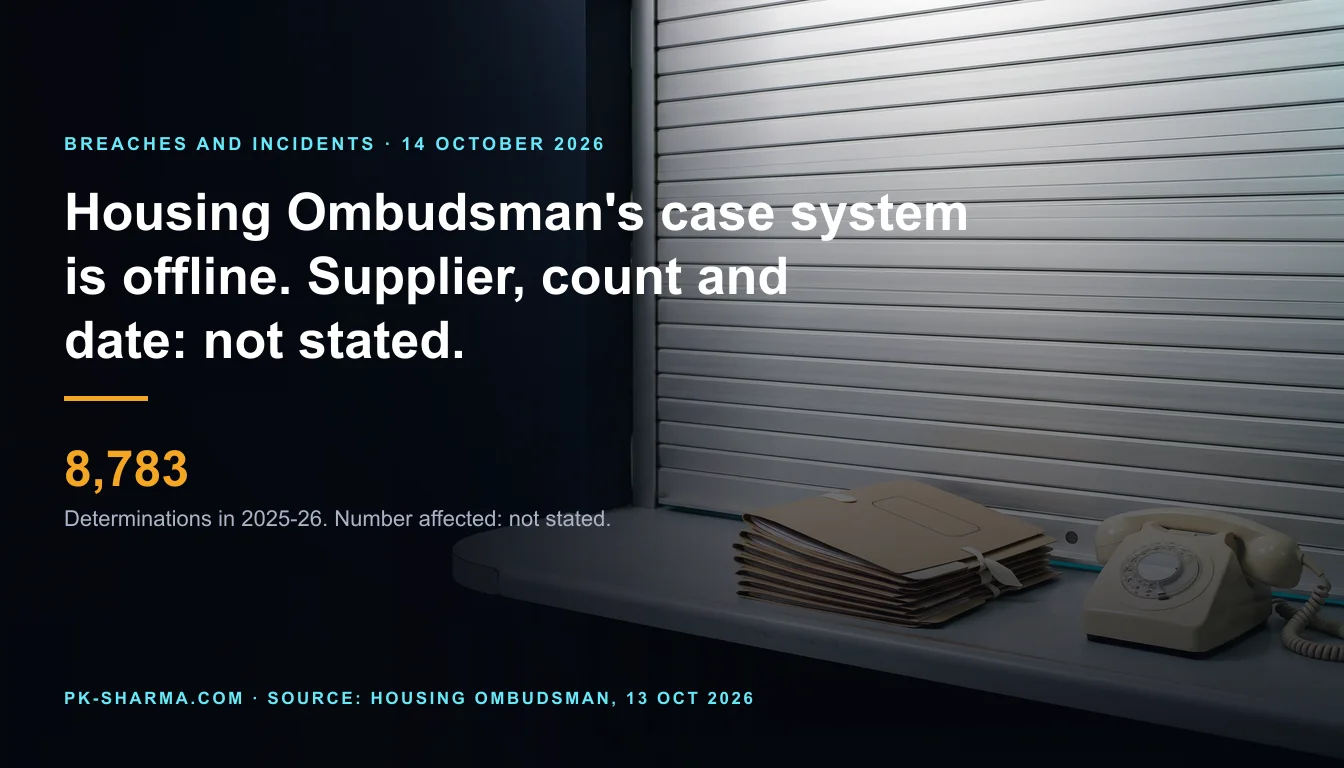
The Housing Ombudsman Service says it made 8,783 determinations in 2025-26, and its Annual Complaints Review says 1,670 member landlords represent "just over 5 million households" who can come to it. On 13 October 2026 it published a statement that "a third-party IT security incident" has "impacted our case management system". The first figures are the Ombudsman's own. The statement says nothing about how many of those cases, people or households sit in the affected system: it gives no count, no data categories, no supplier and no incident date.
The statement's page data gives its first publication as 10:16:11 UTC, which is 11:16 BST on Tuesday 13 October. At 06:43 BST on Wednesday 14 October the homepage banner still said residents would be "unable to submit a new complaint, view an existing complaint, or use our web chat or webform". That is at least 19 hours 26 minutes with the online route closed (derived: 11:16:11 to 06:43 BST), and the figure only grows. It is a floor, because the statement does not say when the outage began, or when the route will return. The gap between the incident and the alert cannot be computed at all: the page states neither an incident date nor the time the Ombudsman became aware. BleepingComputer says the incident affected the system "on Tuesday", the same day the statement appeared.
There are two accounts of this incident from the Ombudsman, at two levels of certainty. The public statement says the Ombudsman is "continuing to investigate whether any personal information has been affected". Inside Housing, a sector paper, reports that emails "seen by Inside Housing" went to those affected earlier on 13 October, and quotes them as saying that "some contact details such as name, address, telephone number and postal addresses may have been copied from our system". This briefing did not see that email, and the Ombudsman's website does not mention it. The public statement, unchanged when it was re-read at 06:43 BST on 14 October, still asks only whether any personal information has been affected.
This briefing reads the Ombudsman's own pages first: the statement, the homepage banner, its Annual Complaints Review, its annual report and accounts, its privacy notice and its data protection report. BleepingComputer, Housing Today and Inside Housing are secondary, used for what they report and not as proof. Everything was read between 06:19 and 06:43 BST on Wednesday 14 October 2026. BleepingComputer's page data gives 14:19:44 at a UTC offset of minus four hours, which is 19:19 BST; its time is US Eastern. No form was filled in or submitted. In a limited search, no supplier statement and no statement about this incident from the regulator, the NCSC or the sponsoring ministry was found.
How large the case load is, from the Ombudsman's own figures
The Ombudsman publishes enough to size what it handles, though not what an incident touched. Every figure below is stated by the Ombudsman unless it is marked derived, which means this briefing did the arithmetic.
Scale figures from the Ombudsman's Annual Complaints Review 2025-26, its news item of 15 September 2026, its Annual Report and Accounts 2024-25 and its dispute resolution privacy notice. Derived figures are labelled.
| Figure | What the Ombudsman published | What it can and cannot say here |
|---|---|---|
| Member landlords | 1,670 at the end of 2025-26, together representing "just over 5 million households". | The reach of the scheme. Households, not people, and not a count of who is in the affected system. |
| Determinations | 8,783 in 2025-26. 7,008 in 2024-25. Difference 1,775 (derived), which fits the review's "almost 2,000 more cases". | Cases decided in a year. About 24 a day (derived: 8,783 divided by 365). One resident can have more than one case. |
| Findings | 20,016 category findings in 2025-26. About 2.3 findings per determination (derived). | Inside Housing wrote "more than 20,000 cases". The review's 20,016 counts findings. The case count is the smaller 8,783. |
| Complaints and enquiries received | 44,508 in 2024-25, 40,945, 32,126, 26,259 and 15,914 in the four years before it. Five-year sum 159,752 (derived). | Contacts, not people. Whether the case management system holds enquiries as well as cases is not stated. |
| Cases entering formal remit | 11,349 in 2024-25, then 8,176, 5,109, 4,001 and 2,253. Five-year sum 30,888 (derived). | Formal cases over five years. The statement does not say which years the system holds. |
| Retention | Electronic documents "generally deleted three years from the date of closure of a case". Case management workflow parties' details anonymised "after seven years". Telephone recordings deleted after 6 months. | Sets how far back records could reach, up to seven years for party details (inference). What the affected system holds is not stated. |
| Disability reported | 33% of residents whose case was determined in 2025-26 said they have a disability; 38% did not respond. About 2,900 of 8,783 (derived). | Shows how often case files can carry health information. The product treats determinations as residents, so it is approximate. |
None of these is a count of people in the incident. They set the neighbourhood: the Ombudsman's own tables sum to 30,888 formal cases and 159,752 complaints and enquiries over the five years to 2024-25 (derived). Separately, the Ombudsman determined 8,783 cases in 2025-26. Whether the affected system holds any of that, all of it or only an administrative subset is what the statement leaves open.
What kind of data the Ombudsman handles is also published. Its dispute resolution privacy notice lists "name and address", "family details", "details of your complaint", "photographs/videos", "sound recordings" and "details of personal behaviour". It lists special categories including "health or medical information as relevant to our consideration or investigation" and equality data on ethnic origin, disability, religion, sexual orientation and more. It also says it holds "health and vulnerability data for the management of any requested reasonable adjustments", and keeps details of people it considers present unacceptable behaviour. Which of those sit in the affected system is not stated. The only categories named anywhere are the ones in the email Inside Housing quotes: contact details.
Stated and not stated: the record, line by line
The table sets what the Ombudsman has stated against what it has not. "Not stated" means not found in the Ombudsman's statement, banner, annual report, privacy notice or data protection report, all read in full. It does not mean the information does not exist. Items that rest on Inside Housing's report of an email are marked as such.
What the Housing Ombudsman Service has published about the incident (statement of 13 October 2026, homepage banner) and what it has not. Inside Housing is named where it is the only source.
| The question | Stated | Not stated |
|---|---|---|
| What happened? | "We are aware of a third-party IT security incident that has impacted our case management system." | Whether it was an attack, an error or a supplier breach. The word cyberattack is Inside Housing's and Housing Today's, not the Ombudsman's. How it began. Ransomware or any other kind. |
| When? | Statement first published 11:16 BST on Tuesday 13 October (page data). The page says "Last updated: 13 October 2026 11:00", with no time zone. | When the incident began, when it was detected, when the supplier told the Ombudsman, when the regulator was told. The visible 11:00 is earlier than the page data if read as BST, so the clock here uses the page data. |
| How many people? | The Ombudsman is working to establish "the extent of the data involved". Inside Housing says it "is unable to confirm how many people have been affected at this stage". | Any number of people, cases, households or records. How many emails were sent. |
| What data? | On the website: "whether any personal information has been affected". Per Inside Housing's quotation of the email: contact details "may have been copied". | On the website, any category. Whether case content, health or vulnerability notes, photographs, recordings or landlord staff details were in the system. |
| Which systems? | The case management system. Per the email as quoted: the online form, landlord portal and web chat are offline because the Ombudsman is "unable to currently access" the system. | Whether anything outside that system was touched, and whether the email, telephone or document systems are separate. |
| Who is the supplier? | "Our external supplier." The 2024-25 annual report refers to an "IT supplier" for the case management system. | A name, in the statement, the banner, the annual report or the data protection report. No supplier statement was found. |
| Who is the controller? | The April 2025 data protection report says the Ombudsman is "registered as a data controller". | The supplier's role (processor or other), the contract, who told whom and when. |
| What was contained? | "The incident has been contained." Per the email as quoted, "proactive, precautionary steps to prevent further unauthorised activity" were taken. | What contained means, who did it, and what forensic work has begun or finished. |
| The regulator? | "We have reported the incident to the Information Commission." Per Inside Housing, the Ombudsman "has spoken to the ICO". | When. Whether it was a notification under Article 33. What it said. |
| What can residents do? | No new complaint, no viewing an existing one, no web chat or webform. Email or phone for a new complaint. | A restoration time. How existing deadlines are treated. Which instruction applies: the contact page still says "We do not accept new case enquiries sent to us via email", and the banner asks people to email. That page also says new enquiries were already taking up to 20 working days. |
| When is the next update? | "Will provide further updates as soon as we are able." | Any time or interval. |
| Who is safe? | "Usual caution" with unexpected communications. | Whether a person who received no email can treat themselves as unaffected. L&Q's website, as Inside Housing quoted it on 28 September, said so; the Ombudsman's page does not. |
The gap that matters most is not any single blank. It is the difference between two channels. The public page asks whether any personal information has been affected. The email, as quoted, tells recipients contact details "may have been copied". A resident who reads only the website, where the banner and the statement sit, sees the more tentative account. A resident who got the email sees the more specific one. Neither says how many people, and neither says which people. L&Q, a landlord, gave a count and a rule in its September notice, as Inside Housing reported it: "approximately" 12,000 residents, and that a resident who had not received a message "will not have been affected by this issue". The Ombudsman's page offers neither a count nor a rule.
Who has to tell whom, and what is on the record
UK GDPR sets a chain of notices after a personal data breach. A processor tells the controller. The controller tells the regulator, within 72 hours where feasible, and tells people directly when the risk to them is likely to be high. The diagram puts each link beside what the Ombudsman's record shows for it. Three of the four links have a blank where a time or a number would be.
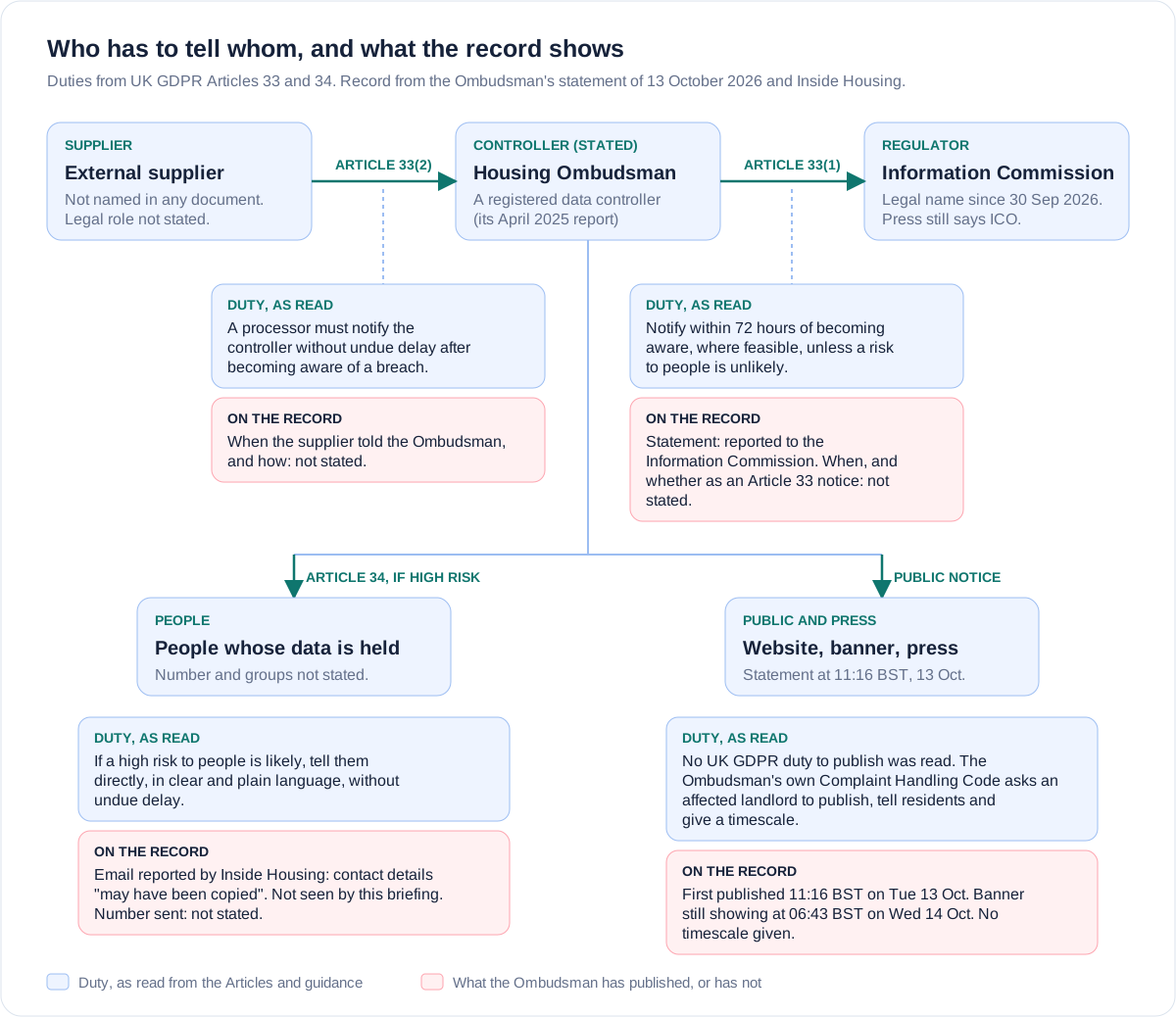
The 72 hours need a start time, and the record gives none. Take the outer bound: the Ombudsman became aware no later than the moment it published its statement. Then its window to notify the regulator closed no later than 11:16 BST on Friday 16 October (derived: 11:16:11 BST on 13 October plus 72 hours). The statement says the incident has been reported, so that window may already have been met. It does not say the report was a notification under Article 33, and the content that Article 33(3) requires, including "the categories and approximate number of data subjects concerned", is not public. Article 33(4) allows the information to be given in phases, so a report with no number is not by itself a failure. The deadline people quote runs to the regulator, not to the public, as this site set out in an earlier briefing on a police force incident.
Seven labels, and what each tells a complainant
A comforting label is not a control, and an alarming one is not a finding. Seven labels appear in this story, in the Ombudsman's words, in its earlier reports and in the press.
Labels in the record, where each appears and what the record shows.
| The label | Where it appears | What the record shows |
|---|---|---|
| "Third-party IT security incident" | Ombudsman statement and banner. | A category, not a cause. Housing Today and Inside Housing write "cyber attack" and "cyberattack". The Ombudsman's statement does not use either word. The email as quoted refers to "unauthorised activity", which suggests someone acted without authority (inference). |
| "Has been contained" | Statement. The email as quoted: "We have contained the incident." | Contained is not resolved. The email also says the Ombudsman is "unable to currently access" the system, so containment looks like a shutdown (inference). What was contained, by whom and how: not stated. |
| "As a precaution ... usual caution" | Statement. | The advice is to keep doing what a resident would do anyway. It does not say which messages to expect, which numbers or addresses to distrust, or what a genuine message from the Ombudsman about this will look like. |
| "Reported the incident to the Information Commission" | Statement. | A report is not a finding. The regulator's legal name changed on 30 September 2026: the ICO's own page says the legal entity is the Information Commission, and legislation.gov.uk shows Article 33 amended that day. BleepingComputer, Housing Today and Inside Housing still wrote "Information Commissioner's Office". The Ombudsman's wording is the current one. |
| "External supplier" | Statement. The annual report 2024-25 says "IT supplier". | A relationship with no name. Neither document names the company, its role or its contract. |
| "Cyber Essentials and Cyber Essentials Plus: accreditations in place" | Annual report 2024-25, strategic risk table. | A certificate covers the scope the organisation declares and five technical controls. Version 3.3 says cloud services holding your data must be in scope and the applicant is "always responsible for ensuring all controls are implemented". Whether the case management system was in scope is not stated, and no certificate says a supplier-side incident cannot happen. |
| "Will provide further updates as soon as we are able" | Statement. The banner: "share updates when we can". | No time is given. The Ombudsman's Complaint Handling Code, section 8.5, tells a landlord that cannot comply "due to exceptional circumstances, such as a cyber incident" to inform the Ombudsman, give information to residents who may be affected, publish it and "provide a timescale". That binds landlords, not the Ombudsman. It does show what the Ombudsman expects an affected organisation to say. |
Method is separate from accusation. On the record the Ombudsman has published a statement on 13 October, put a notice on its site, named a Data Protection Officer contact, told the regulator, offered phone and email routes, and, as Inside Housing reports, written to people it believes affected. Two sector papers moved the label from "incident" to "cyberattack" within hours of the statement: Housing Today at 12:15 BST and Inside Housing at 14:15 BST (page data). The gap is in what the public record says, not in whether the Ombudsman acted.
A supplier with no name, and what was published before
The Ombudsman's own data protection report says it is a registered data controller, and the NCSC's position is that accountability does not move with the data. What a reader can check is what the Ombudsman published about its systems and suppliers before 13 October. None of it describes this incident.
What the Housing Ombudsman Service published before the incident about its case management system, supplier assurance and recovery planning.
| Published | Source and date | What it does not say |
|---|---|---|
| A strategic risk, "Resilience of key business systems": "Ongoing work with IT supplier: to assess risk, resilience and performance of case management system (CMS), including recently completed system review", and a "CMS development group". | Annual Report and Accounts 2024-25, signed 10 December 2025. | The supplier's name, the contract, the review's findings, or whether the review covered security. |
| Supplier assurance: the work "is currently done but will benefit from standardisation", and "Due to resourcing shortages this work has had to be deferred until 2025-26". | Data Protection Annual Report 2024-25, April 2025. | Whether the standard process was delivered in 2025-26, or whether it covered this supplier. |
| Recovery: "quarterly test exercises" with "a suite of disaster recovery responses covering common cyber security issues", and an internal audit of "Cyber-attack restoration and recovery preparations (substantial opinion)". | Annual Report and Accounts 2024-25. | Whether either covered a supplier-side incident or the case management system, or what recovery time was tested. |
| Sponsor oversight: "We held 2 deep dives in-year exploring our cyber security preparedness" with the sponsoring ministry. | Annual Report and Accounts 2024-25. | What the deep dives found. |
| A 2026-27 activity: "work with a digital design and delivery partner to support our technology ambitions focusing on key business systems replacement". | Business Plan 2026-27, April 2026. | Whether the affected system is one of those to be replaced. |
This shows a case management system, an IT supplier for it and a recorded risk about its resilience. It does not show a failing, and 18 months separate the data protection report from the incident. A missing supplier name is not unusual. This site has covered another organisation that cited third-party platforms without naming one. The cost to a complainant is concrete, though. A person cannot ask a supplier about their data without knowing who holds it, and so depends on the Ombudsman's Data Protection Officer to answer for the supplier.
The UK rules as read: data protection, the regulator and public-sector guidance
Two sets of documents bear on this incident: data protection law and its regulator's guidance, and public-sector cyber and supply chain guidance. Quotations are short and exact, read on legislation.gov.uk, ico.org.uk, ncsc.gov.uk and gov.uk on 14 October 2026.
UK GDPR and ICO guidance as read on 14 October 2026, with what each leaves open about this incident.
| Instrument | What it says | What it does not settle here |
|---|---|---|
| UK GDPR Article 33 | The controller notifies "without undue delay and, where feasible, not later than 72 hours after having become aware", unless a risk to people is "unlikely". A late notice needs reasons. "The processor shall notify the controller without undue delay after becoming aware". A notice describes the breach, "categories and approximate number of data subjects", a contact, likely consequences and measures, and may come in phases. | When the Ombudsman became aware, whether it judged a risk likely, and what its notice said. |
| UK GDPR Article 34 | When a breach "is likely to result in a high risk", the controller communicates it to the person "without undue delay", in "clear and plain language", with the contact, likely consequences and measures. Exceptions include encryption and "disproportionate effort", in which case a public communication is required instead. | Whether the Ombudsman judged the risk high, whether the email is an Article 34 communication, and how many people got it. |
| UK GDPR Article 28 | A controller uses only processors giving "sufficient guarantees". The contract sets out the categories of data and people, and the processor "assists the controller" on Articles 32 to 36 and allows audits. A processor that decides the purposes and means "shall be considered to be a controller" for that processing. | The contract, the supplier's role and its terms. None is published. |
| ICO guide to personal data breaches | Report "within 72 hours of becoming aware" and provide what you have, adding later. A processor that suffers a breach "must inform you without undue delay", and breach-reporting terms "should be detailed in the contract". The page notes the guidance is under review after the Data (Use and Access) Act. | Anything about this incident. No statement from the regulator was found. |
| ICO advice for people, page dated 2 October 2026 | An organisation "has 30 days to acknowledge your complaint" and should be able to "confirm if your information was involved". People can complain to the ICO afterwards. Advice covers watching for scam calls, emails and texts, bank and credit checks, Cifas protective registration (fee), and contacting the police if safety is a concern. | The 30 days is for acknowledging a complaint. It is not a deadline for telling people whether they were affected. |
| The regulator's name | The ICO's page of 30 September 2026 says the legal entity is now the Information Commission, "referred to as the Information Commission's Office, or ICO". Article 33 on legislation.gov.uk shows the substitution on 30.9.2026. | Nothing about the incident. It explains why the Ombudsman's wording differs from the press. |
Public-sector, supply chain and certification guidance as read on 14 October 2026, with where each stops.
| Instrument | What it says | Where it stops |
|---|---|---|
| NCSC supply chain security guidance (reviewed 22 October 2025) | With cloud suppliers, "it is not possible to transfer complete responsibility or accountability for protecting information to the provider of that service". Contracts should cover security "including termination and the transfer of services", and a "right to audit", which "might not always be possible or desirable" for cloud. | Guidance for large organisations and the public sector. Does not set a notice period or mention this incident. |
| NCSC incident management (version 1.0, 2019) | Exercise the response and "review your capabilities (including those of any 3rd party service providers)". Document what "constitutes a reportable incident", including "any data held by suppliers", and keep communications plans for when normal channels fail. | An older page with no timescales. |
| NCSC Cyber Assessment Framework 4.0, A4 supply chain | An organisation relying on third parties "remains accountable". "You do not know what data belonging to you is held by suppliers, or how it is managed" is Not achieved. Achieved includes responsibilities "defined in contracts" and supplier incident processes that provide "mutual support". | Written for essential functions. Not stated whether it applies to the Ombudsman. |
| Government Cyber Action Plan (DSIT, 6 January 2026) | Arm's-length bodies are "accountable for their own cyber security and resilience" to their sponsor, and organisations "are responsible for managing the cyber risk posed by suppliers they use". A case study praises the Irish health service for "radical transparency" and "regular, public updates". | A programme with milestones to 2027 and 2029. Names no notice period for public updates. Its definition of arm's-length bodies includes non-departmental bodies, which GOV.UK says the Ombudsman is (executive, sponsored by the housing ministry), but it does not name the Ombudsman. |
| Cyber Essentials requirements v3.3 (April 2026) | Cloud services holding your data "cannot be excluded from scope", and the applicant "is always responsible for ensuring all controls are implemented", whichever party implements them. | Five technical controls on the declared scope. Not an assurance about detection or a supplier's own incident. |
| Cyber Security and Resilience Bill | The stages page lists Lords report stage for 26 October 2026, marked provisional, read at about 06:27 BST on 14 October. Not law. | Its text was not read for this briefing, so no view is offered on whether it would reach a case management supplier. |
The documents agree on one point and leave one open. They agree that using a supplier does not move accountability: the NCSC, the Cyber Essentials requirements and the Government Cyber Action Plan all say so in their own terms. They leave open what a person affected is told, and when. The 72 hours runs to the regulator. The Article 34 duty applies only to a high risk. Between the two, what reaches a complainant is the controller's judgement.
What to do, in the order worth doing, for three audiences
Each list is ordered by what to do first. None is legal advice, and none assumes more than the record establishes. Where a step relies on the Ombudsman's own pages, those pages carry the phone number and addresses, which this briefing does not reproduce: use the Ombudsman's own website, not a number or link in anything sent to you.
Take this with you
A resident with an open or planned case
- Treat any call, text or email that mentions your complaint, your landlord, your repairs or the Ombudsman as unverified until you check it. The Ombudsman's statement says not to disclose personal information unless you are confident who is asking.
- Look up the Ombudsman's number on its own website, or use one from a letter you already hold. Do not use a number, link or address from a message you were sent.
- If you need to start a new complaint now, use the phone or email route on the homepage notice, and keep a dated note of what you sent and when. The Ombudsman's pages give 12 months from your landlord's final response to refer a complaint and do not say whether the outage changes that, so keep the evidence of when you tried.
- If you have an open case, expect the online account, web chat and webform to be unavailable until the Ombudsman says otherwise. Ask by phone how to reach your caseworker, quoting the case reference from a letter you hold.
- If an email from the Ombudsman about this incident reaches you, keep it and check it against the website. If in doubt, phone the number on the website and ask whether it was sent.
- If something unexpected arrives, do not open links or attachments, and call back on a number you looked up yourself. Forward suspicious emails to the NCSC at report@phishing.gov.uk and texts to 7726. If you have given out information or lost money, tell your bank and report it to Report Fraud, or to Police Scotland if you live in Scotland.
- Ask the Ombudsman's Data Protection Officer in writing which of your information was involved. The ICO says an organisation has 30 days to acknowledge a complaint. Keep a record of who you spoke to and when.
- Protect yourself in proportion. Check bank statements and your credit report for anything unrecognised. Cifas protective registration is available for a fee. If your safety could be put at risk by someone obtaining your address or contact details, tell your caseworker and contact the police.
- If you stay unhappy with the Ombudsman's answer, you can complain to the Information Commission. The ICO says it can handle a complaint more quickly if the organisation has had a chance to respond first.
Take this with you
A member landlord that sends case documents to the Ombudsman
- List the cases and documents you have sent through the portal, the webform or email, and mark those that contain health, disability, safeguarding or vulnerability information, witness details in antisocial behaviour cases, or photographs.
- Ask the Ombudsman in writing which of your cases and residents' details were in the affected system, whether the data involved is more than contact details, and when you will next be told. Ask whether response and compliance deadlines are paused.
- Hold non-urgent uploads. Agree a secure channel with the Ombudsman before sending sensitive documents by any other route, and keep your own proof of what was sent and when.
- Have your Data Protection Officer record whether you regard this as a personal data breach affecting your own processing, with the reasons, even if the answer is no. The ICO guide expects the reasoning to be documented either way.
- Prepare a holding line for residents who ask. Say what the Ombudsman has published and that more is not known, point them to the Ombudsman's Data Protection Officer and the NCSC reporting routes, and do not speculate about data.
- Warn complaints, legal and records staff about look-alike requests: an email or call that claims to be the Ombudsman and asks for case papers, logins or payments during the outage. Verify through a contact you already hold.
- Check your own complaint timelines. If you use the portal's date stamps as evidence of when you responded, keep an independent record while it is offline.
- Add the question to your own supplier reviews: which of your suppliers hold resident data, and what the contract says about when they must tell you. The Code's section 8.5 shows the standard the Ombudsman applies to you: tell residents, publish, give a timescale.
Take this with you
A small public body that relies on a supplier-hosted case system
- List what the system holds: categories of data, number of people, and how long each is kept. The NCSC framework treats not knowing what data of yours a supplier holds as Not achieved. Shorter retention shrinks the answer to how many.
- Write down the roles: controller, processor and any sub-processors, and who tells the regulator, who tells people and who speaks to the public. Check the Article 28 contract has the audit, assistance and sub-processor terms.
- Put the clock in the contract in hours rather than "promptly". The law says without undue delay for the supplier, and your own 72 hours starts when you become aware.
- Agree the first questions for a supplier call: what was accessed, which categories and roughly how many people, whether data left the platform, what has been contained and how, and when the next update is due. Keep a contact route that does not depend on the failed system.
- Build the manual fallback before you need it: phone and email routes, a way to take new cases, a plan for existing deadlines, and an export of case references you hold yourself. Test it, and make sure your published contact pages say the same thing as the incident notice.
- Prepare the public line: what you will say first, a time for the next update, and where it will live. The Government Cyber Action Plan holds up regular public updates as a model.
- Exercise it with the supplier in the room. The NCSC says to review the capabilities of third-party providers, and the ICO lists insurers, law enforcement and the NCSC as parties to consider telling.
- Know who else needs to hear from you early: the sponsor department or funder (the Government Cyber Action Plan makes sponsors accountable for their arm's-length bodies' cyber risk), the insurer and, if the cause looks criminal, the police.
What could not be verified
- The email. Inside Housing's quotation of an email to affected people was not independently seen. The Ombudsman's website does not mention it. Its date and time, recipients and full text are unknown.
- The supplier. No primary names it. The privacy notice names a portal supplier. No source links that company to the incident and this briefing does not.
- Cause, data, count, date. Not stated by the Ombudsman. Cause, data taken, number of people and the incident date are all unknown.
- Regulator, NCSC and ministry. No statement about the incident from the Information Commission, the NCSC or the sponsoring ministry was found, in a limited search.
- Whether the 72 hours was met. The start is not public. The 16 October date is a derived outer bound on the generous reading, not a finding.
- What the case management system holds. The scale figures are the Ombudsman's published case load. They are not the contents of the affected system.
- The Bill. Its stages page was read in a browser; its text was not.
- Not read. NCSC supply chain principles other than 4 to 6 and 10, any supplier's website, and social media.
- Other outlets. Computer Weekly and UKAuthority answered scripted requests with a block page and were not read. The Register, Public Technology and the 24housing site showed no coverage when checked.
- Press timing. BleepingComputer's "on Tuesday" is its own wording. The contact page's email wording may predate the incident.
- Time-stamped. Sources were read between 06:19 and 06:43 BST on 14 October 2026. The banner, the statement or a new report could change within hours.
The question that exposes the gap
When a supplier's platform is down and the regulator has been told, whose incident is it, and what does a complainant get told: a count, a date, a supplier's name, or "usual caution"?
Key facts
Sources
- PrimaryThe Ombudsman's statement 'Housing Ombudsman Service statement: IT Security Incident', 13 October 2026, first published 10:16:11 UTC per its page data: the incident wording, containment, the regulator report, the scam advice. The vendor of the statement is the Ombudsman itselfHousing Ombudsman Serviceaccessed 2026-10-14
- PrimaryThe Ombudsman's homepage banner, read at 06:20 and 06:28 BST on 14 October 2026: the closed online routes, the phone and email instruction and the promise of updatesHousing Ombudsman Serviceaccessed 2026-10-14
- PrimaryAnnual Complaints Review 2025-26: 1,670 member landlords, just over 5 million households, 20,016 category findings, the disability and ethnicity data, and the casework management systemHousing Ombudsman Serviceaccessed 2026-10-14
- PrimaryNews item of 15 September 2026 on the review: 8,783 determinations made in 2025-26Housing Ombudsman Serviceaccessed 2026-10-14
- PrimaryAnnual Report and Accounts 2024-25, signed 10 December 2025: complaints and enquiries received, cases entering formal remit, the case management system supplier risk, cyber controls, recovery testing, the sponsor deep divesHousing Ombudsman Serviceaccessed 2026-10-14
- PrimaryDispute resolution privacy notice: the categories of personal and special category data, retention periods and who delivers the complaints portalHousing Ombudsman Serviceaccessed 2026-10-14
- PrimaryData Protection Annual Report 2024-25, April 2025, with sections removed for publication: registered as a data controller, supplier due diligence deferred to 2025-26Housing Ombudsman Serviceaccessed 2026-10-14
- PrimaryBusiness Plan 2026-27: the key business systems replacement activityHousing Ombudsman Serviceaccessed 2026-10-14
- PrimaryThe statutory Complaint Handling Code: section 8.5 on exceptional circumstances such as a cyber incidentHousing Ombudsman Serviceaccessed 2026-10-14
- PrimaryContact us page, read on 14 October 2026: new enquiries not accepted by email, up to 20 working days for new enquiries, and phone hoursHousing Ombudsman Serviceaccessed 2026-10-14
- PrimaryWhen to get help page: the 12 months from a landlord's stage 2 response to refer a complaintHousing Ombudsman Serviceaccessed 2026-10-14
- PrimaryData protection complaints procedure: how to complain, identity proof and the 30 calendar day acknowledgementHousing Ombudsman Serviceaccessed 2026-10-14
- PrimaryGOV.UK organisation page: an executive non-departmental public body sponsored by the Ministry of Housing, Communities and Local GovernmentGOV.UKaccessed 2026-10-14
- PrimaryICO guide Personal data breaches: a guide: the 72 hours, phased reporting, processors under Article 33(2) and contracts under Article 28Information Commission's Office (ICO)accessed 2026-10-14
- PrimaryICO report a breach page: report early, update later, who else to consider telling, and the note that the guidance is under reviewInformation Commission's Office (ICO)accessed 2026-10-14
- PrimaryICO news item dated 30 September 2026: the transition to the Information Commission and the naming of the legal entityInformation Commission's Office (ICO)accessed 2026-10-14
- PrimaryICO advice for people affected by a breach, page dated 2 October 2026: complain to the organisation, 30 days to acknowledge, protective stepsInformation Commission's Office (ICO)accessed 2026-10-14
- PrimaryUK GDPR Article 33 as revised, with the substitution of Commission for Commissioner effective 30.9.2026legislation.gov.ukaccessed 2026-10-14
- PrimaryUK GDPR Article 34: communication of a breach to the personlegislation.gov.ukaccessed 2026-10-14
- PrimaryUK GDPR Article 28: processors, contract terms and sub-processorslegislation.gov.ukaccessed 2026-10-14
- PrimaryGovernment Cyber Action Plan, 6 January 2026: arm's-length body accountability, supplier risk, response and the Irish health service case studyDepartment for Science, Innovation and Technologyaccessed 2026-10-14
- PrimaryNCSC supply chain security guidance, principles 4 to 6: accountability cannot be transferred to a cloud provider, and contractsNational Cyber Security Centreaccessed 2026-10-14
- PrimaryNCSC supply chain security guidance, principle 10: the right to auditNational Cyber Security Centreaccessed 2026-10-14
- PrimaryNCSC incident management overview: review third-party providers' capabilitiesNational Cyber Security Centreaccessed 2026-10-14
- PrimaryNCSC incident response processes: legal and regulatory preparation and alternative communicationsNational Cyber Security Centreaccessed 2026-10-14
- PrimaryCAF principle A4 supply chain: knowing what data a supplier holds, contracts and mutual incident supportNational Cyber Security Centreaccessed 2026-10-14
- PrimaryRequirements for IT Infrastructure v3.3, April 2026: cloud services in scope and the applicant's responsibilityNational Cyber Security Centre, Cyber Essentialsaccessed 2026-10-14
- PrimaryNCSC: how to report a scam email, and Report Fraud and Police Scotland for lossesNational Cyber Security Centreaccessed 2026-10-14
- PrimaryNCSC: how to report a scam text to 7726National Cyber Security Centreaccessed 2026-10-14
- PrimaryCyber Security and Resilience (Network and Information Systems) Bill stages page, read in a browser at about 06:27 BST on 14 October 2026: Lords report stage listed for 26 October, provisionalUK Parliamentaccessed 2026-10-14
- Reported byBleepingComputer, 13 October 2026 (14:19 US Eastern, 19:19 BST): the on Tuesday timing and the sector description. Secondary, used for what it reportsBleepingComputeraccessed 2026-10-14
- Reported byHousing Today, 13 October 2026, 12:15 BST: the headline label and the service impact. SecondaryHousing Todayaccessed 2026-10-14
- Reported byInside Housing, 13 October 2026, 14:15 BST: quotations from an email to those affected, which this briefing did not see. SecondaryInside Housingaccessed 2026-10-14
- Reported byInside Housing, 28 September 2026: L&Q's notice with a count and a rule for who was affected. Secondary, used for the comparison onlyInside Housingaccessed 2026-10-14