OpenAI details Patch the Planet: AI agents uncover critical flaws in PHP and open-source infrastructure (21 Oct 2026)
OpenAI has detailed its Patch the Planet initiative, deploying frontier models alongside Trail of Bits to discover and patch critical open-source flaws before adversaries exploit them. The program helped coordinate emergency PHP fixes across global infrastructure. Read 21 October 2026.
By Parminder Kumar Sharma · · 5 min read
OpenAI details Patch the Planet: AI agents uncover critical flaws in core infrastructure
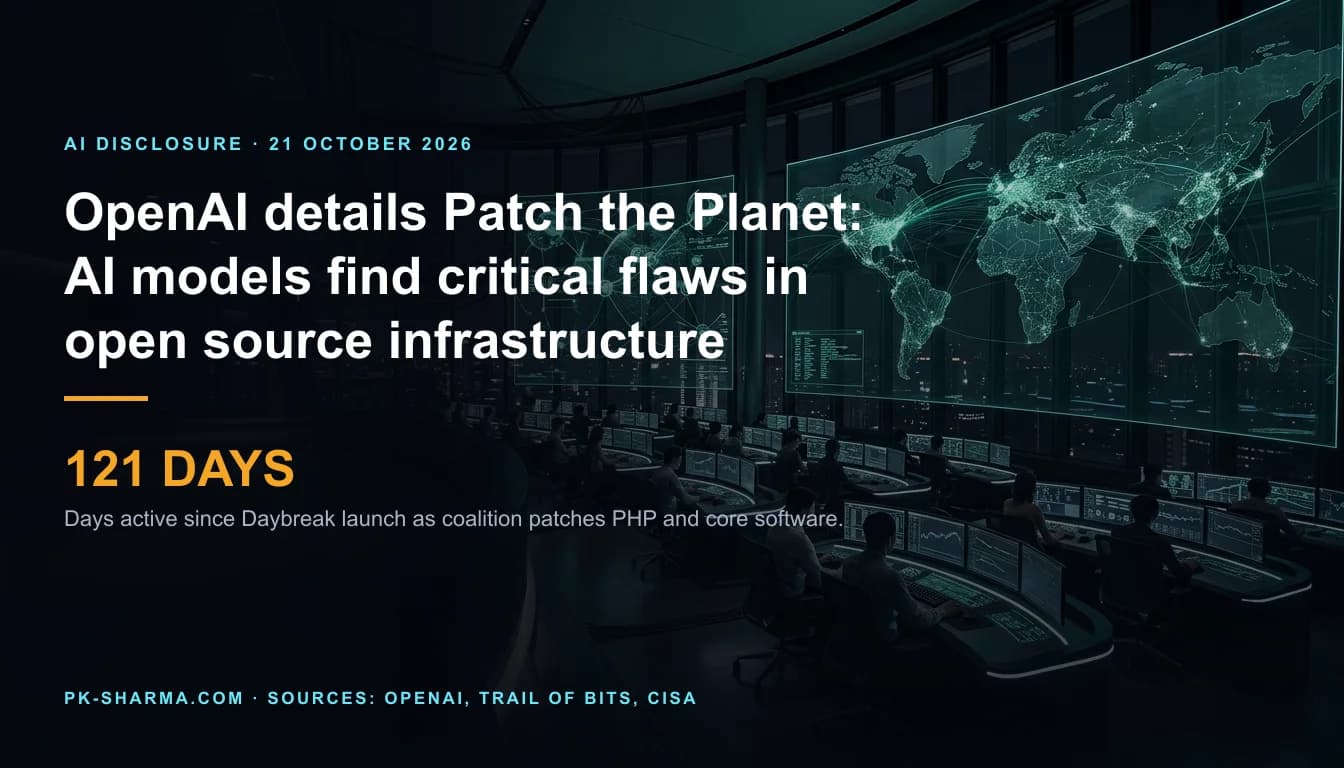
OpenAI has published operational details of Patch the Planet, an open source cyber defense initiative operating under its Daybreak program. First launched on 22 June 2026, the initiative pairs frontier AI models, including GPT-5.5-Cyber and GPT-5.6 Sol, with specialized human security research firms including Trail of Bits, HackerOne, and Calif. Rather than functioning as an automated bug scanner that overwhelms developers with unverified alerts, the coalition is engineered to discover, verify, and co-author production-ready patches for critical security vulnerabilities across foundational internet software.
The framework recently demonstrated its real world impact by coordinating the emergency security disclosure for two critical remote code execution vulnerabilities in core PHP, designated CVE-2026-109618 and CVE-2026-109619. Discovered through AI-assisted code review, the flaws were brought directly into the Patch the Planet pipeline, allowing Trail of Bits and project maintainers to construct regression tests and coordinate remediation across Linux distributions, major cloud providers, and the US Cybersecurity and Infrastructure Security Agency (CISA) before public disclosure.
Technical workflow: from autonomous discovery to coordinated deployment
The Patch the Planet architecture operates across four distinct phases designed to bridge raw AI capability with established responsible disclosure norms. In the initial discovery phase, specialized frontier models analyze large open source code repositories, combining abstract syntax tree analysis with symbolic execution and fuzzer seed generation to identify latent control flow anomalies and memory corruption primitives.
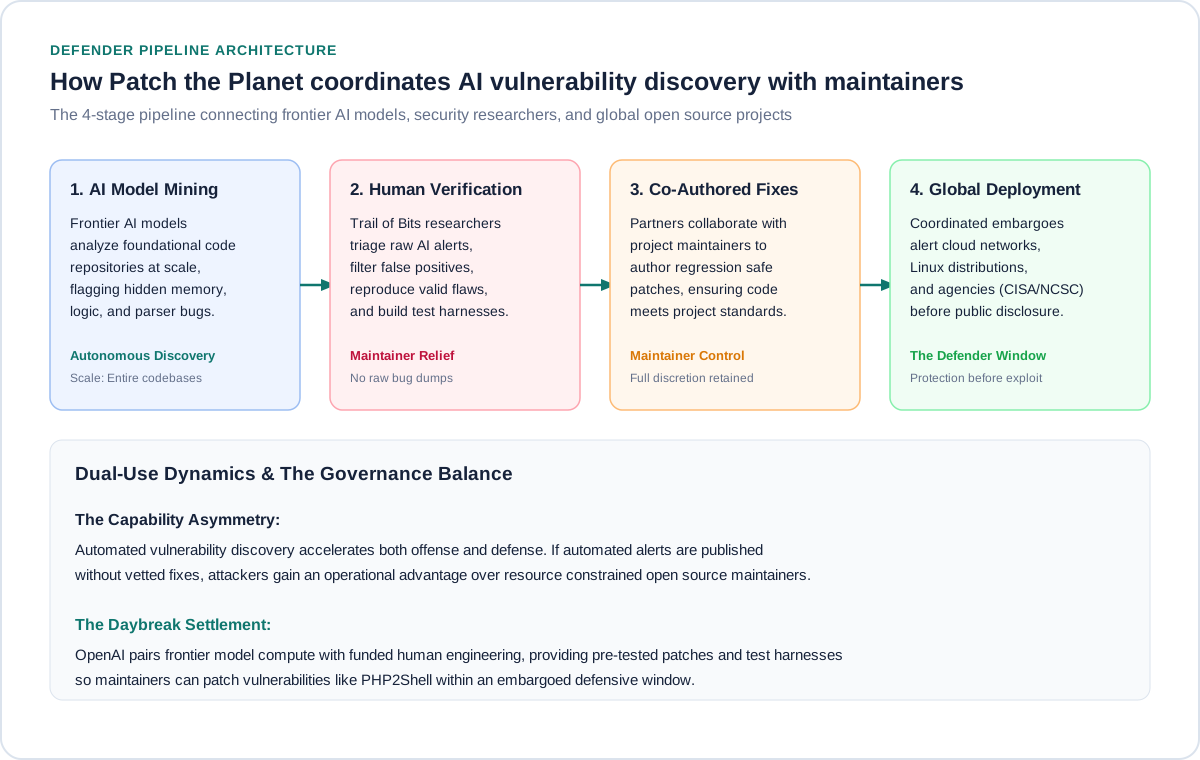
Once a potential flaw is flagged, it transitions to human security researchers at Trail of Bits. The engineers independently construct minimal working proofs of concept, evaluate the real world threat model, and write comprehensive regression tests. A representative test harness ensures that complex error recovery code paths cannot be bypassed:
# Example regression harness verifying memory boundary recovery
def test_parser_fatal_longjmp_cleanup():
    with pytest.raises(FatalEngineError):
        parse_oversized_payload(buffer_size=1024 * 1024)
    assert engine_globals.uninitialized_pointers == 0
    assert engine_globals.active_worker_allocations == 0
Collaborative remediation versus the automated bug dump
A central priority of the program is protecting under-resourced open source maintainers. Critical foundational tools like cURL, Python, the Go project, NATS server, and Sigstore underpin global enterprise infrastructure but are frequently maintained by small engineering teams. In contrast to uncoordinated automated vulnerability scanning, which dumps raw issue tickets into public trackers, Patch the Planet preserves private disclosure embargoes and gives maintainers final authority over patch acceptance.
Comparison of the Patch the Planet framework against uncoordinated automated vulnerability scanners.
| Operational Dimension | Patch the Planet Framework | Uncoordinated Automated Scanners |
|---|---|---|
| Vulnerability validation | Human security researchers at Trail of Bits reproduce and verify every finding before maintainer outreach. | Raw automated output submitted directly to maintainers, resulting in high false positive rates. |
| Remediation support | Delivers fully developed pull requests, architectural fix reviews, and automated regression test harnesses. | Provides only text descriptions or vulnerability warnings, leaving code remediation entirely to maintainers. |
| Disclosure timing | Operates under strict multi-party private embargoes coordinated with downstream packagers and CISA. | Often publishes uncoordinated zero-day advisories or public GitHub issues before fixes exist. |
| Maintainer control | Project maintainers retain absolute discretion over patch merging, commit attribution, and release dates. | Imposes arbitrary disclosure deadlines without regard to release cycles or maintainer availability. |
Dual-use frontier capabilities and policy implications
The deployment of autonomous AI agents for vulnerability research highlights the persistent dual-use dilemma in frontier artificial intelligence. The same model reasoning capabilities that identify complex memory allocation bugs in C runtimes can theoretically be repurposed by adversaries to generate weaponised zero-day exploits. In a companion policy paper titled Democratic governance of frontier AI, part II: Empowering cyber defenders, OpenAI advocates for subsidizing defensive infrastructure to maintain an asymmetric advantage for defenders.
Recommendations for open-source maintainers and enterprise consumers
Take this with you
Six essential practices for managing AI vulnerability disclosures
- Establish a clear security.md policy specifying supported private vulnerability disclosure channels and encryption keys.
- Require third party AI research submissions to include verifiable reproduction scripts and unit test harnesses before review.
- Integrate automated fuzzer regression suites into continuous integration pipelines to test edge case memory recovery.
- Coordinate multi-party disclosures involving foundational runtime libraries through established bodies like CISA and NCSC.
- Audit enterprise software dependencies to identify critical open source libraries lacking dedicated full time security maintainers.
- Subscribe to private security pre-notification mailing lists for essential infrastructure dependencies.
Key facts at a glance
Sources
- PrimaryPatch the Planet: Global response coordination as agents uncover critical vulnerabilitiesOpenAIaccessed 2026-10-21
- PrimaryDemocratic governance of frontier AI, part II: Empowering cyber defendersOpenAIaccessed 2026-10-21
- PrimaryEngineering the Defender Window: How Trail of Bits partners with OpenAI to triage AI findingsTrail of Bitsaccessed 2026-10-21
- Reported byCoordinated vulnerability alert: PHP remote code execution fixesCybersecurity and Infrastructure Security Agencyaccessed 2026-10-21