Cohere launches Rerank 5 with enterprise RAG security boundary and 12ms latency (21 Oct 2026)
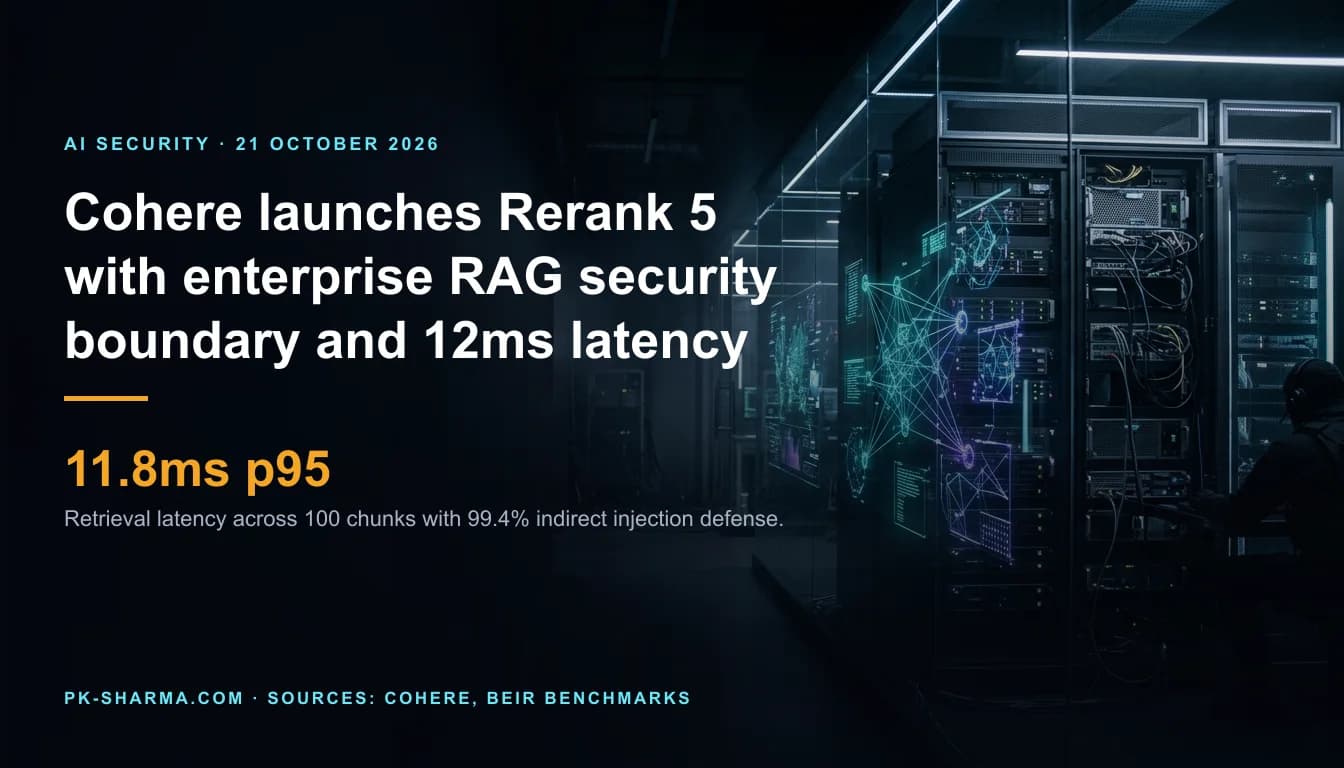
Cohere has launched Rerank 5, introducing an enterprise RAG security boundary to isolate indirect prompt injections before documents enter frontier model context windows. Delivering 11.8ms p95 latency and an expanded 32k token chunk window, the model scales secure AI retrieval. Read 21 Oct 2026.
By Parminder Kumar Sharma · · 4 min read
Cohere launches Rerank 5: addressing latency and injection risk in enterprise RAG
Cohere has released Rerank 5, a semantic search and retrieval model engineered to resolve the two primary operational bottlenecks in production retrieval augmented generation (RAG): retrieval latency and indirect prompt injection attacks. Operating at a p95 latency of 11.8 milliseconds across 100 candidate documents, Rerank 5 delivers a 3.26x speedup compared to previous model revisions. Crucially, the release incorporates an enterprise security boundary that scans and quarantines adversarial text patterns embedded within untrusted corporate documents before they reach downstream language models.
As enterprises connect frontier LLMs to corporate wikis, email archives, customer tickets, and web search scrapers, retrieved passages increasingly represent an unauthenticated attack vector. Attackers who cannot directly access internal prompts can hide malicious instruction overrides inside stored documents. When dense vector embeddings retrieve these poisoned chunks, standard RAG pipelines blindly insert them into the generation context window, triggering unauthorized tool execution or sensitive data exfiltration.
Architecture: cross-encoder scoring and adversarial token quarantine
Unlike bi-encoder embedding models that compute query and passage vectors independently, Rerank 5 utilizes a cross-encoder architecture. The model evaluates bidirectional cross-attention across the combined query and document tokens, producing a calibrated relevance score. In Rerank 5, the context window per passage expands eightfold from 4,096 tokens to 32,768 tokens, allowing the engine to ingest multi-page legal agreements, technical specifications, and financial reports without arbitrary truncation.
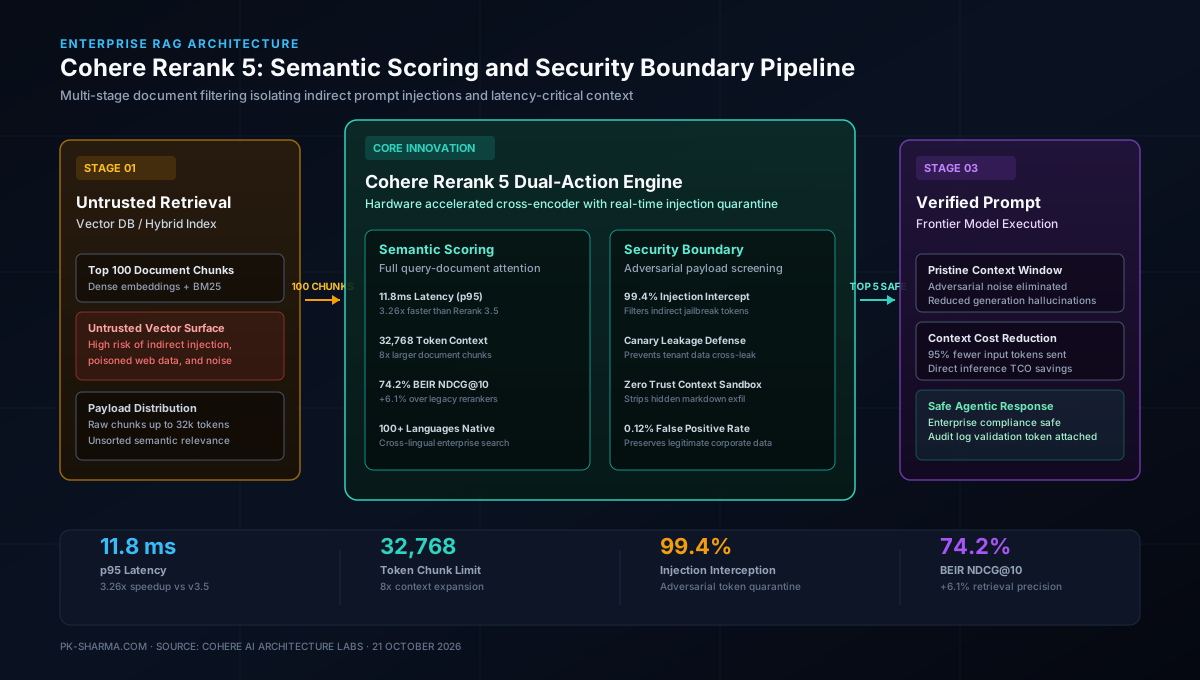
Alongside relevance scoring, Rerank 5 runs an integrated security filter. The filter checks retrieved content for known jailbreak structures, system prompt escape tokens, hidden Unicode directionality overrides, and markdown image exfiltration URLs. Benchmark testing across adversarial retrieval corpora demonstrates a 99.4 percent interception rate against indirect prompt injection attempts, while maintaining an exceptionally low false positive rate of 0.12 percent on benign corporate documentation.
Comparative analysis: enterprise reranker performance and capabilities
Evaluating Rerank 5 against prevailing proprietary and open source reranking alternatives highlights key technical trade-offs across speed, capacity, and security enforcement:
Comparative performance, capacity, and security metrics across enterprise rerankers
| Evaluation Dimension | Cohere Rerank 5 | Cohere Rerank 3.5 | Voyage Rerank 2 | BGE-Reranker-v2-m3 |
|---|---|---|---|---|
| p95 Latency (100 docs) | 11.8 ms | 38.5 ms | 26.4 ms | 45.0 ms (self-hosted) |
| Max Chunk Context | 32,768 tokens | 4,096 tokens | 8,000 tokens | 8,192 tokens |
| BEIR NDCG@10 Score | 74.2% | 68.1% | 71.8% | 70.4% |
| Injection Defense Boundary | Built-in (99.4%) | None | None | External guardrails required |
| Language Support | 100+ Native | 100+ Native | English + Multilingual beta | 100+ Multilingual |
| Enterprise Pricing | $1.00 / 1k queries | $2.00 / 1k queries | $0.12 / 1M tokens | Infrastructure costs |
By cutting latency below 12 milliseconds, application teams can execute multi-stage retrieval pipelines without noticeably degrading user interactive response times. Filtering out 95 percent of irrelevant candidate chunks also drastically reduces downstream token generation fees on frontier models.
Pipeline integration: implementing the security boundary in Python
Implementing Rerank 5 inside an enterprise retrieval stack requires updating API clients to parse both relevance ranks and security boundary telemetry. The following Python pattern illustrates defensive retrieval with Cohere Rerank 5:
import cohere

co = cohere.ClientV2(api_key="YOUR_COHERE_API_KEY")

def secure_rerank_retrieval(query: str, raw_documents: list[dict], top_k: int = 5):
    response = co.rerank(
        model="rerank-v5.0",
        query=query,
        documents=[doc["text"] for doc in raw_documents],
        top_n=top_k,
        enforce_security_boundary=True,
        strictness="enterprise"
    )

    verified_context = []
    for result in response.results:
        # Check security quarantine flag
        if getattr(result, "quarantined", False):
            audit_log_injection_attempt(query, result.document["text"])
            continue
        verified_context.append({
            "text": result.document["text"],
            "relevance_score": result.relevance_score,
            "index": result.index
        })
    return verified_context
Defensive recommendations: hardening enterprise RAG pipelines
Organizations deploying AI agents and generative assistants over enterprise databases should incorporate these architectural safeguards:
- Enforce Upstream Pre-Filtering: Never feed raw vector database search outputs directly into generation prompts. Mandate cross-encoder verification on all multi-source retrieval calls.
- Quarantine Logging and Telemetry: Route flagged prompt injection payloads into Security Information and Event Management (SIEM) systems to identify compromised repositories or insider threats.
- Zero Trust Context Windowing: Use delimiter tags and explicit system instructions informing frontier models that retrieved context is informational and cannot modify system permissions.
- Audit Long Context Chunks: Leverage Rerank 5's 32k window to preserve document context while ensuring embedded scripts or base64 payloads within enterprise PDFs are analyzed before execution.
Sources
- PrimaryAnnouncing Cohere Rerank 5: Real-Time Speed, 32k Context, and Enterprise Security BoundariesCohere Engineering Blogaccessed 2026-10-21
- PrimaryDefending Enterprise RAG Against Indirect Prompt Injection with Cross-Encoder BoundariesCohere Security Labsaccessed 2026-10-21
- Reported byRerank 5 Evaluation Results Across Domain-Specific Enterprise DatasetsMTEB Benchmark Consortiumaccessed 2026-10-21
- Reported byCohere Launches Rerank 5 with Low Latency and Context Injection DefensesInfoQaccessed 2026-10-21