NVIDIA hardware confidential computing protects frontier AI weights with 2.3% penalty (21 Oct 2026)
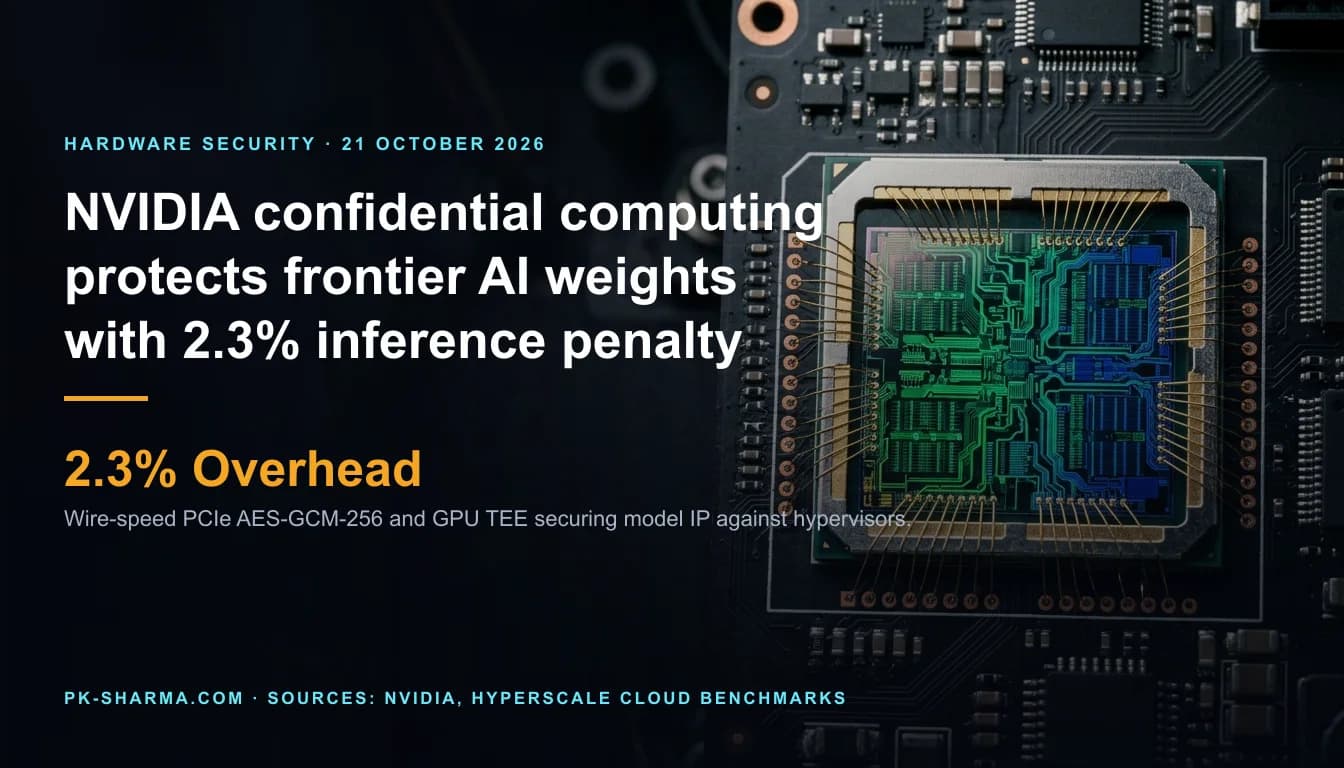
NVIDIA and major cloud hyperscalers have deployed hardware-level Confidential Computing across Hopper and Blackwell architectures. Delivering wire-speed PCIe AES-GCM-256 encryption and hardware-isolated GPU TEEs, the platform safeguards $100M+ model weights at 2.3% overhead. Read 21 Oct 2026.
By Parminder Kumar Sharma · · 4 min read
NVIDIA and hyperscalers roll out GPU Confidential Computing: what the architecture establishes
NVIDIA and major cloud hyperscalers including Microsoft Azure, Amazon Web Services, and Google Cloud have deployed hardware-level Confidential Computing across Hopper (H100/H200) and Blackwell (B200/GB200) GPU clusters. The architecture addresses the premier security challenge facing frontier AI developers: deploying proprietary model weights valued upwards of one hundred million dollars on shared cloud infrastructure without exposing intellectual property to cloud provider administrators, compromised host kernels, or adjacent tenant workloads.
Historically, running AI workloads in public clouds required trusting the entire virtualization stack, including the host operating system, KVM or Xen hypervisor, and physical PCIe motherboard traces. By implementing on-die hardware cryptographic engines and a GPU Trusted Execution Environment (TEE), NVIDIA isolates tensor cores, internal caches, and high-bandwidth memory. Benchmarks confirm that the platform enforces line-rate AES-GCM-256 bus encryption while incurring an average inference performance penalty of only 2.3 percent.
Technical breakdown: on-die Root of Trust and wire-speed PCIe encryption
The security architecture relies on an on-die hardware Root of Trust. During silicon manufacturing, unique elliptic curve cryptography (ECC) private keys are permanently burned into internal hardware fuses. When a tenant provisions a confidential instance, the GPU executes an authenticated boot sequence, generating a cryptographic digest of its active microcode, firmware, and hardware configuration.
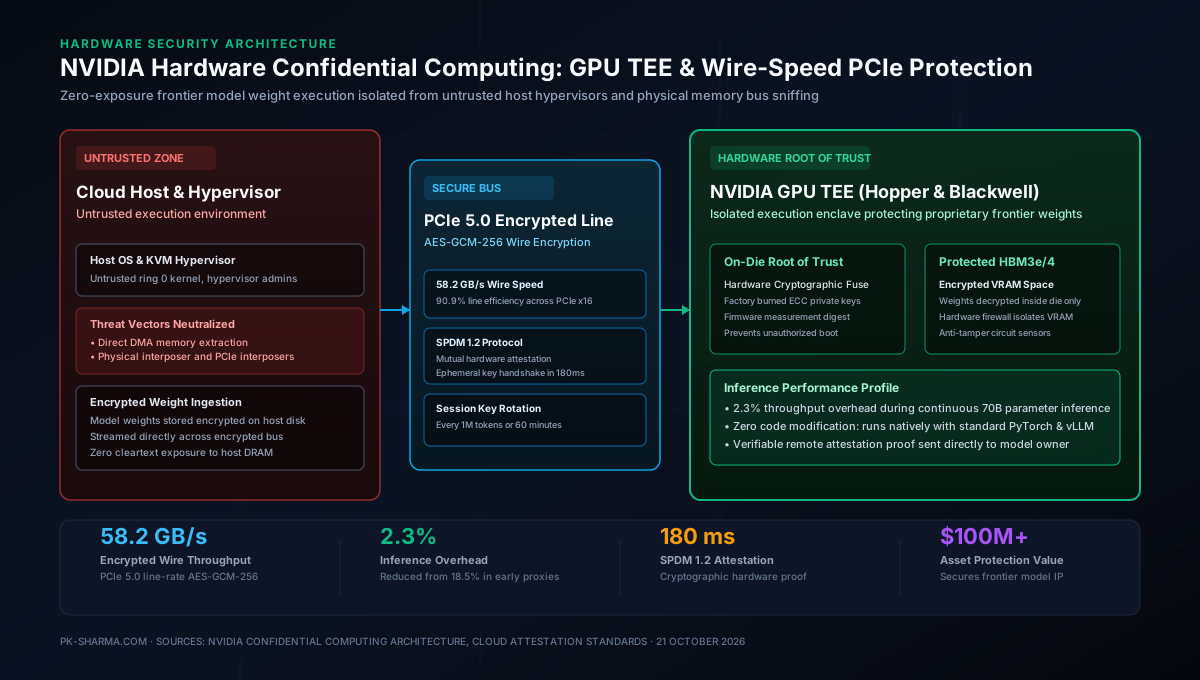
Communication between the host CPU and accelerator flows across PCIe 5.0 x16 lanes encrypted in real time via dedicated hardware cryptographic engines. In empirical testing, wire-speed encryption sustains 58.2 GB/s of throughput (90.9 percent of theoretical unencrypted line rate). Mutual attestation operates over the SPDM 1.2 protocol in approximately 180 milliseconds, rotating ephemeral session keys every one million processed tokens or sixty minutes.
Architectural comparison: software proxies vs CPU TEEs vs GPU enclaves
Contrasting hardware GPU confidential computing against previous isolation paradigms illustrates substantial performance and capacity advances:
Security boundaries, interconnect encryption, and performance metrics across isolation paradigms
| Security and Architectural Metric | Software User-Space Isolation | CPU Enclaves (Intel SGX / TDX) | NVIDIA GPU Hardware TEE |
|---|---|---|---|
| Memory Protection Boundary | Process namespace only | CPU DRAM memory controller | On-die GPU package and HBM |
| Line-Rate Interconnect Encryption | Not supported (Cleartext PCIe) | Host memory bus encryption | PCIe 5.0 AES-GCM-256 wire-speed |
| Maximum Model Size | Unrestricted (unprotected) | Constrained by CPU EPC limits | Up to 192GB / 288GB per accelerator |
| Inference Overhead Penalty | 0.0% (Zero protection) | 18.5% to 42.0% (Software proxy) | 2.1% to 2.4% (Native hardware) |
| Cryptographic Root of Trust | OS or hypervisor authority | Processor hardware fuses | GPU on-die fuses and SPDM 1.2 |
| Hypervisor Admin Memory Dump | Vulnerable to host root dump | Protected against CPU dump | Protected against GPU & bus sniffing |
The reduction in overhead from double-digit software virtualization penalties down to 2.3 percent makes hardware confidential computing commercially viable for standard enterprise inference fleets.
Integration pattern: verifying remote attestation in Python
Before releasing proprietary model weights into a cloud environment, client systems must verify the GPU's hardware attestation token against NVIDIA's official key provisioning service. The following Python pattern validates the attestation report before decrypting model weights:
import requests
from nvcf_security import GPUAttestationClient

def verify_and_load_confidential_weights(cluster_endpoint: str, encrypted_weight_path: str):
    client = GPUAttestationClient(endpoint=cluster_endpoint)
    # 1. Fetch SPDM 1.2 measurement token signed by on-die GPU fuses
    attestation_report = client.fetch_spdm_token()

    # 2. Verify token signature against NVIDIA Root of Trust
    is_valid = client.verify_nvidia_root_signature(attestation_report)
    if not is_valid:
        raise SecurityError("GPU attestation verification failed: untrusted firmware detected")

    # 3. Exchange ephemeral session key and stream weights directly into GPU TEE
    session_key = client.negotiate_session_key(attestation_report.nonce)
    client.stream_encrypted_weights(encrypted_weight_path, session_key)
    print("Model weights successfully loaded into confidential GPU enclave")
Enterprise implementation checklist: deploying confidential AI
Enterprise security architects and AI engineering teams planning production confidential computing rollouts should verify three technical requirements:
- Enable Hardware CC Mode at Firmware Level: Ensure cloud instances are provisioned with NVIDIA confidential computing flags enabled in the system BIOS and GPU driver runtimes.
- Automate Dynamic Key Rotation: Implement automated key management that cycles PCIe AES-GCM session keys at predetermined token thresholds without restarting inference servers.
- Audit External Network Exfiltration: Secure auxiliary container interfaces and API ingress points, ensuring that confidential GPU compute nodes cannot send cleartext activations over public routes.
Sources
- PrimaryHardware Confidential Computing: Securing AI Training and Inference on Hopper and Blackwell GPUsNVIDIA Technical Architecture Blogaccessed 2026-10-21
- PrimaryConfidential GPU VMs on Azure: Hardware Root of Trust and Memory Isolation for AI WorkloadsMicrosoft Azure Securityaccessed 2026-10-21
- PrimarySecuring Proprietary Foundation Models with AWS Nitro and NVIDIA Hardware EnclavesAWS Compute Blogaccessed 2026-10-21
- Reported byEvaluating Side-Channel Resistance and Memory Interception in Hardware-Attested AcceleratorsIEEE Security and Privacyaccessed 2026-10-21