ConnectWise Cloud Backup's app credential, not a person's: Huntress says 162 tenants, a headline says 173
Huntress's post says unauthorised sign-ins were confirmed in 162 tenants by 19:00 UTC on 16 October, using an application's credential held by ConnectWise, with no user and no MFA prompt. A headline attributes 173 to Huntress; that figure is not on the page, and no source says data was taken.
By Parminder Kumar Sharma · · 26 min read
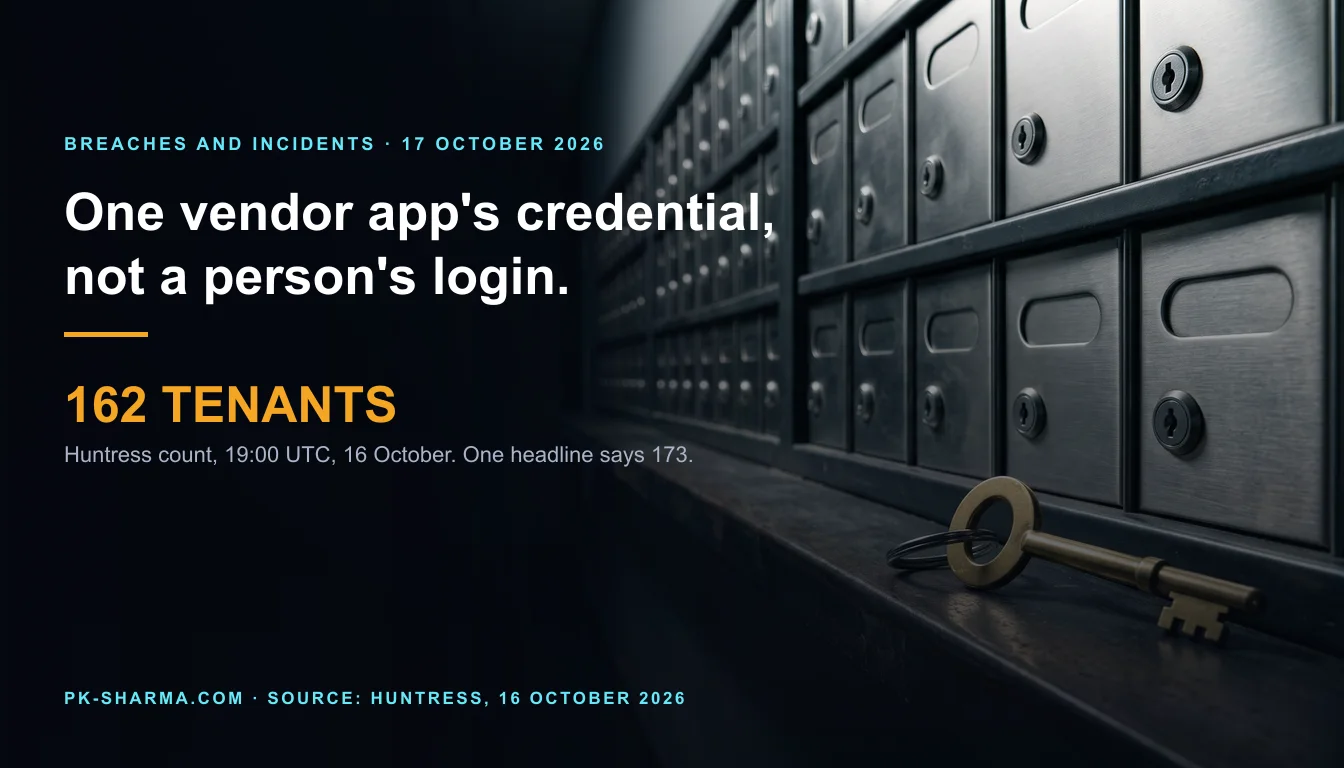
Huntress's page says 162 tenants. The headline that cites Huntress says 173.
Huntress published its account on 16 October 2026 and says that as of 19:00 UTC that day (20:00 BST) it had confirmed unauthorised sign-ins in 162 tenants, made with a credential belonging to the ConnectWise Cloud Backup application, formerly SkyKick. The Hacker News reported on 17 October that Huntress had observed confirmed unauthorised sign-ins in 173 partner and customer tenants. The two figures differ by 11, which is 6.8 per cent of 162 (derived). The Huntress page, read at 11:47 BST and again at 11:54 BST on Saturday 17 October, says 162 and does not contain 173. Todyl's post and ConnectWise's advisory give no tenant count, and the two other write-ups read either give none or repeat 162. So 173 is either a later Huntress update that had not reached the page read here, or it comes from somewhere that could not be read. This briefing says 162 where it quotes Huntress and 173 only where it quotes the headline.
The second computed fact is about time. Huntress puts the Cloud Backup sign-ins between 06:13 and 08:34 UTC on 15 October, a window of 141 minutes (derived). If all 162 tenants fell inside it, which the page does not say, that is one tenant every 52 seconds on average (derived). Huntress also says the actor moved through tenants "a few seconds apart". Both statements can be true only if the script touched many tenants that Huntress cannot see, or if the 162 were not all reached in that window. The page does not say which. Todyl, watching its own tenants, saw the same application and the same source address in a different window, 07:11 to 08:47 UTC, so the two vendors' windows together span 154 minutes (derived). The counts describe what two security companies could see in the tenants they watch. They do not describe how far the credential went.
The headline says a ConnectWise credential was used to sign in. Read against the primary sources, that sentence leaves a lot open. It does not say the credential was a person's: Huntress describes an application's credential, held in the vendor's own tenant. It does not say how many of the tenants had mail, files or Teams data read: no source confirms any. It does not say how the credential left the vendor's hands, why ConnectWise's first advisory came 35 h 34 min after the first sign-in Huntress saw (derived), who the tenants belong to, or whether any are in the UK or the EU. It does not say whether other vendors' application credentials are affected. No source read cites a CVE, and the CISA Known Exploited Vulnerabilities catalogue, dated 16 October 2026 at 17:15 UTC, has no Cloud Backup or SkyKick entry.
Interests, in one sentence: Huntress and Todyl sell managed detection and response to MSPs, ConnectWise sells the product and is the party whose application credential was used, and Microsoft sells the Entra licences that carry the logging and controls discussed here, so every claim below is attributed to the party that made it.
What was read, and how
The news article is the secondary source here, and the primary sources are the security companies' own posts, the vendor's own advisory and Microsoft's documentation. All were read in full on Saturday 17 October 2026 between 11:47 and 12:10 BST. This is a developing story, so any figure below can be overtaken: ConnectWise's advisory has already carried two entries 11 hours apart (derived), and Huntress says it will keep updating its post.
- The Hacker News, 17 October: the article that carries the 173. Secondary. It also covers an unrelated update-server compromise of a backup product, which is not used here.
- Huntress blog post, 16 October: read in full twice. Primary for the sign-in window, the 162, the other ConnectWise applications and the mitigation steps.
- ConnectWise Trust Center advisory page and its status page entry: both entries of each, the first published at 17:47 UTC on 16 October and the update of 05:01 UTC on 17 October (the status page stamps them one and ten minutes later). Primary for what the vendor says.
- Todyl blog post, 16 October: its own tenants' view. It answered a plain request with a bot check, which was not completed; it was read later in a browser tab where the article had loaded.
- Microsoft Learn, NCSC, the ICO, Cyber Essentials and the Bill text: read as cited below.
- Not read: two community threads linked by the news article (scripted pages that returned no text), a post by one security vendor seen only as a search-result snippet, an advisory by another that an aggregator write-up cites, and any ConnectWise partner-only page.
Who counted what, and over what
Every number in this story is a count of something different. Setting them side by side shows how little the largest of them covers.
Counts in the sources, with their basis. Read 17 October 2026. Percentages are derived.
| Source and date | What it counts | Limits |
|---|---|---|
| Huntress blog, 16 October | 162 tenants with confirmed unauthorised sign-ins, as of 19:00 UTC on 16 October | Tenants Huntress can see. It says it cannot check tenants without the Entra licensing, and that the actor is "not limited to the tenants we have confirmed so far" |
| Huntress blog, same post | The application authenticated from the hosting address in 17 of the first 290 or so tenants checked, across 17 partner accounts (5.9 per cent, derived) | An earlier, smaller sample from 06:13 to 08:34 UTC on 15 October. The 5.9 per cent cannot be projected onto tenants not checked |
| The Hacker News, 17 October | 173 partner and customer tenants, attributed to Huntress | Not on the Huntress page read at 11:47 and 11:54 BST. No time, window or method is given |
| Todyl blog, 16 October | No tenant count. Nine tenants had no active backup subscription, and a token was still issued in them | Tenants Todyl monitors. Sign-ins 07:11 to 08:47 UTC on 15 October, one per tenant |
| ConnectWise advisory, 16 and 17 October | No count of tenants, partners or customers | Says it identified "unauthorized access to application identities" in its Cloud Backup environment |
| Huntress blog | About 50 tenants where ConnectWise Cloud Management applications assigned themselves directory roles, mostly Exchange Administrator, from 01:58 UTC on 15 October | Huntress says the pattern points to vendor automation but has not confirmed that with ConnectWise |
| Huntress blog | One tenant where a Cloud Management application made itself Global Administrator and changed two other applications | The one tenant audit log Huntress reviewed in detail. The page does not say how many others were reviewed |
The sequence, in UTC, and the gaps worked out
What each source states, in order. Times are UTC unless a date alone is given. BST is one hour ahead.
| When (UTC) | What the source states | Source |
|---|---|---|
| 13 to 14 October, times not given | Password spraying from one hosting address against four tenants of law firms. Two accounts were locked out. Huntress saw no successful user sign-in from that address | Huntress |
| 15 October, from 01:58 | In about 50 Huntress-monitored tenants, ConnectWise Cloud Management applications assigned themselves directory roles | Huntress |
| 15 October, 03:44 to 03:49 | In one tenant, a Cloud Management application added itself to Global Administrator and made nine changes to two other applications. Six succeeded, three failed | Huntress |
| 15 October, 06:13 to 08:34 | The Cloud Backup application authenticated from the hosting address in tenants Huntress checked, in sorted order, a few seconds apart | Huntress |
| 15 October, 07:11 to 08:47 | Sign-ins as the Cloud Backup application in tenants Todyl monitors, one per tenant, 1 to 6 minutes apart in sorted order | Todyl |
| 16 October, 17:47 (18:47 BST) | ConnectWise: investigating "recent attempts of unauthorized access"; containment in place; no indication partner backup data has been accessed | ConnectWise |
| 16 October, 19:00 | Huntress: unauthorised sign-ins confirmed in 162 tenants | Huntress |
| 17 October, 05:01 (06:01 BST) | ConnectWise: "unauthorized access to application identities"; shutting off Cloud Backup application access until further notice; no indicators that partner backup data has been compromised | ConnectWise |
| 17 October, time not given | The Hacker News: 173 tenants, attributed to Huntress | The Hacker News |
ConnectWise says it "recently identified" the access and that it started incident response on detecting it. It does not say when it detected anything. So the intervals below run between what Huntress observed and when ConnectWise published. They are not detection times, and the window Huntress saw is the span of what it could see, not the span of the compromise.
Intervals between printed times (derived by subtraction; see calc-output.txt).
| Interval | Length (derived) |
|---|---|
| First role self-assignments Huntress saw (15 October, 01:58) to its first Cloud Backup sign-in (06:13) | 4 h 15 min |
| Global Administrator change in one tenant (03:44) to the first Cloud Backup sign-in (06:13); Huntress says about two and a half hours | 2 h 29 min |
| First Cloud Backup sign-in Huntress saw (06:13, 15 October) to ConnectWise's first advisory (17:47, 16 October) | 35 h 34 min |
| Last sign-in Huntress saw (08:34) to ConnectWise's first advisory | 33 h 13 min |
| ConnectWise's first advisory to Huntress's 162 count (19:00) | 1 h 13 min |
| ConnectWise's first advisory to its update shutting off access (05:01, 17 October) | 11 h 14 min |
| First sign-in Huntress saw to the shut-off update | 46 h 48 min |
The earliest dated event tied to the same source address is the spraying on 13 and 14 October, three days before ConnectWise's advisory date (derived). Spraying user accounts is a different act from using an application credential, and Huntress saw no successful user sign-in from it. Whether the credential was held earlier than 15 October is not stated.
An application's credential, not a person's: what Microsoft documents
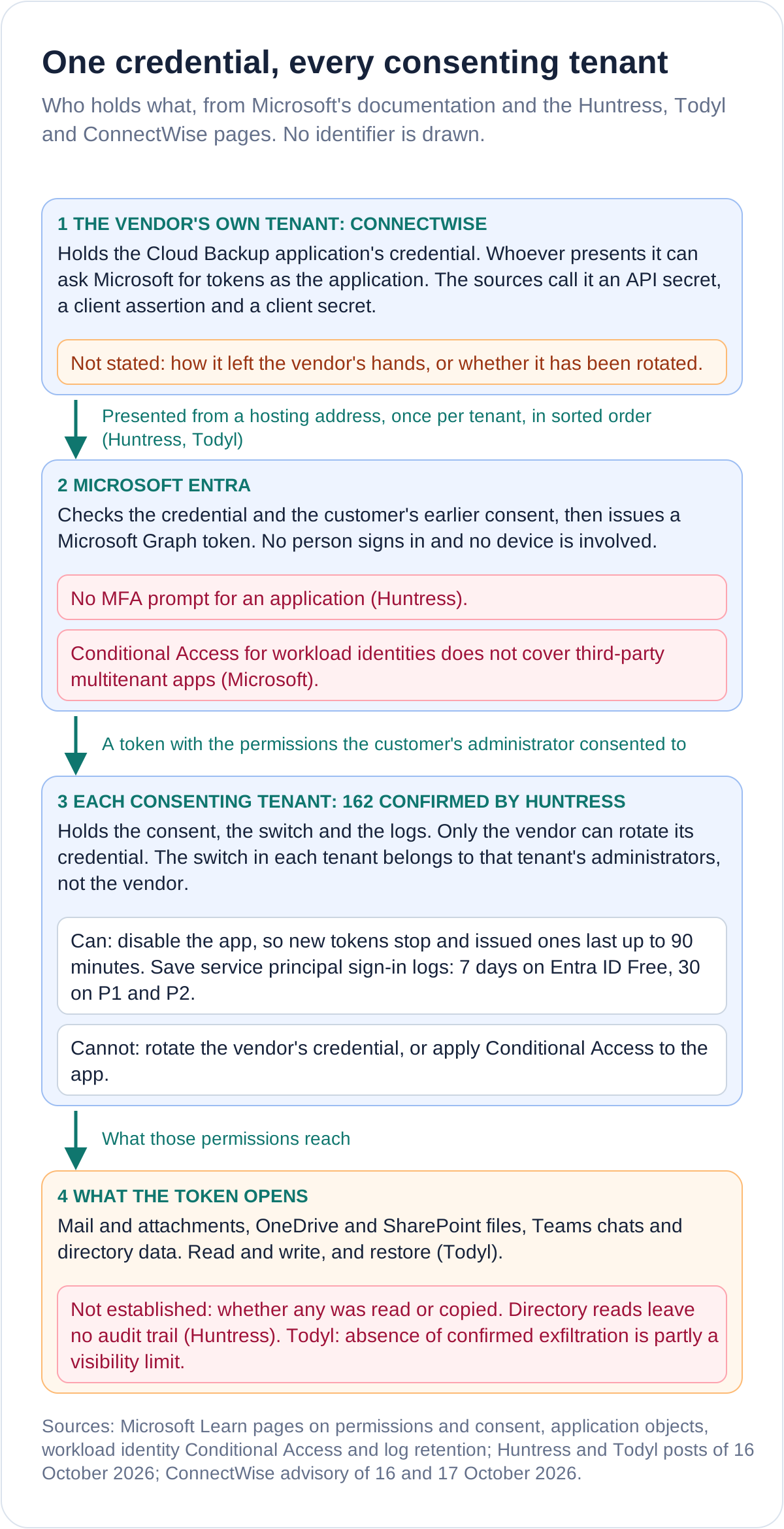
Microsoft's overview of permissions and consent describes two ways an application reaches data. In delegated access it acts for a signed-in user. In app-only access it acts "only as the application's own identity", which Microsoft says is used in scenarios such as automation and backup. App-only access uses application permissions, which only an administrator can consent to, and an application holding a file permission of that kind can read any file in the tenant.
A multitenant application, in Microsoft's description of application objects, has one application object in the vendor's own tenant, and a service principal in each tenant where it has been consented to. The service principal defines what the application can do in that tenant. That is the shape the reports describe. Huntress says the credential type was a client assertion, so that "the credential lives in the vendor's own tenant", and that nothing a customer did could have produced it. Todyl says the application held tenant-wide read and write access to mail and attachments, OneDrive and SharePoint files and Teams chats in each consenting tenant, and the ability to restore data, and that the actor's activity was limited to signing in with the already-approved application. The customer's administrator gave that consent earlier, to a legitimate product. Microsoft's own page on admin consent calls granting it "a sensitive operation" that can give a publisher access to "significant portions of your organization's data".
Huntress says app-only sign-ins involve "no user, no device, and no MFA prompt". Microsoft's page on Conditional Access for workload identities, last updated 24 March 2026, says workload identities cannot perform multifactor authentication and that the policies apply to single-tenant service principals registered in the customer's own tenant: "Microsoft and third-party SaaS applications, including multitenant apps, are not covered by these policies." Todyl's account agrees: Conditional Access was not applied to the sign-ins, and it says least-privilege consent and removing unused applications are the main controls left to a customer. Huntress lists Conditional Access for workload identities, Identity Protection and application management policies among controls that make a planted secret harder to use or easier to spot. On Microsoft's wording those help for applications in the customer's own tenant, such as the single-tenant Huntress application that received a new secret, and not for the vendor's multitenant backup application.
None of the sources reports that granular delegated admin privileges (GDAP) or any partner staff account was involved. Microsoft's GDAP introduction describes "least-privileged access" for partners to customers' workloads, granular and time-bound, and Conditional Access has a separate service provider user target for partner staff. Both govern people who sign in as partners. An application signing in as itself is outside both, so a customer who reviewed its partner relationships this week would have found nothing about this event.
What a customer can do is specific and limited. Disabling the application in its own tenant, which Microsoft says prevents all tokens being issued for it there, stops new tokens. Tokens already issued last up to 90 minutes (Todyl), which fits Microsoft's default access-token lifetime of 60 to 90 minutes. Only the vendor can rotate its own credential (Todyl). The sign-ins sit in the Service principal sign-ins tab, not the default user tab (Huntress), one of the four log types Microsoft lists in its sign-in log overview. Per Microsoft's retention table, sign-in and audit logs are kept for seven days on Entra ID Free and 30 days on P1 and P2, so a free-tier tenant starts losing 13 October entries on 20 October, three days from now (derived). Graph activity logs, which record each request, need a P1 or P2 licence, are not kept unless sent somewhere, and start only when switched on. Todyl says they were not being collected in the tenants where it could not tell the actor's reads from the backup service's.
What the record states, and what it does not
Stated and not stated, from the Huntress post, the Todyl post and the ConnectWise advisory page as read on 17 October 2026.
| Question | Stated | Not stated |
|---|---|---|
| Whose credential? | An application's: Cloud Backup, formerly SkyKick, held by the vendor. Huntress: a client assertion, living in the vendor's own tenant; no user involved | Whether it was a secret or a certificate. Huntress's summary says "API secret" and its body says client assertion; Todyl's prose says client secret and its log field says client assertion |
| How was it obtained? | Nothing. Huntress says it is "in hostile hands"; ConnectWise gives no cause | The method, the date it was lost, and whether it left a vendor system, a repository or a person's device |
| What happened after sign-in? | Graph tokens obtained, one per tenant, in sorted order (Todyl). In the one audit log Huntress reviewed in detail, no mail or file access. Todyl found no directory changes by the backup application | Whether any mail, file, Teams or directory data was read or copied. Huntress: directory reads leave no audit trail. Todyl cannot separate the actor's reads from the backup service's |
| How many tenants? | 162 (Huntress, 19:00 UTC, 16 October). 173 (The Hacker News, 17 October). 17 partner accounts in an earlier sample | The source of 173, the total number of tenants where the application is consented, and any UK or EU count |
| Who are they? | "Partner/customer" tenants (The Hacker News); tenants Huntress and Todyl can see, including Huntress partners' tenants | How many are ConnectWise's partners and how many are those partners' clients. Four tenants of law firms were sprayed on 13 and 14 October; no sector is stated for the rest. ConnectWise's status page lists the affected location as "All Regions" and gives no country count |
| Why was detection not faster? | ConnectWise says it "recently identified" the access | When ConnectWise detected anything, who saw it first, and why its first advisory came 35 h 34 min after the first sign-in Huntress saw (derived) |
| What has ConnectWise done? | Shut off Cloud Backup application access until further notice (update of 05:01 UTC, 17 October); published a source address and client identifiers; "no indicators to date" that partner backup data is compromised | Whether the credential has been rotated (neither ConnectWise entry says so; Todyl notes the same of the first), when service returns, and how many partners it has told |
| Other applications? | Huntress: a second ConnectWise application gave itself Global Administrator in one tenant and added secrets to two other applications; it cannot verify the remaining ConnectWise applications are secure | Whether that and the Cloud Backup sign-ins were one operator (Huntress has not tied them), and whether other vendors' applications are affected |
| CVE or alert? | None cited. The CISA catalogue of 16 October (17:15 UTC) lists ConnectWise ScreenConnect entries and none for Cloud Backup | Any CISA or NCSC alert. None was found; both sites' search pages are scripted and could not be searched conclusively |
ConnectWise's own advisory has moved between the two entries. The first, at 17:47 UTC on 16 October, speaks of "recent attempts of unauthorized access". The second, at 05:01 UTC on 17 October, speaks of "unauthorized access to application identities" and tells customers where in the Entra sign-in log to look. Todyl, whose post is dated 16 October, noted that the first entry did not mention Microsoft 365, the application or its credential. Todyl's own caution on the data question is worth keeping next to the vendor's: "The absence of confirmed exfiltration is partly a visibility limit rather than a clean result."
Friendly names: eight words that carry more than they show
Words in the headline and the reports, and what the sources show behind each.
| Word | What it suggests | What the sources show |
|---|---|---|
| Credential | A person's username and password, protected by MFA | An application's proof of identity, held by the vendor. The sources call it an API secret, a client assertion and a client secret. Huntress says there is no MFA prompt for it |
| Compromised | Known theft and known damage | Huntress: the credential is in "hostile hands" and was used. Huntress says any organisation with the app installed is affected; Todyl says to assume every tenant with it enabled is compromised. Neither states data was taken |
| Sign in | A person typed a password | An application asked Entra for a token as itself, once per tenant, from a script. Success means a token was issued, not that anything was read |
| Tenant | An organisation | A Microsoft Entra directory. The sources count tenants only, which is not a count of organisations, users or mailboxes |
| Partner | A trusted reseller | Three meanings in one story: ConnectWise's partners, who buy Cloud Backup; Huntress's partners, whose tenants it watches; and Microsoft's partner relationships such as GDAP. Only the first two appear in the reports |
| Delegated | Someone acts for you, with limits | ConnectWise's product page advertises "delegated authentication for a seamless zero trust approach". In Microsoft's terms delegated access acts for a signed-in user. The reports describe app-only access. The sources do not say how the two relate |
| Supply chain | A distant, rare risk | Three parties, three different things held: the vendor holds the credential, the MSP chose the product and holds the contract, and the customer's administrator gave the consent |
| MSP | A security specialist | NCSC calls an MSP's own systems "a juicy target". Here the route in was the MSP's supplier's credential, not an MSP account |
The same trust-in-a-trusted-tool pattern appeared in an earlier briefing on this site, where a genuine, signed remote-management installer put a second remote tool on devices. The mechanism differs, because that case ran on endpoints and this one runs on a cloud identity, but in both the property that made the tool trusted was the property that made it useful to an attacker.
Rotating the vendor's credential is necessary, and not enough
In one Huntress partner tenant, Huntress reports that a second ConnectWise application, Cloud Management for Microsoft Teams, added itself to the Global Administrator role at 03:44 UTC on 15 October, then made nine changes to two other applications in about five minutes (03:44 to 03:49, derived). The two were an MSP management application and Huntress's own application. Six changes succeeded and three failed (66.7 per cent succeeded, derived). The successful ones added new client secrets, set to expire in 2028, which is between 443 and 808 days after 15 October 2026 (derived).
Huntress's reading is that a credential on an MSP management application can extend access beyond one tenant, because such applications are often consented in the MSP's customers' tenants, and it says it has not seen that happen. Three points follow from the page. First, Huntress says disabling the ConnectWise applications "will not remove credentials that were already added", so a customer has to review credentials on all of its applications, not only ConnectWise's. Second, a secret planted in a customer's own tenant is a customer-side artefact, and ConnectWise rotating its own credential does not touch it. Third, the relationship between this earlier activity and the later Cloud Backup sign-ins is not settled. Huntress has no source address for the earlier events and has not tied the two phases to one operator; the sign-ins began 2 h 29 min after the Global Administrator change (derived); and Todyl found no directory changes by the backup application in its own tenants. The record describes two phases of unclear relationship, not one proven campaign.
UK: what applies today, and where each piece stops
No source read says that any UK organisation is among the tenants, and none says that none is. That is a gap in itself. A UK customer of an MSP that uses Cloud Backup can check its own tenant whether or not it was among the 162, and the guidance below applies either way.
UK guidance and law as read from the pages cited, on 17 October 2026, and where each stops.
| Instrument | What it says, as read | Where it stops |
|---|---|---|
| NCSC, [Choosing a managed service provider](https://www.ncsc.gov.uk/guidance/choosing-a-managed-service-provider-msp) (SME guide, 24 November 2025) | Apply least privilege to the MSP, require 2-step verification on the MSP's own access, ask how long logs are kept and whether you can see them, fix incident-notification times in the contract, and ask whether you have assessed the MSP's supply chain risks | Written around the MSP's people and access. It does not mention applications consented in your tenant or credentials a vendor holds |
| NCSC, [Using MSPs to administer your cloud services](https://ncsc.gov.uk/blog-post/using-msps-to-administer-your-cloud-services) (blog, 10 January 2023) | An MSP's own systems can be "a juicy target". The contract should oblige the MSP to tell you of breaches, including "any breaches that happened in the MSP's own supply chain" | Speaks of accounts, devices and administrator access. It does not mention consent or application permissions, and it predates this event by three years and nine months (derived) |
| NCSC, [supply chain security guidance](https://www.ncsc.gov.uk/collection/supply-chain/guidance/12-principles) | Twelve principles in four stages: understand the risks, establish control, check your arrangements, continuous improvement | Only the landing page was read for this briefing, not the principles themselves. It is written for large organisations and the public sector |
| Cyber Essentials, [Requirements for IT Infrastructure v3.3](https://www.ncsc.gov.uk/files/cyber-essentials-requirements-for-it-infrastructure-v3-3.pdf) (April 2026) | Accounts used by third parties such as an MSP are in scope. Authentication to cloud services must always use MFA. User accounts are removed or disabled when no longer required | The wording is about user accounts. A search found nothing on service accounts, machine accounts or application permissions, and Huntress says app-only sign-ins have no MFA prompt |
| UK GDPR, ICO [guide to personal data breaches](https://ico.org.uk/for-organisations/report-a-breach/personal-data-breach/personal-data-breaches-a-guide/) | A controller reports a notifiable breach within 72 hours of becoming aware, where feasible, and may give details in phases. A processor must tell the controller "without undue delay". Breaches include access by an unauthorised third party | Whether any personal data was accessed is the open question: the reports establish tokens issued, not reads. Awareness and risk are judgements the controller must record |
| Cyber Security and Resilience Bill, [HL Bill 49](https://bills-api.parliament.uk/api/v1/Publications/67673/Documents/8744/Download) as amended in Grand Committee | A managed service is ongoing IT management under contract, delivered by connecting to or obtaining access to the customer's systems. A relevant managed service provider that is not micro or small would notify the Information Commission within 24 hours (initial) and 72 hours (full) of becoming aware of a significant incident, then tell the UK customers likely to be affected | Not law. Lords report stage is listed for 26 October, nine days from today (derived), and these duties start on a day set by regulations. The text does not say whether a vendor of an automated backup application that connects by consent provides a managed service, or whether a stolen vendor credential is an incident in the systems an MSP relies on |
The Bill is read in detail in an earlier briefing on this site, on its AI gap and its report-stage amendments. For this story the point is narrow: the Bill would put 24-hour and 72-hour duties on larger managed service providers, with customer notification after them, but the text read does not decide whether the product vendor in a case like this is inside it. Stage dates can move; the 26 October date is provisional.
The 72 hours, as arithmetic. Counting from ConnectWise's first advisory, published at 17:47 UTC (18:47 BST) on Friday 16 October, 72 hours ends at 18:47 BST on Monday 19 October (derived), and a weekend sits inside it. That is an illustration and not a legal view. The ICO says the clock runs from becoming aware and points to the Article 29 Working Party guidelines for when a controller is aware, and whether a personal data breach occurred is the very thing the record does not establish. A customer whose tenant had the application consented should record, today, when it became aware, what it checked, and why it did or did not report. The ICO guide says a processor must tell its controller without undue delay, so the question to put to an MSP is when it became aware, not only what it knows.
What to do, in order
Three lists, because the three readers hold different things. Each is ordered by what is cheapest and most time-limited first. They draw on Huntress's and Todyl's recommendations and on Microsoft's documentation, and they stop where the sources stop: none of this can confirm that data was not taken.
Take this with you
For an organisation that uses an MSP
- In the Entra admin centre, open Enterprise applications and search for ConnectWise Cloud Backup, SkyKick and ConnectWise Cloud Management. Note which are present and who consented to each.
- Before changing anything, export what each holds and save the service principal sign-in log (the Service principal sign-ins tab, not the default user tab). On Entra ID Free the log keeps seven days, so entries from 13 October begin to disappear on 20 October (derived).
- Disable each application in your tenant, without deleting it: Huntress says deletion removes the consent and a restore would need a fresh one, and Todyl also advises disabling rather than deleting. Expect backups to pause and ask your MSP what covers the gap.
- Review the credentials, secrets and certificates, on every enterprise application and app registration, especially management and security tools, for any added since 13 October that you did not create. Remove the unexpected ones.
- Check which directory roles any ConnectWise or SkyKick application holds, and in the audit log look for one adding itself to a role or changing another application. Once it is disabled, remove any role you did not grant on purpose.
- Ask your MSP in writing: is the application consented in your tenant, since when, with which permissions, with an active subscription or not, who approved it, who is your named contact for this incident, and when did the MSP first become aware.
- If you hold the licence, switch on Microsoft Graph activity logs and send them somewhere you control. They are not retroactive.
- Record, today, when you became aware, what you checked, and whether you judge a personal data breach to have occurred. The 72 hours run from awareness, and the weekend counts.
- Do not re-enable until ConnectWise confirms all credentials are reset (Huntress). When you do, grant the minimum permissions and ask whether the application needs write access at all.
- Review partner relationships and partner sign-ins too (GDAP roles, Conditional Access for service provider users), but expect nothing about this event there: they govern people, not applications.
Take this with you
For an MSP
- List every ConnectWise and SkyKick application in your own tenant and in each client tenant you manage, with its permissions and subscription status. Todyl found tokens issued in nine tenants with no active subscription.
- Check your own management and security tool applications first for credentials added since 13 October. Huntress asks MSPs to start there.
- Disable, without deleting, in tenants where you are certain of the scope. Tell each client in writing what you did, what you saved and what you could not see, with a named contact.
- Remove the consent for any vendor application whose subscription has lapsed or whose purpose has ended.
- Reduce who can add credentials: limit the Application Administrator and Cloud Application Administrator roles, and use application management policies to restrict or cap the lifetime of new secrets. Microsoft says the tenant default policy exists and is disabled by default, and that it does not block tokens for existing applications.
- Ask each vendor whose application is consented across your clients how its credential is held and rotated, whether credentials are per tenant, how fast you would be told, and whether it can limit where the application signs in from.
- Hold your own client contracts to the NCSC's questions: notification time, who tells whom, log retention, and breaches in your own supply chain.
Take this with you
For a CISO
- Count the third-party multitenant applications consented in your estate and rank them by the breadth of their application permissions. Start with any that can read every mailbox or file without a user.
- Accept what Conditional Access cannot do here. Microsoft says it does not cover third-party multitenant apps, so the controls you hold are least-privilege consent, removal of unused applications, log collection and the contract.
- Decide who may grant tenant-wide admin consent, and make each grant a recorded, reviewed decision. Microsoft calls it a sensitive operation.
- Alert on the events Huntress names: a service principal adding itself to a directory role, an application being modified by another application, credentials added to a service principal, and service principal sign-ins from outside the vendor's normal range.
- Keep service principal sign-in and audit logs beyond the 7 or 30 day defaults, and switch on Graph activity logs.
- Write the supplier clause: notification in hours, including events in the supplier's own supply chain, a named route, and a statement of what it will tell you about credential rotation.
- Run a table-top: a vendor application credential is stolen, the vendor's first advisory arrives 35 hours after the first sign-in, and your logs cover seven days. What can you prove?
- Track the Bill. If you are an MSP above the micro and small thresholds, its 24-hour and 72-hour duties and customer notification would apply once in force. If you buy from one, expect to receive those notices.
The question that exposes the gap
Which of the third-party applications consented in your tenant could read every mailbox without a person signing in, who holds the credential that proves each one is genuine, and who would tell you within hours, rather than days, if that holder lost it?
In this case the accounts of what happened inside customer tenants come from two security companies watching their own customers, and the vendor's first advisory came 35 h 34 min after the first sign-in Huntress saw (derived). Who detected it first is not stated, and neither is how a customer that was not being watched could have known earlier.
Key facts
Sources
- PrimaryBlog post 'ConnectWise (SkyKick) Vendor Credentials Abused in M365 Attacks', published 16 October 2026, read in full twice (11:47 and 11:54 BST on 17 October): the 162 tenants as of 19:00 UTC, the 06:13 to 08:34 UTC window, the one-tenant Global Administrator finding, what is not confirmed and the mitigation stepsHuntressaccessed 2026-10-17
- PrimaryTrust Center advisories page, both entries: first published 16 October 2026 at 17:47 UTC, updated 17 October at 05:01 UTC; the vendor's statement, the shut-off of Cloud Backup application access and the 'no indicators' wording on backup dataConnectWiseaccessed 2026-10-17
- PrimaryProduct and Services Status entry 'ConnectWise Cloud Backup Issue Investigation Security Issue': the same two statements, stamped 17:48 UTC on 16 October and 05:11 UTC on 17 October, with the location listed as All RegionsConnectWiseaccessed 2026-10-17
- PrimaryBlog post 'Investigation: Unauthorized Access Through the ConnectWise Cloud Backup Microsoft 365 App', published and last updated 16 October 2026: its own tenants' window of 07:11 to 08:47 UTC, nine tenants with no active subscription, the visibility limit and the remediation steps. Read in a browser tab after a plain request met a bot check that was not completedTodylaccessed 2026-10-17
- PrimaryProduct page for ConnectWise Cloud Backup: what the product covers (Exchange, OneDrive, SharePoint, Teams, Entra ID) and the 'delegated authentication for a seamless zero trust approach' wordingConnectWiseaccessed 2026-10-17
- PrimaryOverview of permissions and consent in the Microsoft identity platform (updated 18 March 2025): delegated versus app-only access and application permissionsMicrosoft Learnaccessed 2026-10-17
- PrimaryApplication and service principal objects (updated 1 October 2024): the application object in the home tenant and a service principal in each consenting tenantMicrosoft Learnaccessed 2026-10-17
- PrimaryConditional Access for workload identities (updated 24 March 2026): workload identities cannot perform MFA; policies do not cover third-party multitenant appsMicrosoft Learnaccessed 2026-10-17
- PrimaryIntroduction to granular delegated admin privileges (GDAP), updated 28 April 2026: partner access to customer workloadsMicrosoft Learnaccessed 2026-10-17
- PrimaryConditional Access users and groups (updated 24 March 2026): the service provider user target for partner staffMicrosoft Learnaccessed 2026-10-17
- PrimaryGrant tenant-wide admin consent to an application (updated 25 March 2025): the wording on the sensitivity of admin consentMicrosoft Learnaccessed 2026-10-17
- PrimaryDisable user sign-in for an application (updated 15 October 2026): disabling the service principal in a tenant prevents tokens being issued thereMicrosoft Learnaccessed 2026-10-17
- PrimaryConfigurable token lifetimes: the default access-token lifetime of 60 to 90 minutesMicrosoft Learnaccessed 2026-10-17
- PrimarySign-in logs in Microsoft Entra ID (updated 18 November 2025): the four types, including service principal sign-insMicrosoft Learnaccessed 2026-10-17
- PrimaryMicrosoft Entra data retention: seven days on Free and 30 days on P1 and P2 for sign-in and audit logs; Graph activity logs only for P1 and P2Microsoft Learnaccessed 2026-10-17
- PrimaryMicrosoft Graph activity logs (updated 4 July 2026): licensing, destinations and what they recordMicrosoft Learnaccessed 2026-10-17
- PrimaryApplication management policies API overview (updated 14 May 2026): the tenant default policy is disabled by default and does not block tokens for existing applicationsMicrosoft Learnaccessed 2026-10-17
- PrimaryKnown Exploited Vulnerabilities catalogue, release dated 16 October 2026 17:15 UTC: ConnectWise ScreenConnect entries only, none for Cloud Backup or SkyKickCISAaccessed 2026-10-17
- PrimaryChoosing a managed service provider (MSP), SME guide, published 24 November 2025: least privilege, 2-step verification, logs, incident notification and supply chain questionsNational Cyber Security Centreaccessed 2026-10-17
- PrimaryUsing MSPs to administer your cloud services, blog post of 10 January 2023: the MSP as an attack surface and the contract wording on breaches in the MSP's own supply chainNational Cyber Security Centreaccessed 2026-10-17
- Primary12 principles of supply chain security, landing page: four stages. The principles themselves were not readNational Cyber Security Centreaccessed 2026-10-17
- PrimaryRequirements for IT Infrastructure v3.3, April 2026: third-party accounts in scope, MFA for cloud services, user accounts, and no wording on application permissionsNational Cyber Security Centre, Cyber Essentialsaccessed 2026-10-17
- PrimaryPersonal data breaches: a guide: 72 hours from becoming aware, phased reporting, processor duty to inform the controller without undue delayInformation Commissioner's Officeaccessed 2026-10-17
- PrimaryHL Bill 49, Cyber Security and Resilience (Network and Information Systems) Bill as amended in Grand Committee: the managed service definition, the relevant managed service provider incident duties (24 and 72 hours), customer notification and commencement by regulationsUK Parliamentaccessed 2026-10-17
- PrimaryParliament's Bills service, stages for Bill 4035, read 17 October 2026: Lords report stage listed for 26 OctoberUK Parliamentaccessed 2026-10-17
- Reported byNews article of 17 October 2026 headlined 'Hackers Use Compromised ConnectWise Credential to Sign In to 173 Microsoft 365 Tenants': the source of the 173, which is not on the Huntress page. Secondary. A plain curl request returns a bot check; a request with a browser User-Agent was read in fullThe Hacker Newsaccessed 2026-10-17