Alleged Qilin member held over a 2024 logistics attack; Synnovis 'included' on one BBC report, no charge reported
The BBC says German detectives are including the 2024 Synnovis attack in their case against an alleged Qilin member held over a different attack, a logistics company in September 2024. No charge for Synnovis is reported, and the BBC's UK police claim has no stated source.
By Parminder Kumar Sharma · · 25 min read
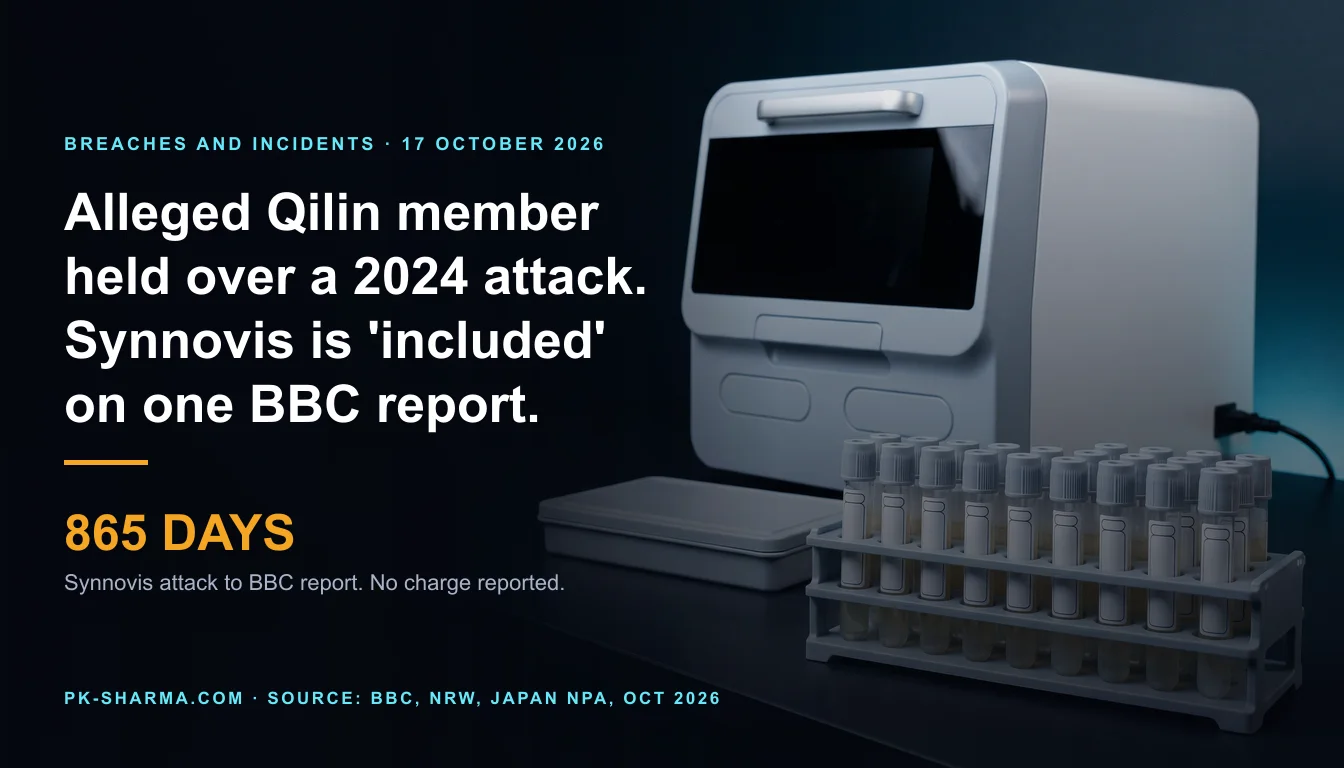
865 days from the Synnovis attack to a BBC report that Germany is 'including' it
On 16 October 2026 the BBC reported that German detectives are now including the 3 June 2024 attack on the pathology provider Synnovis in their investigation of a Russian man, aged 28, who is accused of being one of the core members of the Qilin ransomware gang. That report appeared 865 days after the attack (derived). The man was held in Japan in May 2026, between 697 and 727 days after it (derived), and handed to Germany on 2 October. The case he was wanted for is a different one.
The BBC says he was wanted in Germany for hacking a logistics company in September 2024, encrypting its data and extorting around 160,000 dollars in cryptocurrency. Japan's National Police Agency, in its own release, says only that Germany held a warrant for a ransomware case that occurred in Germany. Against the more than 140 million dollars that the interior minister of North Rhine-Westphalia (NRW), the German state that led the investigation, says the whole group was paid, that one ransom is 0.114 per cent (derived).
The record does not establish that the detained man took part in the Synnovis intrusion. "Including the incident in the investigation" is the BBC's wording, and the BBC does not say who at the German authorities confirmed it or in what form. The German ministers' statement of 7 October, in the news agency and broadcaster reports read, does not mention Synnovis. No charge for Synnovis, in Germany or the United Kingdom, has been reported. The BBC's separate statement that British police are examining whether their own inquiry may lead to an unlawful killing case quotes no police statement, and names no force, no source and no offence.
This briefing reads the primary statements it could reach: the NRW government's media notice, the Japanese police release (read in Japanese), NHS England, Synnovis and Department of Health and Social Care records, Parliament's text of the Cyber Security and Resilience Bill, and the statutes and guidance cited. Translations from German and Japanese are this briefing's own. Where a German minister's words come from news agency or broadcaster reports, that is said. Each source describes its own work: the state ministers announced their own investigative success, Japan's police announced their own contribution, and the BBC reports its own scoop, with no stated source for the UK police claim. The detained man and the patient are not named here, and nothing is said of the patient beyond what the trust itself published. Every source was read between 11:08 and 11:44 BST on Saturday 17 October 2026.
What each authority has said, in date order
The ladder sets the dated statements side by side. The blue cards are statements by an authority, or reports of one, that were read. The orange card rests on the BBC alone. The pink panel is the boundary: what none of the records read states.
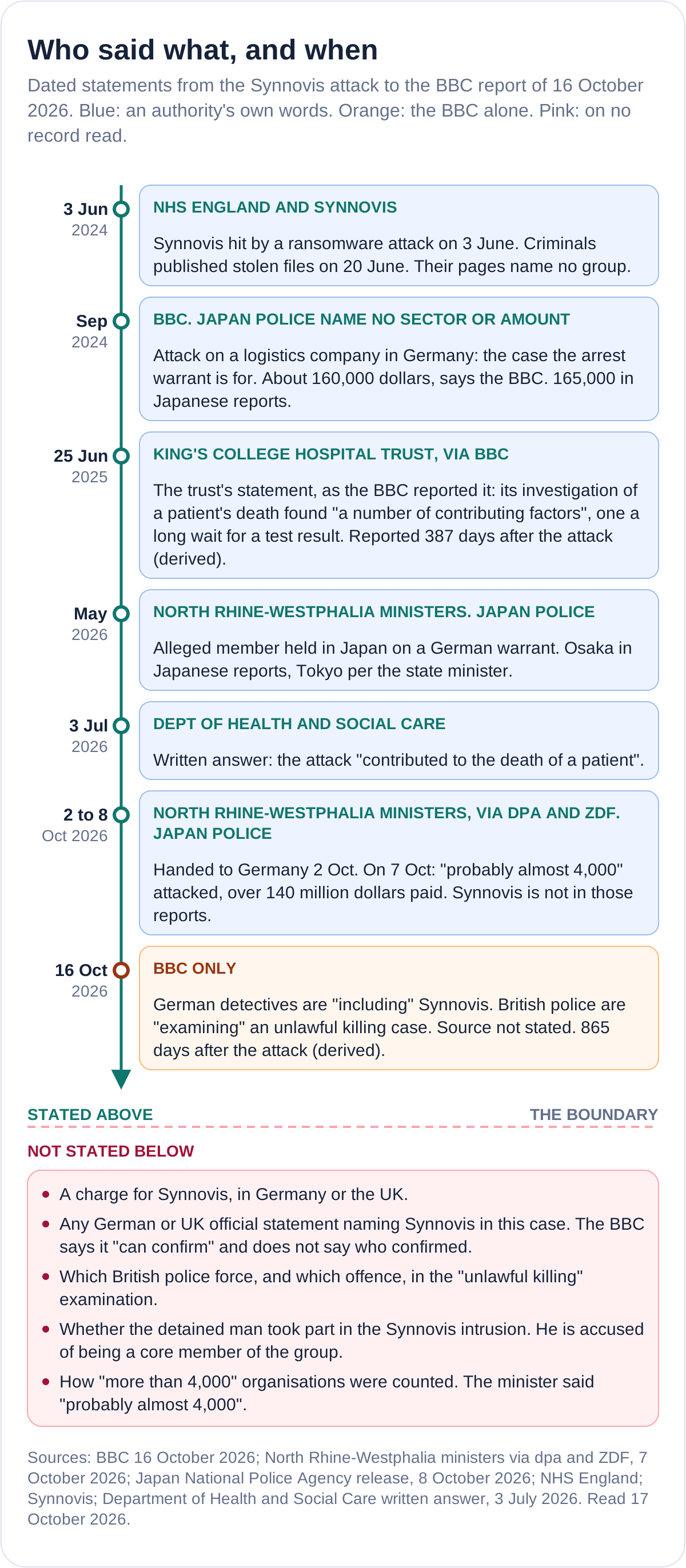
The arrest as stated by the German state ministers, Japan's police and the BBC, read on 17 October 2026. The ministers' words are taken from agency and broadcaster reports of their 7 October statement; translations are this briefing's own.
| Source | Stated | Not stated |
|---|---|---|
| NRW interior and justice ministers, 7 October: state media notice; words via dpa and ZDF | A 28-year-old Russian arrested in Japan in May, handed over on 2 October, "dringend tatverdächtig" (strongly suspected) and "einer der führenden Köpfe" (one of the leading heads) of the group. State criminal police and the central cybercrime unit infiltrated the group for months. A trial awaits. Victims are told: do not pay, report. | Any mention of Synnovis in the reports read. The offence, court or charge. The victim's sector or the amount it paid. No written release was found on the state government, interior ministry, state criminal police or justice websites. |
| Japan National Police Agency release of 8 October, read in Japanese | Germany announced the arrest of a Russian suspect "believed to have led" the group. Japan's police held him on a provisional detention permit under the Act on Extradition of Fugitive Offenders after he came to Japan on a German warrant, working with the Justice Ministry and the Tokyo High Public Prosecutors Office, and he was handed over. The German case is a ransomware case that occurred in Germany. | The dates, the place, the victim company, the amount, his role beyond "led", and any mention of Synnovis or the UK. |
| BBC article, 16 October | He is accused of being one of the core members; wanted for a September 2024 logistics attack, about 160,000 dollars; German detectives are "including" the Synnovis attack; British police are "examining" whether their inquiry may lead to an unlawful killing case. | Who confirmed the German step. The source or force behind the UK police claim. Any charge. How the 4,000 and the 140 million were counted. |
Pages read for the table above: NRW state government media notice, 7 October 2026; dpa report via Stuttgarter Zeitung, 7 October 2026; ZDFheute report, 7 October 2026; Japan National Police Agency release, 8 October 2026 (Japanese); BBC article, 16 October 2026.
The UK record on the Synnovis attack, the death and the investigation, read on 17 October 2026.
| Source | Stated | Not stated |
|---|---|---|
| NHS England update of 10 November 2025 and Synnovis incident page, updated March 2026 | A ransomware attack on 3 June 2024; stolen data published on 20 June; over 11,000 outpatient and elective appointments delayed; services fully restored by December 2024 per NHS England and late autumn 2024 per Synnovis; the incident reported to the ICO; work with the National Crime Agency and the National Cyber Security Centre. Synnovis finished notifying affected organisations by the end of November 2025. | The group's name. Any death. Any police outcome. |
| NCSC statement of 21 June 2024; NCSC annual reviews; gov.uk news of 24 October 2025 | "A cyber criminal group" published the data; "a cyber criminal group executed a ransomware attack on Synnovis". | The group is not named in any of the pages read. |
| King's College Hospital NHS Foundation Trust, 25 June 2025, as reported by the BBC | A patient had died. Its patient safety incident investigation "identified a number of contributing factors that led to the patient's death", including a long wait for a test result because of the attack. | The date of death, the age or the circumstances: the trust declined, citing confidentiality. The trust's own page for this statement was not found. |
| Department of Health and Social Care, written answer of 3 July 2026 | The attack "tragically, contributed to the death of a patient". The department investigated as the competent authority under the NIS Regulations and identified lessons, now actioned. | The findings, the lessons, or any police referral. |
| National Crime Agency, Metropolitan Police and other forces | Nothing found: no release on this arrest, on Synnovis or on an unlawful killing examination, on the NCA news pages or by search. | The force, the offence and the status of any UK inquiry. |
| Information Commission, still called the ICO: public enforcement register | A search for "synnovis" returned no matching results (11:25 BST, repeated at 11:43, when a search for another body returned its entry). Synnovis says it reported the incident and has been in regular contact. | Whether any inquiry is open. The register lists published action only. |
Pages read for the table above: NHS England, Synnovis cyber incident update, 10 November 2025; Synnovis cyber incident summary, updated March 2026; NCSC statement on reports of a Synnovis data breach, 21 June 2024; GOV.UK news on supply chain ransomware guidance, 24 October 2025; BBC report of the trust's statement, 25 June 2025; Department of Health and Social Care written answer, 3 July 2026; ICO enforcement action register.
The 4,000, the 140 million and the 160,000: whose numbers, and on what basis
Three sets of figures travelled with the story. None comes from a charge sheet or a court. All the group-wide figures are the NRW investigators' own, given by the interior minister at a press statement.
The figures in the BBC report, who stated them and on what basis, as read on 17 October 2026.
| Figure | Who says it, and the basis | What it does not say |
|---|---|---|
| More than 4,000 organisations hacked (BBC) | The interior minister, as reported by dpa: since 2024 the group "wohl fast 4.000" (probably almost 4,000) companies and institutions attacked, 150 in Germany and 30 in NRW, the unreported figure "probably higher". Outlets vary the verb: attacked (dpa via Stuttgarter Zeitung), extorted (ChannelPartner and ZDF). ZDF attributes the figure to the minister. | How an organisation was counted, or which cases were verified. The BBC's "more than" sits on the other side of 4,000 from the minister's "almost". |
| More than 140 million dollars extorted (BBC) | The minister: ransom demands of almost 3 billion dollars, more than 140 million actually paid. ZDF adds that the demand figure rests on the state criminal police's findings and that the figures cover the whole group. dpa reports that investigators followed cryptocurrency payment flows. | How the payments were verified. Whether any was paid by Synnovis: the BBC says no ransom was paid. |
| About 160,000 dollars from the logistics company (BBC) | The BBC and SecurityWeek say around or over 160,000; Japanese reports, via ZDF and sumikai, say about 165,000, citing investigators. Neither Japan's police release nor the ministers' remarks, as reported, give an amount. | Whether it was paid in full, or the victim's identity. |
Pages read for the table above: dpa report via Stuttgarter Zeitung, 7 October 2026; dpa report via ChannelPartner, 7 October 2026; ZDFheute report, 7 October 2026; SecurityWeek, 7 October 2026; sumikai, 6 October 2026.
Three derived checks follow. The logistics ransom is 0.114 per cent of the group total (derived), about 1 part in 875. Paid against demanded is about 4.7 per cent (derived), reading "almost" three billion and "more than" 140 million as the figures. One more is an arithmetic illustration only, not a finding: 140 million divided by 4,000 is 35,000 dollars (derived). It assumes every organisation paid, which no source says, and the logistics ransom is 4.6 times it (derived), which shows the quotient describes no organisation.
These are claims about the group. They describe what the state's investigators say they learned by infiltrating it; the BBC puts "allegedly" on them; and they say nothing about what the detained man did. The same press statement urged victims to report rather than pay. The BBC's own "extorted" does not separate demanded from paid, and the minister's two figures differ by a factor of about 21 (derived).
The death link: who established it, and how far it goes
Two UK bodies have said the attack contributed to a patient's death, and neither says it was the only cause. King's College Hospital NHS Foundation Trust said, as the BBC reported on 25 June 2025 (387 days after the attack, derived), that its patient safety incident investigation "identified a number of contributing factors that led to the patient's death", and that these included a long wait for a blood test result because of the attack. The trust declined to give a date or the patient's age. On 3 July 2026 a Department of Health and Social Care written answer said the attack "tragically, contributed to the death of a patient". The patient is not named here and no further detail is given or needed.
The BBC's 16 October report goes further in wording. It calls the attack "the first cyber attack in history to be directly linked to a death". "Directly" is the BBC's word: neither the trust nor the department used it, and whether this is the first such case anywhere was not verified. In 2020 the BBC reported a German homicide investigation after a hospital attack; its 2026 report says that case was dropped because medical experts concluded the patient would have died regardless and prosecutors could not prove the attack was the direct cause. That is the BBC's account; the German prosecutors' own statement was not read.
The distinction matters for what comes next. A clinical safety investigation, and a government answer that an event contributed to a death, are findings about care. They are not a court's finding on causation in law, which is what a manslaughter case turns on. One statute does not need the attack to be the sole cause. Section 3ZA of the Computer Misuse Act 1990 says it is immaterial whether an act "is the only or main cause of the damage", and counts "loss to human life" and "disruption of services relating to health" as damage to human welfare. It still requires proof that a person did an unauthorised act, knew it was unauthorised, and intended serious damage or was reckless as to it. Who did the Synnovis intrusion is the part no record read states.
Seven friendly names, and what each hides
A label is not a finding. Seven appear in this story.
Labels in the story, where each appears and what the record shows.
| The label | Where it appears | What the record shows |
|---|---|---|
| "Linked to" | BBC headline: "Russian man linked to deadly London hospitals hack arrested". | The record ties him to a different attack. "Linked" stretches from named in an investigation to charged. The BBC's own text says "including the incident in their investigation", the weaker end. |
| "Core member" | BBC: "one of the core members". Interior minister, as reported: one of the leading heads. Japan's police: "believed to have led" the group. | Three different claims of rank. None says what he did in any one attack, or whether he did anything in the Synnovis one. |
| "The Qilin gang" | BBC and German reports. | A ransomware-as-a-service operation: German investigators say a core supplies software and infrastructure to several hundred affiliate groups who carry out attacks and share the proceeds. "Qilin did it" does not say which group broke in; see one affiliate working for four brands. The UK pages read do not name the group at all. |
| "Directly linked to a death" | BBC. | The trust says "contributing factors"; the department says "contributed". Neither says direct, or sole. |
| "Unlawful killing" | BBC: "an unlawful killing case". | It is not an offence. At an inquest it is a coroner's conclusion limited to murder, manslaughter (including corporate manslaughter) and infanticide; in a prosecution the charge would be one of those. The BBC does not say which it means, or which force. |
| "Including the incident in the investigation" | BBC. | No charge, no warrant and no German statement naming Synnovis, in the reports read. It is an investigative step, and the confirming source is not named. |
| "Hacked 4,000 organisations" | BBC and the ministers. | Three verbs for one figure (hacked, attacked, extorted). "Almost" became "more than". The figure is the whole group's, not the man's. |
Pages read for the table above: This site's briefing on one affiliate working for four ransomware brands.
The UK: what the law and guidance can reach, and where each stops
Nothing below predicts a UK charge. The point is to show which routes exist on the texts read, what each requires, and where each stops on the present record.
Criminal law routes named by the story, as read on gov.uk, legislation.gov.uk, the CPS and the judiciary site on 17 October 2026. A reading of the texts, not a legal opinion.
| Route | What the text says | Where it stops |
|---|---|---|
| Computer Misuse Act 1990, section 1, section 3 and section 3ZA | Section 1, unauthorised access: up to 2 years. Section 3, acts intended or likely to impair a computer or hinder access to data: up to 10 years. Section 3ZA, acts causing or risking serious damage to human welfare, including loss of life, illness, injury or disruption of health services: up to 14 years, and life where the risk is to life or of illness or injury. Section 4 and section 5 give a UK link where, for 3ZA, the damage occurred in the home country. | Needs a person proved to have done the act. Who intruded at Synnovis is not stated. No UK charge reported. |
| Blackmail, Theft Act 1968 section 21 | An unwarranted demand with menaces, with a view to gain or intent to cause loss: up to 14 years. | The German case, as reported, is extortion. Whether UK blackmail is under consideration is not stated. |
| Murder and manslaughter (CPS homicide guidance, updated 10 March 2026) | Without intent to kill or cause grievous bodily harm the charge is manslaughter. Unlawful act manslaughter needs an intentional unlawful act that all sober and reasonable people would realise must subject the victim to at least some risk of harm. Gross negligence manslaughter needs, in the CPS's quotation, "the breach of an existing duty of care" that gives rise to a serious and obvious risk of death and "does, in fact, cause death". | The guidance does not discuss ransomware, whether an attacker owes a duty of care, or causation where clinical care and delay intervene. The BBC calls a case here "potentially a world first". |
| Corporate manslaughter (2007 Act section 1; CPS corporate manslaughter guidance) | An organisation is guilty if the way its activities are managed or organised causes a death and amounts to a gross breach of a relevant duty of care owed to the deceased, with senior management's failure a substantial element. The penalty is a fine. It applies where the harm is sustained in the UK. | It is aimed at an organisation's own management, not at an outside attacker. Nothing read says any organisation is under investigation under it. |
| Inquest "unlawful killing" (Chief Coroner Law Sheet 1; Chief Coroner Guidance 17) | The conclusion is limited to murder, manslaughter (including corporate manslaughter) and infanticide, and may not name the person responsible. Law Sheet 1 says the criminal standard of proof; Guidance 17, citing the Supreme Court's 2020 Maughan decision, says the balance of probabilities. | No inquest on this patient was found in the sources read. The two documents differ on the standard, and the guidance is the one citing the later authority. |
Pages read for the table above: Computer Misuse Act 1990 section 1; Computer Misuse Act 1990 section 3; Computer Misuse Act 1990 section 3ZA; Computer Misuse Act 1990 section 4; Computer Misuse Act 1990 section 5; Theft Act 1968 section 21; CPS guidance on homicide, updated 10 March 2026; Corporate Manslaughter and Corporate Homicide Act 2007 section 1; CPS guidance on corporate manslaughter; Chief Coroner's Law Sheet No. 1, unlawful killing; Chief Coroner's Guidance No. 17, conclusions.
How they differ. "Unlawful killing" labels a result: a death caused by a homicide offence. It does not itself identify an offender. Gross negligence manslaughter is an offence by a person who owed a duty of care; corporate manslaughter is the organisation's version, with the duty and the senior management test set by statute. On the texts, an outside attacker fits the unlawful act form, or the Computer Misuse Act, more naturally than the duty of care forms (inference, not a legal opinion). None is settled here, because the record names no charge, no suspect for the Synnovis intrusion and no UK force.
Supply chain, data protection and the Cyber Security and Resilience Bill: what each says, and where it stops, as read on 17 October 2026.
| Instrument | What it says | Where it stops |
|---|---|---|
| NCSC supply chain security guidance | Twelve principles in four stages: understand the risks, establish control, check your arrangements, continuous improvement. The NCSC's Director for National Resilience, quoted on gov.uk: a ransomware attack on one organisation "can severely disrupt entire supply chains". | Guidance, not a duty. The page says it is not written for high-assurance needs. |
| Department of Health and Social Care, written answer of 30 June 2026 | Over 80,000 suppliers and limited central visibility of dependencies. A governed list of critical suppliers, a national remediation process, a third-party risk standard and a national platform. The direction is from voluntary commitments to formal standards and legislative underpinning. | No dates, no published list, no contract term. |
| Data Security and Protection Toolkit (NHS England) | All organisations with access to NHS patient data and systems must use it. The 2026-27 version 9 was released on 1 September 2026, and the mandatory audit page of 1 October names IT suppliers among the audited categories. | An assurance of controls, not a time limit for detection, notification or restoration. Whether a pathology provider counts as an IT supplier was not established. |
| UK GDPR Article 32 and Article 33 | Controller and processor must apply security appropriate to the risk, including the ability to restore availability and access to personal data in a timely manner. The controller notifies the regulator within 72 hours where feasible; the processor must notify the controller "without undue delay". | Personal data only, and no hours for the processor. The regulator became the Information Commission on 30 September 2026, still called the ICO. |
| NIS Regulations 2018 and the Cyber Security and Resilience Bill | The department is the competent authority for health in England (written answer of 3 July). The Bill text as amended in Grand Committee on 7 September 2026 would let a competent authority designate a person as a critical supplier if it supplies an operator of an essential service and an incident could disrupt it with a significant impact on the economy or day-to-day functioning of society. Lords report stage is listed for 26 October 2026, provisional. | A power to designate, not a designation. Whether a pathology supplier would be named is not stated. Not yet law. |
| Ransomware payment proposals (Home Office response, 22 July 2025) | Consultation 14 January to 8 April 2025. Three proposals: a targeted ban on payments for regulated critical national infrastructure and the public sector, a payment prevention regime, and mandatory incident reporting. The Government "will continue to develop" the ban. A Home Office written answer of 17 July 2026 repeats that it consulted. | Not in the Bill: its text as amended, 35,509 words searched, does not contain the word ransom (derived). Not law, and the July 2026 answer gives no bill or date. |
Pages read for the table above: NCSC supply chain security guidance; GOV.UK news, 24 October 2025; Department of Health and Social Care written answer, 30 June 2026; Data Security and Protection Toolkit; UK GDPR Article 32; UK GDPR Article 33; Parliament's stages page for the Cyber Security and Resilience Bill; HL Bill 49, the Bill as amended in Grand Committee; Home Office response to the ransomware consultation, 22 July 2025; Home Office written answer, 17 July 2026.
One point of status. The payment proposals are sometimes described as part of the Cyber Security and Resilience Bill. On the texts read they are not. The Home Office response says that for supply chains the Government will "explore existing arrangements under the Cyber Security and Resilience Bill", which points to the Bill's critical supplier power, not to a payment ban (inference). None of these instruments sets a time between a supplier outage and a clinician knowing which patients are waiting on a result.
What to do, in the order worth doing
Each item rests on a record read for this briefing, and none depends on who intruded at Synnovis or on whether anyone is charged. There is one list for each of three roles.
Take this with you
An NHS trust's supplier lead
- List every supplier whose outage would stop a clinical pathway, starting with diagnostics. Write against each the manual fallback and the person who decides to invoke it. NHS England's account of the 2024 outage records trusts unable to cross-match blood for transfusion and using O-type blood instead.
- Ask each of them in writing for their current DSPT status and audit date, the number of hours in which they will tell you of an incident, and where your data sits outside their primary systems.
- Put the notification time and a duty to help your own breach assessment into the contract. UK GDPR says only "without undue delay" for a processor, and your own 72 hours run from when you become aware.
- Agree in advance how the trust will find patients whose results were delayed, and who reviews them. The Department of Health and Social Care says it improved how patient harm is identified after a cyber incident, so ask your integrated care board what that means locally.
- Ask the Department of Health and Social Care whether any of your suppliers is on its governed list of critical suppliers. A statutory designation under the Bill cannot happen until the Bill is law.
- Keep your own evidence trail: logs, decisions and supplier correspondence. 865 days (derived) after the attack, police inquiries are still reported as open, and reviews, claims and inquests can follow.
Take this with you
A pathology or diagnostics supplier
- Treat every working drive, file share and export folder as a store of customer data, and know what is on each. Synnovis says data was taken "in haste and in a random manner" from working drives, not its primary lab databases, and that working out whose data it was took over a year.
- Tell controllers early and in a form they can use. Synnovis finished notifying affected organisations by the end of November 2025, 545 days after the attack (derived).
- Hold a tested manual downtime procedure agreed with each customer, with a named contact on each side. Test restore times against the longest result delay a clinician would accept.
- Complete the DSPT return and any audit, and read the supplier questions in the 2026-27 version.
- Name one contact for law enforcement and the regulator, and preserve evidence. Inquiries last years and ask the same questions again.
- Plan recovery without relying on payment policy. The Government does not advise paying, and the proposed ban is not law.
Take this with you
A CISO
- Ask which of your own services a supplier outage would stop, and who could say within an hour which people or customers were waiting on a result. Then ask who may speak to the press, the police and the regulator.
- Brief the board precisely: a press report of a police investigation is not a charge, and "linked to" is not a finding. Do not change a risk rating on the label alone; use the stated and not stated tables above.
- Do not treat an arrest as a drop in threat. The ministers described a continuing investigation, and researchers cited by The Record put Qilin second most active in July 2026, with 127 reported attacks.
- Align to what UK bodies already ask: register for the NCSC Early Warning service, use the Cyber Governance Code of Practice and adopt Cyber Essentials in supply chains, as a Department for Science, Innovation and Technology written answer of 23 April 2026 lists.
- Run a tabletop on the first day of a supplier outage at board level, using the NCSC's twelve supply chain principles as the agenda.
- Track the law: Lords report stage on 26 October (provisional), and the payment proposals, which are not in the Bill. Ask counsel what a payment ban would mean for your sector.
Pages behind the checklists: NHS England London statement on the outage; Synnovis incident page; DHSC written answer on suppliers, 30 June 2026; DSIT written answer, 23 April 2026; NCSC supply chain guidance; UK GDPR Article 33; The Record, 9 October 2026.
What could not be verified
- No German written release. The only official German item found is the NRW media-event notice. The ministers' words come from dpa, ZDF and ChannelPartner reports. No release was found on the state government, interior ministry, state criminal police or justice websites.
- The Synnovis step. No German statement naming Synnovis in this case was found. It rests on the BBC, which does not say who confirmed it.
- The UK police claim. No NCA or Metropolitan Police statement was found. The BBC gives no source and names no force.
- Arrest place and handover date. Osaka (Japanese reports, SecurityWeek) against Tokyo (the NRW minister, as reported). The Record says he was sent to Germany in June, citing a Japanese outlet; the ministers, SecurityWeek and sumikai say 2 October.
- The offence. The BBC says hacking, encryption and extortion. The sumikai report says the investigation is for extortion. No charge sheet was found.
- Blocked pages. The Japan Times article the BBC links to and the DataBreaches.net repost were not read; one returned a bot challenge and one a refusal, and neither was bypassed. Eurojust's site refused a request and Europol's search page returned no content, so no Europol or Eurojust release on this arrest was found.
- The trust's own statement. Its page was not found; the BBC's report of it was read, with the department's written answer as the government primary.
- The 2020 German case. Read only as the BBC reports it.
- Law. The CPS guidance on homicide and on corporate manslaughter, the statutes and the Chief Coroner's documents were read. Law Commission material was not. Whether a person abroad can be tried in England and Wales for homicide after a death here was not read from any source.
- The ICO register. A search for Synnovis returned no matching results at 11:25 BST and again at 11:43. An inquiry can exist without a published action.
- Time-stamped. Sources were read between 11:08 and 11:44 BST on 17 October 2026. A Bill stage, a police statement or a charge could change within hours.
The question that exposes the gap
If your pathology or diagnostics supplier went dark tonight, how many hours would pass before you could name which patients were waiting on a result, and who has the authority to act on that list?
Key facts
Sources
- PrimaryState government media-event notice for the interior and justice ministers' statement of 7 October 2026 on the arrest and extradition of a member of Qilin. The only official German item foundGovernment of North Rhine-Westphaliaaccessed 2026-10-17
- PrimaryRelease of 8 October 2026 on Germany's announcement of the arrest of a Russian suspect believed to have led Qilin, and Japan's role. Read in Japanese; the translation is this briefing's ownNational Police Agency of Japanaccessed 2026-10-17
- PrimaryNHS England's Synnovis cyber incident page, update of 10 November 2025: the attack date, the data published, appointments delayed and the report to the ICONHS Englandaccessed 2026-10-17
- PrimaryNHS England statement of 21 June 2024: a cyber criminal group published data; the NCA and NCSC verifying itNHS Englandaccessed 2026-10-17
- PrimaryNHS England London media statement: 10,152 outpatient appointments and 1,710 elective procedures postponed, and the use of O-type blood because cross-matching was unavailableNHS England Londonaccessed 2026-10-17
- PrimarySynnovis's incident summary, updated March 2026: the attack, the stolen data taken from working drives, notifications completed by the end of November 2025, and contact with the NCA, NCSC and ICOSynnovisaccessed 2026-10-17
- PrimaryNCSC statement of 21 June 2024 on reports of a Synnovis data breach: a cyber criminal group, investigations led by partnersNational Cyber Security Centreaccessed 2026-10-17
- PrimaryNews release of 24 October 2025 on supply chain ransomware guidance, describing the Synnovis attack as by a cyber criminal groupGOV.UK (Home Office)accessed 2026-10-17
- PrimaryWritten answer UIN 13479, answered 3 July 2026 by the Department of Health and Social Care: the attack contributed to the death of a patient; the department's NIS role and lessonsUK Parliamentaccessed 2026-10-17
- PrimaryWritten answer UIN 10460, answered 30 June 2026: NHS supplier cyber resilience, over 80,000 suppliers, critical supplier list and standardsUK Parliamentaccessed 2026-10-17
- PrimaryWritten answer UIN 18297, answered 17 July 2026 by the Home Office on mandatory ransomware reporting: consulted, no bill or dateUK Parliamentaccessed 2026-10-17
- PrimaryWritten answer UIN 124474, answered 23 April 2026: no authoritative estimate of ransom payment rates; the actions urged on leading companiesUK Parliamentaccessed 2026-10-17
- PrimaryCyber Security and Resilience (Network and Information Systems) Bill stages page, read at 11:16 BST on 17 October 2026: Lords report stage listed for 26 October 2026, provisionalUK Parliamentaccessed 2026-10-17
- PrimaryHL Bill 49, the Bill as amended in Grand Committee, 7 September 2026: 35,509 words searched, no mention of ransom; clause 12 on critical suppliersUK Parliamentaccessed 2026-10-17
- PrimaryGovernment response of 22 July 2025 to the ransomware legislative proposals consultation: the three proposals and the supply chain pointHome Officeaccessed 2026-10-17
- PrimaryComputer Misuse Act 1990 section 3ZA: serious damage, human welfare, only or main cause immaterial, penaltieslegislation.gov.ukaccessed 2026-10-17
- PrimaryComputer Misuse Act 1990 section 3: acts with intent to impair, up to 10 yearslegislation.gov.ukaccessed 2026-10-17
- PrimaryComputer Misuse Act 1990 section 4: territorial scope and significant linkslegislation.gov.ukaccessed 2026-10-17
- PrimaryTheft Act 1968 section 21: blackmail, up to 14 yearslegislation.gov.ukaccessed 2026-10-17
- PrimaryCorporate Manslaughter and Corporate Homicide Act 2007 section 1: the offencelegislation.gov.ukaccessed 2026-10-17
- PrimaryCPS prosecution guidance on homicide, updated 10 March 2026: murder, unlawful act and gross negligence manslaughterCrown Prosecution Serviceaccessed 2026-10-17
- PrimaryCPS prosecution guidance on corporate manslaughter: elements, causation test and territorial jurisdictionCrown Prosecution Serviceaccessed 2026-10-17
- PrimaryChief Coroner's Law Sheet No. 1 on unlawful killing: the conclusion is limited to murder, manslaughter and infanticideCourts and Tribunals Judiciaryaccessed 2026-10-17
- PrimaryChief Coroner's Guidance No. 17 on conclusions: the standard of proof and the reference to Law Sheet 1Courts and Tribunals Judiciaryaccessed 2026-10-17
- PrimaryNCSC supply chain security guidance: the twelve principlesNational Cyber Security Centreaccessed 2026-10-17
- PrimaryData Security and Protection Toolkit home page and release notes: who must use it, the 2026-27 version 9 and the audit areasNHS Englandaccessed 2026-10-17
- PrimaryUK GDPR Article 33: notification of a personal data breach, controller 72 hours, processor without undue delaylegislation.gov.ukaccessed 2026-10-17
- PrimaryUK GDPR Article 32: security of processinglegislation.gov.ukaccessed 2026-10-17
- PrimaryICO enforcement action register: a keyword search for Synnovis returned no matching results at 11:25 and 11:43 BST on 17 October 2026Information Commissioner's Officeaccessed 2026-10-17
- Reported byBBC, 16 October 2026: the report of the arrest, the 4,000 and 140 million claims, the logistics case, German detectives including Synnovis and British police examining an unlawful killing case. Read in full; its source for the UK police claim is not statedBBC Newsaccessed 2026-10-17
- Reported byBBC, 25 June 2025: the King's College Hospital NHS Foundation Trust's statement on a patient's death and the contributing factors. The trust's own page was not foundBBC Newsaccessed 2026-10-17
- Reported byBBC, 18 September 2020: the German homicide investigation after a hospital attack, referred to by the 2026 report as later dropped. Read as the BBC's accountBBC Newsaccessed 2026-10-17
- Reported bydpa report, 7 October 2026: the ministers' words on the arrest, almost 4,000 organisations, 150 in Germany, almost 3 billion dollars demanded, more than 140 million paid. Secondary, used for what the ministers saiddpa via Stuttgarter Zeitungaccessed 2026-10-17
- Reported bydpa report, 7 October 2026: the same statement with a different verb for the 4,000 (extorted)dpa via ChannelPartneraccessed 2026-10-17
- Reported byZDF report, 7 October 2026: the statement, the Japanese-reported 165,000 dollars, and that the figures cover the whole group, based on the state criminal police findingsZDFheuteaccessed 2026-10-17
- Reported bySecurityWeek, 7 October 2026: the arrest in Osaka, the 2 October handover and the logistics case at over 160,000 dollars. SecondarySecurityWeekaccessed 2026-10-17
- Reported bysumikai, 6 October 2026: the Tokyo High Court review, the 2 October handover and that the investigation is for extortion. Secondarysumikaiaccessed 2026-10-17
- Reported byThe Record, 9 October 2026: Japan's police confirmation and Qilin's activity level in 2026. Secondary; its June handover date conflicts with the other sourcesThe Record from Recorded Future Newsaccessed 2026-10-17