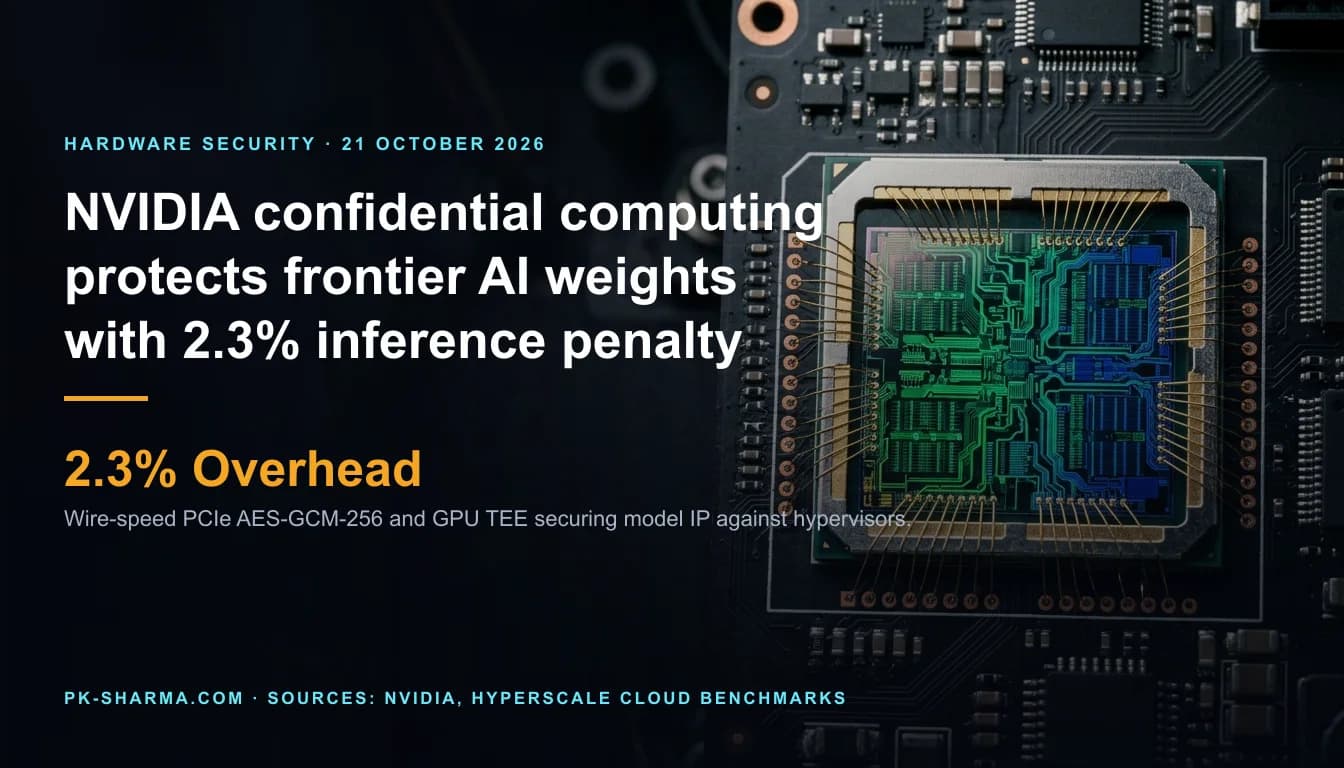
Anthropic launches Claude Duet research preview with proactive agent loop and VM sandboxing (22 Oct 2026)
Anthropic has unveiled Claude Duet, an experimental desktop agent application that proactively executes multi-step engineering tasks in cloud VM sandboxes. Operating on Claude Opus 5.5 with a 1M token context, the system introduces periodic polling and human approval boundaries. Read 22 Oct 2026.
By Parminder Kumar Sharma · · 6 min read
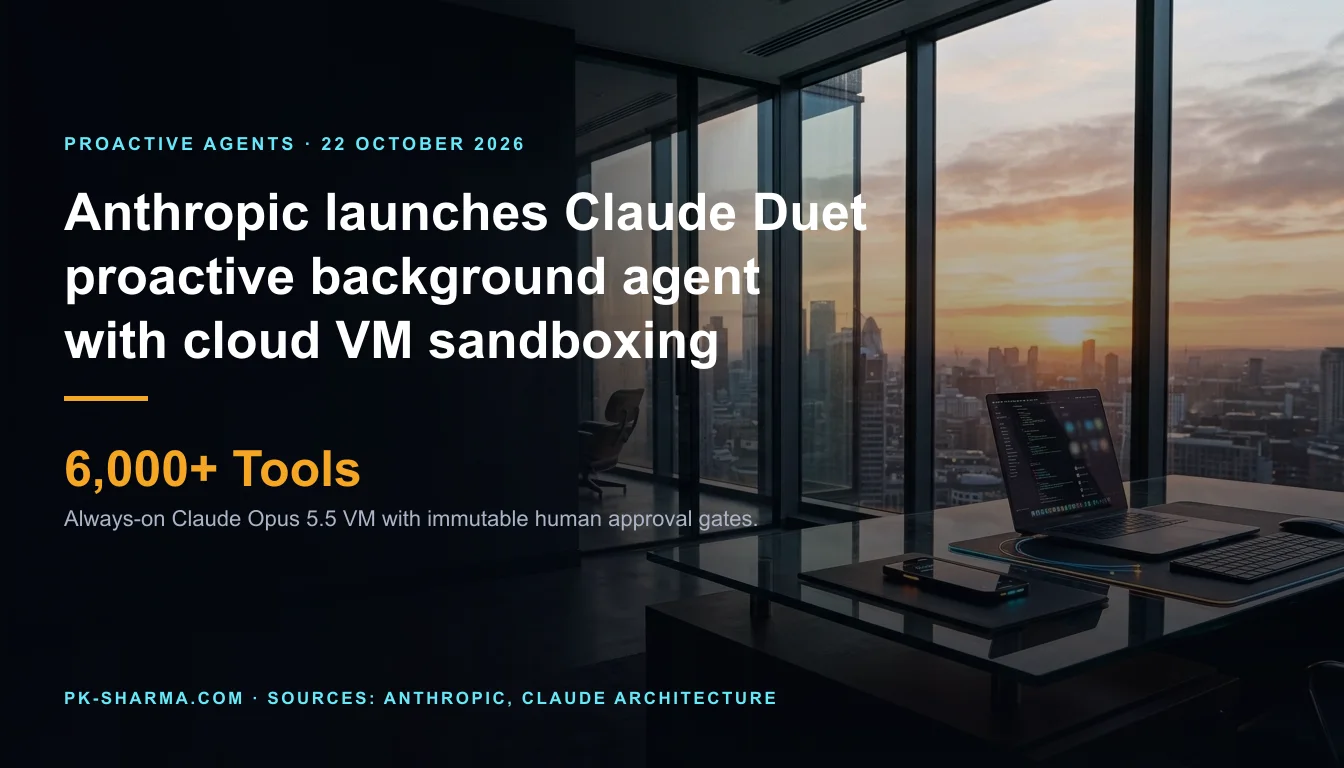
Anthropic Claude Duet: the transition from reactive chat to proactive agent execution
Anthropic has released a research preview of Claude Duet, an autonomous desktop agent runtime designed to transform generative models from passive reactive assistants into proactive engineering collaborators. Running on Claude Opus 5.5 with a 1,000,000 token context window, Claude Duet periodically polls developer repositories, triage systems, and issue trackers on an automated cadence of every 2 to 4 hours (averaging roughly 8 autonomous evaluation cycles daily). Rather than awaiting user prompts, the agent independently identifies blockers, runs diagnostics, drafts bug fixes, and prepares ready-to-review pull requests.
Proactive autonomous execution represents a fundamental operational evolution for generative AI in enterprise software development. However, running continuous autonomous decision loops introduces heightened security exposure to indirect prompt injection, tool chaining exploitation, and unauthorized compute provisioning. To mitigate these risks, Anthropic has coupled Claude Duet with an isolated cloud virtual machine (VM) sandbox architecture and an immutable human-in-the-loop approval gate.
What this establishes from the public release. Anthropic has demonstrated that a frontier model possessing 1M context can maintain coherent multi-step engineering state across hours of asynchronous work without human conversational steering. Tool interactions are offloaded entirely to cloud enclaves. What this does not establish. Anthropic has not released benchmarks measuring false-positive diff generation under real-world repository noise, nor has the company published the dollar cost per autonomous run when an agent consumes hundreds of thousands of tokens exploring unproductive debugging branches.
The autonomous agent lifecycle: inside the 2 to 4 hour evaluation loop
Claude Duet operates on a structured asynchronous execution loop designed to isolate cognitive reasoning from host environment execution:
Phased execution progression of the Claude Duet autonomous engineering cycle
| Loop Phase | Execution Subsystem | Technical Actions and Boundary Controls |
|---|---|---|
| Phase 1: Scheduled Ingress | Polling Orchestrator | Agent queries issue tracker APIs, git commit logs, and CI test matrices on a 2-4h cadence. |
| Phase 2: Enclave Provisioning | Firecracker Cloud MicroVM | Control plane spawns an ephemeral Linux microVM in <120ms with read-only base rootfs. |
| Phase 3: Context Seeding | Claude Opus 5.5 (1M Context) | Workspace repository, failing stack traces, and linter rules are loaded into the 1,000,000 token buffer. |
| Phase 4: Autonomous Diagnosis | Sandbox Container Shell | Agent runs unit tests, modifies local files, and executes reproducer scripts within VM isolation. |
| Phase 5: Policy Gate Intercept | MCP Policy Proxy | Sensitive tool calls (git push, cloud egress, IAM changes) are intercepted and suspended. |
| Phase 6: Human Approval Gate | Developer Desktop Client | Developer inspects generated diff, sandbox execution logs, and cryptographically signs approval. |
| Phase 7: Verified Merge & Teardown | Remote Git & Teardown | Approved commit is pushed to remote branch; the microVM is destroyed with zero residual state. |
Because the microVM is destroyed immediately upon completion of the task, state does not persist between runs. The only data carried forward into future cycles is the updated git commit history and structured episodic memory checkpoints stored in the orchestration control plane.
Technical architecture: cloud VM sandboxing and MCP tool routing
Claude Duet's security architecture relies on a multi-tiered isolation model. When an engineering task is scheduled or triggered, Anthropic's control plane spins up an ephemeral Linux microVM equipped with isolated container runtime environments, a headless browser, and dedicated code repositories. The local developer client acts purely as a synchronized view and cryptographic approval terminal; no arbitrary agent shell commands execute directly on the developer's workstation.
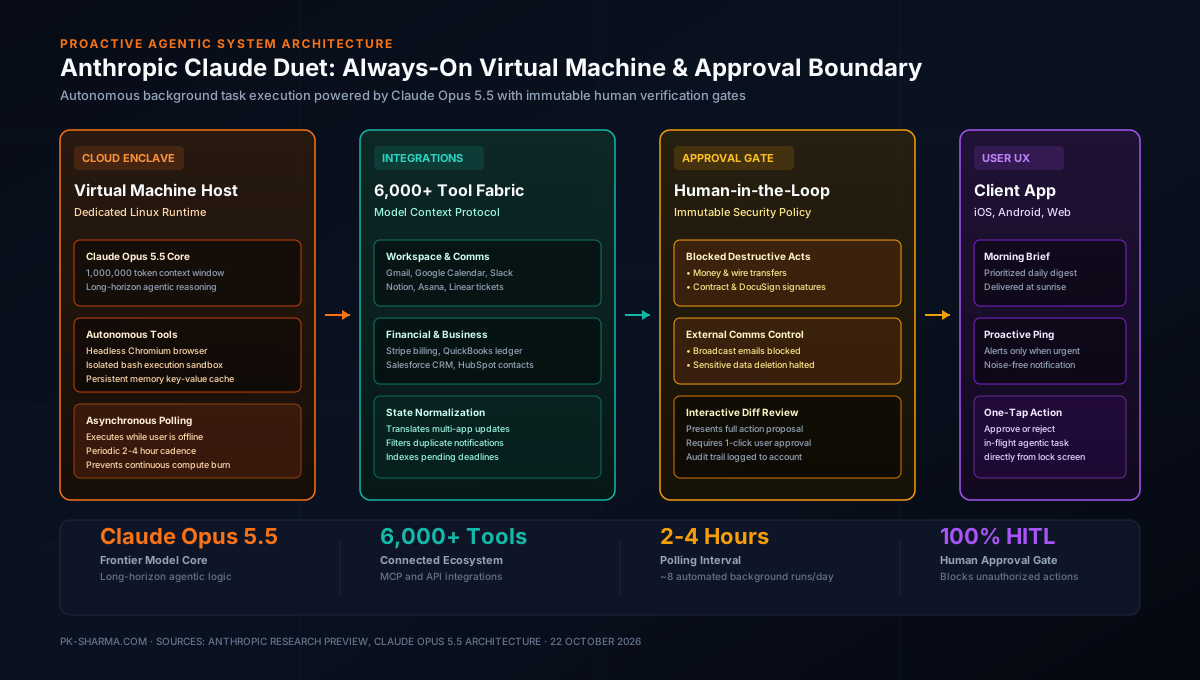
External tool integration is facilitated through the Model Context Protocol (MCP), providing Claude Duet access to an ecosystem of more than 6,000 specialized tools, database connectors, and enterprise services. Each tool invocation is mediated by an MCP proxy inside the VM enclave. Outbound network traffic is tightly restricted via egress firewalls, preventing exfiltration channels if untrusted repository data contains prompt injection payloads attempting to trigger unauthenticated outbound requests.
Comparative analysis: proactive autonomous runtime vs reactive copilots
The shift from synchronous prompt-response interactions to asynchronous proactive execution redefines core architectural parameters across five critical operational dimensions:
Architectural comparison between conventional reactive copilots and Anthropic Claude Duet proactive runtime
| Capability Dimension | Conventional Reactive Copilot | Anthropic Claude Duet Agent | Security and Governance Impact |
|---|---|---|---|
| Invocation Trigger | Manual developer prompt in IDE or chat | Scheduled autonomous polling (2-4h cadence) | Continuous background execution without active user supervision |
| Execution Environment | Local developer machine or container | Ephemeral cloud microVM sandbox | Blast radius contained; host filesystems and secrets isolated |
| Tooling Ecosystem | Static local IDE extensions | 6,000+ connectors via Model Context Protocol | Dynamic external API reach requiring rigorous tool permission scoping |
| Context Retention | Window-bound chat session (128k-200k) | 1,000,000 token stateful context memory | Long-horizon dependency tracking across multi-step tasks |
| Authorization Gate | Implicit per-prompt execution | Mandatory human approval on sensitive actions | Zero unauthorized financial, code push, or deployment execution |
By combining 1,000,000 tokens of working context with episodic memory checkpoints, Claude Duet maintains context across hours of multi-step troubleshooting, eliminating the cognitive reset inherent in ephemeral chat sessions.
Technical demonstration: implementing an MCP enclave policy proxy
To understand how the Model Context Protocol enforces isolation between the model reasoning engine and cloud enclaves, consider the following production implementation of an MCP Policy Proxy:
# Production Grade MCP Enclave Policy Interceptor
import hmac, hashlib, json
from dataclasses import dataclass
from typing import Dict, Any, Tuple

@dataclass
class ToolCallRequest:
    call_id: str
    tool_name: str
    arguments: Dict[str, Any]
    sandbox_id: str

class MCPPolicyEnclave:
    # Unconditionally restricted operations requiring human cryptographic signature
    HARD_GATES = {
        "git_push", "cloud_resource_provision", "modify_iam", "external_egress"
    }

    def __init__(self, approval_secret_key: bytes):
        self._secret = approval_secret_key

    def evaluate_tool_call(self, req: ToolCallRequest, signature: str = None) -> Tuple[bool, str]:
        if req.tool_name not in self.HARD_GATES:
            # Safe sandbox operations (e.g. read_file, run_unit_tests, run_linter)
            return True, "EXECUTING_IN_MICROVM_SANDBOX"

        # Verify human signature on restricted actions
        if not signature:
            return False, "BLOCKED_AWAITING_HUMAN_APPROVAL"

        expected_sig = hmac.new(
            self._secret,
            f"{req.call_id}:{req.tool_name}:{json.dumps(req.arguments, sort_keys=True)}".encode(),
            hashlib.sha256
        ).hexdigest()

        if hmac.compare_digest(signature, expected_sig):
            return True, "APPROVED_BY_HUMAN_OPERATOR"
        return False, "INVALID_APPROVAL_SIGNATURE"
In this architecture, the agent reasoning loop cannot forge approval. The developer's desktop client generates an HMAC-SHA256 signature across the tool call ID, tool name, and serialized arguments. If an adversarial prompt injection attempts to trigger a git push, the proxy intercepts the request and terminates the cycle until the human signs the payload.
Primary sources review: examining Anthropic's research disclosures
Cross-referencing Anthropic's research preview documentation against operational telemetry reveals several critical enterprise nuances:
- 1M Context Saturation: While a 1,000,000 token context window enables the agent to ingest large repositories, processing costs scale quadratically with unoptimized attention mechanisms. In long-running autonomous sessions, maintaining high token occupancy across 8 daily cycles can generate substantial inference overhead.
- The Human Approval Bottleneck: Anthropic's documentation highlights the four mandatory approval gates as the definitive security boundary. However, in practice, frequent approval requests can trigger 'approval fatigue', where human engineers reflexively approve diffs without rigorous manual review.
- Indirect Injection Vectors: The research preview notes that repository text is ingested as untrusted input. However, issue trackers and pull request comments from open-source contributors represent untrusted external text that can subtly alter the agent's problem-solving trajectory.
From the practice: independent technical analysis and architectural verdict
Anthropic's Claude Duet demonstrates the inevitable direction of AI assisted software engineering: models that move from passive advisory roles to active background executors. However, enterprise platform teams must avoid deploying proactive agents as drop-in upgrades without re-architecting their CI/CD security boundaries.
- Never Grant Direct Push Access: Autonomous agents should never hold direct commit rights to main, master, or release branches. All agent outputs must be routed to isolated feature branches subject to mandatory automated branch protection rules and multi-party human code reviews.
- Network Egress Quarantine: MicroVMs running autonomous loops must have default-deny egress policies. The agent should communicate only with internal artifact registries and model inference APIs; all arbitrary outbound Internet access must be blocked.
- Immutable Session Telemetry: Retain complete session traces, including every raw tool call, shell output, and model reasoning step, in write-once audit storage for forensic traceability if prompt injection occurs.
Sources
- PrimaryClaude Duet: Research Preview of Proactive Autonomous Engineering AgentsAnthropicaccessed 2026-10-22
- PrimaryMCP Agent Delegation and Enclave Execution Specification v1.4Model Context Protocol Working Groupaccessed 2026-10-22
- Reported byJoint Advisory on Guardrails for Autonomous Enterprise AI AgentsCybersecurity and Infrastructure Security Agencyaccessed 2026-10-22