WordPress fixed Comment2Shell in 25 releases on one day; check yours is one of them, and that no plugin arrived first
A comment-borne flaw in WordPress core, reported on 8 September, was fixed nine days later across every branch from 4.7 to 7.1. Automatic minor updates cover most sites. The two things to check are whether updates actually ran, and whether anything was added before they did.
By Parminder Kumar Sharma · · 5 min read

Nine days, 25 releases
WordPress core shipped 25 security releases on 17 September 2026, one for every branch from 4.7 to 7.1. The flaw they share was reported on 8 September, so the fix took nine days. It is now tracked as CVE-2026-93485 and has been given the name Comment2Shell by the researcher who found it, Rafie Muhammad of Awesome Motive.
In one sentence: a crafted comment could run script in a signed-in administrator's browser, and use that session to add a plugin to the site. The release notes describe it as stored cross-site scripting in wpautop() that an unauthenticated visitor can inject, subject to comment approval.
What this does not establish: that anyone has used it. CISA's enrichment on the CVE record says exploitation "none" and "not automatable", and it is not in CISA's Known Exploited Vulnerabilities catalogue (version 2026.09.21, 1,717 entries). The published score, CVSS 3.1 7.1, rates the script injection alone, not the route to a plugin.
What the record says, and what it leaves out
Stated and not stated, from the release notes, the CVE record and the researcher's write-up
| Question | Stated | Not stated |
|---|---|---|
| Is it core or a plugin? | WordPress core, all 25 release notes list it | |
| Which versions are fixed? | 4.7.36, 4.8.31, 4.9.32, 5.0.28, 5.1.25, 5.2.27, 5.3.24, 5.4.22, 5.5.21, 5.6.20, 5.7.18, 5.8.16, 5.9.17, 6.0.15, 6.1.13, 6.2.12, 6.3.11, 6.4.11, 6.5.11, 6.6.8, 6.7.8, 6.8.9, 6.9.8, 7.0.5 and 7.1.1 | |
| Is it exploited? | CISA-ADP: exploitation none; not in KEV | Whether anyone tried it before 17 September |
| Which themes? | Block themes, including every default theme from Twenty Twenty-Two to Twenty Twenty-Five, and some classic-theme paths | A full list of affected classic themes |
| Older branches | Fixed back to 4.7 | Whether the older branches can be exploited in practice: the researcher tested 7.1 |
| Web application firewalls | Whether a WAF blocks it: this rests on The Hacker News alone |
Two small inconsistencies are worth knowing about if you are writing your own advisory. The researcher says he reported to WordPress through HackerOne on 8 September and asked Patchstack for a CVE on 15 September; the CVE credits the Patchstack bug bounty programme, and Patchstack's timeline gives the release as both 17 and 18 September. The CVE text also calls the bug DOM-based XSS, where WordPress and the researcher call it stored XSS. None of this changes what you should do.
What has to be true, and which setting actually stops it
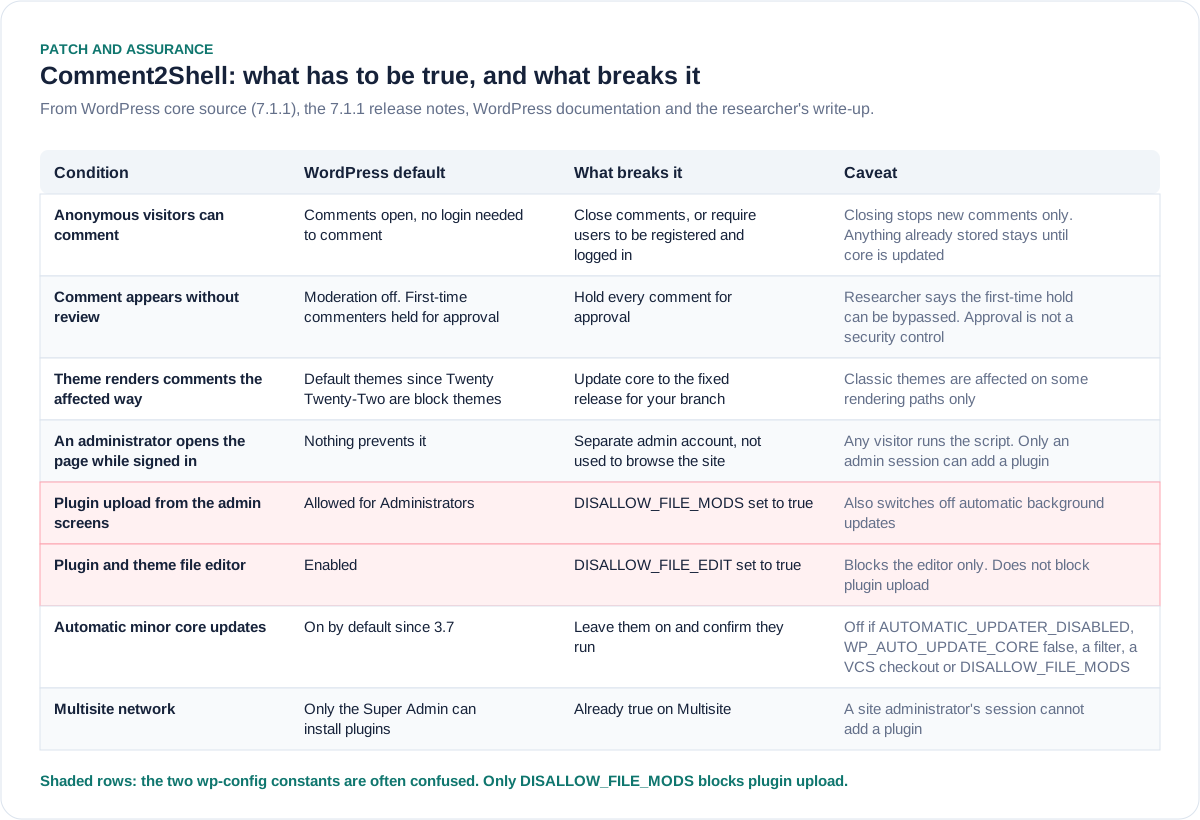
The setting most hardening guides reach for is DISALLOW_FILE_EDIT. It is a good setting, but it only removes the plugin and theme file editors. It does not stop an administrator session from uploading a plugin. The constant that does is DISALLOW_FILE_MODS, and WordPress's own documentation is clear that it also blocks plugin and theme installs and updates and switches off automatic background updates. A site that sets it needs its own, tested update process, or it will fall behind on exactly the kind of fix described here.
Comment approval is not a security control either. WordPress holds a first-time commenter for approval by default, but moderation of other comments is off by default, and the researcher says the first-time hold can be bypassed.
For UK organisations
Automatic minor core updates have been on by default since WordPress 3.7, so most self-hosted sites and nearly all managed hosts will already be on a fixed release. The sites most likely to have missed it are the ones someone deliberately froze: marketing microsites built by an agency, sites under version control where the updater is off, and sites with AUTOMATIC_UPDATER_DISABLED or WP_AUTO_UPDATE_CORE set to false. Those are also the sites nobody is watching.
Updating closes the hole. It does not undo anything done through it before the update. That is the step most advisories skip.
What to do this week
Take this with you
Comment2Shell: patch and assurance
- List every WordPress site you own or pay for, including agency-built and campaign sites.
- Confirm each one reports a fixed version: 7.1.1, or the fixed release for its branch (for example 6.9.8 or 7.0.5).
- Where a site is not fixed, find out why automatic minor updates did not run and switch them back on or schedule the update.
- Open the Plugins screen and look for anything nobody recognises, including inactive plugins, added since 8 September.
- Compare the plugins folder on disk with the Plugins screen, because a folder can exist without appearing active.
- If a site does not need public comments, close them or require registration.
- Use a separate administrator account that is not used to browse the public site.
- Only set DISALLOW_FILE_MODS if you have a separate, tested process for installing updates.
- Keep a recent backup of files and database so a site can be rebuilt if you find something unexpected.
The question to ask
The fix was fast and reached every branch. The question for anyone responsible for a WordPress estate is simpler and harder: for each site, can you show that the update ran, and that nothing was added in the nine days before it did?
Key facts
Sources
- PrimaryWordPress 7.1.1 Maintenance and Security Release, 17 September 2026: the release note listing the stored XSS in wpautop() and the 24 older-branch releasesWordPress.orgaccessed 2026-09-22
- PrimaryVersion 7.1.1 documentation pageWordPress.orgaccessed 2026-09-22
- PrimaryCVE-2026-93485 record, assigned by Patchstack, CVSS 3.1 7.1 and CISA-ADP enrichmentCVE Programaccessed 2026-09-22
- PrimaryNVD entry for CVE-2026-93485, status DeferredNVDaccessed 2026-09-22
- PrimaryKnown Exploited Vulnerabilities catalogue, version 2026.09.21, checked for CVE-2026-93485CISAaccessed 2026-09-22
- PrimaryEditing wp-config.php: DISALLOW_FILE_EDIT, DISALLOW_FILE_MODS and automatic update constantsWordPress Developer Resourcesaccessed 2026-09-22
- PrimaryHardening WordPressWordPress Developer Resourcesaccessed 2026-09-22
- Reported byPatchstack write-up of the 7.1.1 release and its timelinePatchstackaccessed 2026-09-22
- Reported byWordPress Comment2Shell flaw can turn anonymous comment XSS into RCE via admin sessionThe Hacker Newsaccessed 2026-09-22