Defender can report protected while its updates stall: how to prove signatures are current across an estate
A researcher has released a second tool that stops Microsoft Defender Antivirus taking signature and platform updates, and Microsoft has not yet commented. The defence is not a patch but proof: checking the age and version every device actually holds.
By Parminder Kumar Sharma · · 17 min read

About 20 missed updates can still read as up to date
Microsoft's own Defender for Endpoint device health report counts a device's security intelligence as up to date if that version was published in the past seven days. Microsoft says it typically publishes new malware definitions three times a day. Put those two documented figures together and a device can sit on a version that is about 20 releases behind (seven days at three a day is 21 releases, one of which is the version it holds) and still land in the green bucket. A device that stops reporting altogether for more than seven days is not shown as out of date at all. It moves to Unknown.
That arithmetic matters this week because a researcher has published a second tool whose stated purpose is to stop Microsoft Defender Antivirus taking signature and platform updates, leaving a device on whatever protection it already had. The tool is called BigDiskBuster. It was released over the weekend of 19 and 20 September 2026, BleepingComputer reported on Tuesday 22 September, and Microsoft had not commented when the report was published.
What the arithmetic does not establish is equally important. It does not show that BigDiskBuster evades any of Microsoft's reports, and no source says it does. It does not show that anyone is using the tool against real organisations: no exploitation in the wild is reported. It is a statement about how wide the reporting window is, and so about how long a stalled device can look fine to a team that only watches the summary tiles.
What was disclosed, and what is not on the record
The effect, in the researcher's own description as quoted by BleepingComputer, is that while the tool runs in the background Defender cannot complete platform or signature updates, so the device stays on its current versions. The researcher said it appears to work on all supported Windows versions and described the proof of concept as buggy and in need of rewriting.
The researcher, Abdelhamid Naceri, who also publishes as Nightmare Eclipse, compared it to UnDefend, an earlier tool released in April that BleepingComputer says allowed standard users to block definition updates. BleepingComputer counts almost a dozen Windows and Defender zero-days released by the same researcher since April 2026, some of which Microsoft has since fixed and some of which remain unpatched.
What the record says about BigDiskBuster on 22 September 2026, from BleepingComputer's report and Microsoft's Security Update Guide
| Question | Stated | Not stated |
|---|---|---|
| What does it affect? | Microsoft Defender Antivirus platform and signature updates, on all supported Windows versions, per the researcher | Any independent test of that claim |
| Has Microsoft acknowledged it? | A Microsoft spokesperson was not immediately available to comment | Any Microsoft statement, blog or advisory |
| Is there a CVE or fix? | No new Defender denial of service entry in the Security Update Guide when checked on 22 September | Whether Microsoft treats it as a vulnerability, or when a fix might ship |
| Is it exploited in the wild? | No exploitation reported | Any telemetry either way |
| What access does an attacker need? | The tool must be running in the background on the device | The privilege level it needs; the standard user claim was made for UnDefend, not for this tool |
| Does tamper protection stop it? | Nothing | Whether tamper protection, or any Defender detection, blocks or flags it |
The last two rows carry the practical point. Whatever privilege the tool needs, it has to be running on the device. An attacker who can do that already has code execution on the endpoint, so a device whose updates stop without explanation should be treated as a possible intrusion, not only as a maintenance ticket. That is an inference from the report, not a finding in it.
The precedent: an update block Microsoft rated Low and CISA listed as exploited
There is a direct precedent for how this class of problem ends up on the record. On 19 May 2026 Microsoft published CVE-2026-45498, a Microsoft Defender denial of service vulnerability, in its Security Update Guide. BleepingComputer reported at the time that this CVE is UnDefend; Microsoft's own entry does not use that name, so treat the link as secondary reporting.
CVE-2026-45498 on the record, from the MSRC Security Update Guide, the NVD record and CISA's KEV catalogue, fetched 22 September 2026
| Field | On the record | What it does not tell you |
|---|---|---|
| Microsoft severity | Low, CVSS 3.1 base score 4.0, local attack vector, no privileges required | Why a low score still made the exploited list |
| NVD score | 7.5, network attack vector, high availability impact | Why NVD and Microsoft disagree on the vector |
| Exploited | Microsoft: Exploitation Detected. CISA added it to KEV on 20 May 2026 | Who exploited it, or how widely |
| Affected | Defender Antimalware Platform up to 4.18.26030.3011 | Whether older platforms still in your estate are affected |
| Fixed | Platform 4.18.26040.7, delivered automatically, no customer install action | Whether your devices actually received it |
| KEV deadline | 3 June 2026, 14 days after listing, for US federal agencies | Anything binding on UK organisations |
Two points carry over to BigDiskBuster. First, Microsoft fixed the earlier flaw in the Defender platform, which updates itself, so the fix only helps devices whose updates work. A tool that blocks updates therefore also blocks the fix for the tool, which is why the verification steps below matter more than any single patch. Second, the MSRC entry itself tells customers to check. In its FAQ Microsoft says best practice is to "regularly verify whether software distribution" of platform and definition updates "is working as expected in their environment."
A simple assurance check follows directly: any Windows device reporting a Defender platform version below 4.18.26040.7 is still exposed to CVE-2026-45498, four months after the fix. On 22 September 2026 Microsoft's security intelligence page listed the current releases as security intelligence 1.459.333.0, engine 1.1.26080.3 and platform 4.18.26080.4.
A green status is a switch, not a version
The friendly name here is "protected". Most of the fields that feed a green tick in a console answer the question "is Defender switched on?" They do not answer "is Defender current?" A tool whose stated effect is to freeze updates, while leaving the antivirus running, is aimed precisely at the gap between those two questions.
Common Defender health signals, what each one establishes and what it does not, from Microsoft Learn
| Signal | What it establishes | What it does not establish |
|---|---|---|
| AntivirusEnabled, RealTimeProtectionEnabled = True | Scanning and real-time protection are on | That the signatures doing the scanning are recent |
| AMRunningMode = Normal | Defender is the active antivirus, not passive | Anything about update state |
| IsTamperProtected = True | Protected settings cannot be changed | That updates are arriving; tamper protection guards settings |
| Event 1150, hourly | The client is running and reporting | Currency, although the event carries the versions you can compare |
| Device health card: Up to date | Signature published within 7 days, device reported within 7 days | That the device has the latest of roughly 21 releases in that window |
| Device health card: Unknown | The device has not reported for more than 7 days | That it is out of date, although it may well be |
| Intune Unhealthy endpoints list is empty | No device reported a detected issue | That every device is current; clean devices are not listed at all |
None of these signals is wrong. Each answers a narrower question than a dashboard label suggests. The control is the version and age data underneath them, compared against what Microsoft has actually released.
On the device: the fields that prove currency
Get-MpComputerStatus returns the local truth. Microsoft's class reference defines the fields that matter for this purpose:
- AntivirusSignatureAge: signature age in whole days. If signatures have never updated, the value is 65535.
- AntivirusSignatureLastUpdated: local time of the last signature update, null if it has never updated.
- AntivirusSignatureVersion: the signature version, to compare with Microsoft's published current version.
- AMEngineVersion: the antimalware engine version.
- AMProductVersion: the product version. Microsoft's platform releases take the 4.18 form, so this is the field to compare with the platform versions above (our reading of the field, which the class reference labels simply as product version).
- IsTamperProtected and RealTimeProtectionEnabled: the pair Microsoft's tamper protection guide says to read together.
One detail changes how you set thresholds. Microsoft's description of the 1151 health report event says antivirus signature age is calculated from the release date of the security intelligence update, not from when the device installed it. Age therefore measures how far behind Microsoft the device is, which is what you want.
# One device: currency fields, not only status fields
Get-MpComputerStatus | Select-Object AMRunningMode, AntivirusEnabled, RealTimeProtectionEnabled, IsTamperProtected, AntivirusSignatureVersion, AntivirusSignatureLastUpdated, AntivirusSignatureAge, AMEngineVersion, AMProductVersion

# Many servers over CIM: list only those at or beyond your age threshold
$s = New-CimSession -ComputerName (Get-Content .\servers.txt)
Get-MpComputerStatus -CimSession $s | Where-Object AntivirusSignatureAge -ge 2 | Select-Object PSComputerName, AntivirusSignatureAge, AntivirusSignatureLastUpdated, AMEngineVersion, AMProductVersion
For estates without Defender for Endpoint or Intune reporting, this is the cheapest assurance available: it needs only Windows remote management, which many server teams already have. For laptops that are rarely on the corporate network, the portal reports below are more practical.
In the event log: alert on silence, not only on failure
Defender writes its update history to the Windows Defender Operational log (Applications and Services Logs, Microsoft, Windows, Windows Defender, Operational). Microsoft's documented event list includes a clear set of update events:
Update and health related events in the Microsoft-Windows-Windows Defender/Operational channel, from Microsoft Learn's event reference
| Event ID | Microsoft's meaning | Use in monitoring |
|---|---|---|
| 2000 | Antimalware definitions updated successfully | The heartbeat: alert when it stops |
| 2001 | Security intelligence update failed, with update stage and source | Alert, and group by source to spot a broken WSUS or share |
| 2002 / 2003 | Engine updated / engine update failed | Alert on 2003 |
| 2004 | Problem loading definitions, reverting to last known good | Alert: the device may be running older signatures |
| 2005 | Engine could not load because the platform is out of date | Alert: platform is stuck |
| 2006 | Platform update failed | Alert |
| 2007 | Platform will soon be out of date | Warn |
| 1150 | Client running and healthy, hourly, with platform, signature and engine versions | Proof of life: compare versions |
| 1151 | Client health report, including signature age in days | Feed the age straight into your threshold |
| 5001 / 5007 / 5013 | Real-time protection disabled / configuration changed / tamper protection blocked a change | Alert: possible interference |
The failure events are useful, but no source says whether BigDiskBuster causes Defender to log 2001 or 2006, or causes nothing to be logged. A rule that only fires on failure events assumes the failure is noisy. A rule that fires when a device keeps sending 1150 proof of life but has logged no 2000 success for longer than your threshold does not depend on that assumption. That design choice is ours, built from Microsoft's documented events, not a Microsoft recommendation.
# Recent update and interference events on one device (read only)
Get-WinEvent -LogName 'Microsoft-Windows-Windows Defender/Operational' -MaxEvents 500 |
  Where-Object Id -In 2000,2001,2003,2004,2005,2006,2007,5001,5007,5013 |
  Select-Object TimeCreated, Id, Message
In the portal: what Defender for Endpoint and Intune actually measure
Defender for Endpoint device health report. In the Microsoft Defender portal, Reports, then Device health and compliance, the Microsoft Defender Antivirus health tab has eight cards, including engine, security intelligence and platform version cards and three up-to-date cards. Microsoft documents the logic precisely:
- Engine and platform are up to date if the device reported within seven days and its build is at least the most recent monthly release, with a three day grace period after release through Windows Update.
- Security intelligence is up to date if the version on the device was written in the past seven days and the device reported in the past seven days.
- If the device has not reported for more than seven days, all three show as Unknown, whatever its real state.
- Unknown can also mean the device is off the network, powered down, has Defender disabled, lacks cloud protection or does not meet the version prerequisites.
The report needs Defender for Endpoint Plan 2 or Defender for Business, and the View Data, Threat and vulnerability management permission. Microsoft sells those licences, and the richer estate reporting sits behind them; the Get-MpComputerStatus and event log routes above cost nothing extra.
Export it and keep it. The device antivirus health export API returns fields including avSignatureVersion, avEngineVersion, avPlatformVersion and avIsSignatureUpToDate, avIsEngineUpToDate and avIsPlatformUpToDate, all filterable. Microsoft states the data is a current snapshot with no history, so to see a device stop moving you have to store the snapshots yourself. The JSON method is rate limited to 30 calls a minute and 1,000 an hour.
Advanced hunting. Microsoft's reference for the DeviceTvmSecureConfigurationAssessment table gives an example query for devices with non-compliant antivirus configurations, and the tamper protection guide gives a query for tampering attempts:
// Microsoft's example: devices with antivirus configuration issues
DeviceTvmSecureConfigurationAssessment
| where ConfigurationSubcategory == 'Antivirus' and IsApplicable == 1 and IsCompliant == 0
| join kind=leftouter (
    DeviceTvmSecureConfigurationAssessmentKB
    | project ConfigurationId, ConfigurationName, ConfigurationDescription, RiskDescription, Tags, ConfigurationImpact
) on ConfigurationId
| project DeviceName, OSPlatform, ConfigurationId, ConfigurationName, ConfigurationDescription, ConfigurationImpact

// Microsoft's example: tampering attempts in the last 10 days
DeviceEvents
| where Timestamp > ago(10d)
| where ActionType == "TamperingAttempt"
Intune. Reports, Microsoft Defender Antivirus, gives the Antivirus agent status report (real-time and network protection state, Defender status, tamper protection, now labelled controlled configuration) and the Detected malware report. Endpoint security, Antivirus, Unhealthy endpoints lists only devices with detected issues, so an empty list is not a clean bill of health. Windows compliance policy can require Microsoft Defender Antimalware security intelligence up-to-date, which reads the Defender/Health/SignatureOutOfDate CSP, and can set a minimum antimalware version. Setting the minimum version to the platform build that fixed CVE-2026-45498 turns that fix into a compliance gate, which can in turn feed Conditional Access.
Where each reporting route draws its line, from Microsoft Learn
| Route | Threshold it applies | Blind spot |
|---|---|---|
| Get-MpComputerStatus | Whatever you set | Needs remote reach to each device |
| Event log and SIEM | Whatever you set | Only as good as forwarding; failure events may not fire |
| MDE device health | 7 days for signatures; latest monthly build plus 3 days for engine and platform | Silent over 7 days becomes Unknown |
| MDE export API | Same as the report | No history unless you store it |
| Intune compliance | The device's own out of date flag | Depends on the device-side threshold |
Tamper protection guards settings, not the supply line
Tamper protection is the second friendly name. Microsoft's overview lists what it locks when enabled on Windows, and one item on that list is that "security intelligence updates occur". It is easy to read that as a guarantee that updates arrive. The documented mechanism is narrower: tamper protection prevents protected settings from being disabled or changed, and Event 5013 records a blocked change. Nothing in Microsoft's documentation or in the BleepingComputer report says whether tamper protection stops a tool like BigDiskBuster.
Keep tamper protection on regardless; it closes the older, simpler route of switching Defender's settings off, and Defender Vulnerability Management raises a security recommendation for devices where it is off. Then measure updates separately, because a settings lock cannot tell you whether the update source is reachable or the update completed.
The monitoring loop
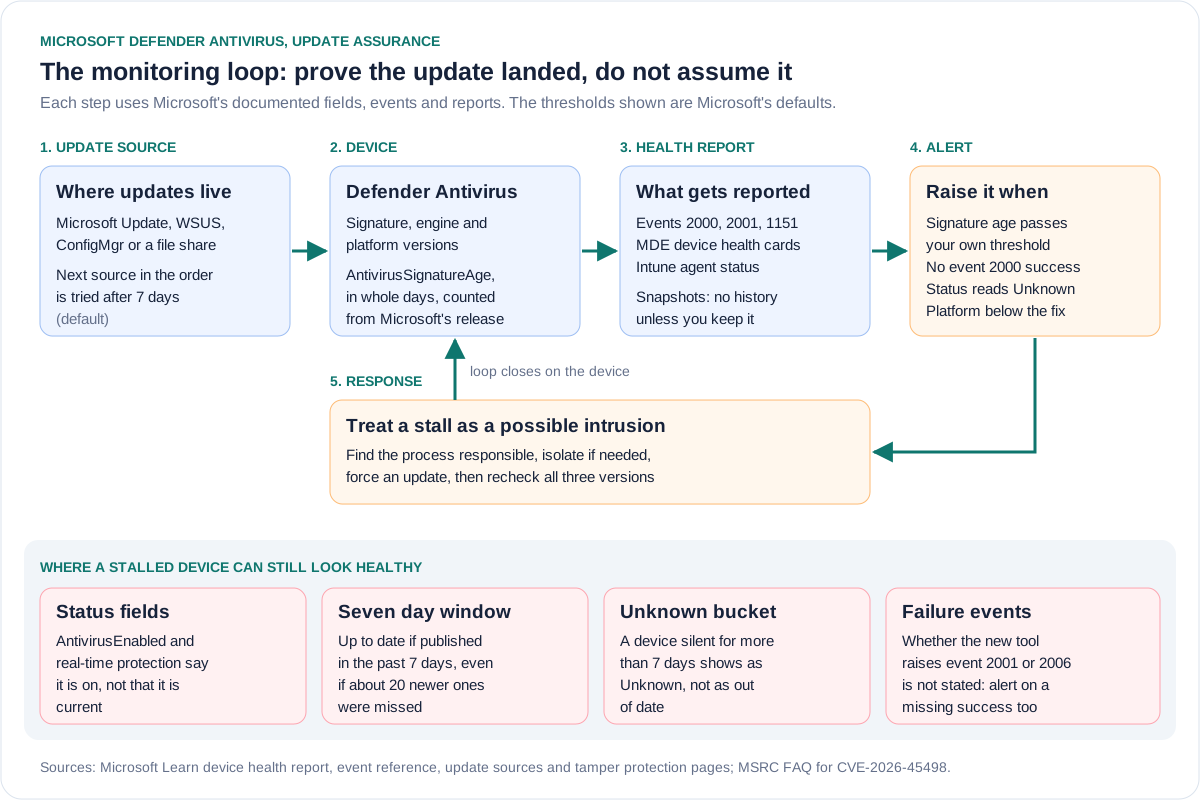
The loop has one weak joint that no product fixes by default: the gap between the update source and the report. Microsoft's fallback logic moves a device to the next configured update source only when the current update is considered out of date, which by default is seven consecutive days of failing to apply updates from WSUS or Microsoft Update. The device-side threshold is configurable through the Group Policy setting "Define the number of days before virus security intelligence is considered out of date", and a catch-up update can be forced after a set number of days with SignatureUpdateCatchupInterval. Tightening those settings shortens the time before a device flags itself, but a device-side setting will not help if something on the device is stopping updates, which is why the alert belongs off the device.
Pick a threshold tighter than seven days
Seven days is Microsoft's reporting window, not a recommendation to wait seven days. For always-connected servers and desktops, an AntivirusSignatureAge of 2 days or more is already abnormal if updates arrive several times a day, and it is where we would set a first alert. That figure is editorial judgement, not Microsoft guidance; pick your own, write it down, and alert on it.
For laptops, the right comparison is between Signature refresh time (when the device last reported update status) and Security intelligence publish time (the release date of the version it holds). A device that reports every day but whose publish time stops moving is the pattern a frozen update produces. A device that stops reporting is a different problem, and belongs in a separate Unknown queue that someone actually works, rather than a slice of a pie chart.
What to do this week, in order
Take this with you
Defender update assurance checklist
- Pull the Defender for Endpoint antivirus health export or run Get-MpComputerStatus across your servers today, and list every device whose platform is below 4.18.26040.7, the build that fixed CVE-2026-45498.
- From the same data, list every device with AntivirusSignatureAge of 2 days or more, and every device in the Unknown bucket, and give both lists an owner.
- Create a SIEM or Defender alert for devices that send event 1150 but have logged no event 2000 within your threshold, alongside alerts on events 2001, 2003, 2004, 2005, 2006, 5001, 5007 and 5013.
- Store a daily snapshot of the export API output, because Microsoft keeps no history, so you can see a device whose versions stop changing.
- Confirm tamper protection is on everywhere with IsTamperProtected or the Intune agent status report, and remember it does not prove updates.
- In Intune compliance, require security intelligence up-to-date and set a minimum Defender antimalware version, and decide whether non-compliance feeds Conditional Access.
- Review update sources and fallback order, and shorten the out of date and catch-up intervals where devices are reliably connected.
- Write a runbook that treats an unexplained update stall as a potential intrusion, with isolation and a forced update as its first steps.
- Watch the MSRC Security Update Guide for a Defender entry covering BigDiskBuster, and when one appears, add its fixed platform build to the minimum version check.
The question that exposes the gap
BigDiskBuster may turn out to be buggy, fixed quickly or never used in anger. The earlier update block was exploited and fixed in a self-updating component, which means its fix reached only the devices whose updates worked. The assurance problem is the same whichever tool comes next.
So the question for any IT manager is this: if one of your devices stopped taking Defender updates at nine o'clock this morning, which person, looking at which report, would know by tomorrow, and would their report say "out of date", "Unknown" or still "up to date"?
Sources
- PrimarySecurity Update Guide entry for CVE-2026-45498, the earlier Defender denial of service flaw, used for severity, exploited status, affected and fixed platform versions and Microsoft's advice to verify updatesMicrosoft Security Response Centeraccessed 2026-09-22
- PrimarySecurity Update Guide API listing of Microsoft Defender CVEs, used to confirm no new Defender denial of service entry had been published by 22 September 2026Microsoft Security Response Centeraccessed 2026-09-22
- PrimaryNVD record for CVE-2026-45498, used for the Microsoft and NVD CVSS scores, the CWE and the fixed platform version rangeNIST NVDaccessed 2026-09-22
- PrimaryKnown Exploited Vulnerabilities catalogue, used for the CVE-2026-45498 entry date and due dateCISAaccessed 2026-09-22
- PrimaryGet-MpComputerStatus cmdlet reference, used for the output fields and the CimSession parameterMicrosoft Learnaccessed 2026-09-22
- PrimaryMSFT_MpComputerStatus class reference, used for the definitions of AntivirusSignatureAge, AntivirusSignatureLastUpdated, AMEngineVersion and AMProductVersionMicrosoft Learnaccessed 2026-09-22
- PrimaryMicrosoft Defender Antivirus event IDs and error codes, used for events 1150, 1151, 2000 to 2007, 5001, 5007 and 5013Microsoft Learnaccessed 2026-09-22
- PrimaryDefender for Endpoint device health, antivirus health report, used for the seven day up to date logic, the Unknown state and the three day grace periodMicrosoft Learnaccessed 2026-09-22
- PrimaryDevice health reports overview, used for the report location, cards and licensing scopeMicrosoft Learnaccessed 2026-09-22
- PrimaryExport device antivirus health report API, used for the filterable up to date fields, rate limits and the absence of historyMicrosoft Learnaccessed 2026-09-22
- PrimaryTamper protection overview, used for the list of protected settings and the tampering hunting queriesMicrosoft Learnaccessed 2026-09-22
- PrimaryConfigure tamper protection on Windows, used for the IsTamperProtected checkMicrosoft Learnaccessed 2026-09-22
- PrimaryManaging out of date endpoints, used for the catch-up update interval and the out of date reporting threshold settingsMicrosoft Learnaccessed 2026-09-22
- PrimaryManaging update sources, used for the fallback order and the seven day default before falling backMicrosoft Learnaccessed 2026-09-22
- PrimaryDefender Antivirus updates and support, used for the monthly platform cadence and N-2 supportMicrosoft Learnaccessed 2026-09-22
- PrimaryDefender Antivirus on Windows, used for the AMRunningMode valuesMicrosoft Learnaccessed 2026-09-22
- PrimaryIntune reports, used for the Antivirus agent status and Detected malware reportsMicrosoft Learnaccessed 2026-09-22
- PrimaryIntune antivirus policy, used for the Unhealthy endpoints view and the controlled configuration renameMicrosoft Learnaccessed 2026-09-22
- PrimaryIntune Windows compliance settings, used for the security intelligence up to date and minimum version settingsMicrosoft Learnaccessed 2026-09-22
- PrimaryDeviceTvmSecureConfigurationAssessment table reference, used for Microsoft's example query for non compliant antivirus configurationsMicrosoft Learnaccessed 2026-09-22
- PrimarySecurity intelligence updates page, used for the latest security intelligence, engine and platform versions on 22 September 2026Microsoftaccessed 2026-09-22
- Reported byNews report of the BigDiskBuster release, used for the researcher's claims, the scope of the effect, Microsoft's lack of comment and the history of earlier disclosuresBleepingComputeraccessed 2026-09-22
- Reported byMay 2026 report used only for the link between the name UnDefend and CVE-2026-45498, which Microsoft's own entry does not makeBleepingComputeraccessed 2026-09-22