Unit 42 says AI-generated code hit government Linux servers, but gives no count of victims, countries or scripts
Unit 42 says AI-style notes in scripts suggest AI wrote code used against government Linux servers from October 2025 to April 2026. Its report gives no count of victims, countries or scripts, came at least 168 days after the last activity (derived), and records planted red-team markers.
By Parminder Kumar Sharma · · 22 min read

At least 168 days after the last activity, a report that counts no victims
Palo Alto Networks' Unit 42 published its report on CL-UNK-1211 on 15 October 2026 and says it observed the activity from October 2025 to April 2026. That window touches seven calendar months (derived). The report gives months, not days, so the gap between the last observed activity and the report is at least 168 days and at most 197 days, which is between 24 and 28 weeks (derived). The observed span itself lies between 152 and 211 days (derived).
Then count what the report counts. In an 18-minute read by its own estimate, with 24 figures, three tables and an indicator list of 31 entries (derived: 10 file hashes, 17 network addresses and 4 domains, none reproduced here), it states no number of victim organisations, no country, no number of the scripts that carry the AI-style notes (the word used is "multiple"), no number of web shells and no amount of data taken. Its counts are about the attackers' tools: at least seven command-and-control servers, and seven command types in one custom remote access trojan. Three web shell hashes sit in the indicator list, which is not a count of the shells deployed.
So the headline, "AI-Powered Espionage Campaign Targets Government Linux Infrastructure", rests on a smaller record than it sounds. A vendor saw intrusions on Linux hosts. In some scripts it found notes it reads as signs of AI generation. It has not decided whether the actor is a state or a criminal group. How many victims, where, which governments, what was taken and whether anyone is still inside are not in the report. Where this briefing says "not stated", it means not found in the full report, its appendices and its figure captions. It does not mean the information does not exist.
This briefing reads the vendor's report, not the coverage of it. The report (marked updated 15 October 2026 at 9:56 AM Pacific on the page), both appendices, the indicator section and all 24 figure captions were read from 11:47 BST on Saturday 17 October 2026, and five of the figures were opened as images. The Unit 42 attribution framework that the report cites was read as well. Nothing was filled in or submitted. Unit 42 is the threat research team of Palo Alto Networks, which sells the endpoint product the report credits with stopping one of the attempts and lists its AI security services on the same page, so the report is a vendor's account and is attributed as one throughout. Six pages of secondary coverage found on 17 October restate the report. None adds a victim count, a second source or a second vendor's analysis, and none is used here for a finding. Searches found no other vendor naming CL-UNK-1211.
The AI claim, rung by rung
The summary says "the attackers relied on AI-generated payloads", and that multiple artifacts "contained AI-made conversational annotations and developer reasoning comments". The body is more careful. It says the payloads showed "structural patterns and artifacts consistent with AI-assisted code generation", and that the notes' presence "suggests" the code was "either copied directly from an AI prompt output or deployed by an automated AI agent". Observation, inference and headline are three different strengths of claim. The diagram puts them on one ladder.
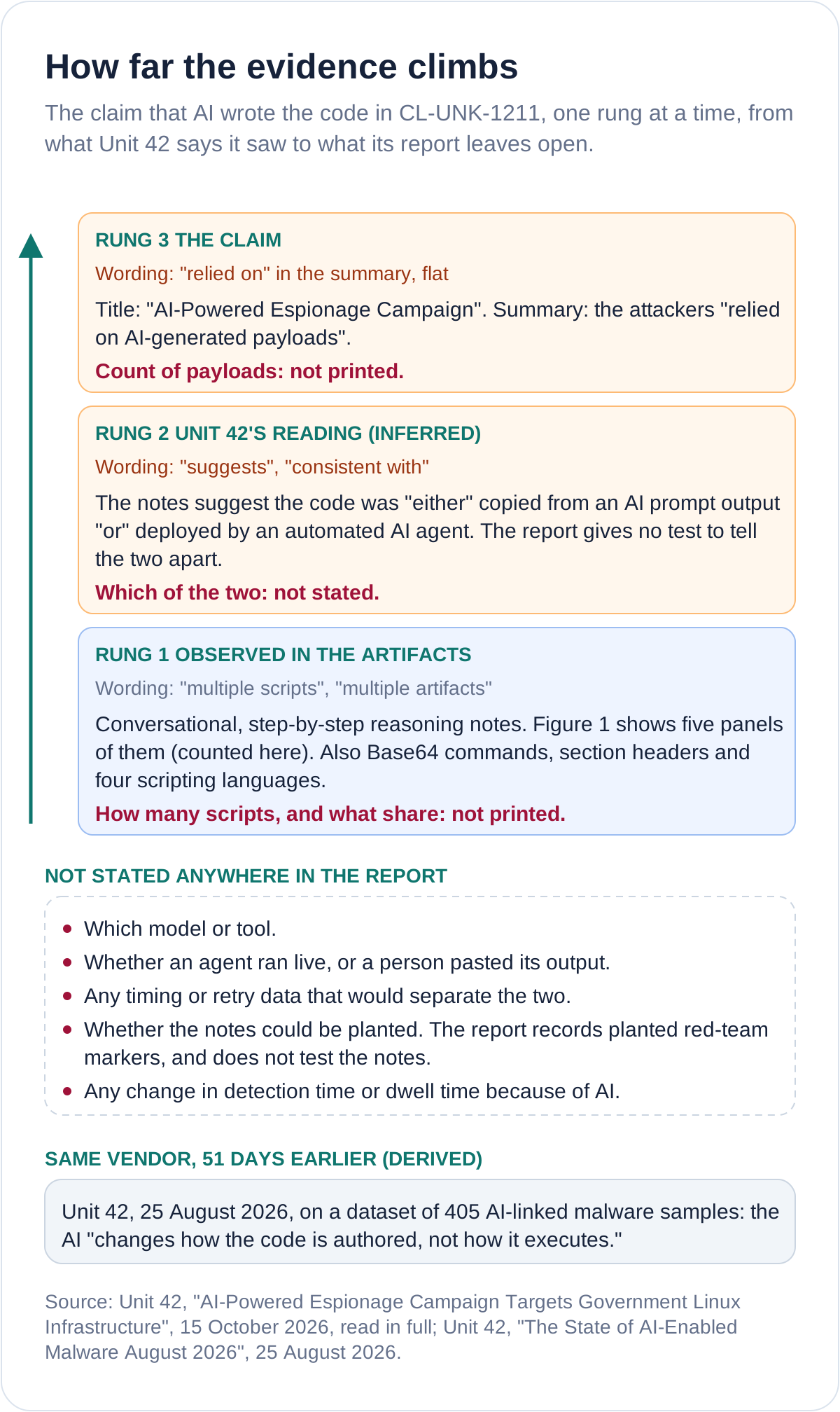
What the visible evidence is. Figure 1 is the one figure captioned as showing AI comments. It has five panels of code with notes that read like a model working a problem aloud: they weigh options, correct themselves mid-note and refer back to an earlier step. That is a short paraphrase. No text from the figure is reproduced here, and Unit 42 blurs parts of it. Two further figures are described as showing scripts "including the original inline comments". Both were opened as images. The comments in them are short numbered step headings, the sort a person also writes, and the report does not say whether it counts them among the AI-made notes.
The three structural characteristics the report lists as consistent with AI-operated attacks are section headers in scripts and commands, extensive Base64-encoded commands, and switching between PHP, JavaScript, Bash and Python. The report does not say how often these appear in intrusions known to be written by people, so they cannot separate the two cases. The notes in Figure 1 carry the claim.
One more observation sits in the report without comment. A script meant to compress whole mailboxes contained, in its words, syntax errors "such as a broken variable assignment" and "would fail upon execution". The report does not say whether a person or a model made the error, or whether the attackers noticed, so it is evidence for neither reading.
The reading that would change a defender's day is the second one, a live agent, because machine-paced commands and retries would show in the endpoint record. That is an inference from how agents are described, not a finding, and Unit 42 publishes none of that record although its figures show it holds endpoint telemetry. Two earlier briefings on this site met the same problem. DIVD offered tempo and code comments as evidence that an AI agent hacked it, and Talos rested an AI-assisted label on three emails. In each case an artefact someone can read stood in for how the work was done.
Stated and not stated: the record, line by line
The table sets what Unit 42's report states against what it does not. Wording in quotation marks is the report's.
What Unit 42's report of 15 October 2026 states and does not state. Not stated means not found in the full text, the appendices or the figure captions.
| The question | Stated | Not stated |
|---|---|---|
| Who is behind it | Cluster CL-UNK-1211. "UNK" means affiliation with "either nation-state or cybercrime activity" is "not yet determined". | Any actor, state, sponsor or link to a named group. Whether one actor or several. |
| The role of AI | Notes in "multiple" scripts. Code "either" pasted from AI output "or" run by an automated agent. | Model or tool, number of artifacts, share of scripts, timing, prompts or sessions. |
| Victims | "Government entities and state-affiliated infrastructure". Mail directories listed for "several domains". | Number of organisations, any country or government, sectors, how Unit 42 came to see each case. |
| Dates | Activity from October 2025 to April 2026. Report 15 October 2026. One figure of the vendor's own AI assistant gives December 2025 to February 2026 for one environment. | First and last day, when it was found, when victims were told, whether it continues. |
| Entry | Web shells "for initial access". A custom scanner for CVE-2025-55182. An open-source local root exploit for CVE-2021-4034. | How the first web shell arrived. The same AI assistant's figure calls the entry point "likely" a vulnerable site plugin or hosting-panel flaw; the report's text does not adopt that. |
| Data | Whole databases dumped to local archives. Exfiltration "attempted". A mailbox script "would fail". "Indications" of intent to take more. | Whether any data left, which databases, how much, whether any social media account was reached. |
| Evasion | An attempt to end the endpoint agent was "detected and mitigated". Logs deleted on several systems. Timestamps altered. Red-team markers planted. | Whether any other control was evaded, how long the activity went unseen, which logs were lost for good. |
| Detection | Product alerts are shown, including one for shell-history clearing. | Time to detect, who detected first, whether AI changed either. |
The vendor's protections the report lists come in five groups: Advanced WildFire; Advanced URL Filtering, DNS Security and IP Defense; the Cortex XDR Analytics Engine; Cortex XDR and XSIAM; and Cortex Cloud. It adds two services, an AI security assessment and a Frontier AI Defense service. It says the findings were shared with Cyber Threat Alliance members and that its own Cortex agentic assistant was used in the investigation. The report states the endpoint product "detected and prevented" the attempts to terminate its processes. That is the vendor's statement about its own product, on the hosts where it ran.
Friendly names, and what each one hides
Nine labels carry weight in the report or its headline. A label is not evidence. Each row says what the report itself states and what the label can hide.
Labels in Unit 42's report of 15 October 2026, with what the report states and what each can hide. The framework quoted is Unit 42's own, published 31 July 2025.
| Label | What the report states | What it can hide |
|---|---|---|
| "AI-powered" (title) | Notes in scripts are read as suggesting LLM generation or an agent. | Power over what. The same vendor wrote on 25 August 2026 that AI "changes how the code is authored, not how it executes". No speed or tempo figure is given here. |
| "AI-generated payloads" | "Relied on" in the summary. "Consistent with" and "suggests" in the body. | A certainty the body does not carry, and no share of payloads. |
| "Automated AI agent" | One of two readings, beside pasted output. | The reading that would change defenders' tempo has no timing evidence behind it. Pasted code and a live agent look alike in a file. |
| "Campaign" | Title and conclusion. The framework calls a cluster "a few puzzle pieces" and a campaign a coordinated effort with a defined objective. | CL-UNK-1211 is a cluster, the lower level. "The attackers" implies one actor; a cluster does not establish that. |
| "State-affiliated infrastructure" | "Government entities and state-affiliated infrastructure". | Affiliated with which state, and in which country. Not stated. |
| "UNK" | The framework defines it as "Unknown motivation". The report says state or crime is "not yet determined". | The headline and summary say espionage and "intelligence-gathering" while the cluster's own tag says motivation unknown. One panel heading in the vendor's AI-assistant figure mentions miner deployments; the text does not discuss mining. |
| "Espionage" | Aim "to support intelligence-gathering". Mailboxes searched to reach social media accounts. | Why those accounts were wanted is not said. The purpose is inferred from targets and tooling. |
| "Red-team markers" | "Planted deception techniques" to "disguise their activity as a red team operation". | A note on a host is not an authorisation. The next section covers it. |
| "Effectively neutralized" | Conclusion: "endpoint security controls effectively neutralized their activity". | A conclusion from the vendor's own telemetry on hosts running its agent. It sits beside database dumps and mail searches described as attempts, with no statement of what, if anything, left. |
Planted red-team markers, and the same question about the AI notes
In "several instances" Unit 42 says the attackers planted markers to make their activity look like an authorised security test: an operation-style key containing a year in one script, and a password for a created user built around a penetration-testing word. The strings are in the report and are not repeated here. They are aimed at the person doing the post-incident analysis. A responder who finds an authorisation-looking note may stand down, defer, or ask the wrong person.
The report treats the AI-style notes as evidence of how the code was made and the markers as deception. Both are text left where an analyst reads it, and the report does not discuss whether the first kind could be planted as the second kind is. This briefing does not say they were: the notes in Figure 1 revise themselves as they go, which matches the report's own description of reasoning notes, and a decoy of that sort would be an odd choice. It says something narrower, and it is inference. A note, from either source, is a claim made by the intruder's side. It is evidence of what was written and weak evidence of who ran it. The better test is in the endpoint record: command timing, retries and error recovery. The report publishes none of it.
The same part of the report is the plainest case for logs that leave the host. The report's own evidence of log deletion is endpoint telemetry (its caption reads "as seen in Cortex XDR"), not the deleted logs. Unit 42's framework says it can lower the reliability score of telemetry where there is evidence of possible interference with logging. Where the endpoint agent is blind, killed or absent, nothing else may remain.
What the intrusion looked like, at defender level
The table keeps to classes of activity. It holds no indicator, file name, command or code, and it is not a complete account; the report's two appendices have more. Both vulnerabilities it names are listed in the CISA Known Exploited Vulnerabilities catalogue, checked on 17 October 2026.
Stages of the activity as Unit 42 describes them, reduced to classes, with what to hunt or harden. The last column is this briefing's, built from the report and the NSA and Australian web shell guidance.
| Stage | What the report describes | What to hunt or harden |
|---|---|---|
| Foothold | Web shells, some custom and some open-source from public repositories, on Linux web servers. The text does not say how the first one landed. Two flaws are named: a custom scanner for CVE-2025-55182 (React Server Components, scored 10.0 by its CNA in NVD, in the catalogue since 5 December 2025) and an open-source local root exploit for CVE-2021-4034 (in the catalogue since 27 June 2022). | Inventory internet-facing hosts and their software. Compare each web root with a known-good copy. Check exposure to the two named flaws. |
| Persistence | A web server setting changed across all PHP configurations under the control panel's directories, so a chosen file runs before every script. A system service or scheduled job from one tool. An added SSH key. | Check PHP configuration for files loaded before every script. Review authorised keys, new services and scheduled jobs on web hosts. Verify package integrity. |
| Credentials | A shell start-up file replaced to capture an administrator's password at the privilege prompt. An admin login page edited to log credentials. Configuration and history files searched for cleartext passwords. | Integrity monitoring on shell start-up files and login code. Remove cleartext secrets. Rotate privileged credentials from a clean system. Multi-factor authentication on admin accounts. |
| Reach | A custom Go remote access tool for Windows and Linux. Reverse shells held in memory to at least seven servers. Tunnelling tools. SSH between servers with stored administrator credentials. A database feature that runs operating-system commands, used to hop between subnets. | Egress allow-listing. Alert when a web server process starts an interactive shell. Disable database features that run OS commands unless needed. Alert on server-to-server SSH from web hosts. |
| Mail and data | Mail directories listed and counted. A script searched message headers for social media messages. Four tables sampled at 100 rows each, then dumped to local archives. Upload attempts to anonymous file-hosting services. | Audit mailbox store access and bulk database reads. Alert on archives created on mail and database hosts. Block or alert on egress to anonymous file hosts. Review recovery addresses of official social media accounts. |
| Cover | An attempt to end the endpoint agent. Deletion of authentication, command history, email, operating system, web server and active PHP session records. Timestamps altered. Single-use scripts deleted after running. Planted red-team markers. | Ship logs off-host. Alert on truncation, deletion and silence. Keep six months or more. Treat markers as unverified. |
UK: what the guidance covers and where it stops
A search of ncsc.gov.uk and gov.uk on 17 October 2026 found no NCSC or government publication that refers to this report. What follows is what the UK sources say that bears on it. The NCSC pages and Cyber Essentials requirements were read in full; the Government Cyber Action Plan, a long document, was read for its passages on assets, monitoring and detection. First, the NCSC on AI and the threat.
NCSC material on AI and the cyber threat, as read on 17 October 2026, and where each stops for this case.
| Source | What it says | Where it stops |
|---|---|---|
| NCSC assessment, "Impact of AI on cyber threat from now to 2027" (7 May 2025) | Threat actors are "almost certainly already using AI" to enhance existing techniques, including "basic malware generation". Fully automated end-to-end advanced attacks are "unlikely" to 2027 and skilled actors "will need to remain in the loop". | Published 528 days before 17 October 2026 (derived). No method for telling pasted output from a live agent. No Linux or hosting detail. |
| NCSC, "Frontier AI: what you need to know" | AI "does not fundamentally change cyber risk" but raises the speed and scale at which weaknesses are found. Fundamentals protect "whether those are AI-assisted or not". | General. Names no control for Linux servers or hosting. |
| NCSC blog, "Why cyber defenders need to be ready for frontier AI" (30 March 2026) | Activity by frontier models released before March 2026 "tends to generate noticeable security alerts", but "only in environments with effective monitoring and the ability to respond". It names the basics: accurate asset inventories, robust access controls, secure configuration, comprehensive logging. | Evaluations on simulated networks, not intrusions in the wild. Silent on model-written code run by people. Names the basics, not the steps on a Linux host. |
The report fits the NCSC's description of AI enhancing existing techniques. It does not test the NCSC's judgement that fully automated attacks are unlikely, because Unit 42 does not claim one. Now the controls and guidance a UK public body would reach for.
UK guidance and controls read for this case, with the dates as read, and where each stops. Ages are counted to 17 October 2026 and are derived.
| Source | What it says | Where it stops |
|---|---|---|
| NCSC blog, "Serving up some server advice" (3 April 2019) | The NCSC publishes nothing equivalent to its end-user-device guidance for servers. It points to its Ubuntu guidance as a starting point, and to its logging and secure configuration material. | A blog 2,754 days old, 7.5 years (derived). Nothing on hosting control panels, PHP configuration, mail stores or web shells. |
| NCSC, "Introduction to logging for security purposes" (8 July 2018, version 1.0) | Keep logs that answer incident questions "for a minimum of 6 months". Protect them from tampering, because "an attacker may well target the logging service". Send logs across trust boundaries by one-way flow. Alert when logs stop arriving. | Version 1.0, 3,023 days old (derived). A six-month window ending on the report date starts on 15 April 2026 and holds at most the last 16 days (derived) of activity that began in October 2025. |
| Government Cyber Action Plan (gov.uk, updated 20 March 2026) and the NCSC public-sector page | GovAssure's first year found "widespread low maturity in fundamental controls such as asset management, protective monitoring, and response planning". The NCSC is to publish a national detect strategy. The NCSC lists Early Warning and a logging and monitoring page for the public sector. | Plans and services, not a control on a Linux host today. The central detection library is something the Government Cyber Coordination Centre "will build". |
| NCSC Cyber Assessment Framework, principles C1 and C2 | Good monitoring is "more than simply the collection of logs", and logs should be isolated so an attacker cannot delete or modify them. Threat hunting looks for activity that "evades standard security prevent/detect solutions", and the top level favours hunts on techniques over atomic indicators such as hashes, addresses and domains. | Outcomes, not procedures. Written for organisations running essential functions; public bodies meet it through GovAssure and the Action Plan. This report prints 31 atomic indicators (derived), and the class-level table above is the technique version. |
| Cyber Essentials, requirements for IT infrastructure v3.3 (April 2026) | Servers are in scope. Fixes for critical or high (CVSS 7 or above) flaws within 14 days. Separate administrator accounts, and multi-factor authentication where available. | The text has no logging, monitoring or detection requirement. The anti-malware option is for Windows and macOS; for Linux the option offered is application allow-listing. "Bespoke and custom components of web applications are out of scope." Asset management "isn't a specific Cyber Essentials control". |
Both flaws the report names fall in the 14-day band, with scores of 10.0 and 7.8 as read in NVD. Cyber Essentials tests software that is in scope and says nothing about whether a host is already compromised. Put together, the NCSC's AI material says what to expect and not how to tell it, the Linux and logging guidance is old and general, the public-sector material is mostly plans, and Cyber Essentials keeps the front door while asking nothing about what happens once someone is inside. None of that is a fault in those documents, which were written for other purposes. It is the gap a public body inherits.
What to do, in order, for three readers
The first list is for the security lead of a government or public-sector body. The second is for a SOC lead, the third for a CISO. None depends on knowing whether AI wrote a single line.
Take this with you
Security lead: in this order
- List every Linux host that serves web pages, mail or databases, with an owner, an administrator group and the hosting control panel it runs. If this takes more than a day, that is the first finding.
- Check exposure to the two named flaws: React Server Components deployments against the vendor advisory for CVE-2025-55182, and privilege escalation fixes for CVE-2021-4034. Both are in CISA's Known Exploited Vulnerabilities catalogue.
- Hunt for web shells by comparing each web root and PHP configuration with a known-good copy, then review what differs. Look for any setting that loads a file before every script, and for web server processes that start interactive shells.
- Review the places a password can be taken: shell start-up files for administrator accounts, admin login pages, and cleartext secrets in configuration and history files. Rotate privileged and database credentials from a clean system, never from the suspect host.
- Turn on access logging for the data itself: mailbox store access, bulk database reads and exports, and archive creation on mail and database hosts. Alert on upload to anonymous file-hosting services.
- Make logs survive the host. Forward them off-host as events happen, to a store the server administrators cannot alter. Alert when a source goes quiet or a log shrinks. Keep at least the NCSC's six months, and longer where budget allows.
- Write the red-team rule: any note, key or account that claims an authorised test is unverified until a named authorising contact confirms the test, its scope and its dates in writing, by a channel that is not on the host. Until then it is an incident.
- Review which official social media accounts use staff mailboxes for sign-in or recovery, and move them to monitored role mailboxes with strong authentication.
Take this with you
SOC lead: detections and triage
- Write detections for classes, not strings: a web server process starting a shell, a change to PHP or web server configuration, a replaced shell start-up file, a new authorised key, a new service or scheduled job on a web host.
- Alert on bulk reads and archives: many mail directories listed in one session, large database exports, archives created in temporary space on mail or database hosts.
- Alert on log tampering: truncation, deletion, history clearing, and a host that stops sending.
- Record observations and conclusions in separate fields. Notes in a script that read like model output are an observation. AI-powered is a conclusion that needs timing and retry evidence.
- Never close or downgrade a case because an artefact says it belongs to a red team. Escalate to the person who owns testing.
- Report incidents through the UK government signposting service at GOV.UK/REPORT-CYBER, and consider the NCSC's Early Warning service, which the NCSC lists as free malicious activity notifications for UK organisations.
Take this with you
CISO: decisions and questions
- Ask for three numbers this month: how many Linux web, mail and database hosts you run; how many send logs off-host; how many have had a known-good comparison in the last quarter.
- Ask every threat-report vendor the questions this report leaves open: how many victims, how many countries, how many artifacts, what dates, what was taken. Put the answers into the terms of any threat-intelligence contract.
- Do not let the AI label set the budget. The NCSC says fundamentals matter "whether those are AI-assisted or not", and its March 2026 blog names asset inventories, access controls, secure configuration and logging first. Fund those before any tool sold to detect AI authorship.
- Set log retention to the dwell you fear, not the default. This report appeared at least 168 days after the last activity (derived), and the NCSC's minimum is six months.
- Decide who can declare a red-team test genuine, and keep a register of authorised tests with dates, scope and contacts.
- Ask whether your Cyber Assessment Framework or GovAssure evidence covers Linux servers and hosting panels, not only the managed desktop estate.
What could not be verified
The count of five panels in Figure 1 is this briefing's, from the image. The report's figures were read as captions and, for five of them, as images; Unit 42 blurs parts of several. The report was read once on 17 October 2026 and was marked updated on 15 October, so any later edit is not reflected. Nothing in the report could be checked against a second source: no other vendor, victim or government has been found confirming the activity, the dates or the AI claim. The "no NCSC publication" statement rests on web searches on 17 October, which cannot prove an absence. The UK documents are quoted as read, and some of them are years old.
The question that exposes the gap
Unit 42's report is useful because it names classes of activity a defender can hunt. It cannot tell a reader how many, where, or what left. The AI label is a statement about how some scripts were written, and the controls that matter here would work the same if a person typed every line. So the test is local.
If every log on one of your Linux web or mail servers were deleted tonight, what record held somewhere else would still show what was read from it, and who would look at it?
Key facts
Sources
- PrimaryUnit 42, 'AI-Powered Espionage Campaign Targets Government Linux Infrastructure', published 15 October 2026 and marked updated 15 October 2026 at 9:56 AM PDT; an 18 minute read. Read in full with both appendices, the indicator section and the 24 figure captions; figures 1, 3, 14, 16 and 17 opened as images. The vendor's own reportUnit 42, Palo Alto Networksaccessed 2026-10-17
- PrimaryUnit 42, 'Introducing Unit 42's Attribution Framework', 31 July 2025, cited by the report: the CL-UNK cluster levels, what UNK means, cluster versus campaign, the six months of observation for a temporary group, false flags and telemetry reliability. Read in fullUnit 42, Palo Alto Networksaccessed 2026-10-17
- PrimaryUnit 42, 'The State of AI-Enabled Malware August 2026', 25 August 2026: 405 samples, 12 seen on endpoints, and the sentence that the AI component changes how code is authored, not how it executes. Read in fullUnit 42, Palo Alto Networksaccessed 2026-10-17
- PrimaryNVD record for CVE-2025-55182, React Server Components: published 3 December 2025, CVSS 3.1 base score 10.0 from the CNA. Read through the NVD API on 17 October 2026NIST National Vulnerability Databaseaccessed 2026-10-17
- PrimaryNVD record for CVE-2021-4034, polkit pkexec local privilege escalation: published 28 January 2022, base score 7.8. Read through the NVD API on 17 October 2026NIST National Vulnerability Databaseaccessed 2026-10-17
- PrimaryCISA Known Exploited Vulnerabilities catalogue, catalogue version 2026.10.16 read from its JSON feed: CVE-2025-55182 added 5 December 2025 and CVE-2021-4034 added 27 June 2022CISAaccessed 2026-10-17
- PrimaryNSA repository for the joint NSA and Australian Signals Directorate web shell guidance: comparing a production web server with a known-good copy as the most effective method. Read the READMENSA Cybersecurityaccessed 2026-10-17
- PrimaryNCSC assessment, 'Impact of AI on cyber threat from now to 2027', published 7 May 2025: threat actors already using AI, fully automated end-to-end attacks unlikely to 2027, humans in the loopNational Cyber Security Centreaccessed 2026-10-17
- PrimaryNCSC, 'Frontier AI: what you need to know': AI does not fundamentally change cyber risk but raises speed and scale, and fundamentals matter whether attacks are AI-assisted or notNational Cyber Security Centreaccessed 2026-10-17
- PrimaryNCSC blog, 30 March 2026: activity by frontier models released before March 2026 generates noticeable alerts, in environments with effective monitoring and responseNational Cyber Security Centreaccessed 2026-10-17
- PrimaryNCSC blog, 'Serving up some server advice', 3 April 2019: no server equivalent of the end-user-device guidance, and the guidance it points toNational Cyber Security Centreaccessed 2026-10-17
- PrimaryNCSC, 'Introduction to logging for security purposes', 8 July 2018, version 1.0: six month minimum, tamper protection, one-way flow, alerting when logs stopNational Cyber Security Centreaccessed 2026-10-17
- PrimaryNCSC advice page for public sector organisations: Early Warning, logging and monitoring, incident reporting through GOV.UK/REPORT-CYBER, Cyber Essentials, the Government Cyber Action PlanNational Cyber Security Centreaccessed 2026-10-17
- PrimaryGovernment Cyber Action Plan, updated 20 March 2026: GovAssure first-year findings on asset management, protective monitoring and response planning, 28 per cent legacy estate, the planned detection library and national detect strategyUK Government, DSITaccessed 2026-10-17
- PrimaryCAF principle C1, security monitoring: good monitoring is more than the collection of logsNational Cyber Security Centreaccessed 2026-10-17
- PrimaryCAF principle C2, threat hunting: seeking activity that evades standard prevent and detect solutionsNational Cyber Security Centreaccessed 2026-10-17
- PrimaryRequirements for IT Infrastructure v3.3, April 2026: servers in scope, 14 day patching, anti-malware option for Windows and macOS only, bespoke web application components out of scope, no logging requirementNational Cyber Security Centre, Cyber Essentialsaccessed 2026-10-17
- Reported byGBHackers, 17 October 2026: a secondary restatement of the report. Used only to confirm the report was being re-reported; no finding rests on itGBHackersaccessed 2026-10-17
- Reported byGridinsoft blog, 16 October 2026: a secondary restatement by a security vendor. Used only to confirm the report was being re-reported; no finding rests on itGridinsoftaccessed 2026-10-17
- Reported byIBTimes Singapore: a secondary restatement quoting the report's own sentences. No finding rests on itIBTimes Singaporeaccessed 2026-10-17