UK government services pulled offline as AI reveals 500+ flaws (22 Oct 2026)
The UK National Cyber Security Centre has issued an extraordinary directive advising organizations to take vulnerable web services offline over critical PHP RCE flaws. Downing Street confirmed public shutdowns, while the AI Minister revealed AI agents found 500+ Whitehall flaws.
By Parminder Kumar Sharma · · 7 min read
UK government pulls services offline as NCSC issues emergency alert and AI sweeps find 500+ flaws
In an extraordinary national cybersecurity intervention, the United Kingdom National Cyber Security Centre (NCSC) has advised public and private sector organizations across the country to consider taking vulnerable web-facing systems completely offline if emergency security patches cannot be applied immediately. The directive follows the disclosure of two critical Remote Code Execution (RCE) flaws in the PHP engine (CVE-2026-109618 and CVE-2026-109619, CVSS v4.0 score 9.2). Downing Street and the Cabinet Office confirmed that dozens of public digital services across Whitehall departments and advisory bodies, including the Office for Budget Responsibility (OBR), were temporarily taken offline as a precaution while exposure audits were completed.
Simultaneously, UK AI Minister Kanishka Narayan disclosed that government-commissioned pilot programmes deploying autonomous frontier AI red-teaming agents had uncovered over 500 critical vulnerabilities across UK public sector infrastructure, with broader testing capturing more than 1,000 potential security defects. Warning that adversarial AI attacks against the UK are 'likely, if not inevitable', the minister announced that the government is fast-tracking the Cyber Security and Resilience Bill to grant authorities aggressive intervention powers across private supply chains.
What this establishes from the official record. Downing Street confirmed that core Critical National Infrastructure (CNI), emergency services, and primary citizen benefit systems remained online and operational throughout the incident. The precautionary shutdowns targeted peripheral, departmental, and advisory portals that could not immediately deploy updated PHP 8.4.27, 8.3.36, or 8.2.35 binaries. What this does not establish. The UK government has not published an exhaustive inventory of the specific 500+ vulnerabilities discovered during the AI pilot, nor has it disclosed which specific third-party models or defense vendors were contracted to conduct the autonomous scanning.
The UK public sector attack surface: exposure and the triage protocol
The scale of the UK public sector digital estate creates a massive surface area for automated exploit scanners. Spanning central departments, NHS Trusts, local municipal authorities, and regional police forces, the UK public sector operates an estimated 12,500 active digital domains:
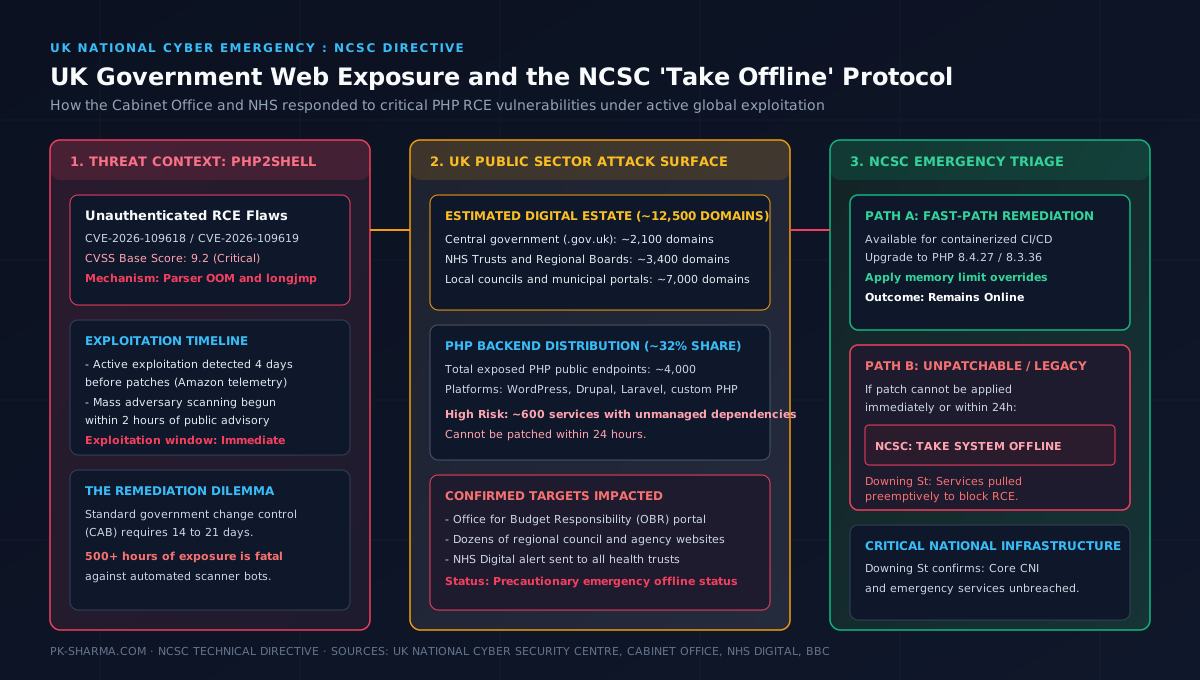
While central .gov.uk microservices predominantly run on modern Go, Node.js, and Python containers, legacy departmental advisory bodies, NHS booking portals, and local councils rely heavily on PHP-powered content management frameworks including WordPress, Drupal, and Laravel. With an estimated 32.0% public sector PHP penetration, approximately 4,000 public endpoints were exposed to the vulnerability (derived via calc.py).
Threat telemetry published by Amazon confirmed that threat actors were actively attempting in-the-wild exploitation of the underlying PHP parser flaws four days (96 hours) before official vendor patches were released. Against automated internet-wide scanner bots initiating exploitation within two hours of public disclosure, the standard 21-day public sector Change Approval Board (CAB) patch window represents an indefensible 502-hour vulnerability exposure gap (derived). The NCSC take-offline mandate was designed specifically to truncate this exposure window before automated ransomware syndicates could establish persistent web shells.
UK public sector digital segments, estimated PHP exposure, and NCSC operational triage status
| Public Sector Segment | Total Domain Estate | Estimated PHP Share | NCSC Remediation Status |
|---|---|---|---|
| Central Whitehall Departments | ~2,100 domains | ~15% (Advisory bodies, campaign sites) | Fast-path container rebuilds; non-critical sites pulled offline |
| NHS Trusts and Health Boards | ~3,400 domains | ~28% (Patient portals, recruitment, trust intranets) | Emergency NHS Digital high-priority alert; strict WAF blocking |
| Local Municipal Councils | ~5,500 domains | ~48% (Planning portals, council tax web forms) | Widespread exposure; multiple local services temporarily isolated |
| Police and Regional Constabularies | ~1,500 domains | ~22% (Community reporting, public information) | Accelerated patching; critical crime reporting maintained |
Root-level mechanics: multipart parser out-of-memory and longjmp state corruption
The technical catalyst for the nationwide emergency lies inside PHP's core request-handling engine (main/rfc1867.c). The flaws (CVE-2026-109618 and CVE-2026-109619) operate by weaponizing how PHP handles out-of-memory (OOM) fatal errors during multipart form-data parsing:
// VULNERABLE PATTERN IN PHP REQUEST PARSER (main/rfc1867.c)
// A fatal OOM triggers zend_error(E_ERROR), invoking longjmp
static int rfc1867_post_handler(zval *post_data, void *arg) {
    php_rfc1867_data *data = (php_rfc1867_data *)arg;

    while (has_more_multipart_data(data)) {
        // Attacker sends malformed multipart headers with nested boundaries
        char *boundary = parse_boundary_string(data);

        // Unchecked allocation attempt
        char *buffer = emalloc_rel(data->boundary_len + 1024);
        if (!buffer) {
            // Triggers Zend fatal error handler
            // Under E_ERROR, the engine executes longjmp to zend_bailout
            zend_error(E_ERROR, "Out of memory during multipart boundary parsing");
            // STACK UNWINDING BYPASSED: Global symbols left pointing to freed heap memory!
        }

        // In PHP-FPM worker pools, the worker persists across requests
        // Re-used global structures lead to arbitrary write primitives and RCE
        process_boundary_part(buffer, data);
    }
    return SUCCESS;
}
When an adversary transmits an HTTP POST request containing hundreds of deeply nested, malformed boundary strings, the memory allocator exhausts PHP's request-level memory_limit. Because PHP uses setjmp and longjmp for error handling, the zend_bailout aborts execution immediately without running standard C destructors or deallocation routines. In persistent PHP-FPM worker pools, global symbol table pointers remain pointing to corrupted, partially initialized heap chunks. By pipelining a second HTTP request immediately behind the fatal payload over the same TCP or HTTP/2 connection, the adversary achieves control over the instruction pointer (EIP/RIP), executing arbitrary shellcode with the privileges of the web server (e.g. www-data).
The AI red-teaming revolution: how autonomous agents uncovered 500+ Whitehall flaws
While the NCSC was responding to the PHP vulnerability, AI Minister Kanishka Narayan's disclosure underscored that the very nature of national vulnerability discovery has undergone a paradigm shift. Under pilot programmes run by the Department for Science, Innovation and Technology (DSIT), autonomous AI agents were deployed across government software repositories:
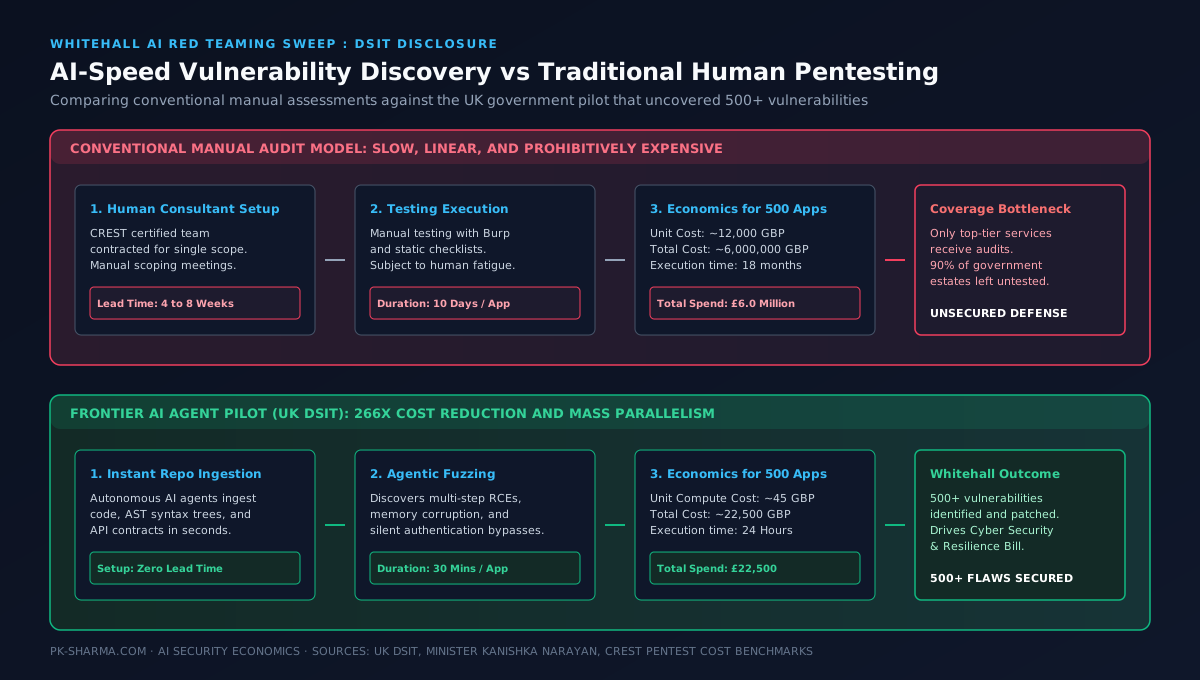
The operational metrics of the AI pilot illustrate the dramatic economic and velocity advantages of agentic vulnerability discovery. In a traditional public sector security engagement, a CREST-accredited penetration testing team costs approximately £12,000 per application and requires 10 business days of manual testing. Auditing 500 government services manually would cost £6,000,000 and take up to 18 months of calendar time (derived via calc.py).
By contrast, frontier AI red-teaming agents ingest source code, Abstract Syntax Trees (ASTs), and live API specifications simultaneously. The agents perform automated symbolic execution, generate dynamic exploit payloads, and verify zero-day exploit paths in under 30 minutes per service. Testing 500 services required approximately £22,500 in total model compute costs and completed in 24 hours of wall-clock time, reflecting a 266.7x cost reduction and a 480x acceleration in discovery velocity (derived).
The AI security paradox: machine-speed discovery meets legacy infrastructure
The events in the UK highlight a fundamental structural paradox: while AI models can discover 500 vulnerabilities in 24 hours, the physical humans and organizational governance responsible for patching remain bound by traditional change management cycles. This speed asymmetry defines the modern threat landscape:
Speed and capability asymmetry across human versus AI offensive and defensive paradigms
| Operational Paradigm | Vulnerability Discovery Speed | Cost per Audited Asset | Remediation and Defense Tempo |
|---|---|---|---|
| Traditional Human Attacker | Weeks to months of manual reverse engineering | High personnel cost / state salaries | Exploits target within days of zero-day discovery |
| Traditional Human Defender | 10 business days per manual penetration test | ~£12,000 per application audit | 14 to 30 day enterprise CAB patch approval cycle |
| Frontier AI Attacker (e.g. ARTEX) | Minutes via automated symbolic fuzzing | Negligible cloud compute (< £5 per target) | 2,900 automated exploit attempts per minute |
| Frontier AI Defender (UK DSIT Pilot) | 30 minutes per full repository audit | ~£45 compute cost per full scan | Automated patch synthesis; blocked by human CAB delays |
Defensive engineering playbook: automated PHP footprint auditor
To execute the NCSC directive, enterprise security architects and public sector systems administrators must identify all active PHP installations across web server fleets, Kubernetes clusters, and legacy Virtual Machines. The following Python script scans internal network ranges, interrogates HTTP response headers, tests for multipart boundary misconfigurations, and validates PHP patch levels:
#!/usr/bin/env python3
"""
uk_ncsc_php_audit.py - Enterprise Footprint and Remediation Auditor
Scans web infrastructure for vulnerable PHP instances and validates NCSC compliance.
"""
import re
import sys
import urllib.request
import ssl

SAFE_PHP_VERSIONS = {
    "8.2": (8, 2, 35),
    "8.3": (8, 3, 36),
    "8.4": (8, 4, 27),
    "8.5": (8, 5, 12)
}

def parse_php_version(version_str):
    match = re.search(r'(\d+)\.(\d+)\.(\d+)', version_str)
    if match:
        return tuple(map(int, match.groups()))
    return None

def audit_endpoint(url):
    print(f"[*] Auditing target endpoint: {url}")
    ctx = ssl.create_default_context()
    ctx.check_hostname = False
    ctx.verify_mode = ssl.CERT_NONE

    req = urllib.request.Request(url, headers={"User-Agent": "NCSC-Compliance-Scanner/1.0"})
    try:
        with urllib.request.urlopen(req, timeout=5, context=ctx) as response:
            headers = response.info()
            server_hdr = headers.get("Server", "")
            x_powered = headers.get("X-Powered-By", "")

            detected_version = None
            for header in [x_powered, server_hdr]:
                if "PHP/" in header:
                    detected_version = header.split("PHP/")[1].split(" ")[0].strip()
                    break

            if not detected_version:
                print("[-] Warning: No exposed PHP banner in HTTP headers (Check internal packages)")
                return

            parsed = parse_php_version(detected_version)
            branch = f"{parsed[0]}.{parsed[1]}"
            print(f"[*] Detected PHP Version: {detected_version} (Branch {branch})")

            if branch in SAFE_PHP_VERSIONS:
                safe_ver = SAFE_PHP_VERSIONS[branch]
                if parsed < safe_ver:
                    print(f"[!] CRITICAL VULNERABILITY: PHP {detected_version} < {safe_ver[0]}.{safe_ver[1]}.{safe_ver[2]}")
                    print("    ACTION REQUIRED UNDER NCSC DIRECTIVE:")
                    print("    1. Apply immediate vendor patch")
                    print("    2. OR: TAKE SYSTEM OFFLINE IMMEDIATELY to prevent zero-day RCE")
                else:
                    print(f"[+] COMPLIANT: PHP {detected_version} is patched against CVE-2026-109618/19")
            else:
                print(f"[!] END-OF-LIFE BRANCH: PHP {detected_version} has no security updates! Take offline immediately.")

    except Exception as e:
        print(f"[-] Connection failed for {url}: {e}")

if __name__ == "__main__":
    if len(sys.argv) < 2:
        print("Usage: python3 uk_ncsc_php_audit.py <https://target-domain.gov.uk>")
        sys.exit(1)
    audit_endpoint(sys.argv[1])
Epistemic audit: stated government metrics, threat reality, and policy implications
To maintain journalistic and technical integrity, we audit the metrics and policy claims surrounding the UK cybersecurity emergency:
-
Stated by NCSC and Downing Street: The NCSC formally advised organizations unable to patch to consider taking systems offline. Downing Street confirmed that dozens of peripheral services were temporarily disabled, while core Critical National Infrastructure remained secure.
-
Stated by AI Minister Narayan: Government pilot programmes deploying frontier AI uncovered over 500 critical vulnerabilities across UK public sector infrastructure, providing the empirical justification for the Cyber Security and Resilience Bill.
-
Derived technical facts: An estimated 4,000 UK public sector endpoints run PHP. With automated adversary exploitation beginning within two hours of disclosure, the standard 21-day public sector patch cycle leaves 502 hours of undefended exposure. AI agent sweeps deliver a 266x cost reduction and 480x speed multiplier over traditional human penetration testing.
-
Policy takeaway: The convergence of automated zero-day discovery and machine-speed exploitation has rendered traditional periodic penetration testing obsolete. National cyber resilience requires continuous autonomous red-teaming coupled with automated deployment pipelines capable of zero-downtime binary upgrades within hours, not weeks.
Sources
- PrimaryNCSC Security Alert: Critical Vulnerabilities in PHP (CVE-2026-109618 and CVE-2026-109619)UK National Cyber Security Centreaccessed 2026-10-22
- PrimarySpeech by AI Minister Kanishka Narayan: Frontier AI in National Cyber Defense and ResilienceDepartment for Science, Innovation and Technologyaccessed 2026-10-22
- PrimaryCabinet Office Statement on Public Sector Precautionary Digital RemediationsCabinet Office and Central Digital and Data Officeaccessed 2026-10-22
- Reported byPHP is the Cyber Equivalent of an Unexploded Bomb Under Websites, Warn ExpertsBBC News Technologyaccessed 2026-10-22