INTERPOL Operation Serengeti III nets 1,462 arrests and recovers $105M across 21 nations (22 Oct 2026)
INTERPOL and AFRIPOL have concluded Operation Serengeti III, arresting 1,462 cybercrime suspects, dismantling 10,909 malicious network assets, and seizing over $105 million in illicit funds across 21 nations. The 64-day sweep targeted BEC factories, boiler rooms, and crypto mines. Read 22 Oct 2026.
By Parminder Kumar Sharma · · 6 min read
Operation Serengeti III: 1,462 arrests, $105M recovered, and what the record establishes
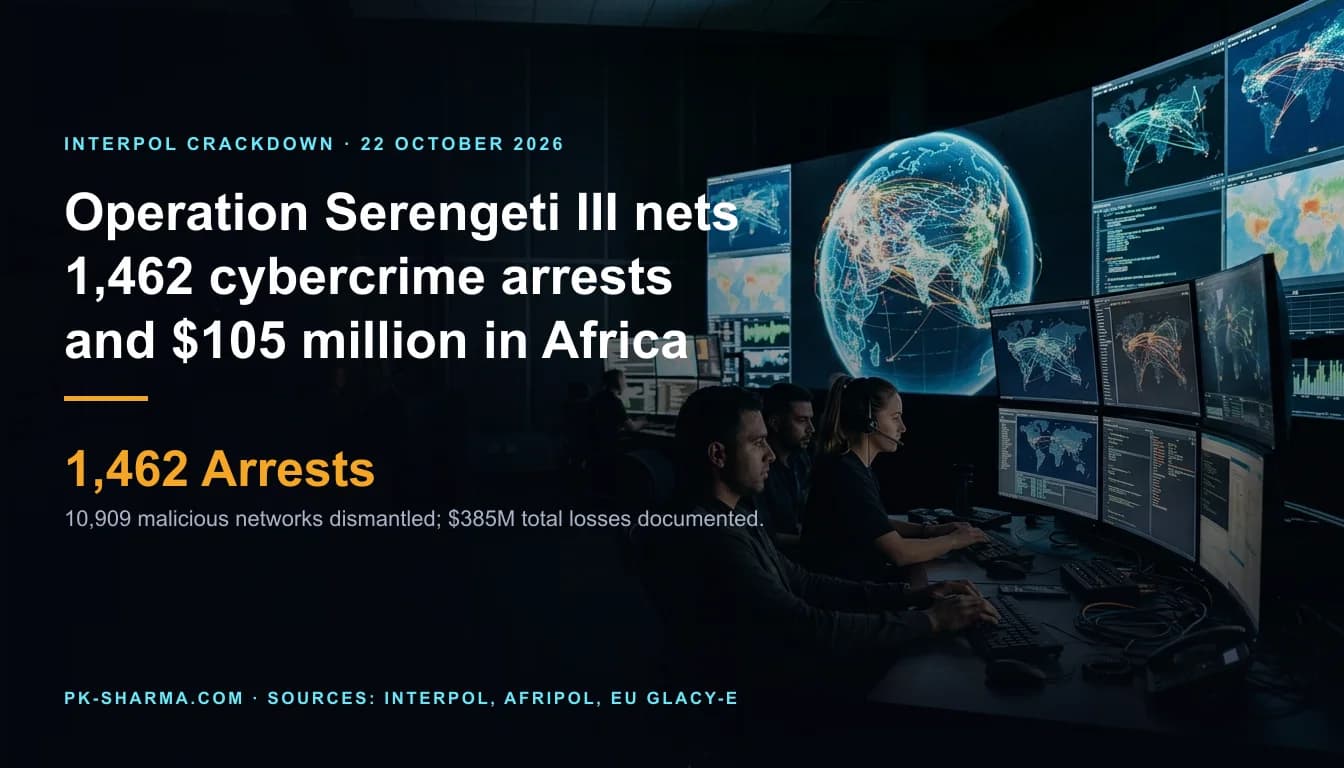
INTERPOL, the African Union's police cooperation mechanism (AFRIPOL), and law enforcement task forces across 21 nations have concluded Operation Serengeti III, an expansive international cybercrime crackdown executed between 29 June and 31 August 2026 (a 64-day operational sweep) and publicly disclosed on 22 October 2026. The coordinated action resulted in the arrest of 1,462 suspects, the disruption of 10,909 malicious network infrastructures, and the recovery of more than $105 million in illicit funds linked to transnational syndicates.
Telemetry compiled across the 21 participating jurisdictions identified 65,929 targeted victims, with aggregate financial losses linked to the criminal networks exceeding $385 million. Dividing total documented losses across identified victims yields an average loss of $5,839 per victim (derived). The $105 million in recovered funds reflects a recovery rate of 27.27% (derived), leaving at least $280 million in stolen capital unrecovered across international banking channels.
What this establishes from the official record. Over 1,400 physical arrests were executed across 20 African nations and coordinated with US federal investigators. Seizures spanned industrial hardware, including 2,000 crypto-mining units and six illegal high-voltage power substations in Angola, alongside 2.1 million harvested corporate email credentials in Nigeria. What this does not establish. The headline figure of 10,909 'malicious networks dismantled' is INTERPOL's own aggregated metric blending domain sinkholes, blocked IP addresses, and seized physical call centers. Law enforcement has not published a breakdown distinguishing between top-tier syndicate kingpins and low-level boiler room workers, nor does the record measure how rapidly the remaining 72.7% of unrecovered funds were laundered through privacy coins.
Operational framework: multi-tier public-private intelligence coordination
Operation Serengeti III operated through a three-tier intelligence-to-enforcement pipeline designed to bridge private threat telemetry with cross-border sovereign policing:
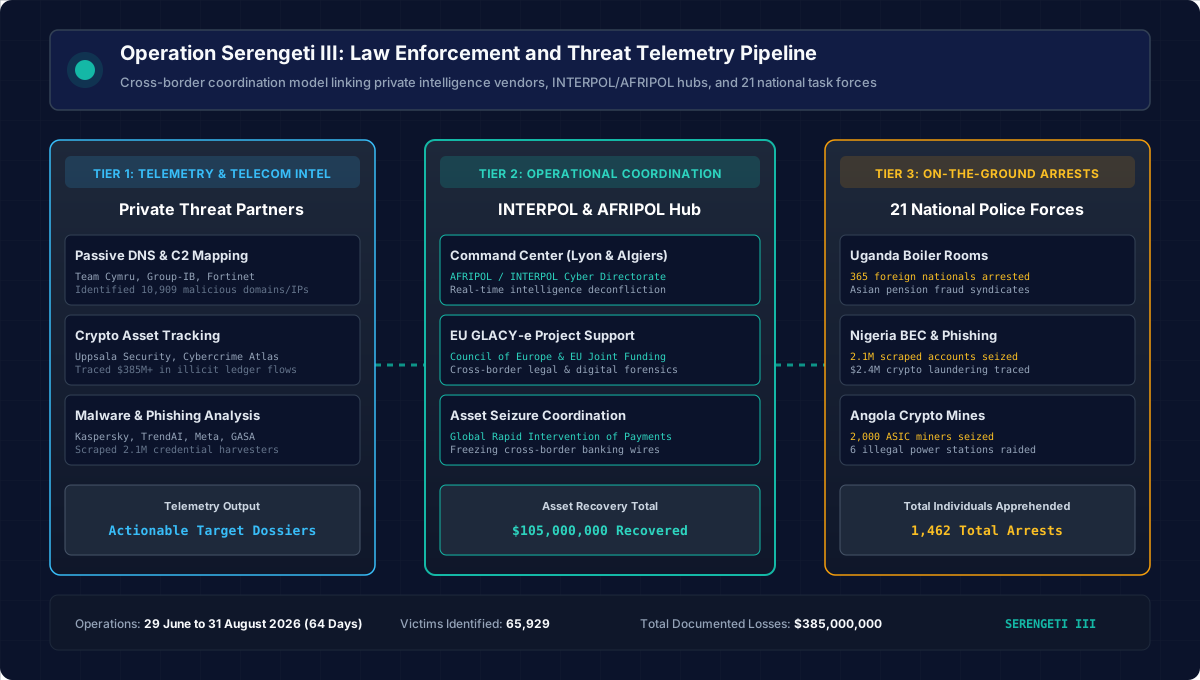
Private sector partners, including Team Cymru, Group-IB, Kaspersky, Fortinet, and Uppsala Security, supplied raw NetFlow feeds, passive DNS traces, and blockchain transaction graphs. This data was ingested into INTERPOL's Cybercrime Directorate in Lyon and AFRIPOL's coordination hub in Algiers, which developed target packages for national police units under co-funding from the European Union's GLACY-e project.
Dismantled attack chains: boiler rooms vs business email compromise
The operation targeted multiple disparate crime archetypes, with the two largest operational centers exhibiting fundamentally different technical mechanics:
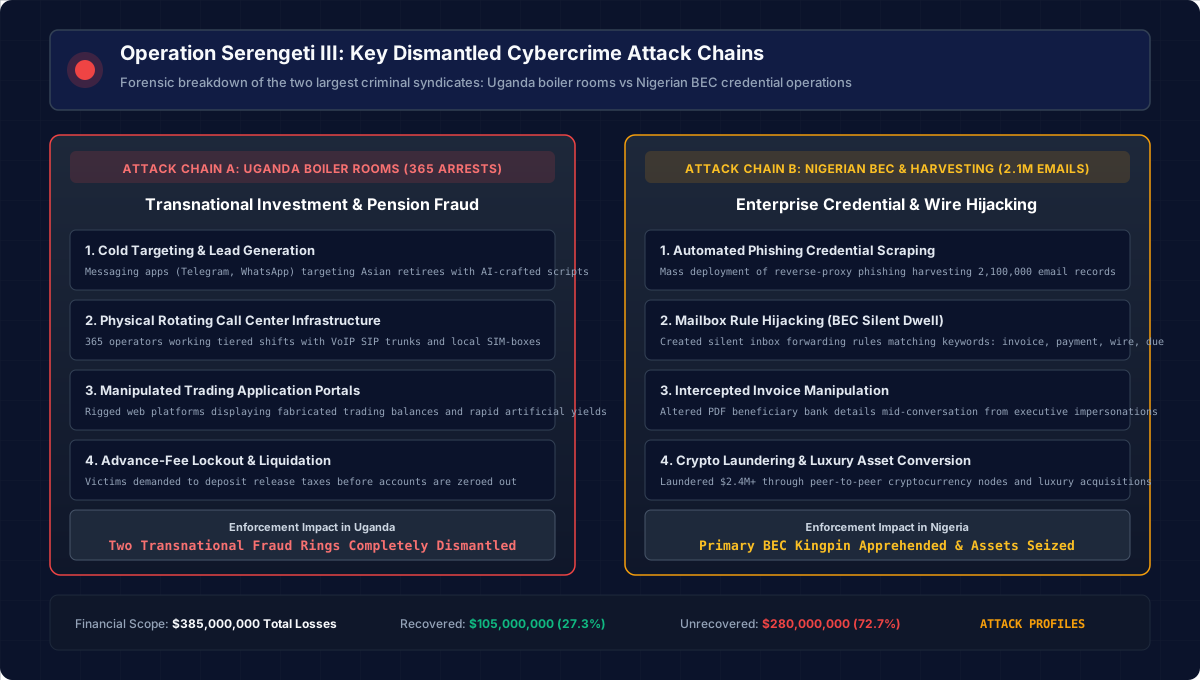
In Uganda, investigators raided two transnational boiler room facilities and arrested 365 foreign nationals (representing 25.0% of total operation arrests). The syndicate operated rotating shifts utilizing VoIP SIP PBX trunks and local SIM-boxes to cold-contact Asian retirees over Telegram and WhatsApp, luring them into fraudulent trading platforms that displayed fabricated high-yield balances before locking accounts behind advance-fee tax demands.
In Nigeria, the primary target was an enterprise Business Email Compromise (BEC) and phishing infrastructure that had harvested 2,100,000 corporate email credentials. Attackers monitored compromised executive mailboxes using silent forwarding rules, intercepting legitimate commercial invoices and swapping payment IBANs mid-conversation to divert corporate wire transfers into cryptocurrency laundering pipelines.
Regional operational breakdown across key jurisdictions
Operational telemetry across the primary participating jurisdictions highlights the diversity of cybercrime models disrupted during the 64-day campaign:
Operation Serengeti III enforcement metrics and tactical targets by primary jurisdiction
| Jurisdiction | Target Threat Vector | Seized Assets and Infrastructure | Operational Enforcement Impact |
|---|---|---|---|
| Uganda | Investment and pension boiler rooms | 365 foreign nationals arrested, VoIP PBX racks, fake trading portals | Two transnational fraud rings targeting Asian pensioners dismantled |
| Nigeria | Business Email Compromise and phishing | 2.1M scraped corporate email accounts, luxury vehicle, $2.4M crypto traced | Arrested primary BEC organizer; seized credential harvesting servers |
| Angola | Illegal industrial cryptocurrency mining | 2,000 ASIC mining rigs, 6 high-voltage power substations ($1M value) | Terminated unauthorized grid power diversions and local laundering |
| Tanzania | Predatory mobile lending malware | Malicious Android loan APKs, C2 command servers, victim SMS logs | Dismantled automated extortion ring exploiting borrower contact lists |
| Gabon | Vehicle import escrow fraud | Social media impersonation portals, fraudulent customs documentation | Seized automotive fraud infrastructure and froze local bank accounts |
Technical deep dive: predatory mobile loan APKs and BEC invoice tampering
Forensic analysis of artifacts seized in Tanzania and Nigeria reveals how threat actors engineered their offensive tooling to maximize psychological and financial coercion:
<!-- Extracted AndroidManifest.xml from predatory loan APK seized in Tanzania -->
<manifest xmlns:android="http://schemas.android.com/apk/res/android" package="com.quickcash.instantcredit">
    <!-- Invasive surveillance permissions masquerading as credit-check requirements -->
    <uses-permission android:name="android.permission.READ_SMS" />
    <uses-permission android:name="android.permission.READ_CONTACTS" />
    <uses-permission android:name="android.permission.ACCESS_FINE_LOCATION" />
    <uses-permission android:name="android.permission.READ_CALL_LOG" />
    <uses-permission android:name="android.permission.CAMERA" />
    <uses-permission android:name="android.permission.INTERNET" />

    <application android:allowBackup="false" android:theme="@style/AppTheme">
        <!-- Stealth background daemon transmitting contact book to C2 -->
        <service android:name=".telemetry.ExfiltrationWorker" android:exported="false" />
    </application>
</manifest>
In the Tanzanian scheme, the loan application operated as a surveillance Trojan. Upon installation, the application transmitted the user's entire address book, SMS history, and photo gallery to an offshore server. If the borrower delayed payment by even 24 hours, automated backend scripts broadcast defamatory messages and manipulated photos to every contact in the victim's phone book.
# Python demonstration of defensive BEC invoice IBAN anomaly detection
import re, pypdf

def audit_invoice_pdf(pdf_path: str, approved_vendor_ibans: set) -> dict:
    reader = pypdf.PdfReader(pdf_path)
    extracted_text = " ".join(page.extract_text() for page in reader.pages)

    # Extract international bank account numbers (IBAN)
    iban_pattern = r"[A-Z]{2}[0-9]{2}[A-Z0-9]{4}[0-9]{7}([A-Z0-9]?){0,16}"
    found_ibans = set(re.findall(iban_pattern, extracted_text.replace(" ", "")))

    anomalous_ibans = found_ibans - approved_vendor_ibans
    return {
        "has_anomaly": len(anomalous_ibans) > 0,
        "flagged_ibans": list(anomalous_ibans),
        "status": "BLOCK_PAYMENT_FOR_OUT_OF_BAND_VERIFICATION" if anomalous_ibans else "CLEARED"
    }
Primary sources review: examining INTERPOL claims against operational reality
A critical examination of INTERPOL's official disclosures requires separating documented law enforcement metrics from broad organizational assertions:
Epistemic audit: what INTERPOL's Operation Serengeti III disclosure establishes vs what remains unverified
| Metric or Claim | Stated in Official Record | Not Stated or Operational Reality |
|---|---|---|
| Arrest Count | 1,462 suspects arrested across 21 nations | Proportion of low-level call center operators vs syndicate leadership not disclosed |
| Disrupted Networks | 10,909 malicious networks dismantled | Aggregate term blending domain sinkholes, blocked IPs, and physical offices |
| Recovered Assets | $105 million recovered across 64 days | Independent audit of liquid fiat versus seized physical goods and crypto wallets not provided |
| Financial Scope | $385 million in linked financial losses | Represents documented complaint files; total unrecorded victim losses likely higher |
| Syndicate Lifespan | Operations active prior to June 2026 | Average dwell time before detection and speed of infrastructure reconstitution not reported |
From the practice: independent technical analysis and enterprise defense verdict
Operation Serengeti III highlights both the vital importance and the structural limitations of international law enforcement sweeps. While recovering $105 million and apprehending 1,462 individuals demonstrates meaningful operational momentum, the underlying economic incentives of cybercrime syndicates remain largely unchanged.
- Out-of-Band Payment Verification Is Non-Negotiable: Technological email defenses (SPF, DKIM, DMARC) cannot prevent BEC once an executive's mailbox is compromised via session theft. Enterprise finance departments must enforce mandatory out-of-band voice or cryptographic verification for any modification to vendor banking coordinates.
- Close the Regional Telecom Spoofing Loophole: The dismantling of 365 call-center operators in Uganda demonstrates that boiler rooms rely entirely on unauthenticated VoIP SIP trunking and SIM-boxes to present spoofed caller IDs to victims abroad. Telecommunications regulators across East Africa must mandate STIR/SHAKEN call authentication protocols.
- Audit Mobile Device Management Policies: Organizations permitting Bring Your Own Device (BYOD) access must enforce MDM profiles that prohibit unvetted side-loaded APKs. As evidenced in Tanzania, predatory loan apps equipped with invasive surveillance SDKs pose severe corporate espionage and credential harvesting risks.
Sources
- PrimaryCybercrime Crackdown in Africa Nets 1,462 Arrests, Recovers Over USD 105 Million in Operation Serengeti IIIINTERPOL General Secretariataccessed 2026-10-22
- PrimaryGlobal Action on Cybercrime Enhanced (GLACY-e): Operational Support and Capacity BuildingCouncil of Europe Cybercrime Programme Officeaccessed 2026-10-22
- PrimaryJoint Communiqué: Transnational Cyber Operations Across African Union Member StatesAFRIPOLaccessed 2026-10-22