A documentation placeholder nobody reserved now serves a ClickFix lure, and the request is the detection
third-party.com was used as an example hostname in W3C specifications, Chromium docs, a Vercel test and agent skills. It is a normal registrable domain, it changed hands, and it now serves a fake verification page to Windows visitors.
By Parminder Kumar Sharma · · 20 min read
Two counts of the same domain, published one day apart
On 23 September 2026 Manifold Security published a finding about third-party.com, a hostname that appears in developer documentation the way example.com does. The post said a public code search turns the domain up in "over 1,500 files across 1,700+ repositories". On 24 September the same firm published a follow-up with a table of fourteen placeholder domains and a stated counting method, and in that table third-party.com sits at 672 files.
Both numbers cannot be exact, and one of them is arithmetically impossible on its own terms. Every file lives in exactly one repository, so a set of matching files cannot be spread across more repositories than there are files. You cannot have 1,500 files in 1,700 repositories.
I ran the count myself against GitHub's code search API on 24 September 2026, signed in, which excludes forks by default. The bare string third-party.com returns 1,106 files. The exact literal "https://third-party.com", which is the form that would actually resolve if something followed it, returns 383 files. Paginating that second query returned 368 rows containing 277 distinct repositories.
What this does not establish. It does not establish that anybody misreported anything. GitHub describes its own code search counts as approximate, Manifold says explicitly that both of its columns are floors, and the two posts were plainly measuring different things: one a broad mention, the other a hostname written as a URL. Nor does a smaller number mean a smaller problem. Code search cannot see private repositories, vendored copies, container images, internal wikis, Confluence pages, PDF runbooks, or the copy somebody pasted into a config file in 2019 and never pushed.
What the disagreement does establish is the shape of this story. Nobody, including the people who found it, can tell you how many places this string is reachable from. The correct response to that is not a better number. It is a control that does not depend on knowing the number.
What the domain actually serves, at a defender's level
Manifold's security engineer Swapnil Patil noticed the domain when a public agent skill that referenced it tripped a phishing indicator in the firm's own monitoring. A documentation placeholder setting off a malware alert did not add up, so the team looked at what the host was serving.
Fetched with a Windows user agent, the page imitates a Cloudflare verification screen, complete with an animated checkbox and a Ray ID in the footer. Its JavaScript stages the system clipboard using a hidden text area and a hijacked copy event, then walks the visitor through opening a Windows system dialog, pasting and pressing Enter. A decoy comment and a random six digit number are appended so that what lands in the dialog reads as a verification token rather than as a command.
Fetched with a macOS or Linux user agent, the same host returns a near identical page that stops at an error saying the site requires a Windows PC. No clipboard staging. No payload. As Ax Sharma, Manifold's head of research, puts it: "The attacker only shows the weapon to the targets it works against."
The second stage the pasted command reaches for, elxxvvx[.]xyz, was not resolving when Manifold tested and was still not resolving when BleepingComputer tested. A Hybrid Analysis submission dated 2 May 2026 shows that host previously served a script that pulled a 134MB archive and tried to launch an executable named after a well known diagramming tool. That archive is gone, so what the final payload did is not established by any source I could reach.
It is a placeholder, not an abandoned project, and that is checkable
Those are different stories. An abandoned project domain that lapsed and got re-registered is an ordinary supply chain failure with a known owner and a known history. A documentation placeholder is not a dependency anybody tracks, has no owner in anybody's inventory, and reaches people who never installed anything.
This is the second kind, and four independent checks say so. I fetched each of these myself rather than taking the coverage's word for it.
Where the domain appears as a documentation example. Each file was fetched directly from its source on 24 September 2026.
| Source | How the domain is used | Verified |
|---|---|---|
| W3C Geolocation, Candidate Recommendation Snapshot, 26 March 2026 | An iframe example showing how to grant geolocation to third-party content | One occurrence, in the section on enabling the API in third-party contexts |
| W3C Compute Pressure, Candidate Recommendation Draft, 14 May 2026 | The same iframe pattern, showing policy-controlled access for remote content | One occurrence, in the policy control section |
| Chromium, Telemetry Extension API README | An externally connectable match pattern for a permitted site | Line 161 of the file at the pinned commit |
| Vercel, Turborepo, builder.rs | A test fixture checking origin matching against a telemetry endpoint | Line 2616 at the pinned commit |
The Sanity example is the one that shows how far this has travelled. The domain appears in .agents/skills/playwright-best-practices/browser-apis/iframes.md, which is an agent skill file, in a cross-origin iframe example. Manifold's own corpus surfaced three more skills carrying it, one of which uses the domain in a snippet explicitly labelled as the wrong way to hardcode an endpoint.
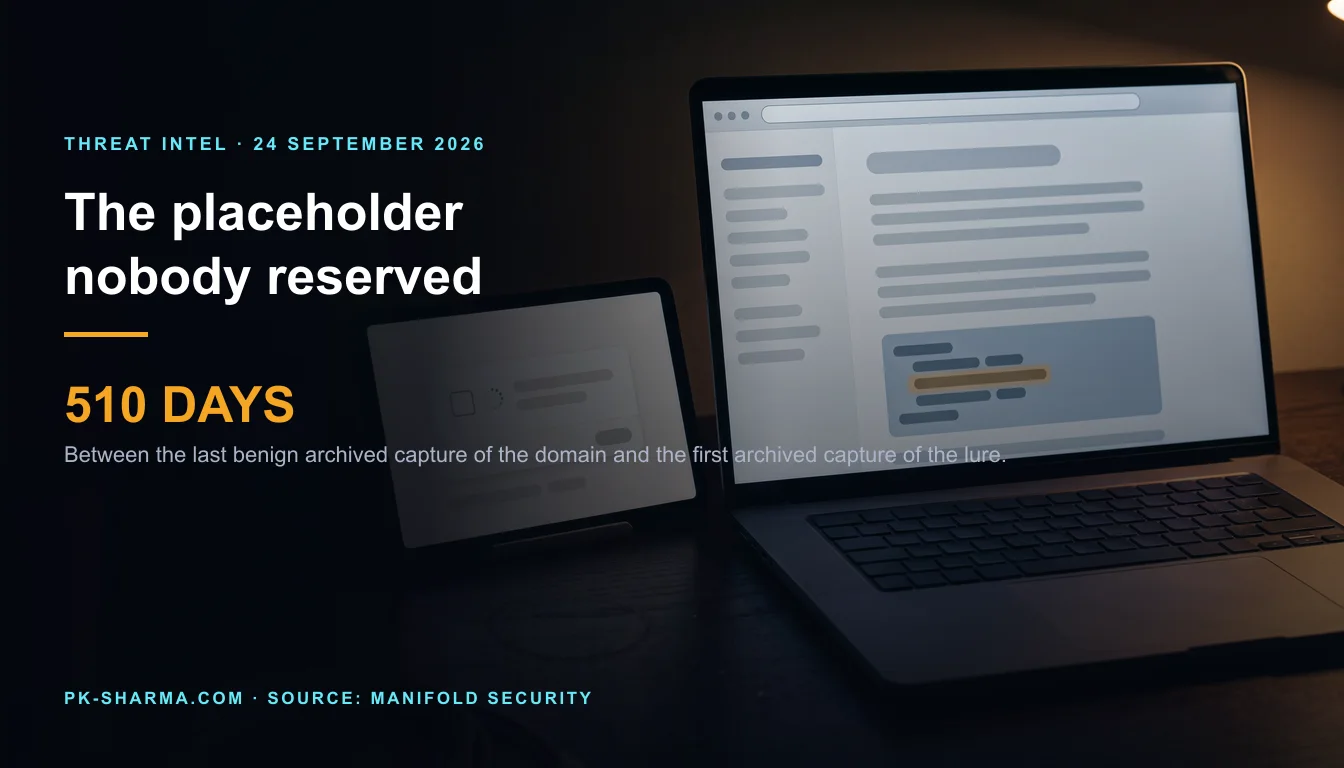
The archive settles the last question. The Internet Archive's capture of 21 January 2025 shows a bare Apache directory listing with a single cgi-bin/ entry last modified in January 2017. That is a dormant server, not a product that died. The capture of 15 June 2026 is the lure page. I checked the captures of 22 and 24 September 2026 myself: both are still the lure, still titled with a holding message, still carrying a Ray ID and an unsupported operating system string.
Between the dormant capture and the first archived lure there are 510 days. No source I could find states when control of the domain changed, or how. The registrar is Network Solutions and the domain was first registered in 1996, which is a quarter of a century before anybody wrote a skill file.
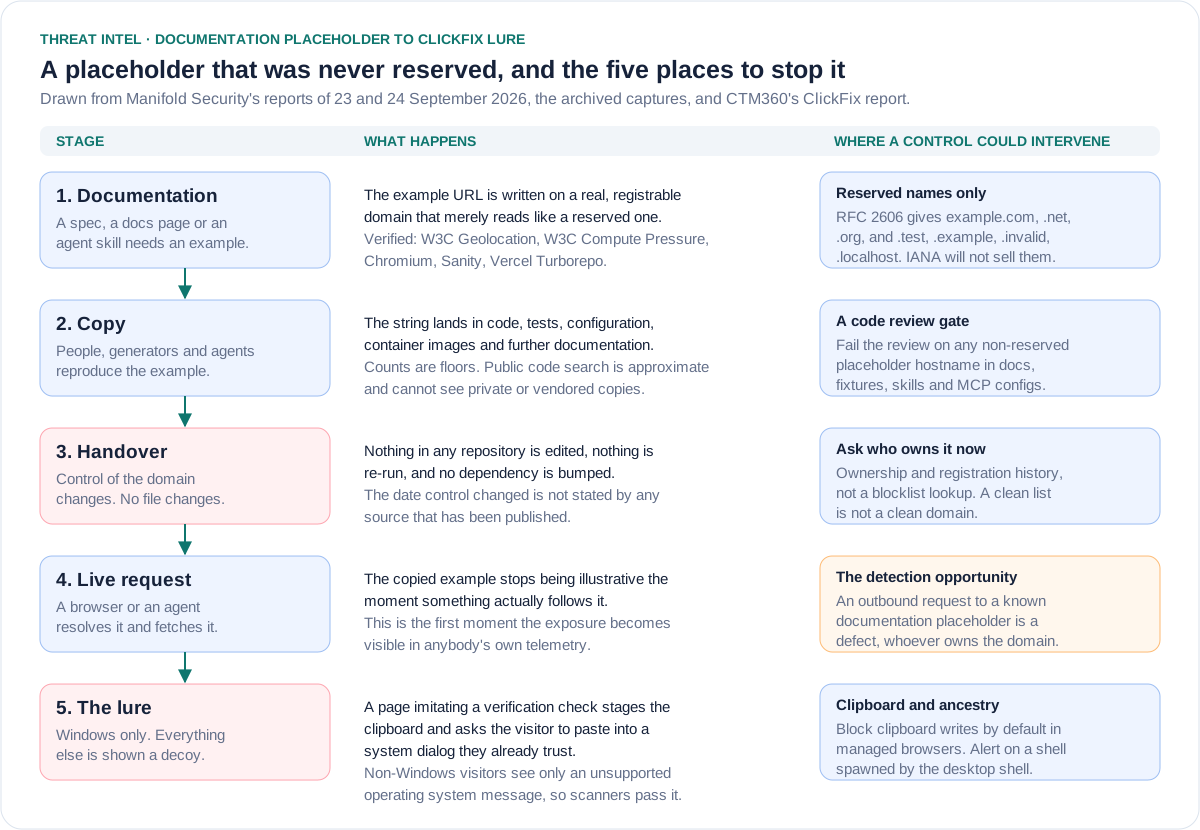
The correct practice has been written down since 1999
RFC 2606, published in June 1999 by Donald Eastlake and Aliza Panitz and designated BCP 32, reserves four top level domains and three second level names for exactly this problem. The top level names are .test for testing DNS code, .example for documentation and examples, .invalid for names that must never resolve, and .localhost for loopback. The second level names are example.com, example.net and example.org. The RFC's stated reason is blunt: test or example code might escape from the testbed.
RFC 6761, published February 2013 by Stuart Cheshire and Marc Krochmal, put those names into a formal IANA Special-Use Domain Names registry and set out how resolvers and authoritative servers should treat each one. IANA's own page on the example domains states the operative fact in one clause: they "are not available for registration or transfer".
That is the whole difference. example.com cannot be bought by anybody, ever. third-party.com could be bought by anybody, and at some point in a 510 day window, somebody's content started appearing on it.
How many places is it reachable from
The honest answer is that nobody can count it, and the useful answer is to describe the shape instead.
Here is my method, so you can repeat it or disagree with it. I queried GitHub's code search API on 24 September 2026 as an authenticated user, which searches indexed public code on default branches and excludes forks. I ran the bare hostname, the hostname written as a URL with a scheme, and three language filters, then paginated the URL-form query and counted distinct repository names in what came back. GitHub caps paginated results and calls the totals approximate, so these are floors, not measurements.
Counts for third-party.com. Rows one to three are my own queries against GitHub's code search API on 24 September 2026; rows four and five are as published.
| Query or source | Result | What it counts |
|---|---|---|
| Bare string third-party.com | 1,106 files | Any mention, including prose and longer hostnames |
| Exact literal with scheme | 383 files, 277 distinct repositories in 368 rows | The form that would resolve if something followed it |
| By language: markdown / TypeScript / JavaScript | 528 / 131 / 59 files | Where the string lives, weighted heavily to documentation |
| Manifold, 23 September 2026 | Over 1,500 files across 1,700+ repositories | Stated without a method; arithmetically impossible as a pair |
| Manifold, 24 September 2026 | 672 files | Hostname preceded by a scheme separator, forks excluded |
The shape matters more than any of those cells. Roughly half of the hits are markdown, which means the dominant artefact is documentation teaching the next person to write the same string. The TypeScript and JavaScript hits are the ones that could produce a request. And the exposure compounds in a direction code search cannot follow: a skill file that carries the line has, on Manifold's count, been forked 1,089 times, and every copy carries it.
There is also a timing point that clears the projects involved entirely. The skill lines that Manifold could date from Git history went in on 19 January and 28 February 2026, months before the lure first appears in the archive. The authors cited a dormant placeholder. The ground moved underneath them, and nothing in any repository had to change for that to happen.
The second Manifold report, published on 24 September, is the one that resets the scale. Sweeping for placeholder hostnames of the same class turned up fourteen that are not IANA reserved, cited by 1,536 skills in the firm's corpus. Three of the fourteen were serving something other than examples. Measured by citations, this ClickFix case is the small one.
Selected rows from Manifold Security's table of unreserved placeholder domains, 24 September 2026. GitHub column counts files writing the domain as a URL, forks excluded, and is described by the authors as a floor.
| Domain | Files on GitHub | What it served when looked at |
|---|---|---|
| foo.com | 333,312 | Not stated |
| yourdomain.com | 195,072 | Not stated |
| yoursite.com | about 185,000 | Investment fraud, to macOS visitors, via a parking page ad chain |
| your-domain.com | about 174,000 | Scareware and investment fraud, to macOS visitors |
| acme.com | 81,536 | Not stated |
| third-party.com | 672 | ClickFix lure, to Windows visitors only |
The two scam cases are worth a defender's attention for a reason that has nothing to do with malware. They are parked domains carrying ordinary advertising, and the scam fires after the page's JavaScript runs, one hop away on another host. Manifold rendered the pair twenty-four times in a real browser: two of sixteen macOS renders ended on a scam, none of the eight Windows or Linux renders did. Static fetches, blocklist history and user agent probing cleared all thirteen domains. If your assurance process is "we checked the domain", that is the result it would have given you.
The request is the detection, and this is the useful part
Everything above is about somebody else's estate. Here is the part that is about yours.
An outbound request from your network to a documentation placeholder domain is almost always a mistake. It means a literal example escaped review and something followed it: a browser rendering a page built from copied markup, a test fixture pointed at the internet, a container built from a config nobody read, an agent that harvested a URL out of documentation it was given and fetched it. None of those is a thing you wanted. The ownership of the domain is not the point. The request is a defect signal whether the far end is an attacker, a parking page or a friendly stranger.
That makes this rare among indicators: a near zero false positive rule that you can write once and that does not decay when the attacker rotates infrastructure, because the string on your side never changes. It also gives you something a code sweep cannot, which is coverage of the copies you do not own: the vendor appliance, the SaaS tenant, the contractor's laptop.
# 1. Sweep source, docs, skills and MCP configs for unreserved placeholders.
#    Reserved names are deliberately absent from this list: they are the fix.
rg -n --hidden -g '!.git' -iE \
  '(https?://)?(third-party|yoursite|your-domain|yourdomain|mysite|myapp|\
   your-app|yourapp|your-site|company|mycompany|vendor|acme|foo)\.com' .

# 2. Detection, in words rather than in one vendor's syntax:
#    alert on any DNS resolution or HTTP request, from any source in the estate,
#    to a hostname on that same list. Severity low, disposition "investigate",
#    expected volume near zero. Do not allowlist any of them to silence noise.

# 3. Reserved names for the fix. These can never be registered by anyone:
#    example.com  example.net  example.org
#    .example  .test  .invalid  .localhost        (RFC 2606, BCP 32)
Why a technique that needs the user to act is so hard to block
CTM360 published a 61 page report titled "ClickFix and Beyond" on 22 September 2026, marked TLP CLEAR, combining campaign level analysis across more than 3,000 compromised websites with host level analysis of a single compromised WordPress site. Its account of why the technique defeats controls that work on other delivery methods is the clearest I have read, and it is defined by absence: there is no exploit for a vulnerability scanner to find and no patch that closes it, usually no attachment for an email gateway to detonate, and no download for a browser's file reputation check to score. The command is pasted by an authenticated interactive user into a native, signed, universally present binary, which is the profile of legitimate administrative work.
MITRE now tracks the behaviour as T1204.004, User Execution: Malicious Copy and Paste, created 18 March 2025 and last modified 12 May 2026, with Linux, Windows and macOS all listed as applicable platforms. ESET recorded a 517 per cent rise in its detection for this class between the second half of 2024 and the first half of 2025.
CTM360's most useful structural observation is that everything cheap for the attacker to change is changing constantly, and everything expensive has not changed in three years. The artwork, the brand being impersonated, the keyboard shortcut and the payload family all rotate. The structure does not: a page writes to the clipboard, a user opens an interpreter, the interpreter reaches the network, something persists.
CTM360's four chokepoints, 22 September 2026, with the intervening control class as the report states it.
| Chokepoint | What must be true for the attack to proceed | Control class |
|---|---|---|
| Clipboard staging | A web page must be able to write to the system clipboard | Browser policy |
| Interpreter access | An interactive user must be able to open a shell or Run dialog and run arbitrary content | OS policy, application control |
| Interpreter egress | That interpreter must reach the internet directly to fetch the next stage | Network policy |
| Post-execution behaviour | Something must persist, inject, collect and exfiltrate | EDR behavioural detection |
CTM360's own prioritisation, if a team can deploy only one control this quarter, is the third: stop script interpreters and fetch utilities reaching arbitrary internet hosts directly, and force them through an authenticated proxy with an allow list. That breaks every staged chain in their report at the first hop, on all three operating systems, without depending on any indicator.
Two detection notes from the same report are worth carrying into a UK SOC. The Windows Run dialog records what was typed in the RunMRU registry key, which the report rates a very high fidelity signal with almost no false positives on a healthy corporate endpoint. Operators noticed, and a now common variant routes the user through the Power User menu into Windows Terminal instead, which leaves no RunMRU entry at all. The durable replacement is process ancestry: the desktop shell spawning PowerShell, pwsh, Windows Terminal or cmd with a long, encoded or obfuscated command line.
And on the cross-platform side, the highest value item per unit of effort is browser policy. Chrome and Edge enterprise policy can set the default clipboard site permission to block, with an allow list for the handful of internal applications that genuinely need it. The page can still display its instructions, but it cannot silently stage the command, and a user asked to retype an obfuscated one liner by hand will usually stop.
There is one line in CTM360's report that should trouble anyone running a Linux engineering estate: the population most at risk is not servers but Linux desktops used by engineers, who are habituated to installing software by pasting a command into a shell, and who typically hold cloud credentials, SSH keys and source access. The campaign CTM360 dissected had a Linux landing page built and held in reserve.
What is established, and what is not
Read against the primary sources fetched for this briefing on 24 September 2026.
| Claim | Established | Not established |
|---|---|---|
| The domain serves a ClickFix lure to Windows visitors | Manifold's fetch, BleepingComputer's confirmation, archived captures of 15 June, 22 and 24 September 2026 | What the final payload did. The second stage host was already offline when both parties tested |
| It is a documentation placeholder, not a lapsed project | Verified in two W3C specifications, Chromium, Vercel Turborepo and a Sanity agent skill; the January 2025 capture is a bare directory listing | Nothing suggests it was ever a product or service |
| Control of the domain changed hands | The archived content changed between 21 January 2025 and 15 June 2026 | When, how, or to whom. No source states this. Registered in 1996 via Network Solutions |
| Developers have copied the examples into live code | A 2015 Stack Overflow question cited by BleepingComputer describes exactly that, before the lure existed | No reported case of a ClickFix attack actually being executed through one of these references |
| The documentation owners have responded | Nothing found. A GitHub issue search for the domain created after 20 September 2026 returns one result, a news aggregator | Absence of a public issue is not absence of a response; private fixes would not appear |
That last row deserves a plain statement rather than an insinuation. As of 24 September 2026 I could find no published statement from the W3C, Chromium, Vercel or Sanity about this, and no public issue or pull request proposing to change the examples. That is a gap of one day and a weekend from the original disclosure, which is not long, and none of those projects did anything wrong. The examples were correct when they were written.
On commercial interest: Manifold Security sells runtime monitoring for AI agents and MCP servers, and both of its posts close by saying so. CTM360 sells external attack surface management and the ClickFix report is gated behind a download form. Neither fact weakens the evidence. I fetched the primary artefacts, the specifications, the source files, the RFCs and the archived captures directly, and the numbers I could not reproduce are flagged above rather than repeated.
What to do, in the order worth doing it
Take this with you
This week, for a UK security or platform team
- Write the detection first, because it covers the copies you do not own. Alert on any DNS resolution or outbound request from the estate to a documentation placeholder domain. Expected volume is near zero and every hit is worth ten minutes.
- Resist the urge to allowlist any of those domains to quieten the alert. That is the control that fails on the day the content turns.
- Sweep your own corpus next: source, README files, test fixtures, Terraform and Helm values, agent skills, MCP server configurations, internal wikis and onboarding docs. Search for the hostnames, not just for the scheme.
- Separate a liveness check from a fetch. If a tool in your pipeline verifies that URLs still work, it is reaching out to attacker infrastructure from your address space. Check syntax and registration, not reachability.
- Add one line to the code review checklist: example hostnames must be RFC 2606 reserved names. example.com, example.net, example.org, or a name under .example, .test, .invalid or .localhost. Nothing else, however obviously fake it reads.
- Set the default clipboard site permission to block in managed Chrome and Edge, with a short allow list. This closes the first chokepoint for the entire ClickFix class, not just this domain.
- Alert on the desktop shell spawning PowerShell, pwsh, Windows Terminal or cmd with a long, encoded or obfuscated command line. Keep the RunMRU rule as well, and understand it misses the Windows Terminal variant.
- Force script interpreters and fetch utilities through an authenticated proxy with destination allow listing. This is the single highest value control in CTM360's report and it is indicator independent.
- Rewrite the awareness message. Training built around not opening attachments and checking the sender does not describe this attack at all. The message is that no legitimate verification check ever asks you to paste anything into a system dialog.
- Check whether your Linux engineering desktops are in scope for any of the above. On current evidence they are the least defended population and the one holding the most credentials.
The question that exposes the gap
The reserved names have existed since June 1999 for exactly this reason, spelled out in the RFC: example code escapes from the testbed. The failure here is not that somebody chose a bad domain. It is that a string which reads like a reserved name, in a specification published by a standards body, carried none of the protection that the reading implies, and there was no point in the pipeline at which anything checked.
So the question is not whether you have third-party.com in your estate. That is a grep, and you should run it. The question is the one underneath it.
Which other strings in your documentation, your test fixtures and your agent configurations are you trusting because of how they read, rather than because somebody verified what stands behind them, and what would tell you on the day one of them changes hands?
Key facts
This analysis was researched with Claude, made by Anthropic.
Sources
- PrimaryThe original research by Ax Sharma, 23 September 2026. Used for how the domain was found, the operating system gated response, the clipboard staging mechanism, the second stage host, the blocklist history and the named affected skills.Manifold Securityaccessed 2026-09-24
- PrimaryFollow-up research by Cody Nash, 24 September 2026. Used for the table of fourteen unreserved placeholder domains, the stated counting method, the 672 file figure, the macOS render counts and the commit dates of the affected skill lines.Manifold Securityaccessed 2026-09-24
- PrimaryRFC 2606, Reserved Top Level DNS Names, June 1999, BCP 32. Used to establish exactly which names are reserved and the stated reason for reserving them.IETFaccessed 2026-09-24
- PrimaryRFC 6761, Special-Use Domain Names, February 2013. Used for the IANA special-use registry and the required treatment of example, invalid, localhost and test names.IETFaccessed 2026-09-24
- PrimaryIANA's page on the example domains. Used for the statement that they are not available for registration or transfer.IANAaccessed 2026-09-24
- PrimaryGeolocation, Candidate Recommendation Snapshot of 26 March 2026. Fetched to verify the single use of the placeholder in the iframe example for third-party contexts.W3Caccessed 2026-09-24
- PrimaryCompute Pressure Level 1, Candidate Recommendation Draft of 14 May 2026. Fetched to verify the placeholder in the policy control iframe example.W3Caccessed 2026-09-24
- PrimaryTelemetry Extension API README at a pinned commit. The raw file was fetched to verify the externally connectable match pattern on line 161.The Chromium Projectaccessed 2026-09-24
- PrimaryTurborepo builder.rs at a pinned commit. The raw file was fetched to verify the origin matching test fixture on line 2616.Vercelaccessed 2026-09-24
- PrimaryA Playwright agent skill file at a pinned commit. The raw file was fetched to verify the cross-origin iframe example on line 75.Sanityaccessed 2026-09-24
- PrimaryClickFix and Beyond, September 2026, 61 pages, TLP CLEAR. Read in full for the four chokepoints, the reasons the technique defeats other controls, the RunMRU and process ancestry detections, and the browser clipboard policy recommendation.CTM360accessed 2026-09-24
- PrimaryT1204.004, User Execution: Malicious Copy and Paste. Used for the technique identifier, its creation date of 18 March 2025 and the platforms listed.MITREaccessed 2026-09-24
- PrimaryPublic blocklist record for the domain. Used to verify the listing of 7 July 2026, the delisting of 17 July 2026 and the relisting on or about 23 September 2026.IPFireaccessed 2026-09-24
- PrimaryCapture of 21 January 2025 showing a bare Apache directory index. Used to establish the domain was dormant rather than an abandoned product.Internet Archiveaccessed 2026-09-24
- PrimaryCapture of 15 June 2026 showing the fake verification page. Used to date the earliest archived appearance of the lure.Internet Archiveaccessed 2026-09-24
- Reported byCoverage by Lawrence Abrams, on or about 23 September 2026. Used as the pointer to the research, for its independent confirmation of the lure page, and for the 2015 Stack Overflow case and the Hybrid Analysis submission of 2 May 2026.BleepingComputeraccessed 2026-09-24
- Reported byESET Threat Report H1 2025, the source of the 517 per cent rise in fake CAPTCHA detections between H2 2024 and H1 2025, cited in the Manifold research.ESETaccessed 2026-09-24