NVIDIA's '5x faster' Nemotron 3.5 Super VL is 1.9x to 2.3x in its own report; NVFP4 weights need 75 GB
NVIDIA's blog says Nemotron 3.5 Super VL is 5x faster than the next best open model. NVIDIA's own technical report measures 1.9x to 2.3x per GPU, Artificial Analysis lists 1.3x to 2.8x against the rival the chart names, and the NVFP4 weights alone are 75 GB.
By Parminder Kumar Sharma · · 28 min read
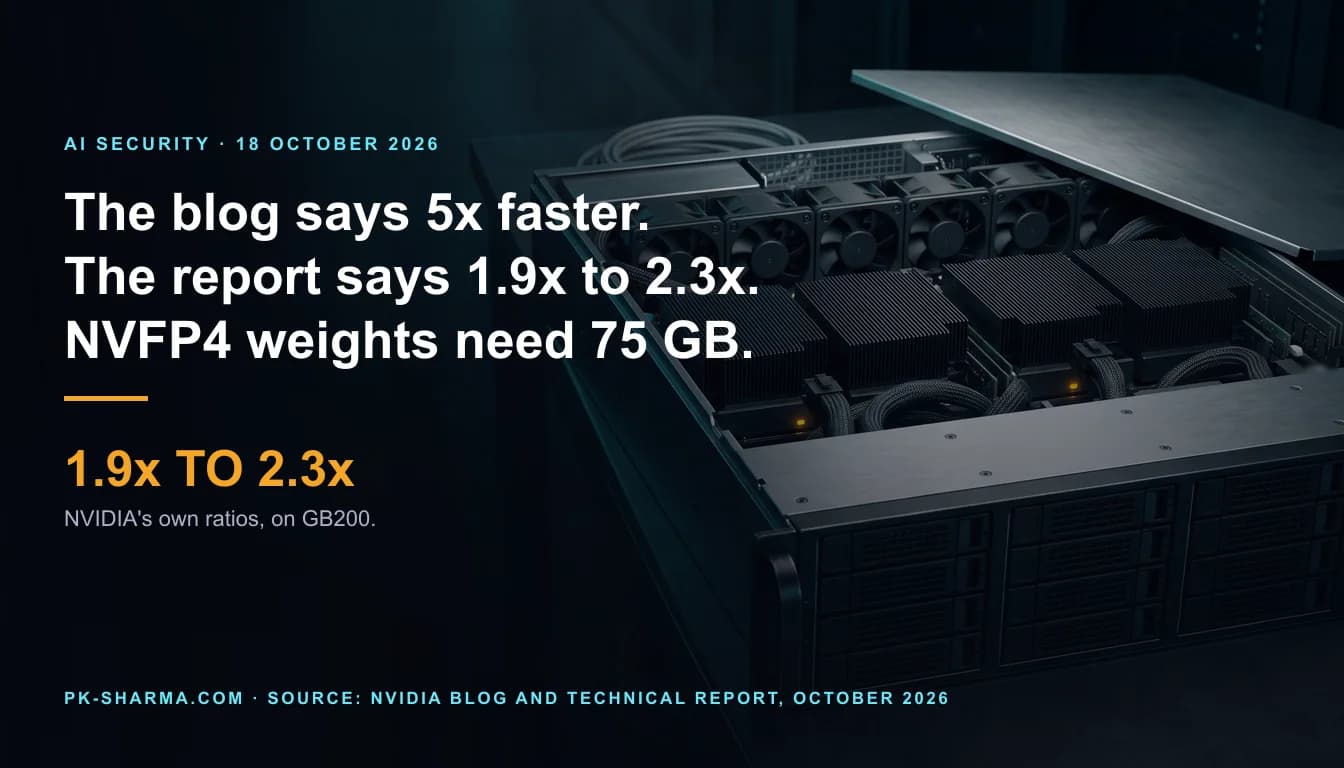
The blog says 5x faster; NVIDIA's report dated a day earlier says 1.9x and 2.3x
NVIDIA's launch post of 15 October 2026 calls Nemotron 3.5 Super VL "the fastest open agentic model in its class" and says it is "5x faster than the next best". The technical report NVIDIA dated 14 October puts the model on GB200 hardware against two named open models, at a floor of 50 output tokens a second for each user, and reports 4,331.88 tokens a second per GPU against 1,854.35 and 2,282.73. That is 2.34 and 1.90 times (derived: 4,331.88 divided by each), which are the ratios the report's abstract states. On an H100 the same figure gives 2.33 and 1.31 times (derived).
Neither ratio says the model is accurate, safe or cheap for a given job, and the 1.90 is NVIDIA's own measurement against rivals and a workload NVIDIA chose. NVIDIA sells the GPUs and systems this model is optimised for, so a speed result on that hardware supports its hardware business. That is a statement of interest, not an accusation.
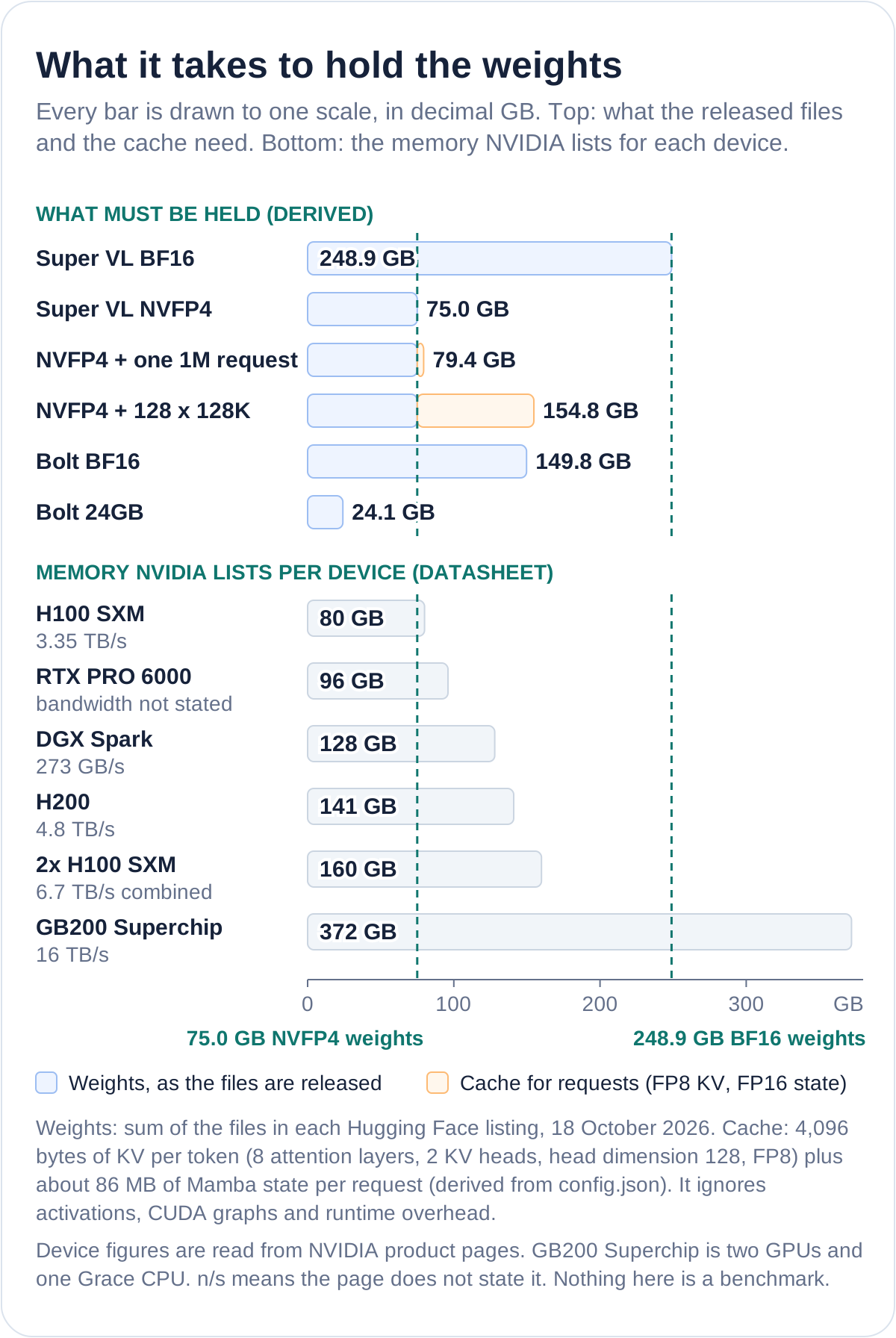
The second computed fact is the memory. The NVFP4 checkpoint NVIDIA released is 75,010,188,240 bytes across 88 files, which is 75.0 GB (derived: the sum of the file sizes in Hugging Face's listing). The BF16 checkpoint is 248.9 GB. In NVFP4 each decoded token reads about 9.77 GB of weights (derived from the tensor shapes and the model's routing of 22 experts out of 512). On a DGX Spark, whose memory bandwidth NVIDIA lists as 273 GB/s, that puts a ceiling near 28 tokens a second for one request before speculative decoding (derived, an upper bound and not a benchmark).
This briefing reads NVIDIA's launch post, its technical blog, the 79-page technical report, the Hugging Face model cards, config.json, the safetensors headers and file listings, the licence text and NVIDIA's EU training-content summary. It also reads Artificial Analysis's model, provider and leaderboard pages, NVIDIA's own product pages for each device's memory, and UK government pages. Everything was read on Sunday 18 October 2026 between 16:15 and 16:45 BST, three days after the release, so every independent number below can move. Fetched with a plain HTTP client; nothing was filled in, no page was gated, and no form was submitted.
Who measured each speed claim, on what, against what
The launch material carries six performance claims. The table sets each beside the primary it rests on and what that primary leaves out. Numbers marked "read by eye" are taken from chart axes and are approximate.
Performance claims in NVIDIA's launch post, technical blog and technical report, and what each rests on. Read 18 October 2026.
| The claim | What it rests on | What it does not establish |
|---|---|---|
| "5x faster than the next best" (launch post, technical blog Figure 1) | A chart carrying Artificial Analysis's name: open-weights models at 100,000 input tokens. The caption says over 600 tokens a second "on the Baseten endpoint"; the 5x arrow points at Inkling Small. Read by eye: about 626 against about 124 (5.05x, derived). | That Inkling Small is the next fastest. Ling 3.0 Flash sits near 311 on the same chart, about 2.0x (derived). Who chose the rival, the workload and the provider figure is not stated. |
| Speed rank among similar-size open models (Artificial Analysis model page) | 409.4 output tokens a second, "based on the median across providers serving the model", ranked 1 of 28 among open-weights models of similar size. The next fastest in that class is Ling 3.0 Flash at 309.9, so 1.32x (derived). | Throughput under load. This is the speed of one request stream on providers' endpoints, not what your own hardware will do. |
| "up to 5x higher throughput" on "a single GPU" (technical blog) | Technical report Figure 11: vLLM, a 20-turn proxy workload of 2,048 input and 1,024 output tokens a turn, at least 50 tokens a second per user. GB200: 4,331.88 against 1,854.35 and 2,282.73. H100: 988.87 against 424.94 and 752.95. | Any rival beyond the two Qwen models NVIDIA chose. NVIDIA set the workload and the definition of a usable point, and ran every model. No outside party ran it. |
| "4x faster task completion" (technical blog Figure 3, report Figure 7) | SWE-bench Pro on four B200 GPUs, all in NVFP4 except one rival in MXFP4. Read by eye: about 10 hours against about 50, 56 and 118. | Equal accuracy. NVIDIA's Table 10 gives Super VL 51.78 against 60.37, 56.91 and 56.54, which is 8.59, 5.13 and 4.76 points lower (derived). The blog axis says 10,000 tasks; the report caption says 2,193. |
| "An independent evaluation by EXO Labs" on DGX Spark (technical blog) | The text names EXO Labs. The chart image carries a local.ai logo and title, and plots an index against end-to-end task time on a log scale. | The method, the tasks, or why the text and the chart name different bodies. Not checked here. |
| "up to 8x more users with 85% lower latency" (launch post, Dynamo) | 16 B200 GPUs at 50 tokens a second per user, with cache-aware routing, session affinity and cache offload. The technical blog calls the 85% "first-token latency"; the launch post says "latency". | The baseline, or whether another router closes the gap. This is a serving-software result, not a property of the model. |
The 5x is one chart, and its two ends are not measured the same way
Artificial Analysis's own page data, read on 18 October, lists speed by workload. At its 100,000-token workload it gives Nemotron 3.5 Super VL a median of 350.1 tokens a second across seven providers, with Baseten at 472.0 and CoreWeave at 477.7. It gives Inkling Small 123.9. The blog chart's Inkling Small point (about 124) matches that figure. Its Nemotron point (about 626) matches neither the model median nor any provider's figure on the page. The caption ties it to the Baseten endpoint.
From Artificial Analysis's figures the ratios at 100,000 tokens are 2.83x on the model median and 3.81x on Baseten (derived), not 5x. Why the chart is higher is not stated. Artificial Analysis's provider page describes medians over the past 72 hours, so these figures roll, and a chart drawn on another day or another endpoint would differ. The inference from the match is that the 5x pairs a best-endpoint figure for Nemotron with a headline figure for Inkling Small. NVIDIA does not say so.
The rival also sits in a different class. Artificial Analysis lists Inkling Small as a "large" open-weights model of 266 billion parameters, 12 billion active, and Super VL as "medium" at 120 billion. So "its class" in the blog is not Artificial Analysis's size class. Inside Artificial Analysis's 40 billion to 150 billion class the next fastest model is Ling 3.0 Flash, 1.32x slower at the default 10,000-token workload and 1.12x at 100,000 (derived). Against the class median of 117.1 that Artificial Analysis prints, Super VL is 3.50 times faster (derived).
Load matters too. Artificial Analysis also lists 1,000 input tokens with 10 parallel queries. There Super VL runs at 214.8 and Inkling Small at 165.0, a ratio of 1.30 (derived). At the default workload the ratio to Inkling Small is 2.05, at 1,000 tokens 2.10 (derived). The measured range for the one rival NVIDIA names is therefore 1.3x to 2.8x on Artificial Analysis's own figures, and 5.05x only on the blog's chart.
A fair reading, with the inference marked: Super VL is the fastest model in Artificial Analysis's size class on Artificial Analysis's measure, by 1.1x to 3.5x depending on the comparator. NVIDIA's own report measures 1.31x to 2.34x per GPU. "Up to 5x" is true of one chart. "Fastest open agentic model in its class, 5x faster than the next best" is not what any of the primaries show: if "next best" means next by score, it is Inkling Small, at 2.05x on the default workload; if it means next fastest, it is Ling 3.0 Flash, at 1.32x.
A speed is not a score: what the same sources say about accuracy and cost
Artificial Analysis scores Super VL 26 on its Intelligence Index (version 4.3.2), ranked 1 of 67 among open-weights models of similar size. In its leaderboard table 81 of 268 current rows score higher, and the top row scores 58 (derived count). Its cost to run the Index is $0.19 a task, and the model produced 170 million output tokens doing so, which Artificial Analysis calls "somewhat verbose". NVIDIA's report says the medium reasoning setting uses about 2.2 times fewer tokens for about a 9% drop in accuracy.
The faster the model, the more the choice of rival matters. Qwen3.8-Flash-Next scores 39.8 on the same index, 13.3 points above Super VL, and runs at 52.8 tokens a second against 409.4, which is 7.76 times slower (derived). In NVIDIA's own SWE-bench Pro chart the fastest model is also the lowest scoring of the four. Speed is bought somewhere. This site has looked at how a vendor's own table is built in another case, where the vendor ran 9 of the 18 rows itself.
The blog's heading promises "Frontier Accuracy at One-Fifth the Size" and says the model is "comparable with NVIDIA's largest reasoning model". The largest is Nemotron 3 Ultra at 550 billion parameters, 55 billion active, on its model card. 120 divided by 550 is 0.218, about one in 4.6 (derived); a fifth of 550 would be 110. The blog's "roughly one-fifth" is fair. The files hold 124.45 billion stored parameters, of which 120.67 billion are the language backbone, with a 2.94 billion multi-token-prediction head and a 0.84 billion vision encoder and projector (derived from the safetensors headers). The model card says Super VL was initialised from Nemotron 3 Super and distilled from Ultra Base for 1 trillion tokens, so the comparison model is also its teacher.
Nemotron 3.5 Super VL against Nemotron 3 Ultra in NVIDIA's technical report Table 10, which NVIDIA ran. Gap is derived. Eleven of the 28 rows where both are scored.
| Benchmark | Super VL | Ultra 550B | Gap (points) |
|---|---|---|---|
| IFBench (instruction following) | 70.86 | 82.94 | minus 12.08 |
| Tau2 Telecom (tool use) | 73.19 | 83.00 | minus 9.81 |
| AA-LCR (long context) | 68.63 | 75.19 | minus 6.56 |
| MMLU-ProX (multilingual) | 76.91 | 83.10 | minus 6.19 |
| SWE-bench Verified | 71.10 | 73.93 | minus 2.83 |
| SWE-bench Pro | 51.78 | 49.66 | plus 2.12 |
| GPQA Diamond | 89.52 | 86.99 | plus 2.53 |
| Terminal-Bench 2.1 | 60.67 | 54.78 | plus 5.89 |
| BrowseComp | 78.91 | 67.85 | plus 11.06 |
| Apex-Shortlist | 88.36 | 75.00 | plus 13.36 |
| GraphWalks (up to 1M) | 89.71 | 63.28 | plus 26.43 |
Across the 28 rows with both scores Super VL is above Ultra on 18 and below on 10 (derived). "Comparable" is fair as a summary of a mixed table and not as a statement of equality. The largest shortfalls are instruction following and multi-turn tool use, two of the capabilities the launch post names first. NVIDIA ran the baselines as well as its own model, and the report says every result was collected through its NeMo Gym harness.
What it takes to run it: bytes, bandwidth and cache
The table lists every Super VL and Bolt checkpoint NVIDIA released, with the weight bytes as the file listings give them. Bits per parameter are derived from the stored parameter counts.
Checkpoints in NVIDIA's Hugging Face listings on 18 October 2026. Sizes are the sum of the weight files. Bits per stored parameter are derived.
| Checkpoint | Weight bytes | Bits per parameter | Notes |
|---|---|---|---|
| Super VL BF16 (post-trained) | 248.91 GB (231.82 GiB) | 16 | The reference weights. 124.45 billion stored parameters. |
| Super VL Base BF16 | 248.91 GB | 16 | The base model, before post-training. |
| Super VL NVFP4 | 75.01 GB (69.86 GiB) | 4.82 | Routed experts at 4.5 bits with their scales. Attention and Mamba projections in FP8. Router, embeddings and vision in BF16. |
| Super VL FP8 | Not released | Not applicable | Derived: 124.5 GB if every stored parameter took one byte. No such checkpoint is in NVIDIA's listing. |
| NVFP4 drafter (LiLiCorr) | 1.32 GB | Not computed | A separate model for speculative decoding. Recommended by NVIDIA for DGX Spark. |
| Bolt 74B-A9B BF16 | 149.77 GB | 16 | 74.89 billion stored parameters. |
| Bolt 74B-A9B 24GB | 24.08 GB (22.43 GiB) | 2.57 | The packed model. The GGUF is 22.02 GB plus a 1.73 GB vision projector. |
| Bolt E4B 4GB | Not released | Not applicable | The launch post says "coming Oct. 23". No NVIDIA repository for it was found on 18 October. |
Bandwidth binds before capacity does. In a decode step the weights are read once and shared by the batch, and each token also reads its own cache and recurrent state. At a batch of one, an NVFP4 token reads 9.77 GB and a BF16 token 24.47 GB (derived: the always-read layers plus 22 of 512 routed experts). The model has 40 Mamba layers, 40 mixture-of-experts layers and 8 attention layers, and activates 12.23 billion parameters a token on that count (derived), against NVIDIA's 12 billion. The table divides each device's listed bandwidth by those bytes. It ignores batching, speculative decoding, interconnect, expert placement and kernel efficiency. It is an upper bound for plain decoding; speculative decoding, which NVIDIA uses, can exceed it per request by checking several tokens for each read of the weights.
Device memory and bandwidth as NVIDIA's own product pages list them, against the released checkpoints. Ceilings are derived: bandwidth divided by bytes read per token, one request, no speculative decoding.
| Device (as NVIDIA lists it) | NVFP4, 75.0 GB weights | BF16, 248.9 GB weights | Ceiling, tokens a second: NVFP4 (BF16) |
|---|---|---|---|
| DGX Spark: 128 GB, 273 GB/s | Fits, 53.0 GB left | Does not fit | 28 (11) |
| H100 SXM: 80 GB, 3.35 TB/s | Fits with 5.0 GB left; the card lists 2 for 1M context | Does not fit | 343 (137) |
| 2x H100 SXM: 160 GB, 6.7 TB/s combined | Fits, 85.0 GB left | Does not fit | 686 (274), ignoring interconnect |
| H200: 141 GB, 4.8 TB/s | Fits, 66.0 GB left | Does not fit | 491 (196) |
| GB200 Superchip, two GPUs: 372 GB, 16 TB/s | Fits, 297.0 GB left | Fits, 123.1 GB left | 1,638 (654) |
| DGX B200, eight GPUs: 1,440 GB, 64 TB/s | Fits | Fits | 6,554 (2,616) |
| RTX PRO 6000 Blackwell: 96 GB | Fits, 21.0 GB left | Does not fit | Bandwidth not stated on the page |
| RTX Spark: up to 128 GB, 256-bit | Fits, 53.0 GB left | Does not fit | Bandwidth not stated on the page |
"1x GB200" in the model card's deployment line is not defined; this table takes it to mean one GB200 Superchip, the two-GPU module on NVIDIA's page, and the card also lists 4x H100 or 2x GB200 for BF16. Datasheet capacities are read as decimal GB; if the vendor means GiB each is about 7% larger. NVIDIA's RTX Spark page says: "Run models up to 120B parameters with 1M context." The capacity half of that holds on this arithmetic, and the page gives no bandwidth, so the speed half cannot be checked.
Cache is small per token and constant for the recurrent part. Only 8 of the 88 layers are attention, with 2 key-value heads of dimension 128, so the key-value cache is 4,096 bytes a token at FP8 and 4.29 GB at the full 1,048,576 tokens (derived from config.json). Had all 88 layers been attention layers it would be 11 times that, a hypothetical shown only to make the design visible. The Mamba state is about 84 MB a request in FP16 and does not grow with context (derived from the standard Mamba-2 shapes; the implementation may pad).
So concurrency, not context, is what eats the memory. One 1M-token request adds 4.38 GB, but 128 requests of 128K tokens each add 79.8 GB (derived). "Up to 1M tokens" is a per-request limit. After the NVFP4 weights a 141 GB H200 has room for about 15 requests at 1M tokens or 105 at 128K, before activations and runtime overhead (derived). OpenRouter lists the paid endpoint's top provider at 262,144 tokens of context and the free variant at 1,000,000.
The speed claims are for the NVFP4 checkpoint, so its accuracy matters. On the model card's same-harness table, NVFP4 keeps a median of 99.55% of the BF16 score across 36 rows (derived; the report states 99.62% over 36 benchmarks). The tail is worse: WebVoyager (offline) falls from 77.72 to 66.31, which is 85.3% of BF16, DeepSWE from 24.65 to 18.20, 73.8%, and MMLU-ProX by 3.15 points (derived). Those are web-browsing and software-engineering agents, the use the launch post sells.
Bolt: what "24GB" means, and what has not been released
NVIDIA says Bolt 74B-A9B 24GB uses "a native 2-bit quantization to fit in 24GB of memory". The packed weights are 24.08 GB in decimal, 0.08 GB over 24.0 GB, or 22.43 GiB (derived from the file listing). The GGUF a laptop would run is 22.02 GB plus a 1.73 GB vision projector, 23.75 GB together. NVIDIA's research page says the design target was to "fit into 24GB of memory and achieve a decoding speed of at least 80 TPS"; the model card says the architecture search targeted a footprint below 24 GB at a batch of one and a 128K context. Whether "GB" there means gigabytes or gibibytes is not stated.
Bolt is Super VL compressed. NVIDIA's pages say routing was cut from 22 experts a token to 9 and the experts were quantised to 2.0625 bits, with attention and embeddings in 8-bit and Mamba layers in NVFP4. config.json shows 13,824 routed experts against Super VL's 20,480 (derived). The key-value cache is 4,096 bytes a token at FP8, 1.07 GB at the full 262,144 tokens, and a token reads 4.71 GB (derived), a plain-decode ceiling of 58 tokens a second on a DGX Spark's 273 GB/s. NVIDIA's own 84 tokens a second on RTX Spark hardware uses a drafter and a different machine, so the two cannot be compared.
NVIDIA's own table on the same RTX Spark laptop (Windows 11 on Arm, llama.cpp, 128 GB) shows Bolt at 83.99 tokens a second against 96.63 for Qwen3.6 35B-A3B and 100.56 for Gemma 4 26B-A4B. That is 0.87 and 0.84 of their speed, and a replay of agent traces that took 600.80 seconds against 453.97 and 480.68, which is 1.32 and 1.25 times as long (derived). It is 2.97 times faster than Qwen3.8 27B. The blog calls the trade "a good balance of intelligence and speed". On the accuracy table NVIDIA published, whose comparators NVIDIA selected, Bolt scores highest of the four models on 10 of 13 rows (derived), for example BrowseComp 66.75 against 48.74 and 26.30. The speed is the cost, as the table above shows.
Two naming points. NVIDIA's research page lists the Bolt checkpoints as "Nemotron 3.5 Super VL 74B-A9B", while the repositories call them Nemotron 3.5 Bolt 74B-A9B. Bolt and Super VL are different models, one compressed from the other. And Bolt E4B 4GB is not released. The launch post says it is "coming Oct. 23", five days after this reading (derived). A search of NVIDIA's Hugging Face account for E4B at 16:43 BST on 18 October, repeated from an earlier check, returned no repository. Nothing about it beyond the blog's one sentence is verified.
"Open": the label, the licence and what is in the release
The launch post says the model "ships with open weights, open datasets and training recipes", and the model card describes Nemotron as "a family of open models with open weights, training data, and recipes". Artificial Analysis lists the model as "open weights". The table sets those words against what was read. This site has looked at the same label problem on another open-weight launch, where the provenance question stayed open.
What NVIDIA calls open, what was read in the release, and what is missing or not stated. Read 18 October 2026.
| The label | What was read | Missing or not stated |
|---|---|---|
| Open weights | BF16, Base BF16, NVFP4 and a drafter, in public repositories that need no token. | No FP8 checkpoint. The Hugging Face id that OpenRouter lists for the model returned an authentication error to an unauthenticated request; the released repositories carry the suffixes BF16, Base-BF16 and NVFP4. |
| Licence: OpenMDW-1.1 | The text grants permission "to deal in the Model Materials without restriction". Conditions: keep a copy of the licence and notices when distributing; rights end if the user sues claiming the materials infringe a patent or copyright, unless responding to a suit. No restriction on outputs. No acceptable-use list, user cap, naming rule, or geographic or field-of-use limit appears. | Any warranty. The materials are "as is" and the user is solely responsible for clearing other people's rights. The repository has no licence file (the path returned 404) and tags the licence "other". Whether the Open Source Initiative has approved OpenMDW-1.1 was not checked. |
| Open datasets | Datasets released on Hugging Face, including 40 vision-language sets (technical blog). The card tabulates sources: 66 third-party private entries and 9 NVIDIA private entries (derived counts). | The private data is not released. Of the 66 third-party entries, 32 read Unknown or Undisclosed in the model column. The card's synthetic tables have 180 rows, and 98 carry an Undisclosed entry. |
| Training size | The launch post says "about 26 trillion tokens". The card says more than 20 trillion for the foundation and more than 10 trillion for text. | NVIDIA's EU summary ticks "1 billion to 10 trillion tokens" for text. Three documents, three statements, no reconciliation. |
| Recipes and code | Cookbooks, NeMo Gym environments and training recipes are named in the launch material. | The code repositories were not read. Training compute, GPU hours and cost are not stated. |
The Open Source Initiative's Open Source AI Definition 1.0, read in full, is a yardstick and not an accusation. It requires data information detailed enough that a skilled person could build a substantially equivalent system, the complete code used to train and run it, and the parameters, and says Open Source weights "must include the data information and code". NVIDIA says "open", not "open source", and does not claim the Initiative's definition. What the release holds is three sets of weights, part of the data, and a licence with almost no conditions.
Provenance has a second layer. NVIDIA's EU summary lists 60 third-party models whose outputs generated synthetic training data, among them DeepSeek, Kimi, GLM, Qwen, Mistral and OpenAI's gpt-oss. The model card also names GPT-5.5 as the generator of one dataset, and that name is not in the summary's list. Those upstream models carry their own terms, which were not assessed here. The OpenMDW text puts rights clearance on the user. NVIDIA's summary also ticks that it is not a signatory to the EU code of practice for general-purpose models.
"Built in collaboration with the Nemotron Coalition" is all the launch post says about the coalition. NVIDIA's March 2026 release describes it as a collaboration of model builders and AI labs on "frontier open models through shared research, expertise, data and compute", with a first base model co-developed by Mistral AI and NVIDIA to underpin a Nemotron 4 family. The technical blog adds that Perplexity datasets helped mid-training and Prime Intellect environments helped build teacher models. Prime Intellect is not among the eight inaugural members the March release names. Who did what is not stated.
Safety and evaluation: what NVIDIA states, and what was not found
The model's own card carries the warning that matters for agent builders. Its explainability subcard says the model "was optimized explicitly for instruction following" and so "is more susceptible to prompt injection and jailbreaking", and that without effective controls that can lead to "remote code execution in agentic systems". It tells deployers to pair the model with rails or filtering against instructions from malicious sources, "either directly or indirectly by retrieval".
That is the exposure the launch post sells: agents that read web pages, PDFs and documents, which the post covers under the heading "What Nemotron 3.5 Super VL Actually Sees". The model card's safety fields describe a guard model used to filter training data and say use restrictions come from the licence. The bias subcard reports one metric, BBQ, and describes its unwanted-bias testing as "Constrained to English-language inputs", with multilingual parity not claimed.
What was not found: in the extracted text of the 79-page technical report there is no section on jailbreak, prompt-injection or red-team results, and those words do not appear. The figures were not read as images, so a chart could carry one. No third-party safety evaluation was found. The UK AI Security Institute's published open-weight cyber evaluation of 17 July 2026 tested GLM-5.2 and DeepSeek V4-Pro, and its blog and research indexes have no Nemotron entry on 18 October.
One plain sentence on what open weights change. The weights cannot be withdrawn, and the licence puts no use restriction on them. The Institute puts the general point this way: "Once open weight models are released, these options are lost permanently". That sentence is about open-weight models in general and says nothing about this model's capabilities.
Customer figures in the technical blog are partner claims relayed by NVIDIA and were not verified. One, a 40 times lower inference cost for a Skydance workload, is worded "will decrease", a projection and not a measurement. The launch post also says AI21 and Alice post-trained the model for "cybersecurity attack resilience" and that CrowdStrike is customising it for "agentic blue teaming". Those are statements of intent and uses, not results.
Stated and not stated: the record, line by line
"Not stated" means not found in the sources read, in full. It does not mean the information does not exist.
What NVIDIA, Artificial Analysis and the model files state about Nemotron 3.5 Super VL and Bolt, and what they do not. Read 18 October 2026.
| The question | Stated | Not stated |
|---|---|---|
| Who measured the 5x? | The chart carries Artificial Analysis's name; the caption says Baseten; the arrow points at Inkling Small. | Who chose the rival, workload and provider figure; why about 626 when Artificial Analysis's page shows 472.0 for Baseten and 350.1 as the median at 100,000 tokens; the date. |
| Throughput on my hardware? | 4,331.88 tokens a second per GPU on GB200 at 50 tokens a second per user, vLLM, 20-turn proxy workload. | My prompt mix, my concurrency, cost per completed task on that hardware, how well the Qwen configurations were tuned. |
| Independent accuracy? | An independent index score of 26.5 and rank 1 of 67 in its size class from Artificial Analysis. | Independent replication of the SWE-bench Pro, Tau2 and BrowseComp rows. The report's table is NVIDIA-run, baselines included. |
| Safety evaluation? | A guard model for training-data filtering, a BBQ bias metric, and a written warning about prompt injection and remote code execution. | Red-team results, prompt-injection rates, a third-party evaluation, any cyber-capability evaluation. |
| Training data and compute? | Token counts at three different values; stage token counts; 60 named generator models in the EU summary. | GPU hours, cost, the contents of the private datasets, which synthetic dataset came from which model in full. |
| Licence limits? | OpenMDW-1.1 text, with no use restrictions in it. | Open Source Initiative approval, the terms of the upstream models that generated data, any indemnity. |
| Bolt E4B 4GB? | "Coming Oct. 23", for voice assistants, characters and embedded interfaces. | Size, licence, benchmarks, a repository. It does not exist yet. |
| Memory for the RTX machines? | Up to 128 GB unified memory on RTX Spark and 96 GB on RTX PRO 6000. | Memory bandwidth on NVIDIA's pages for either, so no speed ceiling is computed. |
The UK: the DSIT Code of Practice, the AI Security Institute and the ICO
Nothing read makes the model unavailable to UK users, and the licence text has no geographic limit. The UK material below is guidance, mostly voluntary, and none of it mentions this model.
UK sources as read on 18 October 2026, with the lines that apply to an open-weight multimodal model and where each stops.
| UK source | What it says | What it means here, and where it stops |
|---|---|---|
| DSIT, Code of Practice for the Cyber Security of AI, published 31 January 2025 (voluntary) | Provision 5.2: track, authenticate and version-control assets. 7.3: developers and operators "shall re-run evaluations on released models that they intend on using". 8.1.2: developers release cryptographic hashes for model components. 3.1.2: manage risk where a multi-modal model is used for a single modality. 2.6: grant the AI system only the permissions it needs. 12.1: log system and user actions. | Hugging Face's listing gives a SHA-256 object ID for each weight file (88 of 88 for NVFP4) and no signature or checksum file was found in the repository. Super VL takes images and video; use text only and the code says to weigh the extra function. Voluntary, and it assigns duties to developers and system operators, not to a buyer by itself. |
| UK AI Security Institute, blog of 17 July 2026 and its blog and research indexes | Tested GLM-5.2 and DeepSeek V4-Pro on cyber tasks and ranges. Says open-weight release removes safeguards such as monitoring and user bans. | No Institute publication on Nemotron 3.5 was found. This briefing cannot say what the Institute would find. |
| ICO, Guidance on AI and data protection (page updated 15 March 2023) | The page says the guidance "is under review" because of the Data (Use and Access) Act. Only the landing page was read, not its chapters. | The model reads documents, screenshots and web pages, so personal data in inputs is the deployer's to assess in a data protection impact assessment. NVIDIA's privacy subcard says training data included material "relating to people". |
| NVIDIA's EU Public Summary of Training Content, updated 14 October 2026 | Lists 60 generator models, ticks not a signatory to the EU code of practice for general-purpose models, and gives a July 2026 latest collection date. | An EU document, not UK law. It matters to a UK firm selling into the EU. The model card gives a collection period ending December 2025; the two differ and are not reconciled. |
NVIDIA's separate UK commitment is covered in the briefing on its UK pledge. It has no bearing on what the licence permits a UK deployer to do.
What to do, in the order worth doing
Each item rests on a number or a line in the sources above. None needs a benchmark to justify it.
Take this with you
Deployer actions, in order
- Record the model as separate artefacts in the AI inventory: the checkpoint (BF16, Base or NVFP4), the drafter, the serving software and its version, and the licence text as downloaded, with the model card saved. Super VL and Bolt are different models.
- Pull the weights through one controlled path. Record the repository revision (the NVFP4 repository was at revision 59b8721 on 18 October) and each file's SHA-256, and re-sign internally, because no signature was found.
- Have the licence read by someone qualified. The text is short and permissive, and it makes the user responsible for clearing other people's rights. Check the upstream model terms before fine-tuning for resale or redistributing.
- Budget memory with the formula, not the headline: weights plus per-request cache times concurrency. Set a context cap per request instead of assuming 1M tokens for everyone.
- Measure speed on your own workload: prompt length, concurrency, tokens per completed task and cost per task, with and without speculative decoding and at each reasoning setting. Do not plan on a vendor's ratio.
- Evaluate accuracy on your own tasks using the checkpoint you will run. NVFP4 and BF16 differ most on web and software agents, and NVIDIA's own table shows Super VL behind its teacher on instruction following and tool use.
- Treat NVIDIA's own warning as the threat model. Red-team before exposure with injected instructions in PDFs, web pages and images, and keep credentials, shells and write access out of the model's trust zone.
- Give the agent least privilege and log prompts, tool calls, retrieved sources and outputs. A locally hosted model means egress is yours to restrict.
- Turn off the modalities you do not use, video especially, and reduce the context limit to what the job needs.
- Plan updates. NVIDIA says NIM images are refreshed every two weeks. Re-run your evaluations on every new checkpoint or image, and keep the previous weights.
- Run a data protection impact assessment where documents or screenshots hold personal data. The vendor's privacy subcard is not one.
- When a supplier quotes a ratio, ask which rival, which workload, which provider or hardware, what date, what precision, and the accuracy given up at that point.
- Do not plan around Bolt E4B 4GB until it exists. Re-check on or after 23 October.
What could not be verified
- The 5x chart's origin. Who made it, when, and why its Nemotron point is about 626 when Artificial Analysis's page shows 472.0 for Baseten and 350.1 as the median at that workload. The chart values were read by eye from axes.
- The EXO Labs and local.ai attribution. The text and the chart name different bodies, and the method was not read.
- Partner and customer results. The 40x, 10x and 40% figures, the Nolla prescribing claim and the Dynamo 8x are NVIDIA's relay of others' numbers.
- Memory bandwidth for RTX Spark and RTX PRO 6000. Not on NVIDIA's pages read, so no ceiling is computed. Datasheet GB units are read as decimal.
- The code repositories, the NeMo Gym recipes, the Bolt technical report and the NIM licence. Not read.
- The safety posture beyond the cards and the report text. Figures in the report were not read as images.
- Open Source Initiative approval of OpenMDW-1.1 and the terms of the upstream models.
- Artificial Analysis numbers. They move daily; its own pages disagree slightly between the headline and the provider table (for example Baseten at 502.4 and 540 for the same default workload).
- Time-stamped. Sources were read between 16:15 and 16:45 BST on 18 October 2026. Bolt E4B's release, a page's wording or a leaderboard rank could change within hours.
The question that exposes the gap
If a supplier says a model is five times faster, can they name the rival, the workload, the hardware, the precision and the date of the measurement, and tell you what accuracy you give up at that point on your own tasks?
Key facts
Sources
- PrimaryNVIDIA blog, 15 October 2026, 'Open From Data Center to Desktop': the 5x, one-fifth, frontier and open claims, the Bolt and E4B availability, the Dynamo and training-token statements. Read in full, twiceNVIDIAaccessed 2026-10-18
- PrimaryNVIDIA technical blog, 15 October 2026: Figures 1 to 6 and their captions (the Baseten endpoint, the Inkling Small 5x, 4x on four B200s, EXO Labs), the 8x Dynamo result, partner claimsNVIDIAaccessed 2026-10-18
- PrimaryTechnical report dated 14 October 2026, 79 pages: abstract ratios, Table 10, Figures 7 and 11, Table 24, the inference section, safety terms searched. Read from the PDF textNVIDIAaccessed 2026-10-18
- PrimaryNVFP4 model card, config.json, file listing, safetensors headers, safety, bias, explainability and privacy subcards: the weights, formats, layer layout, benchmark table, data tables and the prompt-injection warningNVIDIA on Hugging Faceaccessed 2026-10-18
- PrimaryBF16 model card, config.json and safetensors headers: the comparison table including Nemotron 3 Ultra, the BF16 size and parameter countNVIDIA on Hugging Faceaccessed 2026-10-18
- PrimaryOpenMDW License Agreement, version 1.1, read in full: the grant, the conditions, the termination clause, no restriction on outputs, the disclaimerOpenMDWaccessed 2026-10-18
- PrimaryPublic Summary of Training Content, updated 14 October 2026: generator models, token-size tick box, collection date, the EU code of practice answerNVIDIAaccessed 2026-10-18
- PrimaryBolt 74B-A9B 24GB model card, config.json and file listing: the 24.08 GB packed weights, IQ2, the 9-expert routing, the benchmark tableNVIDIA on Hugging Faceaccessed 2026-10-18
- PrimaryBolt 24GB page, 15 October 2026: the 24GB design target, the quantisation formats and NVIDIA's measured speed and replay table on RTX Spark hardwareNVIDIA Researchaccessed 2026-10-18
- PrimaryNemotron 3 Ultra model card and file record: 550B total, 55B active, the size of NVIDIA's largest reasoning modelNVIDIA on Hugging Faceaccessed 2026-10-18
- PrimaryModel page, read 18 October 2026: Intelligence Index 26, speed 409.4, cost per task, output tokens, size class, speed by workload in the page dataArtificial Analysisaccessed 2026-10-18
- PrimaryProvider page: seven providers, speed at 10,000 and 100,000 input tokens per provider, latency and priceArtificial Analysisaccessed 2026-10-18
- PrimaryLeaderboard table: Index, cost per task and speed for 268 current rows, including Inkling Small, Qwen3.5 122B A10B and Nemotron 3 UltraArtificial Analysisaccessed 2026-10-18
- PrimaryOpenRouter listing and model data: price per million tokens, context lengths for the paid and free variants, creation time 15 October 2026 15:04 UTCOpenRouteraccessed 2026-10-18
- PrimaryDGX Spark page: 128 GB unified memory, 273 GB/s memory bandwidthNVIDIAaccessed 2026-10-18
- PrimaryH100 page: 80 GB and 3.35 TB/s for the SXM formNVIDIAaccessed 2026-10-18
- PrimaryH200 page: 141 GB and 4.8 TB/sNVIDIAaccessed 2026-10-18
- PrimaryGB200 page: the Superchip column, 372 GB HBM3E and 16 TB/s, two GPUs and one Grace CPUNVIDIAaccessed 2026-10-18
- PrimaryDGX B200 page: 1,440 GB and 64 TB/s across eight GPUsNVIDIAaccessed 2026-10-18
- PrimaryRTX PRO 6000 Blackwell page: 96 GB GDDR7; no bandwidth statedNVIDIAaccessed 2026-10-18
- PrimaryRTX Spark page: up to 128 GB unified memory and the 120B-parameters with 1M context statement; its specifications page gives a 256-bit interface and no bandwidthNVIDIAaccessed 2026-10-18
- PrimaryNemotron Coalition press release, 16 March 2026: what the coalition is, its inaugural members, the first base modelNVIDIAaccessed 2026-10-18
- PrimaryThe Open Source AI Definition 1.0, read in full: data information, code and parametersOpen Source Initiativeaccessed 2026-10-18
- PrimaryCode of Practice for the Cyber Security of AI, published 31 January 2025: provisions 2.6, 3.1.2, 5.2, 7.3, 8.1.2 and 12.1, quoted exactlyDSITaccessed 2026-10-18
- PrimaryBlog of 17 July 2026 on open-weight cyber capability: GLM-5.2 and DeepSeek V4-Pro, and the statement on lost safeguards. No mention of NemotronUK AI Security Instituteaccessed 2026-10-18
- PrimaryGuidance on AI and data protection landing page: updated 15 March 2023, under review because of the Data (Use and Access) Act. Chapters not readInformation Commissioner's Officeaccessed 2026-10-18