Nvidia's $250m UK AI safety pledge is $50m a year of compute, with commercial terms still to be agreed
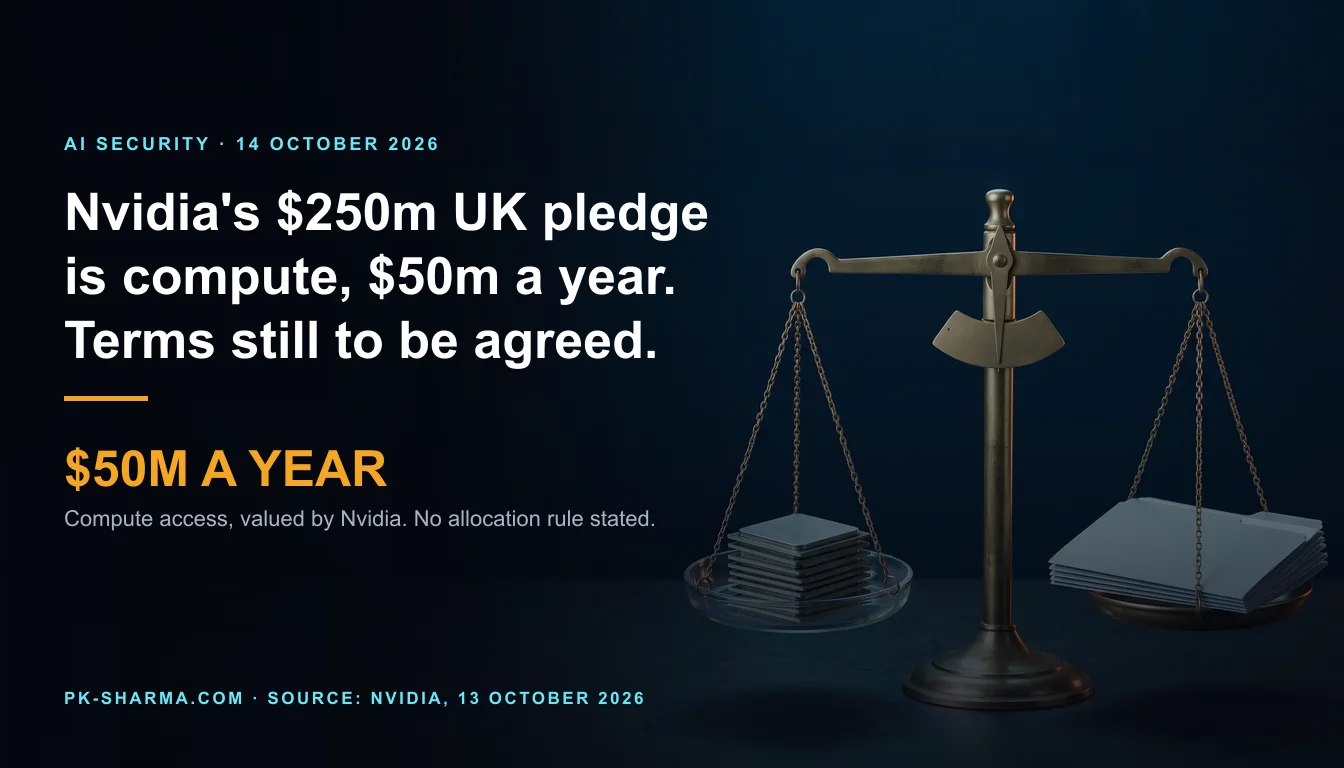
Nvidia says it will give UK researchers compute valued at $250 million over five years, $50 million a year, through UK-based cloud partners. Its release says provider selection, architecture and commercial terms are still to be agreed, and states no allocation, independence or publication rule.
By Parminder Kumar Sharma · · 26 min read
Fifty million dollars a year of compute, valued by the donor, with no allocation rule published
Nvidia's own release gives the arithmetic. It announces "a five-year compute donation valued at $250 million" and says the commitment "will provide $50 million in compute access annually". That is $250 million divided by five, or $50 million a year. In pounds it is about £37 to £38 million a year and £186 to £189 million in all (derived). The range is the difference between two rates: the pair of figures in the Guardian's report, $5.5tn and £4.1tn, implies $1.34 to the pound, and the European Central Bank reference rates for 13 and 14 October give $1.32 to $1.33 (derived).
Set against two other numbers, one year of the pledge is more than half of a public budget line and a rounding error in the donor's accounts. It is about 56 to 57 per cent of the £66 million a year that the AI Security Institute (AISI) publishes about itself, and 62 to 63 per cent of the £60 million research and development plan for AISI in the Department for Science, Innovation and Technology's 2026-27 Main Estimate (derived). Against Nvidia's own reported figures it is 0.04 per cent of fiscal 2026 operating income of $130,387 million, in the year to 25 January 2026. Nvidia's operating income for the 91 days to 26 July 2026 was $63,734 million, about $700 million a day, so one year of the pledge is about 1.7 hours of it and the whole five years about 8.6 hours (derived).
What that scale does not establish is the point of this briefing. It does not establish that any of the compute reaches AISI: Nvidia's release does not name AISI, and the Guardian says Nvidia "did not reference AISI in its statement". It does not establish what the $250 million is measured in, because the release says "valued at" and gives no basis. It does not say who decides which researchers get the compute, what share goes to the three named labs, or whether any condition touches the research agenda or the right to publish. The release says that "provider selection, technical architecture and commercial terms are to be agreed". A headline figure has been announced, and the terms that would let anyone judge it have not.
Nvidia's interest is stated in its own results release of 26 August 2026: it sells the compute that AI labs train and run their models on, reported Data Center revenue of $89.0 billion for the quarter to 26 July 2026, and its chief executive says "compute is revenue". A policy environment that favours more AI compute is in its interest (inference). That does not make a pledge wrong. It makes every missing term a governance question and not a courtesy.
What was read, and how. Nvidia's release was read on its newsroom page, which dates it 13 October 2026. The Guardian's article was read in full: it was published at 10:10 UTC on 14 October and the version read was last modified at 17:37 UTC. The UK sources named in each section were read from their publishers, about 19:05 to 20:10 BST on Wednesday 14 October 2026. No UK government press release on the pledge was found. The gov.uk search for items published since 13 October that mention Nvidia returned one unrelated algorithmic transparency record, and the Cabinet Office and AI Security Institute news feeds showed nothing on it, up to about 19:30 BST. The government statements about it that can be read sit inside Nvidia's release. A GlobeNewswire copy of the release answered with an access-denied page and was not read.
What was announced, by whom, through which body
Nvidia announced it. The release carries quotes from its founder and chief executive, from the UK AI minister, from the Business Secretary, from the founding director of the British Open-ended Learning and Discovery Lab (BOLD) and from a director at Imperial College London's frontier AI research lab. No UK public body is named as the donor's counterparty, as the administrator of the compute or as a recipient. The table puts the two accounts side by side. Where they differ, the briefing follows Nvidia's release and says so.
What Nvidia's release (newsroom page dated 13 October 2026) and the Guardian's report (14 October 2026) say, item by item. Quotation marks show the sources' own words.
| Item | Nvidia's release | The Guardian |
|---|---|---|
| Form | "compute donation valued at $250 million". Also called a "commitment". The Business Secretary's quote calls it an "investment". | "donating $250m worth of computing power" in the first line, but later "money" and "cash". |
| Size and period | $250 million over five years, and "$50 million in compute access annually". | $250m, which "spans five years". |
| Scope | "agentic safety and security research across the U.K." | "AI safety research" in the headline; quotes Nvidia's "agentic safety and security research". |
| Recipients | "The majority" to "the wider U.K. AI safety and security research community"; "a proportion" to BOLD, the Science of Fundamental AI Research Lab (SOFAIR) and Imperial College London. | "most of the money" to the wider community; "a proportion of the cash" to the three. |
| Channel | Through "U.K.-based NVIDIA Cloud Partners", with infrastructure hosted in the UK. | "delivered via UK-based datacentres using Nvidia chips". |
| Public body | None named. Two ministers are quoted welcoming it. | Says Nvidia "did not reference AISI"; separately reports the government confirmed AISI can test models before release. |
| Status | "Provider selection, technical architecture and commercial terms are to be agreed." | Not mentioned. |
Two of the differences matter. First, the words "money" and "cash" appear in the Guardian's text and not in Nvidia's release, which says compute throughout and never uses either word. On the release's wording, recipients get compute access, not cash. Second, "AI safety research" in the headline is wider than "agentic safety and security research" in the release. The release's scope is narrower than the headline's. The Guardian also places the pledge against rising concern about AI agents, citing an OpenAI-confirmed incident involving Hugging Face and the UK AI minister's remark that a breach of UK cyber defences is "likely, if not inevitable". This site has examined both: OpenAI's report on the incident and the AI minister's speech.
Stated and not stated: the terms, question by question
The table asks the questions a recipient, a funder or a regulator would ask of any gift of this size. "Not stated" means not found in Nvidia's release or in the Guardian's text, both read in full. It does not mean the answer does not exist. A word search of the release found no instance of "grant", "cash", "money", "independent", "conflict", "publish", "AISI", "UKRI" or "Turing" (derived: a count of zero for each).
Terms of the pledge: what Nvidia's release states and what it does not state. Source: Nvidia newsroom release dated 13 October 2026, read in full.
| Question | Stated | Not stated |
|---|---|---|
| What is the value measured in? | Compute access "valued at" $250 million, $50 million a year. | The valuation basis (list price, cost to Nvidia or a market rate), the hardware generation, the number of GPU hours. |
| When and how is it delivered? | Five years. Through UK-based NVIDIA Cloud Partners, hosted in the UK. | Start date, schedule, whether unused compute carries over or lapses, who contracts with the cloud partners. |
| Who decides who gets it? | Nothing. | Any panel, criteria, application route, assessor or appeal. |
| How is it split? | "The majority" to the wider community and "a proportion" to BOLD, SOFAIR and Imperial. | Any percentage. Who counts as the "wider community". |
| Does any condition touch the research agenda or publication? | Findings are "intended to inform safeguards across the wider computing ecosystem". Programmes will "focus on secure agents, open-model security and real-world threat mitigations". | Any review, approval or delay right for the donor, any right to request removal, any rule on publishing results that criticise Nvidia products. |
| Must the research use Nvidia software? | Research "including" work using NVIDIA OpenShell and the NVIDIA Sentry reference design. | Whether use is required, encouraged or optional, and whether alternatives must be compared. |
| Can customers or competitors receive it? | Nothing. | Any eligibility rule. The channel is Nvidia's own cloud partners. |
| What governs independence and conflicts? | Nothing. | Any governance, independence or conflict-of-interest arrangement. |
| Is a public body involved? | Two ministers are quoted welcoming it. | Any public body as recipient, administrator or approver. |
| Is it public money? | "NVIDIA will fund compute access." | Whether any public body will pay for related costs such as hosting, staff or data handling. |
| What is the legal form? | "donation" and "commitment". | Whether it is a gift agreement, a memorandum, a grant or a contract, and who signs. |
Of the eleven questions, the release says nothing at all on three: who decides, who may receive it, and what governs independence and conflicts. On the others it gives a purpose, a channel or a label. That is normal for a press release. It is also why $250 million cannot yet be compared with anything: it is a promise, and the instrument that would turn it into terms has not been published.
The scale, computed: one year of the pledge against two budgets
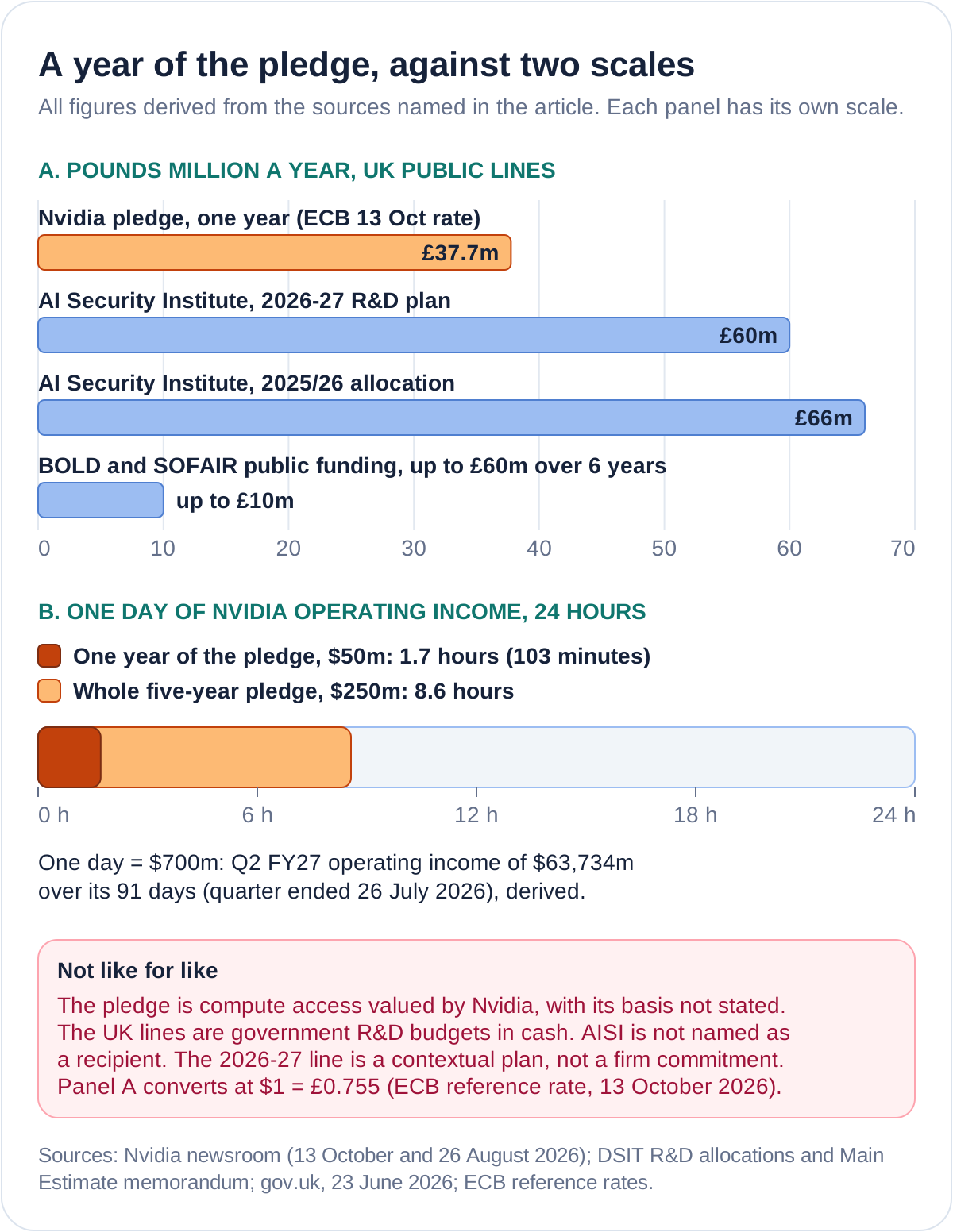
The table gives every comparator with its source, so a reader can swap one in. All shares are derived. The two ends of each range come from the two exchange rates in the opening section.
The pledge against published figures. Pounds from the dollar pledge at $1.32 to $1.34 to the pound (derived). UK figures from the DSIT, AISI, gov.uk and AMD pages named in each row; Nvidia figures from its newsroom releases of 25 February, 26 August, 28 September and 8 October 2026.
| Comparator (period, source) | Figure | Pledge against it (derived) |
|---|---|---|
| AISI R&D allocation, 2025/26 (DSIT, 4 April 2025). AISI's own page says "£66m in funding per financial year". | £66 million a year | 56.5 to 57.2 per cent, one year |
| AISI R&D plan, 2026-27 (DSIT Main Estimate memorandum, 27 May 2026, table 10). The memorandum calls the table "contextual", not "a firm spending commitment". | £60 million, down £9.0 million (13.0 per cent) on the final 2025-26 budget | 62.1 to 62.9 per cent, one year |
| AISI, Spending Review 2025 ("£240 million for the AI Security Institute"), over the review period | £240 million in total | 77.7 to 78.6 per cent, five-year total (the periods differ) |
| AISI Alignment Project, first round (AISI page: "over £27 million" to "over 60 projects") | over £27 million | 6.9 to 7.0 times, five-year total |
| BOLD and SOFAIR, public funding (gov.uk, 23 June 2026: "up to £60 million" over six years) | up to £10 million a year | 3.7 to 3.8 times, one year |
| Nvidia, fiscal 2026 operating income (year to 25 January 2026; 364 days) | $130,387 million | 0.038 per cent, one year |
| Nvidia, fiscal 2026 revenue | $215,938 million | 0.023 per cent, one year |
| Nvidia, Q2 fiscal 2027 operating income (91 days to 26 July 2026) | $63,734 million, about $700 million a day | 1.7 hours, one year (103 minutes); 8.6 hours, five years |
| Nvidia, share repurchase authorisation increase (28 September 2026) | $150 billion | 0.17 per cent, five-year total |
| Nvidia, US science commitments (8 October 2026: "commitments valued at $1 billion" over five years) | $1,000 million | 25 per cent: the UK pledge is a quarter of it |
Three cautions. The comparisons are scale, not verdict: the AISI lines are cash research budgets inside government, and the pledge is compute valued by its donor. The 2026-27 line is a spending plan in a table the department itself calls contextual, and it predates a move: a 27 July 2026 fact sheet says responsibility for AISI moves to the Cabinet Office, and whether the estimate has been restated was not found. The pledge is also not a sum that falls to AISI, so the ratio is not a measure of what it could do for AISI. It is a measure of what sort of number $50 million a year is in UK AI safety funding: 3.7 to 3.8 times the up to £10 million a year of public money behind two of the three labs it names, and 54 to 63 per cent of the AISI annual lines in the table above (derived).
Friendly names: six labels that do the work of terms
A label that sounds like a control is not one. Six labels in the announcement stand where a term should be. The first has a defined meaning in UK public finance, which makes it the easiest to test: HM Treasury's Managing Public Money (April 2026 edition, annex 4.12) defines a gift as "something voluntarily donated, with no preconditions and without the expectation of any return".
Labels in the Nvidia release and the Guardian's report against what the record shows. Sources: Nvidia release; Managing Public Money annex 4.12; gov.uk release of 23 June 2026; UKRI AI Research Resource guidance on gov.uk.
| Label | What it sounds like | What the record shows |
|---|---|---|
| "Donation" | A gift with no strings. | Managing Public Money defines a gift as having "no preconditions" and no "expectation of any return". The release also says "commitment" and, in a minister's quote, "investment". It names Nvidia's own channel (cloud partners) and products (OpenShell, Sentry). No precondition and no return is stated either way. |
| "AI safety research" | Broad safety work, for everyone. | The release scopes it to "agentic safety and security research". gov.uk describes SOFAIR as building "open-source AI technologies that run on widely available hardware" and BOLD as rethinking "how AI learns", which are fundamental AI programmes. Whether existing work is relabelled as safety work is not stated. |
| "The wider UK AI safety and security research community" | An open pool, fairly shared. | No eligibility rule, no route to apply and no assessor is stated. Public compute through the AI Research Resource has published routes, eligibility rules, peer review with declared conflicts and offer letters with terms. |
| "$250 million" | A cash-equivalent sum. | "Valued at", with no basis. Commercial terms and provider selection are "to be agreed", so the dollar figure is not yet a price anyone has paid or agreed to pay. |
| "Dedicated to agentic safety and security research" | A ring-fence with an assurer. | The release states a purpose. It states no usage report, no audit and no body that checks the compute is used for it, and the release says the research includes work using the donor's own software. |
| "Domestic platform" | Infrastructure independent of the donor. | The channel is "NVIDIA Cloud Partners", and provider selection is "to be agreed". The Guardian says the chips are Nvidia's. The release does not say who contracts with the partners or on what terms. |
None of this shows bad faith. It shows that the three comforting words in the story, donation, safety and community, each cover a term the announcement has not yet written down.
Same lab, another vendor: what a memorandum with terms looks like
Oxford's launch report of 2 September 2026 names Nvidia and AMD among BOLD's collaborators. On 12 August 2026 AMD announced a memorandum of understanding with the University of Oxford for BOLD. Its figures are smaller and its language is conditional, and it states things the Nvidia release does not. The comparison is of what each document commits to, not of who is more generous.
AMD's announcement of 12 August 2026 against Nvidia's of 13 October 2026, as each is worded.
| Item | AMD, for BOLD | Nvidia, for UK agentic safety research |
|---|---|---|
| Instrument | A memorandum of understanding with the University of Oxford. | Not named: "donation" and "commitment". |
| Amount and period | "up to 5 million pounds in compute resources" in the 18 months after the lab's launch. | $250 million valued, five years, $50 million a year. |
| Tense | "would" throughout: AMD "would explore providing". | "will": Nvidia "will fund compute access". |
| Source of the compute | AMD's own infrastructure, cloud providers, public-sector partnerships and hardware contributions. | "U.K.-based NVIDIA Cloud Partners". |
| Recipient | One named lab. | A "majority" to an undefined community and "a proportion" to three labs. |
| Publication | AMD "would help BOLD researchers publish research software, benchmarks, evaluation tools and other artifacts", on permissively licensed open-source software. | "Reproducible research" and findings "intended to inform safeguards". No publication clause stated. |
Headline figures only, and the instruments differ: Nvidia's yearly figure is about 11 times AMD's per-year equivalent (derived). The useful point is different. A recipient reading the AMD announcement can see what it is being offered, for how long, from where and under what publication stance. A recipient reading the Nvidia release cannot yet. BOLD is also one of the two labs that gov.uk says will share up to £60 million of public money through UKRI's Engineering and Physical Sciences Research Council over six years, so a vendor's compute reaches it on top of a public base and beside the compute of AMD, which sells competing accelerators.
The supplier, the safeguards and the people who test them
The governance question is easy to state and hard to answer from the record. A company that sells the hardware on which frontier systems are trained is paying for research on how to make autonomous agents safe, and the programme it describes includes research using the company's own agent-safety software. Who, in that arrangement, tests the claims the donor makes about its own safeguards?
Four facts bear on it, each from a primary. First, Nvidia's 28 September 2026 release launched an Open Agent Safety Platform: OpenShell, open-source runtime software that the release says can be extended to Arm and Intel platforms, and Sentry, a monitor that "runs on NVIDIA BlueField-4 DPUs". Anthropic and Microsoft are among the partners it names. The pledge's research programmes are to include work using both. Second, the UK's most powerful public AI facility, Isambard-AI, is built from 5,448 Nvidia GH200 chips supplied by HPE, according to the AI Research Resource page on gov.uk, which lists Nvidia, AMD, Dell, HPE and Intel among the resource's partners. AISI says it has priority access to more than £1.5 billion of compute in that resource and in the exascale programme. Third, the AI minister's written statement to Parliament of 12 October (reference HCWS357) says "we cannot rely solely on the companies developing these technologies to assess and manage the risks they may pose". Fourth, AISI's post of 12 October lists, among its open questions about independent auditors and evaluators, "what access and resources should they be given" by the frontier AI organisations they assess.
What the record does not establish is that any evaluator, AISI included, will receive the compute. The recipients named are university labs. The structural point therefore stands as a question and not as a finding: Nvidia is not among the developers the Guardian names as giving AISI pre-release access (OpenAI, Anthropic and Google), so the pledge does not obviously make it an evaluated party. It does make Nvidia a funder of research on the safeguards it also sells, and the release states no rule that would stop a funded team's result from being shaped, delayed or left unpublished. A vendor's compute is useful to researchers, and nothing in the record says otherwise. The question is what the terms say about who chooses, who publishes and who can be told no.
UK: how the AI Security Institute is funded, and what it says about its independence
AISI is the body a reader would expect to sit at the centre of a UK AI safety pledge, so its funding and its stated independence matter here even though it is not named as a recipient. Each row below is as the page states it, with its date. "Does not settle" is this briefing's note, not the source's.
AISI's funding and independence, as its pages, DSIT documents, gov.uk and Parliament's record state them.
| Statement and source (date) | What it says | What it does not settle |
|---|---|---|
| AISI about page (read 14 October 2026, undated) | "£66m in funding per financial year and long-term resourcing commitments". Says AISI is "a research organisation within" DSIT. | Which year the £66 million is. The DSIT wording is now at odds with gov.uk: see the Cabinet Office row. |
| DSIT R&D allocations (4 April 2025) | "£66 million continued investment in the AI Security Institute" for 2025/26. | Research and development allocations only. Other AISI costs, if any, are not in this table. |
| Spending Review 2025 (June 2025) and DSIT annual report 2025-26 | "£240 million for the AI Security Institute to remain at the forefront of frontier AI research". | The year-by-year profile: the line is stated over the review period. |
| DSIT Main Estimate memorandum (27 May 2026), table 10 | £60 million for 2026-27. "AISI R&D spend has decreased compared with last year, in line with the Spending Review settlement." | A firm commitment: the memorandum calls the table contextual, not a firm commitment. |
| Machinery of government fact sheet (27 July 2026) and gov.uk organisation page (updated 9 September 2026) | Responsibility for AISI "will move to the Cabinet Office". gov.uk says AISI "is part of the Cabinet Office". | Whether DSIT's 2026-27 line has been restated. |
| AISI blog (13 November 2024) | Plans to "move the organisation onto a statutory footing" are "a critical step towards giving us the power and independence required". | Whether it has happened: no legislation was found. The only 2026 AI-specific bill in Parliament's bills search is a Lords private member's bill, whose latest recorded stage is first reading. |
| Government statement and AISI post (both 12 October 2026) | The government is working with labs and the US Government "to retain access" for AISI to models "before they are released". AISI "is not seeking to mandate requirements for frontier developers". | Access is by arrangement, not by right. The record gives no term for how long it lasts. |
| AISI Alignment Project page (read 14 October 2026) | "Supported by an international coalition of government, industry, and philanthropic funders", including OpenAI, Microsoft, Amazon Web Services and Anthropic. Over £27 million to over 60 projects in round one. Mentions "a world-leading expert advisory board". | Nvidia is not listed. The page does not say how the coalition handles conflicts or who decides awards. |
Two points follow. AISI already runs a fund that takes industry money, with published rounds, a ceiling of £1 million per project and an advisory board, so the UK has a template for how a public body can pair industry money with a published route. And AISI's own wording ties its independence to a statutory footing it does not yet have, while the government's statement ties its access to models to arrangements with developers and the US Government. Neither the statutory footing nor the access arrangements is changed by this pledge, which does not name AISI.
UK: the government's position on AI regulation, and any comment on the pledge
The position, as read from gov.uk and Parliament's record. On 12 October the AI minister said "we will legislate wherever necessary" in a speech and the accompanying release said the government will explore strengthening the Cyber Security and Resilience Bill for AI-related risk. That bill's stages page lists Lords report stage for 26 October 2026. The 7 September written statement (HCWS314) says the government will consider whether protections for autonomous AI systems should be clarified through "the cyber assessment framework, the forthcoming statutory code of practice or NCSC technical guidance". No AI Act was found. The government's one-year review of its AI Opportunities Action Plan describes regulatory sandboxes and regulators' plans, including a Financial Conduct Authority sandbox "in collaboration with Nvidia".
The same speech carries a line that bears on it. The minister said the government wants leading companies investing here "but we will not accept dependence as the price of that investment", and that the country must be clear "about what Britain needs and what our people receive in return". Within two days, the minister's quote is in Nvidia's release welcoming a donation whose terms are not yet written. The sentence is about investment and infrastructure, not donations, but it states a test that transfers: what does Britain need, and what do its people receive in return? The checklist below is that test written as questions (inference).
Comment on the pledge itself: none was found. A search of Parliament's Hansard record for "Nvidia" from 1 October to 14 October returned no contributions, no written answers and no statements. No regulator comment was found in the searches run (gov.uk, Hansard and the open web). No statement from AISI or UKRI was found: AISI's blog listing shows nothing on it and UKRI's news page does not mention Nvidia. The Alan Turing Institute is not named in the release, and its news page answered with a bot check and was not read. The only statements from named recipients are the two lab directors' quotes inside Nvidia's release. This is a snapshot at about 20:00 BST on the day of the announcement and could be overtaken within hours.
A precedent for the form, not the content. The UK-Nvidia memorandum of understanding of 9 June 2025 on AI and advanced connectivity says its "resource commitments and timelines" are "to be finalised through ongoing collaboration and subsequent agreements" and that its activities are "voluntary, not legally binding, and without prejudice to any future procurement decisions". That is a public sentence that tells a reader what the paper does and does not bind. The 13 October release has no equivalent sentence.
UK: procurement and conflict-of-interest guidance, as read, and who it binds
The guidance below was read from its publishers. None of it binds Nvidia, and much of it binds only government bodies. Universities and labs are governed by their own policies, which were not read. The table says what each source says and who it applies to.
UK guidance relevant to accepting vendor money, as read from the pages named. "Binds" is the source's own scope.
| Source | What it says (short quotes are its words) | Binds |
|---|---|---|
| HM Treasury, Managing Public Money, April 2026, annex 4.12 | "Donations, sponsorship or contributions, for example from developers shall also be treated as gifts." Departments "shall maintain a register" of gifts received. Accounting officers offered services "on a gratuitous basis" should weigh future expenditure, "anti-competitiveness risks" and an "incumbency benefit for the supplier that put them at competitive advantage in any future procurement". No upfront cost "does not relieve" them of that duty. | Departments and arm's length bodies. |
| Procurement Act 2023, conflicts of interest guidance (updated 13 July 2026) | Contracting authorities must "take all reasonable steps" so that a conflict does not put a supplier "at an unfair advantage", must prepare a conflicts assessment, and must address a "perceived conflict of interest". A supplier at an unfair advantage that cannot be remedied is excluded. | Contracting authorities in a covered procurement, not a gift. |
| UKRI, declarations of interest policy and guidance | Anyone with "private, personal or commercial interests" that might cause a conflict "must recognise it, disclose it appropriately, and either eliminate it or manage it properly". | UKRI decision-making and funding processes. |
| UKRI and DSIT framework document 2025, paragraph 10.8 | Research conclusions that are publicly funded "can always be communicated independently, freely and objectively, without political restriction". | UKRI. The text says "publicly funded"; a private pledge falls outside it unless mixed with public money. |
| UKRI, Centres of Excellence for Regulatory Science and Innovation call (22 September 2026) | Asks applicants to outline "the rights of the industry or company partner to: review, approve or delay publications" and to "request or require the removal of any information", and to declare and manage conflicts with industry partners. | Applicants to that call. A live example of the questions. |
| UKRI, AI Research Resource guidance on gov.uk (updated 28 September 2026) | Compute through published routes (the gateway route offers up to 10,000 GPU hours), with eligibility rules, distributed peer review in which assessors may declare conflicts, and a formal offer letter that carries the award terms. | Applicants to that route. The model for a published allocation rule. |
Read together, the guidance has one consistent pattern. A donation is treated as a gift to be registered and its future costs weighed. An industry partner's rights over publication are a question that funders ask in writing. Conflicts are declared before the decision, not after it. And public compute is allocated by a published route with assessors who declare conflicts. The Nvidia release states none of those four things yet.
Before accepting vendor compute: an ordered checklist for a UK public body or research group
Take this with you
In the order worth doing
- Get the instrument and the counterparty in writing: gift, grant, memorandum or service contract, and who signs (the vendor, a cloud partner or both). Do nothing else until this is named.
- Ask what the headline figure is measured in: hardware generation, GPU hours, hosting and support, and the price basis (list price, cost to the donor or a market rate). Ask for hours per recipient per year, not dollars.
- Decide whether it is a gift under Managing Public Money annex 4.12 if you are a department or arm's length body: register it, and weigh future costs, withdrawal risk and incumbency benefit. If you are a university, find and read your own gifts and donations policy.
- Declare relationships with the vendor and its cloud partners (funding, shares, advisory roles, earlier grants) under your declarations policy before any allocation is made, and record how each is managed.
- Put allocation in a published route with eligibility rules, assessors who declare conflicts and recorded decisions, as UKRI does for the AI Research Resource. The donor does not sit on the panel and does not see applications.
- Settle publication in writing before any compute is used. No right for the donor to review, approve, delay or request removal of results, or, if any right exists, its scope and time limit, as UKRI asks of industry partners in its calls.
- Settle the research agenda. No requirement to use the donor's software or hardware only. Freedom to compare against alternatives and to publish a result that disfavours the donor.
- Keep evaluators and funded compute apart. A team that tests the donor's safety product, or a body that evaluates models trained on the donor's hardware, says whether it uses the pledge and is not chosen by the donor.
- Plan for withdrawal: what happens to data, models and a half-finished study if the compute stops, where research data sits on a third-party cloud, and which security terms apply.
- Publish a summary and update it yearly: value, period, recipients, hours used, conflicts declared and the publication terms. If a public body is involved, expect questions in Parliament and answer them from that summary.
What could not be verified
Read as of about 20:00 BST on 14 October 2026, and open to change within hours. The agreement behind the pledge, if one exists, was not seen. No gov.uk release on it was found. The valuation basis, the split between the three labs and the wider community, and any role for AISI are not stated in anything read. The GlobeNewswire copy of Nvidia's release was access-denied. UCL's news pages, a Commons Library research briefing that a search surfaced (reference CBP-10003), the Alan Turing Institute's news page and the Parliament written-statement pages answered an automated fetch with a bot check or a refusal and were not bypassed: the two written statements quoted were read through Parliament's Hansard interface instead. The $5.5tn market value is the Guardian's figure and was not checked. The AISI "£66m" page is undated. The AISI R&D lines are research and development only, and the 2026-27 line predates AISI's move to the Cabinet Office.
The question that exposes the gap
If a team using this compute finds that Nvidia's own agent-safety software fails to contain an agent, what in the agreement lets it say so in public, and who outside Nvidia has read that agreement?
Key facts
Sources
- PrimaryNvidia's release 'NVIDIA Commits $250 Million to Advance UK Agentic Safety and Security Research Over the Next Five Years', newsroom page dated 13 October 2026, read in full: the form, size, scope, recipients, channel, quotes and what is 'to be agreed'. The vendor's own releaseNVIDIAaccessed 2026-10-14
- PrimaryNvidia results release for the second quarter of fiscal 2027 (26 August 2026): revenue, operating income, net income and Data Center revenue for the quarter to 26 July 2026, and the chief executive's 'compute is revenue'NVIDIAaccessed 2026-10-14
- PrimaryNvidia results release for the fourth quarter and fiscal 2026 (25 February 2026): fiscal 2026 revenue of $215,938 million and operating income of $130,387 millionNVIDIAaccessed 2026-10-14
- PrimaryNvidia's 28 September 2026 release launching the Open Agent Safety Platform: OpenShell on Vera processors, Sentry on BlueField-4 DPUs, and the named partnersNVIDIAaccessed 2026-10-14
- PrimaryNvidia's 28 September 2026 release of a $150 billion share repurchase authorisation increase, used as a scale comparatorNVIDIAaccessed 2026-10-14
- PrimaryNvidia's 8 October 2026 release of 'commitments valued at $1 billion' for US science over five years, used as a scale comparatorNVIDIAaccessed 2026-10-14
- PrimaryPress release 'Britain steps up national defences against growing AI risks', 12 October 2026: AISI evaluations, the Cyber Security and Resilience Bill and the legislation statementGOV.UKaccessed 2026-10-14
- PrimaryThe Minister for Artificial Intelligence's speech of 12 October 2026: 'legislate wherever necessary' and 'we will not accept dependence as the price of that investment'GOV.UKaccessed 2026-10-14
- PrimaryParliament's Hansard interface returning written ministerial statements HCWS357 (12 October 2026) and HCWS314 (7 September 2026), read in full there because the Parliament pages answered an automated fetch with a bot check; also searched for 'Nvidia' from 1 October with no resultsUK Parliamentaccessed 2026-10-14
- PrimaryPress release 'UK backs new AI labs', 23 June 2026: BOLD and SOFAIR, up to £60 million over six years through EPSRC, and the labs' stated aimsGOV.UKaccessed 2026-10-14
- PrimaryAI Research Resource page (updated 28 September 2026) and its UKRI guidance pages: Isambard-AI's 5,448 Nvidia GH200 chips, the partners, the access routes, distributed peer review and offer lettersGOV.UKaccessed 2026-10-14
- PrimaryMachinery of Government changes fact sheet (22 and 27 July 2026): AISI moves to the Cabinet OfficeGOV.UKaccessed 2026-10-14
- Primarygov.uk organisation page for the AI Security Institute (updated 9 September 2026): 'part of the Cabinet Office'GOV.UKaccessed 2026-10-14
- PrimaryDSIT Main Estimate memorandum 2026 to 2027 (27 May 2026), table 10: AISI £60 million, down £9.0 million; the 'contextual' noteGOV.UKaccessed 2026-10-14
- PrimaryDSIT research and development allocations for 2025/26 (4 April 2025): £66 million for AISIGOV.UKaccessed 2026-10-14
- PrimaryDSIT annual report and accounts 2025 to 2026: the £240 million for AISIGOV.UKaccessed 2026-10-14
- PrimarySpending Review 2025: '£240 million for the AI Security Institute to remain at the forefront of frontier AI research'GOV.UKaccessed 2026-10-14
- PrimaryAI Opportunities Action Plan: One Year On: AISI and regulation and sandbox material, including the Financial Conduct Authority sandbox with NvidiaGOV.UKaccessed 2026-10-14
- PrimaryManaging Public Money (April 2026 edition, read from the PDF linked on the page), annex 4.12 on gifts and section 3.9 on conflicts of interestHM Treasuryaccessed 2026-10-14
- PrimaryProcurement Act 2023 guidance: Conflicts of Interest (updated 13 July 2026): sections 81 to 83 as the guidance describes themCabinet Officeaccessed 2026-10-14
- PrimaryMemorandum of understanding between the UK and NVIDIA on AI and advanced connectivity technologies (9 June 2025): the 'not legally binding' and 'to be finalised' wordingGOV.UKaccessed 2026-10-14
- PrimaryUKRI Framework Document 2025, paragraph 10.8 on communicating the conclusions of publicly funded researchGOV.UKaccessed 2026-10-14
- PrimaryUKRI declarations of interest guidance for assessors, reviewers and panellists (4 December 2023)UKRIaccessed 2026-10-14
- PrimaryUKRI Centres of Excellence for Regulatory Science and Innovation funding call (22 September 2026): the questions on industry partners' publication rights and conflictsUKRIaccessed 2026-10-14
- PrimaryAISI about page (read 14 October 2026): '£66m in funding per financial year' and 'within' DSITAI Security Instituteaccessed 2026-10-14
- PrimaryAISI grants page: the grant programmes and their termsAI Security Instituteaccessed 2026-10-14
- PrimaryThe Alignment Project page: the coalition of government, industry and philanthropic funders, over £27 million in round oneAI Security Instituteaccessed 2026-10-14
- PrimaryAISI blog 'Our First Year' (13 November 2024): the statutory footing and 'power and independence' wordingAI Security Instituteaccessed 2026-10-14
- PrimaryAISI blog 'Towards technical best practice for frontier AI development' (12 October 2026): independent evaluators' access and resources, and AISI's voluntary approachAI Security Instituteaccessed 2026-10-14
- PrimaryAMD's 12 August 2026 announcement of a memorandum of understanding with the University of Oxford for BOLD: up to 5 million pounds, 'would' wording, publication stanceAMDaccessed 2026-10-14
- PrimaryOxford engineering news (2 September 2026) on the BOLD launch: collaborators including Nvidia and AMDUniversity of Oxfordaccessed 2026-10-14
- PrimaryECB euro reference rates for 13 and 14 October 2026, used for the dollar-pound cross rateEuropean Central Bankaccessed 2026-10-14
- PrimaryCyber Security and Resilience (Network and Information Systems) Bill: Lords report stage listed for 26 October 2026UK Parliamentaccessed 2026-10-14
- Reported byThe Guardian, 'Nvidia, worth $5.5tn, donates $250m to UK for AI safety research', 14 October 2026, published 10:10 UTC and read as modified at 17:37 UTC, in full: the headline, the 'computing power' lede, the 'money' and 'cash' wording and the statement that Nvidia did not reference AISI. Used as the story and for the pounds figureThe Guardianaccessed 2026-10-14