Grok Voice 3.0: 3.7 points ahead on one index, 0.2 on task success, 2.9 behind one rival on the agent test
xAI calls Grok Voice 3.0 the world's most intelligent speech-to-speech model. Artificial Analysis does rank it first on one index, but the margins are small on several measures, cheaper models are missing from the cost chart, and production agents moved to the new model by an alias.
By Parminder Kumar Sharma · · 29 min read
86.9 is first on one index by 3.7 points, and the post claims more than that
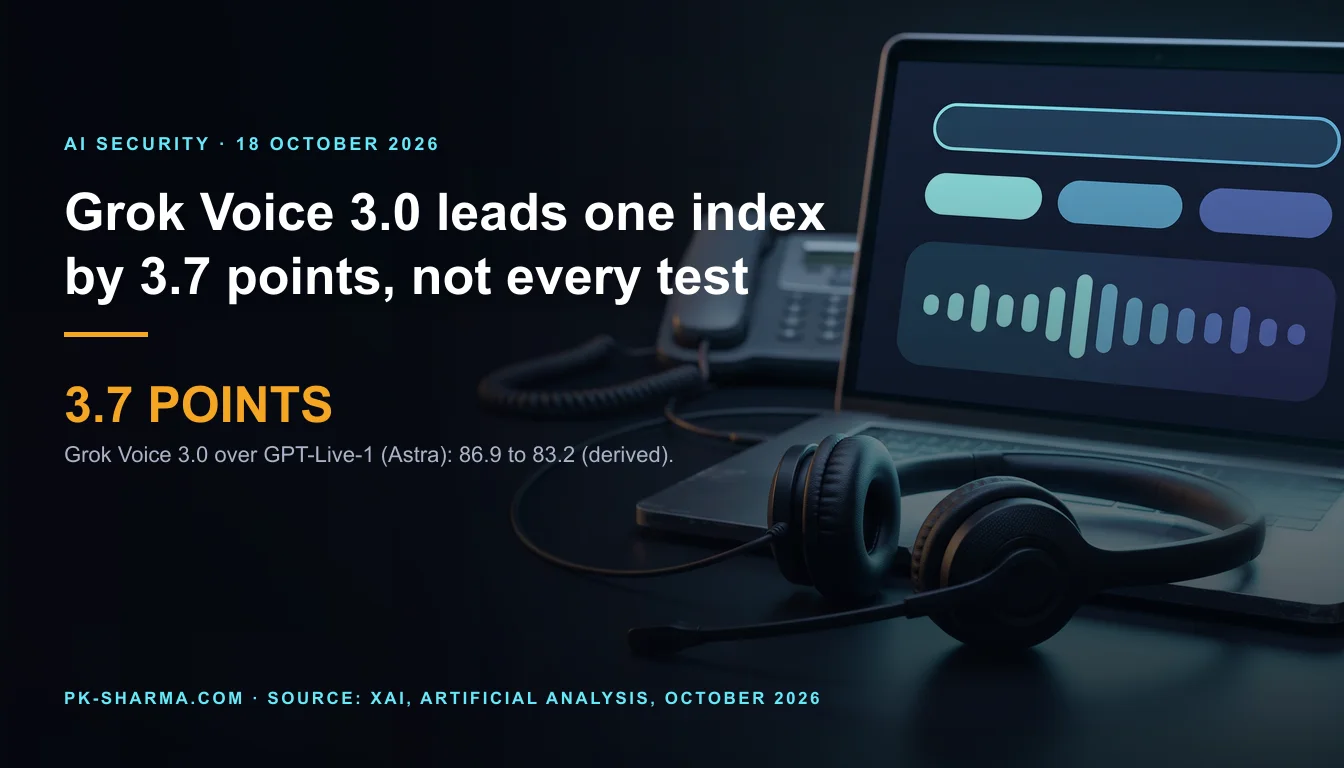
xAI's launch post for Grok Voice 3.0, dated 14 October 2026, calls it "the world's most intelligent speech-to-speech model". Its evidence is a table sourced to Artificial Analysis (AA) and dated 13 October 2026, in which the model scores 86.9 on AA's Speech-to-Speech Index and the nearest listed rival, GPT-Live-1 (Astra, medium), scores 83.2. That is a lead of 3.7 points (derived). On AA's own leaderboard page, read on 18 October, Grok Voice 3.0 is first of the 19 models that carry an index score. That much is confirmed.
What the lead does not establish is the sentence above the table. The index is four parts of equal weight: Big Bench Audio, a 1,000-question speech reasoning test; τ-Voice, a simulated support call; a preference score from blind calls with human participants; and a task success rate from those same calls. It ranks voice agents on those four things. It says nothing about intelligence in general, and AA publishes no interval for it. The 3.74 points of lead (unrounded, derived) are also unevenly built: 2.10 of them come from Big Bench Audio, 1.87 from task success, 0.48 from preference, and minus 0.71 from τ-Voice, where GPT-Live-1 (Astra, medium) is ahead, 74.5% to 71.6% on the post's own chart.
This briefing reads the post and AA's pages, not coverage of them. The post was fetched with a plain request from 16:17 BST on Sunday 18 October 2026 and read in full. AA's leaderboard, arena and methodology pages were read, including the data embedded in them, and every figure in the post's table was checked against that data; two rivals' Elo values differ, for a reason given below. Pages on x.ai other than the launch post answered a plain request with a bot challenge and were not forced: where this briefing quotes xAI's data processing addendum, acceptable use policy, safety page or subprocessor list, it is quoting the Internet Archive's dated capture and says so. No form was filled in or submitted. xAI sells voice-agent minutes and wrote the post. The benchmarks it cites are published by others, Artificial Analysis and ServiceNow, and who ran what is set out below.
The post's claims, line by line
The table sets each headline claim against what the independent pages show and what that does not establish. "Derived" means this briefing's arithmetic, reproduced from AA's page data. Quoted wording is the post's, with apostrophes straightened.
Claims in xAI's Grok Voice 3.0 post (14 October 2026) against AA's pages (read 18 October), ServiceNow's EVA-Bench site and xAI's documentation. The last column is what the record does not establish.
| Claim in the post | What the pages read show | Not established |
|---|---|---|
| "the world's most intelligent speech-to-speech model" | First of 19 indexed models, 86.9 against 83.2 (3.7 points, derived). It stays first if any one of the four components is dropped (smallest margin 0.62 points without τ-Voice) and for any τ-Voice weight up to 67.7% (derived). | Intelligence in general. An interval on the index (none published). Why the four weights are equal. |
| "sets a new record for resolving customer support calls" | Task Success Rate 94.8% against 94.6% for Grok Voice 2.0: 0.2 points (derived), inside AA's 95% intervals of 91.6 to 96.8 and 91.4 to 96.7. On τ-Voice, the test built from support-call replicas, GPT-Live-1 (Astra, medium) shows 74.5% against 71.6%. | A statistically separate record. That the arena tasks are support calls (AA's examples are a dental booking and a pizza order). Which measure the sentence rests on. |
| "class-leading latency at under one second" | 0.81 seconds average time to first audio on Big Bench Audio (AA). Grok Voice 2.0 is faster at 0.70. GPT Realtime Mini (Oct '25) and GPT-Realtime-1.5 are within 0.01 seconds. Fourth fastest of 19 (derived). | Latency on a phone line, with tools, or on ServiceNow's test, where the same model's response speed is 1.96 seconds. |
| "costs less than other frontier models" | $0.025 a task against $0.030 and $0.055: 16.7% and 54.5% lower on the printed figures (derived). Twelve of the other 18 indexed models cost less per task, including one that is in the post's accuracy table. | The cost of a real call. List prices are on different bases: see the cost section. |
| "available today in the API at the same price as its predecessor" | Confirmed. xAI's pricing page lists both models at $0.08 a minute ($4.80 an hour). Grok Voice 2.0 is listed as deprecated. | What a second line, "$0.004 / text input", is charged per. The page gives no unit. |
| "Agents using grok-voice-latest have already been switched over automatically" | Confirmed by xAI's release notes of 14 October: the alias "now points to grok-voice-3.0". | How customers were told. The documentation advises pinning a versioned name in production. |
| "Roughly 70% are resolved with no human in the loop" | A figure for Starlink call centres, given by the vendor. About 14,000 of 20,000 daily calls, and about 6,000 reaching a human (derived). | What resolved means, how it was measured, any audit, what the other 30% were. |
| EVA-Bench: "the highest accuracy score at 74%" | ServiceNow's site lists Grok Voice 3.0 at 73.7% (interval 69.1 to 78.1), first of 21 systems; the next is 67.2% (derived margin 6.5 points). | Who ran this entry. Reliability: the site's five-trial measure (pass^5) is 55.3%. GPT-Live-1 is not on that list. |
What the index is made of, and who ran each part
AA's methodology page says the index is "an equal-weighted score" across four components, 25% each, and that version 2.0, in use since August 2026, "Replaced Conversational Dynamics (Full Duplex Bench) with Task Success Rate". The post's 97% on Full Duplex Bench, which it mentions in the same paragraph as the index, therefore sits outside it. The index is a mean of four numbers, and this briefing reproduced it: from AA's four components, all 19 published values match to three decimals (derived).
The four components of AA's Speech-to-Speech Index and the fifth number the post adds. From AA's methodology, arena overview and leaderboard pages, read 18 October 2026.
| Component | What it is, and who runs it | What it does not show |
|---|---|---|
| Speech reasoning: Big Bench Audio | 1,000 spoken questions in four categories of 250 (formal fallacies, navigation, object counting, web of lies). A judge model marks each answer right or wrong. | Behaviour on a call. The questions are short puzzles, read by synthetic voices. |
| Agentic performance: τ-Voice | 278 replica customer-service scenarios (50 airline, 114 retail, 114 telecom). AA says GPT-4.1 plays the customer and grades the natural-language checks, the same for every model. Each score is a mean of three trials where available. | A real caller. GPT-Live-1 (Astra, medium) rests on one trial, GPT-Realtime-2.1 High on two (AA's note). |
| Arena preference | "Paid, screened third-party participants" complete one scenario with each of two hidden models and record a forced preference. 35 scenarios: 15 with tool calls, 20 without. Converted to an Arena Score from an Elo frozen when the model became eligible. | Preference on a live line. The Elo has an interval of about plus or minus 28 points for Grok Voice 3.0. |
| Task Success Rate | From the same arena calls with tools: the share of eligible conversations in which the model made the correct final task-completing tool call. Two LLM judges decide eligibility and success. | Resolution of a support issue. The examples AA gives are booking a dental check-up and ordering pizzas. |
| Full Duplex Bench (not in the index) | Pause handling, turn taking, interruption and backchannel handling, from a subset of the public benchmark, run by AA. | Anything about the index. Grok Voice 3.0 is third of 19 on it, behind two models that are not in the post's table. |
Two details matter for reading the post's table. First, the Elo. The post prints 1048 for GPT-Live-1 (Astra, medium) and 990 for Gemini 3.8 Live (Ext. Thinking, High). AA's arena page, read on 18 October, five days after the table's date, shows 1056 and 993. Back-solving the index's own Arena Score components gives 1048.2 and 989.8 (derived), so the post printed the frozen values the index uses, not the live ratings. AA's methodology says the rating is frozen when a model first becomes eligible. For Grok Voice 3.0 and 2.0 the frozen and live values are the same, 1070 and 1011. The post does not say which kind of Elo it prints.
Second, where the lead comes from. Taking each component's difference from GPT-Live-1 (Astra, medium) and weighting it one quarter, Big Bench Audio supplies 56% of the 3.74-point gap, task success 50%, preference 13%, and τ-Voice minus 19% (derived). The two components built from simulated or real calls with support-style tasks, τ-Voice and preference, together contribute minus 0.23 points. That is not a flaw in the index, and the lead is robust to the weights: Grok Voice 3.0 stays first until τ-Voice carries 67.7% of the weight instead of AA's 25%, when GPT-Live-1 (Astra, medium) takes over (derived). It is a reason to read a 3.7-point lead as two large wins, on a puzzle test and on dental-booking-style tool calls, and a small deficit on the support-call replica.
The margins, to scale, and the models the table leaves out
The diagram draws the post's own table, its four model columns, on one points scale, so a margin is a distance you can compare across rows. Beneath it are the arena Elo with the intervals AA publishes and the cost per task, with the models that the post's cost chart omits. The post's accuracy table shows four columns. AA's page carries 19 indexed models and 27 on the arena.
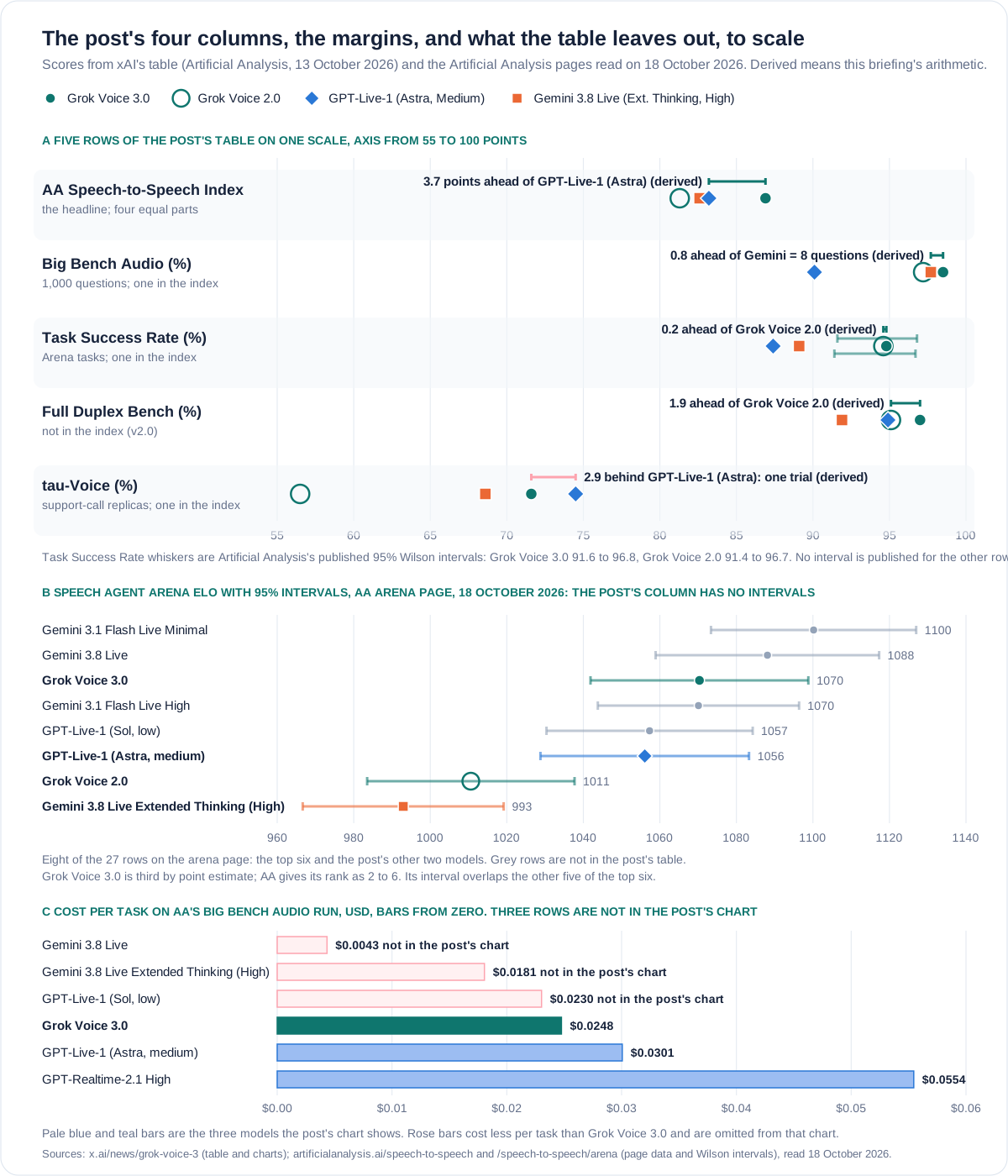
Grok Voice 3.0's margins in the post's table, and its rank among the 19 models that carry an index score on AA's page (derived from AA's page data, 18 October 2026).
| Row | Margin in the post's table (derived) | Rank of 19 on AA's page, and what limits the margin |
|---|---|---|
| Index | 3.7 points ahead of GPT-Live-1 (Astra, medium): 86.9 against 83.2. | First. No interval published. |
| Big Bench Audio | 0.8 points ahead of Gemini 3.8 Live (Ext. Thinking, High), 98.5 against 97.7. That is 8 of 1,000 questions. | Second: Qwen Audio 3.0 Realtime Plus is at 99.2. A rough 95% half-width at 98.5% on 1,000 questions is 0.75 points (binomial, derived). |
| Arena Elo | 22 points ahead of GPT-Live-1 (Astra, medium) on the frozen figures printed, 1070 against 1048. | Third on the live arena, behind Gemini 3.1 Flash Live Minimal (1100) and Gemini 3.8 Live (1088), which the table omits. AA's interval is about plus or minus 28 and AA gives the rank range as 2 to 6. |
| Task Success Rate | 0.2 points ahead of Grok Voice 2.0: 275 of 290 against 281 of 297 conversations. | First by point estimate. The Wilson intervals overlap by 5.0 points, and a two-proportion test gives z of 0.12 (derived). |
| Full Duplex Bench | 1.9 points ahead of Grok Voice 2.0, 97.0 against 95.1. | Third: Qwen Audio 3.0 Realtime Plus (98.4) and GPT-Live-1 (Sol, low) (97.3) are ahead. Not in the index since August. |
| τ-Voice | 2.9 points behind GPT-Live-1 (Astra, medium), 71.6 against 74.5. | Second. Astra's score rests on one trial of 278 scenarios; Grok's on three. Rough 95% half-widths are 5.1 and 3.1 points (derived), so "comparable" is fair and "ahead" is not available to either side. |
| Time to first audio | 0.81 seconds. 39.4% below GPT-Live-1 (Astra, medium) at 1.34 seconds (derived; the post says 40%). | Fourth fastest. Grok Voice 2.0 (0.70) is 14% faster than 3.0 (3.0 is 16.3% slower, derived). |
| Cost per task | $0.0248 unrounded, 17.6% below Astra's $0.0301 (derived). The post prints $0.025 against $0.030. | Twelve of the other 18 indexed models cost less per task; one ties. |
Two of the post's choices deserve a plain sentence each. The accuracy table lists Gemini 3.8 Live (Ext. Thinking, High) as a competitor, but the cost chart beside it does not, and at $0.0181 a task that model costs 27.1% less than Grok Voice 3.0 (derived). The chart of τ-Voice against time to first audio plots 16 models and labels four; this briefing decoded its coordinates and all 16 points match AA's page data, so the chart is AA's data, with the unlabelled twelve left unlabelled.
"Under one second": which clock
AA's methodology defines the figure behind the claim: "Time to First Audio (TTFA): Average number of seconds required to generate the first token of audio output, measured across the Big Bench Audio question set." The post's chart carries the same number in its accessibility text: "Grok Voice 3.0 scores 71.6% at 0.81s". AA's page data has it as 0.8143 seconds. So "under one second" means 0.81 seconds from the end of a short benchmark question to the first audio token, headroom of 0.19 seconds (derived), measured by AA.
ServiceNow's EVA-Bench site defines a different clock. Its response speed is "the elapsed time in seconds between the user's last audio and the agent's first audio response", measured in multi-turn enterprise scenarios with tool calls. On that site Grok Voice 3.0's response speed is 1.96 seconds (interval 1.92 to 1.99), 2.4 times AA's figure (derived), and Grok Voice 2.0's is 1.70. Neither number is wrong. They measure different things, the post cites the faster, and neither includes a telephone network, a contact-centre platform or the time a tool takes to answer. A deployer's own figure is the one that matters, and it has to be measured on the deployer's path.
Cost: $0.08 a minute, and what a call costs
The post's cost chart is "Average cost per task on Artificial Analysis's Big Bench Audio run". AA's page defines its hourly cost as the "Cost to complete fixed 40-question Big Bench Audio subset based on length of input audio, normalized to hourly basis", and the cost per task moves with it: for each of the three models in the post's chart the ratio to Grok Voice 3.0 is the same on both measures (1.214 for Astra, derived). For Grok Voice 3.0 the AA hourly figure, $4.80, is simply xAI's list price of $0.08 a minute multiplied by 60. A flat per-minute price and a token-based price are therefore compared on a short question-answering run, not on a call.
Prices as read on the vendors' own pages on 18 October 2026, and AA's measured cost on its Big Bench Audio run. Different bases: not a like-for-like price list.
| Model | Price as read | What the price leaves out, or is based on |
|---|---|---|
| xAI Grok Voice 3.0 (pricing page) | $0.08 a minute ($4.80 an hour), speech to speech. AA: $4.80 an hour, $0.0248 a task. | A second line, "$0.004 / text input", has no unit on the page. The visible page shows no telephony charge; its embedded data lists a separate PSTN minute field without explaining it (if it shares the audio-second unit that reproduces $0.08 a minute, it would be $0.01 a minute, an inference). |
| OpenAI GPT-Live 1 (pricing page, model page) | $0.05 a minute for the voice session, billed per second. AA, Astra (medium): $5.83 an hour, $0.0301 a task. | OpenAI states that "Backend model and tool usage is billed separately"; the voice model delegates reasoning to a backend model. List price per minute is therefore not an all-in price. |
| Google Gemini 3.8 Live and Extended Thinking (pricing page) | Audio input $3.00 per million tokens or $0.005 a minute; audio output $12.00 or $0.018 a minute. AA, Ext. Thinking (High): $3.50 an hour, $0.0181 a task. | $0.023 a minute if both directions ran the whole minute (derived upper bound). Text, thinking and search charges are separate. |
On those pages xAI's $0.08 a minute is higher than OpenAI's $0.05 session price and Google's $0.023, and none of the three includes everything. On AA's end-to-end benchmark run, Grok Voice 3.0 is cheaper than the two OpenAI models the post names. "Costs less than other frontier models" holds against those two and does not hold against 12 of the other 18 indexed models, one of which is in the post's own accuracy table.
What $0.08 a minute costs for calls of different lengths (derived arithmetic on the list price). Call lengths are illustrations, not xAI figures. 3.64 minutes is AA's mean simulated τ-Voice call for Grok Voice 3.0.
| Call length | Voice cost per call | For 20,000 calls a day |
|---|---|---|
| 2 minutes | $0.16 | $3,200 a day |
| 3 minutes | $0.24 | $4,800 a day |
| 3.64 minutes (AA's simulated call) | $0.29 | $5,824 a day |
| 5 minutes | $0.40 | $8,000 a day |
| 10 minutes | $0.80 | $16,000 a day |
A call that ends with a person has paid for the voice minutes and then for the person. The post gives no call length, no cost of the human hand-off and no cost per resolved call, which is the figure a contact-centre buyer needs.
Tesla, Starlink and a ServiceNow quotation: whose numbers
The post's deployment section is headed "Used by Millions of Customers at Tesla & SpaceX". The page's brand is SpaceXSI and its footer reads "© 2026 SpaceXAI LLC". This briefing relies on no claim about how those companies are related beyond the names the page itself uses. What matters for evidence is simpler: every figure in that section is the vendor's description of deployments it has grouped with itself, and none is audited or sourced to a third party.
Deployment claims in xAI's post, what the wording states and what it does not (derived counts marked).
| Claim | Stated | Not stated |
|---|---|---|
| Tesla | "Grok Voice 3.0 handles millions of conversations a day in Tesla vehicles." It also "powers Grok Bot's voice mode". | What a conversation is, how many millions, the period, any audit, how many are voice-agent turns rather than commands. |
| Starlink volume | "Starlink call centers use Grok Voice to answer 20,000 customer calls every day across multiple languages." | Which languages, call length, since when, on which model version, and whether the figure is a peak or a mean. |
| Starlink resolution | "Roughly 70% are resolved with no human in the loop." About 14,000 calls a day, with about 6,000 reaching a human (derived); a year at 365 days is 7.3 million calls (derived). | The definition of resolved, whether callers phoned back, abandoned or were transferred, what the other 30% were, and who measured. |
| Starlink sales | "one in four sales calls ends in a purchase before the caller hangs up". | How many sales calls, whether outbound or inbound, and the rate before the model. No purchase count can be derived. |
| Agent scope | "A single agent built on Grok Voice 3.0 verifies customers, troubleshoots hardware, issues credits, and ships replacement equipment." | The limits of its authority, the checks before a credit or a shipment, and any human approval. |
| ServiceNow | A Senior Director of Product Management at ServiceNow is quoted: Grok Voice 3.0 "sets a new Pareto frontier on EVA-Bench". | That ServiceNow ran the Grok Voice 3.0 entry. The quotation is supplied through the vendor's post. |
The strongest independent evidence, and the number beside it
The best-supported claim in the post is the accuracy lead on EVA-Bench. The benchmark is described in an arXiv paper (version 3, 9 September 2026) and published as open source with a results site. The paper's abstract reports 213 scenarios across three enterprise domains and, across the 12 systems it tested, that none exceeded 0.5 on both EVA-A pass@1 (accuracy) and EVA-X pass@1 (experience). The results site's published data, read from its files, lists 21 systems with accuracy results. Grok Voice 3.0 is first: EVA-A pass@1 of 0.737 (interval 0.691 to 0.781), against 0.672 for the next system, a cascade of separate speech and language models, and 0.590 for the best other speech-to-speech model, GPT Realtime 2.1. The margin over the next system is 6.5 points (derived) and its interval overlaps by 2.5 points; the margin over the best other speech-to-speech model is 14.7 points with no overlap. Six of the 21 systems now clear 0.5 on both measures, so the paper's finding describes its 12 systems, not the site as it stands. On a simple sum of the two pass@1 scores (this briefing's choice, derived), Grok Voice 3.0 is first at 1.449 against 1.345 for the next, Gemini 3.8 Live, which is consistent with the post's "jointly scored" sentence; the post does not say how it scored them. That supports the post's sentence on accuracy.
Three things sit beside that number. First, the same site's reliability measure, pass^5, which averages over scenarios the estimated probability of passing five independent trials in a row: 55.3% (interval 48.9 to 61.8), against 73.7% for a single trial, a gap of 18.4 points (derived). For a contact centre, the single-trial figure is closer to an average attempt and the five-trial figure closer to a promise. Second, the highest experience score is not Grok's: Gemini 3.8 Live has an EVA-X pass@1 of 0.886. Third, GPT-Live-1 is not on the results site, so the model that leads τ-Voice in the post's own chart has no EVA-Bench result to compare. The site's files carry a last-modified date of 15 October 2026, a day after the post. That does not show when the Grok Voice 3.0 entry was added, and which party ran it is not stated in the data read.
The alias moved on a Wednesday
The post's last section says agents using grok-voice-latest "have already been switched over automatically, with no changes needed". xAI's release notes for 14 October, a Wednesday (derived), say the same in more detail: "grok-voice-latest now points to grok-voice-3.0, so sessions that use the alias are upgraded automatically. The API is unchanged." The same day, Grok Voice 2.0 was marked deprecated. No end-of-life date for it appears in the notes read.
This is the second move. On 29 July the notes announced Grok Voice 2.0 and said the alias "will route to this model starting August 5, 2026", seven days later (derived). The October move was announced as done. xAI's speech-to-speech documentation is plain about the risk: "use a versioned name to pin to a specific release", and "Pin to a versioned model name in production for stability." Its own quick-start code, however, passes grok-voice-latest. The same documentation tells developers moving to 3.0 to "Simplify your system prompt" and says "Reasoning is enabled by default" with a default effort of high. On xAI's own advice a prompt written for the previous model should be rewritten for this one, and an agent on the alias met the new model with no change request.
No statement was found about how customers were notified of the 14 October move. The post says "no changes needed", which describes the interface and says nothing about behaviour. The voluntary DSIT AI Cyber Security Code of Practice (31 January 2025) has provisions that read directly on this. Provision 7.3: "Developers and System Operators shall re-run evaluations on released models that they intend on using." Provision 7.4: "System Operators shall communicate their intention to update models to End-users in an accessible way prior to models being updated." Provision 11.3: "Developers should support System Operators to evaluate and respond to model changes, (for example by providing preview access via beta-testing and versioned APIs)." The Code is voluntary, and whether a caller counts as an "End-user" in its definition is a reading for the deployer.
Safety, cloning and disclosure: what the pages say
The post has no safety section. xAI's safety page, as archived on 14 October at about 16:50 UTC, says "We publish model cards, safety evaluations, and our Frontier AI Framework" and lists model cards for Grok 4.7, 4.6, 4.5, 4 Fast, Code Fast 1 and 4. No Grok Voice card is listed in that capture. An earlier briefing on Grok 4.7 found a model card for that model; none was found here, and an archived page is not proof that none exists.
Safety, cloning and disclosure for a voice agent on xAI's API, from xAI's post, documentation and acceptable use policy (archived 14 October 2026).
| Topic | What the pages say | What they do not say |
|---|---|---|
| Evaluation | The post gives benchmark results only. The documentation describes the API. | A system or model card for Grok Voice 3.0, red-teaming of impersonation or fraud, or evaluation of harmful voice output. |
| Voice cloning | "Create a custom voice by cloning a reference clip up to 120 seconds long." Custom Voices is "currently only available in the United States, with the exception of Illinois". The API endpoint is "gated to teams on an Enterprise plan"; the console allows up to 30 custom voices for free. | Any check that the speaker consented, any verification of the speaker, any watermark or synthetic-voice marker on output. |
| Contractual rules | The acceptable use policy (effective 14 August 2026) prohibits "Deceptively impersonating a real person" and "Misleading others or not being transparent regarding your use of AI", and "high-stakes automated decisions" about legal or material rights. | How those rules are enforced on a live voice session. A policy is a term of use, not a control. |
| Disclosure to callers | The documentation offers a force_message feature for "compliance disclosures (e.g. "This call is being recorded")". | Any default disclosure that the caller is speaking to an AI. That is for the deployer to configure. |
UK: what the primary pages say about a voice agent answering customers
A UK organisation that puts a voice agent on its customer line takes on duties that depend on facts the post does not give: who the controller is, what data the calls carry, whether any call is for marketing, and whether the agent makes decisions. The table sets out what each page read says and what it does not say about a real-time AI voice. The pages are linked here: xAI's data processing addendum and subprocessor list (Internet Archive captures), its security FAQ, voice overview and regional endpoints documentation; the ICO's automated decision-making guidance, live calls guidance and PECR telephone marketing page; and Ofcom's silent and abandoned calls notice and AI and telecoms customers release.
Primary UK and xAI contractual pages read in full for this briefing (18 October 2026). Ofcom, ICO and DSIT pages are read directly; xAI legal pages are Internet Archive captures with their dates.
| Source | What it says, as read | What it does not say about this case |
|---|---|---|
| xAI data processing addendum (effective 22 September 2026; capture of 17 October) | SpaceXSI is a processor. "Customer agrees that it will process Personal Data through the Services only using SpaceXSI's ZDR-Enabled API", and "SpaceXSI requires that Customer does not submit Personal Data to SpaceXSI's non-ZDR Services." A failure "will constitute a material breach". Transfers outside Europe are allowed "including in the United States", with the ICO's UK Addendum. | A UK processing location. Whether a deployer's voice calls can meet the ZDR condition and keep the features it needs. |
| xAI security FAQ (10 October 2026) | By default requests and responses are stored for 30 days. "For most customers, we do not recommend enabling ZDR." "Voice agent conversations are not persisted when ZDR is enabled." Asked whether it is GDPR and SOC 2 compliant, the page answers "We are SOC 2 Type 2 compliant." | A GDPR compliance statement in that answer. The voice docs' card "GDPR Compliant" is a separate claim. |
| xAI voice overview (14 October 2026) | "All audio data is processed in real time and never stored or used for training." Cards read "EU data residency options" and "Regional processing for compliance requirements". | How that squares with the 30-day default above, or any UK option. The two pages are not reconciled. |
| xAI regional endpoints (10 October 2026) | The global endpoint "may route requests between regions for capacity or reliability, so the processing location is not guaranteed." The US endpoint does not serve "voice APIs". | Any EU or UK endpoint for voice. The page says a regional endpoint "is not, by itself, a comprehensive data-residency guarantee". |
| xAI subprocessor list (capture of 3 October) | 24 entries, 23 in the US and one, a SpaceXAI subsidiary for services and support, in the UK. One entry, LiveKit, is listed for real-time media. | Which subprocessors touch voice audio. |
| ICO, automated decision-making (draft updated 31 March 2026, under consultation) | ADM means a decision "based solely on automated processing" with "no meaningful human involvement" and a "legal or similarly significant effect" (UK GDPR articles 22A to 22D, after the Data (Use and Access) Act). | Whether issuing a credit or shipping equipment meets that test. That depends on the facts. |
| ICO, live calls guidance and the PECR telephone marketing page | A live call is "a telephone call where a live person is speaking". An automated call is one "made by an automated dialling system that plays a recorded message", and needs specific consent. Customer-service calls are not direct marketing unless they contain promotion. Both pages say they are under review after the Data (Use and Access) Act. | Where a real-time synthetic voice falls. Neither definition describes it. |
| Ofcom, silent and abandoned calls (22 January 2026) | Organisations "should ensure that their practices, systems and processes are designed to prevent silent and abandoned calls". Repeated ones may be persistent misuse, with penalties of up to £2 million. | Anything about AI voice agents. |
| Ofcom, consumers and AI (25 September 2026) | "It should be very clear to telecoms customers when they are interacting with a GenAI application." Ofcom "would be concerned" if AI "were to act as 'gatekeepers' that create barriers to accessing support". | A rule for sectors outside telecoms. It is a statement of expectation by the regulator, and it sits in a news release. |
Two readings follow, both limited to the pages. First, the contract and the documentation do not yet line up for a UK deployer who wants to send personal data to the voice API: the addendum assumes the zero-data-retention setting, the security FAQ advises against it for most customers, the voice overview says audio is never stored, and the regional page lists no UK or EU voice endpoint. A deployer has to ask xAI in writing, not infer from the cards. Second, the post's most striking operational claim is a call centre that resolves about 70% of calls without a person. Its example is a satellite internet provider, the kind of service Ofcom's September statement speaks to for UK telecoms providers: tell customers it is AI and keep the human route open. The statement applies to a company only if it is one. The ICO's ADM guidance asks whether any decision the agent takes has no meaningful human involvement and a significant effect. The post says the agent "issues credits, and ships replacement equipment" and does not say whether a person reviews either.
What a deployer should do, in order
None of these steps needs a benchmark to justify it. They are the controls a change of model, a change of price basis or a change of data path would call for, in the order worth doing. Earlier briefings applied the same reading to an earlier xAI launch and to a Google launch table.
Take this with you
Deployer actions for a hosted voice model, in order
- Find out which model each voice agent ran on 13 October and which it runs now. If it called grok-voice-latest, it changed on 14 October without a request from you. Record the date and who knew.
- Pin a versioned model name in production, as xAI's own documentation advises, and treat any move to a newer version as a change with a test, an approver and a rollback.
- Re-run your own call set against the new version before it takes live calls: your accents, your noise, your tools and your policies. Measure the time from the caller's last word to the agent's first audio on your own telephony path, not on a benchmark.
- Define resolved in writing before quoting a containment figure. Count recontacts, abandoned calls, transfers and complaints, and report the share that reached a person.
- Decide what personal data enters the voice path. Ask xAI in writing where voice audio and transcripts are processed and stored, whether the zero-data-retention condition in its addendum applies to you, and what you lose by enabling it.
- Tell callers early that they are speaking to an AI and keep a route to a person, as Ofcom's 25 September 2026 statement expects of telecoms providers. Do not let the agent become the only channel.
- Classify each call type under PECR before using a synthetic voice for outbound sales. The ICO pages define live and automated calls by a live person and a recorded message, and a real-time synthetic voice fits neither description on those pages, so take advice.
- If the agent issues credits, ships equipment or refuses requests, test whether any of those is a decision with no meaningful human involvement and a legal or similarly significant effect, using the ICO's draft ADM guidance, and record the result.
- Control voice cloning: decide who may create a custom voice, require documented consent from the speaker, and log each use. The xAI documentation read states no consent check.
- Log model version, session events and tool calls for every call, keep them under your own retention schedule (DSIT provision 12.1: System Operators shall log system and user actions), and exercise your incident plan against a bad model release.
- Compare cost on your own traffic: minutes per call, the share handed to people, the text and telephony lines on the pricing page, and cost per resolved call, not cost per benchmark task.
What could not be verified
- xAI's other pages. The safety, security, data processing addendum, acceptable use and subprocessor pages answered a plain request with a bot challenge and were not forced. They were read from Internet Archive captures of 14 October (safety, acceptable use), 17 October (addendum) and 3 October (subprocessors). The live pages could differ today. The Trust Center needs an NDA and was not read.
- The deployment figures. Tesla's "millions of conversations", Starlink's 20,000 calls, 70% and one in four are the vendor's. The post links an X post by Tesla; X was not read.
- EVA-Bench. Who ran Grok Voice 3.0's entry, and when it was added, are not stated in the data read. The paper's abstract was read, not its full text.
- τ-Voice. AA's methodology was read; the Sierra paper it builds on was not. Whether AA ran Grok Voice 3.0 at xAI's default reasoning effort is not stated: AA labels effort for other models and not for this one.
- AA's data over time. The post's table is dated 13 October 2026. AA's pages were read on 18 October and show no per-model publication date. Every figure in the post's table matched AA's page data except two rivals' Elo values, explained above.
- Safety documentation. No model or system card for Grok Voice 3.0 was found. An archived page not listing one is not proof of absence.
- UK. No ICO page on recording telephone calls was found by searching the ICO's published page list. The ICO's AI and data protection guidance (updated 15 March 2023) and its PECR pages say they are under review after the Data (Use and Access) Act.
- Customer notification of the alias change. No statement found.
- Time-stamped. Read between 16:17 and 16:50 BST on Sunday 18 October 2026. AA's numbers, xAI's documentation and the EVA site can change within hours.
The question that exposes the gap
On Wednesday 14 October the model answering some companies' customers changed without a request from them: can you say whether yours was one, who approved it, and how you would have known?
Key facts
Sources
- Primary'Introducing Grok Voice 3.0', 14 October 2026: the claims, the table and charts sourced to Artificial Analysis (13 October), the EVA-Bench quotation, the Tesla and Starlink figures and the price. Re-fetched with a plain request and read in full, including the chart data in the pagexAI (SpaceXSI)accessed 2026-10-18
- PrimarySpeech to Speech leaderboard, read 18 October 2026 with the data embedded in the page: every index score, component, time to first audio, cost per task and cost per hour used hereArtificial Analysisaccessed 2026-10-18
- PrimarySpeech Agent Arena leaderboard: Elo with 95% intervals, rank ranges, samples and Task Success Rate with Wilson intervalsArtificial Analysisaccessed 2026-10-18
- PrimarySpeech Agent Arena overview: how a round works, 15 agentic and 20 non-agentic scenarios, paid screened participants, the dental booking exampleArtificial Analysisaccessed 2026-10-18
- PrimaryMethodology: index version 2.0 and its equal weights, Big Bench Audio, tau-Voice (GPT-4.1 customer and grader, three trials), Arena Score and frozen Elo, Task Success Rate and the Wilson interval, time to first audio, version historyArtificial Analysisaccessed 2026-10-18
- PrimaryPricing page: grok-voice-3.0 and grok-voice-2.0 at $0.08 a minute ($4.80 an hour), the '$0.004 / text input' line, Grok Voice 2.0 marked deprecated, and the embedded model listxAI documentationaccessed 2026-10-18
- PrimaryRelease notes: 14 October 2026 'Grok Voice 3.0 is available' and the alias now pointing to it, Grok Voice 2.0 deprecation, and the 29 July note that the alias would route to Grok Voice 2.0 from 5 AugustxAI documentationaccessed 2026-10-18
- PrimarySpeech to Speech guide: model selection and pinning, 'Upgrading from Grok Voice 2.0', the 3.0 best practices (reasoning effort, prompt advice), force_message disclosures, telephony integrationxAI documentationaccessed 2026-10-18
- PrimaryVoice overview, last updated 14 October 2026: 'sub-second' latency card, enterprise compliance cards (never stored, EU data residency options)xAI documentationaccessed 2026-10-18
- PrimaryCustom Voices: cloning from a reference clip up to 120 seconds, US only except Illinois, Enterprise-gated API, 30 free voices in the consolexAI documentationaccessed 2026-10-18
- PrimaryRegional endpoints, last updated 10 October 2026: global endpoint routing, the US endpoint not serving voice APIs, 'not, by itself, a comprehensive data-residency guarantee'xAI documentationaccessed 2026-10-18
- PrimarySecurity FAQ, last updated 10 October 2026: 30-day default retention, Zero Data Retention and what it disables (including voice agent conversation history), the SOC 2 answerxAI documentationaccessed 2026-10-18
- PrimaryData Processing Addendum, effective 22 September 2026: processor role, the ZDR-Enabled API condition, transfers and the UK Addendum. The live page answered a plain request with a bot challenge, so this capture was read insteadxAI (Internet Archive capture, 17 October 2026)accessed 2026-10-18
- PrimaryAcceptable Use Policy, effective 14 August 2026: impersonation, transparency about AI, high-stakes automated decisions. Read from the capture because the live page answered with a bot challengexAI (Internet Archive capture, 14 October 2026)accessed 2026-10-18
- PrimarySafety page: the commitment to publish model cards and the list of model cards (six text models, no voice model). Read from the capture because the live page answered with a bot challengexAI (Internet Archive capture, 14 October 2026)accessed 2026-10-18
- PrimarySubprocessor list: 24 entries, 23 in the US and one UK subsidiary. Read from the capture because the live page answered with a bot challengexAI (Internet Archive capture, 3 October 2026)accessed 2026-10-18
- PrimaryEVA-Bench results published as the site's data files (last modified 15 October 2026): 21 systems with accuracy results, pass@1, pass@k, pass^k, EVA-X, response speed definition and valuesServiceNow (EVA-Bench results site)accessed 2026-10-18
- PrimaryEVA-Bench paper, version 3 of 9 September 2026: 213 scenarios, three enterprise domains, and the finding across 12 systems that none exceeded 0.5 on both measures. Abstract readarXiv (ServiceNow researchers)accessed 2026-10-18
- PrimaryAPI pricing page: GPT-Live 1 voice sessions at $0.05 a minute, billed per second, with backend model and tool usage charged separatelyOpenAIaccessed 2026-10-18
- PrimaryGPT-Live 1 model page: full-duplex voice model that delegates reasoning and tools to a backend agent; pricing statementOpenAIaccessed 2026-10-18
- PrimaryGemini API pricing, last updated 16 October 2026: Gemini 3.8 Live and Extended Thinking audio input and output per million tokens and per minuteGoogleaccessed 2026-10-18
- PrimaryAutomated decision-making, including profiling: draft guidance updated 31 March 2026 after the Data (Use and Access) Act, the article 22A definition and consultation statusInformation Commissioner's Officeaccessed 2026-10-18
- PrimaryDirect marketing using live calls: the definition of a live call, the service-message point, and the review notice after the Data (Use and Access) ActInformation Commissioner's Officeaccessed 2026-10-18
- PrimaryGuide to PECR, telephone marketing: live calls, automated calls (an automated dialling system that plays a recorded message) and the consent ruleInformation Commissioner's Officeaccessed 2026-10-18
- PrimaryGuidance on AI and data protection: updated 15 March 2023 and under review after the Data (Use and Access) Act. The transparency chapter was readInformation Commissioner's Officeaccessed 2026-10-18
- PrimaryRefresher messaging on silent and abandoned calls, 22 January 2026: persistent misuse and penalties of up to 2 million poundsOfcomaccessed 2026-10-18
- PrimaryConsumers using AI to help manage their telecoms services, 25 September 2026: the transparency expectation and the concern about AI as a gatekeeperOfcomaccessed 2026-10-18
- PrimaryAI Cyber Security Code of Practice, published 31 January 2025, voluntary: provisions 7.3, 7.4, 10.1, 11.2, 11.3 and 12.1 and the stakeholder definitionsDepartment for Science, Innovation and Technologyaccessed 2026-10-18