The August zero-day was North Korea. The part still working is the job advert
CVE-2026-68820, the only exploited flaw in Microsoft's August release, was a Lazarus zero-day used against defence and aerospace for at least 35 days. Microsoft patched the exploit. Nothing patches a fake vendor site ranking first in search.
By Parminder Kumar Sharma · · 7 min read

The bug that would have sorted low
On 12 August this site published that Microsoft's August release contained one confirmed exploited vulnerability, that it was rated Important rather than Critical, and that a queue sorted by severity would place it below sixty-two Critical entries nobody was touching.
Check Point Research published the other half of that on 11 August. CVE-2026-68820 is a Lazarus zero-day, used against defence and aerospace companies since at least early July, to load a kernel rootkit that switches off endpoint detection.
The severity rating was correct. It describes a local privilege escalation requiring code already running on the machine. What it does not describe, and cannot, is that a state-sponsored group had been using it for five weeks to blind EDR on defence contractors.
Thirty-five days between first use and a patch
7 Jul 2026
Sample compiled
Compiler timestamp on Afd4Eop12_x64.dll, 22:07:44 UTC.
Early Jul
In the wild
Check Point assesses active use in Operation Dream Job from this point.
28 Jul
Reported to Microsoft
Check Point Research discloses to MSRC.
5 Aug
CVE assigned
CVE-2026-68820.
11 Aug
Patched
Shipped in the August Patch Tuesday release.
The interesting part is not the exploit
Every outlet will lead on the zero-day. It is the least actionable thing in the report, because it was unpatchable until Tuesday and is patched now.
What deserves attention is how people were reached, because that part is still working and nothing Microsoft shipped touches it.
The lure is a job. Recruiters approach staff at defence, aerospace and aviation companies, most likely on LinkedIn, offering roles at names people want to work for. One decoy document impersonates a Lockheed Martin job description. Another wave impersonates Enveil, a privacy technology company that Check Point is explicit was neither targeted nor compromised.
Then comes the step that should worry anybody running an estate.
The attackers built at least three websites impersonating Enveil and got them ranking in search results, in some cases as the top result for the product name. Not a link in an email. Not a lookalike domain buried in a phishing header. A site a person finds by searching for a tool they were told to install, that appears above the real vendor.
Check Point's assessment of why is the detail that matters: splitting delivery in two. The crafted PDF arrives by message; the viewer that opens it is fetched separately, from what looks like the vendor's own site. Neither half is obviously malicious on its own, and the download does not come from the phishing channel at all.
Where a control actually exists
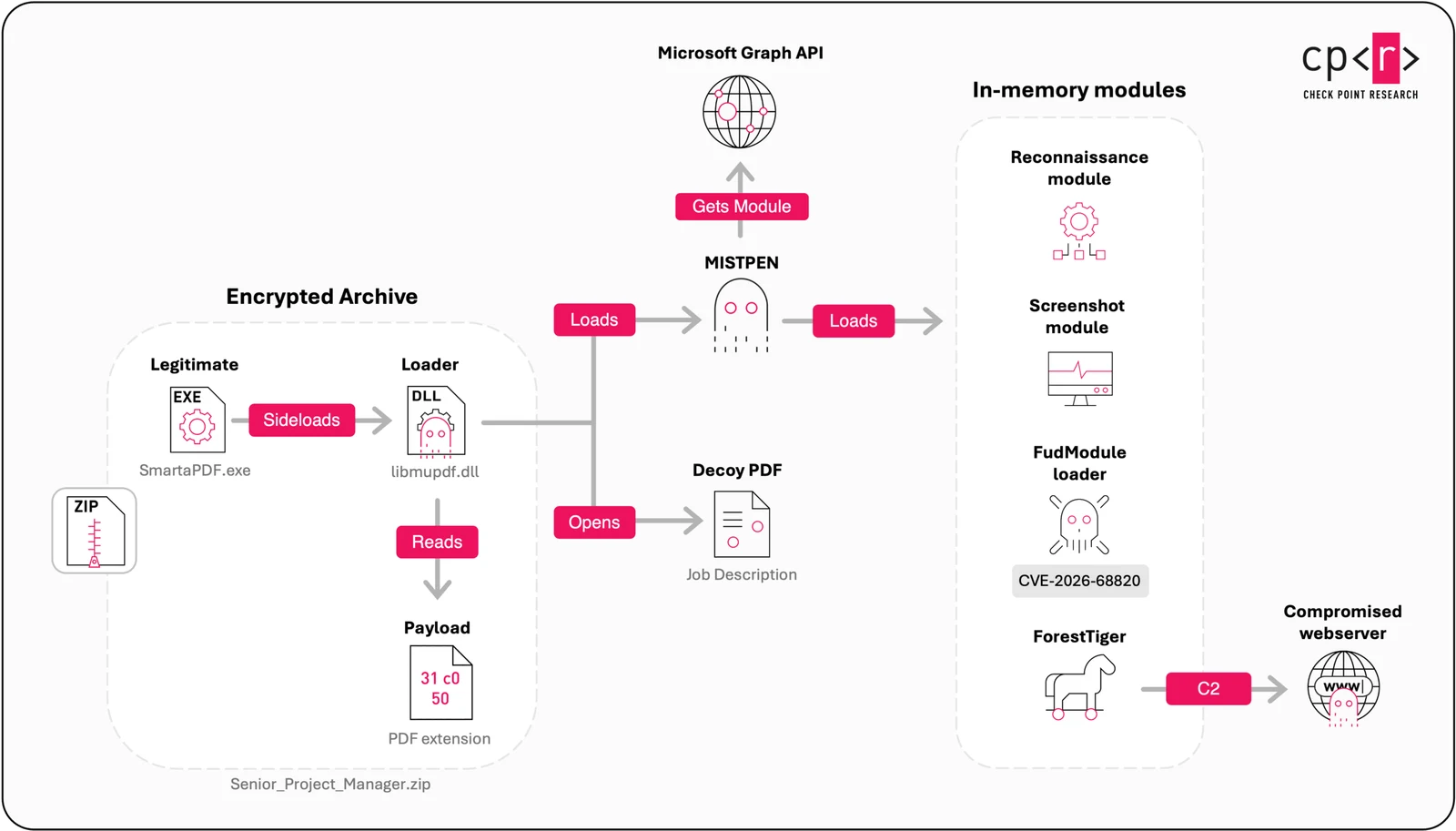
That is the machinery. The question a defender actually has is a different one, so here is the same chain arranged by where a control exists.
Every control you own sits before the exploit
Check Point Research · 11 Aug 2026
- 01
Recruiter approach
A job at a defence or aerospace name
Stoppable: Awareness, and a route to verify a recruiter
- 02
Fake vendor site
Ranking top for the tool's own name
Stoppable: Software comes from a catalogue, not a search result
- 03
Encrypted ZIP opened
Signed viewer, sideloaded DLL, crafted PDF
Stoppable: Application control, and no unpacking to a user profile
- 04
MISTPEN in memory
Beacons out over the Microsoft Graph API
Stoppable: Egress policy, because Graph traffic looks legitimate
- 05
CVE-2026-68820
Race in afd.sys, use after free, SYSTEM
Not stoppable: Nothing. It was a zero-day until 11 August
- 06
FudModule v3.1
94 ETW providers killed, callbacks unlinked
Not stoppable: Your EDR is now being switched off by SYSTEM
- Steps you control
- 4 of 6
- All of them before
- the exploit runs
- Days it was a zero-day
- at least 35
Four of the six steps sit before any payload executes, and each is something a normal organisation already has a lever for. The fifth was a zero-day. By the sixth the attacker holds SYSTEM and is dismantling the tooling that was meant to notice.
That is the argument in one line: for five weeks, every defence that mattered on this chain was a decision made by a person before they double-clicked anything.
The tradecraft, step by step
Enough of the chain is documented to map it properly, and the detail matters because several steps are detectable without any vendor product.
Techniques observed, and what each one leaves behind
- Stage
- Delivery
- Technique
- T1566.002 Spearphishing link
- What it looks like on a host
- A recruiter approach ending in a download, not an attachment
- Stage
- Delivery
- Technique
- T1608.006 SEO poisoning
- What it looks like on a host
- A vendor download page that is not the vendor. Check the domain against the vendor’s own site, not against the search result
- Stage
- Execution
- Technique
- T1204.002 User execution
- What it looks like on a host
- A signed PDF viewer launched from an unpacked archive in the user profile
- Stage
- Defence evasion
- Technique
- T1574.001 DLL search order hijacking
- What it looks like on a host
- libmupdf.dll loaded from beside the executable rather than from System32
- Stage
- Execution
- Technique
- T1055.001 Reflective DLL injection
- What it looks like on a host
- new.exe spawned in %TEMP% with a PDF viewer as parent process
- Stage
- Command and control
- Technique
- T1102.002 Web service
- What it looks like on a host
- Outbound to graph.microsoft.com from a process with no business using it
- Stage
- Persistence
- Technique
- T1547 Boot or logon autostart
- What it looks like on a host
- A second-stage module writing MISTPEN to disk after validation, not on first run
- Stage
- Privilege escalation
- Technique
- T1068 Exploitation for privilege escalation
- What it looks like on a host
- CVE-2026-68820, a race in afd.sys. No host artefact until after it succeeds
- Stage
- Defence evasion
- Technique
- T1562.001 Disable or modify tools
- What it looks like on a host
- 94 ETW providers stopped, kernel callbacks unlinked, NT Kernel Logger terminated
- Stage
- Defence evasion
- Technique
- T1562.006 Indicator blocking
- What it looks like on a host
- Smart App Control policy state set to zero and code integrity policy reloaded in place
- Stage
- Command and control
- Technique
- T1584.006 Compromise infrastructure
- What it looks like on a host
- Beaconing to ordinary WordPress, PrestaShop and Roundcube hosts rather than to attacker domains
| Stage | Technique | What it looks like on a host |
|---|---|---|
| Delivery | T1566.002 Spearphishing link | A recruiter approach ending in a download, not an attachment |
| Delivery | T1608.006 SEO poisoning | A vendor download page that is not the vendor. Check the domain against the vendor’s own site, not against the search result |
| Execution | T1204.002 User execution | A signed PDF viewer launched from an unpacked archive in the user profile |
| Defence evasion | T1574.001 DLL search order hijacking | libmupdf.dll loaded from beside the executable rather than from System32 |
| Execution | T1055.001 Reflective DLL injection | new.exe spawned in %TEMP% with a PDF viewer as parent process |
| Command and control | T1102.002 Web service | Outbound to graph.microsoft.com from a process with no business using it |
| Persistence | T1547 Boot or logon autostart | A second-stage module writing MISTPEN to disk after validation, not on first run |
| Privilege escalation | T1068 Exploitation for privilege escalation | CVE-2026-68820, a race in afd.sys. No host artefact until after it succeeds |
| Defence evasion | T1562.001 Disable or modify tools | 94 ETW providers stopped, kernel callbacks unlinked, NT Kernel Logger terminated |
| Defence evasion | T1562.006 Indicator blocking | Smart App Control policy state set to zero and code integrity policy reloaded in place |
| Command and control | T1584.006 Compromise infrastructure | Beaconing to ordinary WordPress, PrestaShop and Roundcube hosts rather than to attacker domains |
Three of those are worth dwelling on because they invert a normal assumption.
The staging is conditional. MISTPEN does not persist on first execution. It profiles the host first, through GetInfoPlugin for domain, hostname, user and build, then PvPlugin for the full process list with PIDs, parents and owners. Only once the operator is satisfied the target is real does a persistence module arrive. A sandbox that detonates the sample and sees nothing written to disk has not seen a benign file. It has failed the interview.
The exploit is delivered, not carried. The LPE module fetches the payload from the C2 at the moment it is needed, negotiating a session key with Kyber/ML-KEM and layering GOST-CBC over MISTPEN's own AES. A post-quantum key exchange, in a loader, to protect a single privilege escalation download. That is not necessary and it tells you what the group expects of the people collecting its traffic.
The final backdoor asks for very little. Troy supports seventeen commands, and the interesting thing is how ordinary they are: directory listing, file upload and download, ZIPDOWNLOAD which shells out to PowerShell Compress-Archive, a CMD handler that tracks cd /d so the working directory persists, and mem for in-memory DLL injection. Nothing exotic. It is a competent implant designed to look like administration.
What the rootkit does once it is too late
FudModule v3.1 is worth reading precisely because it shows what the earlier controls are protecting. Check Point's decompilation of the main routine reads as a checklist of everything a defender relies on:
LOBYTE(v6) = enable_god_mode(ctx);
  disable_crash_dump_callback(ctx);
  unlink_nonpreserved_registry_callbacks(ctx);
  unlink_targeted_minifilter_callbacks(ctx);
  disable_nt_kernel_logger(ctx);
  if ( unlink_nonpreserved_object_callbacks(ctx) == 1
    && disable_nonpreserved_ps_notify_callbacks(ctx) == 1
    && disable_kaspersky_wfp_callbacks(ctx) == 1
    && disable_hardcoded_user_etw_sources(ctx) == 1
    && hijack_handle_to_services_process(ctx) == 1
    && inject_spawn_msiexec_shellcode(ctx) == 1
    && disable_smart_app_control_remotely(ctx) == 1
Ninety-four ETW provider GUIDs are killed, matching the first ninety-four entries of the list published for the 2024 version, in the same order. Process, thread, image, object and registry callbacks are unlinked. Minifilters are removed by altitude band. The NT Kernel Logger is stopped.
Two changes from the 2024 version are worth noting. The dedicated Microsoft Defender stage is gone, leaving only an orphaned string: Defender is now blinded by the generic suppression engine like any other product, which reads as confidence rather than retreat. And a new stage tampers with Smart App Control, setting the policy state to zero and forcing an in-place reload of code integrity policy.
The version also refuses to run on anything older than Windows 11 build 26100. Lazarus is targeting current, patched, well-configured estates on purpose.
The infrastructure is other people's websites
The command and control is not attacker-owned. It is compromised Roundcube webmail servers, exploited through CVE-2025-49113, a PHP deserialisation flaw that requires valid credentials, which Check Point assesses were taken from dark web credential dumps. WordPress and PrestaShop sites were used the same way.
Each hosts RelayShell, a webshell that does not execute commands. It relays them, passing messages between the operator and the implant through session files on the compromised host. Seventeen unique identifiers were recovered, implying at least seventeen compromised servers acting as relays. Operators reached them over ExpressVPN.
One compromised organisation, headquartered in France, was then used to send spear-phishing to further targets. Its reputation became the attacker's credibility. If your suppliers or partners are in defence, that is the pattern to sit with.
Indicators
Infrastructure
- Indicator
- envell[.]xyz
- Type
- Domain
- Associated with
- Fake Enveil site distributing SecurityPDF
- Indicator
- enveil[.]online
- Type
- Domain
- Associated with
- Fake Enveil site distributing SecurityPDF
- Indicator
- uxtramine[.]org
- Type
- Domain
- Associated with
- Troy backdoor C2
- Indicator
- 135.181.67[.]203
- Type
- IPv4
- Associated with
- Troy backdoor C2
- Indicator
- 135.181.185[.]158
- Type
- IPv4
- Associated with
- Troy backdoor C2
| Indicator | Type | Associated with |
|---|---|---|
| envell[.]xyz | Domain | Fake Enveil site distributing SecurityPDF |
| enveil[.]online | Domain | Fake Enveil site distributing SecurityPDF |
| uxtramine[.]org | Domain | Troy backdoor C2 |
| 135.181.67[.]203 | IPv4 | Troy backdoor C2 |
| 135.181.185[.]158 | IPv4 | Troy backdoor C2 |
Sample hashes, by family
- Family
- DLL loader and dropper
- Count
- 12
- First hash (truncated)
- 2b4987c07a3d9a9a
- Family
- MISTPEN
- Count
- 9
- First hash (truncated)
- 2db25ac41a66aa52
- Family
- ForestTiger
- Count
- 5
- First hash (truncated)
- 72dccae85e062f54
- Family
- PDF payload
- Count
- 6
- First hash (truncated)
- a673ae661593c0de
- Family
- Troy backdoor
- Count
- 3
- First hash (truncated)
- 590fb6ae19480d69
- Family
- SecurityPDF.exe
- Count
- 2
- First hash (truncated)
- 743172aab606974b
- Family
- RelayShell
- Count
- 2
- First hash (truncated)
- 21c3ad4838c4324b
- Family
- FudModule
- Count
- 1
- First hash (truncated)
- 3b6378df8442e63a
| Family | Count | First hash (truncated) |
|---|---|---|
| DLL loader and dropper | 12 | 2b4987c07a3d9a9a |
| MISTPEN | 9 | 2db25ac41a66aa52 |
| ForestTiger | 5 | 72dccae85e062f54 |
| PDF payload | 6 | a673ae661593c0de |
| Troy backdoor | 3 | 590fb6ae19480d69 |
| SecurityPDF.exe | 2 | 743172aab606974b |
| RelayShell | 2 | 21c3ad4838c4324b |
| FudModule | 1 | 3b6378df8442e63a |
The marker string inside a crafted PDF is worth a detection rule of its own, because it is plain text and specific: This document is encrypted with sumatrapdf reader!!!!!!!!!!!!. The payload after it is XOR encoded with a single byte, 0x39, and written to %TEMP%\\new.exe.
What to do this week
Take this with you
None of this is about the zero-day
- Patch CVE-2026-68820 if you have not. It is in the August release and it is the one thing here that is now solved.
- Ask how software actually arrives on a laptop in your organisation. If the honest answer includes searching for it, the SEO half of this campaign works on you and no email gateway sees it.
- Tell recruiting-adjacent staff and anybody in engineering that an unsolicited approach ending in a file download is the pattern. Not awareness training in general, this specific shape.
- Check whether you host Roundcube, WordPress or PrestaShop anywhere, including sites marketing owns. CVE-2025-49113 needs valid credentials, so rotate them and check for unexpected .ses and .log files.
- Treat a genuine-looking approach from a real partner as in scope. One compromised French organisation was used to phish onward, and sender reputation was no help.
- Search your estate for the marker string and for new.exe executing from %TEMP% with a PDF viewer as parent. Both are cheap and specific.
- If you run defence or aerospace supply, assume you are in the target set. Europe, India and Brazil are all named.
The position
There is a version of this story that is about a clever kernel exploit, and it is the version most people will publish. It is also the version with nothing in it for a reader, because Microsoft closed it on Tuesday.
The version worth your attention is that a nation-state group's most reliable delivery mechanism is a job advert and a search result. No exploit was required to get to the point where an exploit became useful. Somebody had to be flattered, and then had to download software from a website that ranked first.
The zero-day is patched. The recruitment lure, the SEO-ranked impersonation site, and the habit of installing tools from search results are all exactly as effective today as they were last month.
Sources
- PrimaryShattering the Dream: When a Job Offer Becomes a Zero-Day AttackCheck Point Researchaccessed 2026-08-13
- PrimaryCVE-2026-68820, Windows Ancillary Function Driver for WinSock elevation of privilegeMicrosoft Security Response Centeraccessed 2026-08-13