Google's mole inside TeamPCP saw 500,000 stolen credentials and a gang that could barely cash them
A Google Threat Intelligence researcher says a Mandiant persona sat inside TeamPCP's core chat from March, saw its stolen credential store and helped get keys revoked. The insider view changes less about the malware than about what the gang valued and where it was weak.
By Parminder Kumar Sharma · · 15 min read

Half a million credentials, tens of thousands of dollars
The Australian Federal Police says TeamPCP's malicious code enabled the theft of more than 500,000 credentials from more than 1,000 organisations (AFP, 27 August 2026). Austin Larsen of the Google Threat Intelligence Group (GTIG) estimates the group was pulling in only tens of thousands of dollars in extortion payments (WIRED, 18 September 2026). Take the top of that range, $99,999, and divide by 500,000: the gang realised under 20 US cents per stolen credential. At $10,000 it is 2 cents.
That ratio is the most useful thing to come out of Google's disclosure that a Mandiant persona sat inside TeamPCP's inner circle during its spring 2026 supply chain spree. It says the gang's hard problem was never getting in. It was turning access into money, and that is why it handed its loot to other extortion crews.
This site has touched TeamPCP twice this week. On 16 September we noted that Mandiant tracks TeamPCP intrusions as UNC6780 but that the report we examined did not link them to that Shai-Hulud case (briefing). On 19 September CrowdSec traced the copy of about 170 private repositories to an OAuth token harvested by the May TanStack npm compromise (briefing), one of the attacks WIRED attributes to TeamPCP.
What the source actually is
There is no Google report on the infiltration. The primary source is a conference talk: Larsen presented at SentinelOne's LABScon on 18 September 2026, and the detail in circulation comes from his interview with WIRED's Andy Greenberg published the same day and syndicated by Ars Technica on 20 September. The talk has not been published as a paper or video that we could find. Everything about the persona, the chat and the credential server therefore rests on one Google researcher's account, relayed by a journalist.
Parts of it can be checked against documents Google and the police did publish, which is what the table below does.
The operation's main claims, checked against sources we fetched (WIRED interview; AFP release; GTIG reports of 11 May, 30 July and 8 September 2026)
| Claim (Larsen, via WIRED) | Corroborated in a document | Not stated anywhere we found |
|---|---|---|
| TeamPCP is UNC6780 and ran a spring 2026 supply chain spree | Yes: GTIG 11 May and 8 September name TeamPCP as UNC6780 | Group size beyond about 12 core chat members |
| A persona was in the core chat from March | No: no Google document mentions a persona | How long it stayed; the exile date |
| An insider built an AI-assisted 2FA bypass zero-day | Partly: GTIG 11 May describes the exploit, actor unnamed | Which product, which vendor, which CVE |
| Google got credentials revoked via AWS and Microsoft | No | How many credentials, how many victims notified, the date |
| Google tipped the FBI after seeing a Drive backup | Partly: AFP says tips from several threat assessment companies | The date of the tip; that Google was one of the firms |
| The analyst broke no law | No | The guardrails, and which legal regime applied |
A US indictment of the 21-year-old also exists. The Department of Justice release (Northern District of California) would not load for us behind a bot check, so we rely only on search result text for it: conspiracy to commit Computer Fraud and Abuse Act violations and obtaining information from a protected computer, over conduct in spring 2026. Treat that as unverified until the release or the indictment itself is read. This briefing does not name the defendants; the AFP release does not either.
Is this the same group, and is it Shai-Hulud?
Yes on the first, not necessarily on the second. GTIG's 11 May report says TeamPCP is tracked as UNC6780 and describes its late March compromises of Trivy, Checkmarx, LiteLLM and BerriAI, with the SANDCLOCK credential stealer lifting AWS keys and GitHub tokens from build environments (GTIG). The FBI's cyber division assistant director calls the arrested men alleged members of TeamPCP in the AFP release. So the group in Larsen's talk, the group Mandiant calls UNC6780 and the group behind the August arrests are the same, on the record.
Shai-Hulud is where names start doing misleading work.
Names in this story and what each actually refers to (WIRED; GTIG 8 September 2026; Aikido; KrebsOnSecurity; The Register)
| Name | What it refers to | Does it mean TeamPCP? |
|---|---|---|
| Shai-Hulud (September 2025) | An earlier npm worm | Not established: WIRED says TeamPCP's involvement is still unclear |
| Mini Shai-Hulud | A worm TeamPCP deployed to automate spread | Yes, per WIRED |
| Shai-Hulud framework | Open-source worm code; GTIG saw a PRC-nexus group drop it | No: the code is public and reused |
| CanisterWorm (malware) | npm worm seen 20 March 2026 after Trivy | Yes, per Aikido |
| CanisterWorm (chat) | TeamPCP's core chat, per Larsen | Yes, per Larsen |
| UNC6780 | Mandiant and GTIG tracking name | Yes |
The Register's report on the arrests calls Shai-Hulud one of TeamPCP's attacks (The Register). GTIG's 8 September tracker, by contrast, describes a China-nexus espionage group dropping the Shai-Hulud framework onto compromised hosts (GTIG). A detection or an advisory that says Shai-Hulud tells you which code ran. It does not tell you who ran it, and after the source was published in May it tells you less every month.
How the analyst got in, and for how long
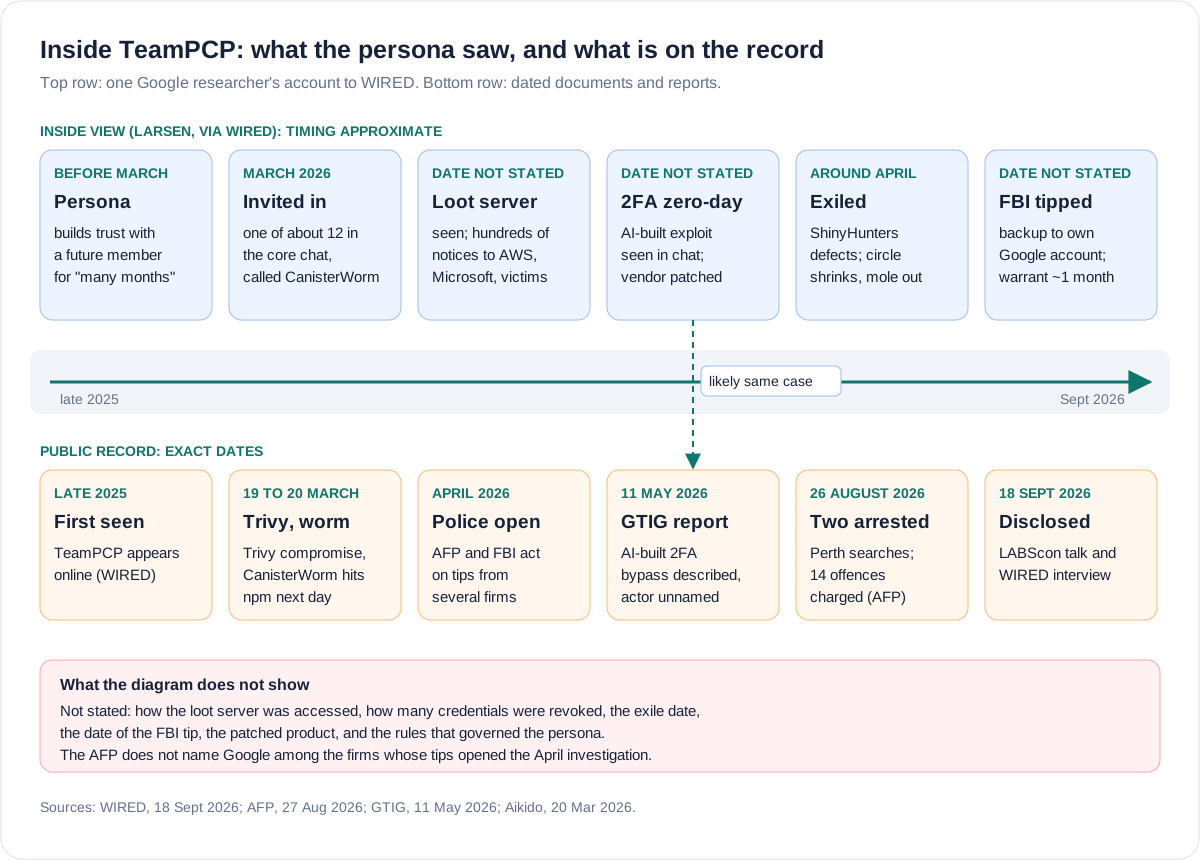
Larsen's account of the access is short. A persona had spent many months building trust with one individual who was later invited into TeamPCP, and was brought in with them. In March, as the Trivy compromise and the CanisterWorm npm worm were starting the spree, that persona became one of about 12 members of the core chat. Larsen did not name the analyst and said it was not him.
The persona then gained access to a server where TeamPCP kept stolen usernames, passwords and access tokens. How that access was obtained is not stated.
The period is shorter than the headlines suggest. Around April, a few weeks after partnering with TeamPCP, ShinyHunters began extorting victims with TeamPCP's credentials and keeping the money. TeamPCP responded by shrinking its inner circle, moving its data to a new server and expelling ShinyHunters and several others, including Google's analyst. On that account the inside view lasted from March to some point after April, perhaps weeks rather than months. No end date is given.
What the inside view added
Most of TeamPCP's tradecraft was already public before the talk, from incident responders and from Google's own reports. The insider account adds four things: how the group was organised, how it made money, the link to an AI-built zero-day, and how the leader was identified. Larsen had earlier described TeamPCP to KrebsOnSecurity as a peer community of individually skilled actors, not a structured crew (KrebsOnSecurity).
Outside view before 18 September against the insider account, and whether it changes defensive practice (GTIG reports; WIRED; KrebsOnSecurity)
| Outside view | Inside view (Larsen) | Changes what defenders do? |
|---|---|---|
| A big haul means a rich crew | Tens of thousands of dollars; loot shared with partners for a percentage | Yes: whoever extorts you may not be who stole from you |
| 2FA zero-day by unnamed criminals (GTIG, May) | Built in TeamPCP's core circle with an AI tool | Somewhat: credential theft plus logic flaws in admin tools |
| A central credential store was assumed | A server of stolen credentials held for extortion | Yes: stolen secrets sit waiting; revocation speed matters |
| Attribution by forum research | Leader's own Google account backed up the new server | No: this is about their opsec, not yours |
| Targeting of popular packages | Not addressed in the insider account | Already actionable from public reporting |
On package selection the insider account adds nothing new. The clearest public evidence is TeamPCP's recruitment contest after the third Shai-Hulud version's source was published in May: entrants were scored on weekly and monthly downloads of the packages they compromised, as KrebsOnSecurity reports from Dataminr's research. That is secondary reporting, but it matches the choice of targets: Trivy, Checkmarx tooling and LiteLLM are tools that sit in build pipelines with access to cloud keys.
On which credentials the gang prized, the Google documents are more specific than the talk. GTIG's May report names AWS keys and GitHub tokens taken from build environments. The September tracker says DUSTMAKER, TeamPCP's later stealer, pulls OIDC tokens from the memory of GitHub Actions runners and uses them to publish poisoned packages with valid, signed SLSA Build 3 attestations. Google routing its revocation requests through AWS and Microsoft fits that picture: cloud and code hosting credentials were the loot.
How long TeamPCP sat on access before using it is not stated in the talk coverage or in any Google document we read. What the insider account does show is that the credential store was kept for later extortion and shared with partner crews, so a credential stolen in March could still be used by someone else weeks later.
What Google did with it, and the link to the arrests
Larsen describes three actions. First, instead of contacting each victim, which he said would take too long, Google went to the providers where the stolen credentials worked, including Amazon Web Services and Microsoft, to get them revoked. It then notified victims, sending hundreds of emails in total. No count of revoked credentials or notified organisations has been published.
Second, the chat showed a member developing a zero-day exploit, with an AI tool, that bypassed two-factor authentication in widely used login software. Google obtained the code, confirmed it worked with small changes, and warned the developer, who patched. GTIG's May report describes what appears to be the same case without naming TeamPCP: a Python exploit for a 2FA bypass in a popular open-source, web-based system administration tool, which needs valid credentials first and exploits a hardcoded trust assumption (GTIG). GTIG says it has high confidence an AI model helped build it. Neither source names the product.
Third, attribution. After the expulsion, Larsen says Google learned through an unnamed trusted partner about some contents of TeamPCP's new server, and that it was being backed up to a Google Drive tied to a Gmail address he had linked, through a leaked BreachForums database and a 2019 forum dispute, to the 21-year-old later arrested. Google tipped the FBI. About a month later US law enforcement completed a warrant for the account data.
That makes this operation part of the story The Register reported on 28 August. The AFP says its investigation and the FBI's began in April 2026 after information from multiple cyber threat assessment companies, and that searches in Cottesloe, Hamilton Hill and Mandurah on 26 August led to 14 charges against two men aged 21 and 23 (AFP). The AFP does not name Google. Because Larsen places the Drive tip after the server move, which followed the April rift, it is our inference that Google's tip was not what opened the April investigation, but may have helped identify a suspect. KrebsOnSecurity published its own identification in August and says it knew the 21-year-old's identity from June.
Ethics and legal authority: what is said, and what is not
Larsen's only statement on conduct is that the analyst never took part in illegal hacking or encouraged the group's breaches. In his words they were "a fly on the wall, only saying enough to not be suspicious", and "there are guardrails around what we do". The guardrails themselves have not been published.
Legal and ethical questions the operation raises, and what the public account answers (WIRED; Nextgov; AFP)
| Question | Stated | Not stated |
|---|---|---|
| Did the persona commit or encourage crime? | Larsen says no | Any independent review or oversight |
| How was the credential server accessed? | Only that the persona gained access | Method, and whether it involved using stolen credentials |
| Under which legal authority? | Nothing; Google is a private company, not police | Which country's law the analyst worked under |
| How did Google learn of the Drive backup? | Via a trusted partner and server contents | Whether Google looked at the account before the warrant |
| Was data from ShinyHunters used? | ShinyHunters sent a chat log unsolicited | Whether it was passed to police |
The Drive question needs asking plainly, without assuming the answer. The account holder was Google's own customer. Larsen says Google learned the backup existed, gave the tip, and law enforcement then obtained the data by warrant. He does not say how Google knew the destination account without looking at it. There may be a simple answer, such as the partner's view of the server's configuration. Google should give it, because the same question applies to every Google Workspace customer.
The operation also sits inside a stated policy shift. Google launched a cyber disruption unit at RSAC in March 2026. GTIG vice president Sandra Joyce said it was not hacking back but made "legal and ethical use of intelligence" (Nextgov). Larsen told WIRED disruption is now one of GTIG's missions. For UK readers, persona work against criminal forums still falls under the Computer Misuse Act 1990 and other laws; nothing in Google's account explains how a similar operation would be lawful here, and none of it is guidance for doing one.
The comforting labels in this story
Signed provenance. GTIG says DUSTMAKER used stolen runner OIDC tokens to publish packages with valid, cryptographically signed SLSA Build 3 attestations that pass automated trust checks by AI coding agents (GTIG). An attestation proves where and how a package was built. It does not prove the build was meant to happen.
Security tooling. The spree started in a vulnerability scanner and a security vendor's tooling. The word "security" in a tool's description is not a reason to give it broad pipeline secrets.
AI utility names. DUSTMAKER created GitHub Actions tasks with names like "Copilot Setup" and then deleted their run logs. A workflow's name is not a control.
Undercover. "Fly on the wall" describes the analyst's intended role. It is not a description of the controls on that role, which remain private.
Method, accusation and commercial interest
Google sells threat intelligence through Google Threat Intelligence and Mandiant. A story of a mole inside a notorious gang is excellent marketing for that business, and the disclosure came at a vendor-run conference. That does not make it untrue: the AFP confirms threat intelligence companies supplied the information that started the investigation, and GTIG's May report documented the zero-day months before the talk. It does mean the most dramatic claims, the persona and the revocations, are the ones nobody outside Google can check.
Google's July mitigation guidance for this class of attack is sound, but it also points readers to Google's Assured Open Source Software, its OSV-Scanner tool and a Wiz framework (GTIG). The controls below are chosen on what the evidence supports and do not depend on any one vendor's product. The two arrested men have been charged, not convicted, and the attribution trail comes from Larsen's account and Krebs's reporting, not from a court.
What a UK engineering team should change
The insider view's lesson is that stolen credentials sit in storage, get shared with partner crews, and are defeated by revocation. Put speed of revocation ahead of everything else, then shrink what a compromised build can steal.
Take this with you
In the order worth doing
- Treat a cloud provider or code host notice that a key is exposed as the start of a supply chain incident: find the machine or runner it came from, not just the key.
- List every long-lived secret your CI can read, starting with cloud access keys, GitHub tokens and package registry tokens, and rotate any that were present on a runner that installed an affected package since February 2026.
- Replace static CI secrets with short-lived OIDC federation and cap personal access token lifetime; GTIG suggests at most seven days.
- Audit GitHub Actions workflows that use the pull_request_target trigger and remove secrets from any that check out untrusted code; GTIG names this trigger as a TeamPCP entry point.
- Set a package cooldown: minimumReleaseAge of at least 1,440 minutes for npm and pnpm, and keep Dependabot's three-day default rather than overriding it.
- Disable install scripts by default with ignore-scripts or npm v12 defaults, and allowlist only the packages that need them.
- Review committed files in hidden AI assistant and IDE folders such as .claude, .vscode and .cursor as code, since DUSTMAKER hid persistence and prompt injection there.
- Alert on new workflows named like AI utilities and on API calls that delete workflow run logs.
- Do not accept a valid SLSA attestation as proof a new package version is safe; pair it with cooldown and review for security-critical dependencies.
- Put internet-facing admin panels behind a VPN or identity-aware proxy, because the AI-built 2FA bypass needed valid credentials and those were what TeamPCP stole.
- If you buy threat intelligence, ask the vendor in writing what rules govern its undercover personas and who reviews them.
The question that is left
Google says it watched TeamPCP from the inside, drained its credential store through AWS and Microsoft, and handed the FBI its leader. The AFP confirms the arrests and that private firms supplied the tips. Neither says how many of the 500,000 credentials were revoked before someone used them. For a UK team the question is not whether Google was inside. It is this: if one of those credentials was yours, would you have known from the provider's email where it had been taken from, and how long it had been waiting?
Key facts
Sources
- PrimaryJoint AFP, FBI and WA Police media release of 27 August 2026: charges, dates, 1,000 organisations, 500,000 credentials, 300 GBAustralian Federal Policeaccessed 2026-09-21
- PrimaryGTIG report of 11 May 2026: AI-developed 2FA bypass zero-day case study and TeamPCP (UNC6780) SANDCLOCK supply chain caseGoogle Threat Intelligence Groupaccessed 2026-09-21
- PrimaryGTIG AI Threat Tracker of 8 September 2026: UNC6780 DUSTMAKER tradecraft, OIDC token theft, hidden AI assistant directories, Shai-Hulud used by a PRC-nexus actorGoogle Threat Intelligence Groupaccessed 2026-09-21
- PrimaryMitigation guidance for supply chain compromise, 30 July 2026: UNC6780 February to May activity, pull_request_target, cooldown and token lifetime recommendationsGoogle Threat Intelligence Group and Mandiantaccessed 2026-09-21
- PrimaryCanisterWorm technical write-up: npm worm detected 20 March 2026 following the Trivy compromiseAikido Securityaccessed 2026-09-21
- PrimaryIndictment press release; could not be loaded (bot check), details taken only from search result text and marked as suchUS Department of Justice, Northern District of Californiaaccessed 2026-09-21
- Reported byAndy Greenberg's 18 September 2026 report and interview with GTIG's Austin Larsen ahead of his LABScon talk: the only public account of the undercover operationWIREDaccessed 2026-09-21
- Reported bySyndicated copy of the WIRED report, 20 September 2026; the pointer for this briefingArs Technicaaccessed 2026-09-21
- Reported byReport on the arrests with Larsen's description of TeamPCP as a peer community and the downloads-scored recruitment contestKrebsOnSecurityaccessed 2026-09-21
- Reported by28 August 2026 report on the Australian arrests with FBI assistanceThe Registeraccessed 2026-09-21
- Reported byMarch 2026 report on the launch of Google's cyber disruption unit and its stated legal and ethical limitsNextgov/FCWaccessed 2026-09-21