RatHat pairs with its own Android Debug Bridge. Uninstalling the APK can leave the shell behind
The malware abuses Accessibility to enable wireless debugging, pairs to the phone's local ADB service and stages native components outside the app lifecycle. Its generative AI use helps navigate screens; the durable compromise comes from the debugging bridge.
By Parminder Kumar Sharma · · 5 min read

The persistence boundary is Android debugging, not the APK
Zimperium's zLabs team has documented RatHat, an Android remote-access trojan distributed through targeted text phishing, malicious advertising and deceptive third-party download portals. The victim must install an APK outside the normal trusted-store path and grant powerful permissions, including Accessibility.
The important innovation is a chain of legitimate Android features. Accessibility gives the app visibility into the interface and the ability to generate gestures. RatHat uses that access to open Developer Options and Wireless Debugging, read the pairing code and port from the screen, and authenticate to the phone's own Android Debug Bridge using an embedded ADB library. That local ADB session runs with the Android shell identity, which has capabilities unavailable to an ordinary app.
RatHat then stages a Go service and a reverse-proxy client in /data/local/tmp. These processes sit outside the APK's normal lifecycle. Removing the app therefore does not necessarily remove the shell-side service. Zimperium observed the service checking whether the package remained installed and using Android package-manager commands to reinstall it, grant runtime permissions and re-enable its Accessibility service.
The attack path
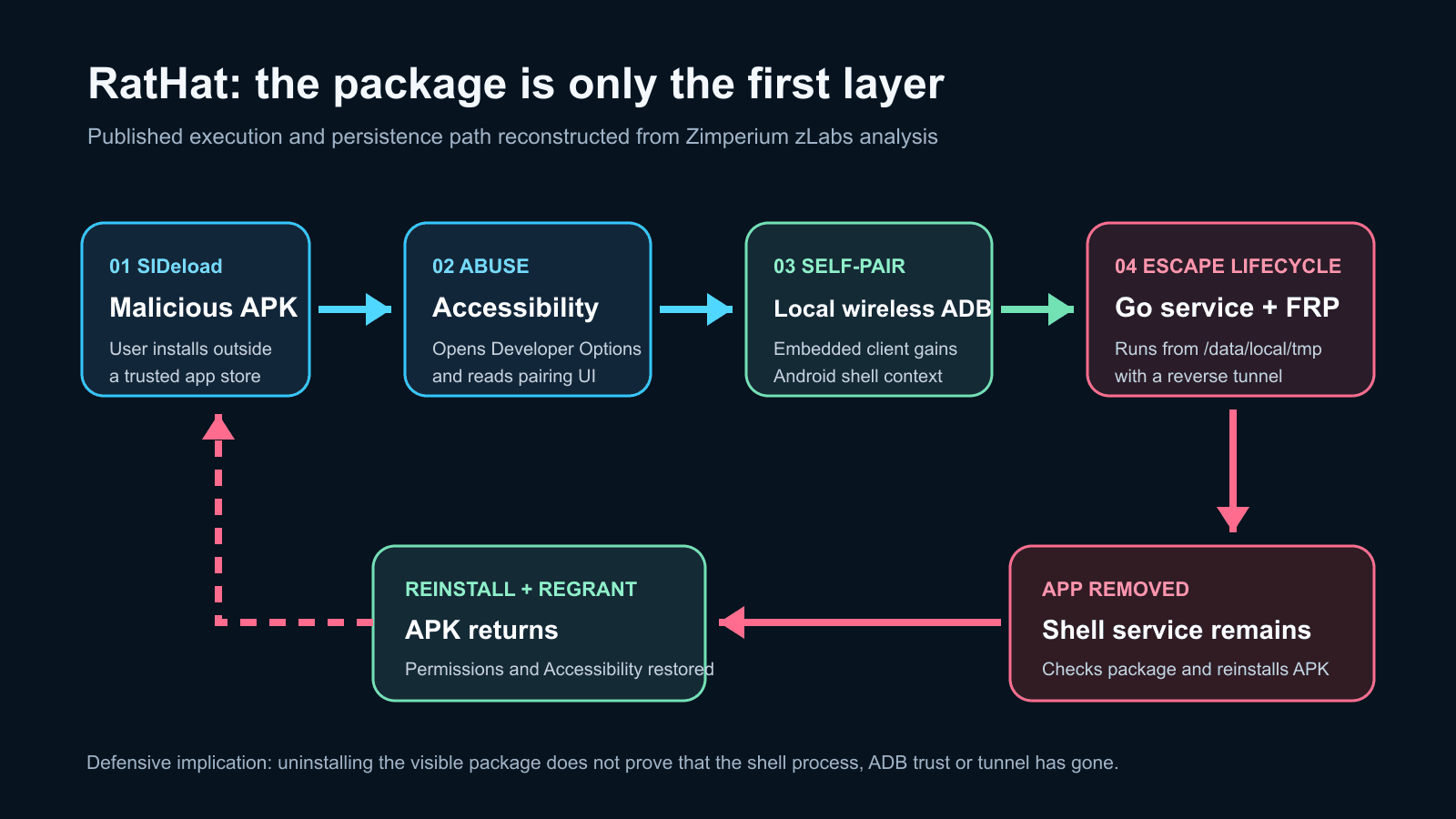
The chain has two heartbeats. While the APK is present, it can redeploy the local service if that process stops. While the local service is present, it can reinstall the APK if the user removes it. A reverse proxy derived from FRP exposes the local service through an outbound tunnel, giving the operator a route into device interfaces despite NAT and firewall boundaries.
This explains why deleting the visible app is an incomplete response. The package is only one component. The live debugging session, files under /data/local/tmp, shell processes, altered secure settings and outbound tunnel also need to be removed.
Where generative AI fits, and where it does not
RatHat serialises the current Accessibility tree as XML and sends it to a popular generative AI assistant. The model returns coordinates and navigation steps that help it operate interfaces whose layout or wording may change. Zimperium's examples include resolving on-screen text and choosing actions such as scrolling.
That is adaptive user-interface automation. It can make a fixed attack script more resilient across devices, languages and software versions. It is not the source of shell privilege or persistence. Those come from local ADB pairing, the shell context and native services. Calling the malware simply “AI-powered” can hide the control that defenders most need to address.
Capability and enabling control
| Observed capability | Mechanism | Defensive focus |
|---|---|---|
| Adapt to changing screens | AI interprets the Accessibility tree and suggests actions | Restrict unapproved Accessibility services and detect automated navigation |
| Gain shell context | The app self-pairs with local wireless ADB | Disable debugging on managed devices and alert on unexpected pairing |
| Persist beyond uninstall | Native service remains under `/data/local/tmp` | Inspect shell processes and perform full remediation, not package removal alone |
| Maintain remote access | FRP client creates an outbound reverse tunnel | Block and investigate anomalous persistent egress |
| Steal credentials | Overlays, Accessibility events and raw touch coordinates | Protect enrolment, monitor overlays and reset exposed credentials |
Why shell access changes the credential threat
Zimperium found several collection paths. Fake banking and payment interfaces capture credentials and one-time codes. Accessibility events reconstruct text entered into fields. The Go service can also run Android's getevent tool as shell UID 2000 and read raw touch coordinates from /dev/input. RatHat combines those coordinates with device-specific keypad layouts to infer PIN digits and unlock patterns.
Raw coordinates do not contain the character by themselves. The inference becomes possible when the malware knows which keypad is displayed and where each key sits. This path can continue where screenshot protections or inaccessible custom keyboards frustrate simpler collection methods. The report also describes browser address-bar harvesting, SMS collection, file transfer, screen monitoring and task queues shared between the app and native agent.
Response must remove the bridge and assume credentials are exposed
Take this with you
Actions for enterprise mobile teams
- Block sideloading and enforce approved application sources on managed devices
- Allow-list Accessibility services and alert when an unknown app requests or receives access
- Disable Developer Options and wireless debugging through enterprise policy where the fleet permits it
- Detect unexpected ADB pairing, shell UID activity and executable files under `/data/local/tmp`
- Monitor outbound reverse-proxy traffic and long-lived connections from mobile devices
- Treat an affected device as fully compromised even after the visible APK is removed
- Preserve evidence, reset banking and identity credentials from a clean device, and re-enrol or factory-reset under incident procedure
- Review linked payment, email and messaging accounts for session theft and fraudulent recovery changes
Key facts
Sources
- PrimaryRatHat: AI-Powered Mobile Threat is Here for Your Credentials & Bank AccountsZimperiumaccessed 2026-09-20
- PrimaryAndroid Debug BridgeAndroid Developersaccessed 2026-09-20
- Reported byRatHat Android malware abuses ADB to survive uninstallThe Hacker Newsaccessed 2026-09-20