California's seven data centre laws cap nothing, and state energy reporting skips every site under 10 MW
Newsom signed seven data centre bills on 21 September, all in force on 1 January 2027. They shift grid and water costs onto operators, but cap no energy or water use, and state energy reporting starts at 10 MW with no deadline and no site-level publication.
By Parminder Kumar Sharma · · 22 min read
Seven chapters, one start date, and a state report with no deadline
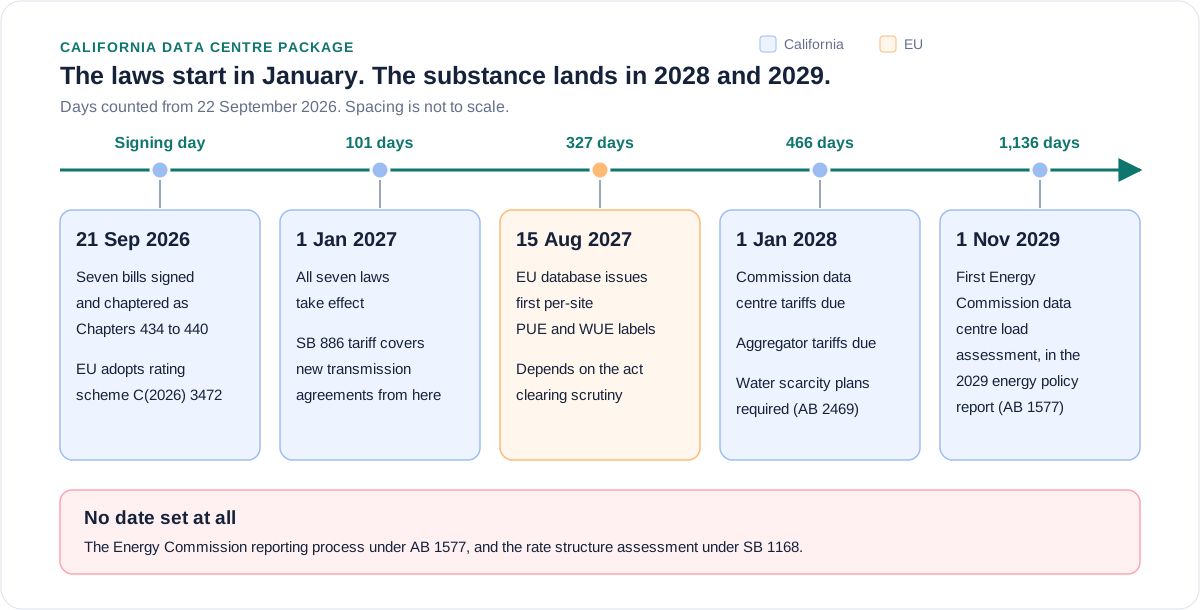
Governor Gavin Newsom signed seven data centre bills on 21 September 2026, and the Secretary of State filed them the same day as Chapters 434 to 440 of the Statutes of 2026. None of the seven carries an urgency clause, so under the California Constitution each takes effect on 1 January 2027, the first 1 January after a 90 day wait. From today, that is 101 days.
The date on the statute book is not the date anything much happens. The Public Utilities Commission has until 1 January 2028 to produce the new data centre electricity tariffs, 466 days from today. Water scarcity plans are not required until the same day. The first state assessment of data centre electricity load is due in the 2029 Integrated Energy Policy Report, which statute sets for 1 November 2029: 1,136 days away. And the one bill that makes a data centre report its energy use to the state, AB 1577, sets no date at all by which the Energy Commission must build the reporting process. Operators report "in a manner and timeframe specified by the commission", and the commission is given no timeframe of its own.
The Governor's office calls the package the "most comprehensive data center laws in the nation". The Verge headline says California "tightens rules on AI data center energy and water use".
What that does not establish. It does not establish that the package is weak. Three of the seven bills do real work: they make a data centre, rather than the household next door, carry the cost of the grid and water infrastructure built to serve it, with collateral, minimum payments and exit fees. One of them ends the use of blanket environmental exemptions for data centres. What the timeline does establish is narrower. No bill in the package limits how much electricity or water a data centre may use. The reporting duties split three ways, to three different recipients, with three different size thresholds, and only one of them carries a named penalty. Anyone asking a supplier "are you compliant with California's new data centre rules?" in January will get an answer that is true and tells them very little.
What each bill actually makes someone do
Read the seven chaptered texts end to end and they sort into three groups: energy reporting, water disclosure, and grid cost allocation, plus one bill on environmental review. The table sets out who carries the duty, at what size, and what happens if they ignore it. Where the bill is silent, the table says so.
The seven bills as chaptered on 21 September 2026. Drawn from the chaptered text of each bill on leginfo.legislature.ca.gov.
| Bill (chapter) | Duty and who carries it | Size threshold | Consequence named in the bill |
|---|---|---|---|
| AB 1577 (434) | Owner or operator reports site data, energy use and PUE to the Energy Commission; also estimates energy and noise to the council when applying for a permit | 10 MW electrical capacity and above | None named |
| AB 2619 (437) | Owner or operator gives water estimates to the water supplier and the council, then reports actual annual water use at each licence renewal | Any size | Perjury |
| AB 2469 (436) | Council may not approve a new or expanded data centre without a water supply assessment, water use figures, workforce data and, from 2028, a water scarcity plan | Not defined | Permit cannot be approved |
| AB 2383 (435) | Utilities file data centre tariffs; community choice aggregators and electric service providers adopt generation tariffs by 1 January 2028 | Generation tariff threshold set by the regulator, capped at 25 MW | Violation of a commission order is a crime under existing law |
| SB 886 (438) | Commission sets tariffs and rules for data centres by 1 January 2028, including a transmission connection tariff | Transmission-level connections from 1 January 2027 | Violation of a commission order is a crime under existing law |
| SB 1168 (440) | Commission must assess opportunities for rate structures | Not stated | None: an assessment, with no deadline |
| SB 887 (439) | Ends categorical CEQA exemptions for data centres; creates an optional fast track with eleven conditions | Not stated | Full environmental review applies |
Energy reporting goes to the state, starts at 10 MW, and is published only in aggregate
AB 1577 (Bauer-Kahan) adds section 25302.10 to the Public Resources Code. It defines a data centre broadly, as a facility housing "graphics and central processing units, servers, storage devices, networking equipment, and associated power and cooling systems", then removes every facility "with an electrical capacity of less than 10 megawatts".
Above that line, the owner or operator must report to the Energy Commission once on energisation: name, address, operator contact, start date, total floor area, IT floor area, the anticipated peak capacity from the load interconnection request, and expected onsite generation. After that, at least annually and broken down by month unless the commission says otherwise, it reports:
- maximum electrical load and installed IT capacity in kilowatts;
- total energy consumption in kilowatthours;
- power usage effectiveness (PUE), defined as total facility energy divided by IT energy;
- participation in demand flexibility programmes;
- refrigerant types and cumulative cooling degree days;
- onsite generation by type, fuel burned by onsite generators, and battery storage type, capacity and chemistry.
The "owner or operator" is defined as the entity overseeing daily operations "for the entire data center facility, regardless of the individual parties that may rent or host equipment". In a colocation hall, that is the colocation provider, not the cloud or AI company renting the cages.
Three things are missing, and each matters to a buyer.
No water. The Energy Commission report contains no water field at all. The water figures in this package go elsewhere, as the next section shows.
No named penalty and no deadline. The bill says operators "shall submit" but names no fine and no enforcement route, and gives the commission no date to open the process. The first dated output is the 2029 load assessment.
No site-level publication. The commission must publish the data "in an anonymized and aggregated format", annually. A new Government Code section 7927.303 bars disclosure that would reveal "energy consumption data for a specific data center customer", and the commission must set up a process for operators to flag information they claim is exempt. A UK customer will not be able to look up a Californian facility in a public register.
AB 1577 also requires a second, one-off estimate at the planning stage: expected annual energy consumption, expected onsite generation, and average and maximum noise at the loudest point of the site boundary, given to the city or county with the permit application. The same 10 MW definition applies.
Water disclosure goes to the supplier and the council, under penalty of perjury, at any size
AB 2619 (Papan) is the only bill in the package with a named personal consequence. Before applying to a city or county for an initial business licence, "a person who owns or operates a data center" must give its water supplier, "under penalty of perjury", a good faith estimate of expected water use, the anticipated source, and projected volume for the maximum day, maximum month and average year. The same estimate goes on the licence application. At every renewal, the operator must report, again under penalty of perjury, the previous calendar year's total water use and direct water use by source (potable, non-potable or recycled), and the cooling system type.
AB 2619 is a near copy of AB 93, which the Legislature passed in 2025. Newsom vetoed that bill on 11 October 2025, 345 days before he signed this one. His veto message said he was "reluctant to impose rigid reporting requirements about operational details on this sector". The 2026 version asks for more, not less: AB 93 asked operators to self-certify that they had given the supplier a report; AB 2619 puts the figures on the licence application itself.
AB 2469 (Papan) works on the council rather than the operator. A city or county may not approve a permit for a new data centre, or for an expansion "that increases the maximum peak water use", unless the applicant has supplied a water supply assessment under the Water Code, projected water use and efficiency measures, workforce disclosures (composition, job classes, duration, wages and the share of workers living in the county and the state) and, from 1 January 2028, a water scarcity plan covering each drought stage defined by the United States drought monitor. The applicant must also assume "the full cost" of any water conveyance, treatment, storage or distribution upgrades, as determined by the water supplier.
Two details are worth noticing. AB 2469 never defines "data center", so it carries no size threshold at all. And the cost clause is expressly severable: the Legislature wrote in that if the cost duty is struck down, the rest survives. That is a drafting choice made with a court challenge in mind.
AB 2619 also amends the Water Code so that urban water suppliers must count "the unconstrained demand of data centers" when they run their annual supply and demand assessment. Nowhere in the package does any figure go to a state water agency.
Grid costs: the utility files the tariff, the data centre pays through it
The cost bills are the substance of the package, and they are built as instructions to the Public Utilities Commission, not direct duties on data centres. The data centre feels them through the tariff it signs.
SB 886 (Padilla and McNerney), the "California Technology Innovation and Ratepayer Protection Act", requires the commission to establish new tariffs or update electric rules for data centre connections and service by 1 January 2028, and to make sure they "prevent the creation of stranded costs for, or cost shifts to, nonparticipating customers". Its transmission connection tariff must:
- make the data centre disclose every other utility territory or jurisdiction where it has applied for a connection for the same project;
- assign it the cost of transmission upgrades, including shared network upgrades where federal law allows;
- cap refunds of its upfront contributions at 75 percent of the annual net transmission revenue the utility earns from it, paid only as its load materialises;
- charge an early termination fee if it leaves within 10 years or fails to ramp up, set no lower than the revenue gap against its projected demand over the minimum 10 year term.
The transmission tariff applies only to data centres signing a new transmission-level interconnection agreement on or after 1 January 2027. Utilities may bring exceptional case contracts for projects that arrive before the tariff exists.
AB 2383 (Zbur) fills in the rest. Each utility must file a distribution tariff under which data centres pay "a reasonable share" of wildfire mitigation, wildfire liability and other societal costs, and a generation tariff with a payment mechanism lasting at least 10 years that includes upfront collateral or prepayment, a minimum payment based on the load the data centre projected in its application, fees for projects that never connect, and a credit for zero-emission generation installed behind the meter. The commission sets the size at which the generation tariff bites, but "may not set a minimum peak electricity demand threshold that exceeds 25 megawatts". Community choice aggregators and electric service providers must adopt equivalent tariffs by 1 January 2028.
The two bills lean on each other. SB 886 creates Article 14.7 of the Public Utilities Code; AB 2383 adds the definitions to the same article, including "participating customer", which SB 886 uses but never defines. Read either alone and it is incomplete.
SB 1168 (McNerney) asks the commission to "assess opportunities for rate structures" that make data centres pay their share of transmission and distribution costs. It sets no deadline and requires no outcome. Its findings cite an expected 2.3 gigawatts of data centre load growth by 2030 and about 2,300 megawatts of data centre applications to Pacific Gas and Electric in 2024; those are the Legislature's figures, not audited data.
On enforcement, the Legislative Counsel's digests for AB 2383 and SB 886 note that a violation of a commission order implementing them is a crime under the existing Public Utilities Act. In practice the lever is the tariff: a data centre that will not post collateral does not get connected.
Land use: no blanket exemption, and a fast lane with eleven conditions
SB 887 (Padilla) does two things under the California Environmental Quality Act. It bars the use of categorical exemptions for projects "in furtherance of the development and operation of a data center", with carve-outs for public research, public safety, national security, publicly owned and utility facilities. And it lets the Governor certify a data centre as an "environmental leadership development project", which brings procedural streamlining, if the lead agency certifies eleven conditions. Among them:
- the applicant pays the full cost of interconnection in advance;
- the project does not increase fossil fuel consumption in the state;
- zero-carbon storage with at least four hours of capacity at 100 percent of forecast peak demand;
- 100 percent zero-carbon electricity for hourly needs within five years of opening, 75 percent of it newly developed;
- recycled water and water-efficient or waterless cooling;
- a binding community benefits agreement.
These are the only performance standards for energy and water anywhere in the package, and they are optional. A developer who does not want the fast lane does not have to meet them.
What the headlines say and what the text delivers
The friendly names in this package are doing a lot of work. "Most comprehensive in the nation" is a claim about other states, and the Governor's office offers no comparison to test it against. The "Ratepayer Protection Act" protects ratepayers through tariffs that do not yet exist. "Hyperscale" is defined and never used. None of these is a control. The table below separates what the chaptered text states from what a reader might assume.
Claims made about the package, tested against the chaptered bill text.
| Claim or assumption | Stated in the text | Not stated in the text |
|---|---|---|
| Data centres must report energy use | Yes, to the Energy Commission, at 10 MW and above (AB 1577) | Any deadline for the process, any penalty, any site-level publication |
| Data centres must report water use | Yes, to the water supplier and the city or county, at any size (AB 2619) | Any report to a state agency; any publication duty |
| Rules limit data centre energy or water use | Standards exist only as conditions for the optional fast track (SB 887) | Any cap, efficiency minimum or PUE target |
| Data centres pay for grid upgrades | Yes, through tariffs to be set by 1 January 2028 (SB 886, AB 2383) | The tariff amounts, which the commission has not yet set |
| Data centres pay for water upgrades | Yes, as a condition of permit approval (AB 2469) | Whether the severable cost clause survives challenge |
| Existing data centres are covered | Energy reporting applies once energised; water reporting at each licence renewal | Any transmission cost tariff for agreements signed before 1 January 2027 (SB 886 applies only from that date) |
This is a method point, not an accusation. The Governor's release is a political document, openly framed against the federal administration, and its job is to sell. The bills are careful, often clever drafting, and their authors had to get them past a Governor who vetoed the water bill a year ago. The gap between the two is the ordinary gap between a press release and a statute. It only becomes a problem when a procurement team quotes the press release back to a supplier and accepts "yes" as an answer.
When each piece bites
Put the dates on one line and the package turns out to be two years of rule-making with a January start. The diagram shows every date the seven bills fix, with the EU dates that fall in the same window for comparison. Day counts run from 22 September 2026.
Europe publishes a grade per site; the UK regulates resilience and offers a discount
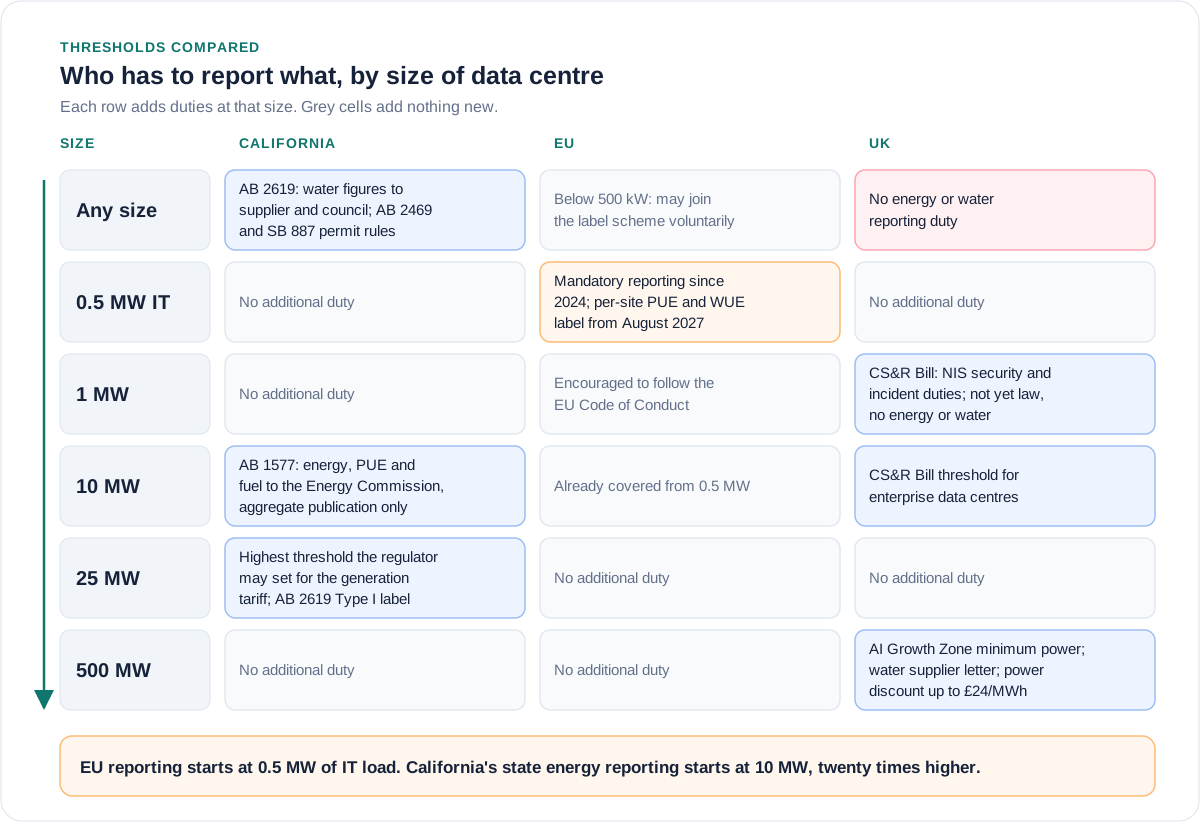
The EU has been collecting this data since 2024. Article 12 of the recast Energy Efficiency Directive, Directive (EU) 2023/1791, requires owners and operators of data centres with installed IT power demand of at least 500 kW to publish the information in its Annex VII by 15 May 2024 and every year after. That is one twentieth of California's 10 MW line, and because the EU counts IT load alone while California counts total electrical capacity, the real gap is wider still. That annex covers energy consumption, power utilisation, temperature set points, waste heat, "water usage and use of renewable energy". Delegated Regulation (EU) 2024/1364 turned that into a reporting scheme with a European database, measurement methods tied to the EN 50600-4 standards, and four calculated indicators: PUE, water usage effectiveness (WUE), energy reuse factor and renewable energy factor. The European database publishes only aggregates and keeps individual sites confidential, although the Directive separately requires operators to make the Annex VII information public, subject to trade secret exceptions, through national rules. Penalties are for each Member State to set, under Article 32 of the Directive.
On the same day Newsom signed his bills, the Commission adopted the second stage. The delegated regulation C(2026) 3472 of 21 September 2026 has the European database generate an electronic label for every reporting data centre "by 15 August 2027 and every year thereafter", published in all official EU languages. The label grades PUE from A (1.15 or below) to G (above 1.9) and WUE from A (0.1 or below) to G (above 1.0), and shows the renewable and nuclear share of energy, grid flexibility and whether the site is "waste heat reuse ready". Operators must provide the label to "any physical or legal person requesting it". The act amends the confidentiality clause to let the label information out; the rest of the site data stays confidential. It now sits in a two month scrutiny period before the Parliament and Council, extendable by two months, before it can be published and enter into force. The Commission has also opened a consultation on minimum performance standards, which would be a cap of the kind California chose not to impose.
The UK sits outside all of this. The recast Directive was adopted in 2023, after the UK left the EU, and there is no UK equivalent of Article 12. What the UK has done points in other directions.
Resilience, not resources. The government designated data centres as Critical National Infrastructure on 12 September 2024. That designation brings a government team, prioritised access to the NCSC and emergency coordination; it imposes no energy or water duty. The Cyber Security and Resilience Bill would make data centres with a rated IT load of 1 MW or more (10 MW for enterprise data centres) operators of essential services under the NIS Regulations, regulated by Ofcom, with security, notification and incident reporting duties. It is at Lords report stage, with a sitting listed for 26 October 2026, and is not yet law.
Discounts, not cost allocation. Under Delivering AI Growth Zones (13 November 2025), data centres in zones that ease grid constraints "will receive a commensurate discount on electricity costs", for a 500 MW site up to £24 per MWh in Scotland, £16 in Cumbria and £14 in the North East, with the precise approach subject to consultation. Applicants must show at least 500 MW of power by 2030 and written confirmation from the local water supplier of the volumes needed and available. That is a siting test at application, not ongoing reporting.
A report on water use in AI and data centres from the Government Digital Sustainability Alliance, published on GOV.UK, recommended legislation requiring data centres above a threshold such as 1 MW to file "mandatory, granular reports" on energy, water and carbon. It is an advisory group's recommendation, not government policy, and no such legislation has been introduced.
Mandatory data centre reporting and cost regimes compared. Sources: the California bills, Directive (EU) 2023/1791, Delegated Regulation (EU) 2024/1364, C(2026) 3472, and GOV.UK publications linked above.
| Regime | Threshold | Energy and water reported | Public per site |
|---|---|---|---|
| California AB 1577 | 10 MW | Energy and PUE to the state; no water | No, aggregate only |
| California AB 2619 | Any size | Water to supplier and council | Not stated |
| EU Directive and 2024 scheme | 500 kW IT | Energy, PUE, water, WUE, heat reuse, renewables | Database aggregate only; operator disclosure under national rules |
| EU rating scheme, from August 2027 | 500 kW IT | Graded PUE and WUE label | Yes, label only |
| UK CS&R Bill (not yet law) | 1 MW, or 10 MW enterprise | Neither: security and incidents | No |
| UK AI Growth Zones | 500 MW power at application | Water supply confirmed at application | No |
What this means for UK organisations buying cloud and AI capacity
Most UK organisations do not operate a Californian data centre. Many of them run workloads in one, through US West cloud regions, AI model APIs served from California, or SaaS providers who do not say where they host. Three practical consequences follow.
Figures will exist that your supplier can quote. From 2027 the operators of large Californian sites will be measuring monthly energy, PUE and onsite fuel burn for the Energy Commission, and annual water use by source for the water supplier. The state will not publish those figures per site. Your supplier can. Ask for them.
Colocation tenants are one step removed. AB 1577 and the EU scheme both put the reporting duty on the facility operator. A cloud or AI provider renting space in someone else's building can truthfully say the duty is not theirs. The EU has anticipated this: its scheme lets colocation operators estimate coverage and gather figures from tenants. California's bill says nothing about tenants. If your provider uses colocation, the question is whether it can obtain the operator's figures, not whether it files them.
Cost pass-through is plausible, not proven. The new tariffs put collateral, minimum payments and 10 year exit fees on data centres that connect in California from 2027. It is a reasonable inference that some of that cost will reach cloud and AI prices for California-hosted capacity. Nothing in the bills requires or prevents it, and no provider has said so. Treat it as a question for your next renewal, not a fact.
For UK sustainability reporting, the useful comparison is the EU label. From August 2027 any European data centre above 500 kW will carry a public A to G grade for PUE and WUE that anyone can request. A Californian or UK facility will have nothing equivalent. A supplier who can hand over an EU label for Frankfurt and nothing for Oregon or Slough is not necessarily hiding anything; the law simply asks less of them there. Your supplier questionnaire should be built on that difference rather than on the headline.
What to do, in order
Take this with you
Actions for UK security, IT and procurement leads
- List which of your cloud, AI and SaaS workloads run in California, in the EU and in the UK, by provider and region. You cannot ask the right question without knowing where the hardware sits.
- For each major provider, ask whether the facilities serving you are operated by the provider or by a colocation operator. The reporting duty sits with the operator in both California and the EU.
- Ask EU-hosted providers to commit to supplying the EU data centre label for your regions once issued from 15 August 2027, and put that commitment in the contract schedule.
- Ask California-hosted providers for the annual PUE and monthly energy figures they will report to the California Energy Commission from 2027, and the annual water use they will report at licence renewal. Accept a site-level figure, not a corporate average.
- Ask UK-hosted providers what energy and water figures they measure voluntarily, since no UK law requires them. Record the answer as a supplier assurance, not a regulatory fact.
- Add a renewal question on whether new California grid tariffs from 2028 will change pricing for California-hosted capacity, and whether regional price differences will be disclosed.
- Retire any questionnaire wording that asks whether a supplier complies with California data centre rules. Replace it with the specific figures above.
- If you operate a data centre of 1 MW or more in the UK, prepare for NIS duties under the Cyber Security and Resilience Bill, and note that energy and water reporting is not part of it.
The question that exposes the gap
California now makes a data centre pay for the grid and the pipes built for it, and makes it tell the water company and the council how much water it uses, on pain of perjury. It still does not tell the public, facility by facility, how much energy or water any site consumes, and it caps neither. The EU will start publishing a grade for every site above 500 kW within eleven months. The UK has made data centres critical infrastructure and is paying some of them to locate well, but asks none of them to report what they consume.
So the question for a UK organisation is not whether its providers comply with California's new laws. They almost certainly will, because the laws ask for little that a buyer can see. The question is this: for the specific facilities running your workloads, can your provider give you the PUE and water figures it already has to measure, and if it will not, what are you paying for when you pay for its sustainability claims?
For the other half of California's September, on frontier model safety rather than infrastructure, see our briefing on the kill switch executive order.
Key facts
Sources
- PrimaryAB 1577 (Bauer-Kahan), Chapter 434, Statutes of 2026. Read in full for the 10 MW definition, the Energy Commission reporting fields, aggregate publication, confidentiality and the absence of a deadline or penalty.California Legislative Informationaccessed 2026-09-22
- PrimaryAB 2619 (Papan), Chapter 437. Read in full for water estimates and annual water reports under penalty of perjury, the Type I to III definitions and the Water Code amendment.California Legislative Informationaccessed 2026-09-22
- PrimaryAB 2469 (Papan), Chapter 436. Read in full for the permit conditions, the 2028 water scarcity plan, the full-cost clause and its severability.California Legislative Informationaccessed 2026-09-22
- PrimaryAB 2383 (Zbur), Chapter 435. Read in full for the distribution and generation tariffs, the 10 year payment mechanism, the 25 MW threshold cap and the 1 January 2028 aggregator deadline.California Legislative Informationaccessed 2026-09-22
- PrimarySB 886 (Padilla, McNerney), Chapter 438. Read in full for the 1 January 2028 tariff deadline, the transmission tariff terms, the 75 percent refund cap and the 10 year early termination fee.California Legislative Informationaccessed 2026-09-22
- PrimarySB 1168 (McNerney), Chapter 440. Read in full for the rate structure assessment and the legislative findings on load growth.California Legislative Informationaccessed 2026-09-22
- PrimarySB 887 (Padilla), Chapter 439. Read in full for the end of categorical CEQA exemptions and the eleven fast-track conditions.California Legislative Informationaccessed 2026-09-22
- PrimaryBill history pages for the seven bills, used for approval and chaptering dates of 21 September 2026 and chapter numbers.California Legislative Informationaccessed 2026-09-22
- PrimaryCalifornia Constitution article IV section 8(c)(1), used for the 1 January effective date rule.California Legislative Informationaccessed 2026-09-22
- PrimaryPublic Resources Code section 25302(a), used for the 1 November biennial Integrated Energy Policy Report date.California Legislative Informationaccessed 2026-09-22
- PrimaryPress release of 21 September 2026 listing the seven bills and authors, with the Governor's statement. No signing message was published for these bills.Office of the Governor of Californiaaccessed 2026-09-22
- PrimaryVeto message for AB 93, 11 October 2025, used for the quote and date.Office of the Governor of Californiaaccessed 2026-09-22
- PrimaryAB 93 as enrolled in 2025 and its history, used to compare with AB 2619 and confirm the veto date.California Legislative Informationaccessed 2026-09-22
- PrimarySB 57 (2025), Chapter 647, used for the Public Utilities Commission's cost shift assessment due 1 January 2027.California Legislative Informationaccessed 2026-09-22
- PrimaryDirective (EU) 2023/1791, recast Energy Efficiency Directive. Used for Article 12, Annex VII, Article 32 penalties and the Article 34 scrutiny period.Publications Office of the European Unionaccessed 2026-09-22
- PrimaryDelegated Regulation (EU) 2024/1364 on the first phase of the rating scheme. Used for the 500 kW scope, reporting dates, KPIs, indicators and confidentiality.Publications Office of the European Unionaccessed 2026-09-22
- PrimaryCouncil document 13444/26 transmitting Commission Delegated Regulation C(2026) 3472 of 21 September 2026. Used for the label, the 15 August 2027 date, operator obligations, the confidentiality amendment and review clause.Council of the European Unionaccessed 2026-09-22
- PrimaryAnnexes to C(2026) 3472, used for the A to G PUE and WUE class boundaries and label contents.European Commission, DG Energyaccessed 2026-09-22
- PrimaryNews item of 21 September 2026 on the rating scheme, the two month scrutiny period and the consultation on minimum performance standards.European Commissionaccessed 2026-09-22
- PrimaryPress release of 12 September 2024 designating data centres as Critical National Infrastructure; used for what the designation provides.UK Department for Science, Innovation and Technologyaccessed 2026-09-22
- PrimaryCyber Security and Resilience Bill factsheet on data centres, updated 30 June 2026. Used for the 1 MW and 10 MW thresholds and Ofcom's role.UK DSIT and DCMSaccessed 2026-09-22
- PrimaryBill record used to confirm Lords report stage, the 26 October 2026 sitting and that the Bill is not yet an Act.UK Parliament Bills APIaccessed 2026-09-22
- PrimaryDelivering AI Growth Zones, 13 November 2025. Used for the electricity discounts and the consultation caveat.UK Department for Science, Innovation and Technologyaccessed 2026-09-22
- PrimaryAI Growth Zones application criteria, updated 13 June 2025. Used for the 500 MW power and water supplier confirmation requirements.UK Department for Science, Innovation and Technologyaccessed 2026-09-22
- PrimaryReport on water use in AI and data centres. Used for its recommendation of mandatory reporting above a threshold such as 1 MW.Government Digital Sustainability Alliance, on GOV.UKaccessed 2026-09-22
- Reported byNews report by Emma Roth, 21 September 2026. Used as the pointer to the story and for its headline.The Vergeaccessed 2026-09-22
- Reported byNews coverage of the seven laws. Used only to confirm that no data centre bill was vetoed this session.CalMattersaccessed 2026-09-22