Anthropic says Moonshot served Claude as Kimi: one accuser, 300,000 requests, no published indicators
Anthropic's September threat report says Moonshot AI silently sent Kimi customers' requests to Claude and showed them Claude's answers. The claim is detailed but rests on Anthropic's own telemetry, Moonshot has not addressed it, and the lesson for UK buyers holds either way.
By Parminder Kumar Sharma · · 16 min read
209 indicators, and none for the Moonshot case
Anthropic's September threat report came with a companion file of indicators for defenders. It has 209 rows. We counted them by harm area: 131 cyber operations, 60 influence operations, 10 surveillance, 8 scams and fraud. None belongs to the illicit distillation section, which is where the company makes its most striking allegation: that Moonshot AI, the Beijing lab behind the Kimi models, quietly passed its own customers' requests to Claude and showed them Claude's answers as if Kimi had written them.
That count does not make the allegation false. Indicators for this kind of case would be account identifiers and customer content, which a provider has good reasons not to publish. What the count does establish is narrower and matters more to a buyer: nobody outside Anthropic can yet test the claim. The allegation is specific, it comes from the one party positioned to see the traffic arrive, and it is serious enough that the attribution has started to fall away: Bloomberg's headline ended "Anthropic Says", but versions circulating on news aggregators and social media by 17 September drop those two words and state the routing as fact. It is still one company's account of its own telemetry.
This briefing sets out exactly what the report says, what it leaves out, who has and has not answered it, and why the evidence people will reach for on social media (Kimi calling itself Claude) cannot settle the question either way. It ends with what a UK organisation buying any third-party AI service should now put in the contract, because the underlying risk does not depend on whether this particular accusation is proved.
What Anthropic actually claims
The allegation sits in the final section of Detecting and countering misuse of AI: September 2026, a 154-page report published on Thursday 10 September 2026 covering activity Anthropic says it disrupted between December 2025 and August 2026. The Moonshot case carries Anthropic's internal designator GTG-16002.
The core sentence is plain. Anthropic says Moonshot "silently forwarded customer requests to Claude, instead of processing them using Kimi", and that users "thought they were using a Kimi model, but received responses from Claude instead." The report then makes five further claims:
- Volume. In one instance, over a ten-day period, Moonshot relayed almost 300,000 customer requests to Anthropic, the vast majority to Opus.
- Access. The traffic ran through a proxy service network of 5,380 accounts Anthropic calls fraudulent, most appearing to be located in Singapore and Japan. Anthropic does not serve China.
- Harvesting. Moonshot saved at least a portion of the relayed exchanges and built a pipeline to extract Claude's chain-of-thought reasoning from them for training.
- Evasion. Claude returns a "thinking signature" rather than raw reasoning. Anthropic says Moonshot saved the signature, opened a new session and got Claude to convert it back into the full trace, which the report calls a cross-session replay attack.
- Exposure. Relayed requests contained sensitive customer information. The report describes a user it assesses was likely affiliated with the People's Liberation Army loading CCTV data about one targeted individual, and an engineer at a major state-owned enterprise whose prompts revealed internal code and live credentials.
Separately, the report attributes "over 23 million exchanges" of distillation activity to Moonshot between May and July 2026. That is a total for the campaign, not a count of Kimi users whose requests were rerouted. Several headlines blurred the two.
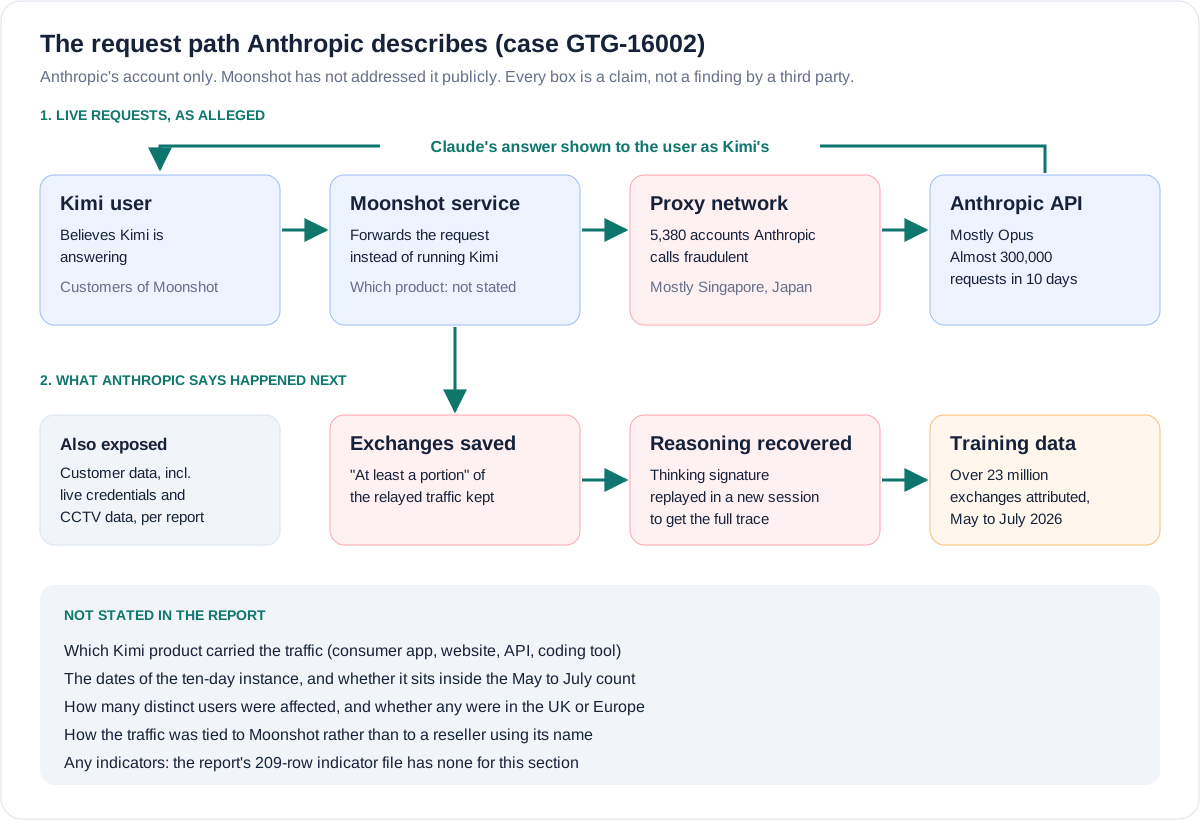
The Moonshot case on the record: what Anthropic's report states and what it leaves out (report pages 143 to 149, read in full)
| Question | Stated in the report | Not stated |
|---|---|---|
| Which Kimi product carried the traffic | "Customer requests" from users who thought they were using Kimi | Consumer app, kimi.com, the API platform or a coding tool |
| When | One ten-day instance; campaign total covers May to July 2026 | The dates of the ten days, or whether they fall inside May to July |
| How many users | Almost 300,000 requests in that instance | Distinct users, their countries, or whether any were in the UK |
| Which Claude models | "The vast majority" went to Opus | Which Opus version, or what the rest went to |
| How attribution was made | High confidence attribution to specific PRC labs, stated for the section as a whole | The method for this case, or the evidence tying it to Moonshot |
| Whether users were told | Anthropic does not know if Moonshot notified customers | Any Moonshot terms, notices or consent text examined |
| What Anthropic did | Blocks requests and bans accounts when confident, as general practice | The date or scope of action against these 5,380 accounts |
The numbers, worked
Anthropic gives three figures for this case. Taken at face value, they say something about how the traffic was shaped.
Arithmetic on the figures in Anthropic's report (our calculations; the report gives only the inputs)
| Calculation | Result | What it does not tell you |
|---|---|---|
| 300,000 requests over 10 days | About 30,000 a day | Whether traffic was steady or bursty |
| 300,000 requests across 5,380 accounts | About 56 per account, or 5.6 per account per day | Whether all accounts were active in those ten days |
| 23 million exchanges over May to July (92 days) | About 250,000 a day | How much of it was rerouted customer traffic |
| 300,000 as a share of 23 million | About 1.3 per cent | Whether the ten days sit inside the 23 million at all |
| February figure (over 3.4 million) against September (over 23 million) | About 6.8 times larger | Anything about growth: the periods are not the same |
The per-account figure is the interesting one. About five or six requests per account per day looks more like an individual user than a bulk harvester. Our inference, not a claim in the report: if the numbers are right, spreading live customer traffic thinly across thousands of accounts is exactly how you would avoid per-account rate and abuse thresholds. It is also, awkwardly, what legitimate reselling would look like from the provider's side, which is why the attribution method matters and why its absence from the public record is the central gap.
In its February disclosure, Anthropic did say how it tied an earlier campaign to Moonshot: request metadata "matched the public profiles of senior Moonshot staff." The September report gives no equivalent for GTG-16002. It may use the same technique. It does not say so.
Who says what, and who has not answered
Two days before Anthropic published, on Tuesday 8 September, the NSA, CISA and the FBI released joint advisory AA26-251A, naming DeepSeek, Moonshot AI, Alibaba, MiniMax, StepFun and Z.AI as running industrial-scale distillation campaigns against US models "likely with Chinese government awareness." It is easy to read that as corroboration. On routing, it is not: the advisory describes Moonshot extracting data from US models to train Kimi, and says nothing about Kimi customers being served another company's answers.
Every public position we could find as of 17 September 2026, read at source except where marked
| Source | What it says | What it does not say |
|---|---|---|
| Anthropic report, 10 September | Moonshot served Claude to Kimi users and kept exchanges for training | Attribution method, product, dates, indicators |
| NSA, CISA, FBI advisory AA26-251A, 8 September | Moonshot distilled Claude Fable 5 data into Kimi-K3 and GPT-4o data into Kimi-K2 | Anything about rerouting live customer requests |
| China's Ministry of Commerce, 9 September | US distillation accusations have no factual or legal basis; countermeasures if firms are suppressed | Moonshot or Anthropic by name |
| Moonshot, Weibo statement, 12 September (via Beijing News) | Online claims about its founder and employees are fabricated; reported to police | Anything about Anthropic, Claude or routing |
| Moonshot to Bloomberg, 10 September (secondary) | Did not immediately respond outside business hours | Any denial or explanation |
| Independent researchers | Kimi K3 sometimes calls itself Claude (July testing) | Anything about routing (see below) |
No court filing, regulator action or terms-of-service dispute on the public record involves this case. The only enforcement described is Anthropic's own: blocking requests and banning accounts. China's Commerce Ministry answered the US advisory, calling distillation a common, neutral industry practice, and did not address the specific claim that paying customers were misled about which model answered them. That is a different allegation from distillation, and it is the one that matters to a customer.
Why "Kimi says it is Claude" proves nothing about routing
Expect screenshots. In July, The Register reported testing by MATS research fellows in which Kimi K3 said it was Kimi in 6 of 10 unprompted runs and Claude in 4 of 10. Its unprompted Claude claims disappeared after 20 July, which the researchers speculated was a server-side change. They wrote that the finding "is not proof of a distillation".
It is weaker still as evidence of routing. Moonshot published Kimi K3's weights under its own licence, so anyone can run the model on their own hardware, where it cannot forward anything anywhere. A model trained on text that contains Claude transcripts, whether from deliberate distillation or from a web corpus full of them, learns to answer "I am Claude" some of the time. Self-identification tells you something about training data. It tells you nothing about where a given request was served.
The reverse also holds, and the July testing illustrates it. If a server-side change can make a hosted model stop calling itself Claude overnight, then a service that really was routing to Claude could equally strip or rewrite any self-description. Absence of "I am Claude" is not evidence of clean serving.
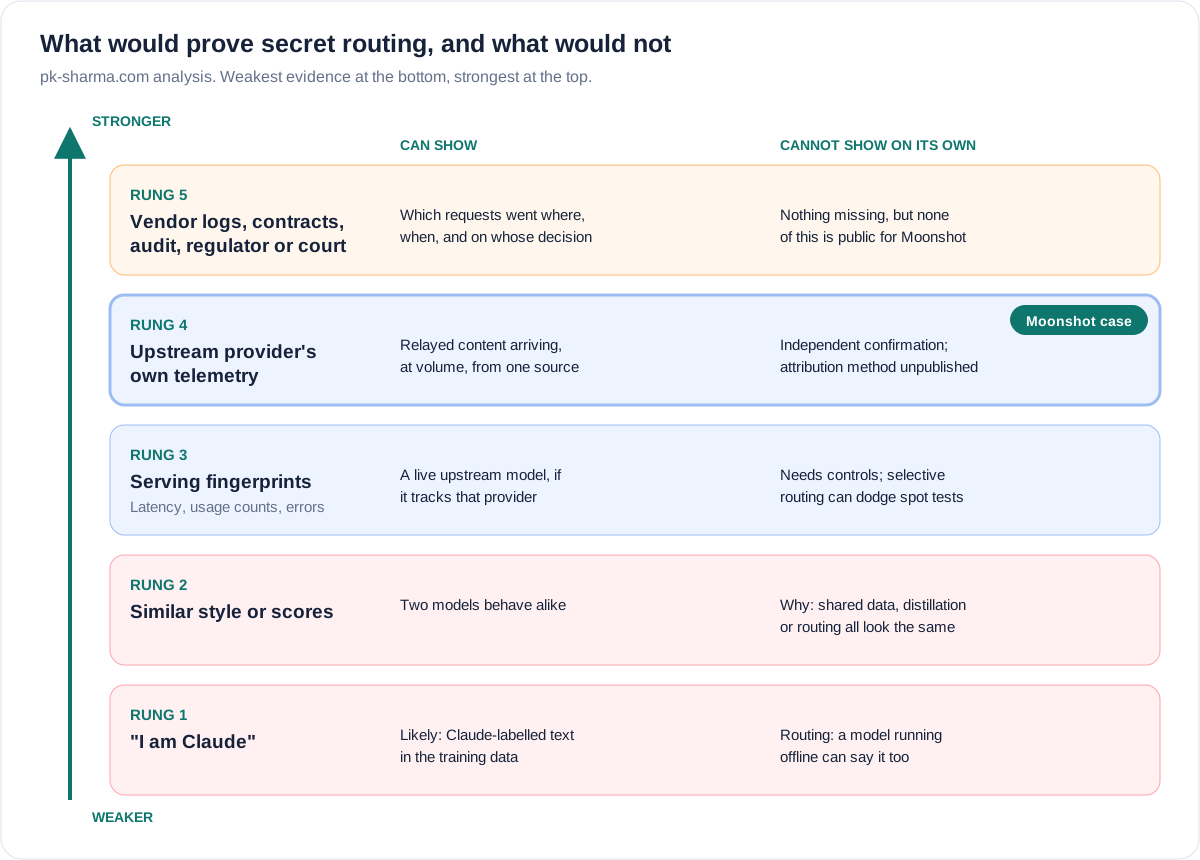
What would, and would not, prove routing
Routing is a claim about serving infrastructure, so the evidence that settles it comes from infrastructure: logs, contracts, and the traffic itself. Here is how the kinds of evidence people will cite actually rank. This is our analysis, not a method from Anthropic's report.
Evidence for secret model routing, and its limits (pk-sharma.com analysis)
| Evidence | What it can establish | What it cannot establish |
|---|---|---|
| Model calls itself Claude | Claude-labelled text probably reached training | Routing; open-weight copies do not route |
| Similar outputs or benchmark scores | The models behave alike | Why: shared data, distillation and routing look the same |
| Latency, usage counts or error text that track another provider | A live upstream model is plausible | Proof, without controls; selective routing can miss your test |
| Outages that coincide with the other provider's incidents | Shared dependency is plausible | Which model served which request |
| Upstream provider's telemetry (Anthropic's position) | Content arriving from a source at volume | Independent confirmation, until the method is shown |
| Vendor's own logs, contracts, audit or regulator findings | Which requests went where, when, on whose decision | Nothing material; none public here |
The DeepSeek case in the same report shows why spot testing is fragile. Anthropic says DeepSeek checked strings in inbound requests to tag users of coding harnesses such as Claude Code, the Claude Agent SDK and OpenCode, and relayed only selected tagged users to Claude Opus. If that is accurate, a buyer probing a service from a clean test client would see the vendor's own model every time. The report does not say what selection, if any, Moonshot applied.
Method, motive and politics
Separating method from accusation means saying three uncomfortable things at once.
Anthropic has a commercial interest. Moonshot is a direct competitor: kimi.com presents K3 as built for agentic programming and knowledge work, which is squarely Claude's market. A finding that a rival's product was partly Claude is valuable to Anthropic. That does not make the finding wrong, and Anthropic is the party that could see the traffic, but it is a reason to want the method on the record.
The timing is political. The report followed a US government advisory by two days, and Beijing framed both as suppression of its AI industry. Readers in the UK should weigh the specific, checkable claims on their own merits rather than as a proxy for that dispute.
The provider read the content. The PLA-linked CCTV example and the engineer's credentials are in the report because Anthropic's investigators examined what arrived through the relayed accounts. Those users had no relationship with Anthropic. Whatever you think of the accounts they were sent through, the lesson for a buyer is blunt: content sent to an AI service can be read by trust and safety staff at every provider it passes through, including ones you never chose.
One further point cuts the other way. The US advisory recommends that AI companies "subtly alter responses for suspected malicious distillation attempts" and avoid telling suspected distillers they have been switched to a downgraded model. That advice targets distillers, and the advisory says safety researchers and third-party evaluators should be told. But it means silent changes to what model answers a request are now recommended practice on the provider side too. The model name on an API call is a label, not an attestation, in both directions.
What it means for a UK buyer
Set Moonshot aside. The general risk this case illustrates is that the model you think you are paying for is not the only party that sees your data. Anthropic's report says that across DeepSeek, Xiaomi and Moonshot, many relayed exchanges came from users of third-party model routing services "commonly used by users in the United States and Europe", and contained names, email addresses and company data of hundreds of end users. It does not break that down by lab, and it does not mention the UK.
UK GDPR already covers the principle. Article 28(2) says a processor "shall not engage another processor without prior specific or general written authorisation of the controller", and under a general authorisation must tell the controller about added or replaced processors so it can object. Article 28(3)(h) requires the processor to allow for and contribute to audits. An upstream model provider that receives your prompts is a sub-processor on any ordinary reading. Two caveats: whether a given AI vendor is your processor or an independent controller depends on its terms, and many consumer and developer terms reserve rights to use content to improve models, which pushes towards the latter.
This is where the friendly-name fallacy bites. The Kimi Open Platform privacy policy, which shows a last update of 30 April 2025 and so, on its face, was the version in force through the period Anthropic describes, says services are provided by Moonshot AI Pte. Ltd. in Singapore, that data is stored on servers in Singapore, and that it shares information with "service providers", listing categories that end with "other information technology providers". It names no model provider. A category list is not a sub-processor list, and a storage location is not an inference path: data can be stored in one country and sent for processing somewhere else. We are not saying the Open Platform was involved; the report does not identify the product. The policy is simply a typical example of wording that would not tell a customer either way.
Contract terms a UK buyer of a third-party AI service should require, and the gap each one closes
| Term | What to require | Gap it closes |
|---|---|---|
| Named sub-processors | Every model provider that may receive prompts, named per product and endpoint | "Service providers" as a catch-all category |
| Change notice and objection | Advance notice of new or replaced model providers, with a right to object (Article 28(2)) | Silent addition of an upstream model |
| Model provenance warranty | The named model serves every request; no fallback to another provider's model without consent | A brand name standing in for an attestation |
| Per-request attestation | Response metadata or logs recording the model, version and serving region for each call | No way to check serving after the fact |
| Inference location | Where prompts are processed, not only where data is stored | Storage clauses that say nothing about processing |
| No training on your data | Explicit bar on using prompts and outputs for any model training, by the vendor or its sub-processors | Your content becoming someone's training set |
| Audit rights | Right to audit or receive independent assurance covering routing, with evidence (Article 28(3)(h)) | Assurance that stops at the vendor's front door |
| Incident notice | Notice if prompts reach an undisclosed party, treated as a personal data breach where personal data is involved | Finding out from a competitor's threat report |
What to do, in order
Take this with you
Actions worth doing this month
- List every third-party AI service in use, including model routers and aggregators, browser extensions and coding assistants, and who approved each.
- For each, record which models the vendor says serve requests, and whether that statement is contractual or only marketing.
- Check whether any service's terms name upstream model providers as sub-processors. Treat a category list as a gap, not an answer.
- Where staff use routers or aggregators, confirm the router reports which provider served each request, and keep those records.
- Stop sending credentials, secrets and regulated personal data to any AI service without a signed data processing agreement, and scan prompts for secrets where tooling allows.
- Add the contract terms above to procurement templates and to renewals already in the pipeline.
- For sensitive workloads that need a particular open-weight model, consider hosting it yourself or through a provider contractually bound to serve only that model.
- Record the Moonshot allegation in the supplier risk register as unproven and single-sourced, and set a date to review it if Moonshot responds or a regulator acts.
The question that exposes the gap
Anthropic's allegation may well be proved. It may never be tested. Either way, the case shows that a customer of an AI service generally cannot see, from the outside, which model answered a request or who else read it. The only people who knew that Kimi users' prompts, including live credentials, were reaching Claude were the company allegedly doing it and the company receiving it.
So the question for every AI supplier on your register is this: if your service sent our prompts to another company's model tomorrow, what in our contract would oblige you to tell us, and what in your logs would let us check?
Key facts
Sources
- PrimaryDetecting and countering misuse of AI: September 2026 (154-page PDF). Read in full for the distillation section, case GTG-16002 on Moonshot, pages 143 to 154Anthropicaccessed 2026-09-17
- PrimaryWeb version of the September 2026 threat report, used to confirm text matches the PDF and to locate the indicator fileAnthropicaccessed 2026-09-17
- PrimaryIndicator file published with the report; we counted 209 rows by harm area and found none for distillationAnthropicaccessed 2026-09-17
- PrimaryFebruary 2026 distillation disclosure, used for the earlier Moonshot figure and the attribution method stated thenAnthropicaccessed 2026-09-17
- PrimaryJoint advisory AA26-251A on China-based AI distillation campaigns, read for what it says and does not say about Moonshot and for its response-alteration adviceCISA, NSA and FBIaccessed 2026-09-17
- PrimarySpokesperson's response of 9 September 2026 to the US distillation advisoryMinistry of Commerce of the People's Republic of Chinaaccessed 2026-09-17
- PrimaryKimi K3 model card, used to confirm open weights and hosted API availabilityMoonshot AI on Hugging Faceaccessed 2026-09-17
- PrimaryKimi Open Platform privacy policy (last updated 30 April 2025), read for its service provider and storage wordingMoonshot AIaccessed 2026-09-17
- PrimaryUK GDPR Article 28 on processors and sub-processorslegislation.gov.ukaccessed 2026-09-17
- Reported byReport quoting Moonshot's 12 September Weibo statement on rumours about its founder and employeesBeijing Newsaccessed 2026-09-17
- Reported byOriginal news report of 10 September, used for its headline and for Moonshot's non-responseBloomberg (via Yahoo Finance)accessed 2026-09-17
- Reported byReport on MATS testing of Kimi K3 and GLM 5.2 self-identification, used for the 4 in 10 figure and the 20 July changeThe Registeraccessed 2026-09-17