WeatherNext 3 draws the global forecast on a 5 km grid and refreshes it every hour
Google's new weather model ingests live geostationary satellite mosaics, predicts key surface variables at 5 km and refreshes hourly. That is a sharper global decision layer, but a 5 km cell is still not a forecast for one street or roof.
By Parminder Kumar Sharma · · 4 min read
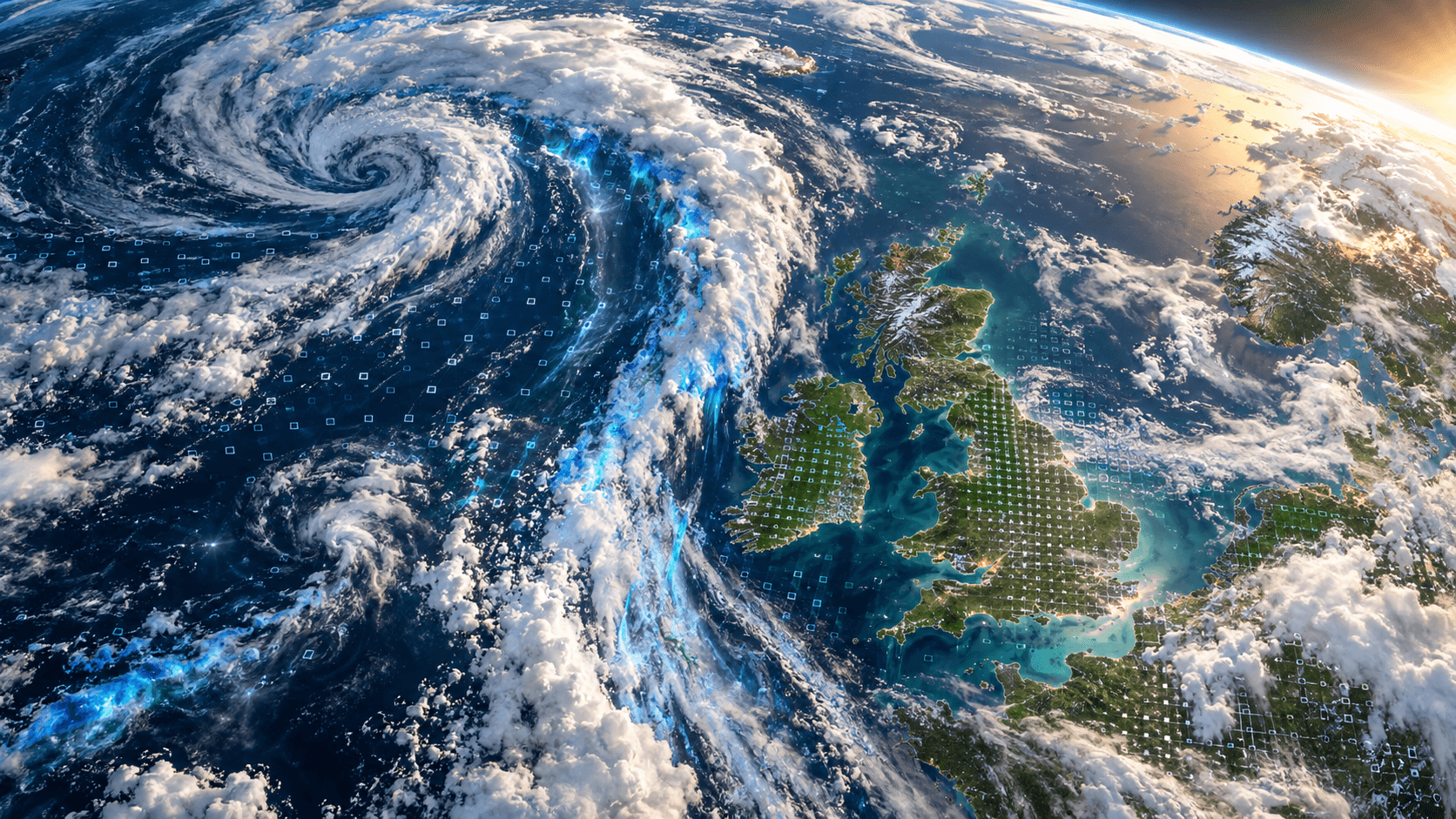
Five times sharper is a statement about the grid
WeatherNext 3 changes both the input and the output of Google's global AI forecasting system. It ingests hourly mosaics from geostationary satellites alongside historical analysis and station observations. A flexible mesh transformer then predicts dense weather fields, cyclone tracks and values at sparse station locations.
For temperature and moisture, the model can produce a 5-kilometre grid. Other surface variables use 10 kilometres, while atmospheric variables such as wind use 25 kilometres. Forecasts update hourly. WeatherNext 2 used a 25-kilometre grid and six-hour increments, so Google describes the overall picture as roughly five times sharper.
That phrase should not be converted into "five times more accurate". Moving from a 25 km cell to a 5 km cell resolves much more coastline, terrain and temperature variation. Accuracy still depends on the variable, place, lead time and event.
Live observations shorten the model's view of now
Many AI weather models learn from the output of numerical weather prediction systems. Those physics simulations are valuable but can introduce a data lag. WeatherNext 3 also learns directly from raw satellite observations, giving it a continuously refreshed picture of clouds and the atmosphere.
That matters most when the world changes between scheduled model runs. A rain band that develops after the last six-hour analysis can change an airport, delivery route or wind-generation decision. An hourly model has five additional opportunities to incorporate the changing scene before the next six-hour boundary.
Google reports up to 50% more accurate precipitation forecasts for planning a day or more ahead, with larger improvements in historically underserved regions. Again, "up to" marks a best result, not a promise for every storm. The company also highlights improved rain and snow, discrete cyclone tracks and clean-energy variables.
The practical meaning of WeatherNext 3's main output scales.
| Output | Native detail described by Google | A decision it can improve |
|---|---|---|
| Temperature and moisture | 5 km | Heat planning across coastal, urban and elevated areas |
| Other surface variables | 10 km | Agriculture, road operations and regional planning |
| Atmospheric wind | 25 km | Aviation routing and broad renewable-energy planning |
| Refresh cycle | Every hour | Revising a plan when a front or rain band develops quickly |
One forecast, three decisions
Consider a logistics operator moving refrigerated goods from Bristol to distribution centres in Wales and the Midlands. The same forecast can serve three different decisions.
The route planner uses the hourly precipitation update to avoid a corridor where heavy rain is developing. The depot manager uses the temperature field to adjust loading time. The energy team uses broader wind forecasts to estimate renewable supply and electricity exposure. None should consume a single weather value as certainty. Each should compare probabilities, operational thresholds and the cost of a false alarm against the cost of delay.
WeatherNext 3 is being integrated into Google Search, Gemini, Maps, the Maps Platform Weather API, Earth Engine and cloud data services. That distribution may matter as much as the model improvement because it puts the same forecast layer inside consumer and enterprise decisions.
The P.K. view
Weather AI becomes valuable when it changes a decision early enough to matter. Higher resolution helps a forecast represent local terrain; hourly ingestion helps it notice a changing atmosphere; broad distribution helps the signal reach an operator.
The procurement test is therefore operational. Compare the new feed with the forecast already used, across the exact sites, variables and lead times that drive cost. Record false alarms as well as misses. Keep national meteorological warnings as the authority for public safety.
The impressive number is 5 km. The useful number is how many times a better-timed forecast prevents a cancelled route, wasted energy or missed warning in the organisation that adopts it.
Sources
- PrimaryIntroducing WeatherNext 3, our most advanced and accurate global weather AI modelGoogleaccessed 2026-09-14
- PrimaryWeatherNext 3: Increasing resolution and performance of global weather models with raw observationsarXivaccessed 2026-09-14